Derivatives of Functions and Inverse Functions E. Alexander Burt Potomac School
Review of Functions A function is a rule which maps one set of numbers (the domain) to another set of numbers (the range) The function may take the form of an equation:
y=f(x)
The function may also take the form of a set of equations
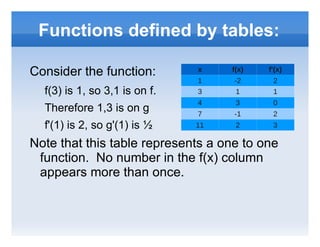
The function may also take the form of a table of values.
One to One functions In math-speak, for every value c, the function has at most one solution f(x) = c In plain English:  if y=f(x) the function never produces the same y value twice. As examples, try graphing the following functions
y=3 x
y=5x-2
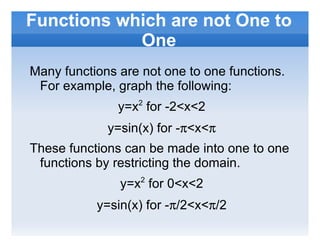
Functions which are not One to One Many functions are not one to one functions.  For example, graph the following:
y=x 2  for -2<x<2
y=sin(x) for - p <x< p
These functions can be made into one to one functions by restricting the domain.

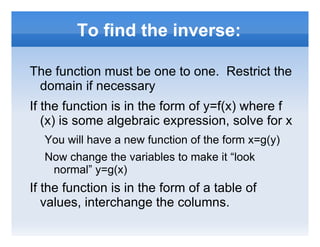
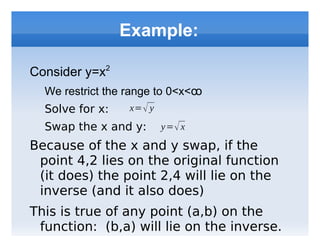
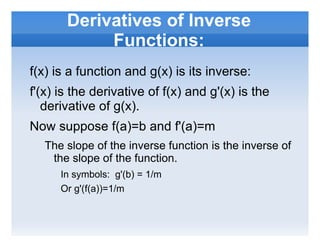
Inverse Functions

  • 1.
    Derivatives of Functionsand Inverse Functions E. Alexander Burt Potomac School
  • 2.
    Review of FunctionsA function is a rule which maps one set of numbers (the domain) to another set of numbers (the range) The function may take the form of an equation:
  • 3.
  • 4.
    The function mayalso take the form of a set of equations
  • 5.
    The function mayalso take the form of a table of values.
  • 6.
    One to Onefunctions In math-speak, for every value c, the function has at most one solution f(x) = c In plain English: if y=f(x) the function never produces the same y value twice. As examples, try graphing the following functions
  • 7.
  • 8.
  • 9.
    Functions which arenot One to One Many functions are not one to one functions. For example, graph the following:
  • 10.
    y=x 2 for -2<x<2
  • 11.
  • 12.
    These functions canbe made into one to one functions by restricting the domain.