Functions
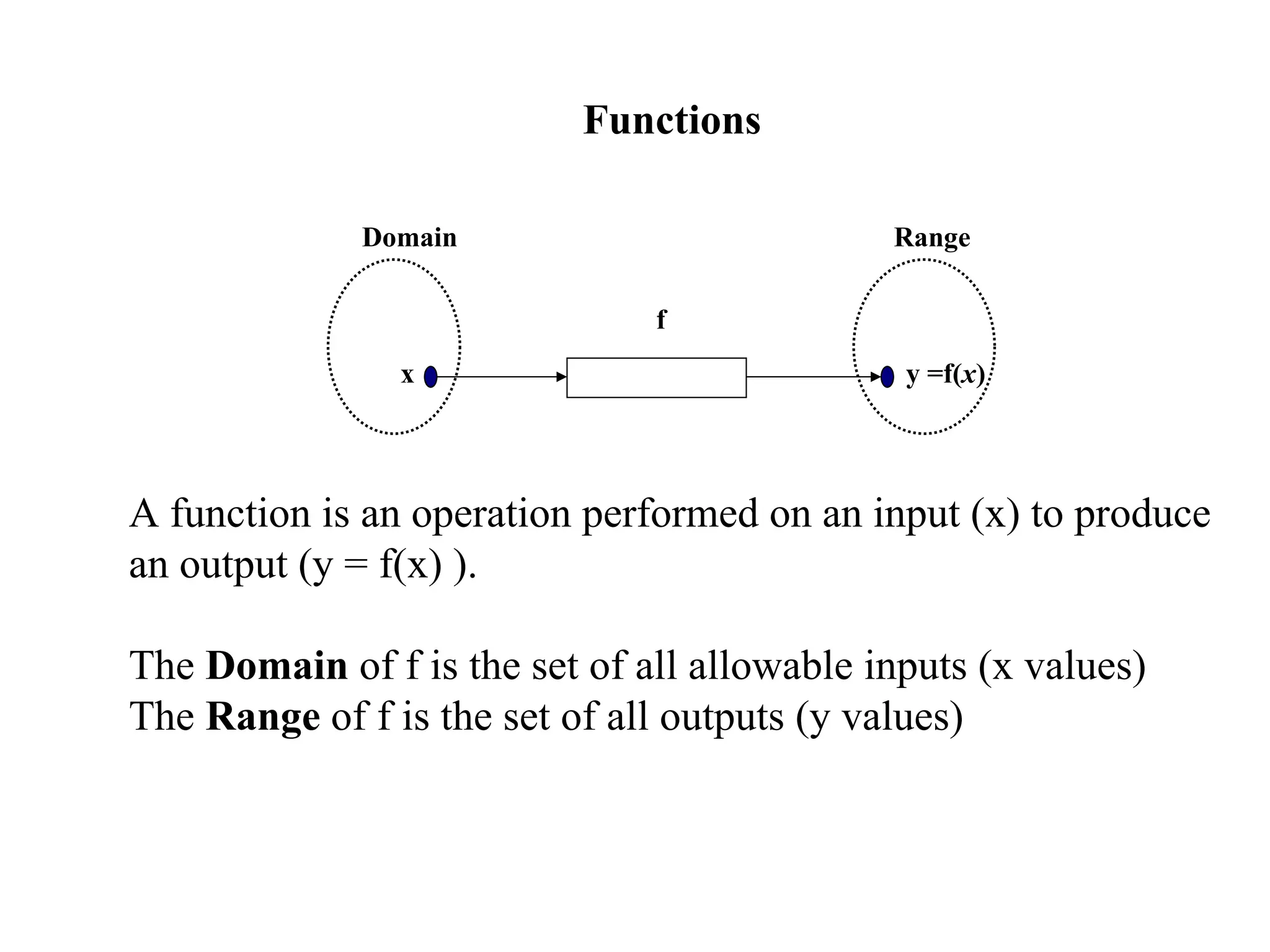
A function is an operation performed on an input (x) to produce
an output (y = f(x) ).
The Domain of f is the set of all allowable inputs (x values)
The Range of f is the set of all outputs (y values)
f
x y =f(x)
Domain Range
To be well defined a function must
· Have a value for each x in the domain
· Have only one value for each x in the domain
e.g y = f(x) = √(x-1), x   is not well defined as if x < 1 we
will be trying to square root a negative number.
y = f(x) = 1/(x-2), x   is not well defined as if x = 2 we
will be trying to divide by zero.
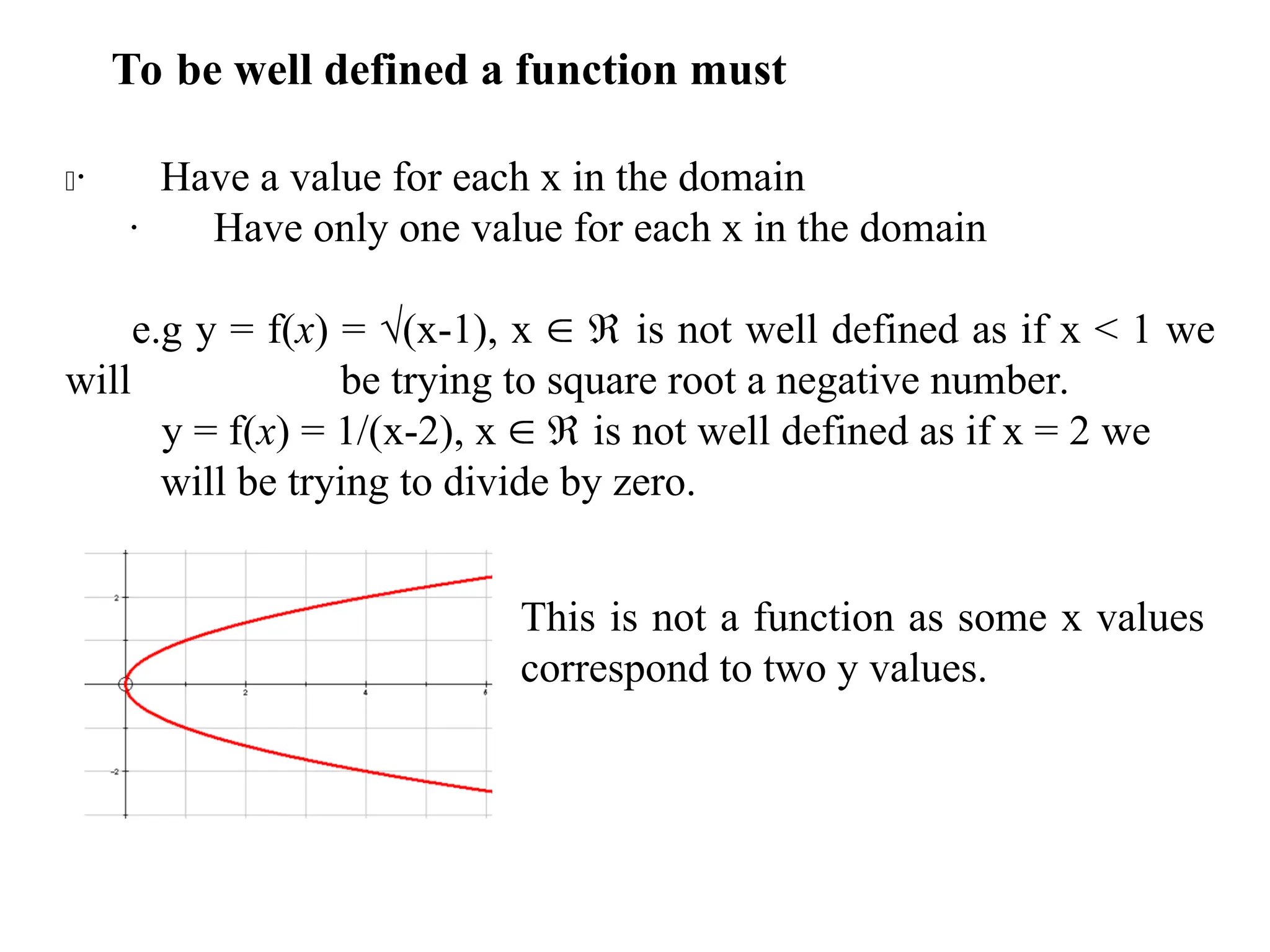
This is not a function as some x values
correspond to two y values.
Dom
ain
y = (x-2)2
+3
2
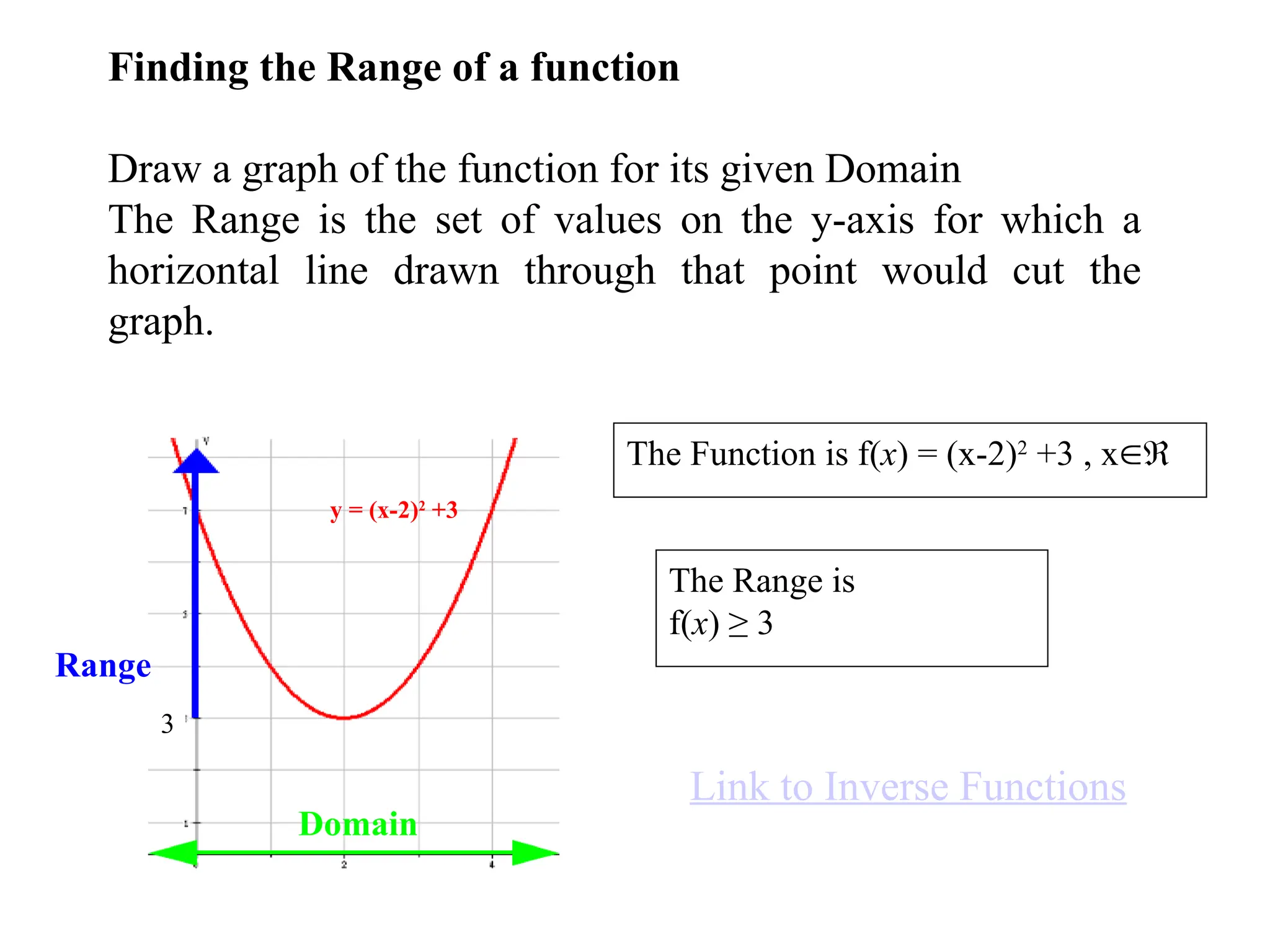
The Range is
f(x) ≥ 3
Finding the Range of a function
Draw a graph of the function for its given Domain
The Range is the set of values on the y-axis for which a
horizontal line drawn through that point would cut the
graph.
Range
Domain
3
y = (x-2)2
+3
The Function is f(x) = (x-2)2
+3 , x
Link to Inverse Functions
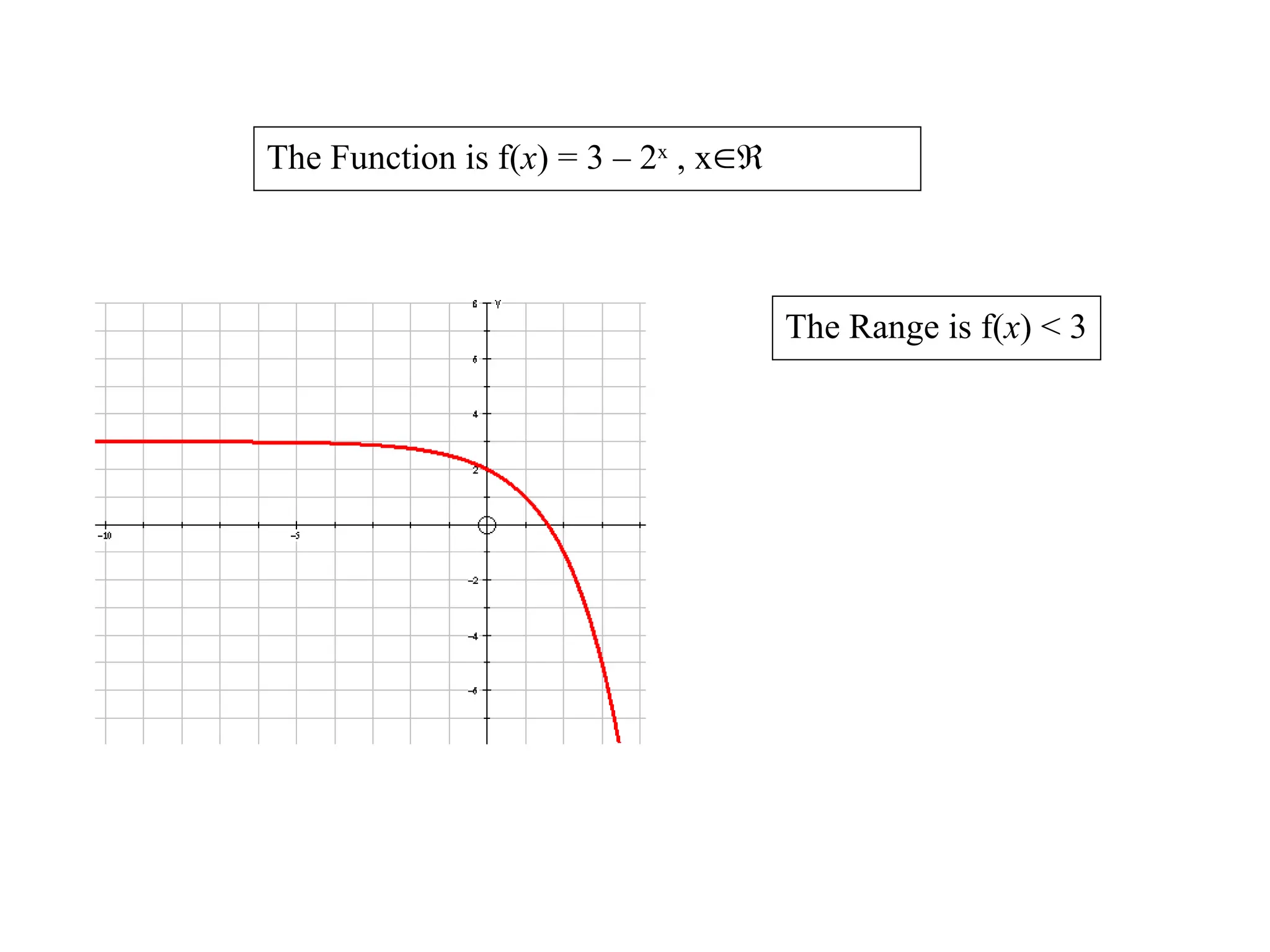
The Function is f(x) = 3 – 2x
, x
The Range is f(x) < 3
f
x g(f(x))
= gf(x)
g
f(x)
Finding gf(x)
Note: gf(x)
does not mean
g(x) times f(x).
Note : When finding f(g(x))
Replace all the x’s in the rule for
the f funcion with the expression
for g(x) in a bracket.
e.g If f(x) = x2
–2x
then f(x-2) = (x-2)2
– 2(x-2)
Composite Functions
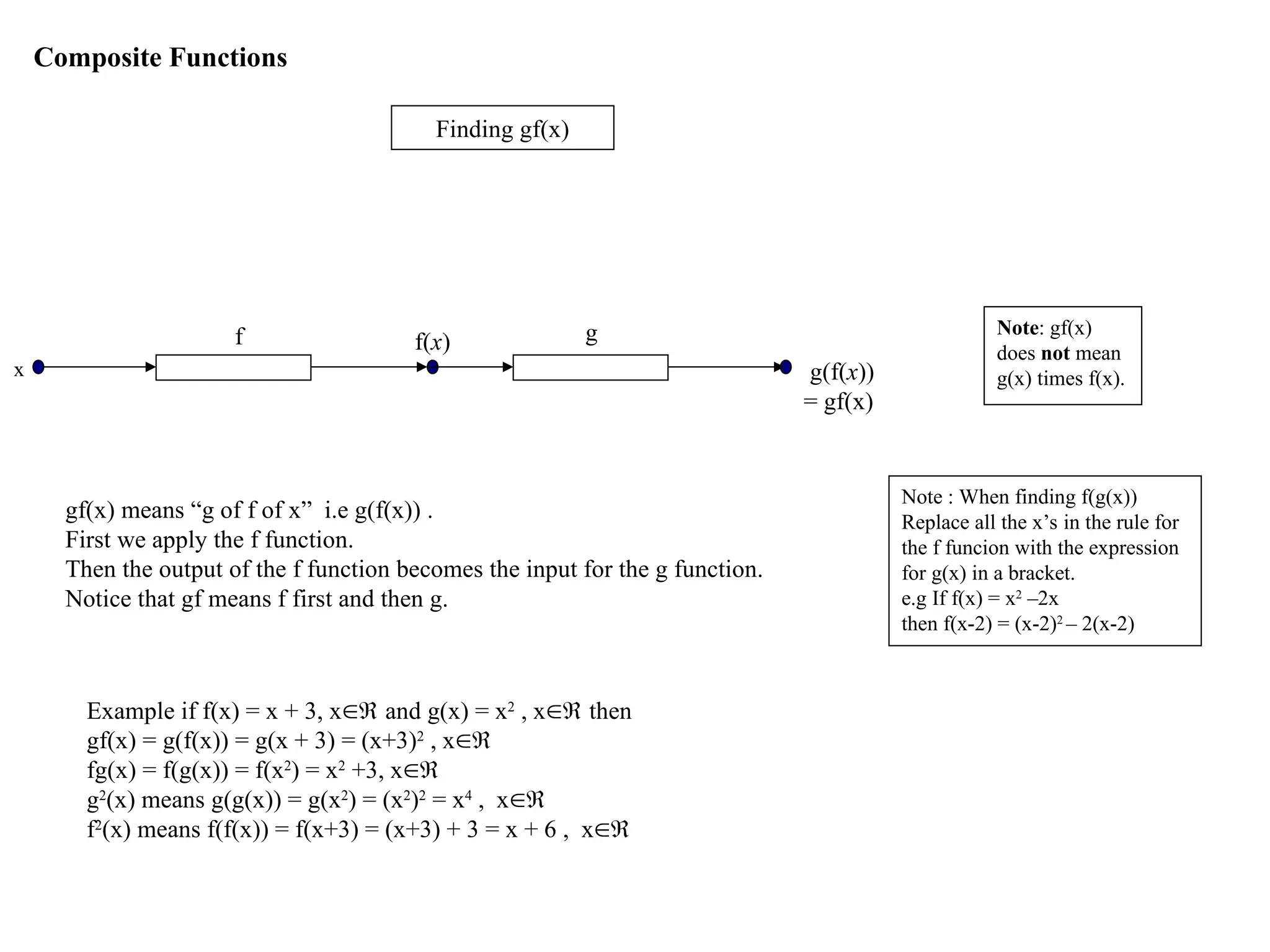
gf(x) means “g of f of x” i.e g(f(x)) .
First we apply the f function.
Then the output of the f function becomes the input for the g function.
Notice that gf means f first and then g.
Example if f(x) = x + 3, x and g(x) = x2
, x then
gf(x) = g(f(x)) = g(x + 3) = (x+3)2
, x
fg(x) = f(g(x)) = f(x2
) = x2
+3, x
g2
(x) means g(g(x)) = g(x2
) = (x2
)2
= x4
, x
f2
(x) means f(f(x)) = f(x+3) = (x+3) + 3 = x + 6 , x
Notice that fg and gf are not the same.
The Domain of gf is the same as the Domain of f since f is the
first function to be applied.
The Domain of fg is the same as the Domain of g.
For gf to be properly defined the Range (output set) of f must fit
inside the Domain (input set) of g.
For example if g(x) = √x , x ≥ 0 and f(x) = x – 2, x
Then gf would not be well defined as the output of f could be a
negative number and this is not allowed as an input for g.
However fg is well defined, fg(x) = √x – 2, x ≥ 0.
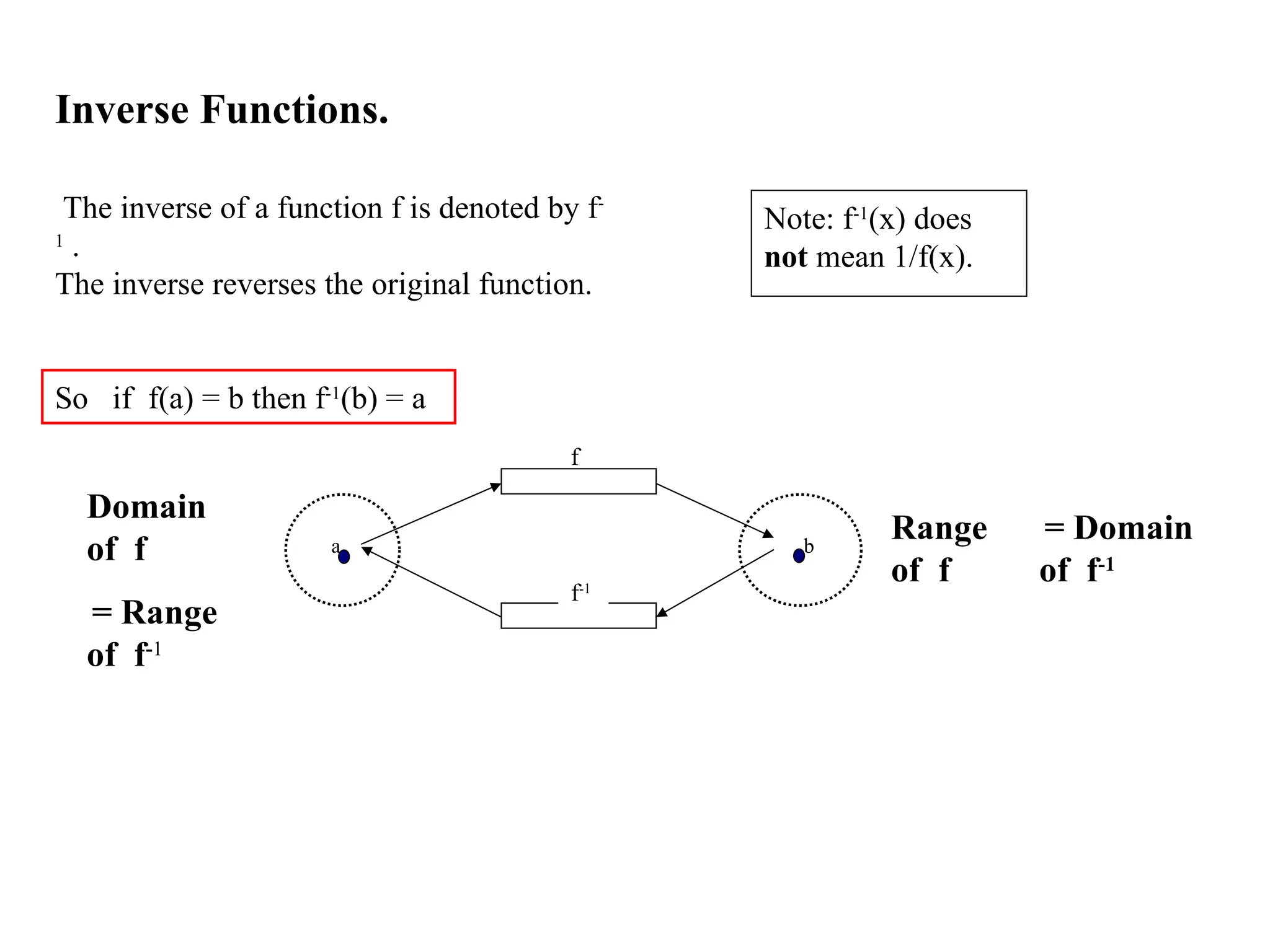
Domain
of f
Range
of f
b
f
a
f-1
= Domain
of f-1
= Range
of f-1
Note: f-1
(x) does
not mean 1/f(x).
Inverse Functions.
The inverse of a function f is denoted by f-
1
.
The inverse reverses the original function.
So if f(a) = b then f-1
(b) = a
One to one Functions
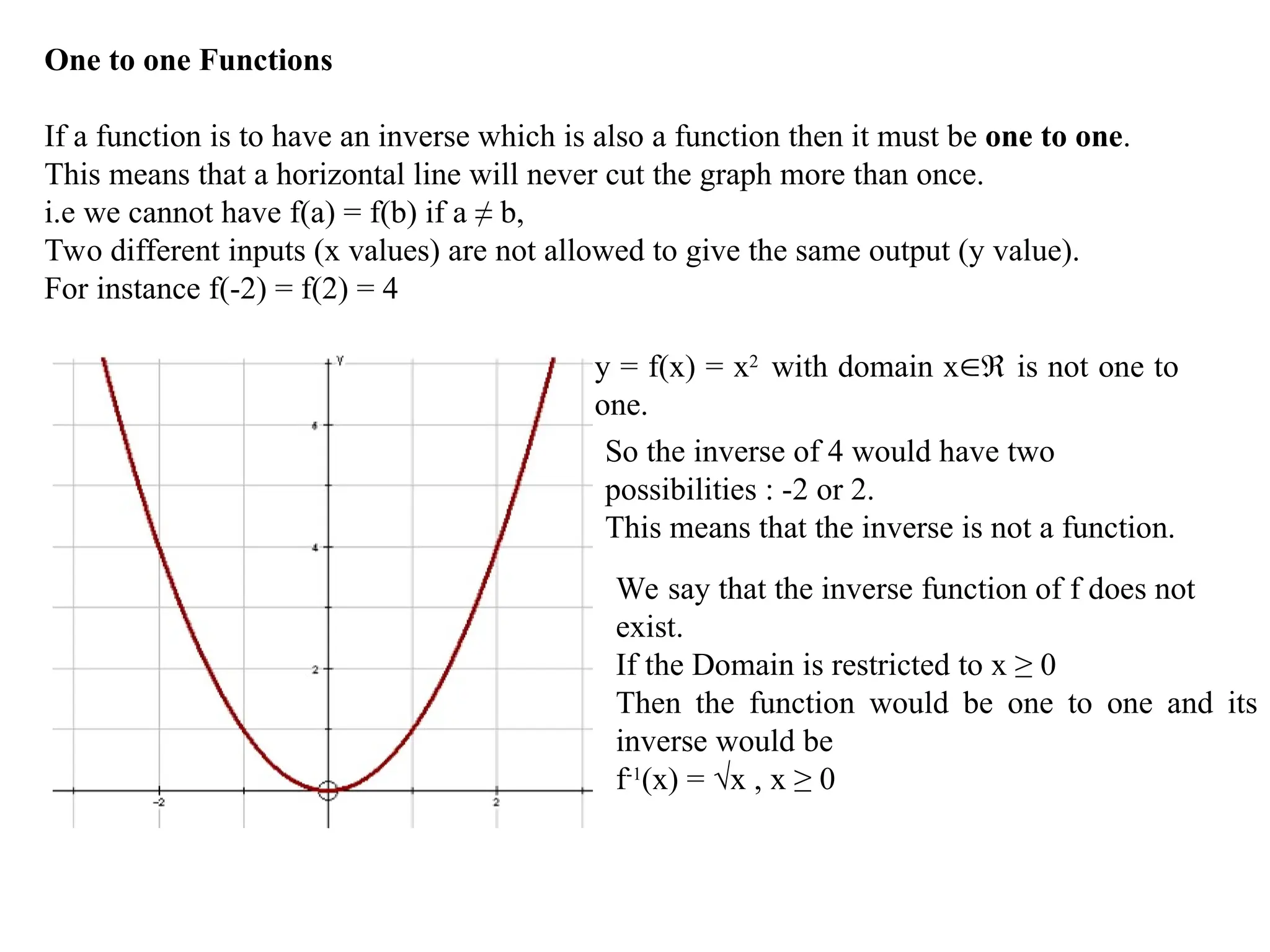
If a function is to have an inverse which is also a function then it must be one to one.
This means that a horizontal line will never cut the graph more than once.
i.e we cannot have f(a) = f(b) if a ≠ b,
Two different inputs (x values) are not allowed to give the same output (y value).
For instance f(-2) = f(2) = 4
y = f(x) = x2
with domain x is not one to
one.
So the inverse of 4 would have two
possibilities : -2 or 2.
This means that the inverse is not a function.
We say that the inverse function of f does not
exist.
If the Domain is restricted to x ≥ 0
Then the function would be one to one and its
inverse would be
f-1
(x) = √x , x ≥ 0
Domain
The domain of the inverse = the
Range of the original.
So draw a graph of y = f(x) and
use it to find the Range
Finding the Rule and Domain of an inverse function
Rule
Swap over x and y
Make y the subject
Drawing the graph of the Inverse
The graph of y = f-1
(x) is the reflection in y = x of the graph of y = f(x).
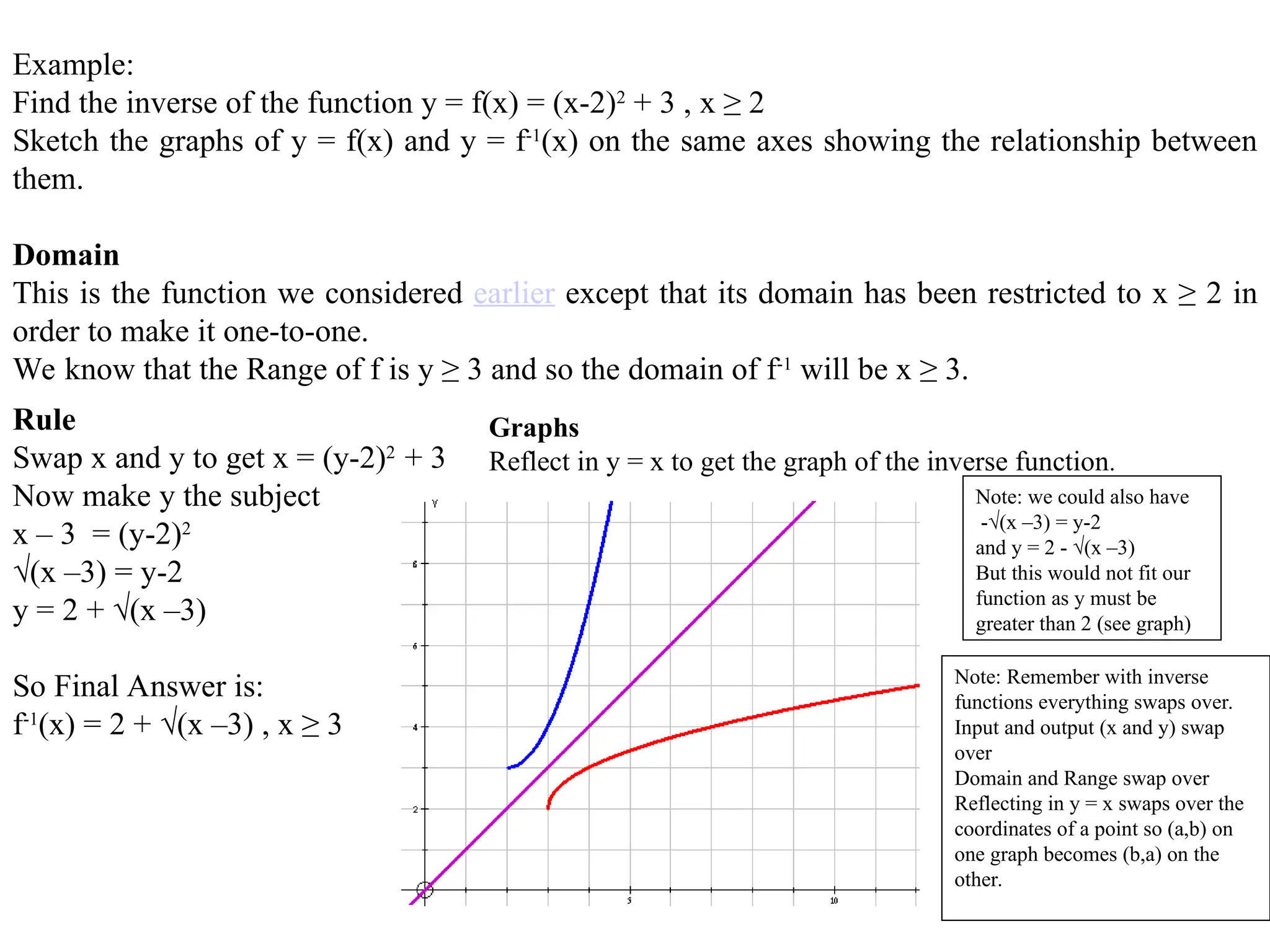
Example:
Find the inverse of the function y = f(x) = (x-2)2
+ 3 , x ≥ 2
Sketch the graphs of y = f(x) and y = f-1
(x) on the same axes showing the relationship between
them.
Domain
This is the function we considered earlier except that its domain has been restricted to x ≥ 2 in
order to make it one-to-one.
We know that the Range of f is y ≥ 3 and so the domain of f-1
will be x ≥ 3.
Note: we could also have
-√(x –3) = y-2
and y = 2 - √(x –3)
But this would not fit our
function as y must be
greater than 2 (see graph)
Rule
Swap x and y to get x = (y-2)2
+ 3
Now make y the subject
x – 3 = (y-2)2
√(x –3) = y-2
y = 2 + √(x –3)
So Final Answer is:
f-1
(x) = 2 + √(x –3) , x ≥ 3
Graphs
Reflect in y = x to get the graph of the inverse function.
Note: Remember with inverse
functions everything swaps over.
Input and output (x and y) swap
over
Domain and Range swap over
Reflecting in y = x swaps over the
coordinates of a point so (a,b) on
one graph becomes (b,a) on the
other.
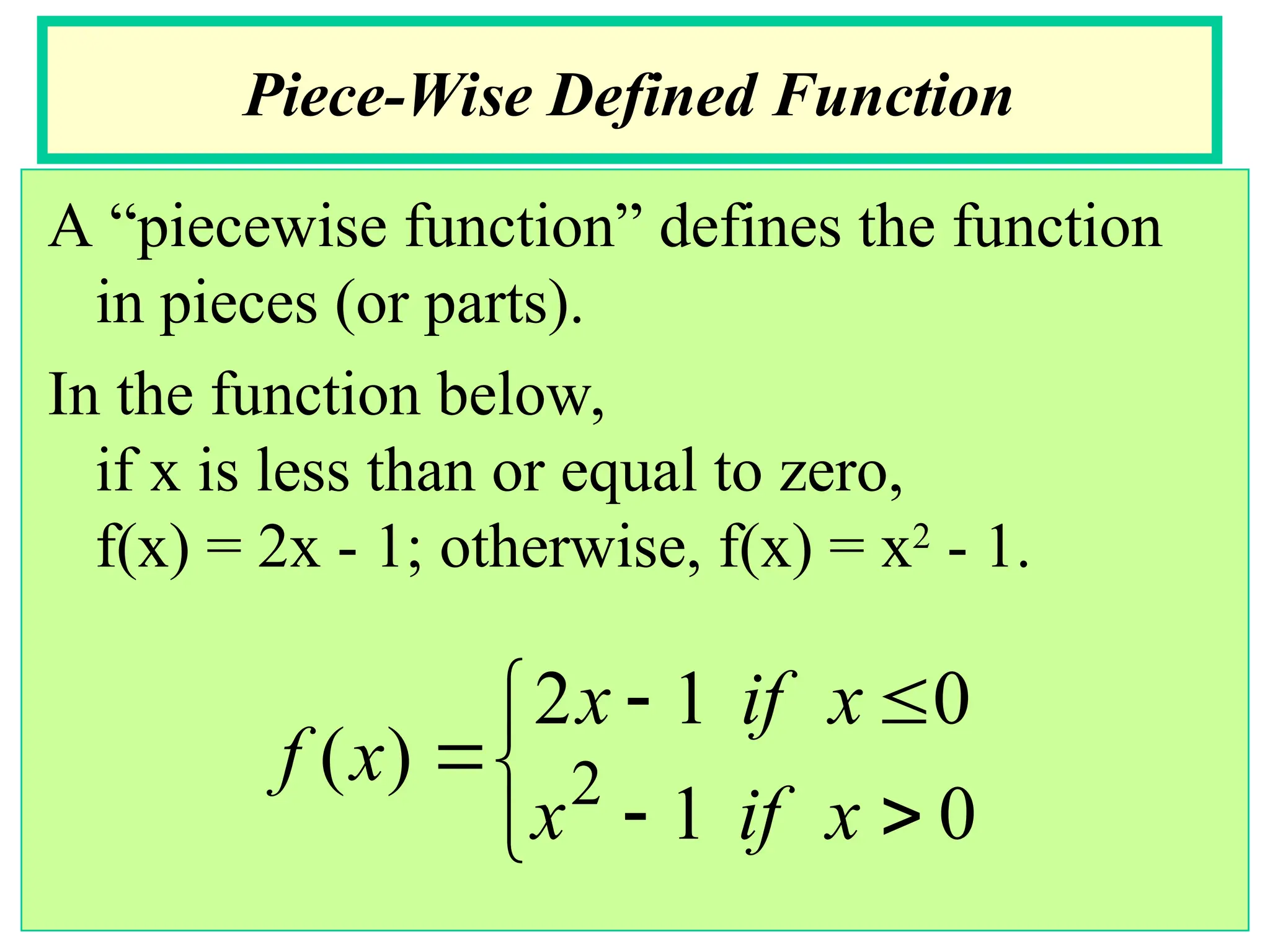
A “piecewise function” defines the function
in pieces (or parts).
In the function below,
if x is less than or equal to zero,
f(x) = 2x - 1; otherwise, f(x) = x2
- 1.
Piece-Wise Defined Function








0
1
0
1
2
)
( 2
x
if
x
x
if
x
x
f
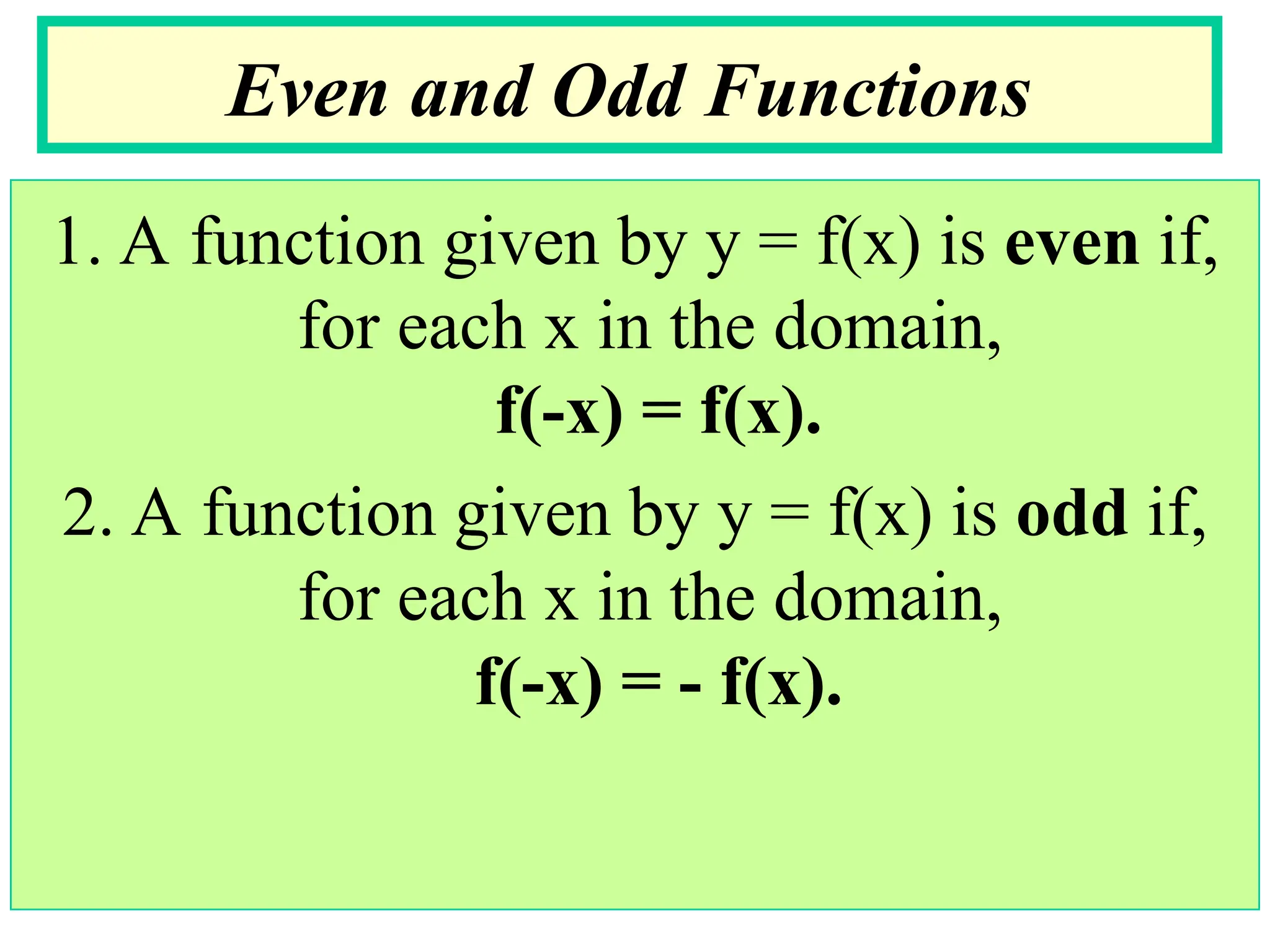
1. A function given by y = f(x) is even if,
for each x in the domain,
f(-x) = f(x).
2. A function given by y = f(x) is odd if,
for each x in the domain,
f(-x) = - f(x).
Even and Odd Functions
Basic Mathematics Bernard Muwonge Ssajjabbi, PhD
Q & A
“In life, always expect questions, but do not expect answers”
Functions, and quaduratic equatioins in mathematics

  • 1.
    Functions A function isan operation performed on an input (x) to produce an output (y = f(x) ). The Domain of f is the set of all allowable inputs (x values) The Range of f is the set of all outputs (y values) f x y =f(x) Domain Range
  • 2.
    To be welldefined a function must · Have a value for each x in the domain · Have only one value for each x in the domain e.g y = f(x) = √(x-1), x   is not well defined as if x < 1 we will be trying to square root a negative number. y = f(x) = 1/(x-2), x   is not well defined as if x = 2 we will be trying to divide by zero. This is not a function as some x values correspond to two y values.
  • 3.
    Dom ain y = (x-2)2 +3 2 TheRange is f(x) ≥ 3 Finding the Range of a function Draw a graph of the function for its given Domain The Range is the set of values on the y-axis for which a horizontal line drawn through that point would cut the graph. Range Domain 3 y = (x-2)2 +3 The Function is f(x) = (x-2)2 +3 , x Link to Inverse Functions
  • 4.
    The Function isf(x) = 3 – 2x , x The Range is f(x) < 3
  • 5.
    f x g(f(x)) = gf(x) g f(x) Findinggf(x) Note: gf(x) does not mean g(x) times f(x). Note : When finding f(g(x)) Replace all the x’s in the rule for the f funcion with the expression for g(x) in a bracket. e.g If f(x) = x2 –2x then f(x-2) = (x-2)2 – 2(x-2) Composite Functions gf(x) means “g of f of x” i.e g(f(x)) . First we apply the f function. Then the output of the f function becomes the input for the g function. Notice that gf means f first and then g. Example if f(x) = x + 3, x and g(x) = x2 , x then gf(x) = g(f(x)) = g(x + 3) = (x+3)2 , x fg(x) = f(g(x)) = f(x2 ) = x2 +3, x g2 (x) means g(g(x)) = g(x2 ) = (x2 )2 = x4 , x f2 (x) means f(f(x)) = f(x+3) = (x+3) + 3 = x + 6 , x
  • 6.
    Notice that fgand gf are not the same. The Domain of gf is the same as the Domain of f since f is the first function to be applied. The Domain of fg is the same as the Domain of g. For gf to be properly defined the Range (output set) of f must fit inside the Domain (input set) of g. For example if g(x) = √x , x ≥ 0 and f(x) = x – 2, x Then gf would not be well defined as the output of f could be a negative number and this is not allowed as an input for g. However fg is well defined, fg(x) = √x – 2, x ≥ 0.
  • 7.
    Domain of f Range of f b f a f-1 =Domain of f-1 = Range of f-1 Note: f-1 (x) does not mean 1/f(x). Inverse Functions. The inverse of a function f is denoted by f- 1 . The inverse reverses the original function. So if f(a) = b then f-1 (b) = a
  • 8.
    One to oneFunctions If a function is to have an inverse which is also a function then it must be one to one. This means that a horizontal line will never cut the graph more than once. i.e we cannot have f(a) = f(b) if a ≠ b, Two different inputs (x values) are not allowed to give the same output (y value). For instance f(-2) = f(2) = 4 y = f(x) = x2 with domain x is not one to one. So the inverse of 4 would have two possibilities : -2 or 2. This means that the inverse is not a function. We say that the inverse function of f does not exist. If the Domain is restricted to x ≥ 0 Then the function would be one to one and its inverse would be f-1 (x) = √x , x ≥ 0
  • 9.
    Domain The domain ofthe inverse = the Range of the original. So draw a graph of y = f(x) and use it to find the Range Finding the Rule and Domain of an inverse function Rule Swap over x and y Make y the subject Drawing the graph of the Inverse The graph of y = f-1 (x) is the reflection in y = x of the graph of y = f(x).
  • 10.
    Example: Find the inverseof the function y = f(x) = (x-2)2 + 3 , x ≥ 2 Sketch the graphs of y = f(x) and y = f-1 (x) on the same axes showing the relationship between them. Domain This is the function we considered earlier except that its domain has been restricted to x ≥ 2 in order to make it one-to-one. We know that the Range of f is y ≥ 3 and so the domain of f-1 will be x ≥ 3. Note: we could also have -√(x –3) = y-2 and y = 2 - √(x –3) But this would not fit our function as y must be greater than 2 (see graph) Rule Swap x and y to get x = (y-2)2 + 3 Now make y the subject x – 3 = (y-2)2 √(x –3) = y-2 y = 2 + √(x –3) So Final Answer is: f-1 (x) = 2 + √(x –3) , x ≥ 3 Graphs Reflect in y = x to get the graph of the inverse function. Note: Remember with inverse functions everything swaps over. Input and output (x and y) swap over Domain and Range swap over Reflecting in y = x swaps over the coordinates of a point so (a,b) on one graph becomes (b,a) on the other.
  • 11.
    A “piecewise function”defines the function in pieces (or parts). In the function below, if x is less than or equal to zero, f(x) = 2x - 1; otherwise, f(x) = x2 - 1. Piece-Wise Defined Function         0 1 0 1 2 ) ( 2 x if x x if x x f
  • 12.
    1. A functiongiven by y = f(x) is even if, for each x in the domain, f(-x) = f(x). 2. A function given by y = f(x) is odd if, for each x in the domain, f(-x) = - f(x). Even and Odd Functions
  • 13.
    Basic Mathematics BernardMuwonge Ssajjabbi, PhD Q & A “In life, always expect questions, but do not expect answers”