3.4 Composition of Functions
Chapter 3 Functions
Concepts and Objectives
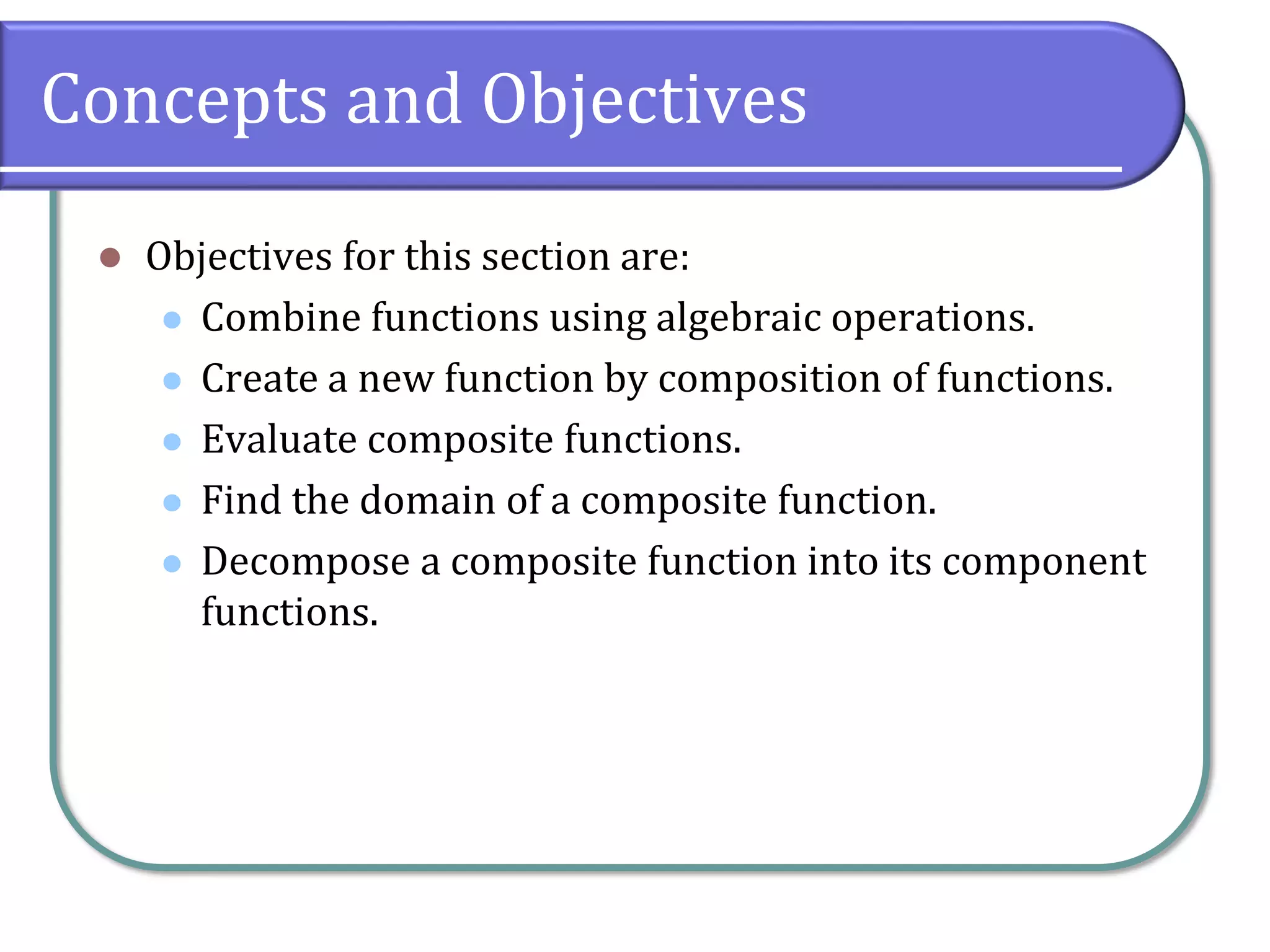
⚫ Objectives for this section are:
⚫ Combine functions using algebraic operations.
⚫ Create a new function by composition of functions.
⚫ Evaluate composite functions.
⚫ Find the domain of a composite function.
⚫ Decompose a composite function into its component
functions.
Operations on Functions
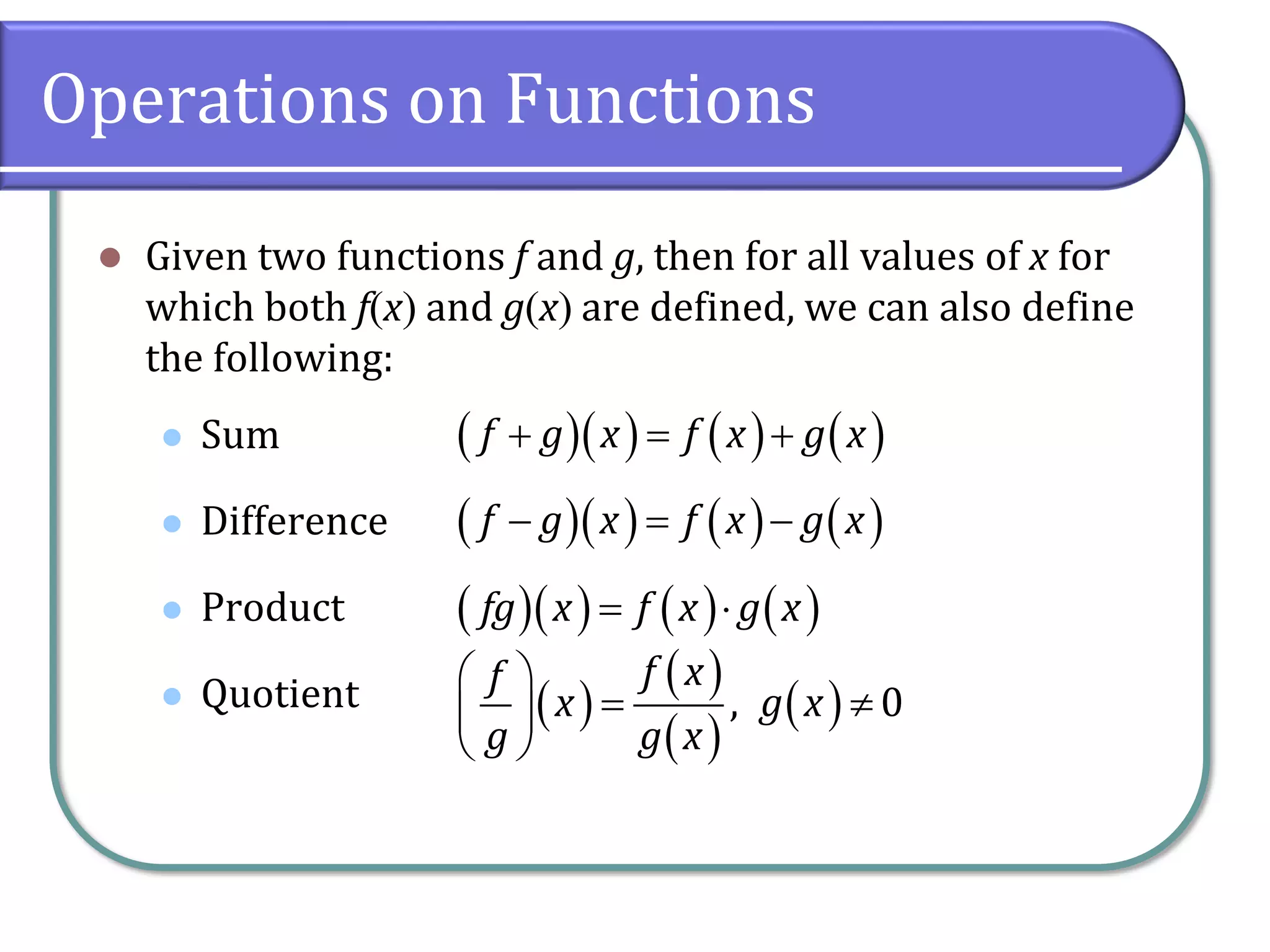
⚫ Given two functions f and g, then for all values of x for
which both f(x) and g(x) are defined, we can also define
the following:
⚫ Sum
⚫ Difference
⚫ Product
⚫ Quotient
( )( ) ( ) ( )
f g x f x g x
+ = +
( )( ) ( ) ( )
f g x f x g x
− = −
( )( ) ( ) ( )
fg x f x g x
= 
( )
( )
( )
( )
, 0
f x
f
x g x
g g x
 
= 
 
 
Operations on Functions (cont.)
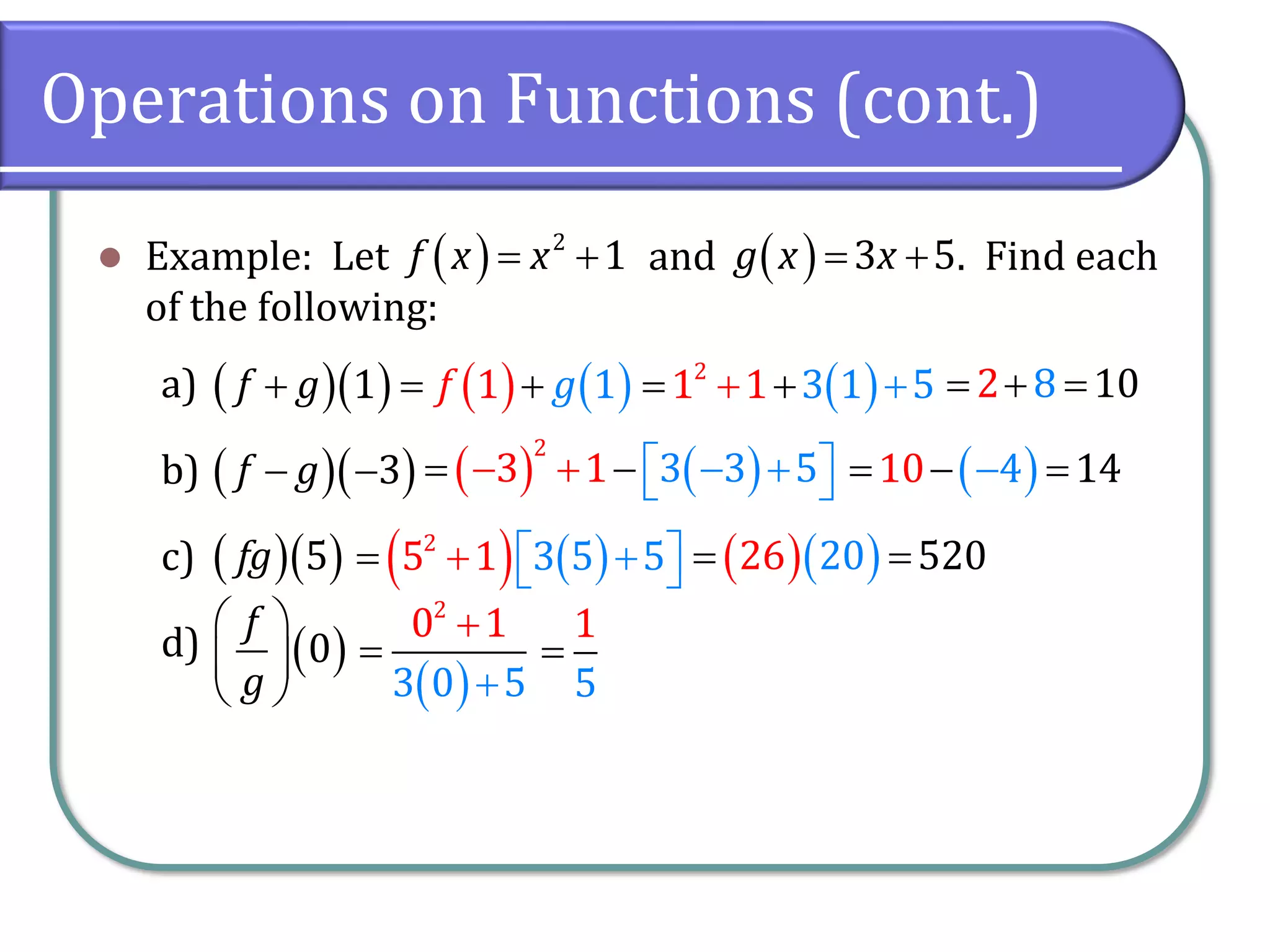
⚫ Example: Let and . Find each
of the following:
a)
b)
c)
d)
( ) 2
1
f x x
= + ( ) 3 5
g x x
= +
( )( )
1
f g
+ ( ) ( )
1 1
g
f
= + ( )
2
5
1 1
1 3
= + +
+ 0
2 1
8
= + =
( )( )
3
f g
− − ( ) ( )
2
3 5
3 3
1  
− +
 
−
− +
= ( ) 4
10 1
4
−
= − =
( )( )
5
fg ( ) ( )
2
3 5 5
5 1  
+
 
+
= ( )( ) 0
20
26 52
= =
( )
0
f
g
 
 
  ( )
2
5
0 1
3 0
+
+
=
5
1
=
Operations on Functions (cont.)
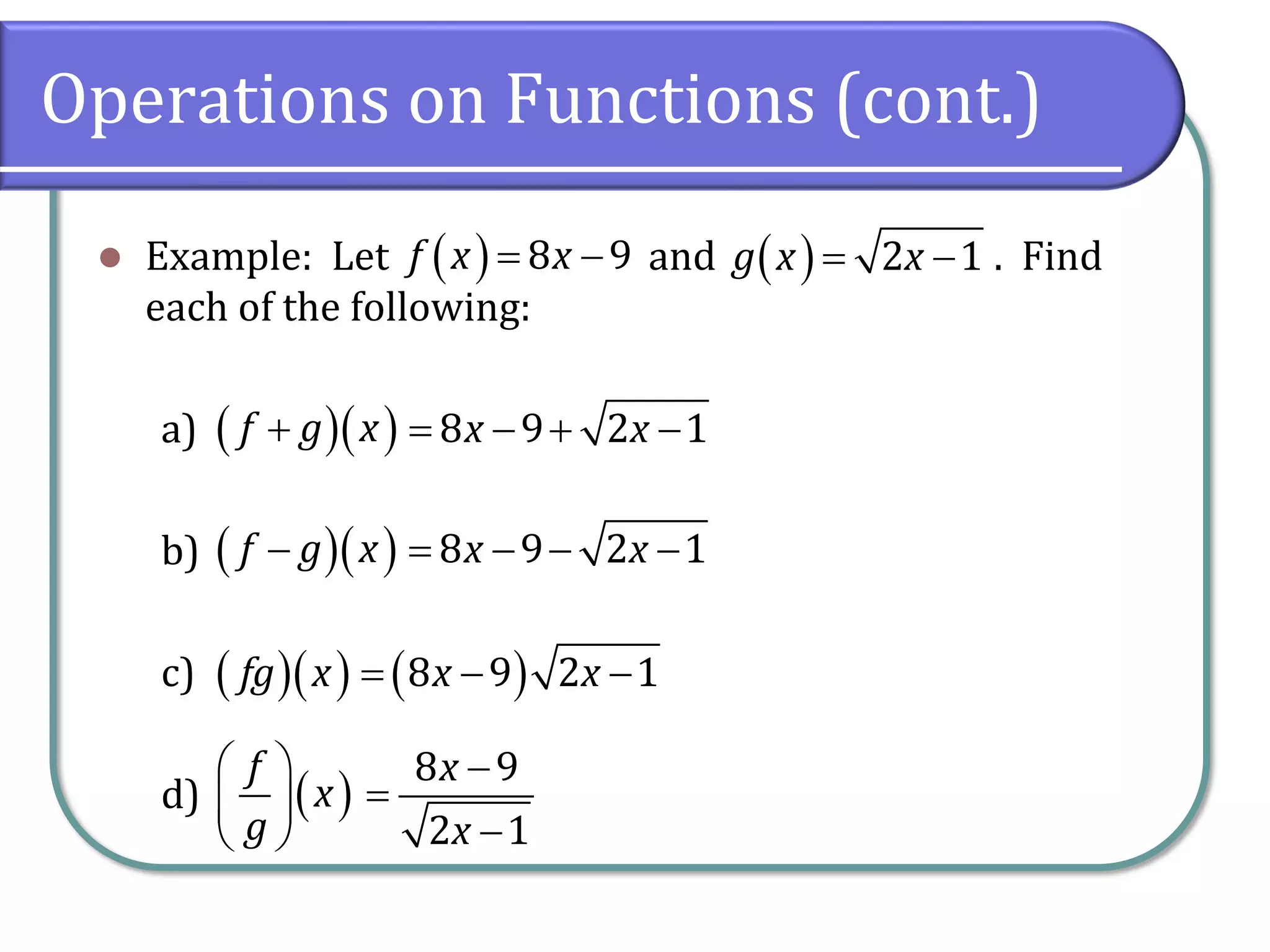
⚫ Example: Let and . Find
each of the following:
a)
b)
c)
d)
( ) 8 9
f x x
= − ( ) 2 1
g x x
= −
( )( )
f g x
+ 8 9 2 1
x x
= − + −
( )( )
f g x
− 8 9 2 1
x x
= − − −
( )( )
fg x ( )
8 9 2 1
x x
= − −
( )
f
x
g
 
 
 
8 9
2 1
x
x
−
=
−
Operations on Functions (cont.)
⚫ Example: Let and . Find
each of the following:
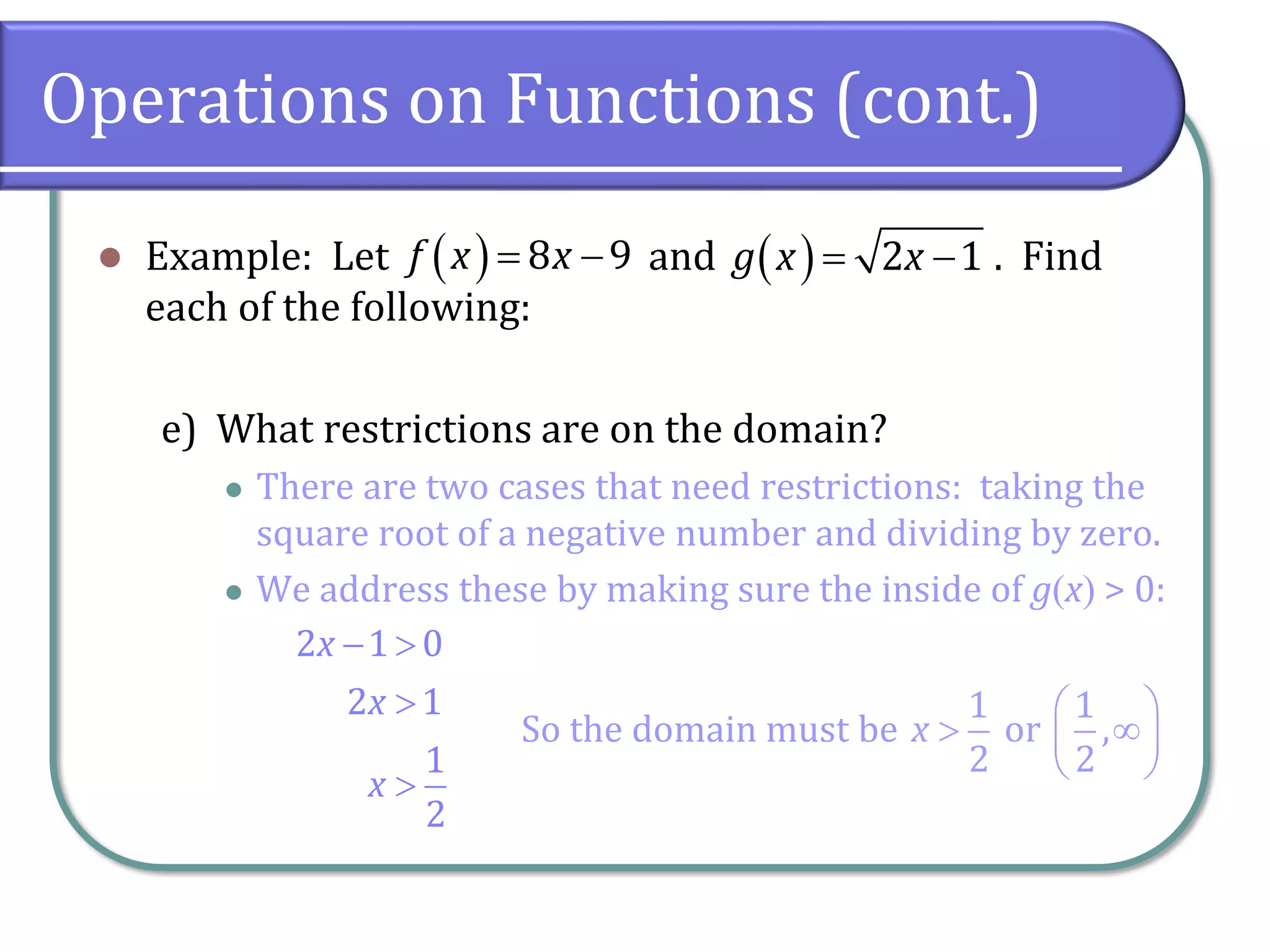
e) What restrictions are on the domain?
⚫ There are two cases that need restrictions: taking the
square root of a negative number and dividing by zero.
⚫ We address these by making sure the inside of g(x) > 0:
( ) 8 9
f x x
= − ( ) 2 1
g x x
= −
2 1 0
2 1
1
2
x
x
x
− 


So the domain must be
1 1
or ,
2 2
x
 
 
 
 
Composition of Functions
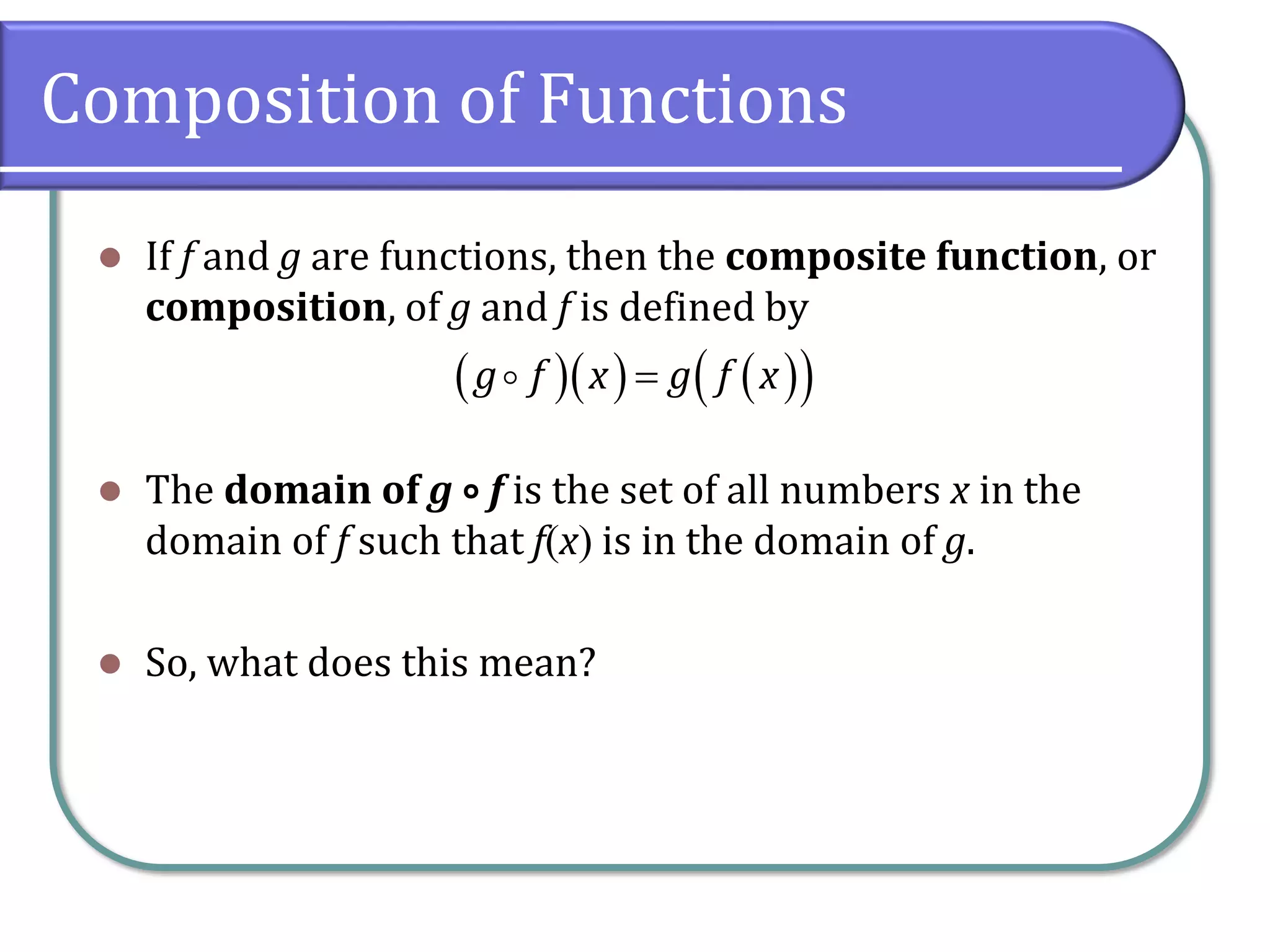
⚫ If f and g are functions, then the composite function, or
composition, of g and f is defined by
⚫ The domain of g ∘ f is the set of all numbers x in the
domain of f such that f(x) is in the domain of g.
⚫ So, what does this mean?
( )( ) ( )
( )
g f x g f x
=
Composition (cont.)
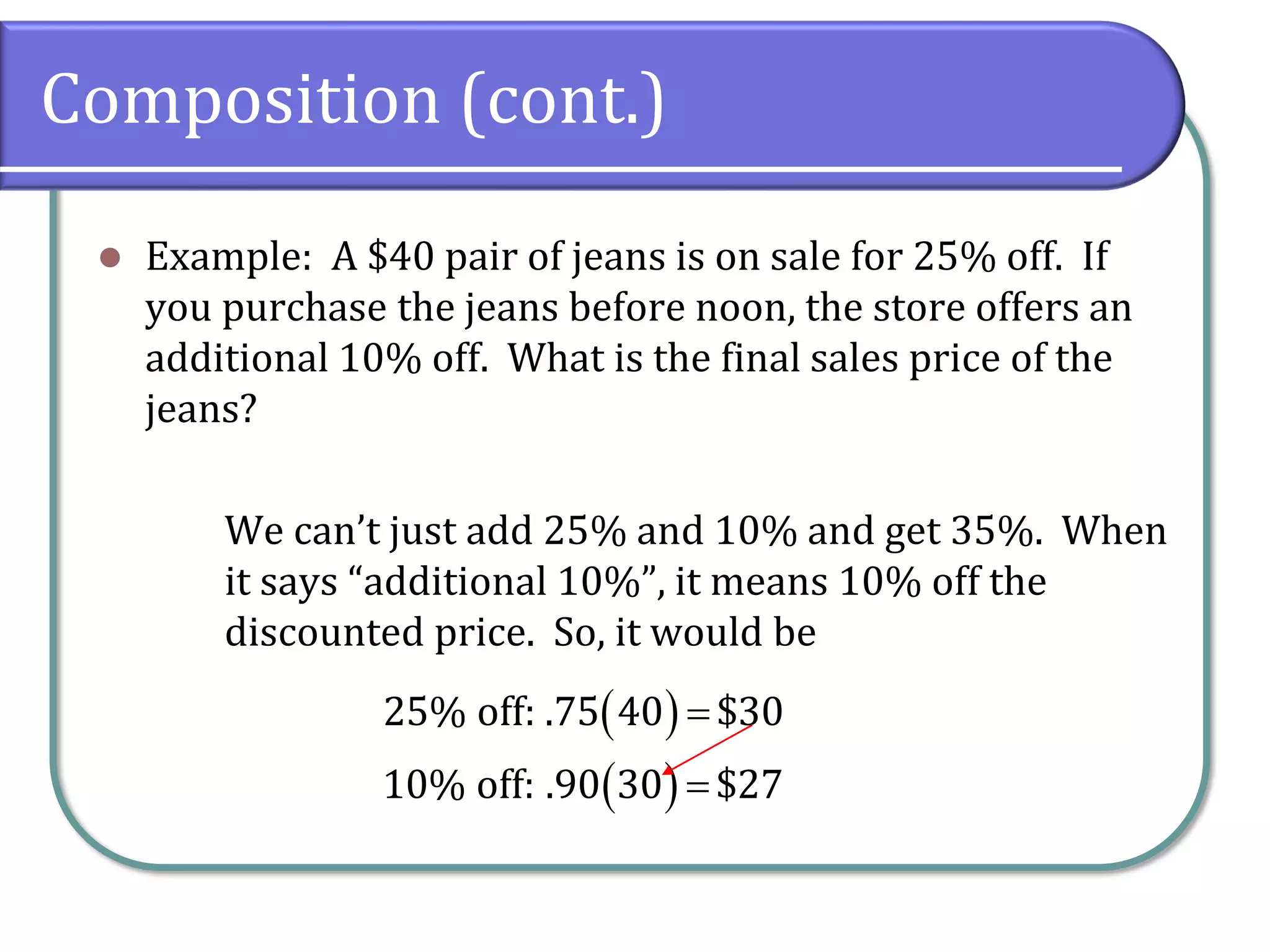
⚫ Example: A $40 pair of jeans is on sale for 25% off. If
you purchase the jeans before noon, the store offers an
additional 10% off. What is the final sales price of the
jeans?
We can’t just add 25% and 10% and get 35%. When
it says “additional 10%”, it means 10% off the
discounted price. So, it would be
( )
( )
25% off: .75 40 $30
10% off: .90 30 $27
=
=
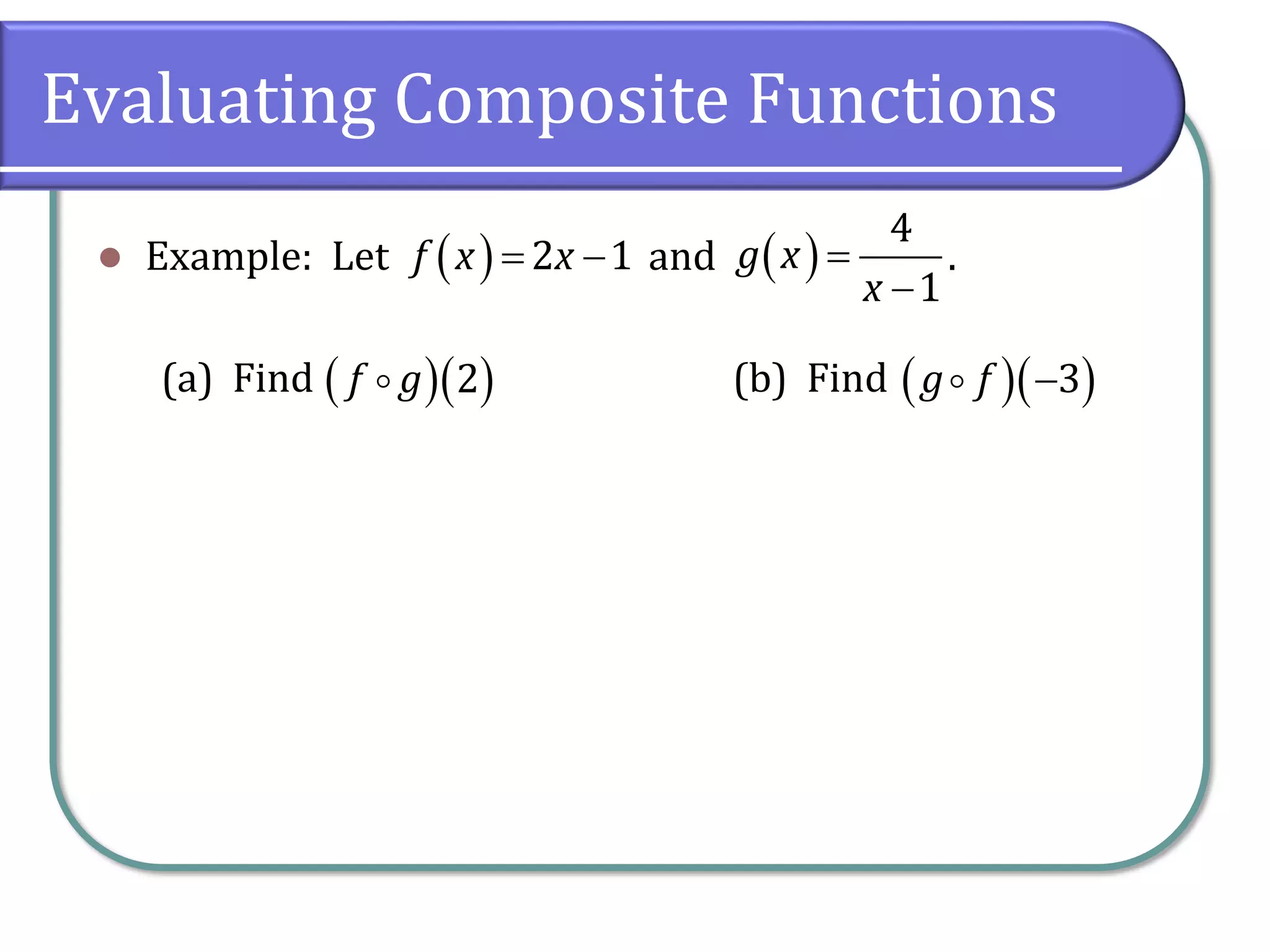
Evaluating Composite Functions
⚫ Example: Let and .
(a) Find (b) Find
( ) 2 1
f x x
= − ( )
4
1
g x
x
=
−
( )( )
2
f g ( )( )
3
g f −
Evaluating Composite Functions
⚫ Example: Let and .
(a) Find (b) Find
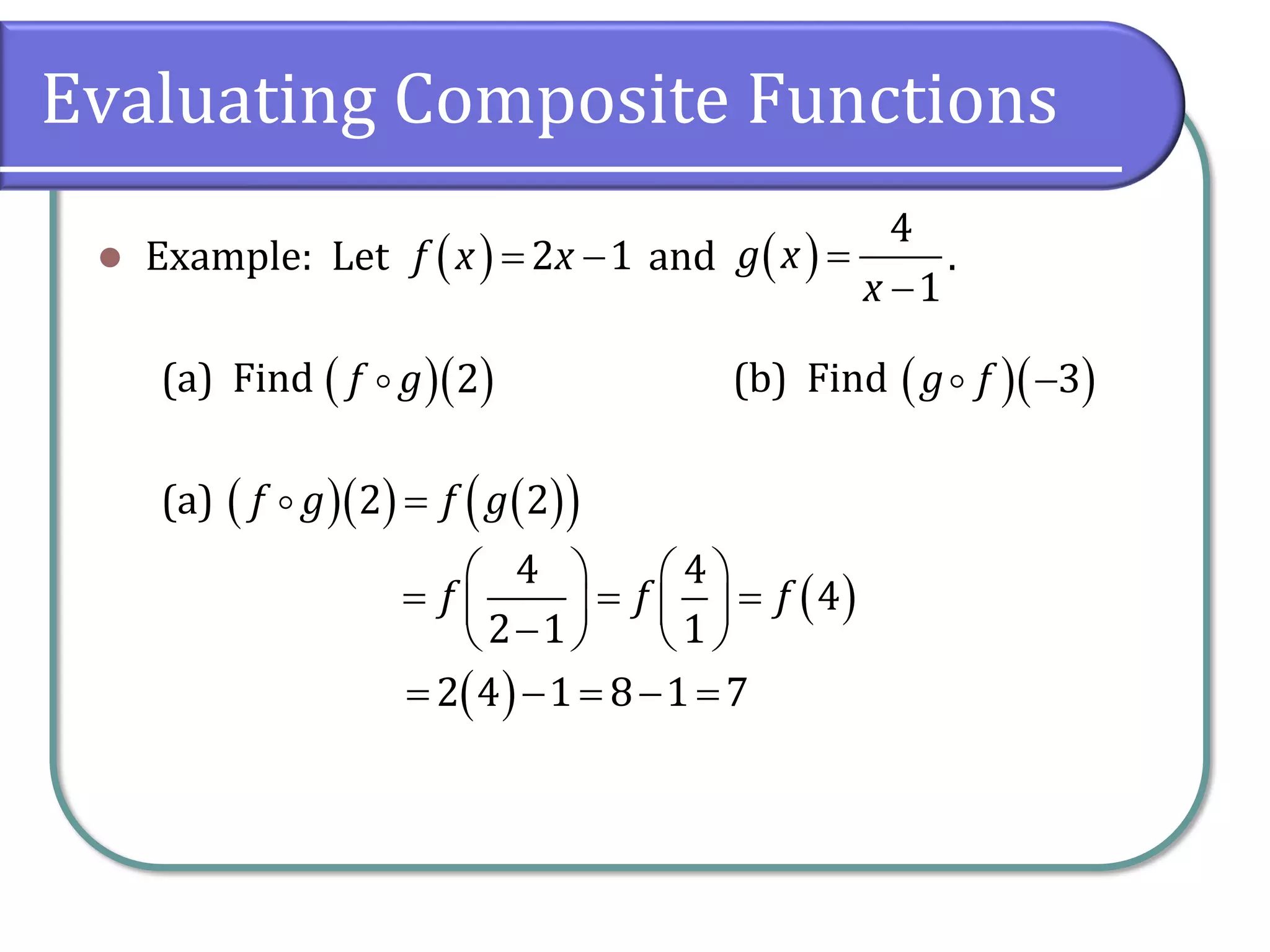
(a)
( ) 2 1
f x x
= − ( )
4
1
g x
x
=
−
( )( )
2
f g ( )( )
3
g f −
( )( ) ( )
( )
2 2
f g f g
=
( )
4 4
4
2 1 1
f f f
   
= = =
   
−
   
( )
2 4 1 8 1 7
= − = − =
Evaluating Composite Functions
⚫ Example: Let and .
(a) Find (b) Find
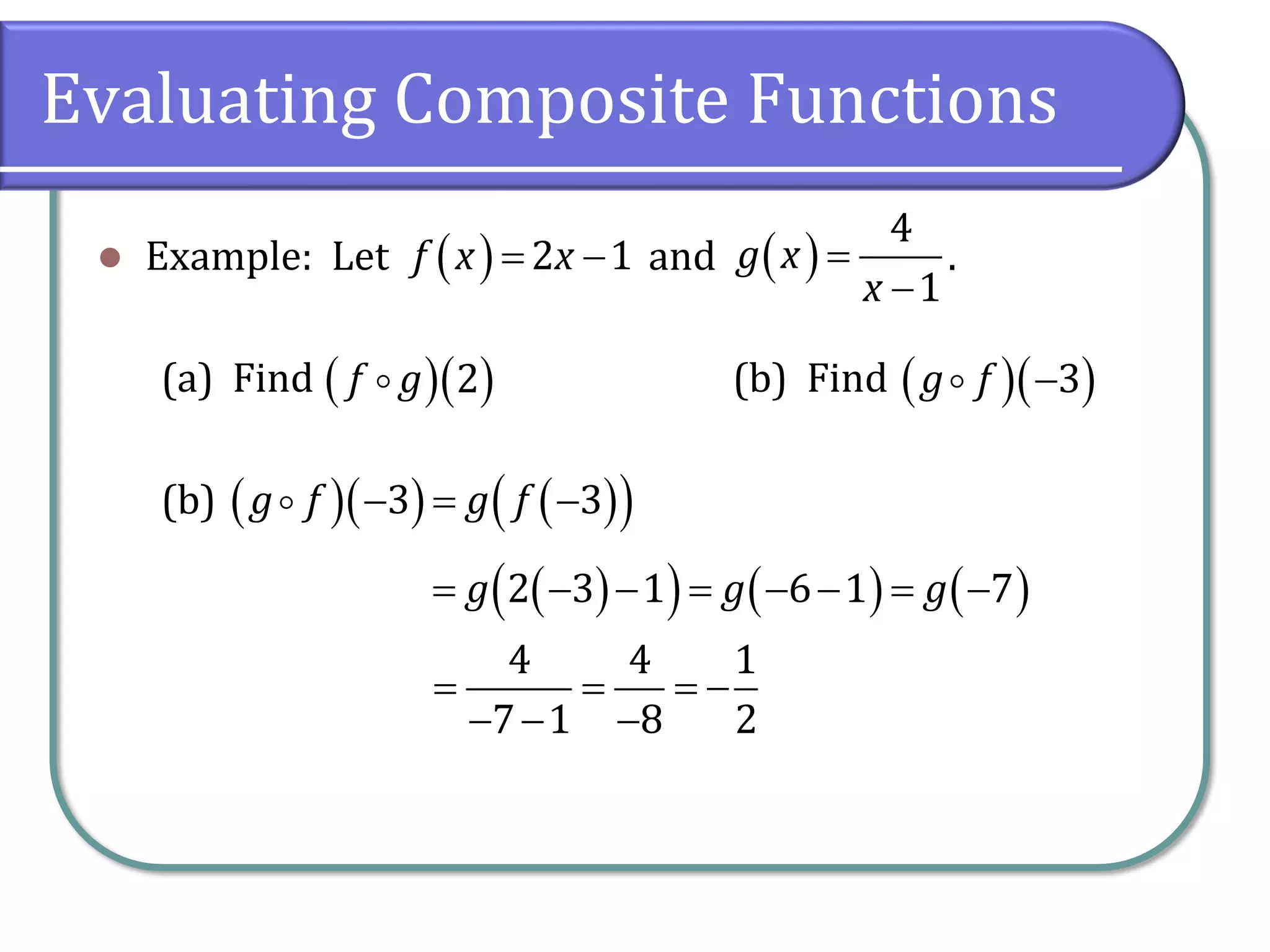
(b)
( ) 2 1
f x x
= − ( )
4
1
g x
x
=
−
( )( )
2
f g ( )( )
3
g f −
( )( ) ( )
( )
3 3
g f g f
− = −
( )
( ) ( ) ( )
2 3 1 6 1 7
g g g
= − − = − − = −
4 4 1
7 1 8 2
= = = −
− − −
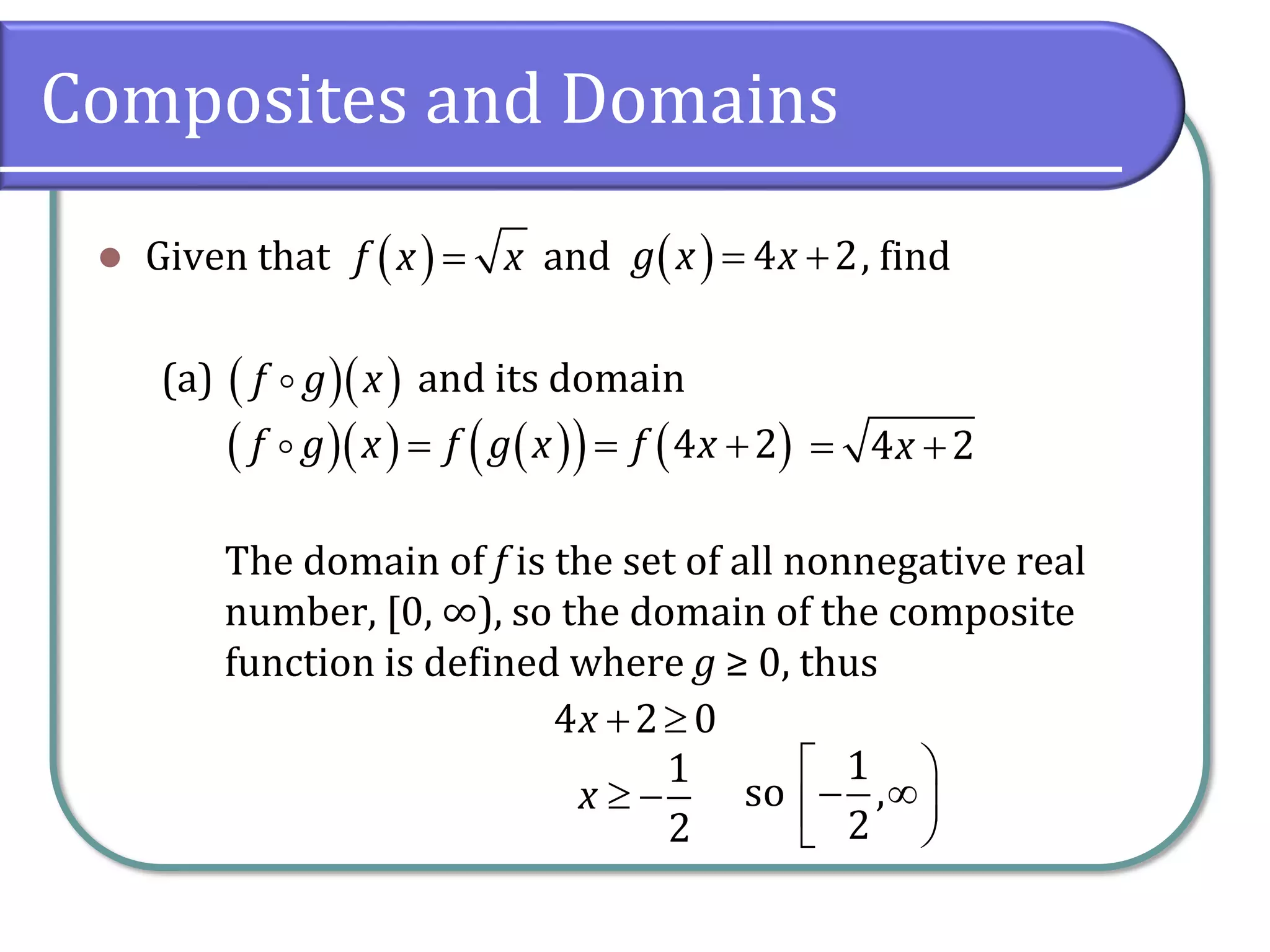
Composites and Domains
⚫ Given that and , find
(a) and its domain
The domain of f is the set of all nonnegative real
number, [0, ∞), so the domain of the composite
function is defined where g ≥ 0, thus
( )
f x x
= ( ) 4 2
g x x
= +
( )( )
f g x
( )( ) ( )
( ) ( )
4 2
f g x f g x f x
= = + 4 2
x
= +
4 2 0
x + 
1
2
x  −
1
so ,
2
 
− 

 
Composites and Domains
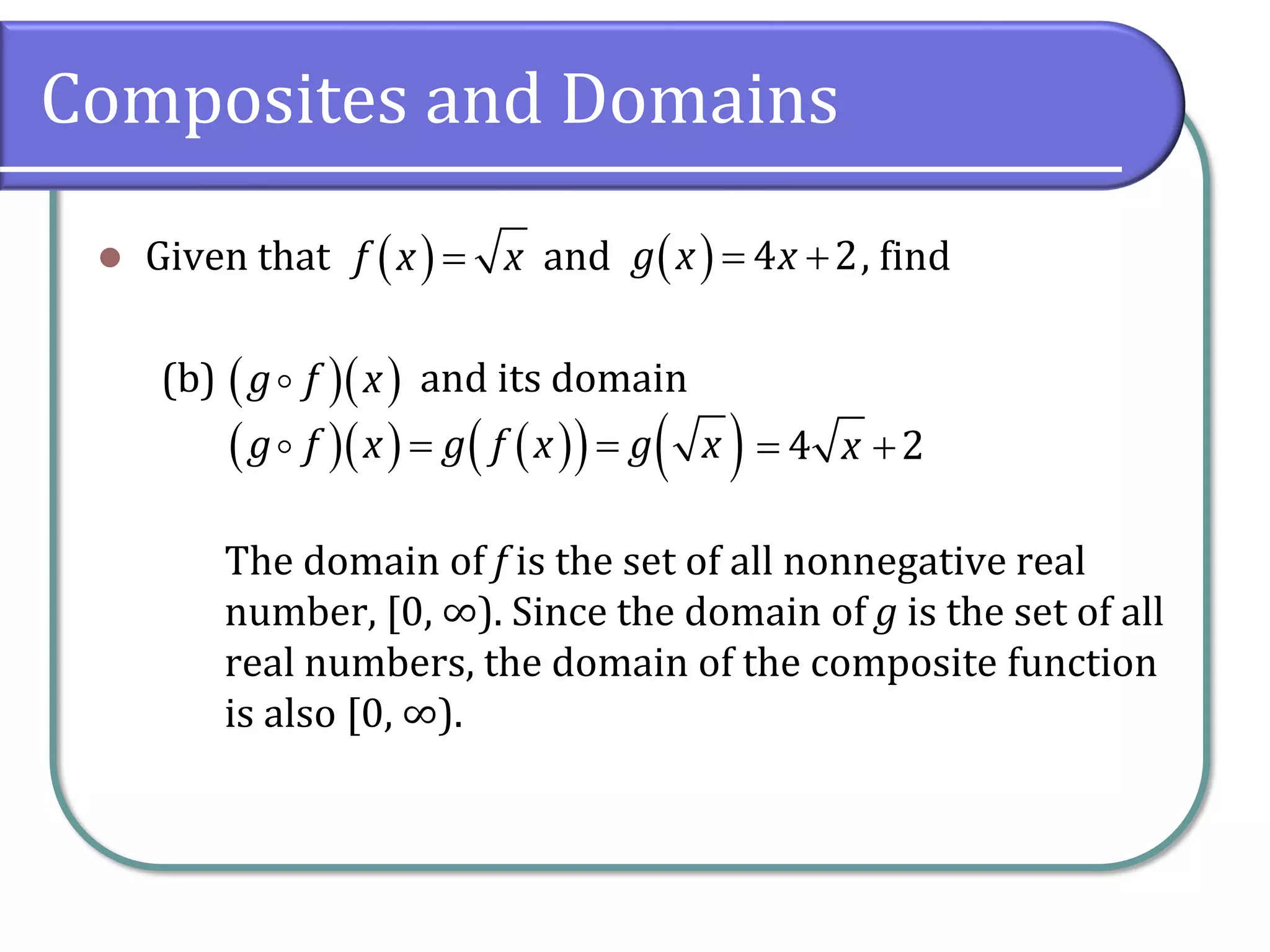
⚫ Given that and , find
(b) and its domain
The domain of f is the set of all nonnegative real
number, [0, ∞). Since the domain of g is the set of all
real numbers, the domain of the composite function
is also [0, ∞).
( )
f x x
= ( ) 4 2
g x x
= +
( )( )
g f x
( )( ) ( )
( ) ( )
g f x g f x g x
= = 4 2
x
= +
Composites and Domains (cont.)
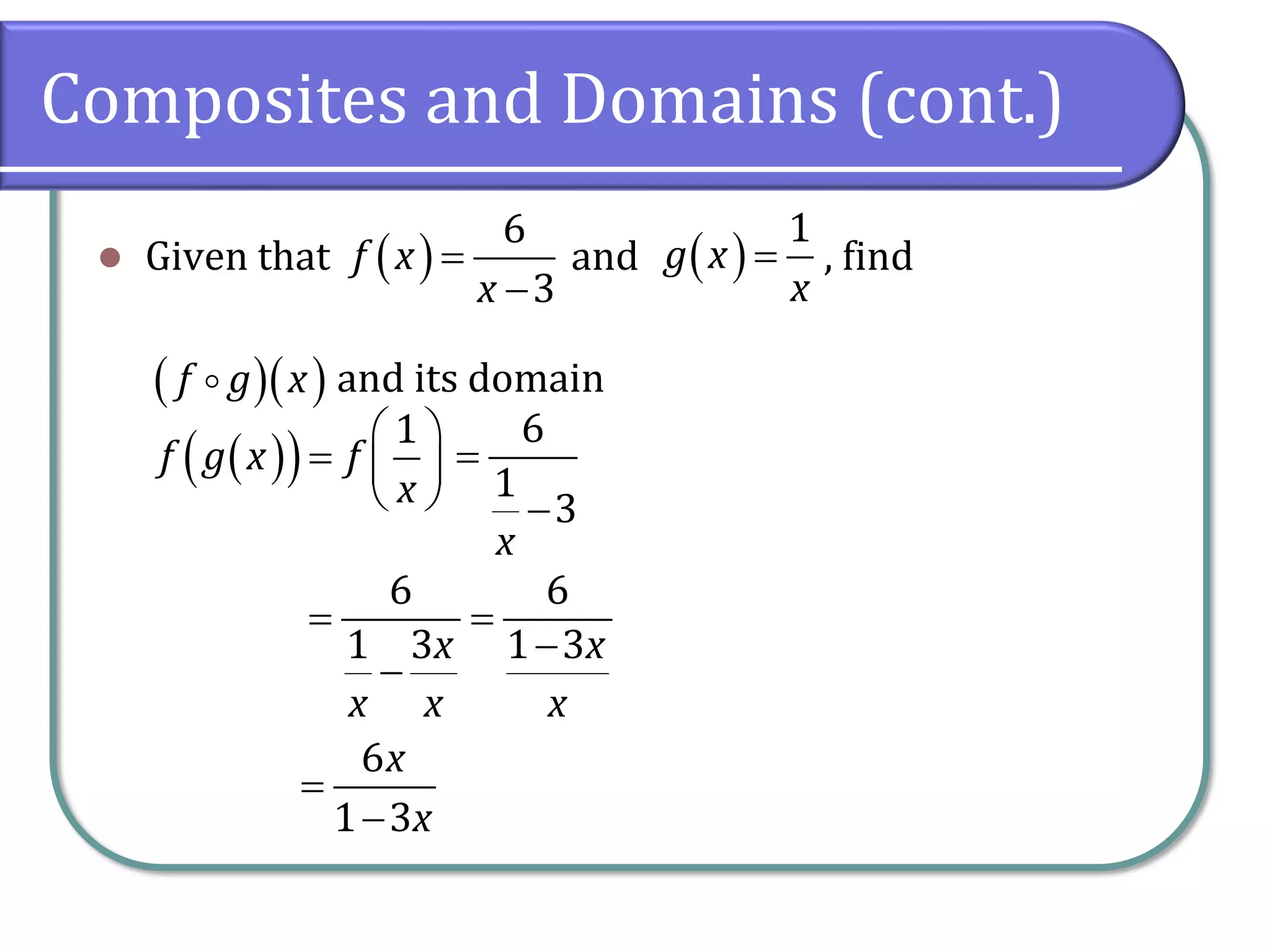
⚫ Given that and , find
and its domain
( )
6
3
f x
x
=
−
( )
1
g x
x
=
( )( )
f g x
( )
( ) 1
f g x f
x
 
=  
 
6
1
3
x
=
−
6 6
1 3 1 3
x x
x x x
= =
−
−
6
1 3
x
x
=
−
Composites and Domains (cont.)
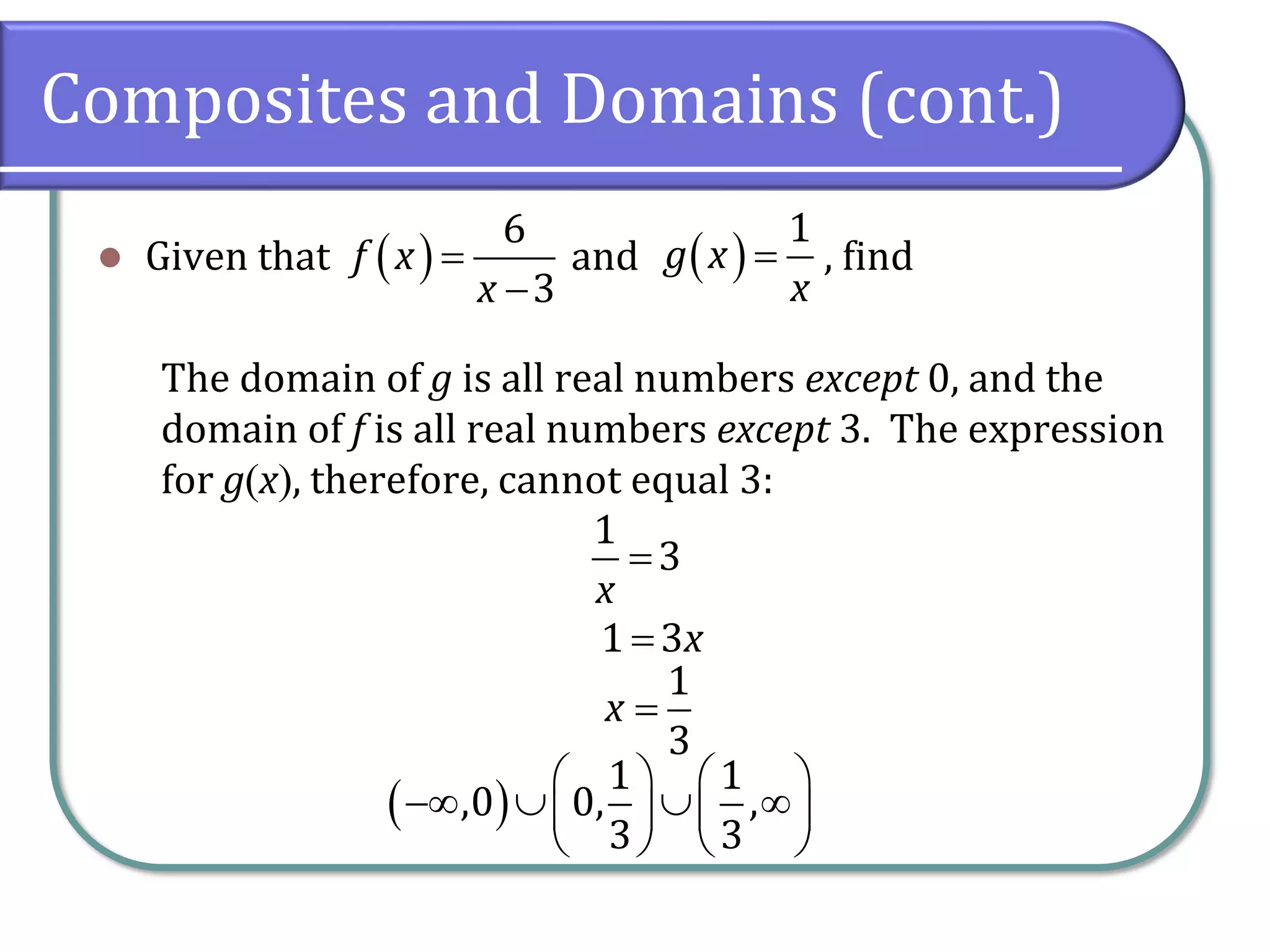
⚫ Given that and , find
The domain of g is all real numbers except 0, and the
domain of f is all real numbers except 3. The expression
for g(x), therefore, cannot equal 3:
( )
6
3
f x
x
=
−
( )
1
g x
x
=
1
3
x
=
1 3x
=
1
3
x =
( )
1 1
,0 0, ,
3 3
   
−   
   
   
Decomposition of Functions
⚫ In some cases, it is necessary to decompose a
complicated function. In other words, we can write it as
a composition of two simpler functions.
⚫ There may be more than one way to decompose a
composite function, so we may choose the
decomposition that appears to be the most expedient.
Decomposition of Functions
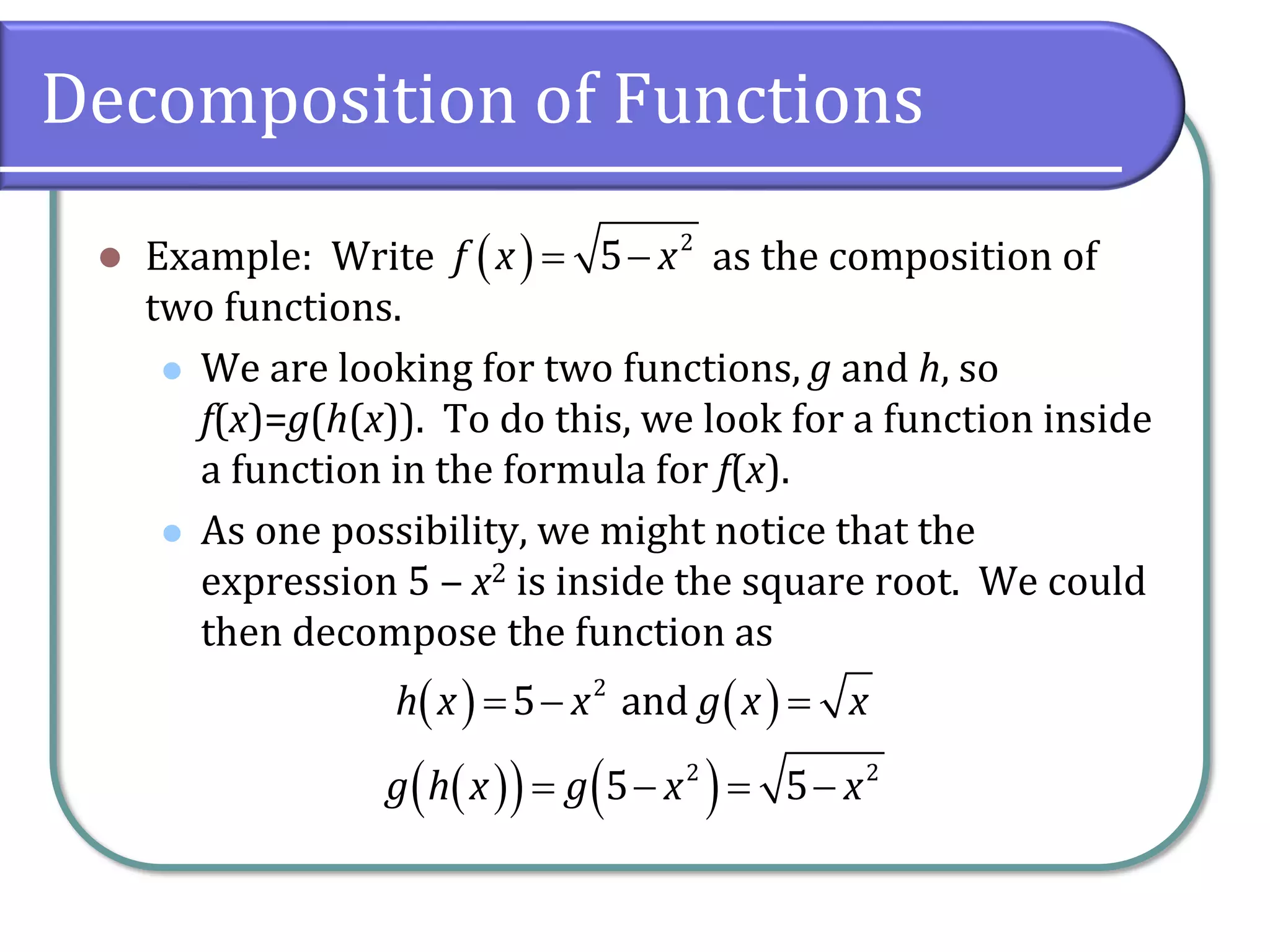
⚫ Example: Write as the composition of
two functions.
⚫ We are looking for two functions, g and h, so
f(x)=g(h(x)). To do this, we look for a function inside
a function in the formula for f(x).
⚫ As one possibility, we might notice that the
expression 5 ‒ x2 is inside the square root. We could
then decompose the function as
( ) 2
5
f x x
= −
( ) ( )
2
5 and
h x x g x x
= − =
( )
( ) ( )
2 2
5 5
g h x g x x
= − = −
Classwork
⚫ College Algebra 2e
⚫ 3.4: 6-16 (even); 3.3: 16-24 (even); 3.2: 38-54 (even)
⚫ 3.4 Classwork Check
⚫ Quiz 3.3

3.4 Composition of Functions

  • 1.
    3.4 Composition ofFunctions Chapter 3 Functions
  • 2.
    Concepts and Objectives ⚫Objectives for this section are: ⚫ Combine functions using algebraic operations. ⚫ Create a new function by composition of functions. ⚫ Evaluate composite functions. ⚫ Find the domain of a composite function. ⚫ Decompose a composite function into its component functions.
  • 3.
    Operations on Functions ⚫Given two functions f and g, then for all values of x for which both f(x) and g(x) are defined, we can also define the following: ⚫ Sum ⚫ Difference ⚫ Product ⚫ Quotient ( )( ) ( ) ( ) f g x f x g x + = + ( )( ) ( ) ( ) f g x f x g x − = − ( )( ) ( ) ( ) fg x f x g x =  ( ) ( ) ( ) ( ) , 0 f x f x g x g g x   =     
  • 4.
    Operations on Functions(cont.) ⚫ Example: Let and . Find each of the following: a) b) c) d) ( ) 2 1 f x x = + ( ) 3 5 g x x = + ( )( ) 1 f g + ( ) ( ) 1 1 g f = + ( ) 2 5 1 1 1 3 = + + + 0 2 1 8 = + = ( )( ) 3 f g − − ( ) ( ) 2 3 5 3 3 1   − +   − − + = ( ) 4 10 1 4 − = − = ( )( ) 5 fg ( ) ( ) 2 3 5 5 5 1   +   + = ( )( ) 0 20 26 52 = = ( ) 0 f g       ( ) 2 5 0 1 3 0 + + = 5 1 =
  • 5.
    Operations on Functions(cont.) ⚫ Example: Let and . Find each of the following: a) b) c) d) ( ) 8 9 f x x = − ( ) 2 1 g x x = − ( )( ) f g x + 8 9 2 1 x x = − + − ( )( ) f g x − 8 9 2 1 x x = − − − ( )( ) fg x ( ) 8 9 2 1 x x = − − ( ) f x g       8 9 2 1 x x − = −
  • 6.
    Operations on Functions(cont.) ⚫ Example: Let and . Find each of the following: e) What restrictions are on the domain? ⚫ There are two cases that need restrictions: taking the square root of a negative number and dividing by zero. ⚫ We address these by making sure the inside of g(x) > 0: ( ) 8 9 f x x = − ( ) 2 1 g x x = − 2 1 0 2 1 1 2 x x x −    So the domain must be 1 1 or , 2 2 x        
  • 7.
    Composition of Functions ⚫If f and g are functions, then the composite function, or composition, of g and f is defined by ⚫ The domain of g ∘ f is the set of all numbers x in the domain of f such that f(x) is in the domain of g. ⚫ So, what does this mean? ( )( ) ( ) ( ) g f x g f x =
  • 8.
    Composition (cont.) ⚫ Example:A $40 pair of jeans is on sale for 25% off. If you purchase the jeans before noon, the store offers an additional 10% off. What is the final sales price of the jeans? We can’t just add 25% and 10% and get 35%. When it says “additional 10%”, it means 10% off the discounted price. So, it would be ( ) ( ) 25% off: .75 40 $30 10% off: .90 30 $27 = =
  • 9.
    Evaluating Composite Functions ⚫Example: Let and . (a) Find (b) Find ( ) 2 1 f x x = − ( ) 4 1 g x x = − ( )( ) 2 f g ( )( ) 3 g f −
  • 10.
    Evaluating Composite Functions ⚫Example: Let and . (a) Find (b) Find (a) ( ) 2 1 f x x = − ( ) 4 1 g x x = − ( )( ) 2 f g ( )( ) 3 g f − ( )( ) ( ) ( ) 2 2 f g f g = ( ) 4 4 4 2 1 1 f f f     = = =     −     ( ) 2 4 1 8 1 7 = − = − =
  • 11.
    Evaluating Composite Functions ⚫Example: Let and . (a) Find (b) Find (b) ( ) 2 1 f x x = − ( ) 4 1 g x x = − ( )( ) 2 f g ( )( ) 3 g f − ( )( ) ( ) ( ) 3 3 g f g f − = − ( ) ( ) ( ) ( ) 2 3 1 6 1 7 g g g = − − = − − = − 4 4 1 7 1 8 2 = = = − − − −
  • 12.
    Composites and Domains ⚫Given that and , find (a) and its domain The domain of f is the set of all nonnegative real number, [0, ∞), so the domain of the composite function is defined where g ≥ 0, thus ( ) f x x = ( ) 4 2 g x x = + ( )( ) f g x ( )( ) ( ) ( ) ( ) 4 2 f g x f g x f x = = + 4 2 x = + 4 2 0 x +  1 2 x  − 1 so , 2   −    
  • 13.
    Composites and Domains ⚫Given that and , find (b) and its domain The domain of f is the set of all nonnegative real number, [0, ∞). Since the domain of g is the set of all real numbers, the domain of the composite function is also [0, ∞). ( ) f x x = ( ) 4 2 g x x = + ( )( ) g f x ( )( ) ( ) ( ) ( ) g f x g f x g x = = 4 2 x = +
  • 14.
    Composites and Domains(cont.) ⚫ Given that and , find and its domain ( ) 6 3 f x x = − ( ) 1 g x x = ( )( ) f g x ( ) ( ) 1 f g x f x   =     6 1 3 x = − 6 6 1 3 1 3 x x x x x = = − − 6 1 3 x x = −
  • 15.
    Composites and Domains(cont.) ⚫ Given that and , find The domain of g is all real numbers except 0, and the domain of f is all real numbers except 3. The expression for g(x), therefore, cannot equal 3: ( ) 6 3 f x x = − ( ) 1 g x x = 1 3 x = 1 3x = 1 3 x = ( ) 1 1 ,0 0, , 3 3     −           
  • 16.
    Decomposition of Functions ⚫In some cases, it is necessary to decompose a complicated function. In other words, we can write it as a composition of two simpler functions. ⚫ There may be more than one way to decompose a composite function, so we may choose the decomposition that appears to be the most expedient.
  • 17.
    Decomposition of Functions ⚫Example: Write as the composition of two functions. ⚫ We are looking for two functions, g and h, so f(x)=g(h(x)). To do this, we look for a function inside a function in the formula for f(x). ⚫ As one possibility, we might notice that the expression 5 ‒ x2 is inside the square root. We could then decompose the function as ( ) 2 5 f x x = − ( ) ( ) 2 5 and h x x g x x = − = ( ) ( ) ( ) 2 2 5 5 g h x g x x = − = −
  • 18.
    Classwork ⚫ College Algebra2e ⚫ 3.4: 6-16 (even); 3.3: 16-24 (even); 3.2: 38-54 (even) ⚫ 3.4 Classwork Check ⚫ Quiz 3.3