Diseases of the  crystalline lens By  Dr. Bakhtiar Q. Hamasalh Jaf M.B.Ch.B , M.D-OPHTHALMOLOGY University of Suleimani-college of medicine
ANATOMY
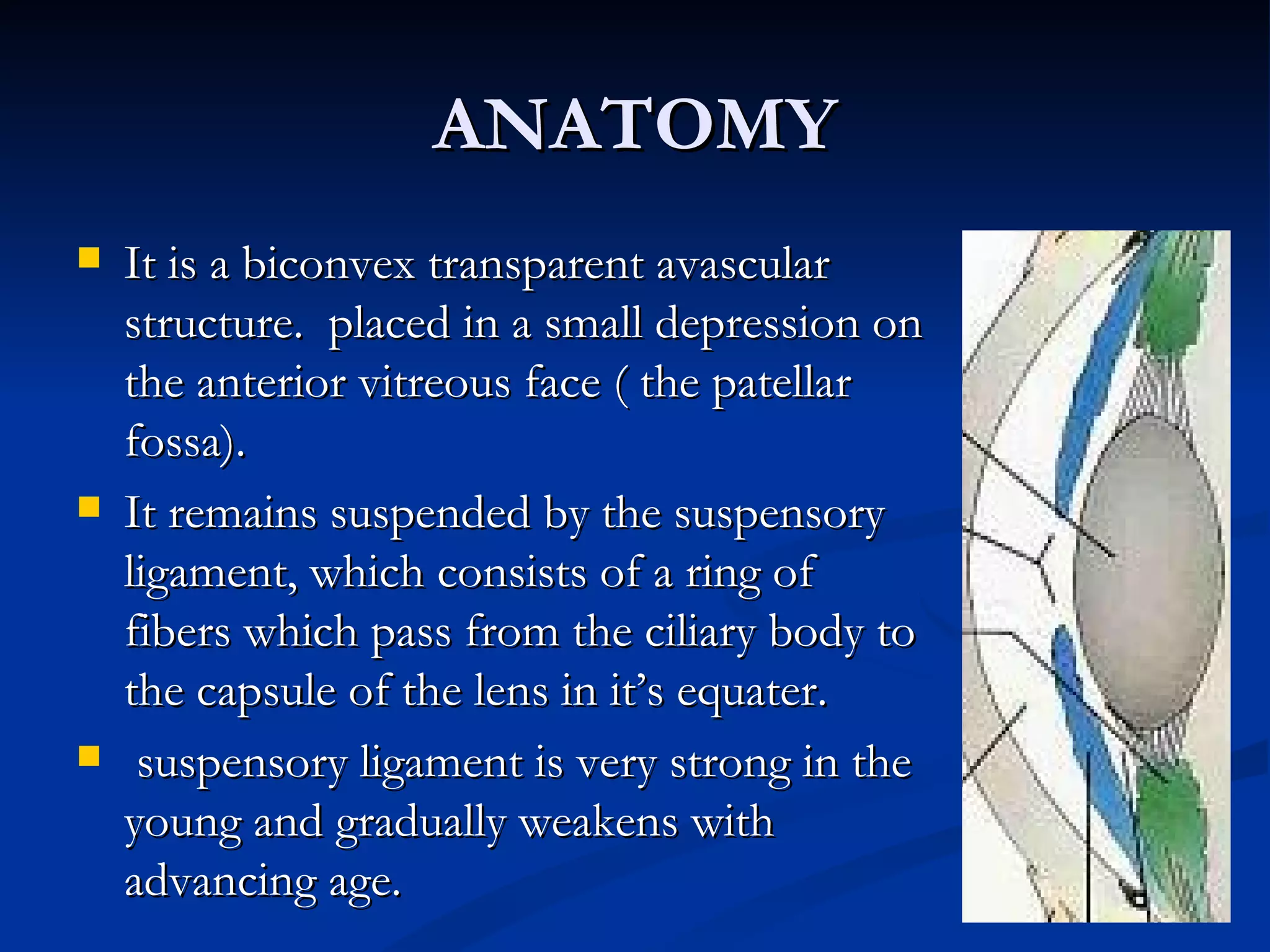
ANATOMY It is a biconvex transparent avascular structure.  placed in a small depression on the anterior vitreous face ( the patellar fossa).  It remains suspended by the suspensory ligament, which consists of a ring of  fibers which pass from the ciliary body to the   capsule of the lens in it’s equater.  suspensory ligament is very strong in the young and gradually weakens with advancing age.
Structure of the lens : is enveloped by an elastic capsule, which is thinnest at the nodal point  posteriorly. Anteriorly, the capsule is lined by a single layer of cubical epithelium which gives rise to new lens fibers at the equatores. The lens mass consists of: 1)  Peripheral cortex Central nucleus The lens grows by proliferation of the peripheral cells ,. The cortex consists of the youngest cell and the nucleus   of the oldest cells, The old cells, however cannot be cast off but undergo changes  leading to  lental sclerosis N N C
Diseases of   the   lens   : Cataract : Any opacity of the lens or its capsule whether developmental or acquired is called cataract. To find out  cataract:  distant direct ophthalmoscopy , when the patient's pupil is dilated. The examiner sits 22 to 25 cm in front of the patient and reflects light into his pupil. Normally a red glow is seen. In cases of cataract a black opacity is seen against a red background.
Parallax when the patient looks up or down, the lenticular opacity may remain stationary (when involving the anterior capsule) or  may  move in the opposite direction to the movement of the eyeball  That is why always the moon  goes with us = with movement... شاخةكان لةطةلَمان ديَن  ( دوَستمانن ) Near things = against movement
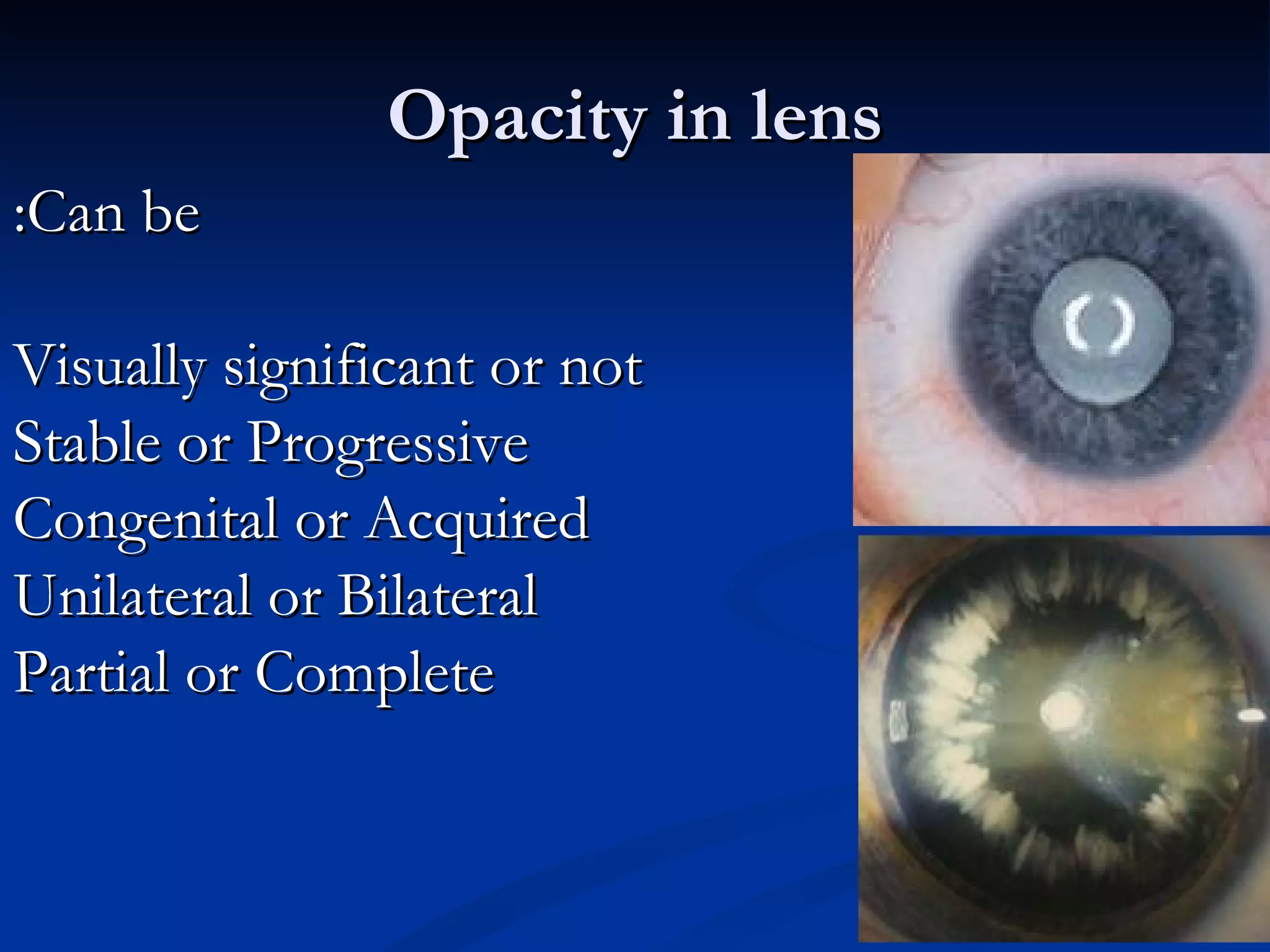
Opacity in lens Can be: Visually significant or not Stable or Progressive Congenital or Acquired Unilateral or Bilateral Partial or Complete
B)  Acquired cataract : Senile cataract Traumatic cataract  :  Blunt :  Sharp Complicated cataract ( due to  ocular diseases)  :  Chronic anterior uveitis :  High myopia :  Fundus dystrophies eg Retinitis pigmentosa Secondary cataract  ( due to  systemic diseases ) : diabetic cataract  :myotonic dystrophy :atopic dermatitis  Toxic  : due to drugs  :  Corticosteroids :  Chlorpromazine physica l  :Irradiation cataract (exposure to deep X-ray) : Electric cataract:
Anatomical classification of cataract  1.  Sub capsular Anterior Posterior 2.  Nuclear 3.  Cortical 4.  Christmas tree
Age related cataract Clinical features:  It occurs above 50 years but is not uncommon at a lower age (pre senile cataract).  Males and females are equally affected. In most cases it is bilateral but in one eye more advanced.  It is the most important cause of blindness in the developing countries
Symptoms : 1)  Painless gradual diminution of vision:  due to a)  Lenticular opacity Refractive error induced :  due to the changes in refractive index of lens ;  Cortical cataract    index hypermetropia.  Nuclear cataract    index myopia. , a previously ,ie presbyopic patient may be able to read again without the aid of spectacles. This known as  'second sight' . 2)  Seeing fixed black spots in the field of vision. 3) monocular diplopia or polyopia due to irregular refraction by the lens. Vision steadily diminishes until only light perception (LP) remains in the mature stage of cataract.
painless progressive diminution of vision in old age is not always due to cataract but may be caused by a more serious disease such as  chronic simple glaucoma … Blindness  from cataract is temporary whereas that to glaucoma is permanent.
Signs: cortical or soft cataract:  hydration followed by coagulation of proteins appears primarily in the cortex of the lens. Incipient stage:  Wedge shaped spokes of opacity striae) extend from the periphery of the cortex, to the center. The areas between them are clear. Immature stage:  The process of opacification advanced further.  The lens appears greyish.  Clear lens are still present in the cortex and therefore iris shadow is present Progressive sometimes rapid hydration of the cortical layers may cause swelling of the lens, thus making the AC shallow  ( intumescent cataract )  leading to increase IOP. Mature stage:  Eventually the entire cortex becomes opaque and white. The cataract is said to ripe or mature no iris shadow is seen. The vision is now reduced to HM or PL
COMPARISION Cortical cataract Since the opacity is peripheral vision is good in bright light (when the pupil constricts) and poor in dim light when Pupil dilates. Gives rise to index nypetmetropia Appear greyish in immature  stage and white in mature stage Progress is gradual Nuclear cataract Since the opacity is central vision is good in dim light (when pupil dilates) and poor in bright light (when pupil constricts). Gives rise to index myopia. (second sight) Appears brown or even black due to deposition of melanin. Progress is very slow and takes a long time to mature
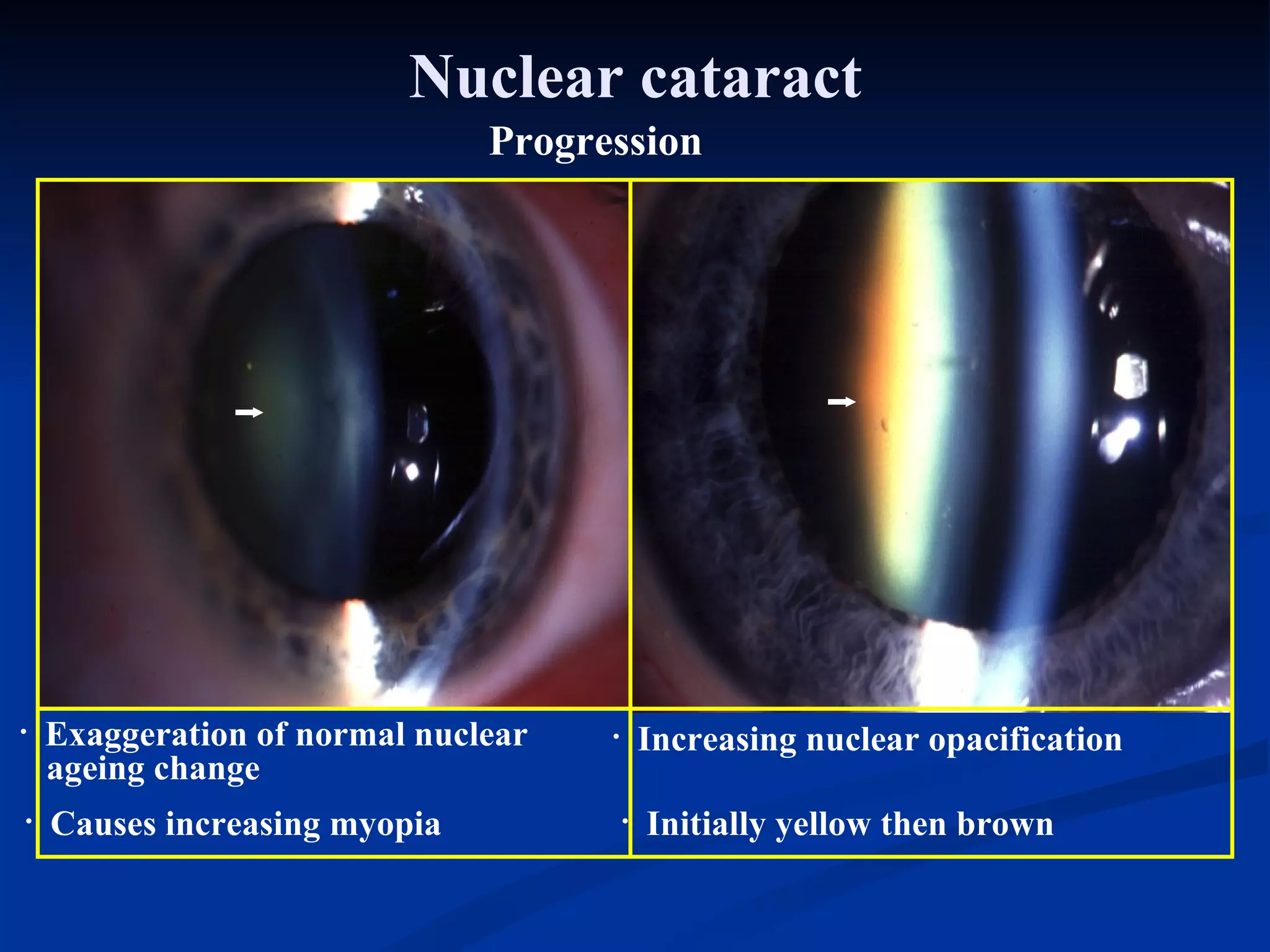
Nuclear cataract Exaggeration of normal nuclear ageing change Causes increasing myopia Increasing nuclear opacification Initially yellow then brown Progression
Cortical cataract Initially vacuoles and clefts Progressive radial spoke-like opacities Progression
Subcapsular cataract Anterior Posterior
Christmas tree cataract Polychromatic, needle-like opacities May co-exist with other opacities
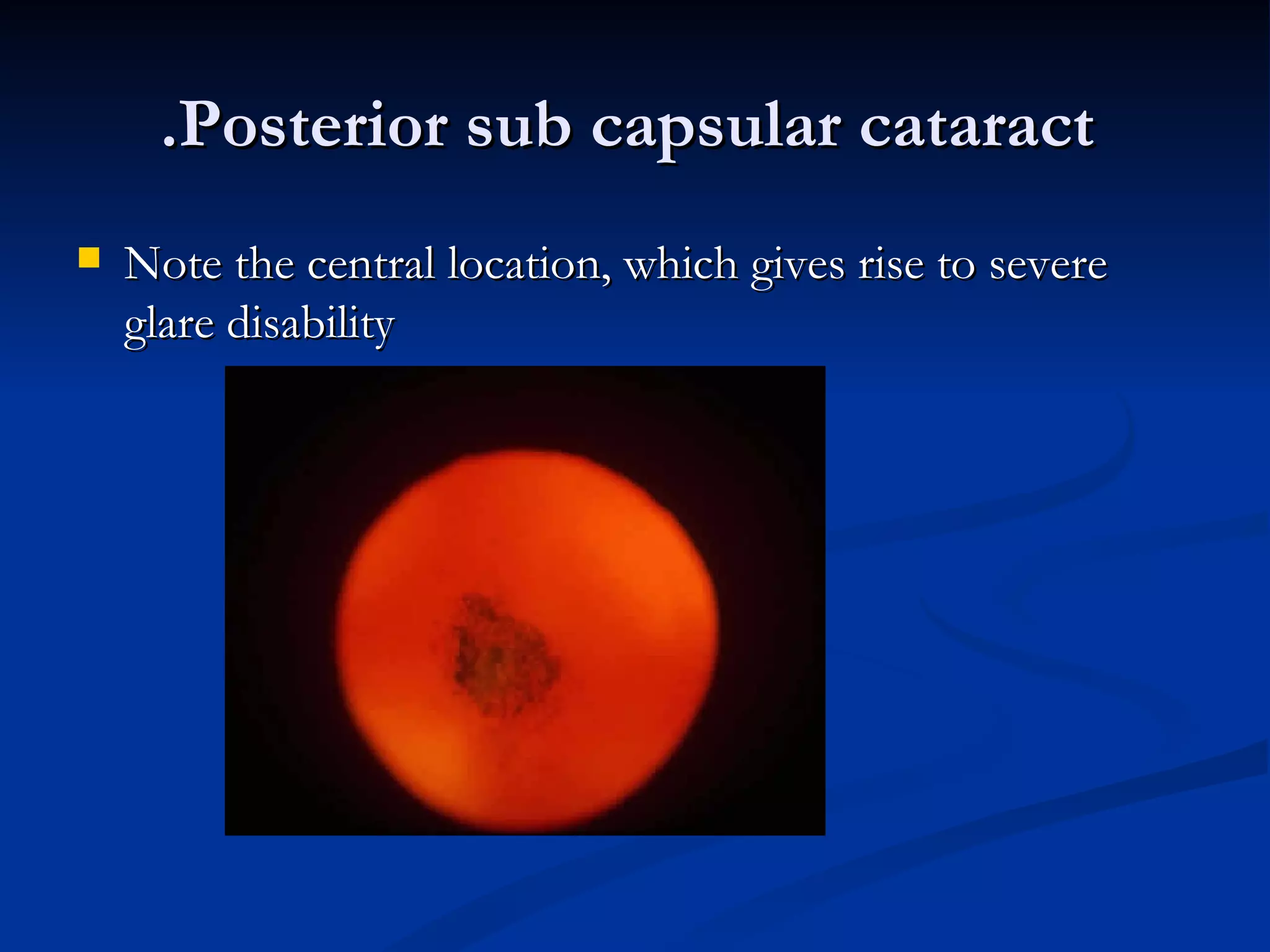
Posterior sub capsular cataract. Note the central location, which gives rise to severe glare disability
COMPARISION Immature cataract 1.  Vision reduced to varying degree. 2.  Iris shadow is seen 3.  Appears greyish 4.  Distant direct ophthalmoscopy red fundal glow present but interrupted by black opacities. Mature cataract Vision reduced to   hand movements close to face or to perception of light(HM or PL) Iris shadow is not seen. Apears white. no red fundal glow seen
Classification according to maturity Immature Mature Hypermature Morgagnian
Complications of hypermature cataract: 1 )  Secondary glaucoma   : phakomorphic glaucoma  : The swollen Morgagnian cataract may cause a pupillary block and give rise to glaucoma Phakolytic glaucoma: The lens matter might leak out into the AC. Here it gets engulfed by macrophages which then go and block the trabecular meshwork. 2)  Uveitis ; Phakoanaphylactic uveitis: The lens matter leaks out and sensitises the uveal tissue. phakoanaphylactic uveitis occurs. 3)  Subluxation   and dislocation  of  lens  :  Along  with  the hyper maturity , there is associated degeneration of the zonules. This may give rise to subluxation and dislocation of lens. 4)  Rapture of lens:   A swollen Morgagnian cataract may burst releasing milky fluid into the AC. This will produce glaucoma and uveitis. Therefore lens extraction should be done in the immature or mature stage not only to improve vision but to prevent complications of hypermature cataract.
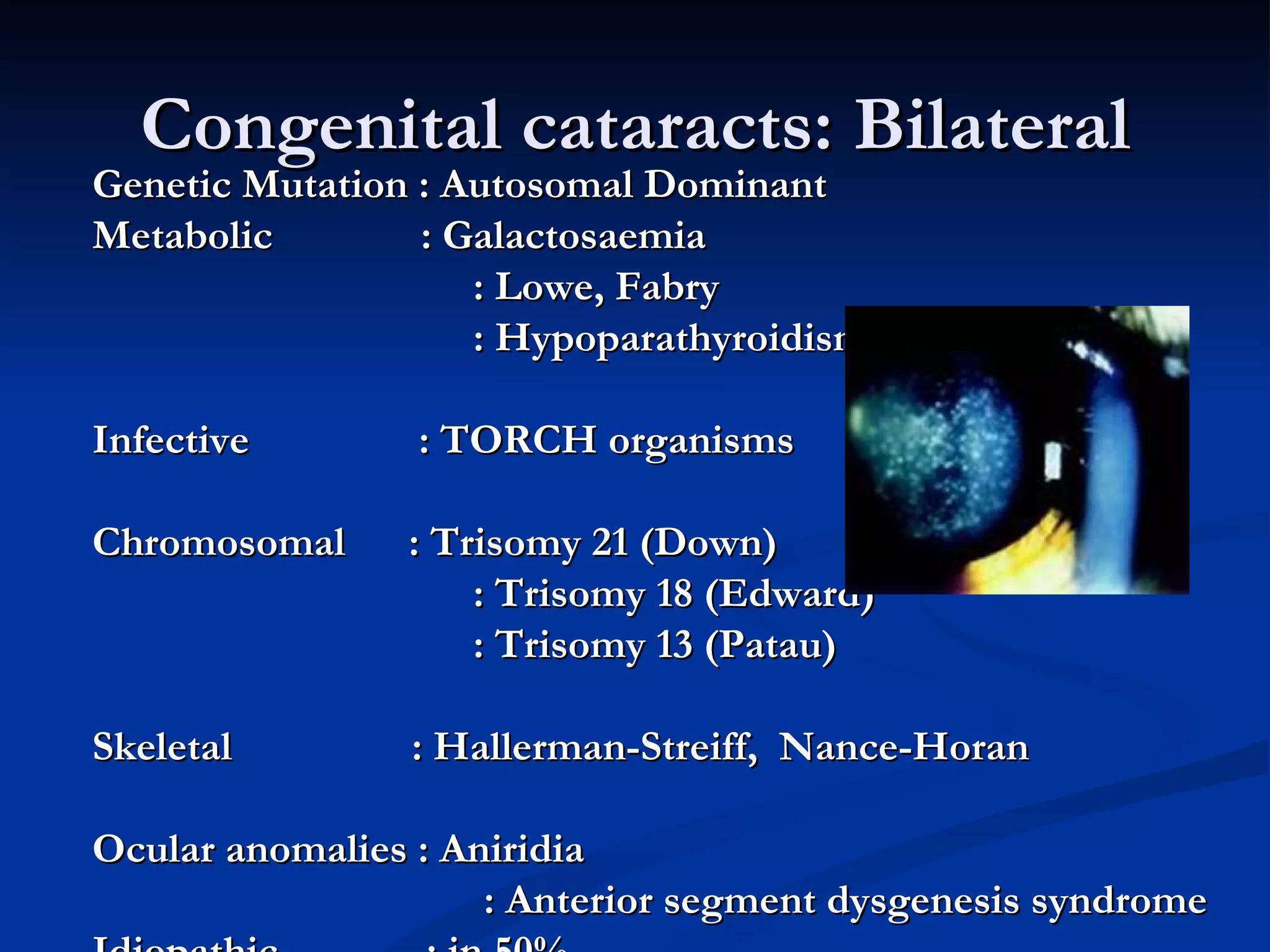
Congenital cataracts: Bilateral Genetic Mutation : Autosomal Dominant  Metabolic  : Galactosaemia  : Lowe, Fabry : Hypoparathyroidism Infective  : TORCH organisms Chromosomal  : Trisomy 21 (Down) : Trisomy 18 (Edward) : Trisomy 13 (Patau)  Skeletal  : Hallerman-Streiff,  Nance-Horan Ocular anomalies : Aniridia : Anterior segment dysgenesis syndrome Idiopathic  : in 50%
Congenital: incidence 3-6/10 000 2/3 rd  of cases are billateral ,  The cause can be identified in 50% of bilateral cases, 10% of unilateral cases 10% of childhood blindness Genetic Mutation  is the most common cause of congenital cataract Congenital cataracts: Unilateral Sporadic, no family history Ocular anomalies : Persistent foetal vasculature
Genetic origin : With a strong hereditary tendency of the dominant type i.e.if one parent suffers; 50% of the children are affected. This is seen in cases of zonular cataract.
Systemic association Many systemic conditions can cause cataract , but vast majority of them are very rare;  the following are more common: Intra  uterine infection(TORCH) as rubella (German measles) : In the mother, particularly if the infection is contracted in the 2nd or 3rd month of pregnancy.  Other congenital anomalies seen in rubella syndrome are microphthalmos, microcephaly, mental retardation …
3.Malnutrition  at   some stage of late intrauterine or early infantile life. Lack of Vit. D is apparently a potent factor and other evidence of rickets are seen in bones & teeth. 4)   Hypoparathyroidism  (tetany) of intrauterine life 5)   Galactosaemia d ue to deficiency of the enzyme galactose I phosphate uridyl transferase 6)Anoxia  of lens owing to placental haemorrhage.
Congenital (developmental) cataract:- Morphology 1)  Lamellar or zonular cataract 2)  Blue dot cataract 3)  Coronary cataract 4)  Anterior capsular or polar cataract 5)  Posterior capsular cataract. 6)  Sutural cataract 7)  Coralliform cataract 8)  Flori - form cataract 9)  Total cataract 10)  Membranous cataract
Morphology : Examples
Congenital or developmental: Cataracts may be present at birth or may form during infancy or adolescence.  they are developmental and this term rather than congenital should be used, since in the growth of the lens fibres the moment of birth is only an incident. The lens is formed in layers, the central nucleus being the earliest formation, around which concentric zones are subsequently laid down. has a tendency to affect the particular zone which was being formed when the process was disturbed by the offending agent. This type of opacity of the lens is stationary.
Symptoms: 1)   Diminished vision 2)  Mother might complain of 'white opacity' in child's eye. 3)  Squint or Nystagmus. Types : Lamellar or zonular cataract  :   is the commonest form of developmental  cataract , accounts  40%  of  all developmental cataracts.  The opacity is usually sharply demarcated and the area of lens within and around the opaque zone is clear. On dilating the pupil - a central disc shaped opacity surrounded by clear cortex is seen. Sometimes linear opacities like the spokes of a wheel  riders may radiate towards the periphery from the opaque area. It is usually bilateral. 2)   Blue dot cataract  :  multiple small opaque dots  scattered all over the lens, appearing as tiny blue dots by oblique illumination with slit lamp, they are known as blue dot cataract. 3)   Coronary cataract  :  club shaped opacities are arranged in the form of a crown in the peripheral part of the cortex.
4)   Anterior capsular or polar cataract  : It develops as a result of delayed formation of the anterior chamber during the development of lens. A white plaque is formed in the anterior lens capsule in the pupillary area. Sometimes this opacity may project into the anterior chamber in the form of a pyramid - anterior pyramidal cataract  More commonly anterior capsular cataract is acquired and follows contact of the lens capsule with the cornea, usually after the perforation of the corneal ulcer 5)  Posterior capsular cataract:   This is due to persistence of the posterior part of the vascular sheath of the lens. 6)  Sutural cataract  : tiny opaque dots crowded in the Y sutures of the lens are seen. 7 )  Coralliform cataract  : there are opacities arranged in the central area of the lens in the form of a coral. 8)  Floriform cataract  : The opacities are arranged like the petals of a flower in the central part of the lens. 9 )  Total cataract  : The whole lens is opaque. 10)  Membranous cataract:  Results from spontaneous absorption of lens matter.
Evaluation Screen newborns with red reflex test History : Family Maternal infections Examination: systemic diseases or  syndromes Workup: Bilateral cases without known hereditary basis TORCH screen s-glucose s-calcium, phosphate Urine: reducing substances  (galactosaemia) amino acids ( Lowe syndrome) haematuria (Alport syndrome)
The visually significant cataract In central visual axis, bigger than 3mm Posterior cataract No clear zones in between Retinal details not visible with direct ophthalmoscope Nystagmus or strabismus present Poor central fixation after 8 weeks
 
MANAGEMENT OF DEVELOPMENTAL CATARACT : Surgery: Cataract extraction for visually significant cataract Bilateral cases: 1 week apart Non visually significant cases : careful observation, possible pupillary dilation: I.  Medical Treatment 1)  Prescription of glasses if necessary 2)  Mydriasis : This is particularly useful in cases where there is a central dense opacity with a relatively clear periphery. a)  10% phenylephrine 3 or 4 times a day. With this accommodation is retained. b)  1% atropine or 1% tropicamide drops in younger children. 3) Magnifying lens can be used for near vision. II  Optical iridectomy : To avoid the constant photophobia due to mydriasis an optical iridectomy may be performed. III. Surgery on lens : should not be performed if the vision is 6/12 or even 6/18. This vision with retained accommodation is to be preferred to probably improved vision after operation without accommodation.
Considerations regarding surgery Intraocular lens : Power of lens – Myopic shift of the  growing eye Postoperative intraocular inflammation (uveitis) Glaucoma and retinal detachment may develop
Postoperative considerations Clear vision for distance and near  Intraocular lens: regular refraction Spectacles Contact lenses Treatment of amblyopia : Occlusion therapy
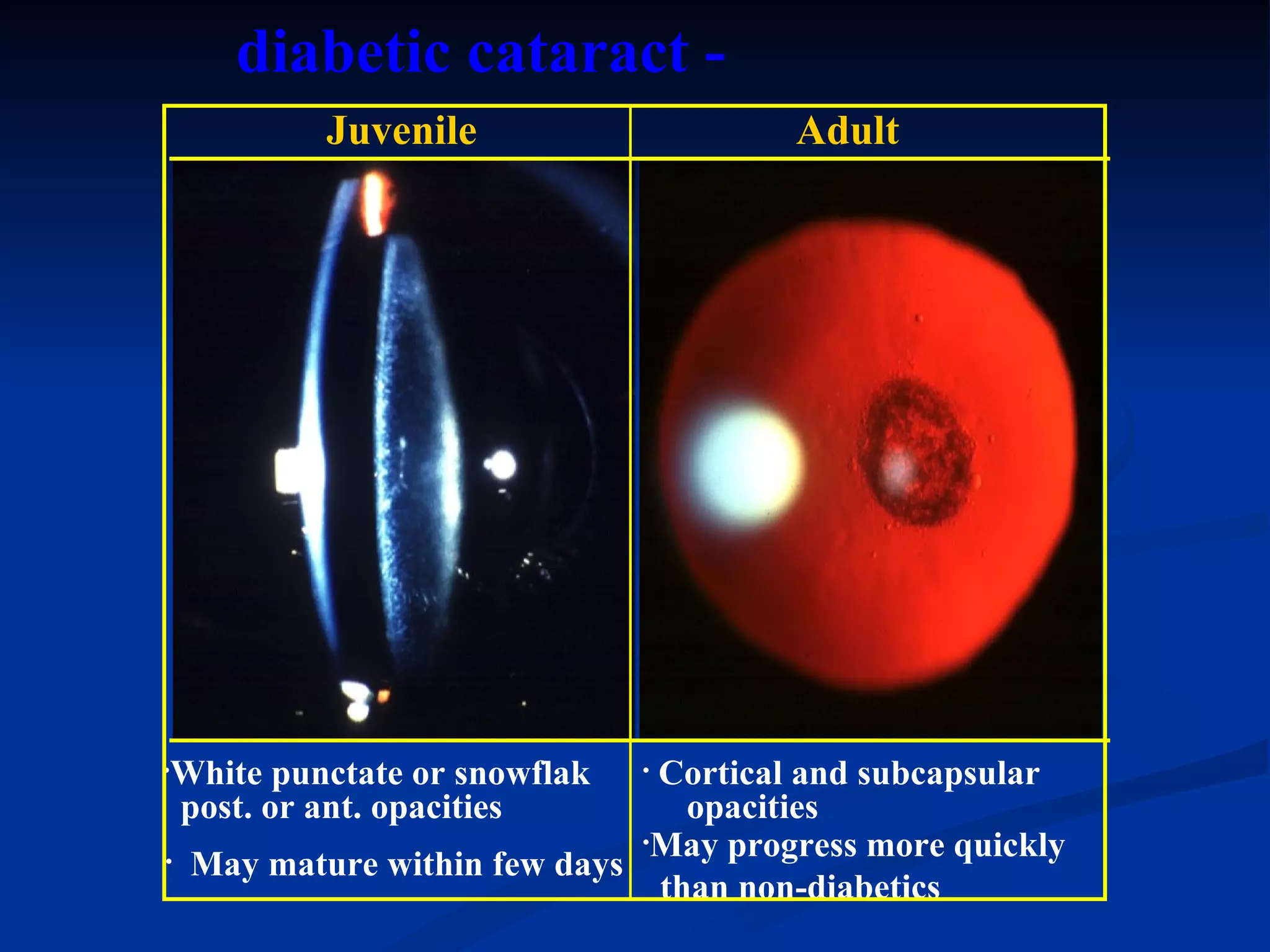
METABOLIC CATARACT:  Diabetes mellitus : In diabetic subjects senile cataract tends to develop at an earlier age. True diabetic cataract occurs in young people due to osmotic influences. A large number of fluid vacuoles appear under the anterior & posterior parts of the capsule, producing a diffuse opacity which at this stage is reversible. Thereafter a cloud of opacities resembling snow flakes appear all over the cortex. The entire lens becomes completely opaque very soon.
diabetic cataract - Juvenile White punctate or snowflak post. or ant. opacities May mature within few days Adult Cortical and subcapsular opacities May progress more quickly  than non-diabetics
TRAUMATIC CATARACT Mechanical : a)  Concussion or blunt injury: It is due partly to the mechanical effects of the injury on the lens fibres and the entrance of the aqueous into the lens due to damage of the capsule (impairment of  semipermeability or actual tear). b)  Perforating injury Types of traumatic cataract: 1)  Punctate opacities in the cortex 2)  Rosette - shaped cataract: It is usually seen in the posterior cortex, sometimes in the anterior. The star shaped cortical sutures are delineated and from them radiate feathery lines of opacities. It may remain stationary or it may progress until the entire lens becomes opaque. 3) Total cataract: It develops when the lens capsule is severely damaged.  The whole of the lens becomes opaque.
Causes of traumatic cataract Penetration Concussion  ‘ Vossius’ ring from imprinting of iris pigment Flower-shaped Ionizing radiation Electric shock Lightning Other causes
Other causes: - myotonic dystrophy Myotonic facies Frontal balding 90% of patients after age 20 years Stellate posterior subcapsular  No visual problem until age 40 years
Other causes: - atopic dermatitis Cataract develops in 10%  of cases between 15-30 years Bilateral in 70%  Frequently becomes mature Anterior subcapsular plaque (shield cataract) Wrinkles in anterior capsule
Complicated Cataract: Definition : This results from a disturbance of the nutrition of the lens & action of toxins. It accompanies or follows other diseases of the eye which may be inflammatory, degenerative, neoplastic etc  Causes : 1)  Iridocyclitis 2)  Choroiditis 3)  Pathological myopia 4)  Retinids pigmentosa 5)  Retinal detachment 6)  Severe form of corneal ulcer 7)  Glaucoma 8)  Intraocular tumours - melanoma of choroid. 9) Scleritis:
Complicated Cataract:   Clinical features  Symptoms : Even in the early stages vision is usually much impaired owing to the position of the opacity at the nodal point. Signs : The opacification usually commences in the center of the posterior part of lens  (posterior cortical cataract).  This part of the lens being most actively metabolic is most vulnerable to disturbance of nutrition. In addition the ant. capsule has sub-capsular epithelium  to prevent entry of toxins. With the slit lamp the opacity is seen to have irregular borders extending diffusely towards the equator and the nucleus bread crumb appearance) and a characteristic rainbow display of colours often replaces the normal achromatic sheen polychromatic luster) progress: 1) Such a cataract may remain stationary indefinitely, in other cases it spreads to involve the whole cortex.
complicated cataract Chronic anterior uveitis High myopia Posterior subcapsular Hereditary fundus dystrophies Central, anterior subcapsular opacities Glaukomflecken Follows acute angle-closure  glaucoma
Treatment: Lens extraction is to be done under the cover of systemic steroids when the eye has been  free from active   inflammation for 6 months to 1 year. 1)  Intracapsular  cat. extraction (ICCE)  :  This  was  the  definite-indication earlier on the grounds that retained lens matter following extracapsular extraction induces recurrent iridocyclitis and thick after cataract. 2)  Extracapsular  cat. extraction (ECCE)  :  Modern ECCE surgery has been perfected to such a degree that the results in cases of uveitis compare with that of ICCE. The intact posterior capsule guards against vitreous loss and  provides a support for introduction of a posterior chamber IOL. There is also a lesser chance of developing cystoid macular oedema in the presence of an intact posterior capsule.
Drugs Chlorpromazine Long-acting miotics Other drugs Amiodarone Busulphan - initially posterior subcapsular Systemic or topical steroids - central, anterior capsular granules
Extracapsular cataract extraction 1. Anterior  capsulotomy 2. Completion of incision 3. Expression of  nucleus 4. Cortical cleanup 6. Polishing of posterior capsule, if appropriate 5. Care not to aspirate  posterior capsule accidentally
8. Grasping of IOL and coating with viscoelastic substance Extracapsular cataract extraction ( cont. ) 7. Injection of viscoelastic substance 9. Insertion of inferior haptic and optic 11. Placement of haptics into capsular bag 10. Insertion of superior haptic 12. Dialling of IOL into  horizontal position and not into ciliary sulcus
Phacoemulsification 1. Capsulorrhexis  2. Hydrodissection 3. Sculpting of nucleus 4. Cracking of nucleus 5. Emulsification of  each quadrant 6. Cortical cleanup and insertion of  IOL
Posterior capsular opacification (after cataract or secondary cataract) Posterior capsular opacification (PCO) refers to the opacification of the lens remnants along the posterior capsule occurring after ECCE, phacoemulsification & lensectomy In these operations the posterior and part of the anterior is left behind. In many cases these remnants are fine, forming a thin membrane, which does not affect vision. However in other cases the membrane may be thick causing decrease in vision. symptoms : If the after cataract is thin, vision is not affected.  However, when it is thick vision is diminished even with intraocular lenses, spectacle correction or contact lenses.
Treatment ; Preoperatively the pupil should be well dilated with  mydriatics. 1.  Laser capsulotomy is done using Neodymium YAG (1 YAG) laser. The laser energy is used to create an opening in the after cataract. This avoids the problems associated with intraocular surgery such as infection and can be done as an outpatient procedure 2. pars plana membranectomy is done using VTSC (Vitreo infusion suction  cutter) 3.  Needling or discission : This is done with Ziegler's knife needle or Bowman's needle. A rent is made in the after cataract in the pupillary area. 4.  Capsuloiridectomy is done in cases where the after cataract is associated with an updrawn pupil.
Subluxation and dislocation of lens: The lens is normally placed in a small depression on the anterior vitreous face known as the patellar fossa. It remain suspended by the zonules of Zinn or suspensory ligament. a)  Subluxation : When a few fibers of the suspensory ligament are torn, the lens is said to be subluxated. It still remains in the pupillary area. b)  Dislocation : When all the fibers of the suspensory ligament are torn, the lens is said to be dislocated. It is no longer in the pupillary area. Posterior dislocation  :  When the lens is in the vitreous anterior  dislocation  :  When the lens is in the AC.
Etiology: 1) Congenital - ectopia lentis - It is usually bilateral a)  Marfans's syndrome : mesodermal dystrophy i)  The lens is displaced superotemporally ii) Arachnodactyly of hands and feet long fingers and toes iii) High arched palate iv) Span of arms is more than the height; tall individual, v) Congenital anomalies of CVS - dissecting aneurysm b)  Marchesani syndrome : Mesodermal dystrophy. It is the opposite of Marfan's syndrome. i)  Ectopia lentis ii) Short stubby fingers and toes iii) Short individual  iv) Excess of subcutaneous tissue c)Homocystinuria
2-Traumatic -  Concussion injury 3)  Spontaneous a)  Buphthalmos b)  Hypermature cataract c)  Sudden perforation of corneal ulcer
ectopia lentis Symptoms : In subluxation when the lens is clear. a)  Defective vision due to curvature myopia (due to tear of some fibres of suspensory ligament the lens becomes spherical) and astigmatism (due to tilting of lens) b)  Uniocular diplopia : There are 2 different images of the same object formed on the retina, one through the aphakic part and one through the phakic part of the pupil. Signs: 1)  In subluxation: a)  Iridodonesis (tremulousness of iris) and phakodonesis (tremulousness of lens)  on movement of eyeball side to side b)  Unequal depth of AC in different parts. 2)  In dislocation a)  In anterior dislocation - the lens is seen in AC. b)  In posterior dislocation there are signs of aphakia (deep AC, jet  black pupil, iridodonesis,) and the lens is seen in the vitreous.
Complications: 1)  Secondary glaucoma 2)  Uveitis Treatment: 1)  Subluxated lens - concave  or convex lenses may be tried to improve vision. The lens may be removed with cryoprobe or with wire vectis. 2)  Dislocated lens: Anterior dislocation - lens may be removed with cryoprobe or with wire vectis. Posterior dislocation  of  lens.  Vision may be  improved with aphakic glasses. Lens may be removed with wire vectis
Dislocation of the Lens (Ectopia Lentis)  Ectopia lentis. Lens in anterior chamber.
Thank you
Thank you

ophthalmology.Diseases of the lens.(dr.baxtyar)

  • 1.
    Diseases of the crystalline lens By Dr. Bakhtiar Q. Hamasalh Jaf M.B.Ch.B , M.D-OPHTHALMOLOGY University of Suleimani-college of medicine
  • 2.
  • 3.
    ANATOMY It isa biconvex transparent avascular structure. placed in a small depression on the anterior vitreous face ( the patellar fossa). It remains suspended by the suspensory ligament, which consists of a ring of fibers which pass from the ciliary body to the capsule of the lens in it’s equater. suspensory ligament is very strong in the young and gradually weakens with advancing age.
  • 4.
    Structure of thelens : is enveloped by an elastic capsule, which is thinnest at the nodal point posteriorly. Anteriorly, the capsule is lined by a single layer of cubical epithelium which gives rise to new lens fibers at the equatores. The lens mass consists of: 1) Peripheral cortex Central nucleus The lens grows by proliferation of the peripheral cells ,. The cortex consists of the youngest cell and the nucleus of the oldest cells, The old cells, however cannot be cast off but undergo changes leading to lental sclerosis N N C
  • 5.
    Diseases of the lens : Cataract : Any opacity of the lens or its capsule whether developmental or acquired is called cataract. To find out cataract: distant direct ophthalmoscopy , when the patient's pupil is dilated. The examiner sits 22 to 25 cm in front of the patient and reflects light into his pupil. Normally a red glow is seen. In cases of cataract a black opacity is seen against a red background.
  • 6.
    Parallax when thepatient looks up or down, the lenticular opacity may remain stationary (when involving the anterior capsule) or may move in the opposite direction to the movement of the eyeball That is why always the moon goes with us = with movement... شاخةكان لةطةلَمان ديَن ( دوَستمانن ) Near things = against movement
  • 7.
    Opacity in lensCan be: Visually significant or not Stable or Progressive Congenital or Acquired Unilateral or Bilateral Partial or Complete
  • 8.
    B) Acquiredcataract : Senile cataract Traumatic cataract : Blunt : Sharp Complicated cataract ( due to ocular diseases) : Chronic anterior uveitis : High myopia : Fundus dystrophies eg Retinitis pigmentosa Secondary cataract ( due to systemic diseases ) : diabetic cataract :myotonic dystrophy :atopic dermatitis Toxic : due to drugs : Corticosteroids : Chlorpromazine physica l :Irradiation cataract (exposure to deep X-ray) : Electric cataract:
  • 9.
    Anatomical classification ofcataract 1. Sub capsular Anterior Posterior 2. Nuclear 3. Cortical 4. Christmas tree
  • 10.
    Age related cataractClinical features: It occurs above 50 years but is not uncommon at a lower age (pre senile cataract). Males and females are equally affected. In most cases it is bilateral but in one eye more advanced. It is the most important cause of blindness in the developing countries
  • 11.
    Symptoms : 1) Painless gradual diminution of vision: due to a) Lenticular opacity Refractive error induced : due to the changes in refractive index of lens ; Cortical cataract  index hypermetropia. Nuclear cataract  index myopia. , a previously ,ie presbyopic patient may be able to read again without the aid of spectacles. This known as 'second sight' . 2) Seeing fixed black spots in the field of vision. 3) monocular diplopia or polyopia due to irregular refraction by the lens. Vision steadily diminishes until only light perception (LP) remains in the mature stage of cataract.
  • 12.
    painless progressive diminutionof vision in old age is not always due to cataract but may be caused by a more serious disease such as chronic simple glaucoma … Blindness from cataract is temporary whereas that to glaucoma is permanent.
  • 13.
    Signs: cortical orsoft cataract: hydration followed by coagulation of proteins appears primarily in the cortex of the lens. Incipient stage: Wedge shaped spokes of opacity striae) extend from the periphery of the cortex, to the center. The areas between them are clear. Immature stage: The process of opacification advanced further. The lens appears greyish. Clear lens are still present in the cortex and therefore iris shadow is present Progressive sometimes rapid hydration of the cortical layers may cause swelling of the lens, thus making the AC shallow ( intumescent cataract ) leading to increase IOP. Mature stage: Eventually the entire cortex becomes opaque and white. The cataract is said to ripe or mature no iris shadow is seen. The vision is now reduced to HM or PL
  • 14.
    COMPARISION Cortical cataractSince the opacity is peripheral vision is good in bright light (when the pupil constricts) and poor in dim light when Pupil dilates. Gives rise to index nypetmetropia Appear greyish in immature stage and white in mature stage Progress is gradual Nuclear cataract Since the opacity is central vision is good in dim light (when pupil dilates) and poor in bright light (when pupil constricts). Gives rise to index myopia. (second sight) Appears brown or even black due to deposition of melanin. Progress is very slow and takes a long time to mature
  • 15.
    Nuclear cataract Exaggerationof normal nuclear ageing change Causes increasing myopia Increasing nuclear opacification Initially yellow then brown Progression
  • 16.
    Cortical cataract Initiallyvacuoles and clefts Progressive radial spoke-like opacities Progression
  • 17.
  • 18.
    Christmas tree cataractPolychromatic, needle-like opacities May co-exist with other opacities
  • 19.
    Posterior sub capsularcataract. Note the central location, which gives rise to severe glare disability
  • 20.
    COMPARISION Immature cataract1. Vision reduced to varying degree. 2. Iris shadow is seen 3. Appears greyish 4. Distant direct ophthalmoscopy red fundal glow present but interrupted by black opacities. Mature cataract Vision reduced to hand movements close to face or to perception of light(HM or PL) Iris shadow is not seen. Apears white. no red fundal glow seen
  • 21.
    Classification according tomaturity Immature Mature Hypermature Morgagnian
  • 22.
    Complications of hypermaturecataract: 1 ) Secondary glaucoma : phakomorphic glaucoma : The swollen Morgagnian cataract may cause a pupillary block and give rise to glaucoma Phakolytic glaucoma: The lens matter might leak out into the AC. Here it gets engulfed by macrophages which then go and block the trabecular meshwork. 2) Uveitis ; Phakoanaphylactic uveitis: The lens matter leaks out and sensitises the uveal tissue. phakoanaphylactic uveitis occurs. 3) Subluxation and dislocation of lens : Along with the hyper maturity , there is associated degeneration of the zonules. This may give rise to subluxation and dislocation of lens. 4) Rapture of lens: A swollen Morgagnian cataract may burst releasing milky fluid into the AC. This will produce glaucoma and uveitis. Therefore lens extraction should be done in the immature or mature stage not only to improve vision but to prevent complications of hypermature cataract.
  • 23.
    Congenital cataracts: BilateralGenetic Mutation : Autosomal Dominant Metabolic : Galactosaemia : Lowe, Fabry : Hypoparathyroidism Infective : TORCH organisms Chromosomal : Trisomy 21 (Down) : Trisomy 18 (Edward) : Trisomy 13 (Patau) Skeletal : Hallerman-Streiff, Nance-Horan Ocular anomalies : Aniridia : Anterior segment dysgenesis syndrome Idiopathic : in 50%
  • 24.
    Congenital: incidence 3-6/10000 2/3 rd of cases are billateral , The cause can be identified in 50% of bilateral cases, 10% of unilateral cases 10% of childhood blindness Genetic Mutation is the most common cause of congenital cataract Congenital cataracts: Unilateral Sporadic, no family history Ocular anomalies : Persistent foetal vasculature
  • 25.
    Genetic origin :With a strong hereditary tendency of the dominant type i.e.if one parent suffers; 50% of the children are affected. This is seen in cases of zonular cataract.
  • 26.
    Systemic association Manysystemic conditions can cause cataract , but vast majority of them are very rare; the following are more common: Intra uterine infection(TORCH) as rubella (German measles) : In the mother, particularly if the infection is contracted in the 2nd or 3rd month of pregnancy. Other congenital anomalies seen in rubella syndrome are microphthalmos, microcephaly, mental retardation …
  • 27.
    3.Malnutrition at some stage of late intrauterine or early infantile life. Lack of Vit. D is apparently a potent factor and other evidence of rickets are seen in bones & teeth. 4) Hypoparathyroidism (tetany) of intrauterine life 5) Galactosaemia d ue to deficiency of the enzyme galactose I phosphate uridyl transferase 6)Anoxia of lens owing to placental haemorrhage.
  • 28.
    Congenital (developmental) cataract:-Morphology 1) Lamellar or zonular cataract 2) Blue dot cataract 3) Coronary cataract 4) Anterior capsular or polar cataract 5) Posterior capsular cataract. 6) Sutural cataract 7) Coralliform cataract 8) Flori - form cataract 9) Total cataract 10) Membranous cataract
  • 29.
  • 30.
    Congenital or developmental:Cataracts may be present at birth or may form during infancy or adolescence. they are developmental and this term rather than congenital should be used, since in the growth of the lens fibres the moment of birth is only an incident. The lens is formed in layers, the central nucleus being the earliest formation, around which concentric zones are subsequently laid down. has a tendency to affect the particular zone which was being formed when the process was disturbed by the offending agent. This type of opacity of the lens is stationary.
  • 31.
    Symptoms: 1) Diminished vision 2) Mother might complain of 'white opacity' in child's eye. 3) Squint or Nystagmus. Types : Lamellar or zonular cataract : is the commonest form of developmental cataract , accounts 40% of all developmental cataracts. The opacity is usually sharply demarcated and the area of lens within and around the opaque zone is clear. On dilating the pupil - a central disc shaped opacity surrounded by clear cortex is seen. Sometimes linear opacities like the spokes of a wheel riders may radiate towards the periphery from the opaque area. It is usually bilateral. 2) Blue dot cataract : multiple small opaque dots scattered all over the lens, appearing as tiny blue dots by oblique illumination with slit lamp, they are known as blue dot cataract. 3) Coronary cataract : club shaped opacities are arranged in the form of a crown in the peripheral part of the cortex.
  • 32.
    4) Anterior capsular or polar cataract : It develops as a result of delayed formation of the anterior chamber during the development of lens. A white plaque is formed in the anterior lens capsule in the pupillary area. Sometimes this opacity may project into the anterior chamber in the form of a pyramid - anterior pyramidal cataract More commonly anterior capsular cataract is acquired and follows contact of the lens capsule with the cornea, usually after the perforation of the corneal ulcer 5) Posterior capsular cataract: This is due to persistence of the posterior part of the vascular sheath of the lens. 6) Sutural cataract : tiny opaque dots crowded in the Y sutures of the lens are seen. 7 ) Coralliform cataract : there are opacities arranged in the central area of the lens in the form of a coral. 8) Floriform cataract : The opacities are arranged like the petals of a flower in the central part of the lens. 9 ) Total cataract : The whole lens is opaque. 10) Membranous cataract: Results from spontaneous absorption of lens matter.
  • 33.
    Evaluation Screen newbornswith red reflex test History : Family Maternal infections Examination: systemic diseases or syndromes Workup: Bilateral cases without known hereditary basis TORCH screen s-glucose s-calcium, phosphate Urine: reducing substances (galactosaemia) amino acids ( Lowe syndrome) haematuria (Alport syndrome)
  • 34.
    The visually significantcataract In central visual axis, bigger than 3mm Posterior cataract No clear zones in between Retinal details not visible with direct ophthalmoscope Nystagmus or strabismus present Poor central fixation after 8 weeks
  • 35.
  • 36.
    MANAGEMENT OF DEVELOPMENTALCATARACT : Surgery: Cataract extraction for visually significant cataract Bilateral cases: 1 week apart Non visually significant cases : careful observation, possible pupillary dilation: I. Medical Treatment 1) Prescription of glasses if necessary 2) Mydriasis : This is particularly useful in cases where there is a central dense opacity with a relatively clear periphery. a) 10% phenylephrine 3 or 4 times a day. With this accommodation is retained. b) 1% atropine or 1% tropicamide drops in younger children. 3) Magnifying lens can be used for near vision. II Optical iridectomy : To avoid the constant photophobia due to mydriasis an optical iridectomy may be performed. III. Surgery on lens : should not be performed if the vision is 6/12 or even 6/18. This vision with retained accommodation is to be preferred to probably improved vision after operation without accommodation.
  • 37.
    Considerations regarding surgeryIntraocular lens : Power of lens – Myopic shift of the growing eye Postoperative intraocular inflammation (uveitis) Glaucoma and retinal detachment may develop
  • 38.
    Postoperative considerations Clearvision for distance and near Intraocular lens: regular refraction Spectacles Contact lenses Treatment of amblyopia : Occlusion therapy
  • 39.
    METABOLIC CATARACT: Diabetes mellitus : In diabetic subjects senile cataract tends to develop at an earlier age. True diabetic cataract occurs in young people due to osmotic influences. A large number of fluid vacuoles appear under the anterior & posterior parts of the capsule, producing a diffuse opacity which at this stage is reversible. Thereafter a cloud of opacities resembling snow flakes appear all over the cortex. The entire lens becomes completely opaque very soon.
  • 40.
    diabetic cataract -Juvenile White punctate or snowflak post. or ant. opacities May mature within few days Adult Cortical and subcapsular opacities May progress more quickly than non-diabetics
  • 41.
    TRAUMATIC CATARACT Mechanical: a) Concussion or blunt injury: It is due partly to the mechanical effects of the injury on the lens fibres and the entrance of the aqueous into the lens due to damage of the capsule (impairment of semipermeability or actual tear). b) Perforating injury Types of traumatic cataract: 1) Punctate opacities in the cortex 2) Rosette - shaped cataract: It is usually seen in the posterior cortex, sometimes in the anterior. The star shaped cortical sutures are delineated and from them radiate feathery lines of opacities. It may remain stationary or it may progress until the entire lens becomes opaque. 3) Total cataract: It develops when the lens capsule is severely damaged. The whole of the lens becomes opaque.
  • 42.
    Causes of traumaticcataract Penetration Concussion ‘ Vossius’ ring from imprinting of iris pigment Flower-shaped Ionizing radiation Electric shock Lightning Other causes
  • 43.
    Other causes: -myotonic dystrophy Myotonic facies Frontal balding 90% of patients after age 20 years Stellate posterior subcapsular No visual problem until age 40 years
  • 44.
    Other causes: -atopic dermatitis Cataract develops in 10% of cases between 15-30 years Bilateral in 70% Frequently becomes mature Anterior subcapsular plaque (shield cataract) Wrinkles in anterior capsule
  • 45.
    Complicated Cataract: Definition: This results from a disturbance of the nutrition of the lens & action of toxins. It accompanies or follows other diseases of the eye which may be inflammatory, degenerative, neoplastic etc Causes : 1) Iridocyclitis 2) Choroiditis 3) Pathological myopia 4) Retinids pigmentosa 5) Retinal detachment 6) Severe form of corneal ulcer 7) Glaucoma 8) Intraocular tumours - melanoma of choroid. 9) Scleritis:
  • 46.
    Complicated Cataract: Clinical features Symptoms : Even in the early stages vision is usually much impaired owing to the position of the opacity at the nodal point. Signs : The opacification usually commences in the center of the posterior part of lens (posterior cortical cataract). This part of the lens being most actively metabolic is most vulnerable to disturbance of nutrition. In addition the ant. capsule has sub-capsular epithelium to prevent entry of toxins. With the slit lamp the opacity is seen to have irregular borders extending diffusely towards the equator and the nucleus bread crumb appearance) and a characteristic rainbow display of colours often replaces the normal achromatic sheen polychromatic luster) progress: 1) Such a cataract may remain stationary indefinitely, in other cases it spreads to involve the whole cortex.
  • 47.
    complicated cataract Chronicanterior uveitis High myopia Posterior subcapsular Hereditary fundus dystrophies Central, anterior subcapsular opacities Glaukomflecken Follows acute angle-closure glaucoma
  • 48.
    Treatment: Lens extractionis to be done under the cover of systemic steroids when the eye has been free from active inflammation for 6 months to 1 year. 1) Intracapsular cat. extraction (ICCE) : This was the definite-indication earlier on the grounds that retained lens matter following extracapsular extraction induces recurrent iridocyclitis and thick after cataract. 2) Extracapsular cat. extraction (ECCE) : Modern ECCE surgery has been perfected to such a degree that the results in cases of uveitis compare with that of ICCE. The intact posterior capsule guards against vitreous loss and provides a support for introduction of a posterior chamber IOL. There is also a lesser chance of developing cystoid macular oedema in the presence of an intact posterior capsule.
  • 49.
    Drugs Chlorpromazine Long-actingmiotics Other drugs Amiodarone Busulphan - initially posterior subcapsular Systemic or topical steroids - central, anterior capsular granules
  • 50.
    Extracapsular cataract extraction1. Anterior capsulotomy 2. Completion of incision 3. Expression of nucleus 4. Cortical cleanup 6. Polishing of posterior capsule, if appropriate 5. Care not to aspirate posterior capsule accidentally
  • 51.
    8. Grasping ofIOL and coating with viscoelastic substance Extracapsular cataract extraction ( cont. ) 7. Injection of viscoelastic substance 9. Insertion of inferior haptic and optic 11. Placement of haptics into capsular bag 10. Insertion of superior haptic 12. Dialling of IOL into horizontal position and not into ciliary sulcus
  • 52.
    Phacoemulsification 1. Capsulorrhexis 2. Hydrodissection 3. Sculpting of nucleus 4. Cracking of nucleus 5. Emulsification of each quadrant 6. Cortical cleanup and insertion of IOL
  • 53.
    Posterior capsular opacification(after cataract or secondary cataract) Posterior capsular opacification (PCO) refers to the opacification of the lens remnants along the posterior capsule occurring after ECCE, phacoemulsification & lensectomy In these operations the posterior and part of the anterior is left behind. In many cases these remnants are fine, forming a thin membrane, which does not affect vision. However in other cases the membrane may be thick causing decrease in vision. symptoms : If the after cataract is thin, vision is not affected. However, when it is thick vision is diminished even with intraocular lenses, spectacle correction or contact lenses.
  • 54.
    Treatment ; Preoperativelythe pupil should be well dilated with mydriatics. 1. Laser capsulotomy is done using Neodymium YAG (1 YAG) laser. The laser energy is used to create an opening in the after cataract. This avoids the problems associated with intraocular surgery such as infection and can be done as an outpatient procedure 2. pars plana membranectomy is done using VTSC (Vitreo infusion suction cutter) 3. Needling or discission : This is done with Ziegler's knife needle or Bowman's needle. A rent is made in the after cataract in the pupillary area. 4. Capsuloiridectomy is done in cases where the after cataract is associated with an updrawn pupil.
  • 55.
    Subluxation and dislocationof lens: The lens is normally placed in a small depression on the anterior vitreous face known as the patellar fossa. It remain suspended by the zonules of Zinn or suspensory ligament. a) Subluxation : When a few fibers of the suspensory ligament are torn, the lens is said to be subluxated. It still remains in the pupillary area. b) Dislocation : When all the fibers of the suspensory ligament are torn, the lens is said to be dislocated. It is no longer in the pupillary area. Posterior dislocation : When the lens is in the vitreous anterior dislocation : When the lens is in the AC.
  • 56.
    Etiology: 1) Congenital- ectopia lentis - It is usually bilateral a) Marfans's syndrome : mesodermal dystrophy i) The lens is displaced superotemporally ii) Arachnodactyly of hands and feet long fingers and toes iii) High arched palate iv) Span of arms is more than the height; tall individual, v) Congenital anomalies of CVS - dissecting aneurysm b) Marchesani syndrome : Mesodermal dystrophy. It is the opposite of Marfan's syndrome. i) Ectopia lentis ii) Short stubby fingers and toes iii) Short individual iv) Excess of subcutaneous tissue c)Homocystinuria
  • 57.
    2-Traumatic - Concussion injury 3) Spontaneous a) Buphthalmos b) Hypermature cataract c) Sudden perforation of corneal ulcer
  • 58.
    ectopia lentis Symptoms: In subluxation when the lens is clear. a) Defective vision due to curvature myopia (due to tear of some fibres of suspensory ligament the lens becomes spherical) and astigmatism (due to tilting of lens) b) Uniocular diplopia : There are 2 different images of the same object formed on the retina, one through the aphakic part and one through the phakic part of the pupil. Signs: 1) In subluxation: a) Iridodonesis (tremulousness of iris) and phakodonesis (tremulousness of lens) on movement of eyeball side to side b) Unequal depth of AC in different parts. 2) In dislocation a) In anterior dislocation - the lens is seen in AC. b) In posterior dislocation there are signs of aphakia (deep AC, jet black pupil, iridodonesis,) and the lens is seen in the vitreous.
  • 59.
    Complications: 1) Secondary glaucoma 2) Uveitis Treatment: 1) Subluxated lens - concave or convex lenses may be tried to improve vision. The lens may be removed with cryoprobe or with wire vectis. 2) Dislocated lens: Anterior dislocation - lens may be removed with cryoprobe or with wire vectis. Posterior dislocation of lens. Vision may be improved with aphakic glasses. Lens may be removed with wire vectis
  • 60.
    Dislocation of theLens (Ectopia Lentis) Ectopia lentis. Lens in anterior chamber.
  • 61.
  • 62.