CATARACTS Lena G. Park, OD Park Family Eye Care North Aurora, IL www.parkfamilyeyecare.com
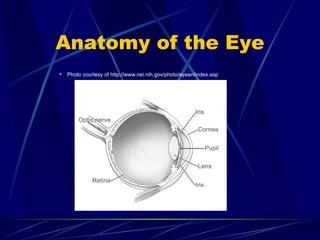
Anatomy of the Eye Photo courtesy of http://www.nei.nih.gov/photo/eyean/index.asp
What is a Cataract? A cataract is a clouding of the lens of the eye.  The lens is located behind the pupil and is the part that is responsible for focusing light onto the retina. Cataracts may be attributed to such factors as old age, ultraviolet light, cigarette smoking, alcohol, and corticosteroid medications. About 50% of Americans age 65 or older have cataracts or have already had cataract surgery.
Types of Cataracts Age Related  Due to protein clusters in the lens which cause the cloudiness Discoloration as a result of age Secondary  Glaucoma  Diabetic retinopathy Traumatic Occurs after eye injury Congenital Present after birth due to birth defects, diseases, or other cause Radiation After prolonged exposure to radiation
Symptoms Gradually decreasing vision Glare at night from approaching car headlights Bright colors may appear more dull Frequently changing glasses/contact lens prescription Double vision
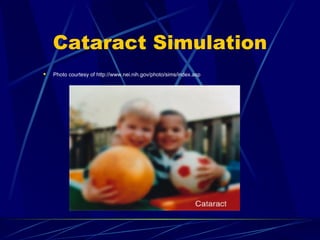
Cataract Simulation Photo courtesy of http://www.nei.nih.gov/photo/sims/index.asp
Diagnosis & Treatment Detailed medical history  Dilated examination Eyeglasses may help to improve vision in mild cases of cataracts  When the lens of the eye becomes too cloudy to see any sharp images and the poor vision starts to interfere with performing daily activities, cataract surgery may be considered
Cataract Surgery Very safe & successful procedure The operation usually lasts less than 1 hour and is an outpatient procedure If the patient has cataracts in both eyes, only one cataract is removed at a time.  The second surgery takes place after enough healing time has been allowed for the first procedure
Cataract Surgery Local anesthesia is generally used Doctor makes a small incision in the cornea and removes the lens 2 methods of cataract removal Phacoemulsification :  tiny probe inserted on side of cornea which breaks the lens and sucks the contents out Extracapsular surgery :  longer incision made on side of cornea and hard center of lens is removed in one piece.  The remainder of lens is removed by suction
Cataract Surgery The lens that is removed is replaced with a lens implant (intraocular lens).  Generally the implants are chosen to match close to the patient’s current prescription and so only a minimal distance prescription along with the reading prescription is needed
Post Cataract Surgery Eye that received surgery is patched and patient can go home that same day Eye drops are prescribed following the procedure to reduce risk of infection and control any inflammation of the eye It may take up to 6 weeks until the eye is fully healed.  Medications must be taken during this time as prescribed
Risks and complications Risks and complications may occur as with any surgical procedure but are very rare Infection Problems with use of anesthesia Bleeding & inflammation of the eye, thus leading to decreased vision Eventually (usually years following surgery) the capsule which supports the lens implant may become cloudy.  If the cloudiness is greatly interfering with the patient’s vision, a laser procedure may be done to improve the clarity of vision
Types of Intraocular Implants Conventional IOLs Accommodating/Presbyopia-Correcting IOLs AcrySof ReSTOR ReZoom Crystalens
Conventional IOL Monofocal-offer vision at one distance only such as far (Must wear contact lenses or spectacle lenses in order to read or use a computer)
Accommodating IOLs Enable the patient to see at more than one distance without glasses (far & near)
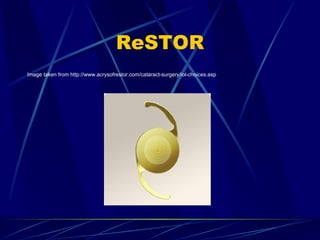
ReSTOR Image taken from http://www.acrysofrestor.com/cataract-surgery/iol-choices.asp
ReSTOR Apodized diffractive technology -responds to size of pupil to provide near, intermediate, and distance vision Image quality is improved while minimizing visual disturbances (nighttime glare & halos) Controls diameter of diffractive lens to work with the pupil Apodization - gradual decrease in step heights from the center to the periphery which helps to create a smoother transition of light when focusing between different distances Provides +4.00 add to separate near and distance images
Alcon clinical study 80% of ACRYSOF RESTOR IOL patients reported never needing to wear glasses for any type of activity Four out of five patients with the AcrySof® ReSTOR® IOL reported never wearing glasses following cataract surgery in both eyes, compared to only 1 out of 10 patients with monofocal lenses Average binocular uncorrected distance visual acuity was 20/20  and 20/25 for near 85% ReSTOR IOL vs 67% monofocal IOL achieved 20/40 or better binocular uncorrected intermediate vision
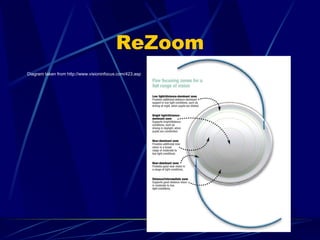
ReZoom Diagram taken from http://www.visioninfocus.com/423.asp
ReZoom Multifocal refractive IOL Balanced View Optics™ Technology :  creates multiple focal points so you can see well at a variety of distances Each multifocal lens is divided into 5 different zones, and each zone is designated for different light and focal distances (ex.  Some zones have greater low light and distance vision to aid with night driving)
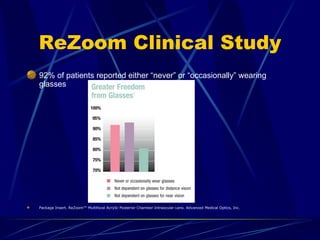
ReZoom Clinical Study 92% of patients reported either “never” or “occasionally” wearing glasses Package Insert. ReZoom™ Multifocal Acrylic Posterior Chamber Intraocular Lens. Advanced Medical Optics, Inc.
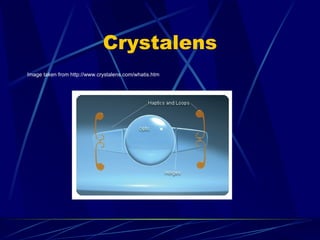
Crystalens Image taken from http://www.crystalens.com/whatis.htm
Crystalens Uses the natural focusing ability of the eye by moving the lens implant  in response to flexing of the same muscles that move the crystalline lens for accommodation, which may also be termed  pseudoaccommodation .  This is different from traditional IOLs which are fixed or stationary in the eye Provides a single focal point throughout a continuous range of vision from near to far Is made up of a hinge which allows the lens implant to move back and forth as you change focus on images that are near and far away from you Two and three year follow up data indicates that the pseudoaccommodation of the Crystalens does not significantly diminish with time
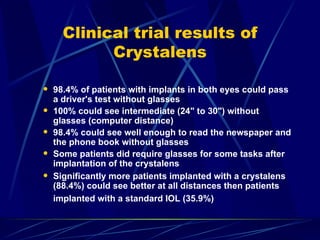
Clinical trial results of Crystalens 98.4% of patients with implants in both eyes could pass a driver's test without glasses   100% could see intermediate (24" to 30") without glasses (computer distance) 98.4% could see well enough to read the newspaper and the phone book without glasses   Some patients did require glasses for some tasks after implantation of the crystalens   Significantly more patients implanted with a crystalens (88.4%) could see better at all distances then patients implanted with a standard IOL (35.9%)
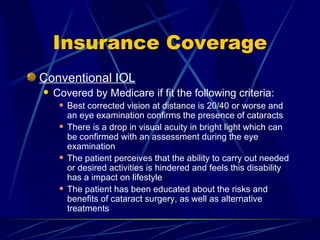
Insurance Coverage Conventional IOL Covered by Medicare if fit the following criteria: Best corrected vision at distance is 20/40 or worse and an eye examination confirms the presence of cataracts There is a drop in visual acuity in bright light which can be confirmed with an assessment during the eye examination The patient perceives that the ability to carry out needed or desired activities is hindered and feels this disability has a impact on lifestyle The patient has been educated about the risks and benefits of cataract surgery, as well as alternative treatments
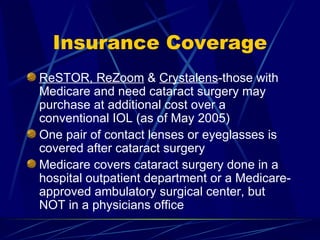
Insurance Coverage ReSTOR, ReZoom  &  Crystalens -those with Medicare and need cataract surgery may purchase at additional cost over a conventional IOL (as of May 2005) One pair of contact lenses or eyeglasses is covered after cataract surgery Medicare covers cataract surgery done in a hospital outpatient department or a Medicare-approved ambulatory surgical center, but NOT in a physicians office
What Can You Do to Prevent the Onset of Cataracts? Sunglasses to provide adequate UV protection whenever outdoors Don’t smoke or drink alcohol Antioxidant vitamins C & E
References Acrysof ReSTOR Apodized Diffractive IOL. http://www.acrysofrestor.com/cataract-surgery/iol-choices.asp American Optometric Association:  Nutrition & Cataracts.  http://www.aoa.org/documents/NutrCatar_public.pdf Bascom Palmer Eye Institute. Cataracts.  http://www.bpei.med.miami.edu/site/disease/disease_cataracts.asp CMS Rulings. http://www.usaeyes.org/lasik/library/CMSRefractiveIOLPolicy.pdf Guide to IOLs or Intraocular Lenses. http://www.allaboutvision.com/conditions/iols.htm Medem Medical Library: Cataract.  http://www.medem.com/MedLB/articleslb.cfm?sub_cat=119 National Eye Institute.  http://www.nei.nih.gov/photo/eyean/index.asp Vision in Focus. http://www.visioninfocus.com/423.asp
Thank You!!

Cataracts

  • 1.
    CATARACTS Lena G.Park, OD Park Family Eye Care North Aurora, IL www.parkfamilyeyecare.com
  • 2.
    Anatomy of theEye Photo courtesy of http://www.nei.nih.gov/photo/eyean/index.asp
  • 3.
    What is aCataract? A cataract is a clouding of the lens of the eye. The lens is located behind the pupil and is the part that is responsible for focusing light onto the retina. Cataracts may be attributed to such factors as old age, ultraviolet light, cigarette smoking, alcohol, and corticosteroid medications. About 50% of Americans age 65 or older have cataracts or have already had cataract surgery.
  • 4.
    Types of CataractsAge Related Due to protein clusters in the lens which cause the cloudiness Discoloration as a result of age Secondary Glaucoma Diabetic retinopathy Traumatic Occurs after eye injury Congenital Present after birth due to birth defects, diseases, or other cause Radiation After prolonged exposure to radiation
  • 5.
    Symptoms Gradually decreasingvision Glare at night from approaching car headlights Bright colors may appear more dull Frequently changing glasses/contact lens prescription Double vision
  • 6.
    Cataract Simulation Photocourtesy of http://www.nei.nih.gov/photo/sims/index.asp
  • 7.
    Diagnosis & TreatmentDetailed medical history Dilated examination Eyeglasses may help to improve vision in mild cases of cataracts When the lens of the eye becomes too cloudy to see any sharp images and the poor vision starts to interfere with performing daily activities, cataract surgery may be considered
  • 8.
    Cataract Surgery Verysafe & successful procedure The operation usually lasts less than 1 hour and is an outpatient procedure If the patient has cataracts in both eyes, only one cataract is removed at a time. The second surgery takes place after enough healing time has been allowed for the first procedure
  • 9.
    Cataract Surgery Localanesthesia is generally used Doctor makes a small incision in the cornea and removes the lens 2 methods of cataract removal Phacoemulsification : tiny probe inserted on side of cornea which breaks the lens and sucks the contents out Extracapsular surgery : longer incision made on side of cornea and hard center of lens is removed in one piece. The remainder of lens is removed by suction
  • 10.
    Cataract Surgery Thelens that is removed is replaced with a lens implant (intraocular lens). Generally the implants are chosen to match close to the patient’s current prescription and so only a minimal distance prescription along with the reading prescription is needed
  • 11.
    Post Cataract SurgeryEye that received surgery is patched and patient can go home that same day Eye drops are prescribed following the procedure to reduce risk of infection and control any inflammation of the eye It may take up to 6 weeks until the eye is fully healed. Medications must be taken during this time as prescribed
  • 12.
    Risks and complicationsRisks and complications may occur as with any surgical procedure but are very rare Infection Problems with use of anesthesia Bleeding & inflammation of the eye, thus leading to decreased vision Eventually (usually years following surgery) the capsule which supports the lens implant may become cloudy. If the cloudiness is greatly interfering with the patient’s vision, a laser procedure may be done to improve the clarity of vision
  • 13.
    Types of IntraocularImplants Conventional IOLs Accommodating/Presbyopia-Correcting IOLs AcrySof ReSTOR ReZoom Crystalens
  • 14.
    Conventional IOL Monofocal-offervision at one distance only such as far (Must wear contact lenses or spectacle lenses in order to read or use a computer)
  • 15.
    Accommodating IOLs Enablethe patient to see at more than one distance without glasses (far & near)
  • 16.
    ReSTOR Image takenfrom http://www.acrysofrestor.com/cataract-surgery/iol-choices.asp
  • 17.
    ReSTOR Apodized diffractivetechnology -responds to size of pupil to provide near, intermediate, and distance vision Image quality is improved while minimizing visual disturbances (nighttime glare & halos) Controls diameter of diffractive lens to work with the pupil Apodization - gradual decrease in step heights from the center to the periphery which helps to create a smoother transition of light when focusing between different distances Provides +4.00 add to separate near and distance images
  • 18.
    Alcon clinical study80% of ACRYSOF RESTOR IOL patients reported never needing to wear glasses for any type of activity Four out of five patients with the AcrySof® ReSTOR® IOL reported never wearing glasses following cataract surgery in both eyes, compared to only 1 out of 10 patients with monofocal lenses Average binocular uncorrected distance visual acuity was 20/20 and 20/25 for near 85% ReSTOR IOL vs 67% monofocal IOL achieved 20/40 or better binocular uncorrected intermediate vision
  • 19.
    ReZoom Diagram takenfrom http://www.visioninfocus.com/423.asp
  • 20.
    ReZoom Multifocal refractiveIOL Balanced View Optics™ Technology : creates multiple focal points so you can see well at a variety of distances Each multifocal lens is divided into 5 different zones, and each zone is designated for different light and focal distances (ex. Some zones have greater low light and distance vision to aid with night driving)
  • 21.
    ReZoom Clinical Study92% of patients reported either “never” or “occasionally” wearing glasses Package Insert. ReZoom™ Multifocal Acrylic Posterior Chamber Intraocular Lens. Advanced Medical Optics, Inc.
  • 22.
    Crystalens Image takenfrom http://www.crystalens.com/whatis.htm
  • 23.
    Crystalens Uses thenatural focusing ability of the eye by moving the lens implant in response to flexing of the same muscles that move the crystalline lens for accommodation, which may also be termed pseudoaccommodation . This is different from traditional IOLs which are fixed or stationary in the eye Provides a single focal point throughout a continuous range of vision from near to far Is made up of a hinge which allows the lens implant to move back and forth as you change focus on images that are near and far away from you Two and three year follow up data indicates that the pseudoaccommodation of the Crystalens does not significantly diminish with time
  • 24.
    Clinical trial resultsof Crystalens 98.4% of patients with implants in both eyes could pass a driver's test without glasses 100% could see intermediate (24" to 30") without glasses (computer distance) 98.4% could see well enough to read the newspaper and the phone book without glasses Some patients did require glasses for some tasks after implantation of the crystalens Significantly more patients implanted with a crystalens (88.4%) could see better at all distances then patients implanted with a standard IOL (35.9%)
  • 25.
    Insurance Coverage ConventionalIOL Covered by Medicare if fit the following criteria: Best corrected vision at distance is 20/40 or worse and an eye examination confirms the presence of cataracts There is a drop in visual acuity in bright light which can be confirmed with an assessment during the eye examination The patient perceives that the ability to carry out needed or desired activities is hindered and feels this disability has a impact on lifestyle The patient has been educated about the risks and benefits of cataract surgery, as well as alternative treatments
  • 26.
    Insurance Coverage ReSTOR,ReZoom & Crystalens -those with Medicare and need cataract surgery may purchase at additional cost over a conventional IOL (as of May 2005) One pair of contact lenses or eyeglasses is covered after cataract surgery Medicare covers cataract surgery done in a hospital outpatient department or a Medicare-approved ambulatory surgical center, but NOT in a physicians office
  • 27.
    What Can YouDo to Prevent the Onset of Cataracts? Sunglasses to provide adequate UV protection whenever outdoors Don’t smoke or drink alcohol Antioxidant vitamins C & E
  • 28.
    References Acrysof ReSTORApodized Diffractive IOL. http://www.acrysofrestor.com/cataract-surgery/iol-choices.asp American Optometric Association: Nutrition & Cataracts. http://www.aoa.org/documents/NutrCatar_public.pdf Bascom Palmer Eye Institute. Cataracts. http://www.bpei.med.miami.edu/site/disease/disease_cataracts.asp CMS Rulings. http://www.usaeyes.org/lasik/library/CMSRefractiveIOLPolicy.pdf Guide to IOLs or Intraocular Lenses. http://www.allaboutvision.com/conditions/iols.htm Medem Medical Library: Cataract. http://www.medem.com/MedLB/articleslb.cfm?sub_cat=119 National Eye Institute. http://www.nei.nih.gov/photo/eyean/index.asp Vision in Focus. http://www.visioninfocus.com/423.asp
  • 29.