Nawat Watanachai
Chiangmai University Hospital
2013
Cataract
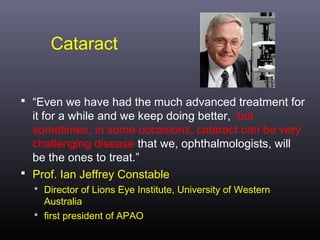
 “Even we have had the much advanced treatment for

it for a while and we keep doing better, but
sometimes, in some occasions, cataract can be very
challenging disease that we, ophthalmologists, will
be the ones to treat.”
 Prof. Ian Jeffrey Constable
 Director of Lions Eye Institute, University of Western

Australia
 first president of APAO
terms
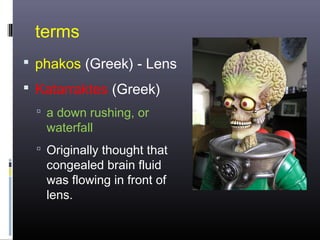
 phakos (Greek) - Lens
 Katarraktes (Greek)
 a down rushing, or

waterfall

 Originally thought that

congealed brain fluid
was flowing in front of
lens.
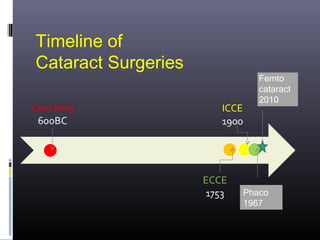
Timeline of
Cataract Surgeries
Femto
cataract
2010

Phaco
1967
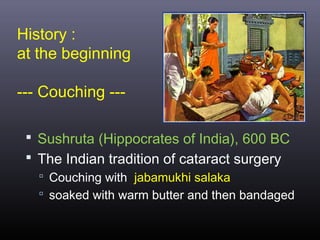
History :
at the beginning
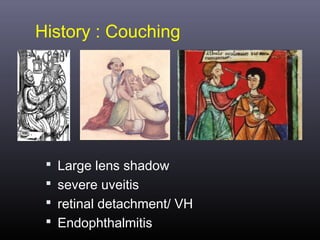
--- Couching -- Sushruta (Hippocrates of India), 600 BC
 The Indian tradition of cataract surgery
 Couching with jabamukhi salaka
 soaked with warm butter and then bandaged
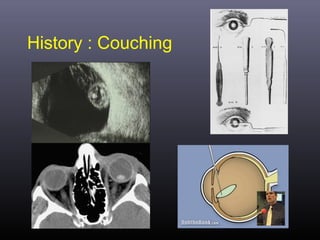
History : Couching
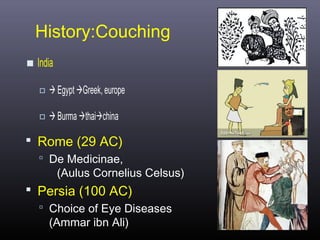
History:Couching

 India
  Egypt Greek, europe
  Burma thaichina
 Rome (29 AC)
 De Medicinae,

(Aulus Cornelius Celsus)

 Persia (100 AC)
 Choice of Eye Diseases

(Ammar ibn Ali)
History : Couching

 Large lens shadow
 severe uveitis
 retinal detachment/ VH
 Endophthalmitis
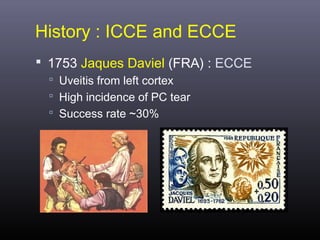
History : ICCE and ECCE
 1753 Jaques Daviel (FRA) : ECCE
 Uveitis from left cortex
 High incidence of PC tear
 Success rate ~30%
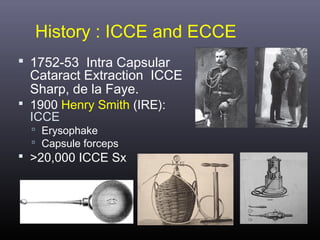
History : ICCE and ECCE
 1752-53 Intra Capsular

Cataract Extraction ICCE
Sharp, de la Faye.

 1900 Henry Smith (IRE):

ICCE

 Erysophake
 Capsule forceps

 >20,000 ICCE Sx
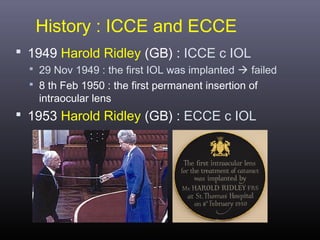
History : ICCE and ECCE
 1949 Harold Ridley (GB) : ICCE c IOL
 29 Nov 1949 : the first IOL was implanted  failed
 8 th Feb 1950 : the first permanent insertion of

intraocular lens

 1953 Harold Ridley (GB) : ECCE c IOL
History :
ICCE and ECCE

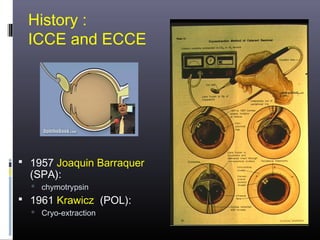
 1957 Joaquin Barraquer

(SPA):


chymotrypsin

 1961 Krawicz (POL):


Cryo-extraction
History : ICCE and ECCE
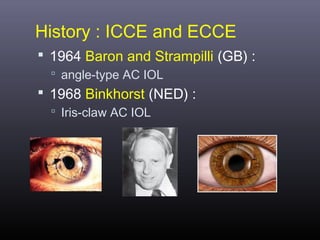
 1964 Baron and Strampilli (GB) :
 angle-type AC IOL

 1968 Binkhorst (NED) :
 Iris-claw AC IOL
History : ICCE and ECCE
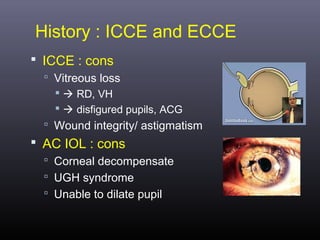
 ICCE : cons
 Vitreous loss
  RD, VH

  disfigured pupils, ACG
 Wound integrity/ astigmatism

 AC IOL : cons
 Corneal decompensate
 UGH syndrome
 Unable to dilate pupil
History : ECCE(and PE)

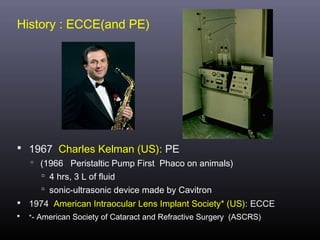
 1967 Charles Kelman (US): PE
 (1966 Peristaltic Pump First Phaco on animals)

 4 hrs, 3 L of fluid
 sonic-ultrasonic device made by Cavitron
 1974 American Intraocular Lens Implant Society* (US): ECCE


*- American Society of Cataract and Refractive Surgery (ASCRS)
History : ECCE(and PE)
 1975 AILIS (US)
 PC IOL
 1980 Pape and Balazs
 Hyaluronic acid

 1980 Danielle Aron-Rosa (FRA)
 Nd:YAG capsulotomy
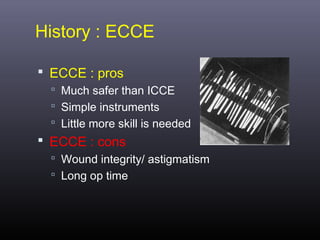
History : ECCE
 ECCE : pros
 Much safer than ICCE
 Simple instruments
 Little more skill is needed

 ECCE : cons
 Wound integrity/ astigmatism
 Long op time
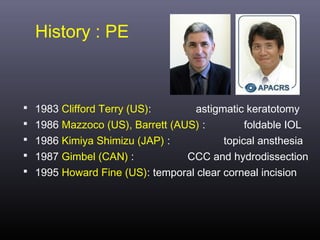
History : PE

 1983 Clifford Terry (US):
astigmatic keratotomy
 1986 Mazzoco (US), Barrett (AUS) :
foldable IOL
 1986 Kimiya Shimizu (JAP) :
topical ansthesia
 1987 Gimbel (CAN) :
CCC and hydrodissection
 1995 Howard Fine (US): temporal clear corneal incision
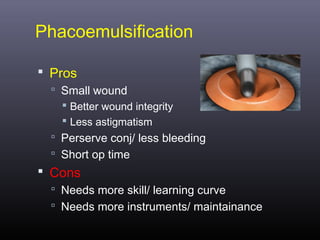
Phacoemulsification
 Pros
 Small wound
 Better wound integrity

 Less astigmatism
 Perserve conj/ less bleeding
 Short op time

 Cons
 Needs more skill/ learning curve
 Needs more instruments/ maintainance
Let start doing cataract Sx
Extracapsular
Cataract
Extraction
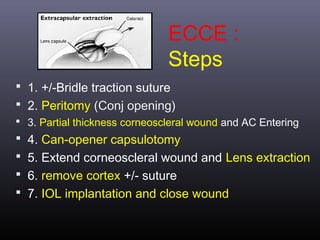
ECCE :
Steps
 1. +/-Bridle traction suture
 2. Peritomy (Conj opening)
 3. Partial thickness corneoscleral wound and AC Entering

 4. Can-opener capsulotomy
 5. Extend corneoscleral wound and Lens extraction
 6. remove cortex +/- suture
 7. IOL implantation and close wound
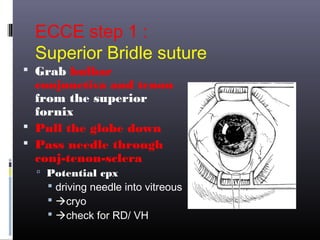
ECCE step 1 :
Superior Bridle suture
 Grab bulbar

conjunctiva and tenon
from the superior
fornix
 Pull the globe down
 Pass needle through
conj-tenon-sclera
 Potential cpx

 driving needle into vitreous
 cryo
 check for RD/ VH
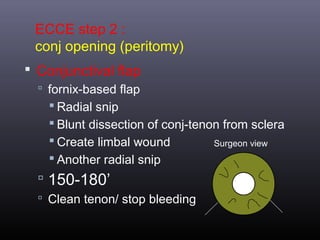
ECCE step 2 :
conj opening (peritomy)
 Conjunctival flap
 fornix-based flap

 Radial snip
 Blunt dissection of conj-tenon from sclera
 Create limbal wound
Surgeon view
 Another radial snip

 150-180’
 Clean tenon/ stop bleeding
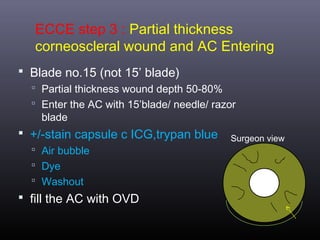
ECCE step 3 : Partial thickness
corneoscleral wound and AC Entering
 Blade no.15 (not 15’ blade)
 Partial thickness wound depth 50-80%
 Enter the AC with 15’blade/ needle/ razor

blade

 +/-stain capsule c ICG,trypan blue
 Air bubble
 Dye
 Washout

 fill the AC with OVD

Surgeon view
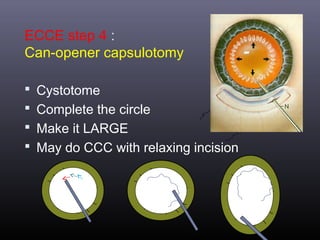
ECCE step 4 :
Can-opener capsulotomy
 Cystotome
 Complete the circle
 Make it LARGE
 May do CCC with relaxing incision
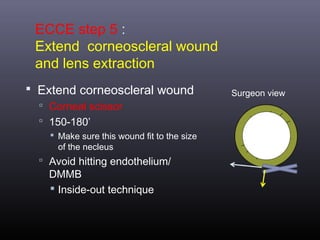
ECCE step 5 :
Extend corneoscleral wound
and lens extraction
 Extend corneoscleral wound
 Corneal scissor
 150-180’
 Make sure this wound fit to the size
of the necleus

 Avoid hitting endothelium/

DMMB
 Inside-out technique

Surgeon view
ECCE step 5 :

extend corneoscleral wound

and lens extraction
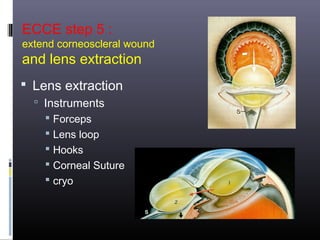
 Lens extraction
 Instruments
 Forceps

 Lens loop
 Hooks
 Corneal Suture
 cryo
ECCE step 5 :
extend corneoscleral wound
and lens extraction
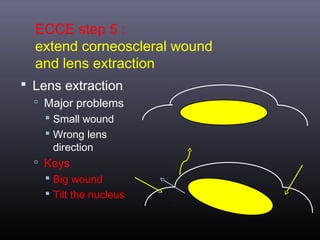
 Lens extraction
 Major problems
 Small wound

 Wrong lens
direction
 Keys
 Big wound

 Tilt the nucleus
ECCE step 6 :
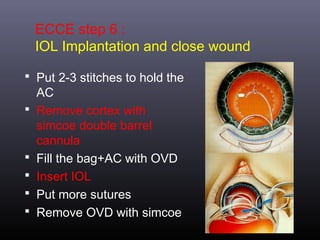
IOL Implantation and close wound
 Put 2-3 stitches to hold the







AC
Remove cortex with
simcoe double barrel
cannula
Fill the bag+AC with OVD
Insert IOL
Put more sutures
Remove OVD with simcoe
ECCE step 6 :
IOL Implantation and close wound
 Closing corneosclearl wound
 3-7 stitches of Nylon 10-0
 Terry notches
 Aim : little WTR astigmatism

 Close conj wound
 Topical steroid/ ABO/ miotic
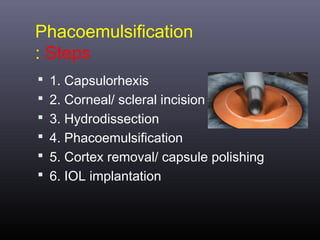
Phacoemulsification
Phacoemulsification
: Steps
 1. Capsulorhexis
 2. Corneal/ scleral incision
 3. Hydrodissection
 4. Phacoemulsification
 5. Cortex removal/ capsule polishing
 6. IOL implantation
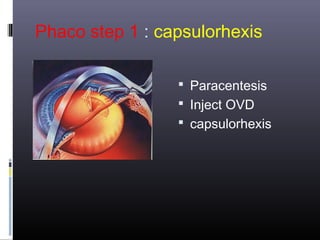
Phaco step 1 : capsulorhexis
 Paracentesis
 Inject OVD
 capsulorhexis
Phaco step 1 : capsulorhexis
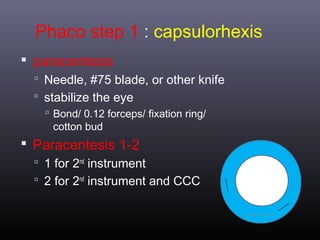
 paracentesis
 Needle, #75 blade, or other knife
 stabilize the eye
 Bond/ 0.12 forceps/ fixation ring/
cotton bud

 Paracentesis 1-2
 1 for 2nd instrument
 2 for 2nd instrument and CCC
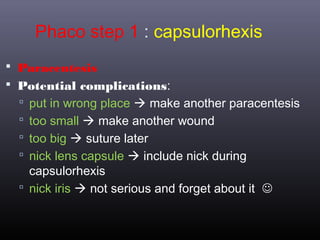
Phaco step 1 : capsulorhexis
 Paracentesis
 Potential complications:
 put in wrong place  make another paracentesis
 too small  make another wound
 too big  suture later
 nick lens capsule  include nick during

capsulorhexis
 nick iris  not serious and forget about it 
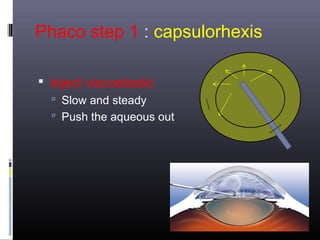
Phaco step 1 : capsulorhexis
 Inject viscoelastic
 Slow and steady
 Push the aqueous out
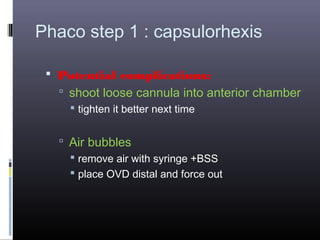
Phaco step 1 : capsulorhexis
 Potential complications:
 shoot loose cannula into anterior chamber
 tighten it better next time
 Air bubbles
 remove air with syringe +BSS
 place OVD distal and force out
Phaco step 1 :
capsulorhexis
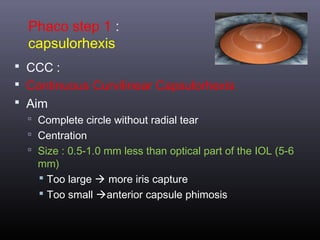
 CCC :
 Continuous Curvilinear Capsulorhexis
 Aim
 Complete circle without radial tear
 Centration
 Size : 0.5-1.0 mm less than optical part of the IOL (5-6

mm)
 Too large  more iris capture
 Too small anterior capsule phimosis
Phaco step 1 : capsulorhexis
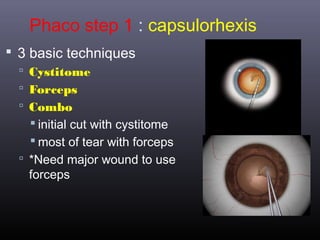
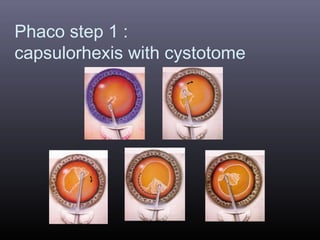
 3 basic techniques
 Cystitome
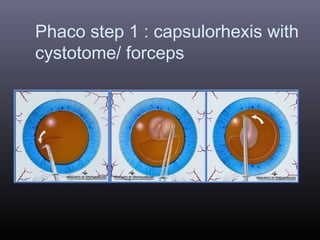
 Forceps
 Combo

 initial cut with cystitome
 most of tear with forceps
 *Need major wound to use

forceps
Phaco step 1 :
capsulorhexis with cystotome
Phaco step 1 : capsulorhexis with
cystotome/ forceps
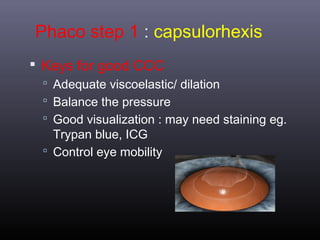
Phaco step 1 : capsulorhexis
 Keys for good CCC
 Adequate viscoelastic/ dilation
 Balance the pressure
 Good visualization : may need staining eg.

Trypan blue, ICG
 Control eye mobility
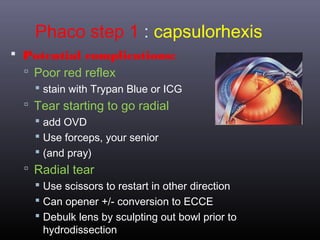
Phaco step 1 : capsulorhexis
 Potential complications:
 Poor red reflex
 stain with Trypan Blue or ICG
 Tear starting to go radial
 add OVD
 Use forceps, your senior
 (and pray)
 Radial tear
 Use scissors to restart in other direction
 Can opener +/- conversion to ECCE
 Debulk lens by sculpting out bowl prior to
hydrodissection
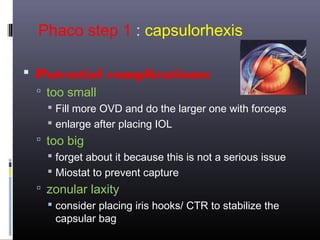
Phaco step 1 : capsulorhexis
 Potential complications:
 too small
 Fill more OVD and do the larger one with forceps
 enlarge after placing IOL
 too big
 forget about it because this is not a serious issue
 Miostat to prevent capture
 zonular laxity
 consider placing iris hooks/ CTR to stabilize the
capsular bag
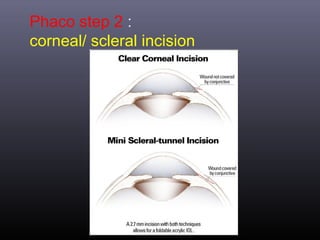
Phaco step 2 :
corneal/ scleral incision
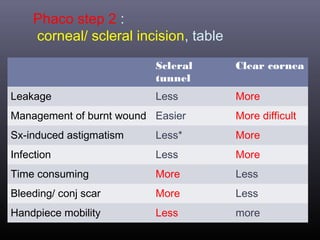
Phaco step 2 :
corneal/ scleral incision, table
Scleral
tunnel
Leakage

Clear cornea

Less

More

Management of burnt wound Easier

More difficult

Sx-induced astigmatism

Less*

More

Infection

Less

More

Time consuming

More

Less

Bleeding/ conj scar

More

Less

Handpiece mobility

Less

more
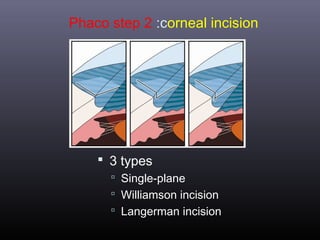
Phaco step 2 :corneal incision

 3 types
 Single-plane
 Williamson incision
 Langerman incision
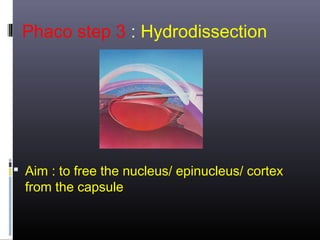
Phaco step 3 : Hydrodissection

 Aim : to free the nucleus/ epinucleus/ cortex

from the capsule
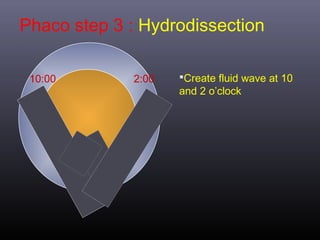
Phaco step 3 : Hydrodissection
10:00

2:00

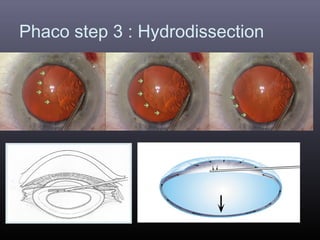
Create fluid wave at 10

and 2 o’clock
Phaco step 3 : Hydrodissection
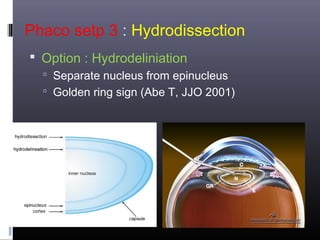
Phaco setp 3 : Hydrodissection
 Option : Hydrodeliniation
 Separate nucleus from epinucleus
 Golden ring sign (Abe T, JJO 2001)
Phaco setp 3 : Hydrodissection
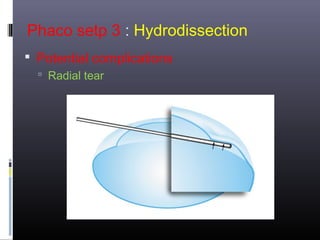
 Potential complications
 Radial tear
Phaco setp 3 : Hydrodissection

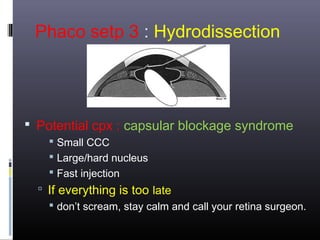
 Potential cpx : capsular blockage syndrome
 Small CCC
 Large/hard nucleus
 Fast injection

 If everything is too late
 don’t scream, stay calm and call your retina surgeon.
Phaco setp 3 : Hydrodissection
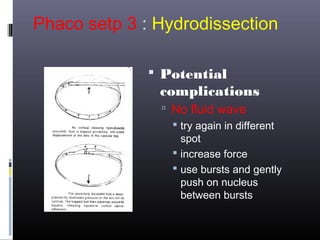
 Potential

complications
 No fluid wave
 try again in different
spot
 increase force
 use bursts and gently
push on nucleus
between bursts
Phaco setp 3 : Hydrodissection
 Iris Prolapse
 Remove dispersive OVD. If using a clear
cornea wound, then use sub-incisional iris
hook
 Prolapse nucleus
 Brown technique or Pop n Chop, flip into
ciliary sulcus, or push back into bag
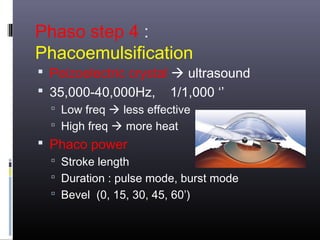
Phaso step 4 :
Phacoemulsification

 Peizoelectric crystal  ultrasound
 35,000-40,000Hz, 1/1,000 ‘’
 Low freq  less effective
 High freq  more heat

 Phaco power
 Stroke length
 Duration : pulse mode, burst mode
 Bevel (0, 15, 30, 45, 60’)
Phaso step 4 :
Phacoemulsification
 The goal is to remove lens with the minimum u/s
 Trend is to use increasing vacuum and decreasing

u/s power
 Techniques

 Endocapsular - keeping the nucleus in bag during phaco
 Supracapsular - prolapsing nucleus into sulcus during phaco
 Anterior chamber shell - prolapsing shelled out nucleus into anterior

chamber
 ½ bag ½ anterior chamber --tipping nucleus on side ½ in bag; ½ in
anterior chamber – a.k.a., Brown Technique, Pop-n-Chop.
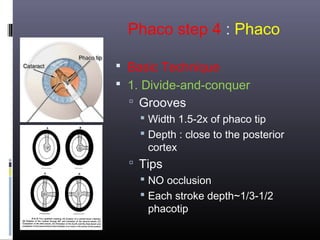
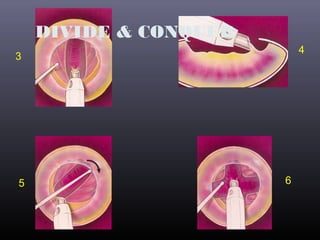
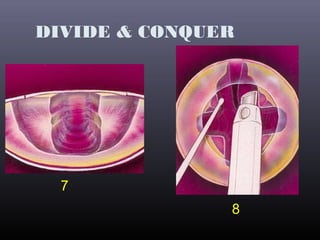
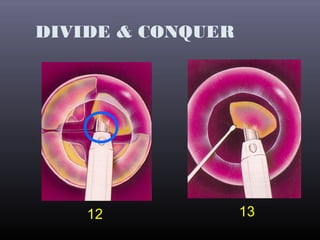
Phaco step 4 : Phaco
 Basic Technique
 1. Divide-and-conquer
 Grooves
 Width 1.5-2x of phaco tip
 Depth : close to the posterior
cortex
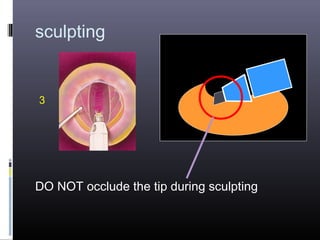
 Tips
 NO occlusion
 Each stroke depth~1/3-1/2
phacotip
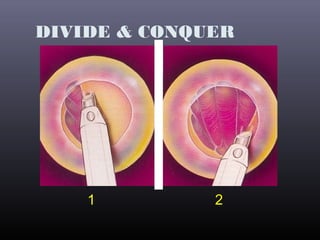
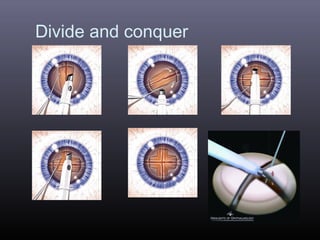
DIVIDE & CONQUER

1

2
DIVIDE & CONQUER
4

3

5

6
sculpting

3

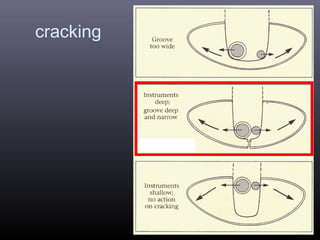
DO NOT occlude the tip during sculpting
DIVIDE & CONQUER

7
8
DIVIDE & CONQUER

12

13
cracking
Divide and conquer
Phaco step 4 :
Phacoemulsification

 Basic technique
 2. slow-motion phacoemulsification
 Divide-and –conquer with Low flow rate, low

vacuum
 For beginner/ soft nucleus-PSC-posterior
polar
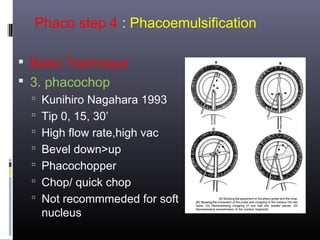
Phaco step 4 : Phacoemulsification
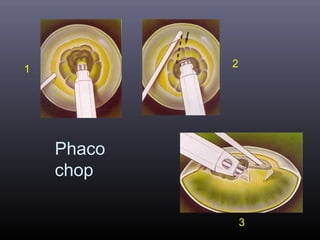
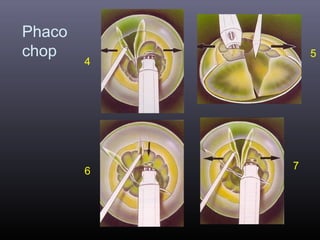
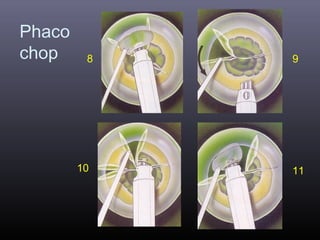
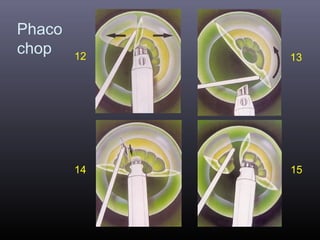
 Basic Technique
 3. phacochop
 Kunihiro Nagahara 1993
 Tip 0, 15, 30’
 High flow rate,high vac
 Bevel down>up
 Phacochopper
 Chop/ quick chop
 Not recommmeded for soft

nucleus
2

1

Phaco
chop
3
Phaco
chop

5

4

6

7
Phaco
chop

8

10

9

11
Phaco
chop

12

13

14

15
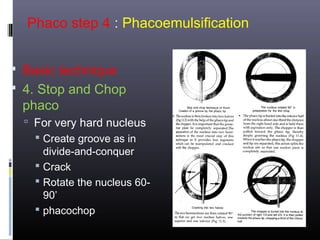
Phaco step 4 : Phacoemulsification
 Basic technique
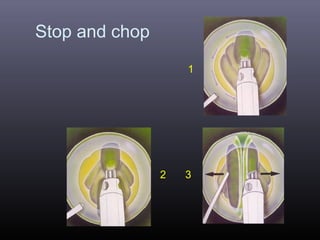
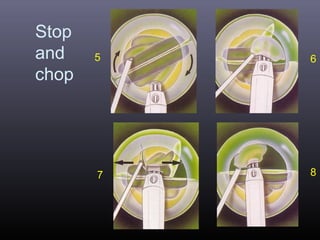
 4. Stop and Chop

phaco

 For very hard nucleus
 Create groove as in
divide-and-conquer
 Crack

 Rotate the nucleus 6090’
 phacochop
Stop and chop
1

2

3
Stop
and
chop

5

6

7

8
Phaco step 4 :
Phacoemulsification

 Basic technique
 5. Chip and Flip (Bowl-out)
 For very soft nucleus
 Complete hydrodissection+hydrodeliniation

 Emulsified the nuclear core
 Flip the nuclear shell
 Emulsified the shell (low power, low vacuum,
high flow rate)
Phaco step 4 : Phaco
 Some other techniques
 Quick chop
 Phaco flip (supracapsular)
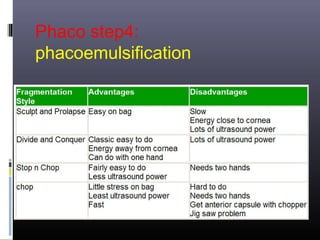
Phaco step4:
phacoemulsification
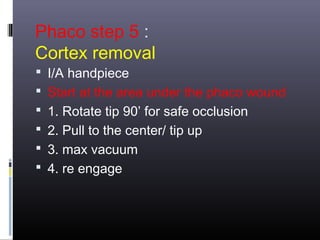
Phaco step 5 :
Cortex removal

 I/A handpiece
 Start at the area under the phaco wound
 1. Rotate tip 90’ for safe occlusion
 2. Pull to the center/ tip up
 3. max vacuum
 4. re engage
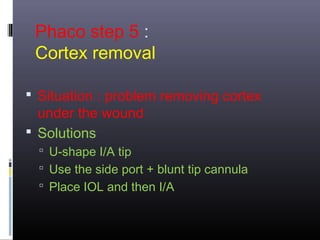
Phaco step 5 :
Cortex removal
 Situation : problem removing cortex

under the wound
 Solutions

 U-shape I/A tip
 Use the side port + blunt tip cannula
 Place IOL and then I/A
Phaco step 5 : cortex removal
 Capsule polishing

 For less/ later PCO
 Anterior capsule : high vac
 Posterior capsule
 vac 5-10 mmHg, flow rate 5-6 cc/min
 Slow tip movement
 Not recommend in
 Loose capsule eg. PXS
 Radial tear
 Zonule lysis
Phaco step 6 :
IOL implantation
 Inject viscoelastic to fill the capsular bag/ AC
 Do not pierce the PC with your blunt needle

 Insert IOL

 Rigid IOL
 need to extend the wound
 IOL diameter 5-5.5 mm
 1-3 stitches
 Foldable IOL
 Use injector or forceps
 0-1 stitch

 Remove viscoelastic : bag  AC
Phaco step 6 :
IOL implantation
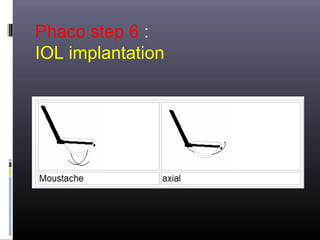
Phaco step 6 :
IOL implantation

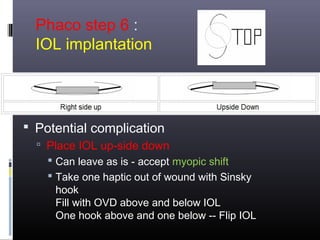
 Potential complication
 Place IOL up-side down
 Can leave as is - accept myopic shift

 Take one haptic out of wound with Sinsky
hook
Fill with OVD above and below IOL
One hook above and one below -- Flip IOL
Phaco step 6 :
IOL implantation

 Inadvertent sulcus placement
 Fill with OVD -- Rotate into bag with hook
 If a 3 piece can leave in sulcus with myopic shift
 Do not leave single piece acrylic (eg. Alcon

SA60) in sulcus
Phaco step 6 :IOL implantation
 IOL doesn't center Usually one haptic in

sulcus one in bag

 dial both into bag or both into sulcus

 Possible zonular dialysis
 if nearly centered leave it alone
 rotate IOL carefully for best centration

with 3 piece often haptics best at weak area
 check wound for vitreous, miostat
 consider placement of CTR
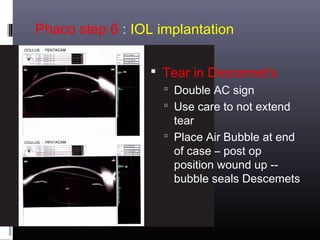
Phaco step 6 : IOL implantation
 Tear in Descemet's
 Double AC sign
 Use care to not extend

tear
 Place Air Bubble at end
of case – post op
position wound up -bubble seals Descemets
Phaco step 6 :
IOL implantation

 Lens Material behind IOL
 Rotate haptic 90 deg from wound

Toe down with I/A and get under IOL
With aspiration tip showing at all times
aspirate
 Note – make sure that you have an
INTACT capsule
Special IOL Placement
Conditions
 Anterior Capsular Tear
 Single piece acrylic in the bag - creates little

tension on the bag
 3 piece with both haptics in the sulcus

 Zonular Dialysis
 Capsular Tension Ring with any IOL
 3 piece IOL with PMMA haptic oriented toward

weak area of zonules
Special IOL Placement
Conditions
 Posterior Capsular Tear
 Dispersive OVD in the post capsular hole -- gently place

IOL into bag
 Place 3 piece in sulcus +/- capture of optic by centered
anterior CCC

 No Capsular Support
 AC IOL: there are 3 sizes depending on white to white

size
 Iris Sutured PC IOL
 Scleral Sutured PC IOL
Phaco step 6 :
IOL implantation Viscoelastic
removal
 OVD is removed with I/A device
 As always keep tip opening up
 Go under IOL to remove OVD, especially

if you have been having IOP problems
post op
One Last Step
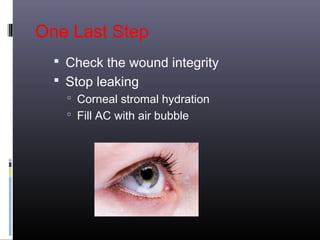
 Check the wound integrity
 Stop leaking
 Corneal stromal hydration
 Fill AC with air bubble
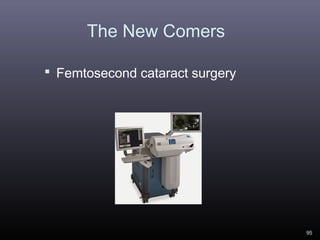
The New Comers
 Femtosecond cataract surgery

95
Femto cataract, Hx
 2005
 Image-guided laser cataract surgery was first

conceptualized
 D. Palanker and M. Blumenkranz


patents US 8394084; US 8403921; US 8425497

 2005-2010
 OptiMedica Corp. developed and tested
 integrated Optical Coherence Tomography

and femtosecond laser



Palanker DV, Blumenkranz MS, Andersen D, et al. Femtosecond laserassisted cataract surgery with integrated optical coherence tomography. Sci
Transl Med 2010;2:58ra85.
Femto cataract, Hx
 2008
 first used clinically in cataract surgery
 Prof. Zoltan Nagy
 Budapest, Hungary

 2010 Dr Steven Slade in the USA
 2011 Dr Michael Lawlwss in Asia/ AUS


”The Future of Laser Cataract Surgery” Keynote Lecture American Academy of
Ophthalmology, Subspecialty Day, Chicago, November, 2012
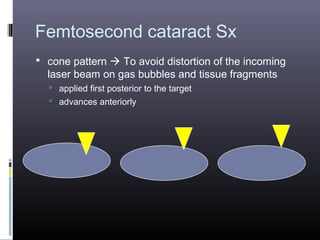
Femtosecond cataract Sx
 cone pattern  To avoid distortion of the incoming

laser beam on gas bubbles and tissue fragments
 applied first posterior to the target
 advances anteriorly
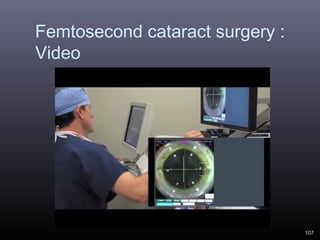
Femtosecond cataract surgery
 What femto can do?
 Create corneal flap/tunnels
 CCC
 Nuclear fragmentation
 LRI
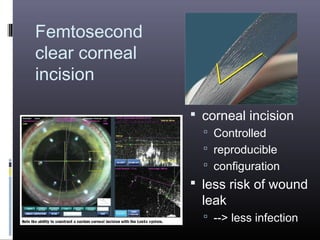
Femtosecond
clear corneal
incision
 corneal incision
 Controlled
 reproducible
 configuration

 less risk of wound

leak

 --> less infection
Femtosecond capsulotomy

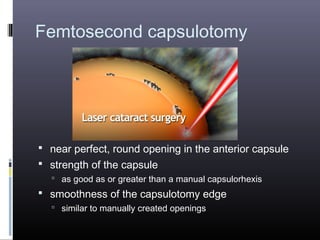
 near perfect, round opening in the anterior capsule
 strength of the capsule
 as good as or greater than a manual capsulorhexis

 smoothness of the capsulotomy edge
 similar to manually created openings
Femtosecond capsulotomy

incidence of anterior capsular tears
 Manual CCC
 0.79% in very experienced hands
 5.3% within teaching institutions
 Marques et al
 40% of anterior capsular tears extended to the posterior capsule

 20% required further surgery

 Lawless in November 2012
 0.2% incidence of anterior tears
 throughout his initial 500 cases


Marques FF, Marques DM. Fate of AC tears during cataract surgery. J Cataract Refract Surg 2006;32:1638-42.



Unal M, Yücel I, Sarici A et al. Phaco with topical anesthesia: Resident experience. J Cataract Refract Surg. 2006;32:13615.



Marques FF, Marques DM. Fate of anterior capsule tears during cataract surgery. J Cataract Refract Surg 2006;32:1638-42.



Lawless M. ”The Future of Laser Cataract Surgery” Keynote Lecture American Academy of Ophthalmology, Subspecialty
Day, Chicago, November, 2012
Femtosecond capsulotomy
 Precised CCC means
 Less tear/ nucleus dropping/ uveitis/ VH/ RRD/ endophthalmitis
 Less IOL decentration

 Lawless : mean circularity
 0.942 in 29 lasered eyes
 0.774 in 30 manual eyes
 12X improvement in the precision of the capsulotomy diameter

 Freidman : deviation from intended diameter
 29 µm ± 26μm for laser capsulotomies (mean deviation 6%)
 337μm ± 258μm for a manual technique (mean deviation 20%)


Friedman NJ, Palanker DV, Schuele G. Femtosecond laser capsulotomy. J Cataract
Refract Surg. 2011 Jul;37(7):1189-98.
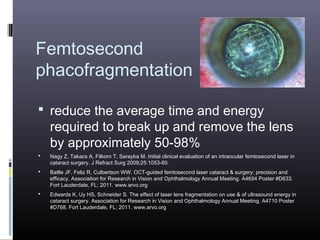
Femtosecond
phacofragmentation
 reduce the average time and energy

required to break up and remove the lens
by approximately 50-98%



Nagy Z, Takacs A, Filkorn T, Sarayba M. Initial clinical evaluation of an intraocular femtosecond laser in
cataract surgery. J Refract Surg 2009;25:1053-60.



Batlle JF, Feliz R, Culbertson WW. OCT-guided femtosecond laser cataract & surgery: precision and
efficacy. Association for Research in Vision and Ophthalmology Annual Meeting. A4694 Poster #D633.
Fort Lauderdale, FL; 2011. www.arvo.org



Edwards K, Uy HS, Schneider S. The effect of laser lens fragmentation on use & of ultrasound energy in
cataract surgery. Association for Research in Vision and Ophthalmology Annual Meeting. A4710 Poster
#D768. Fort Lauderdale, FL; 2011. www.arvo.org
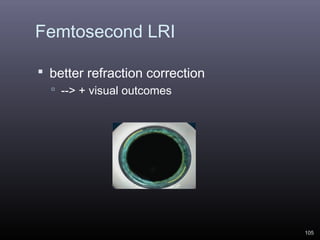
Femtosecond LRI
 better refraction correction
 --> + visual outcomes

105
Femtosecond cataract surgery :
Video

106
Femtosecond cataract surgery :
Video

107
Femtosecond cataract surgery :
cons
 Need suction
 Rise IOP
 SCH

 Can not do well in some dense cataract
 Failure during PC scanning

 PRICE
Machines
 Alcon LenSx
 (Alcon Laboratories, Ft Worth, TX, USA)

 OptiMedica Catalys
 (Optimedica Corp, CA, USA)

 LensAR
 (LensAR Inc, FL, USA)

 Technolas
 (Technolas Perfect Vision GmbH, Germany)
Now you guys are ready
to ROCK!!!!

Nw2012 cataract surgery11

  • 1.
  • 2.
    Cataract  “Even wehave had the much advanced treatment for it for a while and we keep doing better, but sometimes, in some occasions, cataract can be very challenging disease that we, ophthalmologists, will be the ones to treat.”  Prof. Ian Jeffrey Constable  Director of Lions Eye Institute, University of Western Australia  first president of APAO
  • 3.
    terms  phakos (Greek)- Lens  Katarraktes (Greek)  a down rushing, or waterfall  Originally thought that congealed brain fluid was flowing in front of lens.
  • 4.
  • 5.
    History : at thebeginning --- Couching -- Sushruta (Hippocrates of India), 600 BC  The Indian tradition of cataract surgery  Couching with jabamukhi salaka  soaked with warm butter and then bandaged
  • 6.
  • 7.
    History:Couching  India  Egypt Greek, europe   Burma thaichina  Rome (29 AC)  De Medicinae, (Aulus Cornelius Celsus)  Persia (100 AC)  Choice of Eye Diseases (Ammar ibn Ali)
  • 8.
    History : Couching Large lens shadow  severe uveitis  retinal detachment/ VH  Endophthalmitis
  • 9.
    History : ICCEand ECCE  1753 Jaques Daviel (FRA) : ECCE  Uveitis from left cortex  High incidence of PC tear  Success rate ~30%
  • 10.
    History : ICCEand ECCE  1752-53 Intra Capsular Cataract Extraction ICCE Sharp, de la Faye.  1900 Henry Smith (IRE): ICCE  Erysophake  Capsule forceps  >20,000 ICCE Sx
  • 11.
    History : ICCEand ECCE  1949 Harold Ridley (GB) : ICCE c IOL  29 Nov 1949 : the first IOL was implanted  failed  8 th Feb 1950 : the first permanent insertion of intraocular lens  1953 Harold Ridley (GB) : ECCE c IOL
  • 12.
    History : ICCE andECCE  1957 Joaquin Barraquer (SPA):  chymotrypsin  1961 Krawicz (POL):  Cryo-extraction
  • 13.
    History : ICCEand ECCE  1964 Baron and Strampilli (GB) :  angle-type AC IOL  1968 Binkhorst (NED) :  Iris-claw AC IOL
  • 14.
    History : ICCEand ECCE  ICCE : cons  Vitreous loss   RD, VH   disfigured pupils, ACG  Wound integrity/ astigmatism  AC IOL : cons  Corneal decompensate  UGH syndrome  Unable to dilate pupil
  • 15.
    History : ECCE(andPE)  1967 Charles Kelman (US): PE  (1966 Peristaltic Pump First Phaco on animals)  4 hrs, 3 L of fluid  sonic-ultrasonic device made by Cavitron  1974 American Intraocular Lens Implant Society* (US): ECCE  *- American Society of Cataract and Refractive Surgery (ASCRS)
  • 16.
    History : ECCE(andPE)  1975 AILIS (US)  PC IOL  1980 Pape and Balazs  Hyaluronic acid  1980 Danielle Aron-Rosa (FRA)  Nd:YAG capsulotomy
  • 17.
    History : ECCE ECCE : pros  Much safer than ICCE  Simple instruments  Little more skill is needed  ECCE : cons  Wound integrity/ astigmatism  Long op time
  • 18.
    History : PE 1983 Clifford Terry (US): astigmatic keratotomy  1986 Mazzoco (US), Barrett (AUS) : foldable IOL  1986 Kimiya Shimizu (JAP) : topical ansthesia  1987 Gimbel (CAN) : CCC and hydrodissection  1995 Howard Fine (US): temporal clear corneal incision
  • 19.
    Phacoemulsification  Pros  Smallwound  Better wound integrity  Less astigmatism  Perserve conj/ less bleeding  Short op time  Cons  Needs more skill/ learning curve  Needs more instruments/ maintainance
  • 20.
    Let start doingcataract Sx
  • 21.
  • 22.
    ECCE : Steps  1.+/-Bridle traction suture  2. Peritomy (Conj opening)  3. Partial thickness corneoscleral wound and AC Entering  4. Can-opener capsulotomy  5. Extend corneoscleral wound and Lens extraction  6. remove cortex +/- suture  7. IOL implantation and close wound
  • 23.
    ECCE step 1: Superior Bridle suture  Grab bulbar conjunctiva and tenon from the superior fornix  Pull the globe down  Pass needle through conj-tenon-sclera  Potential cpx  driving needle into vitreous  cryo  check for RD/ VH
  • 24.
    ECCE step 2: conj opening (peritomy)  Conjunctival flap  fornix-based flap  Radial snip  Blunt dissection of conj-tenon from sclera  Create limbal wound Surgeon view  Another radial snip  150-180’  Clean tenon/ stop bleeding
  • 25.
    ECCE step 3: Partial thickness corneoscleral wound and AC Entering  Blade no.15 (not 15’ blade)  Partial thickness wound depth 50-80%  Enter the AC with 15’blade/ needle/ razor blade  +/-stain capsule c ICG,trypan blue  Air bubble  Dye  Washout  fill the AC with OVD Surgeon view
  • 26.
    ECCE step 4: Can-opener capsulotomy  Cystotome  Complete the circle  Make it LARGE  May do CCC with relaxing incision
  • 27.
    ECCE step 5: Extend corneoscleral wound and lens extraction  Extend corneoscleral wound  Corneal scissor  150-180’  Make sure this wound fit to the size of the necleus  Avoid hitting endothelium/ DMMB  Inside-out technique Surgeon view
  • 28.
    ECCE step 5: extend corneoscleral wound and lens extraction  Lens extraction  Instruments  Forceps  Lens loop  Hooks  Corneal Suture  cryo
  • 29.
    ECCE step 5: extend corneoscleral wound and lens extraction  Lens extraction  Major problems  Small wound  Wrong lens direction  Keys  Big wound  Tilt the nucleus
  • 30.
    ECCE step 6: IOL Implantation and close wound  Put 2-3 stitches to hold the      AC Remove cortex with simcoe double barrel cannula Fill the bag+AC with OVD Insert IOL Put more sutures Remove OVD with simcoe
  • 31.
    ECCE step 6: IOL Implantation and close wound  Closing corneosclearl wound  3-7 stitches of Nylon 10-0  Terry notches  Aim : little WTR astigmatism  Close conj wound  Topical steroid/ ABO/ miotic
  • 32.
  • 33.
    Phacoemulsification : Steps  1.Capsulorhexis  2. Corneal/ scleral incision  3. Hydrodissection  4. Phacoemulsification  5. Cortex removal/ capsule polishing  6. IOL implantation
  • 34.
    Phaco step 1: capsulorhexis  Paracentesis  Inject OVD  capsulorhexis
  • 35.
    Phaco step 1: capsulorhexis  paracentesis  Needle, #75 blade, or other knife  stabilize the eye  Bond/ 0.12 forceps/ fixation ring/ cotton bud  Paracentesis 1-2  1 for 2nd instrument  2 for 2nd instrument and CCC
  • 36.
    Phaco step 1: capsulorhexis  Paracentesis  Potential complications:  put in wrong place  make another paracentesis  too small  make another wound  too big  suture later  nick lens capsule  include nick during capsulorhexis  nick iris  not serious and forget about it 
  • 37.
    Phaco step 1: capsulorhexis  Inject viscoelastic  Slow and steady  Push the aqueous out
  • 38.
    Phaco step 1: capsulorhexis  Potential complications:  shoot loose cannula into anterior chamber  tighten it better next time  Air bubbles  remove air with syringe +BSS  place OVD distal and force out
  • 39.
    Phaco step 1: capsulorhexis  CCC :  Continuous Curvilinear Capsulorhexis  Aim  Complete circle without radial tear  Centration  Size : 0.5-1.0 mm less than optical part of the IOL (5-6 mm)  Too large  more iris capture  Too small anterior capsule phimosis
  • 40.
    Phaco step 1: capsulorhexis  3 basic techniques  Cystitome  Forceps  Combo  initial cut with cystitome  most of tear with forceps  *Need major wound to use forceps
  • 41.
    Phaco step 1: capsulorhexis with cystotome
  • 42.
    Phaco step 1: capsulorhexis with cystotome/ forceps
  • 43.
    Phaco step 1: capsulorhexis  Keys for good CCC  Adequate viscoelastic/ dilation  Balance the pressure  Good visualization : may need staining eg. Trypan blue, ICG  Control eye mobility
  • 44.
    Phaco step 1: capsulorhexis  Potential complications:  Poor red reflex  stain with Trypan Blue or ICG  Tear starting to go radial  add OVD  Use forceps, your senior  (and pray)  Radial tear  Use scissors to restart in other direction  Can opener +/- conversion to ECCE  Debulk lens by sculpting out bowl prior to hydrodissection
  • 45.
    Phaco step 1: capsulorhexis  Potential complications:  too small  Fill more OVD and do the larger one with forceps  enlarge after placing IOL  too big  forget about it because this is not a serious issue  Miostat to prevent capture  zonular laxity  consider placing iris hooks/ CTR to stabilize the capsular bag
  • 46.
    Phaco step 2: corneal/ scleral incision
  • 47.
    Phaco step 2: corneal/ scleral incision, table Scleral tunnel Leakage Clear cornea Less More Management of burnt wound Easier More difficult Sx-induced astigmatism Less* More Infection Less More Time consuming More Less Bleeding/ conj scar More Less Handpiece mobility Less more
  • 48.
    Phaco step 2:corneal incision  3 types  Single-plane  Williamson incision  Langerman incision
  • 49.
    Phaco step 3: Hydrodissection  Aim : to free the nucleus/ epinucleus/ cortex from the capsule
  • 50.
    Phaco step 3: Hydrodissection 10:00 2:00 Create fluid wave at 10 and 2 o’clock
  • 51.
    Phaco step 3: Hydrodissection
  • 52.
    Phaco setp 3: Hydrodissection  Option : Hydrodeliniation  Separate nucleus from epinucleus  Golden ring sign (Abe T, JJO 2001)
  • 53.
    Phaco setp 3: Hydrodissection  Potential complications  Radial tear
  • 54.
    Phaco setp 3: Hydrodissection  Potential cpx : capsular blockage syndrome  Small CCC  Large/hard nucleus  Fast injection  If everything is too late  don’t scream, stay calm and call your retina surgeon.
  • 55.
    Phaco setp 3: Hydrodissection  Potential complications  No fluid wave  try again in different spot  increase force  use bursts and gently push on nucleus between bursts
  • 56.
    Phaco setp 3: Hydrodissection  Iris Prolapse  Remove dispersive OVD. If using a clear cornea wound, then use sub-incisional iris hook  Prolapse nucleus  Brown technique or Pop n Chop, flip into ciliary sulcus, or push back into bag
  • 57.
    Phaso step 4: Phacoemulsification  Peizoelectric crystal  ultrasound  35,000-40,000Hz, 1/1,000 ‘’  Low freq  less effective  High freq  more heat  Phaco power  Stroke length  Duration : pulse mode, burst mode  Bevel (0, 15, 30, 45, 60’)
  • 58.
    Phaso step 4: Phacoemulsification  The goal is to remove lens with the minimum u/s  Trend is to use increasing vacuum and decreasing u/s power  Techniques  Endocapsular - keeping the nucleus in bag during phaco  Supracapsular - prolapsing nucleus into sulcus during phaco  Anterior chamber shell - prolapsing shelled out nucleus into anterior chamber  ½ bag ½ anterior chamber --tipping nucleus on side ½ in bag; ½ in anterior chamber – a.k.a., Brown Technique, Pop-n-Chop.
  • 59.
    Phaco step 4: Phaco  Basic Technique  1. Divide-and-conquer  Grooves  Width 1.5-2x of phaco tip  Depth : close to the posterior cortex  Tips  NO occlusion  Each stroke depth~1/3-1/2 phacotip
  • 60.
  • 61.
  • 62.
    sculpting 3 DO NOT occludethe tip during sculpting
  • 63.
  • 64.
  • 65.
  • 66.
  • 67.
    Phaco step 4: Phacoemulsification  Basic technique  2. slow-motion phacoemulsification  Divide-and –conquer with Low flow rate, low vacuum  For beginner/ soft nucleus-PSC-posterior polar
  • 68.
    Phaco step 4: Phacoemulsification  Basic Technique  3. phacochop  Kunihiro Nagahara 1993  Tip 0, 15, 30’  High flow rate,high vac  Bevel down>up  Phacochopper  Chop/ quick chop  Not recommmeded for soft nucleus
  • 69.
  • 70.
  • 71.
  • 72.
  • 73.
    Phaco step 4: Phacoemulsification  Basic technique  4. Stop and Chop phaco  For very hard nucleus  Create groove as in divide-and-conquer  Crack  Rotate the nucleus 6090’  phacochop
  • 74.
  • 75.
  • 76.
    Phaco step 4: Phacoemulsification  Basic technique  5. Chip and Flip (Bowl-out)  For very soft nucleus  Complete hydrodissection+hydrodeliniation  Emulsified the nuclear core  Flip the nuclear shell  Emulsified the shell (low power, low vacuum, high flow rate)
  • 77.
    Phaco step 4: Phaco  Some other techniques  Quick chop  Phaco flip (supracapsular)
  • 78.
  • 79.
    Phaco step 5: Cortex removal  I/A handpiece  Start at the area under the phaco wound  1. Rotate tip 90’ for safe occlusion  2. Pull to the center/ tip up  3. max vacuum  4. re engage
  • 80.
    Phaco step 5: Cortex removal  Situation : problem removing cortex under the wound  Solutions  U-shape I/A tip  Use the side port + blunt tip cannula  Place IOL and then I/A
  • 81.
    Phaco step 5: cortex removal  Capsule polishing  For less/ later PCO  Anterior capsule : high vac  Posterior capsule  vac 5-10 mmHg, flow rate 5-6 cc/min  Slow tip movement  Not recommend in  Loose capsule eg. PXS  Radial tear  Zonule lysis
  • 82.
    Phaco step 6: IOL implantation  Inject viscoelastic to fill the capsular bag/ AC  Do not pierce the PC with your blunt needle  Insert IOL  Rigid IOL  need to extend the wound  IOL diameter 5-5.5 mm  1-3 stitches  Foldable IOL  Use injector or forceps  0-1 stitch  Remove viscoelastic : bag  AC
  • 83.
    Phaco step 6: IOL implantation
  • 84.
    Phaco step 6: IOL implantation  Potential complication  Place IOL up-side down  Can leave as is - accept myopic shift  Take one haptic out of wound with Sinsky hook Fill with OVD above and below IOL One hook above and one below -- Flip IOL
  • 85.
    Phaco step 6: IOL implantation  Inadvertent sulcus placement  Fill with OVD -- Rotate into bag with hook  If a 3 piece can leave in sulcus with myopic shift  Do not leave single piece acrylic (eg. Alcon SA60) in sulcus
  • 86.
    Phaco step 6:IOL implantation  IOL doesn't center Usually one haptic in sulcus one in bag  dial both into bag or both into sulcus  Possible zonular dialysis  if nearly centered leave it alone  rotate IOL carefully for best centration with 3 piece often haptics best at weak area  check wound for vitreous, miostat  consider placement of CTR
  • 87.
    Phaco step 6: IOL implantation  Tear in Descemet's  Double AC sign  Use care to not extend tear  Place Air Bubble at end of case – post op position wound up -bubble seals Descemets
  • 88.
    Phaco step 6: IOL implantation  Lens Material behind IOL  Rotate haptic 90 deg from wound Toe down with I/A and get under IOL With aspiration tip showing at all times aspirate  Note – make sure that you have an INTACT capsule
  • 89.
    Special IOL Placement Conditions Anterior Capsular Tear  Single piece acrylic in the bag - creates little tension on the bag  3 piece with both haptics in the sulcus  Zonular Dialysis  Capsular Tension Ring with any IOL  3 piece IOL with PMMA haptic oriented toward weak area of zonules
  • 90.
    Special IOL Placement Conditions Posterior Capsular Tear  Dispersive OVD in the post capsular hole -- gently place IOL into bag  Place 3 piece in sulcus +/- capture of optic by centered anterior CCC  No Capsular Support  AC IOL: there are 3 sizes depending on white to white size  Iris Sutured PC IOL  Scleral Sutured PC IOL
  • 91.
    Phaco step 6: IOL implantation Viscoelastic removal  OVD is removed with I/A device  As always keep tip opening up  Go under IOL to remove OVD, especially if you have been having IOP problems post op
  • 92.
    One Last Step Check the wound integrity  Stop leaking  Corneal stromal hydration  Fill AC with air bubble
  • 93.
    The New Comers Femtosecond cataract surgery 95
  • 94.
    Femto cataract, Hx 2005  Image-guided laser cataract surgery was first conceptualized  D. Palanker and M. Blumenkranz  patents US 8394084; US 8403921; US 8425497  2005-2010  OptiMedica Corp. developed and tested  integrated Optical Coherence Tomography and femtosecond laser  Palanker DV, Blumenkranz MS, Andersen D, et al. Femtosecond laserassisted cataract surgery with integrated optical coherence tomography. Sci Transl Med 2010;2:58ra85.
  • 95.
    Femto cataract, Hx 2008  first used clinically in cataract surgery  Prof. Zoltan Nagy  Budapest, Hungary  2010 Dr Steven Slade in the USA  2011 Dr Michael Lawlwss in Asia/ AUS  ”The Future of Laser Cataract Surgery” Keynote Lecture American Academy of Ophthalmology, Subspecialty Day, Chicago, November, 2012
  • 96.
    Femtosecond cataract Sx cone pattern  To avoid distortion of the incoming laser beam on gas bubbles and tissue fragments  applied first posterior to the target  advances anteriorly
  • 97.
    Femtosecond cataract surgery What femto can do?  Create corneal flap/tunnels  CCC  Nuclear fragmentation  LRI
  • 98.
    Femtosecond clear corneal incision  cornealincision  Controlled  reproducible  configuration  less risk of wound leak  --> less infection
  • 99.
    Femtosecond capsulotomy  nearperfect, round opening in the anterior capsule  strength of the capsule  as good as or greater than a manual capsulorhexis  smoothness of the capsulotomy edge  similar to manually created openings
  • 100.
    Femtosecond capsulotomy incidence ofanterior capsular tears  Manual CCC  0.79% in very experienced hands  5.3% within teaching institutions  Marques et al  40% of anterior capsular tears extended to the posterior capsule  20% required further surgery  Lawless in November 2012  0.2% incidence of anterior tears  throughout his initial 500 cases  Marques FF, Marques DM. Fate of AC tears during cataract surgery. J Cataract Refract Surg 2006;32:1638-42.  Unal M, Yücel I, Sarici A et al. Phaco with topical anesthesia: Resident experience. J Cataract Refract Surg. 2006;32:13615.  Marques FF, Marques DM. Fate of anterior capsule tears during cataract surgery. J Cataract Refract Surg 2006;32:1638-42.  Lawless M. ”The Future of Laser Cataract Surgery” Keynote Lecture American Academy of Ophthalmology, Subspecialty Day, Chicago, November, 2012
  • 101.
    Femtosecond capsulotomy  PrecisedCCC means  Less tear/ nucleus dropping/ uveitis/ VH/ RRD/ endophthalmitis  Less IOL decentration  Lawless : mean circularity  0.942 in 29 lasered eyes  0.774 in 30 manual eyes  12X improvement in the precision of the capsulotomy diameter  Freidman : deviation from intended diameter  29 µm ± 26μm for laser capsulotomies (mean deviation 6%)  337μm ± 258μm for a manual technique (mean deviation 20%)  Friedman NJ, Palanker DV, Schuele G. Femtosecond laser capsulotomy. J Cataract Refract Surg. 2011 Jul;37(7):1189-98.
  • 102.
    Femtosecond phacofragmentation  reduce theaverage time and energy required to break up and remove the lens by approximately 50-98%  Nagy Z, Takacs A, Filkorn T, Sarayba M. Initial clinical evaluation of an intraocular femtosecond laser in cataract surgery. J Refract Surg 2009;25:1053-60.  Batlle JF, Feliz R, Culbertson WW. OCT-guided femtosecond laser cataract & surgery: precision and efficacy. Association for Research in Vision and Ophthalmology Annual Meeting. A4694 Poster #D633. Fort Lauderdale, FL; 2011. www.arvo.org  Edwards K, Uy HS, Schneider S. The effect of laser lens fragmentation on use & of ultrasound energy in cataract surgery. Association for Research in Vision and Ophthalmology Annual Meeting. A4710 Poster #D768. Fort Lauderdale, FL; 2011. www.arvo.org
  • 103.
    Femtosecond LRI  betterrefraction correction  --> + visual outcomes 105
  • 104.
  • 105.
  • 106.
    Femtosecond cataract surgery: cons  Need suction  Rise IOP  SCH  Can not do well in some dense cataract  Failure during PC scanning  PRICE
  • 107.
    Machines  Alcon LenSx (Alcon Laboratories, Ft Worth, TX, USA)  OptiMedica Catalys  (Optimedica Corp, CA, USA)  LensAR  (LensAR Inc, FL, USA)  Technolas  (Technolas Perfect Vision GmbH, Germany)
  • 108.
    Now you guysare ready to ROCK!!!!