TYPES OF CATARACT
DR. O.UDAYASREE
ANTERIOR SEGMENT (IOL) FELLOW
TRILOCHANA NETHRALAYA SAMBALPUR
INTRODUCTION
● The lens is a transparent, biconvex structure
● The lens provides ~15 D refractive power
● The lens is derived from surface ectoderm cells overlying
the optic vesicle
● Lens transparency depends on the regular arrangement of
the lens fibers and of the cytoplasm within the fibers
● their disorganisation results in the development of cataract.
● Cataract is defined as opacity of clear lens which reduces
amount of light entering eye and results in deterioration of
vision.
● Cataract is the leading cause of preventable blindness.
ETIOLOGICAL CLASSIFICATION :
 1. Congenital cataract
 2. Acquired cataract
a. Age-related cataract
b. Toxic – smoking, drugs
c. Radiation
d. Systemic diseases
e. Ocular diseases
f. Trauma
g. Metabolic
● B. MORPHOLOGICAL CLASSIFICATION
1.Capsular cataract.
• Anterior capsular cataract
• Posterior capsular cataract
2. Subcapsular cataract
3.Cortical cataract.
4. Supranuclear cataract.
5.Nuclear cataract.
6.Polar cataract.
• Anterior polar cataract
• Posterior polar cataract.
● C. CLASSIFICATION BASED ON STAGE OF MATURITY
1. Stage of lamellar separation
2. Stage of incipient cataract
3. Immature cataract.
4. Mature cataract,
5. Hypermature cataract
• Morgagnian hypermature cataract
• Sclerotic type of hypermature cataract
 EYE CONDITIONS:
● Glaucoma + treatment cause cataract
● Drugs – miotics
● Filteration surgeries
● Inflammatory conditions
● Uveitis
● Corneal ulcer
● Endophthalmitis
● Retinitis pigmentosa
● Retinoblastoma
● Melanoma
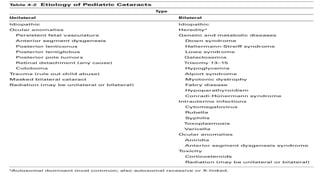
Congenital Cataract:
 present at birth.
 Infantile cataracts develop during the first year of life
 fairly common, occurring in 1 of every 2000 live birth
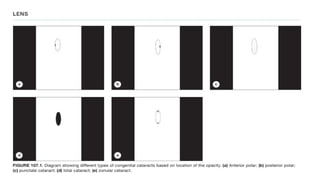
● occur in a variety of morphologic configurations
 Lamellar
 Polar
 Sutural
 Coronary
 Cerulean
 Nuclear
 Capsular
 Complete, Membranous.
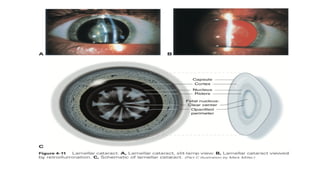
Lamellar :
 Most common
 Bilateral and symmetric,
 Opacifications of specific layers or zones of the lens
 Opacified layer that surrounds a clearer center and is itself
surrounded by a layer of clear cortex.
 Lamellar cataract  disc shaped configuration.
 Horseshoe shaped opacities  riders.
Polar :
● Subcapsular cortex and capsule of the anterior or posterior
pole of the lens.
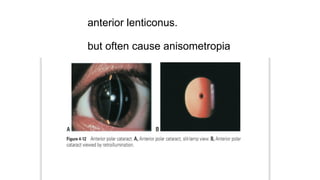
● Anterior polar cataracts  small,bilateral, symmetric,
nonprogressive opacities that do not impair vision
● association with other ocular abnormalities
microphthalmia
persistent pupillary membrane,
anterior lenticonus.
but often cause anisometropia
Posterior polar cataracts
● profound decrease in vision than anterior polar cataracts
● positioned closer to the nodal point.
● Familial : usually bilateral and autosomal dominant.
● Sporadic : unilateral,
associated with remnants of the tunica vasculosa lentis
lenticonus or lentiglobus.
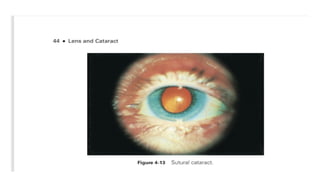
Sutural / Stellate cataract :
● Opacification of the Y- sutures of the fetal nucleus
● Bilateral
● Symmetric
● Inherited in an Autosomal Dominant pattern
Coronary :
● consist of a group of club- shaped cortical opacities that are
arranged around the equator of the lens like a crown, or
corona.
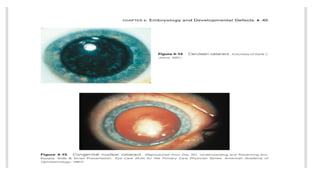
Cerulean :
● Also known as blue- dot cataracts
● small bluish opacities located in the lens cortex
● nonprogressive
● do not cause visual symptoms.
Nuclear :
● Opacities of the embryonic nucleus alone or of both
embryonic and fetal nuclei
● Bilateral
● Eyes with congenital nuclear cataracts tend to be
microphthalmic,
● They are at increased risk of developing aphakic glaucoma.
Capsular
● lens epithelium and anterior lens capsule
● differentiated from anterior polar cataracts by their
protrusion into the anterior chamber.
Complete / Total cataract :
● The red reflex is completely obscured
● Complete cataracts may be unilateral or bilateral,
● Profound visual impairment.
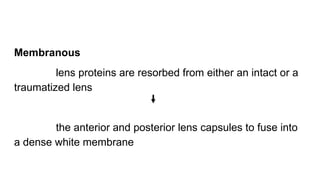
Membranous
lens proteins are resorbed from either an intact or a
traumatized lens
the anterior and posterior lens capsules to fuse into
a dense white membrane
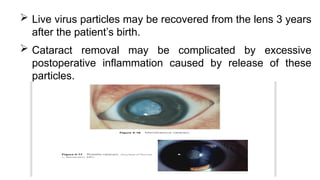
Rubella :
● Maternal infection with the rubella virus,
● RNA togavirus, can cause fetal damage,
● first trimester of pregnancy.
● pearly white nuclear opacifications.
● Sometimes the entire lens is opacified (complete cataract)
 Live virus particles may be recovered from the lens 3 years
after the patient’s birth.
 Cataract removal may be complicated by excessive
postoperative inflammation caused by release of these
particles.
ACQUIRED CATARACT
Age- Related Lens Changes
As the lens ages,
As new layers of cortical fibers form concentrically
increases in mass and thickness and decreases in
accommodative power.
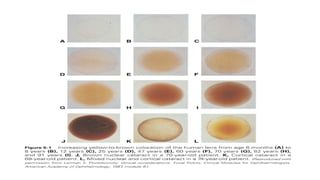
the lens nucleus compresses and hardens (a process
known as nuclear sclerosis).
● Chemical modification and proteolytic cleavage of
crystallins (lens proteins)
high- molecular- mass protein aggregates.
cause abrupt fluctuations in the local refractive
index of the lens,
scattering light and reducing transparency.
● Decreased concentrations of glutathione and
potassium and increased concentrations of sodium
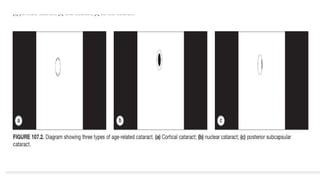
3 main types of age- related cataracts:
(1) nuclear,
(2) cortical,
(3) posterior subcapsular.
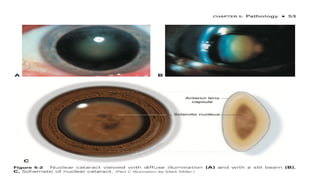
Nuclear Cataracts
 Slowly progressive bilateral asymmetric.
 Distance vision > near vision
 Increase in the refractive index of the lens and a myopic
shift in refraction
 Hyperopic or emmetropic eyes, the myopic shift enables
individuals to have improved distance vision or near vision
without the use of spectacles, a condition referred to as
second sight.
 monocular diplopia.
 poor color discrimination  blue end of the visible- light
spectrum.
CORTICAL CATARCT
 extensive protein oxidation and precipitation
 A common symptom of cortical cataracts is glare from
intense focal light sources such as car headlights.
 Monocular diplopia
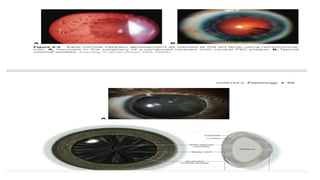
 first visible signs of cortical cataract formation are vacuoles
and water clefts in the anterior or posterior cortex.
 Wedge- shaped opacities form near the periphery of the
lens,
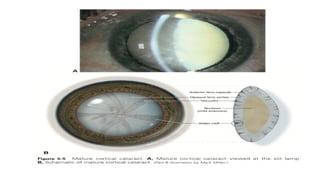
 entire cortex, from the capsule to the nucleus,becomes
white and opaque, the cataract is said to be mature
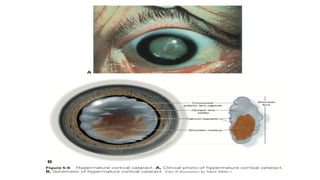
 Degenerated cortical material leaks through the lens
capsule, leaving the capsule wrinkled and shrunken, the
cataract is referred to as hypermature .
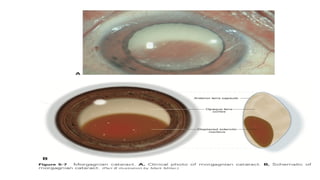
 When further liquefaction of the cortex allows free
movement of the nucleus within the capsular bag, the
cataract is described as morgagnian
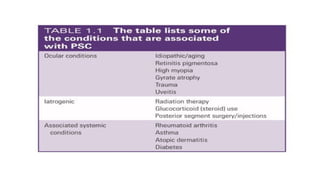
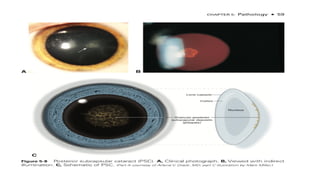
Posterior Subcapsular Cataracts :
Younger than those presenting with nuclear or cortical
cataracts.
First indication 1)subtle iridescent sheen in the posterior
cortical layer
2)granular opacities
3) a plaque like opacity of the posterior
subcapsular cortex
 Near vision > distance vision.
 PSCs are associated with posterior migration of the lens
epithelial cells from the lens equator to the visual axis on
the inner surface of the posterior capsule.
Drug- Induced Lens Changes
Corticosteroids :
Long- term use of corticosteroids :
 oral, topical,or inhaled corticosteroids
 intraocular steroids,
 slow release steroid repositories,  subconjunctival and
Intravitreal implants
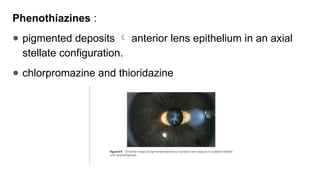
Phenothiazines :
● pigmented deposits  anterior lens epithelium in an axial
stellate configuration.
● chlorpromazine and thioridazine
Topical anticholinesterases :
 small vacuoles within and posterior to the anterior lens
capsule and epithelium
 cataract may progress to posterior cortical and nuclear
lens changes
Amiodarone :
 Antiarrhythmic medication
 stellate pigment deposition in the anterior cortical axis
 Amiodarone is also deposited in the corneal epithelium
(cornea verticillata) and can cause an optic neuropathy
.
Statins :
 concomitant use of simvastatin and erythromycin,
 Increases circulating statin levels, may be associated
with approximately a twofold increased risk of cataract.
Alves C, Mendes D, Batel Marques F. Statins and risk of cataracts: a systematic
review and metaanalysis of observational studies. Cardiovasc Ther.
2018;36(6):e12480
Tamoxifen :
 Antiestrogen
 Used in the prevention and adjuvant treatment of breast
cancer,
 PSC,
 Crystalline maculopathy ,
 Cystoid macular edema (CME)
Trauma :
 Mechanical injury
 Physical forces  radiation, chemicals, and electrical
current.
Contusion :
 Vossius ring : pupillary ruff to be imprinted on the anterior
surface of the lens
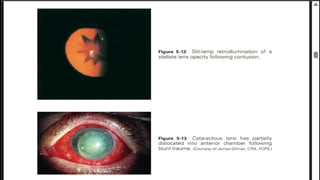
Traumatic cataract :
 A stellate or rosette- shaped opacification (rosette
cataract),
 Usually axial in location
 Blunt trauma causes both dislocation and cataract
formation
 Symptoms and signs of traumatic lens subluxation
Fluctuation of vision,
Impaired accommodation,
Monocular diplopia,
High astigmatism.
Iridodonesis
Phacodonesis is present.
Retroillumination  dilated pupil may reveal the
zonular disruption
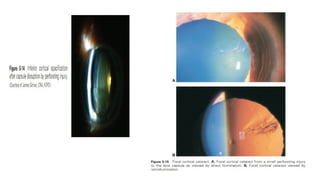
Perforating or Penetrating Injury :
 opacification of the cortex at the site of the rupture,
 which usually progresses rapidly to complete opacification
Intraocular Procedures
 after surgery or following a longer period of healing.
 Pars plana vitrectomy, especially with gas tamponade of the
retina,
 A visually significant nuclear sclerotic cataract develops in
80%–100% of phakic eyes within 2 years of undergoing
vitrectomy.
 Post vitrectomy cataracts are less common in patients younger
than 50 years
 Intravitreal injections  direct trauma to the lens /
an adverse effect medications injected
Trabeculectomy :
 The Collaborative Initial Glaucoma Treatment
Study found that glaucoma patients who were
initially treated with trabeculectomy were 8 times
more likely to need early cataract surgery than
those patients who were initially treated with
medications.
Radiation
● 20 years after exposure
● The first clinical signs of radiation-
1) Punctate opacities within the posterior capsule
2) Feathery anterior subcapsular opacities
Infrared radiation :
1) The outer layers of the anterior lens capsule to
peel off as a single layer  true exfoliation of the lens
capsule
2) Cortical cataract  glassblower’s cataract
Ultraviolet radiation :
 Increased risk of cortical cataracts,
 More frequently in men than women
American National Standards Institute (ANSI) requirements
aimed at reducing UV transmission. Using prescription
corrective lenses and nonprescription sunglasses decreases
UV exposure by more than 80%, and wearing a hat with a
brim decreases ocular sun exposure by 30%–50%
Metallosis
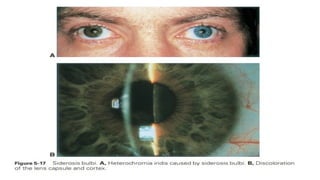
Siderosis bulbi :
 Iron molecules are deposited in the trabecular
meshwork, lens epithelium, iris, and retina
 The epithelium and cortical fibers of the lens show a
yellowish tinge, followed by a rusty brown discoloration
 Later manifestations : cortical cataract formation and
retinal dysfunction
Chalcosis :
 Deposits copper in DM, anterior lens capsule, other
intraocular basement membranes
 Sunflower cataract : petal shaped deposition of yellow or
brown pigment in the lens capsule that radiates from the
anterior axial pole of the lens to the equator
 Containing almost pure copper (more than 90%) can
cause a severe inflammatory reaction and intraocular
necrosis.
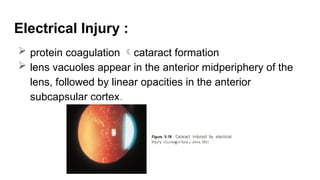
Electrical Injury :
 protein coagulation cataract formation
 lens vacuoles appear in the anterior midperiphery of the
lens, followed by linear opacities in the anterior
subcapsular cortex.
Chemical Injuries :
 Alkali injuries to the ocular surface often result in cataract
 Alkali compounds penetrate the eye readily, causing an
increase in aqueous pH and a decrease in the level of
aqueous glucose and ascorbate
Metabolic Cataract :
Diabetes Mellitus :
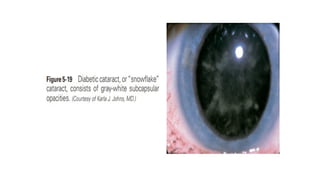
 Acute diabetic cataract or snowflake cataract,  bilateral, subcapsular
 Acute myopic shifts may indicate undiagnosed or poorly controlled
diabetes mellitus
 accumulation of sorbitol within the lens
 accompanying changes in hydration,
 increased nonenzymatic glycosylation
of lens proteins,
 greater oxidative stress.
from alterations in
lens metabolism
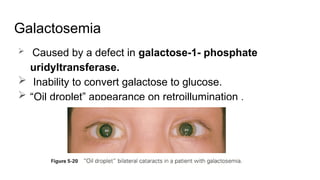
Galactosemia
 Caused by a defect in galactose-1- phosphate
uridyltransferase.
 Inability to convert galactose to glucose.
 “Oil droplet” appearance on retroillumination .
Hypocalcemia :
 Bilateral, hypocalcemic (tetanic) cataracts are punctate
iridescent opacities in the anterior and posterior cortex.
 lie beneath the lens capsule and are usually separated
from it by a zone of clear lens
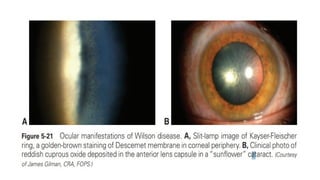
Wilson Disease :
 (hepatolenticular degeneration) is an inherited autosomal
recessive disorder of copper metabolism
 Kayser- Fleischer ring, a golden- brown discoloration of
Descemet membrane around the periphery of the cornea
 Reddish- brown pigment (cuprous oxide) is deposited in
the anterior lens capsule and subcapsular cortex in a
stellate shape that resembles the petals of a sunflower
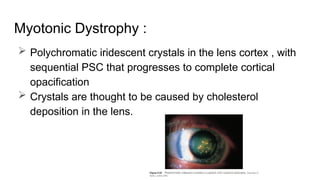
Myotonic Dystrophy :
 Polychromatic iridescent crystals in the lens cortex , with
sequential PSC that progresses to complete cortical
opacification
 Crystals are thought to be caused by cholesterol
deposition in the lens.
Cataract Associated With Uveitis
 Chronic uveitis or associated corticosteroid therapy
 PSC develops, but anterior lens opacification may also
occur
 Thickening of the anterior lens capsule,associated fibrous
pupillary membrane
 Calcium deposits may be observed on the anterior
capsule
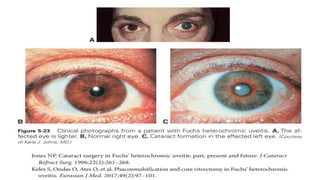
● Cortical cataract formation occurs in up to 70% of cases
of Fuchs heterochromic uveitis  favorable prognosis
● Intraoperative anterior chamber hemorrhage at the time of
cataract surgery has been reported in approximately 8%–
25% of cases.
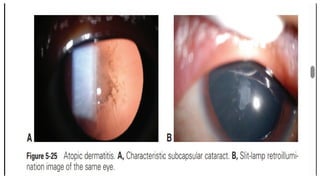
Cataract and Atopic Dermatitis
 Reported in 5%–38% of patients with Atopic dermatitis
 Bilateral, and onset second to third decade of life,
 Although cases in young children have been reported.
 Anterior or posterior subcapsular opacities in the pupillary
area that resemble shieldlike plaques
Types of cataract power point presentation

Types of cataract power point presentation

  • 1.
    TYPES OF CATARACT DR.O.UDAYASREE ANTERIOR SEGMENT (IOL) FELLOW TRILOCHANA NETHRALAYA SAMBALPUR
  • 2.
    INTRODUCTION ● The lensis a transparent, biconvex structure ● The lens provides ~15 D refractive power ● The lens is derived from surface ectoderm cells overlying the optic vesicle ● Lens transparency depends on the regular arrangement of the lens fibers and of the cytoplasm within the fibers ● their disorganisation results in the development of cataract.
  • 3.
    ● Cataract isdefined as opacity of clear lens which reduces amount of light entering eye and results in deterioration of vision. ● Cataract is the leading cause of preventable blindness.
  • 4.
    ETIOLOGICAL CLASSIFICATION : 1. Congenital cataract  2. Acquired cataract a. Age-related cataract b. Toxic – smoking, drugs c. Radiation d. Systemic diseases e. Ocular diseases f. Trauma g. Metabolic
  • 5.
    ● B. MORPHOLOGICALCLASSIFICATION 1.Capsular cataract. • Anterior capsular cataract • Posterior capsular cataract 2. Subcapsular cataract 3.Cortical cataract. 4. Supranuclear cataract. 5.Nuclear cataract. 6.Polar cataract. • Anterior polar cataract • Posterior polar cataract.
  • 6.
    ● C. CLASSIFICATIONBASED ON STAGE OF MATURITY 1. Stage of lamellar separation 2. Stage of incipient cataract 3. Immature cataract. 4. Mature cataract, 5. Hypermature cataract • Morgagnian hypermature cataract • Sclerotic type of hypermature cataract
  • 7.
     EYE CONDITIONS: ●Glaucoma + treatment cause cataract ● Drugs – miotics ● Filteration surgeries ● Inflammatory conditions ● Uveitis ● Corneal ulcer ● Endophthalmitis ● Retinitis pigmentosa ● Retinoblastoma ● Melanoma
  • 8.
    Congenital Cataract:  presentat birth.  Infantile cataracts develop during the first year of life  fairly common, occurring in 1 of every 2000 live birth
  • 10.
    ● occur ina variety of morphologic configurations  Lamellar  Polar  Sutural  Coronary  Cerulean  Nuclear  Capsular  Complete, Membranous.
  • 12.
    Lamellar :  Mostcommon  Bilateral and symmetric,  Opacifications of specific layers or zones of the lens  Opacified layer that surrounds a clearer center and is itself surrounded by a layer of clear cortex.  Lamellar cataract  disc shaped configuration.  Horseshoe shaped opacities  riders.
  • 14.
    Polar : ● Subcapsularcortex and capsule of the anterior or posterior pole of the lens. ● Anterior polar cataracts  small,bilateral, symmetric, nonprogressive opacities that do not impair vision ● association with other ocular abnormalities microphthalmia persistent pupillary membrane,
  • 15.
    anterior lenticonus. but oftencause anisometropia
  • 16.
    Posterior polar cataracts ●profound decrease in vision than anterior polar cataracts ● positioned closer to the nodal point. ● Familial : usually bilateral and autosomal dominant. ● Sporadic : unilateral, associated with remnants of the tunica vasculosa lentis lenticonus or lentiglobus.
  • 17.
    Sutural / Stellatecataract : ● Opacification of the Y- sutures of the fetal nucleus ● Bilateral ● Symmetric ● Inherited in an Autosomal Dominant pattern
  • 19.
    Coronary : ● consistof a group of club- shaped cortical opacities that are arranged around the equator of the lens like a crown, or corona. Cerulean : ● Also known as blue- dot cataracts ● small bluish opacities located in the lens cortex ● nonprogressive ● do not cause visual symptoms.
  • 21.
    Nuclear : ● Opacitiesof the embryonic nucleus alone or of both embryonic and fetal nuclei ● Bilateral ● Eyes with congenital nuclear cataracts tend to be microphthalmic, ● They are at increased risk of developing aphakic glaucoma.
  • 22.
    Capsular ● lens epitheliumand anterior lens capsule ● differentiated from anterior polar cataracts by their protrusion into the anterior chamber.
  • 23.
    Complete / Totalcataract : ● The red reflex is completely obscured ● Complete cataracts may be unilateral or bilateral, ● Profound visual impairment.
  • 24.
    Membranous lens proteins areresorbed from either an intact or a traumatized lens the anterior and posterior lens capsules to fuse into a dense white membrane
  • 25.
    Rubella : ● Maternalinfection with the rubella virus, ● RNA togavirus, can cause fetal damage, ● first trimester of pregnancy. ● pearly white nuclear opacifications. ● Sometimes the entire lens is opacified (complete cataract)
  • 26.
     Live virusparticles may be recovered from the lens 3 years after the patient’s birth.  Cataract removal may be complicated by excessive postoperative inflammation caused by release of these particles.
  • 27.
  • 28.
    Age- Related LensChanges As the lens ages, As new layers of cortical fibers form concentrically increases in mass and thickness and decreases in accommodative power. the lens nucleus compresses and hardens (a process known as nuclear sclerosis).
  • 29.
    ● Chemical modificationand proteolytic cleavage of crystallins (lens proteins) high- molecular- mass protein aggregates. cause abrupt fluctuations in the local refractive index of the lens, scattering light and reducing transparency. ● Decreased concentrations of glutathione and potassium and increased concentrations of sodium
  • 30.
    3 main typesof age- related cataracts: (1) nuclear, (2) cortical, (3) posterior subcapsular.
  • 32.
    Nuclear Cataracts  Slowlyprogressive bilateral asymmetric.  Distance vision > near vision  Increase in the refractive index of the lens and a myopic shift in refraction  Hyperopic or emmetropic eyes, the myopic shift enables individuals to have improved distance vision or near vision without the use of spectacles, a condition referred to as second sight.
  • 33.
     monocular diplopia. poor color discrimination  blue end of the visible- light spectrum.
  • 36.
    CORTICAL CATARCT  extensiveprotein oxidation and precipitation  A common symptom of cortical cataracts is glare from intense focal light sources such as car headlights.  Monocular diplopia
  • 37.
     first visiblesigns of cortical cataract formation are vacuoles and water clefts in the anterior or posterior cortex.  Wedge- shaped opacities form near the periphery of the lens,  entire cortex, from the capsule to the nucleus,becomes white and opaque, the cataract is said to be mature
  • 38.
     Degenerated corticalmaterial leaks through the lens capsule, leaving the capsule wrinkled and shrunken, the cataract is referred to as hypermature .  When further liquefaction of the cortex allows free movement of the nucleus within the capsular bag, the cataract is described as morgagnian
  • 43.
    Posterior Subcapsular Cataracts: Younger than those presenting with nuclear or cortical cataracts. First indication 1)subtle iridescent sheen in the posterior cortical layer 2)granular opacities 3) a plaque like opacity of the posterior subcapsular cortex
  • 44.
     Near vision> distance vision.  PSCs are associated with posterior migration of the lens epithelial cells from the lens equator to the visual axis on the inner surface of the posterior capsule.
  • 47.
    Drug- Induced LensChanges Corticosteroids : Long- term use of corticosteroids :  oral, topical,or inhaled corticosteroids  intraocular steroids,  slow release steroid repositories,  subconjunctival and Intravitreal implants
  • 48.
    Phenothiazines : ● pigmenteddeposits  anterior lens epithelium in an axial stellate configuration. ● chlorpromazine and thioridazine
  • 49.
    Topical anticholinesterases : small vacuoles within and posterior to the anterior lens capsule and epithelium  cataract may progress to posterior cortical and nuclear lens changes Amiodarone :  Antiarrhythmic medication
  • 50.
     stellate pigmentdeposition in the anterior cortical axis  Amiodarone is also deposited in the corneal epithelium (cornea verticillata) and can cause an optic neuropathy .
  • 51.
    Statins :  concomitantuse of simvastatin and erythromycin,  Increases circulating statin levels, may be associated with approximately a twofold increased risk of cataract. Alves C, Mendes D, Batel Marques F. Statins and risk of cataracts: a systematic review and metaanalysis of observational studies. Cardiovasc Ther. 2018;36(6):e12480
  • 52.
    Tamoxifen :  Antiestrogen Used in the prevention and adjuvant treatment of breast cancer,  PSC,  Crystalline maculopathy ,  Cystoid macular edema (CME)
  • 53.
    Trauma :  Mechanicalinjury  Physical forces  radiation, chemicals, and electrical current. Contusion :  Vossius ring : pupillary ruff to be imprinted on the anterior surface of the lens
  • 54.
    Traumatic cataract : A stellate or rosette- shaped opacification (rosette cataract),  Usually axial in location  Blunt trauma causes both dislocation and cataract formation
  • 56.
     Symptoms andsigns of traumatic lens subluxation Fluctuation of vision, Impaired accommodation, Monocular diplopia, High astigmatism. Iridodonesis Phacodonesis is present. Retroillumination  dilated pupil may reveal the zonular disruption
  • 57.
    Perforating or PenetratingInjury :  opacification of the cortex at the site of the rupture,  which usually progresses rapidly to complete opacification
  • 59.
    Intraocular Procedures  aftersurgery or following a longer period of healing.  Pars plana vitrectomy, especially with gas tamponade of the retina,  A visually significant nuclear sclerotic cataract develops in 80%–100% of phakic eyes within 2 years of undergoing vitrectomy.  Post vitrectomy cataracts are less common in patients younger than 50 years
  • 60.
     Intravitreal injections direct trauma to the lens / an adverse effect medications injected Trabeculectomy :  The Collaborative Initial Glaucoma Treatment Study found that glaucoma patients who were initially treated with trabeculectomy were 8 times more likely to need early cataract surgery than those patients who were initially treated with medications.
  • 61.
    Radiation ● 20 yearsafter exposure ● The first clinical signs of radiation- 1) Punctate opacities within the posterior capsule 2) Feathery anterior subcapsular opacities
  • 62.
    Infrared radiation : 1)The outer layers of the anterior lens capsule to peel off as a single layer  true exfoliation of the lens capsule 2) Cortical cataract  glassblower’s cataract
  • 63.
    Ultraviolet radiation : Increased risk of cortical cataracts,  More frequently in men than women American National Standards Institute (ANSI) requirements aimed at reducing UV transmission. Using prescription corrective lenses and nonprescription sunglasses decreases UV exposure by more than 80%, and wearing a hat with a brim decreases ocular sun exposure by 30%–50%
  • 64.
    Metallosis Siderosis bulbi : Iron molecules are deposited in the trabecular meshwork, lens epithelium, iris, and retina  The epithelium and cortical fibers of the lens show a yellowish tinge, followed by a rusty brown discoloration  Later manifestations : cortical cataract formation and retinal dysfunction
  • 66.
    Chalcosis :  Depositscopper in DM, anterior lens capsule, other intraocular basement membranes  Sunflower cataract : petal shaped deposition of yellow or brown pigment in the lens capsule that radiates from the anterior axial pole of the lens to the equator  Containing almost pure copper (more than 90%) can cause a severe inflammatory reaction and intraocular necrosis.
  • 67.
    Electrical Injury : protein coagulation cataract formation  lens vacuoles appear in the anterior midperiphery of the lens, followed by linear opacities in the anterior subcapsular cortex.
  • 68.
    Chemical Injuries : Alkali injuries to the ocular surface often result in cataract  Alkali compounds penetrate the eye readily, causing an increase in aqueous pH and a decrease in the level of aqueous glucose and ascorbate
  • 69.
    Metabolic Cataract : DiabetesMellitus :  Acute diabetic cataract or snowflake cataract,  bilateral, subcapsular  Acute myopic shifts may indicate undiagnosed or poorly controlled diabetes mellitus  accumulation of sorbitol within the lens  accompanying changes in hydration,  increased nonenzymatic glycosylation of lens proteins,  greater oxidative stress. from alterations in lens metabolism
  • 71.
    Galactosemia  Caused bya defect in galactose-1- phosphate uridyltransferase.  Inability to convert galactose to glucose.  “Oil droplet” appearance on retroillumination .
  • 72.
    Hypocalcemia :  Bilateral,hypocalcemic (tetanic) cataracts are punctate iridescent opacities in the anterior and posterior cortex.  lie beneath the lens capsule and are usually separated from it by a zone of clear lens
  • 73.
    Wilson Disease : (hepatolenticular degeneration) is an inherited autosomal recessive disorder of copper metabolism  Kayser- Fleischer ring, a golden- brown discoloration of Descemet membrane around the periphery of the cornea  Reddish- brown pigment (cuprous oxide) is deposited in the anterior lens capsule and subcapsular cortex in a stellate shape that resembles the petals of a sunflower
  • 75.
    Myotonic Dystrophy : Polychromatic iridescent crystals in the lens cortex , with sequential PSC that progresses to complete cortical opacification  Crystals are thought to be caused by cholesterol deposition in the lens.
  • 76.
    Cataract Associated WithUveitis  Chronic uveitis or associated corticosteroid therapy  PSC develops, but anterior lens opacification may also occur  Thickening of the anterior lens capsule,associated fibrous pupillary membrane  Calcium deposits may be observed on the anterior capsule
  • 77.
    ● Cortical cataractformation occurs in up to 70% of cases of Fuchs heterochromic uveitis  favorable prognosis ● Intraoperative anterior chamber hemorrhage at the time of cataract surgery has been reported in approximately 8%– 25% of cases.
  • 79.
    Cataract and AtopicDermatitis  Reported in 5%–38% of patients with Atopic dermatitis  Bilateral, and onset second to third decade of life,  Although cases in young children have been reported.  Anterior or posterior subcapsular opacities in the pupillary area that resemble shieldlike plaques