Department of Ophthalmology
Topic : STRABISMUS
Name : Mohamed Mahmoud Abbass
Group : 7th
Course : 4th
Definition
 Strabismus or squint or simply deviation of the eye
refers to a misalignment of the visual axis.
 Strabismus originates from the Greek.
 Hippocrates used the word streblos, ‘‘turned,’’
‘‘twisted,’’ when he talked about strabismic subjects
and the word is derived from the verb strephein, ‘‘to
twist,’’ ‘‘to turn.’’
 A worldwide estimate would be 130 to 260 million
• Visual axis ; line of vision ; extending from the point
of fixation to the fovea
• Strabismus ; misalignment of the visual axes
• orthophoria ; perfect alignment of the visual axes.
Most individuals have heterophoria
• Heterophoria ; (latent squint) tendency of the eyes
to deviate. Ocular alignment maintained with effort.
• Heterotropia; (manifest squint) which is present at
all times
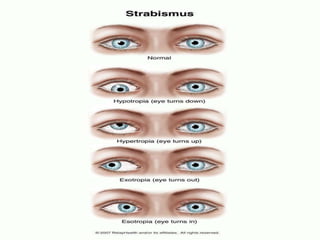
• Esophoria; latent squint inwards turning of the eyes
• Esotropia; manifest squint inwards turning of the eyes
• Exophoria; latent squint outwards turning of the eyes
• Exotropia; manifest squint outwards turning of the eyes
• Hyperphoria/hypertropia; latent/manifest squint
upwards turning of eyes
• Hypophoria/hypertropia; latent/manifest squint
downwards turning of eyes
• Anatomical axis ; is a line passing from the posterior pole
through the centre of the cornia .
• Angle kappa is the angle subtended by the visual and
anatomical axes .
Type of Deviation
 Horizontal Esodeviation or exodeviation
 Vertical Hyperdeviation or hypodeviation
 Torsional Incyclodeviation or excyclodeviation
 Combined Horizontal, vertical, torsional, pattern or any
combination thereof
Laws of ocular motility
 Agonist ; antagonist – muscles of the same eye moving
the eye in opposite direction; medial and lateral rectus
 Synergists= muscles of the same eye moving it in the
same direction; superior rectus and inferior oblique causing
elevation
 Yoke muscles= muscles of both eyes moving the eyes in
same direction; medial rectus of both eyes
 Sherrington law; increase in innervations to one muscle
causes decreased innervations to its antagonist; medial
and lateral rectus
 Hering law; equal innervations flows to yoke muscles in
eye movement ; medial rectus of both eyes
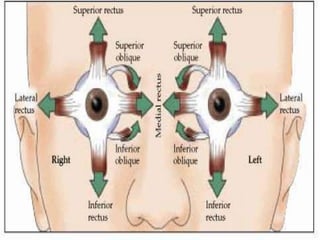
Extraocular muscles
Horizontal muscles;
– Medial rectus-; Its sole action in the primary position is
adduction. occulomotor nerve supply
– Lateral rectus- Its sole action in the primary position is
abduction.; abducens nerve supply
Vertical muscles;
– Superior rectus- Primary action elevation (secondary actions
are adduction and intorsion.
Oculomotor nerve supply
– Inferior rectus ; The primary action is depression ; secondary
actions are adduction and extortion. oculomotor nerve
supply
Extraocular muscles
• Oblique muscles;
– Superior oblque; Originates superomedial to the optic foramen. It
passes forwards through the trochlea at the angle between the
srperior and medial walls and is then reflected backwards and
laterally to insert in the posterior upper temporal quadrant of the
globe.
The primary action is intorsion ;secondary actions are depression and
abduction.
– oculomotor nerve supply
– Inferior oblique; Orginates from a small depression just behind the
orbital rim lateral to the lacrimal sac.
It passes backwards and laterally.
To insert in the posterior lower temporal quadrant of the globe, close to
the macula.
The prmary action is extorsion;;secondary action are elevation and
abduction .
Heterophoria
 when the influence of fusion is interrupted, the visual
axis of the non-fixing eye deviates from the orthoposition.
 Depending upon the direction of deviation, heterophoria
may be classified into:
1. Esophoria
2. Exophoria
3. Right hyperphoria
4. Left hyperphoria
5. Incyclophoria
6. Excyclophoria
Consequences of squint
Suppression , amblyopia , confusion and diplopia , postural
changes according to strabismus
Amblyopia
– Definition – unilateral or bilateral decrease of best corrected
visual acuity caused by stimulus deprivation or abnormal
interaction for which there is no pathology of the eye or the
visual pathway
– Types
• Strabismic amblyopia; abnormal interaction
• Stimulus deprivation amblyopia ; form vision deprivation
• Anisometropic amblyopia; difference of refractive errors in both eye ;
one eye is amblyopic
• Ametropic amblyopia; form vision deprivation of both eyes
• Meridional amblyopia; because of astigmatism
Medical Treatment
Treatment of Amblyopia
– Occlusion therapy
• Initial stage
• Maintenance stage
– Atropine therapy
• Optical Devices
– Spectacles
– Prisms
• Botulinum Toxin
• Orthoptics
Surgical Treatment
Surgical procedures
– Resection and recession
– Shifting of point of muscle attachment
– Faden procedure
• Choice of muscles for surgery
• Adjustable sutures
Strabismus

Strabismus

  • 1.
    Department of Ophthalmology Topic: STRABISMUS Name : Mohamed Mahmoud Abbass Group : 7th Course : 4th
  • 2.
    Definition  Strabismus orsquint or simply deviation of the eye refers to a misalignment of the visual axis.  Strabismus originates from the Greek.  Hippocrates used the word streblos, ‘‘turned,’’ ‘‘twisted,’’ when he talked about strabismic subjects and the word is derived from the verb strephein, ‘‘to twist,’’ ‘‘to turn.’’  A worldwide estimate would be 130 to 260 million
  • 3.
    • Visual axis; line of vision ; extending from the point of fixation to the fovea • Strabismus ; misalignment of the visual axes • orthophoria ; perfect alignment of the visual axes. Most individuals have heterophoria • Heterophoria ; (latent squint) tendency of the eyes to deviate. Ocular alignment maintained with effort. • Heterotropia; (manifest squint) which is present at all times
  • 4.
    • Esophoria; latentsquint inwards turning of the eyes • Esotropia; manifest squint inwards turning of the eyes • Exophoria; latent squint outwards turning of the eyes • Exotropia; manifest squint outwards turning of the eyes • Hyperphoria/hypertropia; latent/manifest squint upwards turning of eyes • Hypophoria/hypertropia; latent/manifest squint downwards turning of eyes • Anatomical axis ; is a line passing from the posterior pole through the centre of the cornia . • Angle kappa is the angle subtended by the visual and anatomical axes .
  • 6.
    Type of Deviation Horizontal Esodeviation or exodeviation  Vertical Hyperdeviation or hypodeviation  Torsional Incyclodeviation or excyclodeviation  Combined Horizontal, vertical, torsional, pattern or any combination thereof
  • 7.
    Laws of ocularmotility  Agonist ; antagonist – muscles of the same eye moving the eye in opposite direction; medial and lateral rectus  Synergists= muscles of the same eye moving it in the same direction; superior rectus and inferior oblique causing elevation  Yoke muscles= muscles of both eyes moving the eyes in same direction; medial rectus of both eyes  Sherrington law; increase in innervations to one muscle causes decreased innervations to its antagonist; medial and lateral rectus  Hering law; equal innervations flows to yoke muscles in eye movement ; medial rectus of both eyes
  • 9.
    Extraocular muscles Horizontal muscles; –Medial rectus-; Its sole action in the primary position is adduction. occulomotor nerve supply – Lateral rectus- Its sole action in the primary position is abduction.; abducens nerve supply Vertical muscles; – Superior rectus- Primary action elevation (secondary actions are adduction and intorsion. Oculomotor nerve supply – Inferior rectus ; The primary action is depression ; secondary actions are adduction and extortion. oculomotor nerve supply
  • 10.
    Extraocular muscles • Obliquemuscles; – Superior oblque; Originates superomedial to the optic foramen. It passes forwards through the trochlea at the angle between the srperior and medial walls and is then reflected backwards and laterally to insert in the posterior upper temporal quadrant of the globe. The primary action is intorsion ;secondary actions are depression and abduction. – oculomotor nerve supply – Inferior oblique; Orginates from a small depression just behind the orbital rim lateral to the lacrimal sac. It passes backwards and laterally. To insert in the posterior lower temporal quadrant of the globe, close to the macula. The prmary action is extorsion;;secondary action are elevation and abduction .
  • 12.
    Heterophoria  when theinfluence of fusion is interrupted, the visual axis of the non-fixing eye deviates from the orthoposition.  Depending upon the direction of deviation, heterophoria may be classified into: 1. Esophoria 2. Exophoria 3. Right hyperphoria 4. Left hyperphoria 5. Incyclophoria 6. Excyclophoria
  • 13.
    Consequences of squint Suppression, amblyopia , confusion and diplopia , postural changes according to strabismus Amblyopia – Definition – unilateral or bilateral decrease of best corrected visual acuity caused by stimulus deprivation or abnormal interaction for which there is no pathology of the eye or the visual pathway – Types • Strabismic amblyopia; abnormal interaction • Stimulus deprivation amblyopia ; form vision deprivation • Anisometropic amblyopia; difference of refractive errors in both eye ; one eye is amblyopic • Ametropic amblyopia; form vision deprivation of both eyes • Meridional amblyopia; because of astigmatism
  • 14.
    Medical Treatment Treatment ofAmblyopia – Occlusion therapy • Initial stage • Maintenance stage – Atropine therapy • Optical Devices – Spectacles – Prisms • Botulinum Toxin • Orthoptics
  • 15.
    Surgical Treatment Surgical procedures –Resection and recession – Shifting of point of muscle attachment – Faden procedure • Choice of muscles for surgery • Adjustable sutures