Cataracts An overview
What is a cataract Clouding of the lens Most are related to aging By 80, more than half Americans have a cataract or have had surgery for it. Can occur in one or both eyes Cannot spread from eye to eye
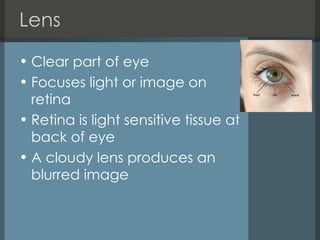
Lens Clear part of eye  Focuses light or image on retina Retina is light sensitive tissue at back of eye A cloudy lens produces an blurred image
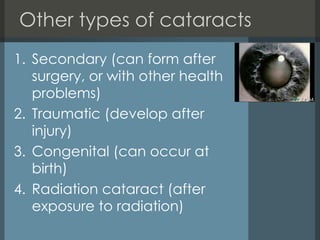
Other types of cataracts Secondary (can form after surgery, or with other health problems) Traumatic (develop after injury) Congenital (can occur at birth) Radiation cataract (after exposure to radiation)
How does it look with cataracts?
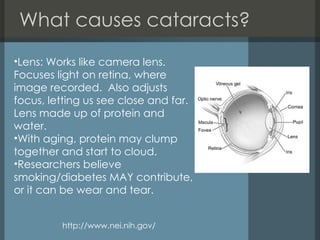
What causes cataracts? http://www.nei.nih.gov/ Lens: Works like camera lens. Focuses light on retina, where image recorded.  Also adjusts focus, letting us see close and far. Lens made up of protein and water.  With aging, protein may clump together and start to cloud. Researchers believe smoking/diabetes MAY contribute, or it can be wear and tear.
How it affects vision? Clumps of protein reduce sharpness of image Clear lens may change to yellowish/brownish color
Who is at risk for cataracts? Diseases such as diabetes Previous eye injury or surgery Prolonged use of corticosteriods Behavior such as smoking & alcohol Environment such as prolonged exposure to sun
How can I protect my eyes? Wear sunglasses and a brimmed hat Stop smoking Nutrition (eat green leafy vegetables, fruit, etc.) Comprehensive dilated eye exam at least once/every 2 years. Early treatment may save your sight.
Symptoms & Detection Cloudy, blurred vision Faded colors Glare from headlights/lamps Poor night vision Double vision  Frequent prescription changes
How is it detected? Visual acuity test (Eye test for distances) Dilated eye exam Tonometry (instrument to measure pressure in eye)
How is it treated? Can be improved with new eyeglasses, brighter lighting, anti glare sunglasses or magnifying glasses Surgery (remove cloudy lens and replace with artificial lens) Cataract surgery will include only one eye at a time, is one of the safest and most effective types of surgery.
What research is being done? Effect of sunlight exposure (may be related) Vitamin supplements which may slow progression Genetic studies, to better understand cataract development
Interactive eye Click on link below for an interactive look at the eye http://www.nei.nih.gov/health/eyediagram/
More information Tutorial on cataracts from Medline Plus: http://www.nlm.nih.gov/medlineplus/tutorials/cataracts/htm/_yes_50_no_0.htm
Resources National Eye Institute http://www.nei.nih.gov/about/

Cataracts

  • 1.
  • 2.
    What is acataract Clouding of the lens Most are related to aging By 80, more than half Americans have a cataract or have had surgery for it. Can occur in one or both eyes Cannot spread from eye to eye
  • 3.
    Lens Clear partof eye Focuses light or image on retina Retina is light sensitive tissue at back of eye A cloudy lens produces an blurred image
  • 4.
    Other types ofcataracts Secondary (can form after surgery, or with other health problems) Traumatic (develop after injury) Congenital (can occur at birth) Radiation cataract (after exposure to radiation)
  • 5.
    How does itlook with cataracts?
  • 6.
    What causes cataracts?http://www.nei.nih.gov/ Lens: Works like camera lens. Focuses light on retina, where image recorded. Also adjusts focus, letting us see close and far. Lens made up of protein and water. With aging, protein may clump together and start to cloud. Researchers believe smoking/diabetes MAY contribute, or it can be wear and tear.
  • 7.
    How it affectsvision? Clumps of protein reduce sharpness of image Clear lens may change to yellowish/brownish color
  • 8.
    Who is atrisk for cataracts? Diseases such as diabetes Previous eye injury or surgery Prolonged use of corticosteriods Behavior such as smoking & alcohol Environment such as prolonged exposure to sun
  • 9.
    How can Iprotect my eyes? Wear sunglasses and a brimmed hat Stop smoking Nutrition (eat green leafy vegetables, fruit, etc.) Comprehensive dilated eye exam at least once/every 2 years. Early treatment may save your sight.
  • 10.
    Symptoms & DetectionCloudy, blurred vision Faded colors Glare from headlights/lamps Poor night vision Double vision Frequent prescription changes
  • 11.
    How is itdetected? Visual acuity test (Eye test for distances) Dilated eye exam Tonometry (instrument to measure pressure in eye)
  • 12.
    How is ittreated? Can be improved with new eyeglasses, brighter lighting, anti glare sunglasses or magnifying glasses Surgery (remove cloudy lens and replace with artificial lens) Cataract surgery will include only one eye at a time, is one of the safest and most effective types of surgery.
  • 13.
    What research isbeing done? Effect of sunlight exposure (may be related) Vitamin supplements which may slow progression Genetic studies, to better understand cataract development
  • 14.
    Interactive eye Clickon link below for an interactive look at the eye http://www.nei.nih.gov/health/eyediagram/
  • 15.
    More information Tutorialon cataracts from Medline Plus: http://www.nlm.nih.gov/medlineplus/tutorials/cataracts/htm/_yes_50_no_0.htm
  • 16.
    Resources National EyeInstitute http://www.nei.nih.gov/about/