Nanotechnology
And
It’s Applications
By-chinmoy paul
CONTENTS:-
BASIC DEFINITION
HISTORY
APPLICATIONS
 MEDICINE
 ENERGY
 STORAGE
 INDUSTRIAL
OBSTACLES AND HURDLES
CONCLUSION
REFERENCE
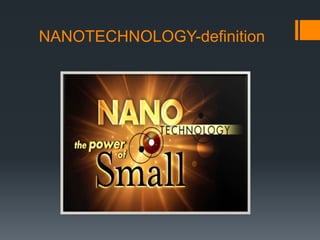
NANOTECHNOLOGY-definition
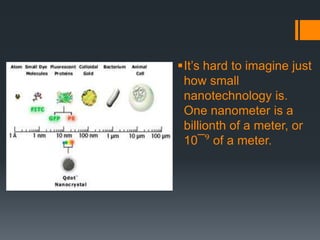
It’s hard to imagine just
how small
nanotechnology is.
One nanometer is a
billionth of a meter, or
10¯⁹ of a meter.
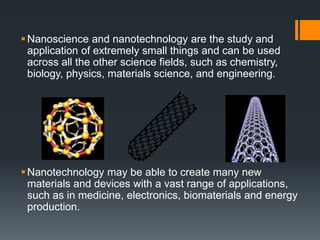
Nanoscience and nanotechnology are the study and
application of extremely small things and can be used
across all the other science fields, such as chemistry,
biology, physics, materials science, and engineering.
Nanotechnology may be able to create many new
materials and devices with a vast range of applications,
such as in medicine, electronics, biomaterials and energy
production.
History:-
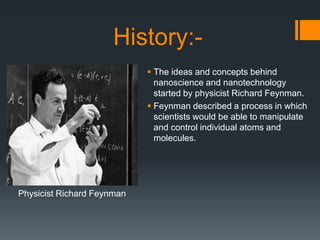
 The ideas and concepts behind
nanoscience and nanotechnology
started by physicist Richard Feynman.
 Feynman described a process in which
scientists would be able to manipulate
and control individual atoms and
molecules.
Physicist Richard Feynman
APPLICATIONS:-
NANOMEDICINE:-
Nanomedicine is the medical application of
nanotechnology.
Nanomedicine ranges from the medical
applications of nanomaterials, to
nanoelectronic biosensors, and even possible
future applications of molecular
nanotechnology.
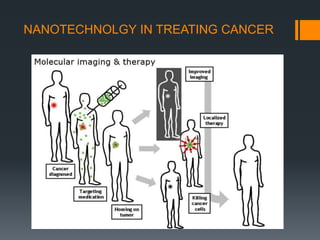
NANOTECHNOLGY IN TREATING CANCER
Energy applications of nanotechnology
An important subfield of nanotechnology related to energy
is nanofabrication.
Nanofabrication is the process of designing and creating
devices on the nanoscale. Creating devices smaller than
100 nanometres opens many doors for the development
of new ways to capture, store, and transfer energy.
Nanotechnology in Memory and
Storage
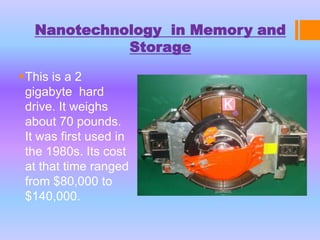
This is a 2
gigabyte hard
drive. It weighs
about 70 pounds.
It was first used in
the 1980s. Its cost
at that time ranged
from $80,000 to
$140,000.
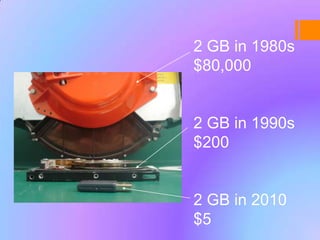
2 GB in 1980s
$80,000
2 GB in 1990s
$200
2 GB in 2010
$5
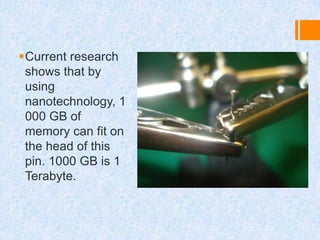
Current research
shows that by
using
nanotechnology, 1
000 GB of
memory can fit on
the head of this
pin. 1000 GB is 1
Terabyte.
Nanotechnologies for Flexible
Electronics
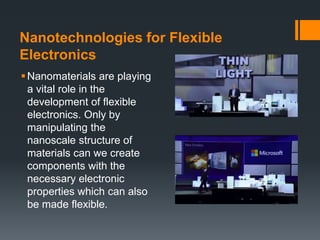
Nanomaterials are playing
a vital role in the
development of flexible
electronics. Only by
manipulating the
nanoscale structure of
materials can we create
components with the
necessary electronic
properties which can also
be made flexible.
Industrial applications of
nanotechnology
Surfaces and coatings-
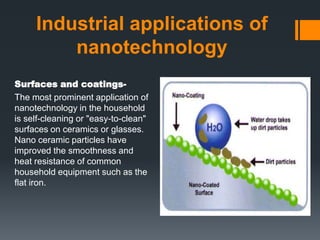
The most prominent application of
nanotechnology in the household
is self-cleaning or "easy-to-clean"
surfaces on ceramics or glasses.
Nano ceramic particles have
improved the smoothness and
heat resistance of common
household equipment such as the
flat iron.
Textiles:-
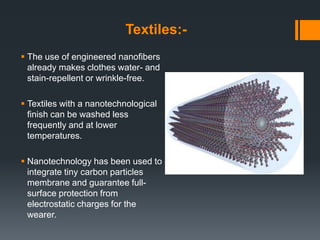
 The use of engineered nanofibers
already makes clothes water- and
stain-repellent or wrinkle-free.
 Textiles with a nanotechnological
finish can be washed less
frequently and at lower
temperatures.
 Nanotechnology has been used to
integrate tiny carbon particles
membrane and guarantee full-
surface protection from
electrostatic charges for the
wearer.
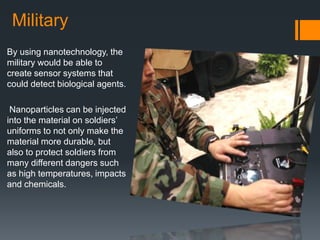
Military
By using nanotechnology, the
military would be able to
create sensor systems that
could detect biological agents.
Nanoparticles can be injected
into the material on soldiers’
uniforms to not only make the
material more durable, but
also to protect soldiers from
many different dangers such
as high temperatures, impacts
and chemicals.
Obstacles and Hurdles
Mass Production/Throughput and Cost
Constraints
Funding Requires Long-Term Investments
Intellectual Property Issues - Patent Office that
is Overwhelmed and Under-Qualified
CONCLUSION:-
 As a conclusion to this topic I would like to say that Nanotechnology is
a brand new technology that has just began, it is a revolutionary
science that will change all what we knew before.
 The future that we were watching just in science fiction movies will in
the near future be real.
 This new technology will first of all, keep us healthy because of Nano
robots that will repair every damage that we have in our body.
 Nanotechnology will give us an abundant energy because it will
transform energy more effectively.
 Nanotechnology covers a lot of domains today and will cover a lot more
in the near future, it is infinitely big and will make a lot of inventions
come true like teleportation for example which scientists are working on
today.
References:-
Websites:-
 www.wikipedia.com/nanotechnoloy
 www.nano.gov/nanotech-101
 www.nanotechgroup.org
Any
questions….???

NANOTECHNOLOGY AND IT'S APPLICATIONS

  • 1.
  • 2.
    CONTENTS:- BASIC DEFINITION HISTORY APPLICATIONS  MEDICINE ENERGY  STORAGE  INDUSTRIAL OBSTACLES AND HURDLES CONCLUSION REFERENCE
  • 3.
  • 4.
    It’s hard toimagine just how small nanotechnology is. One nanometer is a billionth of a meter, or 10¯⁹ of a meter.
  • 5.
    Nanoscience and nanotechnologyare the study and application of extremely small things and can be used across all the other science fields, such as chemistry, biology, physics, materials science, and engineering. Nanotechnology may be able to create many new materials and devices with a vast range of applications, such as in medicine, electronics, biomaterials and energy production.
  • 6.
    History:-  The ideasand concepts behind nanoscience and nanotechnology started by physicist Richard Feynman.  Feynman described a process in which scientists would be able to manipulate and control individual atoms and molecules. Physicist Richard Feynman
  • 7.
  • 8.
    NANOMEDICINE:- Nanomedicine is themedical application of nanotechnology. Nanomedicine ranges from the medical applications of nanomaterials, to nanoelectronic biosensors, and even possible future applications of molecular nanotechnology.
  • 9.
  • 10.
    Energy applications ofnanotechnology An important subfield of nanotechnology related to energy is nanofabrication. Nanofabrication is the process of designing and creating devices on the nanoscale. Creating devices smaller than 100 nanometres opens many doors for the development of new ways to capture, store, and transfer energy.
  • 11.
    Nanotechnology in Memoryand Storage This is a 2 gigabyte hard drive. It weighs about 70 pounds. It was first used in the 1980s. Its cost at that time ranged from $80,000 to $140,000.
  • 12.
    2 GB in1980s $80,000 2 GB in 1990s $200 2 GB in 2010 $5
  • 13.
    Current research shows thatby using nanotechnology, 1 000 GB of memory can fit on the head of this pin. 1000 GB is 1 Terabyte.
  • 14.
    Nanotechnologies for Flexible Electronics Nanomaterialsare playing a vital role in the development of flexible electronics. Only by manipulating the nanoscale structure of materials can we create components with the necessary electronic properties which can also be made flexible.
  • 15.
    Industrial applications of nanotechnology Surfacesand coatings- The most prominent application of nanotechnology in the household is self-cleaning or "easy-to-clean" surfaces on ceramics or glasses. Nano ceramic particles have improved the smoothness and heat resistance of common household equipment such as the flat iron.
  • 16.
    Textiles:-  The useof engineered nanofibers already makes clothes water- and stain-repellent or wrinkle-free.  Textiles with a nanotechnological finish can be washed less frequently and at lower temperatures.  Nanotechnology has been used to integrate tiny carbon particles membrane and guarantee full- surface protection from electrostatic charges for the wearer.
  • 17.
    Military By using nanotechnology,the military would be able to create sensor systems that could detect biological agents. Nanoparticles can be injected into the material on soldiers’ uniforms to not only make the material more durable, but also to protect soldiers from many different dangers such as high temperatures, impacts and chemicals.
  • 18.
    Obstacles and Hurdles MassProduction/Throughput and Cost Constraints Funding Requires Long-Term Investments Intellectual Property Issues - Patent Office that is Overwhelmed and Under-Qualified
  • 19.
    CONCLUSION:-  As aconclusion to this topic I would like to say that Nanotechnology is a brand new technology that has just began, it is a revolutionary science that will change all what we knew before.  The future that we were watching just in science fiction movies will in the near future be real.  This new technology will first of all, keep us healthy because of Nano robots that will repair every damage that we have in our body.  Nanotechnology will give us an abundant energy because it will transform energy more effectively.  Nanotechnology covers a lot of domains today and will cover a lot more in the near future, it is infinitely big and will make a lot of inventions come true like teleportation for example which scientists are working on today.
  • 20.
  • 21.