Nanotechnology
Contents
 Introduction To Nanotechnology
 How Small A Nanometer Is ?
 Origins Of Nanotechnology
 Why Nanotechnology
 Applications Of Nanotechnology
 Advantages Of Nanotechnology
 Disadvantages Of Nanotechnology
 Future of Nanotechnology
 Conclusion
Introduction to Nanotechnology
 Nanotechnology is the study and application of
extremely small things and can be used across
various fields
A nanometer is…
 one billionth of a meter
How Small Is Nanometer?
Human Hair: Approx. 1x10⁵ nm
DNA Sample: Approx. 2 nm
Electron Microscope
Origins of Nanotechnology
 Richard Feynman first conceived the idea of
molecular manufacturing in 1959
 Richard Feynman was the first scientist to
suggest that devices and materials could
someday be fabricated to atomic
specifications
 In 1986, K. Eric Drexler introduced the term
nanotechnology from there Scientific
research expanded to what we know today.
Why Nanotechnology?
 At the nanoscale, the physical, chemical,
and biological properties of materials differ
in fundamental and valuable ways from
the properties of individual atoms and
molecules or bulk matter.
 Nanotechnology research and
development is directed towards
understanding and creating improved
materials, devices, and systems.
 Electronics:
 Nano Transistors
 Nano Diodes
Applications Of Nanotechnology
Electronics
 Displays
 Computers
Applications Of Nanotechnology
 Energy:
 Batteries
 Fuel Cells
 Solar Cells
Applications Of Nanotechnology
 Materials:
 Nano Tubes
 Aerogel
 Nano Particles
Applications Of Nanotechnology
Nanotechnology Is Used Almost
Everywhere
Advantages Of Nanotechnology
 Medical Advantages
 End of Illnesses (I.e. Cancer, heart disease)
 Universal immunity (I.e. aids, flu)
 Body Sculpting (I.e. change your appearance)
 Stop the aging Process
Advantages Of Nanotechnology
 Industrial Advantages
 Computers a billion times faster and a million
times smaller
 Automatic Pollution Cleanup
 Manufacturing at almost no cost
Advantages Of Nanotechnology
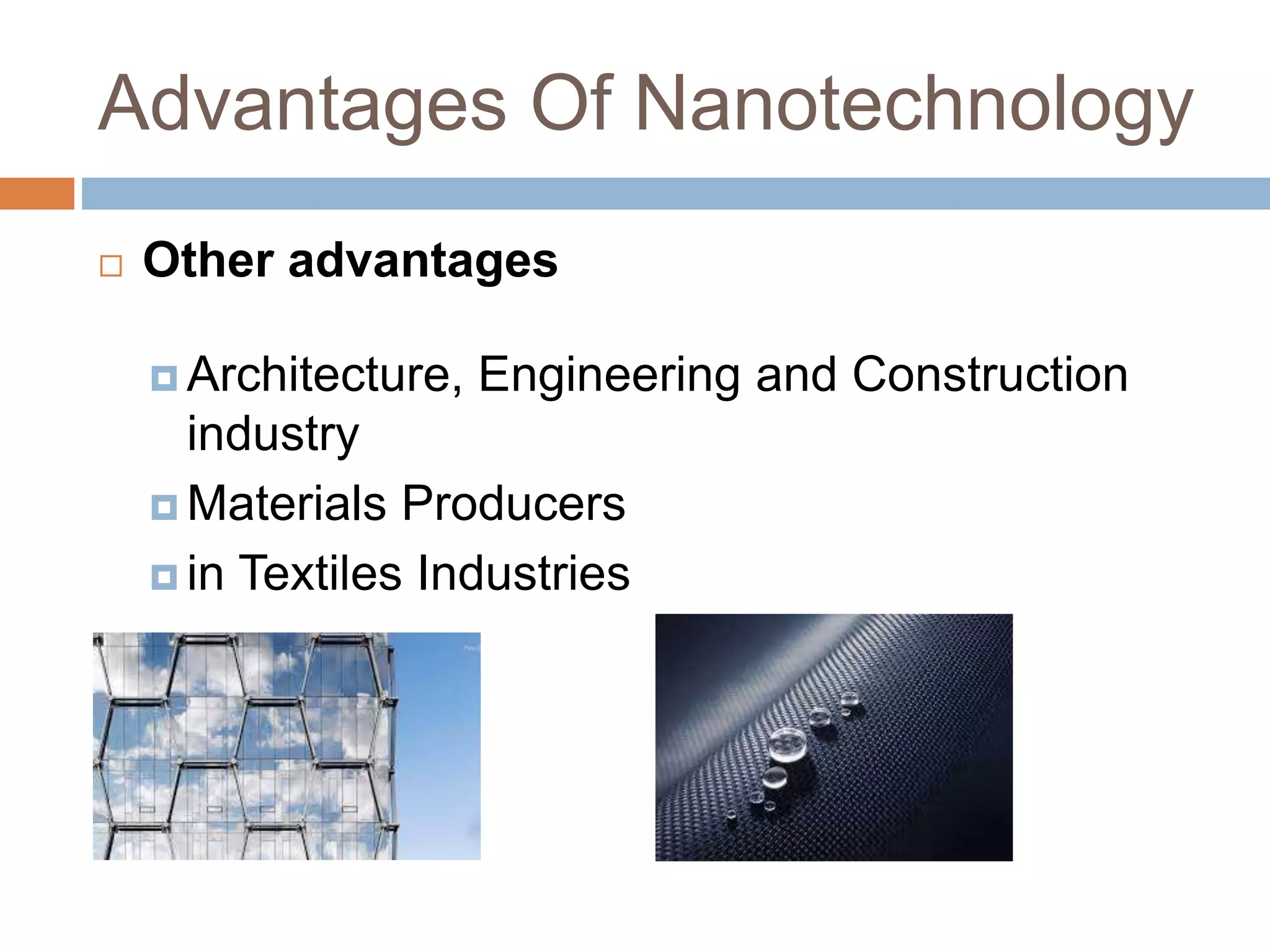
 Other advantages
 Architecture, Engineering and Construction
industry
 Materials Producers
 in Textiles Industries
Disadvantages Of
Nanotechnology
1. Loss of jobs (manufacturing, farming, etc)
2. Oil Becomes worthless
3. increased production of DNA damage, genotoxic
effects, damages to organs and tissues in
humans.
4. effects on growth and yield of crop plants.
5. Atomic weapons more accessible and
Future of Nanotechnology
 Nanotechnology will redesign the future of
several technologies, products and
markets.
 Scientists and engineers can now work
with materials at the atomic level to create
stain-proof fabrics, scratch-resistant
paints, more efficient fuel cells and
batteries
Conclusion
 Nanotechnology offers the ability to build
large numbers of products that are
incredibly powerful
 Nanotechnology is heavily intertwined with
biotechnology and information technology,
making its scope very wide
 The nanotechnology industry is mainly
used to create a better advanced world
Thank You

nanotechnology-ppt (1) kjds.bfsu_ogvd.pptx

  • 1.
  • 2.
    Contents  Introduction ToNanotechnology  How Small A Nanometer Is ?  Origins Of Nanotechnology  Why Nanotechnology  Applications Of Nanotechnology  Advantages Of Nanotechnology  Disadvantages Of Nanotechnology  Future of Nanotechnology  Conclusion
  • 3.
    Introduction to Nanotechnology Nanotechnology is the study and application of extremely small things and can be used across various fields
  • 4.
    A nanometer is… one billionth of a meter How Small Is Nanometer? Human Hair: Approx. 1x10⁵ nm DNA Sample: Approx. 2 nm
  • 5.
  • 6.
    Origins of Nanotechnology Richard Feynman first conceived the idea of molecular manufacturing in 1959  Richard Feynman was the first scientist to suggest that devices and materials could someday be fabricated to atomic specifications  In 1986, K. Eric Drexler introduced the term nanotechnology from there Scientific research expanded to what we know today.
  • 7.
    Why Nanotechnology?  Atthe nanoscale, the physical, chemical, and biological properties of materials differ in fundamental and valuable ways from the properties of individual atoms and molecules or bulk matter.  Nanotechnology research and development is directed towards understanding and creating improved materials, devices, and systems.
  • 8.
     Electronics:  NanoTransistors  Nano Diodes Applications Of Nanotechnology
  • 9.
  • 10.
     Energy:  Batteries Fuel Cells  Solar Cells Applications Of Nanotechnology
  • 11.
     Materials:  NanoTubes  Aerogel  Nano Particles Applications Of Nanotechnology
  • 12.
    Nanotechnology Is UsedAlmost Everywhere
  • 13.
    Advantages Of Nanotechnology Medical Advantages  End of Illnesses (I.e. Cancer, heart disease)  Universal immunity (I.e. aids, flu)  Body Sculpting (I.e. change your appearance)  Stop the aging Process
  • 14.
    Advantages Of Nanotechnology Industrial Advantages  Computers a billion times faster and a million times smaller  Automatic Pollution Cleanup  Manufacturing at almost no cost
  • 15.
    Advantages Of Nanotechnology Other advantages  Architecture, Engineering and Construction industry  Materials Producers  in Textiles Industries
  • 16.
    Disadvantages Of Nanotechnology 1. Lossof jobs (manufacturing, farming, etc) 2. Oil Becomes worthless 3. increased production of DNA damage, genotoxic effects, damages to organs and tissues in humans. 4. effects on growth and yield of crop plants. 5. Atomic weapons more accessible and
  • 17.
    Future of Nanotechnology Nanotechnology will redesign the future of several technologies, products and markets.  Scientists and engineers can now work with materials at the atomic level to create stain-proof fabrics, scratch-resistant paints, more efficient fuel cells and batteries
  • 18.
    Conclusion  Nanotechnology offersthe ability to build large numbers of products that are incredibly powerful  Nanotechnology is heavily intertwined with biotechnology and information technology, making its scope very wide  The nanotechnology industry is mainly used to create a better advanced world
  • 19.

Editor's Notes

  • #5 1. Its a bit difficult to realize how small the nano-scale is. To make things easier to get, we can say that one nanometre (nm) is one billionth of a metre. -2. Lets see some examples to make it clear In the picture on the right, we can see a man staring at his picked hair trying to figuring out the diameter of it, he will essentially come to the conclusion that a human hair is 100,000nm thick, while a DNA molecule is only 2 nms wide.
  • #9 e.g: in da field of electronics nanotransistors are becoming more nd more popular bcoz of it’s compactness.. If u are thinking that this is a single transistor then you need to reshape your thinking, bcoz this is a transistor box containing thousonds of transistors in it… Some other examples of nanoelectronics are Nanodiodes, OLEDs etc.
  • #10 The aapliances made with the help of nanoelectronics are getting its market share increasing and are becoming popular day by day due to the productivity and quality they have. Such as plasma Displays nd Quantum computing..
  • #11 1-This is a nano-engineered battery, light in weight and flexible just like a paper. It can be rolled, twisted, folded or cut into a number of shapes with absolutely no loss of mechanical efficiency. Other energy suppliment examples with some change in their properties are fuel cells and solar cells
  • #12 1-this rotating picture is actually a model of carbon nanotube, the strongest and stiffest materials discovered till to date. These tubes are the building block of almost all the NT objects. 2- Aerogel. The world’s lightest crystalline solid 3-and nano particles