Presented by: Electro Infinity
Vikas Kumar(1325280)
Shaheed Udham Singh College of Engineering & Technology
CONTENTS
Introduction
What is “Nanoscale”?
Nanotechnology
What makes the Nanoscale special?
Need of Nanotechnology in Electronics
Nanotechnology in Electronics
Common Applications of Nanotechnology in
Electronics
Future Scope of Nanotechnology
INTRODUCTION
What is “Nano”?
Nano in Greek means
‘dwarf’…..but in actual Nano is even smaller
than dwarf i.e atomic level of anything.
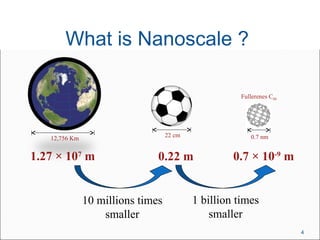
What is Nanoscale ?
1.27 × 10⁷
m 0.22 m 0.7 × 10⁻⁹
m
Fullerenes C60
12,756 Km 22 cm 0.7 nm
10 millions times
smaller
1 billion times
smaller
4
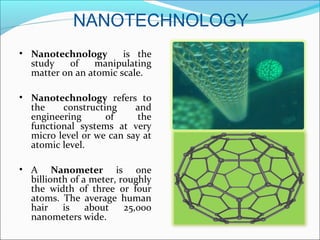
NANOTECHNOLOGY
• Nanotechnology is the
study of manipulating
matter on an atomic scale.
• Nanotechnology refers to
the constructing and
engineering of the
functional systems at very
micro level or we can say at
atomic level.
• A Nanometer is one
billionth of a meter, roughly
the width of three or four
atoms. The average human
hair is about 25,000
nanometers wide.
What makes the Nanoscale special?

High density of structures is possible with small size.

Physical and chemical properties can be different at
the nano-scale (e.g. electronic, optical, mechanical,
thermal, chemical).

The physical behavior of material can be different in
the nano-regime because of the different ways
physical properties scale with dimension (e.g. area vs.
volume).
What is a Carbon
Nanotube?
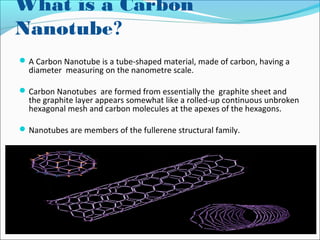
A Carbon Nanotube is a tube-shaped material, made of carbon, having a
diameter measuring on the nanometre scale.
Carbon Nanotubes are formed from essentially the graphite sheet and
the graphite layer appears somewhat like a rolled-up continuous unbroken
hexagonal mesh and carbon molecules at the apexes of the hexagons.
Nanotubes are members of the fullerene structural family.
Need of Nanotechnology in
Electronics
Today microelectronics are used and
they solve our most of the problems.
The two exceptional disadvantages
of micro electronics are:
 Physical size
 Increasing cost of fabrication of
integrated circuits.
To overcome these disadvantages
nanotechnology can be used.
Nanotechnology in Electronics
Nanoelectronics refer to the use of nanotechnology
on electronic components, especially transistors. 
Nanoelectronics often refer to transistor devices that are 
so small that inter-atomic interactions and quantum 
mechanical properties need to be studied extensively. 
Besides being small and allowing more transistors to be 
packed into a single chip, the uniform and symmetrical 
structure of nanotubes allows a higher electron mobility, a 
higher dielectric constant (faster frequency), and a 
symmetrical electron/ hole characteristic.
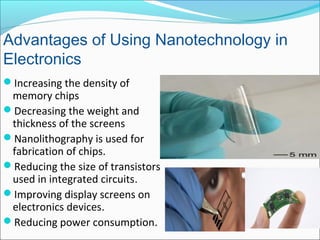
Increasing the density of
memory chips
Decreasing the weight and
thickness of the screens
Nanolithography is used for
fabrication of chips.
Reducing the size of transistors
used in integrated circuits.
Improving display screens on
electronics devices.
Reducing power consumption.
Advantages of Using Nanotechnology in
Electronics
Graphene transistor
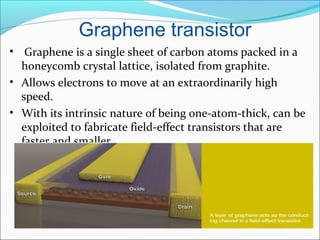
• Graphene is a single sheet of carbon atoms packed in a
honeycomb crystal lattice, isolated from graphite.
• Allows electrons to move at an extraordinarily high
speed.
• With its intrinsic nature of being one-atom-thick, can be
exploited to fabricate field-effect transistors that are
faster and smaller.
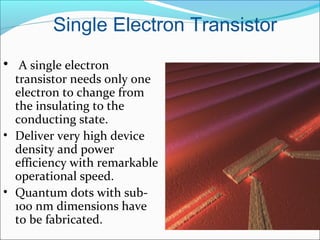
Single Electron Transistor
• A single electron
transistor needs only one
electron to change from
the insulating to the
conducting state.
• Deliver very high device
density and power
efficiency with remarkable
operational speed.
• Quantum dots with sub-
100 nm dimensions have
to be fabricated.
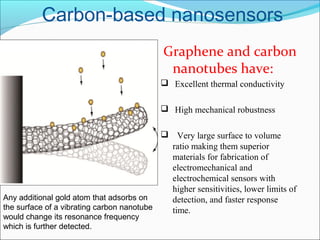
Carbon-based nanosensors
Graphene and carbon
nanotubes have:
  Excellent thermal conductivity
  High mechanical robustness
   Very large surface to volume 
ratio making them superior 
materials for fabrication of 
electromechanical and 
electrochemical sensors with 
higher sensitivities, lower limits of 
detection, and faster response 
time.
Any additional gold atom that adsorbs on
the surface of a vibrating carbon nanotube
would change its resonance frequency
which is further detected.
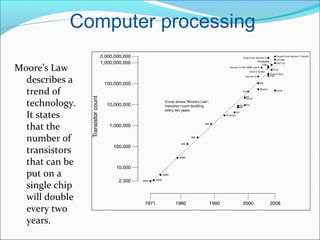
Computer processing
Moore’s Law
describes a
trend of
technology.
It states
that the
number of
transistors
that can be
put on a
single chip
will double
every two
years.
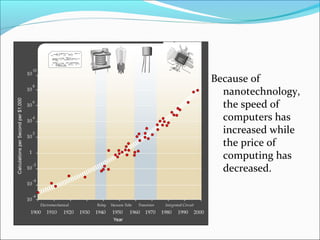
Because of
nanotechnology,
the speed of
computers has
increased while
the price of
computing has
decreased.
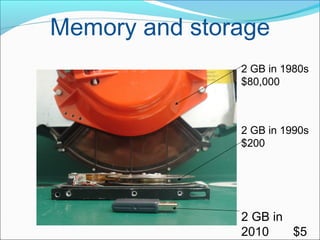
Memory and storage
2 GB in 1980s
$80,000
2 GB in 1990s
$200
2 GB in
2010 $5
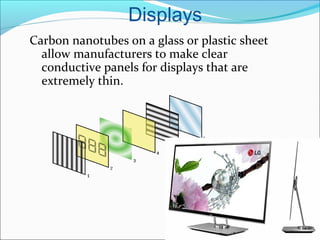
Displays
Carbon nanotubes on a glass or plastic sheet
allow manufacturers to make clear
conductive panels for displays that are
extremely thin.
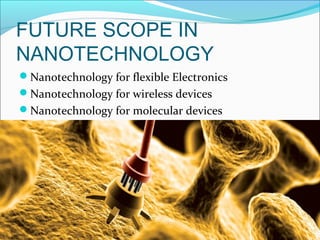
FUTURE SCOPE IN
NANOTECHNOLOGY
Nanotechnology for flexible Electronics
Nanotechnology for wireless devices
Nanotechnology for molecular devices
NANOTECHNOLOGY FOR
FLEXIBLE ELECTRONICS
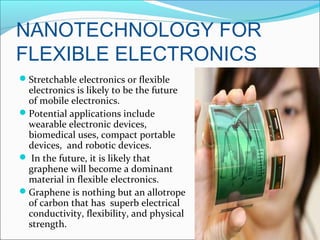
Stretchable electronics or flexible
electronics is likely to be the future
of mobile electronics.
Potential applications include
wearable electronic devices,
biomedical uses, compact portable
devices, and robotic devices.
 In the future, it is likely that
graphene will become a dominant
material in flexible electronics.
Graphene is nothing but an allotrope
of carbon that has superb electrical
conductivity, flexibility, and physical
strength.
NANOTECHNOLOGY FOR
MOLECULAR DEVICES
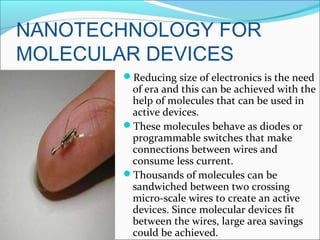
Reducing size of electronics is the need
of era and this can be achieved with the
help of molecules that can be used in
active devices.
These molecules behave as diodes or
programmable switches that make
connections between wires and
consume less current.
Thousands of molecules can be
sandwiched between two crossing
micro-scale wires to create an active
devices. Since molecular devices fit
between the wires, large area savings
could be achieved.
"The Next Big Thing Is Really Small”
APPLICATIONS OF NANOTECHNOLOGY IN ELECTRONICS.

APPLICATIONS OF NANOTECHNOLOGY IN ELECTRONICS.

  • 1.
    Presented by: ElectroInfinity Vikas Kumar(1325280) Shaheed Udham Singh College of Engineering & Technology
  • 2.
    CONTENTS Introduction What is “Nanoscale”? Nanotechnology Whatmakes the Nanoscale special? Need of Nanotechnology in Electronics Nanotechnology in Electronics Common Applications of Nanotechnology in Electronics Future Scope of Nanotechnology
  • 3.
    INTRODUCTION What is “Nano”? Nanoin Greek means ‘dwarf’…..but in actual Nano is even smaller than dwarf i.e atomic level of anything.
  • 4.
    What is Nanoscale? 1.27 × 10⁷ m 0.22 m 0.7 × 10⁻⁹ m Fullerenes C60 12,756 Km 22 cm 0.7 nm 10 millions times smaller 1 billion times smaller 4
  • 5.
    NANOTECHNOLOGY • Nanotechnology isthe study of manipulating matter on an atomic scale. • Nanotechnology refers to the constructing and engineering of the functional systems at very micro level or we can say at atomic level. • A Nanometer is one billionth of a meter, roughly the width of three or four atoms. The average human hair is about 25,000 nanometers wide.
  • 6.
    What makes theNanoscale special?  High density of structures is possible with small size.  Physical and chemical properties can be different at the nano-scale (e.g. electronic, optical, mechanical, thermal, chemical).  The physical behavior of material can be different in the nano-regime because of the different ways physical properties scale with dimension (e.g. area vs. volume).
  • 7.
    What is aCarbon Nanotube? A Carbon Nanotube is a tube-shaped material, made of carbon, having a diameter measuring on the nanometre scale. Carbon Nanotubes are formed from essentially the graphite sheet and the graphite layer appears somewhat like a rolled-up continuous unbroken hexagonal mesh and carbon molecules at the apexes of the hexagons. Nanotubes are members of the fullerene structural family.
  • 8.
    Need of Nanotechnologyin Electronics Today microelectronics are used and they solve our most of the problems. The two exceptional disadvantages of micro electronics are:  Physical size  Increasing cost of fabrication of integrated circuits. To overcome these disadvantages nanotechnology can be used.
  • 9.
    Nanotechnology in Electronics Nanoelectronics refer to the useof nanotechnology on electronic components, especially transistors.  Nanoelectronics often refer to transistor devices that are  so small that inter-atomic interactions and quantum  mechanical properties need to be studied extensively.  Besides being small and allowing more transistors to be  packed into a single chip, the uniform and symmetrical  structure of nanotubes allows a higher electron mobility, a  higher dielectric constant (faster frequency), and a  symmetrical electron/ hole characteristic.
  • 10.
    Increasing the densityof memory chips Decreasing the weight and thickness of the screens Nanolithography is used for fabrication of chips. Reducing the size of transistors used in integrated circuits. Improving display screens on electronics devices. Reducing power consumption. Advantages of Using Nanotechnology in Electronics
  • 12.
    Graphene transistor • Grapheneis a single sheet of carbon atoms packed in a honeycomb crystal lattice, isolated from graphite. • Allows electrons to move at an extraordinarily high speed. • With its intrinsic nature of being one-atom-thick, can be exploited to fabricate field-effect transistors that are faster and smaller.
  • 13.
    Single Electron Transistor •A single electron transistor needs only one electron to change from the insulating to the conducting state. • Deliver very high device density and power efficiency with remarkable operational speed. • Quantum dots with sub- 100 nm dimensions have to be fabricated.
  • 14.
    Carbon-based nanosensors Graphene andcarbon nanotubes have:   Excellent thermal conductivity   High mechanical robustness    Very large surface to volume  ratio making them superior  materials for fabrication of  electromechanical and  electrochemical sensors with  higher sensitivities, lower limits of  detection, and faster response  time. Any additional gold atom that adsorbs on the surface of a vibrating carbon nanotube would change its resonance frequency which is further detected.
  • 16.
    Computer processing Moore’s Law describesa trend of technology. It states that the number of transistors that can be put on a single chip will double every two years.
  • 17.
    Because of nanotechnology, the speedof computers has increased while the price of computing has decreased.
  • 18.
    Memory and storage 2GB in 1980s $80,000 2 GB in 1990s $200 2 GB in 2010 $5
  • 19.
    Displays Carbon nanotubes ona glass or plastic sheet allow manufacturers to make clear conductive panels for displays that are extremely thin.
  • 21.
    FUTURE SCOPE IN NANOTECHNOLOGY Nanotechnologyfor flexible Electronics Nanotechnology for wireless devices Nanotechnology for molecular devices
  • 22.
    NANOTECHNOLOGY FOR FLEXIBLE ELECTRONICS Stretchableelectronics or flexible electronics is likely to be the future of mobile electronics. Potential applications include wearable electronic devices, biomedical uses, compact portable devices, and robotic devices.  In the future, it is likely that graphene will become a dominant material in flexible electronics. Graphene is nothing but an allotrope of carbon that has superb electrical conductivity, flexibility, and physical strength.
  • 23.
    NANOTECHNOLOGY FOR MOLECULAR DEVICES Reducingsize of electronics is the need of era and this can be achieved with the help of molecules that can be used in active devices. These molecules behave as diodes or programmable switches that make connections between wires and consume less current. Thousands of molecules can be sandwiched between two crossing micro-scale wires to create an active devices. Since molecular devices fit between the wires, large area savings could be achieved.
  • 24.
    "The Next BigThing Is Really Small”