Electromagnetic Wave Propagation
By: Engr. Shinbei Batac
ELECTROMAGNETIC WAVES AND
PROPAGATION
• Electromagnetic Wave
▫ Electrical energy that has escaped into free space
▫ Travel in a straight line at approximately the
speed of light and are made up of magnetic and
electric fields that are right angles to each other
and at right angles to the direction of propagation
▫ Essential properties: Frequency, Intensity,
Direction of Travel, Plane of Polarization
• Radio Waves
▫ A form of electromagnetic radiation similar to
light and heat
▫ Differ from other radiations in the manner in
which they area generated and detected and in
frequency range
▫ Consists of traveling electric and magnetic fields
with the energy evenly divided between two types
of fields
Polarization
• Orientation of the electric field vector in respect to the Earth’s
surface
▫ Linear Polarization – Polarization remains constant. Its 2
forms are:
 Horizontal Polarization – If propagating parallel to Earth’s surface
 Vertical Polarization – If the electric field is propagating in
perpendicular to Earth’s surface
▫ Circular Polarization – If the polarization vector rotates 360° as
the wave moves one wavelength through space and field strength is
equal at all angles of polarization
▫ Elliptical Polarization – When field strength varies with
changes in polarization
RAYS AND WAVEFRONTS
• Aids to illustrating the effects of
electromagnetic wave propagation
through free space
• Ray – line drawn along the direction
of electromagnetic wave propagation;
however does not necessarily
represent the propagation of a single
electromagnetic wave
• Wavefront – shows a surface of
constant phase of electromagnetic
source are joined together
 Plane surface: wavefront is
perpendicular to direction of
propagation
 Closer to source: More complicated
wavefront
 Rays within a small area of a
spherical wavefront: Nearly parallel
 Farther from source: more wave
propagation appears a plane
wavefront
ELECTROMAGNETIC RADIATION
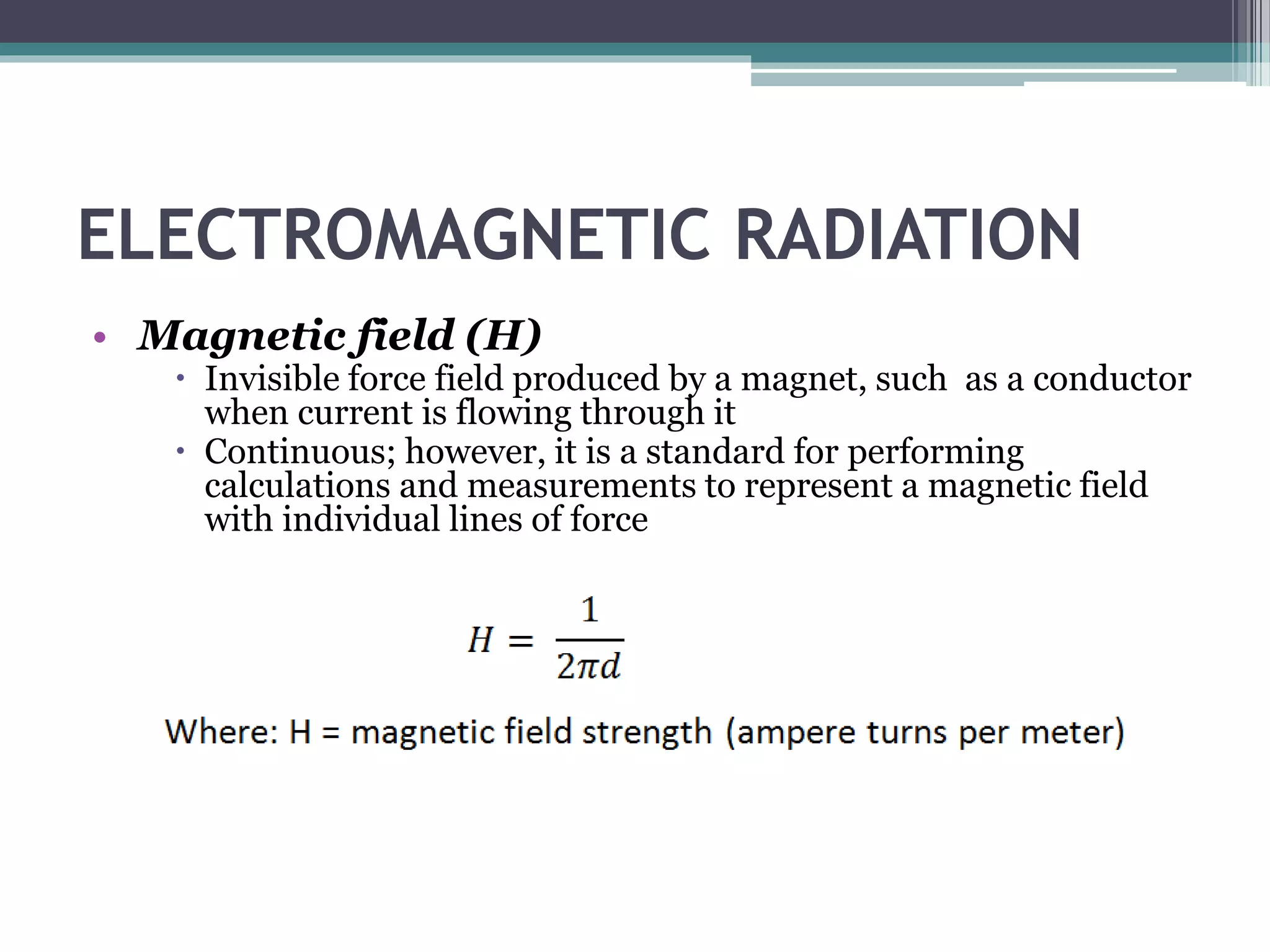
• Magnetic field (H)
 Invisible force field produced by a magnet, such as a conductor
when current is flowing through it
 Continuous; however, it is a standard for performing
calculations and measurements to represent a magnetic field
with individual lines of force
• Electric field (E)
 Invisible force fields produced by a difference in voltage
potential between two conductors
Electric Field Magnetic Field
CHARACTERISTIC IMPEDANCE OF
FREE SPACE
• Characteristic Impedance
 Relates electric and magnetic field intensities in free space
 For a lossless transmission medium, it is equal to
SPHERICAL WAVEFRONT AND THE
INVERSE SQUARE LAW
Spherical Wavefront
 Isotropic radiator
▫ – a point source that radiates power at a constant rate uniformly in all
directions closely approx.. by an omnidirectional antenna
▫ Produces a spherical wavefront with radius R, where all points rely and have
equal power densities
Power Density
WAVE ATTENUATION AND
ABSORPTION
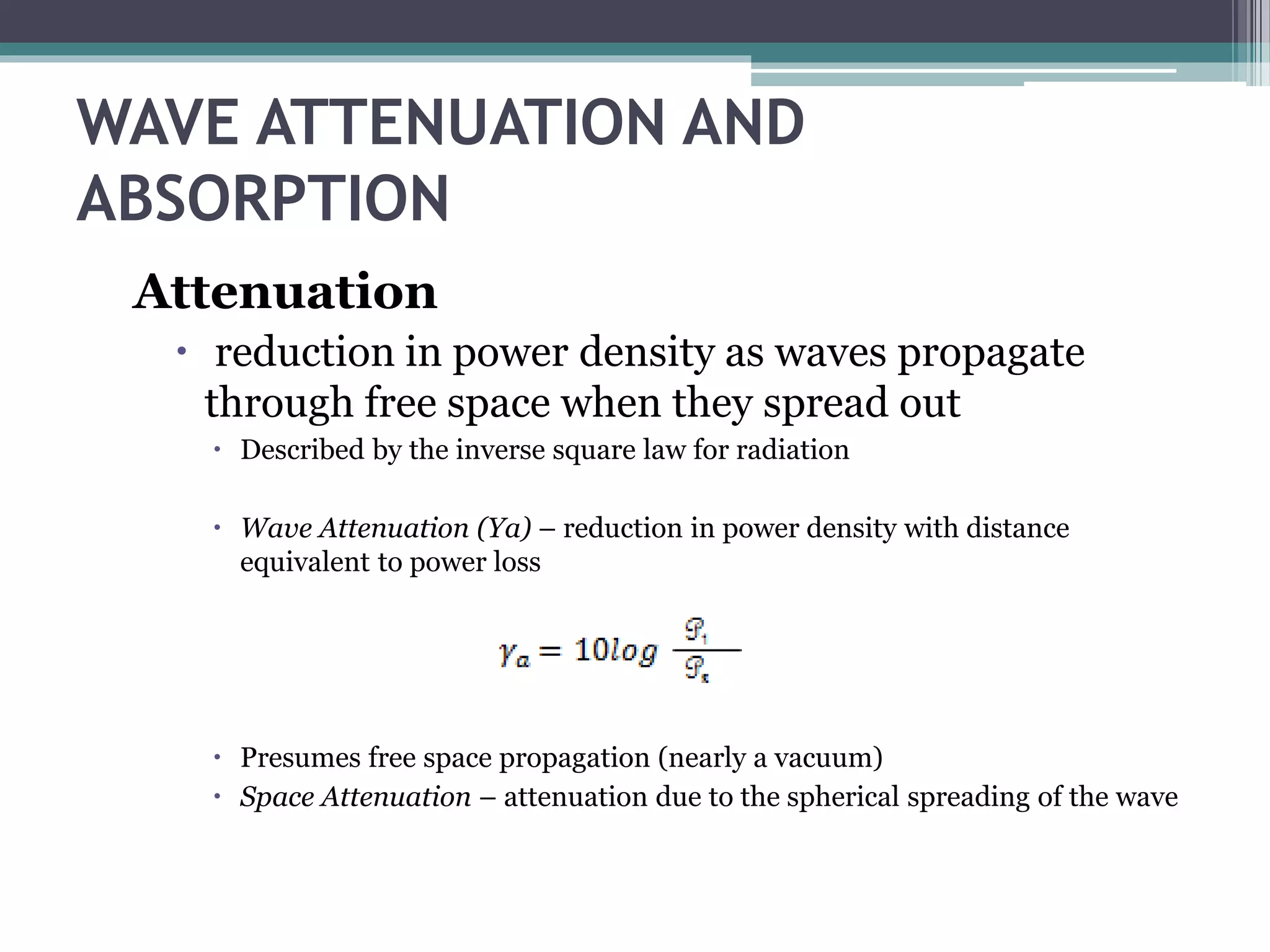
Attenuation
 reduction in power density as waves propagate
through free space when they spread out
 Described by the inverse square law for radiation
 Wave Attenuation (Υa) – reduction in power density with distance
equivalent to power loss
 Presumes free space propagation (nearly a vacuum)
 Space Attenuation – attenuation due to the spherical spreading of the wave
Absorption
-reduction in power density due to non-free-space
propagation
Homogenous medium
▫ one with uniform properties throughout
▫ absorption experienced during the first mile of propagation
is the same for the last mile
Inhomogenous medium
▫ absorption coefficient varies considerably with location,
thus creating a difficult problem for radio systems engineer
• OPTICAL PROPERTIES OF RADIO
WAVES
 Refraction – bending
 Reflection – bouncing
 Diffraction – scattering
 Interference – colliding
• Refraction
 “Bending of the radio-wave path”
 Actually changing of direction of an electromagnetic ray as it
passes obliquely from one medium into another with difference
 Occurs when a radio wave passes from one medium into
another medium of different density
• Normal - An imaginary line drawn perpendicular to the interface at the point of
incidence
• Angle of incidence - Angle formed between the incident wave and the normal
• Angle of refraction - Angle formed between the incident wave and the normal
• Power Transmission Coefficient (T) – portion of
total incident power that is not reflected
• Absorption Coefficient – fraction of power that
penetrates medium 2
• Irregular or rough surface – may destroy the shape
of the wavefront
• Diffuse reflection – When an incident wavefront
strikes an irregular surface, it is randomly scattered in
many directions
• Specular (mirrorlike) surfaces – Reflection from a
perfectly smooth surface
• Semirough surfaces – surfaces that fall between
smooth and irregular
• Diffraction
▫ Spreads out or “scattering”
▫ Modulation or redistribution of energy within a wavefront when
it passes near the edge of an opaque object
▫ A phenomenon that allows light or radio waves to propagate
(peek) around corners
• Hyugen’s Principle
▫ used to explain when a wavefront passes near an obstacle or
discontinuity with dimensions comparable in size to a wavelength
▫ States that every point on a given spherical wavefront can be
considered as a secondary point source of electromagnetic waves
from which other secondary waves (wavelets) are radiated
outward
• Shadow Zone
▫ Diffraction occurs around the edge of the obstacle, which allows
secondary waves to “sneak” around the corner of the obstacle
• Interference
 “Opposition”
 Act of interfering
 Occurs when two or more electromagnetic waves
combine in such a way that system performance is
degraded
 Subjects to the principle of linear superposition of
electromagnetic waves and occurs whenever two or
more waves simultaneously occupy the same point
in space
• Linear Superposition
 Its principle states that the total voltage intensity at
a given point in space is the sum of the individual
wave vectors
TERRESTRIAL PROPAGATION OF
ELECTROMAGNETIC WAVES
• Terrestrial Waves – are electromagnetic waves travelling within the Earth’s
atmosphere.
• Terrestrial Radio Communications – communication between two or more points on
the Earth.
• Sky waves – used for high frequency applications
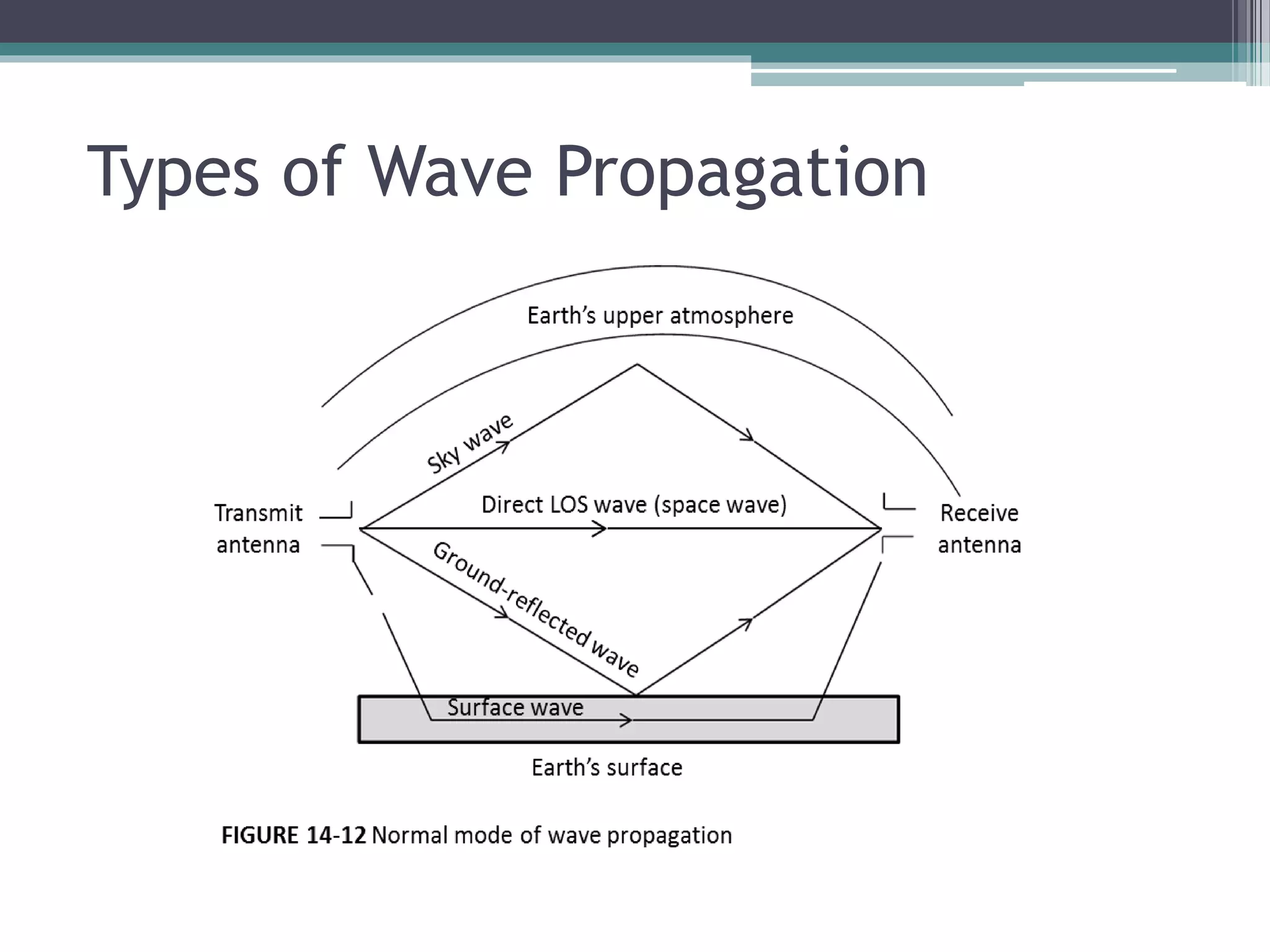
Types of Wave Propagation
Surface Wave Propagation
• Disadvantages of Surface/Ground
Waves:
▫ Ground waves require a relative transmission
power
▫ Ground waves are limited to a very low, low, and
medium frequencies
▫ Requiring large antennas
▫ Ground losses vary considerably with the surface
material and composition
• Advantages of Ground Waves:
▫ Given enough transmit power, ground waves can
be used to communicate between any two
locations in the world
▫ Ground waves are relatively unaffected by
changing atmospheric conditions.
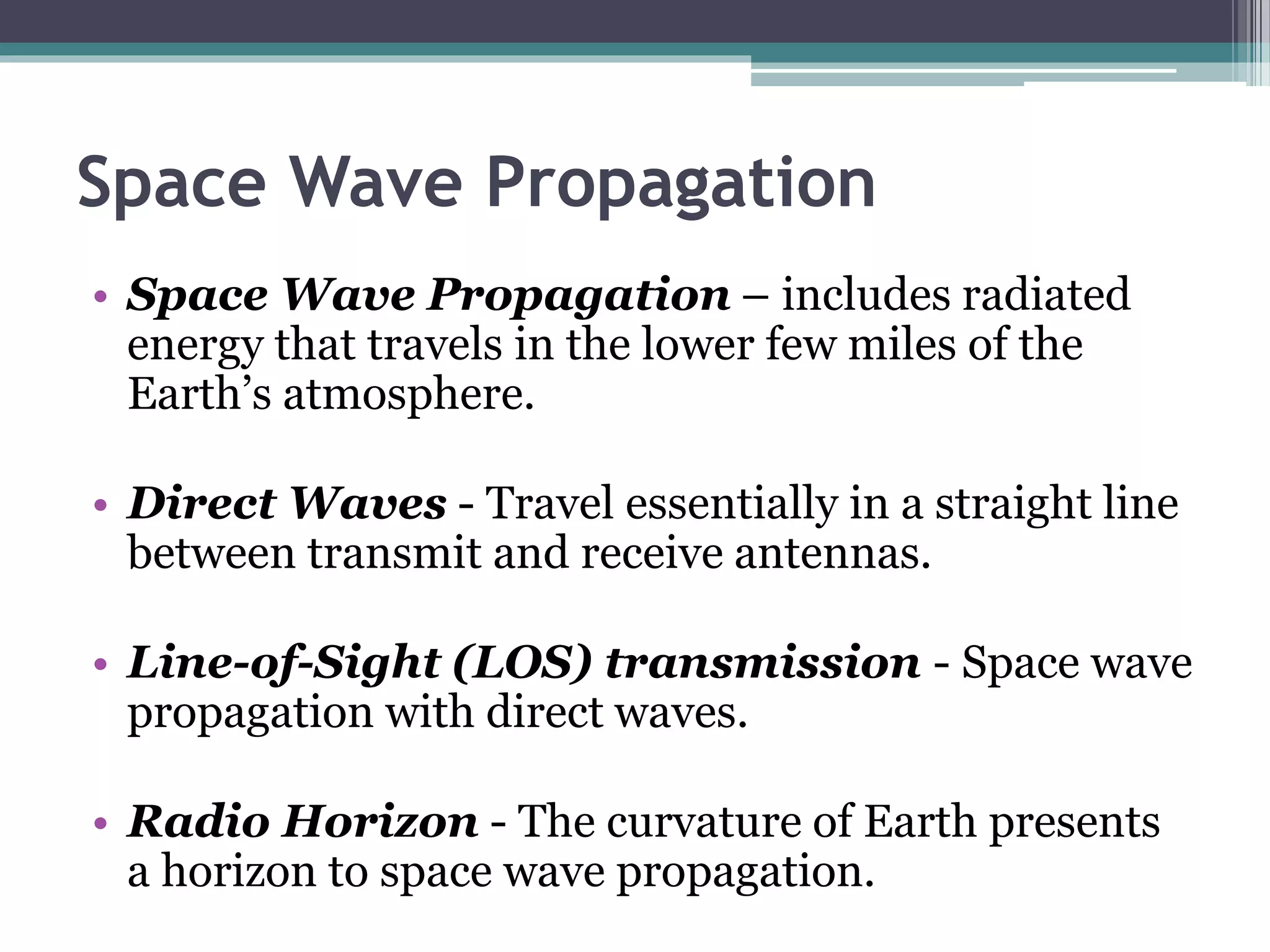
Space Wave Propagation
• Space Wave Propagation – includes radiated
energy that travels in the lower few miles of the
Earth’s atmosphere.
• Direct Waves - Travel essentially in a straight line
between transmit and receive antennas.
• Line-of-Sight (LOS) transmission - Space wave
propagation with direct waves.
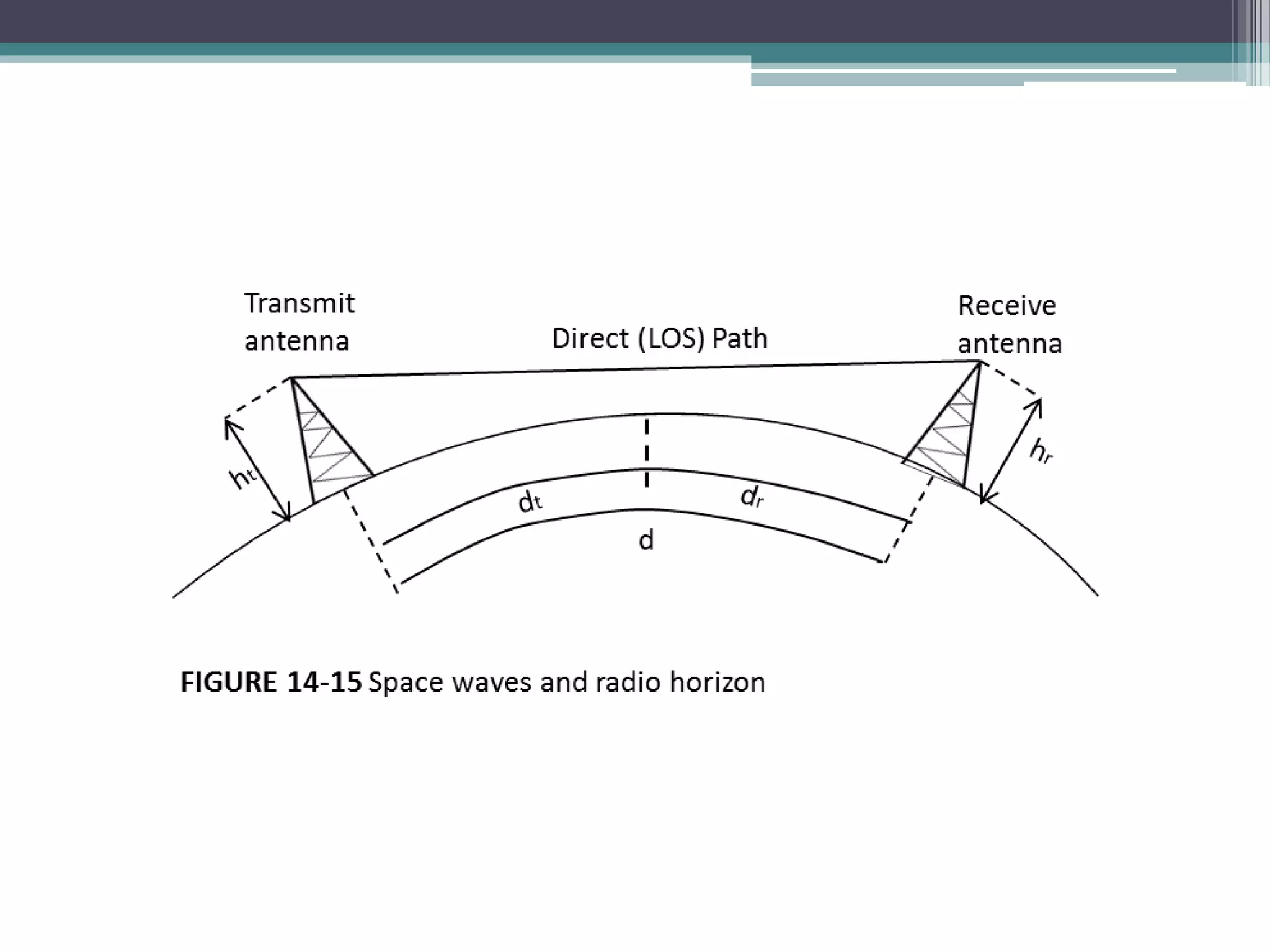
• Radio Horizon - The curvature of Earth presents
a horizon to space wave propagation.
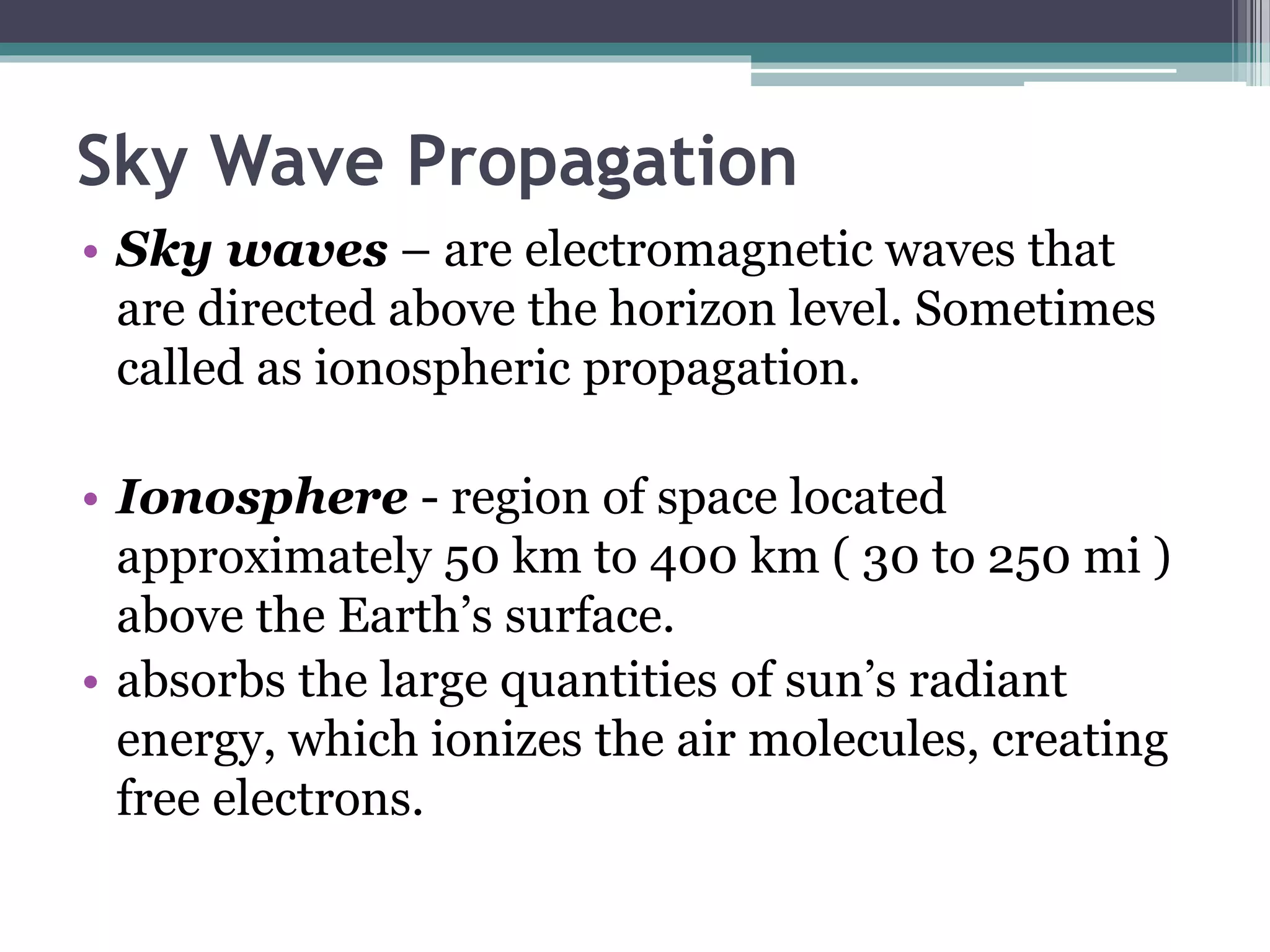
Sky Wave Propagation
• Sky waves – are electromagnetic waves that
are directed above the horizon level. Sometimes
called as ionospheric propagation.
• Ionosphere - region of space located
approximately 50 km to 400 km ( 30 to 250 mi )
above the Earth’s surface.
• absorbs the large quantities of sun’s radiant
energy, which ionizes the air molecules, creating
free electrons.
Sky Wave Propagation
• D-layer – is the lowest layer of the ionosphere.
Approximately 30 miles and 60 miles (50km to 100km)
above the Earth’s surface. Because it is the farthest from
the sun, there is only little ionization. However, ions in
the D-layer can absorb appreciable amounts of
electromagnetic energy.
• The amount of ionization depends on the altitude of the
sun above the horizon. D-layer reflects VLF and LF
waves and absorbs MF and HF waves.
• E-layer – approximately 60 miles to 85 miles (100km
to 140km) above the Earth’s surface. Sometimes called
Kennelly-Heaviside layer.
• Has the maximum density approximately 70 miles at
noon when the sun is in the highest point. E-layer aids
MF surface wave propagation and reflects HF waves
somewhat during daytime.
• Sporadic Layer- upper portion of the E-layer
• F-layer – made up of two layer F1 and F2 layers.
• During daytime, F1 is located 85 miles to 155 miles
(140km to 250km) above the Earth’s surface; F2 is
located 85 miles to 185 miles (140km to 300km) at
winter and 155 miles to 220 miles (250km to 350km)
during summer.
• During the night, F1 layer combines with F2 layer to
form a single layer. F1 layer absorbs and attenuates HF
waves, although most of the waves pass F2 where they
are refracted back to Earth.
Critical Frequency and Critical Angle
• Critical Frequency
▫ Highest frequency that can be propagated directly upward and
still be returned to Earth by the ionosphere
▫ Depends on the ionization density, varies with time of day and
season
▫ Used only as a point of reference for comparison purposes
• Critical Angle
▫ Maximum vertical angle at which it can be propagated and still be
refracted back by the ionosphere
• Ionospheric Sounding
Used to determine the critical frequency
• Virtual Height
▫ Height above the Earth’s surface from which a
refracted wave appears to have been reflected
▫ ha - actual maximum height the wave reaches
▫ hv – maximum height that this hypothetical
reflected wave would have reached
• SKIP DISTANCE AND SKIP ZONE
• Skip Distance
▫ Minimum distance from a transmit antenna that a sky wave at a given
frequency will be returned to Earth
▫ This frequency must be less than the maximum usable frequency and
propagated at its critical angle
▫ When the radiation angle (), exceeds the critical angle (), the wave
penetrates the ionosphere and escapes Earth’s atmosphere.
• 2 rays that can take different paths and still be returned to the
same point on Earth;
▫ Lower ray
▫ Upper Ray or Pedersen Ray – usually of little significance because it
spreads over a much larger area than the lower ray
 Becomes important when circumstances prevent the lower ray from
reaching a particular point
• Skip Zone (or Quiet Zone)
▫ Area between the where the surface waves are completely dissipated and
the point where the first sky wave returns to Earth
▫ An area where there is no reception
FREE-SPACE PATH LOSS
▫ Loss incurred by an electromagnetic wave as it propagates in a
straight line through a vacuum, with no absorption or reflection
of energy from nearby objects
▫ A fabricated engineering quantity that evolved from manipulating
communications system link budget equations into a particular
format
• Link Equations
•
▫ Include transmit antenna gain, free-space path loss, and effective
area of the receiving antenna
• Spreading Loss
▫ A term for a phenomena where no electromagnetic energy is
actually loss or dissipated – it merely spreads out as it propagates
away from the source, resulting in lower relative power densities
▫ Occurs simply because of the inverse square law.
FADING AND FADE MARGIN
• Fading
Variation in signal loss that can be caused by natural
weather disturbances such as rainfall, snowfall,
fog, hail and extremely cold air over a warm Earth.
▫ It can also be caused by man-made disturbances such as
irrigation, or from multiple transmission path, irregular
Earth surfaces and varying terrain.
• Fade Margin
the additional loss added to the normal path loss to
accommodate temporary fading
FADE MARGIN

electromagnetic-wave-propagation

  • 1.
  • 2.
    ELECTROMAGNETIC WAVES AND PROPAGATION •Electromagnetic Wave ▫ Electrical energy that has escaped into free space ▫ Travel in a straight line at approximately the speed of light and are made up of magnetic and electric fields that are right angles to each other and at right angles to the direction of propagation ▫ Essential properties: Frequency, Intensity, Direction of Travel, Plane of Polarization
  • 3.
    • Radio Waves ▫A form of electromagnetic radiation similar to light and heat ▫ Differ from other radiations in the manner in which they area generated and detected and in frequency range ▫ Consists of traveling electric and magnetic fields with the energy evenly divided between two types of fields
  • 4.
    Polarization • Orientation ofthe electric field vector in respect to the Earth’s surface ▫ Linear Polarization – Polarization remains constant. Its 2 forms are:  Horizontal Polarization – If propagating parallel to Earth’s surface  Vertical Polarization – If the electric field is propagating in perpendicular to Earth’s surface ▫ Circular Polarization – If the polarization vector rotates 360° as the wave moves one wavelength through space and field strength is equal at all angles of polarization ▫ Elliptical Polarization – When field strength varies with changes in polarization
  • 5.
    RAYS AND WAVEFRONTS •Aids to illustrating the effects of electromagnetic wave propagation through free space • Ray – line drawn along the direction of electromagnetic wave propagation; however does not necessarily represent the propagation of a single electromagnetic wave • Wavefront – shows a surface of constant phase of electromagnetic source are joined together  Plane surface: wavefront is perpendicular to direction of propagation  Closer to source: More complicated wavefront  Rays within a small area of a spherical wavefront: Nearly parallel  Farther from source: more wave propagation appears a plane wavefront
  • 6.
    ELECTROMAGNETIC RADIATION • Magneticfield (H)  Invisible force field produced by a magnet, such as a conductor when current is flowing through it  Continuous; however, it is a standard for performing calculations and measurements to represent a magnetic field with individual lines of force
  • 7.
    • Electric field(E)  Invisible force fields produced by a difference in voltage potential between two conductors
  • 8.
  • 10.
    CHARACTERISTIC IMPEDANCE OF FREESPACE • Characteristic Impedance  Relates electric and magnetic field intensities in free space  For a lossless transmission medium, it is equal to
  • 11.
    SPHERICAL WAVEFRONT ANDTHE INVERSE SQUARE LAW Spherical Wavefront  Isotropic radiator ▫ – a point source that radiates power at a constant rate uniformly in all directions closely approx.. by an omnidirectional antenna ▫ Produces a spherical wavefront with radius R, where all points rely and have equal power densities
  • 12.
  • 14.
    WAVE ATTENUATION AND ABSORPTION Attenuation reduction in power density as waves propagate through free space when they spread out  Described by the inverse square law for radiation  Wave Attenuation (Υa) – reduction in power density with distance equivalent to power loss  Presumes free space propagation (nearly a vacuum)  Space Attenuation – attenuation due to the spherical spreading of the wave
  • 15.
    Absorption -reduction in powerdensity due to non-free-space propagation Homogenous medium ▫ one with uniform properties throughout ▫ absorption experienced during the first mile of propagation is the same for the last mile Inhomogenous medium ▫ absorption coefficient varies considerably with location, thus creating a difficult problem for radio systems engineer
  • 16.
    • OPTICAL PROPERTIESOF RADIO WAVES  Refraction – bending  Reflection – bouncing  Diffraction – scattering  Interference – colliding
  • 17.
    • Refraction  “Bendingof the radio-wave path”  Actually changing of direction of an electromagnetic ray as it passes obliquely from one medium into another with difference  Occurs when a radio wave passes from one medium into another medium of different density
  • 18.
    • Normal -An imaginary line drawn perpendicular to the interface at the point of incidence • Angle of incidence - Angle formed between the incident wave and the normal • Angle of refraction - Angle formed between the incident wave and the normal
  • 21.
    • Power TransmissionCoefficient (T) – portion of total incident power that is not reflected • Absorption Coefficient – fraction of power that penetrates medium 2 • Irregular or rough surface – may destroy the shape of the wavefront • Diffuse reflection – When an incident wavefront strikes an irregular surface, it is randomly scattered in many directions • Specular (mirrorlike) surfaces – Reflection from a perfectly smooth surface • Semirough surfaces – surfaces that fall between smooth and irregular
  • 23.
    • Diffraction ▫ Spreadsout or “scattering” ▫ Modulation or redistribution of energy within a wavefront when it passes near the edge of an opaque object ▫ A phenomenon that allows light or radio waves to propagate (peek) around corners • Hyugen’s Principle ▫ used to explain when a wavefront passes near an obstacle or discontinuity with dimensions comparable in size to a wavelength ▫ States that every point on a given spherical wavefront can be considered as a secondary point source of electromagnetic waves from which other secondary waves (wavelets) are radiated outward • Shadow Zone ▫ Diffraction occurs around the edge of the obstacle, which allows secondary waves to “sneak” around the corner of the obstacle
  • 24.
    • Interference  “Opposition” Act of interfering  Occurs when two or more electromagnetic waves combine in such a way that system performance is degraded  Subjects to the principle of linear superposition of electromagnetic waves and occurs whenever two or more waves simultaneously occupy the same point in space • Linear Superposition  Its principle states that the total voltage intensity at a given point in space is the sum of the individual wave vectors
  • 25.
    TERRESTRIAL PROPAGATION OF ELECTROMAGNETICWAVES • Terrestrial Waves – are electromagnetic waves travelling within the Earth’s atmosphere. • Terrestrial Radio Communications – communication between two or more points on the Earth. • Sky waves – used for high frequency applications
  • 26.
    Types of WavePropagation
  • 27.
  • 28.
    • Disadvantages ofSurface/Ground Waves: ▫ Ground waves require a relative transmission power ▫ Ground waves are limited to a very low, low, and medium frequencies ▫ Requiring large antennas ▫ Ground losses vary considerably with the surface material and composition • Advantages of Ground Waves: ▫ Given enough transmit power, ground waves can be used to communicate between any two locations in the world ▫ Ground waves are relatively unaffected by changing atmospheric conditions.
  • 29.
    Space Wave Propagation •Space Wave Propagation – includes radiated energy that travels in the lower few miles of the Earth’s atmosphere. • Direct Waves - Travel essentially in a straight line between transmit and receive antennas. • Line-of-Sight (LOS) transmission - Space wave propagation with direct waves. • Radio Horizon - The curvature of Earth presents a horizon to space wave propagation.
  • 32.
    Sky Wave Propagation •Sky waves – are electromagnetic waves that are directed above the horizon level. Sometimes called as ionospheric propagation. • Ionosphere - region of space located approximately 50 km to 400 km ( 30 to 250 mi ) above the Earth’s surface. • absorbs the large quantities of sun’s radiant energy, which ionizes the air molecules, creating free electrons.
  • 33.
    Sky Wave Propagation •D-layer – is the lowest layer of the ionosphere. Approximately 30 miles and 60 miles (50km to 100km) above the Earth’s surface. Because it is the farthest from the sun, there is only little ionization. However, ions in the D-layer can absorb appreciable amounts of electromagnetic energy. • The amount of ionization depends on the altitude of the sun above the horizon. D-layer reflects VLF and LF waves and absorbs MF and HF waves. • E-layer – approximately 60 miles to 85 miles (100km to 140km) above the Earth’s surface. Sometimes called Kennelly-Heaviside layer. • Has the maximum density approximately 70 miles at noon when the sun is in the highest point. E-layer aids MF surface wave propagation and reflects HF waves somewhat during daytime. • Sporadic Layer- upper portion of the E-layer • F-layer – made up of two layer F1 and F2 layers. • During daytime, F1 is located 85 miles to 155 miles (140km to 250km) above the Earth’s surface; F2 is located 85 miles to 185 miles (140km to 300km) at winter and 155 miles to 220 miles (250km to 350km) during summer. • During the night, F1 layer combines with F2 layer to form a single layer. F1 layer absorbs and attenuates HF waves, although most of the waves pass F2 where they are refracted back to Earth.
  • 34.
    Critical Frequency andCritical Angle • Critical Frequency ▫ Highest frequency that can be propagated directly upward and still be returned to Earth by the ionosphere ▫ Depends on the ionization density, varies with time of day and season ▫ Used only as a point of reference for comparison purposes • Critical Angle ▫ Maximum vertical angle at which it can be propagated and still be refracted back by the ionosphere • Ionospheric Sounding Used to determine the critical frequency
  • 36.
    • Virtual Height ▫Height above the Earth’s surface from which a refracted wave appears to have been reflected ▫ ha - actual maximum height the wave reaches ▫ hv – maximum height that this hypothetical reflected wave would have reached
  • 38.
    • SKIP DISTANCEAND SKIP ZONE • Skip Distance ▫ Minimum distance from a transmit antenna that a sky wave at a given frequency will be returned to Earth ▫ This frequency must be less than the maximum usable frequency and propagated at its critical angle ▫ When the radiation angle (), exceeds the critical angle (), the wave penetrates the ionosphere and escapes Earth’s atmosphere. • 2 rays that can take different paths and still be returned to the same point on Earth; ▫ Lower ray ▫ Upper Ray or Pedersen Ray – usually of little significance because it spreads over a much larger area than the lower ray  Becomes important when circumstances prevent the lower ray from reaching a particular point • Skip Zone (or Quiet Zone) ▫ Area between the where the surface waves are completely dissipated and the point where the first sky wave returns to Earth ▫ An area where there is no reception
  • 39.
    FREE-SPACE PATH LOSS ▫Loss incurred by an electromagnetic wave as it propagates in a straight line through a vacuum, with no absorption or reflection of energy from nearby objects ▫ A fabricated engineering quantity that evolved from manipulating communications system link budget equations into a particular format • Link Equations • ▫ Include transmit antenna gain, free-space path loss, and effective area of the receiving antenna • Spreading Loss ▫ A term for a phenomena where no electromagnetic energy is actually loss or dissipated – it merely spreads out as it propagates away from the source, resulting in lower relative power densities ▫ Occurs simply because of the inverse square law.
  • 42.
    FADING AND FADEMARGIN • Fading Variation in signal loss that can be caused by natural weather disturbances such as rainfall, snowfall, fog, hail and extremely cold air over a warm Earth. ▫ It can also be caused by man-made disturbances such as irrigation, or from multiple transmission path, irregular Earth surfaces and varying terrain. • Fade Margin the additional loss added to the normal path loss to accommodate temporary fading
  • 43.