This document discusses different methods of electromagnetic wave propagation through space. There are three basic paths: ground waves which follow the Earth's curvature for lower frequencies; space waves which travel line-of-sight; and sky waves which are reflected by ionized layers in the atmosphere, allowing higher frequency signals to travel farther than line-of-sight. The ionosphere, located 30-240 miles above the Earth, plays a key role in sky wave propagation by reflecting radio signals back to Earth, enabling long-distance HF radio communications.
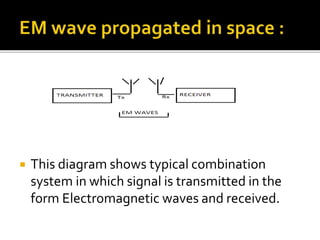
This diagramshows typical combination
system in which signal is transmitted in the
form Electromagnetic waves and received.
4.
The electromagnetictransmission in space
must be in high frequencies because in low
frequency there are two problems.
Size of antenna
Low radiation power.
5.
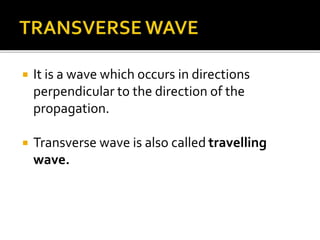
It isa wave which occurs in directions
perpendicular to the direction of the
propagation.
Transverse wave is also called travelling
wave.
7.
There areThreebasic paths that an EM signal
can take through space
Ground wave or Surface wave
Space wave
Sky wave
8.
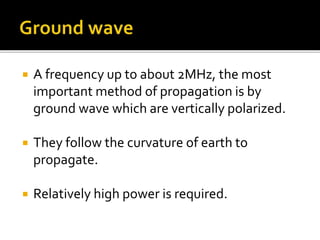
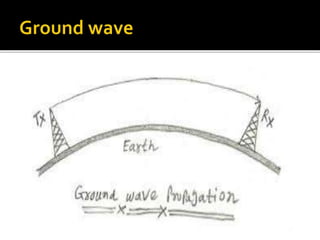
A frequencyup to about 2MHz, the most
important method of propagation is by
ground wave which are vertically polarized.
They follow the curvature of earth to
propagate.
Relatively high power is required.
9.
Surface waveis very dependent upon the
nature of the ground of which the signal
travels. Such as :
Ground conductivity
Roughness
11.
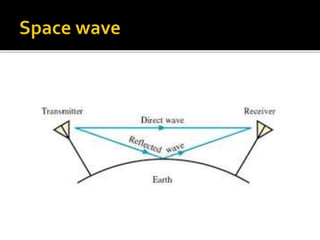
The radiowaves having high frequencies are
called as space wave.
The other name of space wave is Line of
sight propagation
12.
Those waveshave the ability to propagate
through atmosphere, from transmitting
antenna to receiving antenna. It can travel
directly or can travel after reflecting from
earth’s surface to the *troposphere surface of
earth.
*the lowest region of the atmosphere(15km)
14.
It isuseful for FM,T.V and RADAR application.
It is also used inVHF, UHF and microwave
signals.
15.
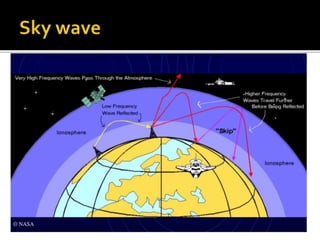
Some wavestravel upwards into the space
towards the sky and get reflected back to the
receiver
Signal reflected ionized layer of atmosphere
and back down to the earth.
These wave are called Sky wave.
16.
Signal thatis radiated by the antenna into
upper atmosphere where it is bent or
reflected back to earth.
This bending of signal caused by a region in
the upper atmosphere known as ionosphere
17.
High energyradiation(Ultraviolet) from
our sun(Solar Radiation) strikes atoms
of various gasses and vapors in the
earth’s upper atmosphere.
Electrons are knocked off the outer
orbits of the atoms creating an ion. The
process is called ionization.
Because this event takes place in the
upper atmosphere, we call the layer
ionosphere
18.
Ranges fromabout 30 to 55 miles
Primarily exist only during daylight
hours.
19.
Ranges fromabout 55 to 90 miles
It exist only during daylight and almost
gone by midnight.
Also called Kennelly-Heaviside Layer.
20.
Exists from about90 to 240 miles
The most highly ionized.
In daytime, this layer split into two
parts: F1 and F2. After sunset, this
layer combines into one.
22.
These wavescan have medium as well
as high frequencies. So, due to this
reason these waves can be used for long
distance transmission.
This mode is used in HF band
International Broadcasting