Modes of
Electromagnetic Wave
    Propagation

                       1
Introduction
 Electromagnetic waves in frequency range of few Hz
 to about 1011 Hz are called the radio waves .

 These waves are useful for transmission of
 information from one place to another without the
 help of wires or any other material medium between
 the 2 places. The signal to be transmitted is converted
 into an electrical signal and then super imposed on a
 high frequency oscillating current flowing through a
 metallic conductor of suitable shape and size.

 This conductor , called the transmitting antenna
 radiates the corresponding radio waves into the
 atmosphere. At the receiving station there is another
 metallic conductor of suitable shape and size, called
 the receiving antenna.
 When the radio waves are intercepted by the
  receiving antenna , a small varying e.m.f. is
  induced in the antenna .
 This e.m.f. I amplified and decoded to obtain the
  information contained in the original signal.
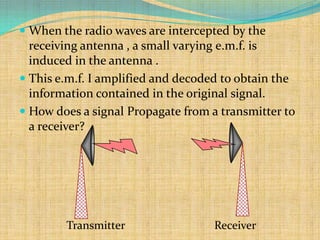
 How does a signal Propagate from a transmitter to
  a receiver?


         Transmitter                 Receiver
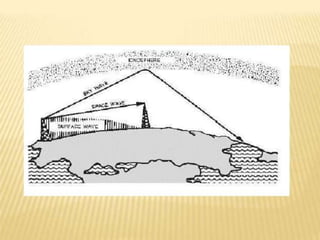
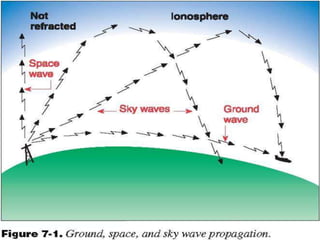
Types of wave propagation
 Surface wave propagation


 Space wave propagation


 Sky wave propagation
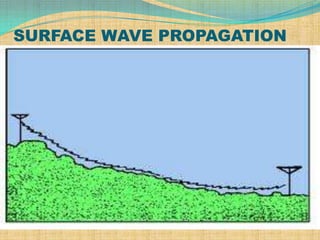
SURFACE WAVE PROPAGATION
 When the radio waves from transmitting
  antenna propagate along the surface of the
  earth so as to reach the receiving antenna
  the wave propagation is called Ground wave
  propagation or Surface wave propagation .
 These radio waves travel close to the surface
  of the earth and move along its curved
  surface from the transmitter to receiver.
 The radio waves induce currents in the
  ground and lose their energy by absorption
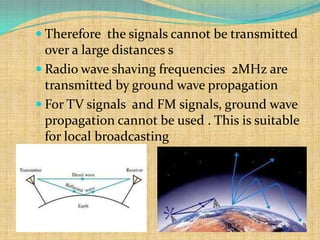
 Therefore the signals cannot be transmitted
  over a large distances s
 Radio wave shaving frequencies 2MHz are
  transmitted by ground wave propagation
 For TV signals and FM signals, ground wave
  propagation cannot be used . This is suitable
  for local broadcasting
Space wave
   propagation


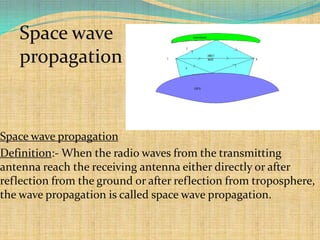
Space wave propagation
Definition:- When the radio waves from the transmitting
antenna reach the receiving antenna either directly or after
reflection from the ground or after reflection from troposphere,
the wave propagation is called space wave propagation.
The Space wave has three components
Direct waves:- The transmitting waves follow path
in a straight line and directly reach the receiver end are
called as Direct waves.
Ground reflected waves:- The transmitting waves follow
path and reach the receiving antenna after reflection from
the ground are called as Ground reflected waves.
Tropospheric waves:- The transmitted waves follow path
and reach the receiving antenna after reflection from the
troposphere are called as Tropospheric waves.
In all the above three waves, the radio waves are not
subjected to the absorption by the ground. Hence, space
waves cover a larger distance then the ground waves. But
due to the curvature of the earth, the receiving antenna
must be in the line of sight distance. The maximum
distance over which the signal can reach is called range.
The range is given by d = √2Rh where R is radius of
curvature of the earth and h is the height of transmitting
antenna. For getting a larger range, h must be increased.
It is for this reason that the transmitting antenna are
located on the top of hills or high building.
Uses of Space waves:-
Space waves are useful in transmitting FM radio signals(they
have frequency greater then 30 MHz so they can pass through
ionosphere after suffering a small deviation. Hence, they can
not be transmitted using sky waves).
Also TV signals cannot be propagated by ground wave
propagation, owing to them high frequency, these signals are
easily absorbed by the earth so for transmitting of these waves
the space wave propagation in which the receiving antenna
directly intercepts the signals are used. These and many others
whose frequencies range from 80 MHz to 120 MHz can be
transmitted using Space wave propagation.
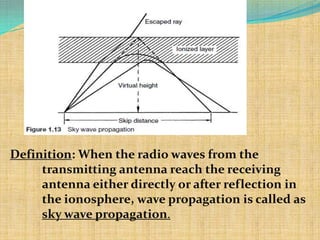
Definition: When the radio waves from the
     transmitting antenna reach the receiving
     antenna either directly or after reflection in
     the ionosphere, wave propagation is called as
     sky wave propagation.
1) It can
       be used for transmission of signals with
frequencies 3MHz to 30MHz.

2) The ionosphere is chosen for sky wave propagation
due to two reasons;
It has high concentration of ions.
It has a low refractive index.

3) It is highly unreliable as the signal may be lost due to
seasonal variations and unfaurable weather conditions.

4) It can be used for high frequency signal transmission.

5) This E.M. waves travel directly from the transmitter to
the receiver without being influenced by the ground.
•TV programmes can be transmitted all over the world
with the help of geostationary satellites(artificial
satellites).The satellite receives the signals from the
transmitting station, amplifies them and then sends to the
receiving stations on earth.
•It is used for telecommunication for sending signals over
large distance.
•For transmitting FM signals and mobile signals, etc.
Electromagnetic waves( college)

Electromagnetic waves( college)

  • 1.
  • 4.
    Introduction  Electromagnetic wavesin frequency range of few Hz to about 1011 Hz are called the radio waves .  These waves are useful for transmission of information from one place to another without the help of wires or any other material medium between the 2 places. The signal to be transmitted is converted into an electrical signal and then super imposed on a high frequency oscillating current flowing through a metallic conductor of suitable shape and size.  This conductor , called the transmitting antenna radiates the corresponding radio waves into the atmosphere. At the receiving station there is another metallic conductor of suitable shape and size, called the receiving antenna.
  • 5.
     When theradio waves are intercepted by the receiving antenna , a small varying e.m.f. is induced in the antenna .  This e.m.f. I amplified and decoded to obtain the information contained in the original signal.  How does a signal Propagate from a transmitter to a receiver? Transmitter Receiver
  • 7.
    Types of wavepropagation  Surface wave propagation  Space wave propagation  Sky wave propagation
  • 9.
  • 10.
    SURFACE WAVE PROPAGATION When the radio waves from transmitting antenna propagate along the surface of the earth so as to reach the receiving antenna the wave propagation is called Ground wave propagation or Surface wave propagation .  These radio waves travel close to the surface of the earth and move along its curved surface from the transmitter to receiver.  The radio waves induce currents in the ground and lose their energy by absorption
  • 11.
     Therefore thesignals cannot be transmitted over a large distances s  Radio wave shaving frequencies 2MHz are transmitted by ground wave propagation  For TV signals and FM signals, ground wave propagation cannot be used . This is suitable for local broadcasting
  • 13.
    Space wave propagation Space wave propagation Definition:- When the radio waves from the transmitting antenna reach the receiving antenna either directly or after reflection from the ground or after reflection from troposphere, the wave propagation is called space wave propagation.
  • 14.
    The Space wavehas three components Direct waves:- The transmitting waves follow path in a straight line and directly reach the receiver end are called as Direct waves. Ground reflected waves:- The transmitting waves follow path and reach the receiving antenna after reflection from the ground are called as Ground reflected waves. Tropospheric waves:- The transmitted waves follow path and reach the receiving antenna after reflection from the troposphere are called as Tropospheric waves.
  • 15.
    In all theabove three waves, the radio waves are not subjected to the absorption by the ground. Hence, space waves cover a larger distance then the ground waves. But due to the curvature of the earth, the receiving antenna must be in the line of sight distance. The maximum distance over which the signal can reach is called range. The range is given by d = √2Rh where R is radius of curvature of the earth and h is the height of transmitting antenna. For getting a larger range, h must be increased. It is for this reason that the transmitting antenna are located on the top of hills or high building.
  • 17.
    Uses of Spacewaves:- Space waves are useful in transmitting FM radio signals(they have frequency greater then 30 MHz so they can pass through ionosphere after suffering a small deviation. Hence, they can not be transmitted using sky waves). Also TV signals cannot be propagated by ground wave propagation, owing to them high frequency, these signals are easily absorbed by the earth so for transmitting of these waves the space wave propagation in which the receiving antenna directly intercepts the signals are used. These and many others whose frequencies range from 80 MHz to 120 MHz can be transmitted using Space wave propagation.
  • 19.
    Definition: When theradio waves from the transmitting antenna reach the receiving antenna either directly or after reflection in the ionosphere, wave propagation is called as sky wave propagation.
  • 20.
    1) It can be used for transmission of signals with frequencies 3MHz to 30MHz. 2) The ionosphere is chosen for sky wave propagation due to two reasons; It has high concentration of ions. It has a low refractive index. 3) It is highly unreliable as the signal may be lost due to seasonal variations and unfaurable weather conditions. 4) It can be used for high frequency signal transmission. 5) This E.M. waves travel directly from the transmitter to the receiver without being influenced by the ground.
  • 21.
    •TV programmes canbe transmitted all over the world with the help of geostationary satellites(artificial satellites).The satellite receives the signals from the transmitting station, amplifies them and then sends to the receiving stations on earth. •It is used for telecommunication for sending signals over large distance. •For transmitting FM signals and mobile signals, etc.