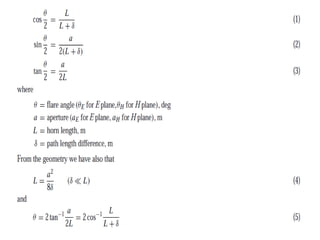
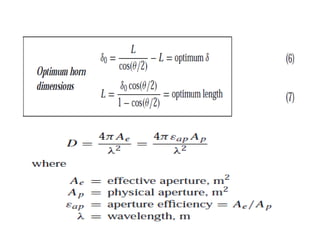
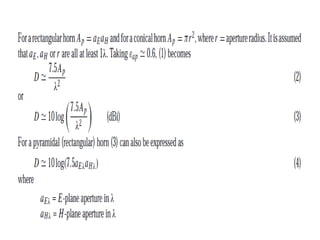
HORN ANTENNAS
R.Ramalakshmi
Assistant Professor
Ramco Institute of Technology
Rajapalayam
What is Horn Antenna?
• A horn antenna or microwave horn is an antenna
that consists of a flaring (gradually become wider
at one end) metal waveguide shaped like a horn
to direct radio waves in a beam.
• Horns are widely used as antennas at UHF and
microwave frequencies, above 300 MHz.
• A horn antenna is used to transmit radio waves
from a waveguide ( a metal pipe used to carry
waves) out into space, or collect radio waves into
a waveguide for reception.
History
• One of the first horn antenna was constructed in
1897 by Indian radio researcher Jagadish Chandra
Bose in his pioneering experiments with
microwaves.
• In the 1930’s the first experimental research and
theoretical analysis of horns as antenna was
done.
• The development of RADAR in world war 2
stimulated horn research to design feed horns for
radar antennas.
Description
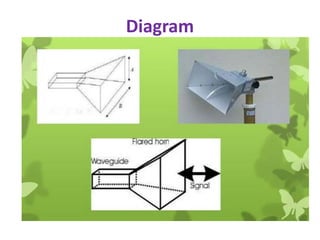
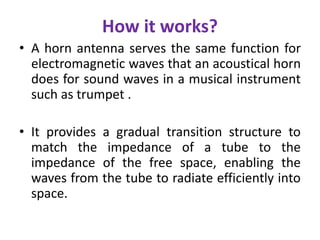
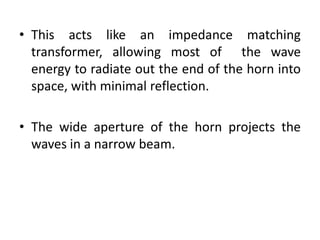
• It typically consists of a short length of
rectangular or cylindrical metal tube closed at
one end, flaring into an open-ended conical or
pyramidal shaped horn on the other hand.
• The radio waves are usually introduced into
the waveguide by a coaxial cable attached to
the side, with the central conductor projecting
into the waveguide to form a quarter-wave
monopole antenna.
• The waves then radiate out the horn end in a
narrow beam.
• In horns installed outdoors, such as the feed
horns of satellite dishes, the open mouth of
the horn is often covered by a plastic sheet
which is transparent to the radio waves, to
keep out moisture.
Diagram
How it works?
• A horn antenna serves the same function for
electromagnetic waves that an acoustical horn
does for sound waves in a musical instrument
such as trumpet .
• It provides a gradual transition structure to
match the impedance of a tube to the
impedance of the free space, enabling the
waves from the tube to radiate efficiently into
space.
• This acts like an impedance matching
transformer, allowing most of the wave
energy to radiate out the end of the horn into
space, with minimal reflection.
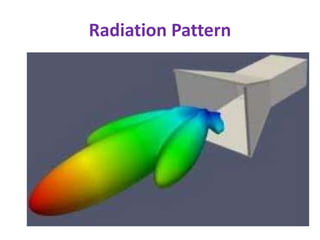
• The wide aperture of the horn projects the
waves in a narrow beam.
Radiation Pattern
Types of Horn Antennas
• The following are the common types of horn
antenna. Horns can have different flare angles as
well as different expansion curves (elliptic,
hyperbolic, etc..) in the E-field and H-field
directions, making possible a wide variety of
different beam profiles.
• Pyramidal Horn
• Sectoral Horn
• Conical Horn
• Septum Horn
Pyramidal Horn
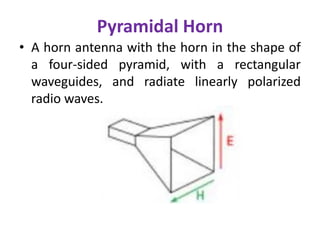
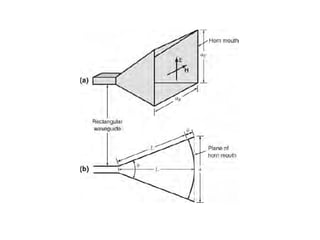
• A horn antenna with the horn in the shape of
a four-sided pyramid, with a rectangular
waveguides, and radiate linearly polarized
radio waves.
Sectoral Horn
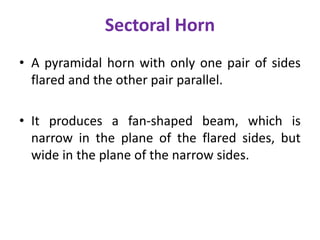
• A pyramidal horn with only one pair of sides
flared and the other pair parallel.
• It produces a fan-shaped beam, which is
narrow in the plane of the flared sides, but
wide in the plane of the narrow sides.
Types of Sectoral Horn
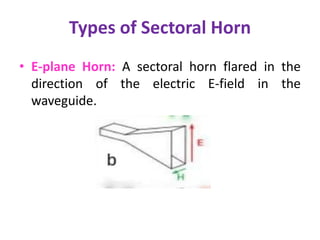
• E-plane Horn: A sectoral horn flared in the
direction of the electric E-field in the
waveguide.
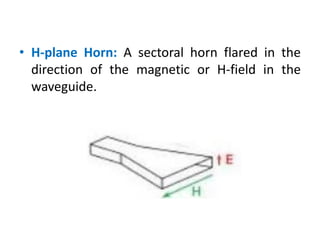
• H-plane Horn: A sectoral horn flared in the
direction of the magnetic or H-field in the
waveguide.
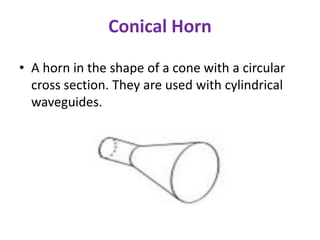
Conical Horn
• A horn in the shape of a cone with a circular
cross section. They are used with cylindrical
waveguides.
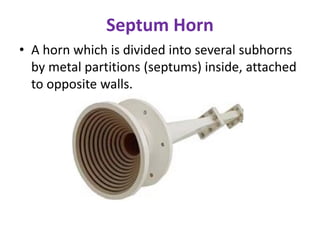
Septum Horn
• A horn which is divided into several subhorns
by metal partitions (septums) inside, attached
to opposite walls.
REFERENCES
• John D Kraus,” Antennas for all Applications”,
3rd Edition, McGraw Hill, 2005.
• Edward C.Jordan and Keith G.Balmain”
Electromagnetic Waves and Radiating
Systems” PrenticeHall of India, 2006
• Constantine.A.Balanis “Antenna Theory
Analysis and Design”, Wiley Student Edition,
2006.
Thank You

Horn antennas

  • 1.
    HORN ANTENNAS R.Ramalakshmi Assistant Professor RamcoInstitute of Technology Rajapalayam
  • 2.
    What is HornAntenna? • A horn antenna or microwave horn is an antenna that consists of a flaring (gradually become wider at one end) metal waveguide shaped like a horn to direct radio waves in a beam. • Horns are widely used as antennas at UHF and microwave frequencies, above 300 MHz. • A horn antenna is used to transmit radio waves from a waveguide ( a metal pipe used to carry waves) out into space, or collect radio waves into a waveguide for reception.
  • 3.
    History • One ofthe first horn antenna was constructed in 1897 by Indian radio researcher Jagadish Chandra Bose in his pioneering experiments with microwaves. • In the 1930’s the first experimental research and theoretical analysis of horns as antenna was done. • The development of RADAR in world war 2 stimulated horn research to design feed horns for radar antennas.
  • 4.
    Description • It typicallyconsists of a short length of rectangular or cylindrical metal tube closed at one end, flaring into an open-ended conical or pyramidal shaped horn on the other hand. • The radio waves are usually introduced into the waveguide by a coaxial cable attached to the side, with the central conductor projecting into the waveguide to form a quarter-wave monopole antenna.
  • 5.
    • The wavesthen radiate out the horn end in a narrow beam. • In horns installed outdoors, such as the feed horns of satellite dishes, the open mouth of the horn is often covered by a plastic sheet which is transparent to the radio waves, to keep out moisture.
  • 6.
  • 7.
    How it works? •A horn antenna serves the same function for electromagnetic waves that an acoustical horn does for sound waves in a musical instrument such as trumpet . • It provides a gradual transition structure to match the impedance of a tube to the impedance of the free space, enabling the waves from the tube to radiate efficiently into space.
  • 8.
    • This actslike an impedance matching transformer, allowing most of the wave energy to radiate out the end of the horn into space, with minimal reflection. • The wide aperture of the horn projects the waves in a narrow beam.
  • 9.
  • 10.
    Types of HornAntennas • The following are the common types of horn antenna. Horns can have different flare angles as well as different expansion curves (elliptic, hyperbolic, etc..) in the E-field and H-field directions, making possible a wide variety of different beam profiles. • Pyramidal Horn • Sectoral Horn • Conical Horn • Septum Horn
  • 11.
    Pyramidal Horn • Ahorn antenna with the horn in the shape of a four-sided pyramid, with a rectangular waveguides, and radiate linearly polarized radio waves.
  • 12.
    Sectoral Horn • Apyramidal horn with only one pair of sides flared and the other pair parallel. • It produces a fan-shaped beam, which is narrow in the plane of the flared sides, but wide in the plane of the narrow sides.
  • 13.
    Types of SectoralHorn • E-plane Horn: A sectoral horn flared in the direction of the electric E-field in the waveguide.
  • 14.
    • H-plane Horn:A sectoral horn flared in the direction of the magnetic or H-field in the waveguide.
  • 15.
    Conical Horn • Ahorn in the shape of a cone with a circular cross section. They are used with cylindrical waveguides.
  • 16.
    Septum Horn • Ahorn which is divided into several subhorns by metal partitions (septums) inside, attached to opposite walls.
  • 22.
    REFERENCES • John DKraus,” Antennas for all Applications”, 3rd Edition, McGraw Hill, 2005. • Edward C.Jordan and Keith G.Balmain” Electromagnetic Waves and Radiating Systems” PrenticeHall of India, 2006 • Constantine.A.Balanis “Antenna Theory Analysis and Design”, Wiley Student Edition, 2006.
  • 23.