Basic Phonetics
Dr.S.Sundarabalu,M.A;M.A;Ph.D
Assistant Professor
Department of Linguistics
Bharathiar University,Coimbatore-46
sunder_balu@yahoo.co.in
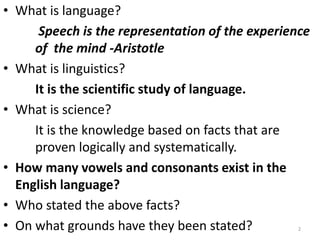
• What is language?
Speech is the representation of the experience
of the mind -Aristotle
• What is linguistics?
It is the scientific study of language.
• What is science?
It is the knowledge based on facts that are
proven logically and systematically.
• How many vowels and consonants exist in the
English language?
• Who stated the above facts?
• On what grounds have they been stated? 2
 Language - defines the actions that occur in the world.
 Language is thus composed of sign, letter, sentence,
gesture, sound, light, movements, space, silence, function
and the like.
 Language is rightly used by those who intently observe
the events of the world.
 The growth of the brain should not be associated with a
corresponding growth of knowledge, as knowledge can
develop only when the brain is trained by constant
intellectual musing .
 What is required for the proper growth of the body?
 Food.
 What is required for the proper growth of the brain?
 Thinking. 3
LANGUAGE AS A SYSTEM
• Language as a system consists of two
parts:
(1) expression and
(2) content (Gleason,1961- p.67).
• Expression refers to the form of the
language mainly spoken, sometimes
written, in the case of languages, which
have developed a writing system.
• The structure of sentences, phrases,
words, and morphemes referred to
above which are all meaningful and
phonemes or sound units of which
these higher units are made of represent
the expression system.
• The content system is concerned with
the study of how these units of the
expression system become 'meaningful'
or relate to the various types of activities
of the human beings, their
surroundings, their ideas,
organizations, social, cultural,
political etc., or the 'world'.
• Of the different aspects of the
expression system sentence structure is
studied by the branch or level of
linguistics called, syntax, word and
morpheme structure by morphology,
sound structure by the branches
phonemics and phonetics together
called phonology and content
structure is studied by semantics.
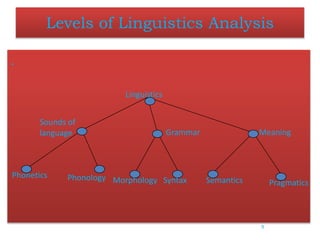
Levels of Linguistics Analysis
.
9
Phonetics Phonology
Sounds of
language
Linguistics
Grammar
Morphology Syntax
Meaning
Semantics Pragmatics
History of Phonetics
The Prague School
• Prague School is originally known as the Prague
Linguistic Circle, a group of scholars with a common
approach to linguistics who were working in Prague
in the late 1920s and early 1930s.
• This School was founded in 1926 by Vilém
Mathesius (1882 - 1945), who was a professor of
English at the Caroline University of Prague. ( Vilém
Mathesius (1882-1945), founder of the Prague Linguistic Circle (PLC),
was a representative of functional linguistics.)Although most of
its members were Czech linguists, two of its most
influential figures were Russian: Nikolai Trubetzkoi
and Roman Jakobson, who were among its founders
in 1926.
• Vilém Mathesius, (born August 3, 1882, Pardubice,
Bohemia, Austria-Hungary [now in Czech Republic]—
died April 12, 1945, Prague, Czech.), Czech linguist and
scholar of English language and literature. He was the
founder (1926) and president of the Prague Linguistic
Circle, famous for its influence on structural linguistics
and for its phonological studies. Mathesius taught at
Charles University in Prague, beginning in 1909 after he
had received his degree in Germanic and Romance
studies. He became its first professor of Anglistics in
1912 and was promoted to full professor in 1919.
• He also published a two-volume history of English
literature (Dějiny anglické literatury; 1910–15) and
several Shakespearean studies rather
• The Pragueans produced a set of principles
that were pretty generally agreed upon by
members of the group and have been widely
accepted elsewhere.
The Pragueans produced a set of principles that were pretty generally
agreed upon by members of the group and have been widely
accepted elsewhere.
1.The separation of phonetics and phonemics as two subfields
of phonology – Phonetics deals with the production,
transmission and perception of sounds whereas
phonemics studies the classes of sounds and their use in a
language according to their distribution and function.
2.The idea of the phoneme (the simple units of sound that
distinguish one word from another) as the minimal functional
element of language was expounded by Trubetzkoy and became
a Praguean concept.
3.Each of the phonemes that appear in the lexicon of a language may
be classified in terms of a set of phonetic properties, or features.
• 4.The “minimal pairs”
• 5.They also developed the notion of “functional
load”—
• 6.“Binarity” was also a Prague idea, where the
phonemes are specified by plusses and minuses
applied to each feature, illustrates this principle;
• 7.Markedness is a way of expressing the amount of
information that is coded in a form.
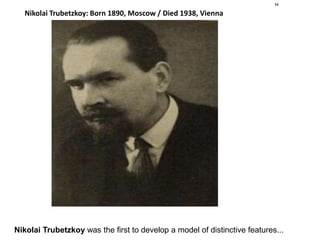
Nikolai Trubetzkoy: Born 1890, Moscow / Died 1938, Vienna
Nikolai Trubetzkoy was the first to develop a model of distinctive features...
Trubetzkoy’s contributions, basically in the field of phonology
and phonetics are very important:
Trubetzkoy redefined the phoneme functionally as the smallest
distinctive unit within the structure of a given language, and
he further broke these phonemes into their distinctive
features. To understand the phoneme, we have to know two
concepts that are strictly related to the concept of the
phoneme:
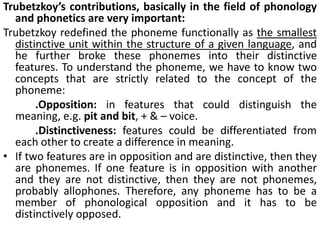
.Opposition: in features that could distinguish the
meaning, e.g. pit and bit, + & – voice.
.Distinctiveness: features could be differentiated from
each other to create a difference in meaning.
• If two features are in opposition and are distinctive, then they
are phonemes. If one feature is in opposition with another
and they are not distinctive, then they are not phonemes,
probably allophones. Therefore, any phoneme has to be a
member of phonological opposition and it has to be
distinctively opposed.
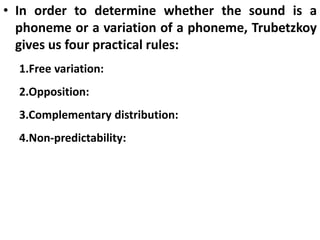
• In order to determine whether the sound is a
phoneme or a variation of a phoneme, Trubetzkoy
gives us four practical rules:
1.Free variation:
2.Opposition:
3.Complementary distribution:
4.Non-predictability:
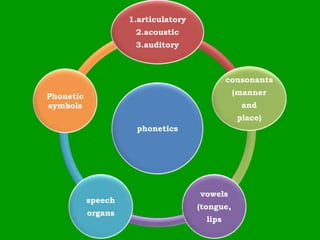
phonetics
1.articulatory
2.acoustic
3.auditory
consonants
(manner
and
place)
vowels
(tongue,
lips
speech
organs
Phonetic
symbols
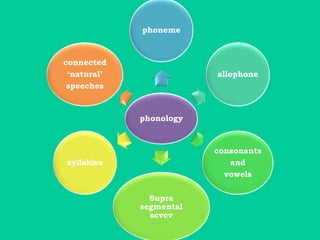
phonology
phoneme
allophone
consonants
and
vowels
Supra
segmental
scvcv
syllables
connected
‘natural’
speeches
1. Phonetics
2. Organs of Speech
3. The Air-stream Mechanism
4. The Types of Air-stream
5. Speech Sounds
6. Description and Classification
of Vowels Sounds
7. Description and Classification
of Consonants
• Phonetics is the study of the sounds of human speech.
• Phonetics (pronounced as [fəˈnɛtɪks], from the Greek: φωνή, phōnē, 'sound, voice') is a branch of linguistics
that comprises the study of the sounds of human speech.
• It is concerned with the physical
properties of speech sounds or signs
(phones): their physiological production,
acoustic properties, auditory perception,
and neurophysiological status.
• The field of phonetics is a multiple
layered subject of linguistics that focuses
on speech
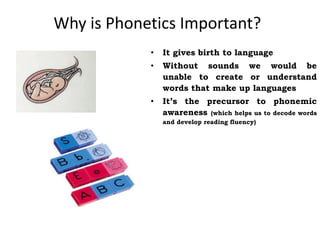
Why is Phonetics Important?
• It gives birth to language
• Without sounds we would be
unable to create or understand
words that make up languages
• It’s the precursor to phonemic
awareness (which helps us to decode words
and develop reading fluency)
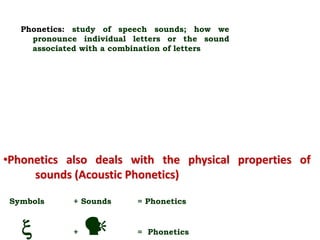
•Phonetics also deals with the physical properties of
sounds (Acoustic Phonetics)
Symbols + Sounds = Phonetics
 +  = Phonetics
Phonetics: study of speech sounds; how we
pronounce individual letters or the sound
associated with a combination of letters
.
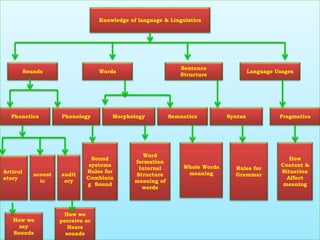
Sentence
Structure
acoust
ic
Phonetics Pragmatics
Language Usages
Syntax
Sounds
Knowledge of language & Linguistics
SemanticsMorphology
Words
Phonology
audit
ory
Articul
atory
Sound
systems
Rules for
Combinin
g Sound
Word
formation
Internal
Structure
meaning of
words
Whole Words
meaning
Rules for
Grammar
How
Context &
Situation
Affect
meaning
How we
say
Sounds
How we
perceive or
Hears
sounds
Main branches of phonetics
1. Articulatory phonetics
2. Acousitc phonetics
3.Auditory Phonetics
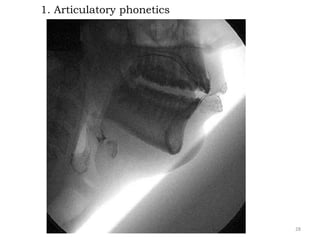
• 1. Articulatory phonetics
• Study of the vocal organs and how they
produce speech sounds
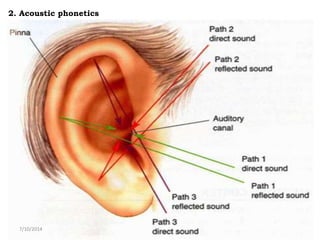
• 2. Acoustic phonetics
• A study of the physical properties of
speech sounds as sound waves.
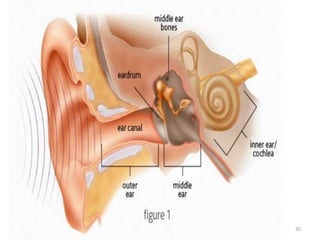
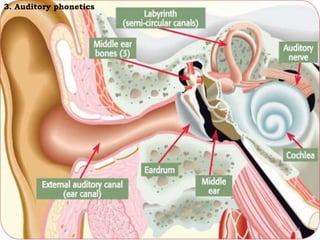
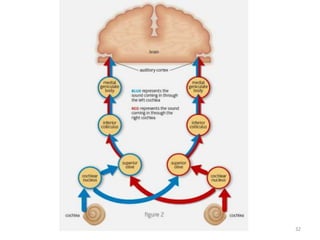
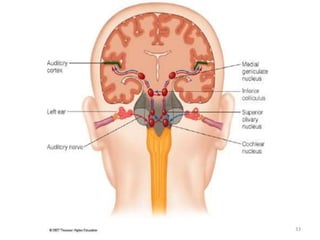
• 3.Auditory Phonetics
• Study of how speech sounds in the
form of sound waves are perceived and
processed by ears , nervous system,
and brain.
1. Articulatory phonetics
28
2. Acoustic phonetics
7/10/2014
30
3. Auditory phonetics
31
32
33
The Names of the
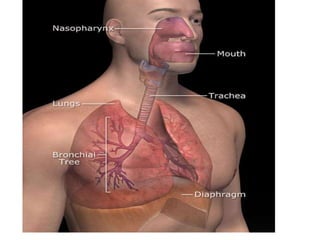
Organs of Speech
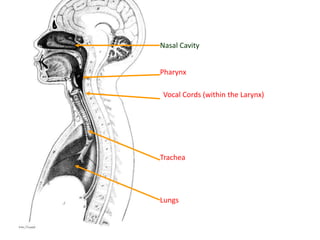
Lungs
Trachea
Vocal Cords (within the Larynx)
Pharynx
Nasal Cavity
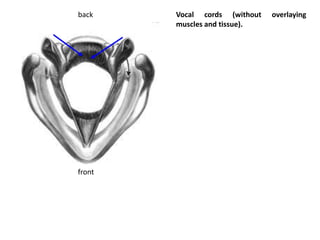
Vocal cords (without overlaying
muscles and tissue).
front
back
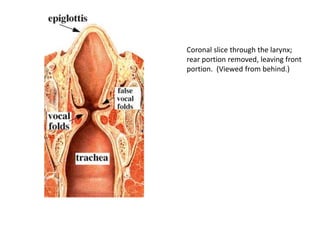
Coronal slice through the larynx;
rear portion removed, leaving front
portion. (Viewed from behind.)
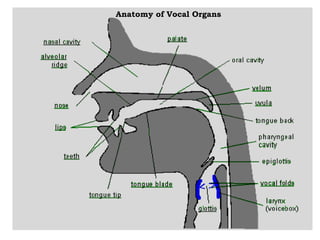
Anatomy of Vocal Organs
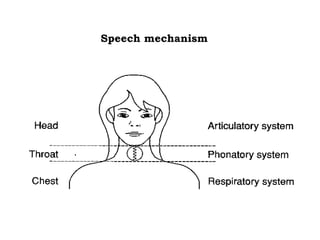
Speech mechanism
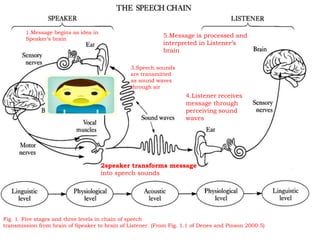
Fig. 1. Five stages and three levels in chain of speech
transmission from brain of Speaker to brain of Listener. (From Fig. 1.1 of Denes and Pinson 2000:5)
2speaker transforms message
into speech sounds
4.Listener receives
message through
perceiving sound
waves
5.Message is processed and
interpreted in Listener’s
brain
3.Speech sounds
are transmitted
as sound waves
through air
1.Message begins as idea in
Speaker’s brain
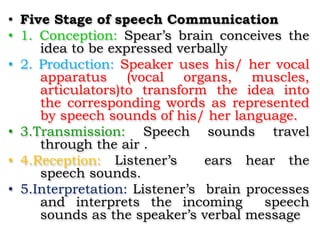
• Five Stage of speech Communication
• 1. Conception: Spear’s brain conceives the
idea to be expressed verbally
• 2. Production: Speaker uses his/ her vocal
apparatus (vocal organs, muscles,
articulators)to transform the idea into
the corresponding words as represented
by speech sounds of his/ her language.
• 3.Transmission: Speech sounds travel
through the air .
• 4.Reception: Listener’s ears hear the
speech sounds.
• 5.Interpretation: Listener’s brain processes
and interprets the incoming speech
sounds as the speaker’s verbal message
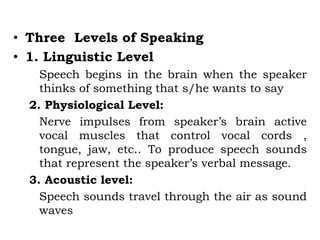
• Three Levels of Speaking
• 1. Linguistic Level
Speech begins in the brain when the speaker
thinks of something that s/he wants to say
2. Physiological Level:
Nerve impulses from speaker’s brain active
vocal muscles that control vocal cords ,
tongue, jaw, etc.. To produce speech sounds
that represent the speaker’s verbal message.
3. Acoustic level:
Speech sounds travel through the air as sound
waves
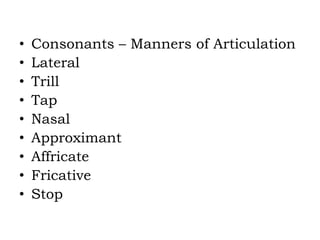
• Consonants – Manners of Articulation
• Lateral
• Trill
• Tap
• Nasal
• Approximant
• Affricate
• Fricative
• Stop
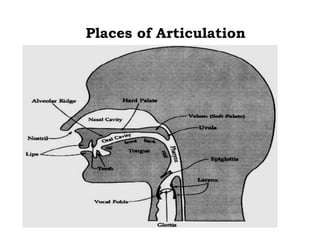
Places of Articulation
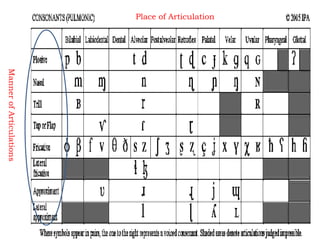
Place of Articulation
MannerofArticulations
• 3. Organs of Speech
• Groups of Organs of Speech
• Respiratory system
• Phonatory system
• Articularosy system
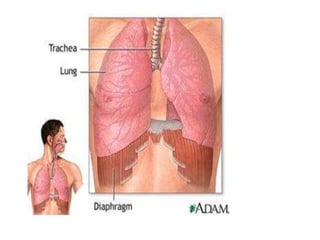
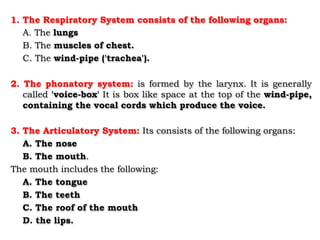
1. The Respiratory System consists of the following organs:
A. The lungs
B. The muscles of chest.
C. The wind-pipe ('trachea').
2. The phonatory system: is formed by the larynx. It is generally
called 'voice-box' It is box like space at the top of the wind-pipe,
containing the vocal cords which produce the voice.
3. The Articulatory System: Its consists of the following organs:
A. The nose
B. The mouth.
The mouth includes the following:
A. The tongue
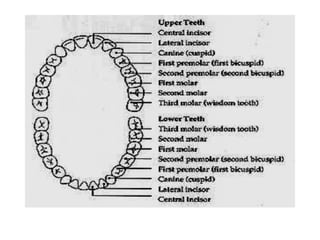
B. The teeth
C. The roof of the mouth
D. the lips.
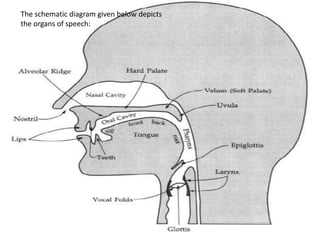
The schematic diagram given below depicts
the organs of speech:
(1) the Larynx ".
When we produce speech sound with the vocal cords drawn
separately, such sounds are called breathed or voiceless
sounds.
In other words, voiceless sounds are produced when the
vocal cords do not vibrate.
For example, as in
pin - p
tin - t
kin - k
chin - tʃ
fin - f
thin - θ
sin - s
shin - ʃ
him - h
If the vocal cords are held loosely together, the
pressure of the air coming from the lungs
makes them vibrate, that is, they open and
close regularly many times a second. This
vibration of the vocal cords produces a
musical note called voice, and sounds
produced in this way are called voiced
sounds. In other words, voiced sound are
produced when the vocal cords vibrate. For
example all vowel sounds and the
consonants () as in the English words
bin,
din,
gun,
join,
vain,
them, .
zoo,
pleasure,
mine,
near
sing,
love,
red,
yellow and
win.
The number of times the vocal cords open and close in one
second is known as the frequency of vibration, and this
decide the pitch of the voice.
(2) The Pharynx: The pharynx or pharyngal cavity is
the voice box. This acts as a vibrating cavity for the
sounds produced by the vibration of the vocal cords.
The partial or complete stoppage of the air-stream
can be achieved by modifying the shape of this cavity
that makes the soft-palate or the tongue act.
In the head we have the organs of articulation and
two cavities. :
(i) the oral cavity, and
(ii) the nasal cavity. The oral cavity is the
mouth and the nasal cavity is the nose.
The shape of the mouth cavity depends on the
positions of the tongue and the lips. The roof of the
mouth can be divided into the following three
parts;
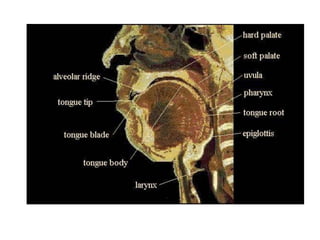
1.the alveolar ridge or teeth ridge having
hard convex surface just behind the
upper teeth; ALVEOLAR RIDGE
A short distance behind the upper teeth is a
change in the angle of the roof of the mouth.
This is the alveolar ridge. Sounds which involve
the area between the upper teeth and this ridge
are called alveolars.
2.the hard palate, (the hard concave
surface); (HARD) PALATE
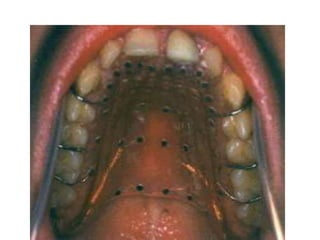
The hard portion of the roof of the mouth.
The term "palate" by itself usually refers to the
hard palate.
3.the soft-palate or the velum at the back, with
the uvula at its end SOFT PALATE/VELUM The soft
portion of the roof of the mouth, lying behind the hard
palate. The tongue hits the velum in the sounds [k], [g],
and [N]. The velum can also move: if it lowers, it creates
an opening that allows air to flow out through the nose; if
it stays raised, the opening is blocked, and no air can
flow through the nose.
4. UVULA
The small, dangly thing at the back of the soft
palate. The uvula vibrates during the r sound in many
French dialects.
5. PHARYNX
The cavity between the root of the tongue and the
walls of the upper throat.
(3) The Tongue; The tongue is a very important organ of speech. It can
take up a very large number of different positions for the articulation of
different vowel and consonant sounds. The tongue has five parts which
are as follows:
A. the tip
B, the blade
C. the front
D. the back
E. the root.
The extreme edge of the tongue is called the tip. Immediately after the tip is
the blade and it is the part of the tongue that lies opposite the teeth-
ridge when the speech organs are at rest. Beyond the blade is the front
of the tongue which lies opposite the hard palate when the speech-
organs are at rest.
• 6. TONGUE BLADE
The flat surface of the tongue just behind the tip.
• 7. TONGUE BODY/DORSUM
The main part of the tongue, lying below the hard and soft palate. The body,
specifically the back part of the body, moves to make vowels and many consonants.
• 8. TONGUE ROOT
The lowest part of the tongue in the throat.
• (4) The Lips: The lips play their part in the
articulation of certain consonants.
For example, the initial sound in the English
words, pill, bil1 and mill are produced with
the lips tightly close. Also, the lips play an
important part during the articulation of
vowel sounds.
The lips assume different positions-spread,
neutral, or rounded-for different vowel
sounds. For example, the vowel in the
English word see is produced with spread
lips, that in the word sat is produced with
neutral lips and that in the word shop is
produced with rounded lips.
10. VOCAL FOLDS/VOCAL CORDS
Folds of tissue stretched across the airway to
the lungs. They can vibrate against each other,
providing much of the sound during speech.
11. GLOTTIS
The opening between the vocal cords. During
a glottal stop, the vocal cords are held together and
there is no opening between them.
9. EPIGLOTTIS
The fold of tissue below the root of the tongue. The
epiglottis helps cover the larynx during swallowing,
making sure (usually!) that food goes into the
stomach and not the lungs. A few languages use the
epiglottis in making sounds. English is fortunately
not one of them.
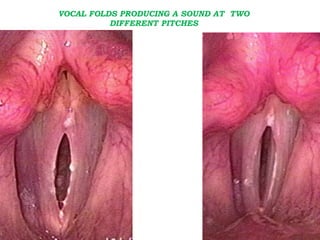
VOCAL FOLDS PRODUCING A SOUND AT TWO
DIFFERENT PITCHES
• There are some sounds during the
articulation of which the air escapes
simultaneously through the nose and the
mouth. That is, the velum is lowered,
thereby opening the nasal passage, and the
oral passage is so open. Such sounds are
called nasalized sounds. Many Indian
languages have such sounds. For example.
the vowel in the Hindi word [a~ : kh] is a
nasalized vowel.
• Nasalization is marked in phonetic
transcription by adding the tilde [~] above
the vowel symbol.
•
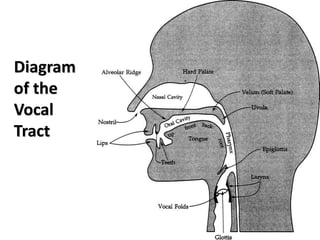
Diagram
of the
Vocal
Tract
Descriptions for
Different Organs of
Speech
(4)The Air-stream Mechanism
a)Pulmonic
b) Glottic
c) Velaric
We breathe in and breathe out air. When we breathe in
air, no sound is produced but it is not so in the case of
breathe outing air form the lungs. Sound is produced
when air is puff out form the lungs.
Technically speaking, for the production of speech we
need air stream mechanism. There are three types of
air-stream mechanism. They are as follows :
A. Pulmonic
B. Glottalic
C. Veleric
A. Pulmonic air-stream mechanism is
one which consists of the lungs and the
respiratory muscles, which set the sir-
stream in motion.
• Pulmonic Sounds
• Air flow is directed outwards towards
the oral cavity
• Pressure built by compression of lungs
• English [p], [n], [s], [l], [e]
•Glottic Egressive Sounds
•Air flow is directed outwards
towards the oral Cavity
• Pressure built by pushing up
closed glottis [p’], [t’], [k’]
B. Glottalic air-stream mechanism is one in
which the larynx, with the glottis firmly closed,
is moved up or down to initiate the air-stream.
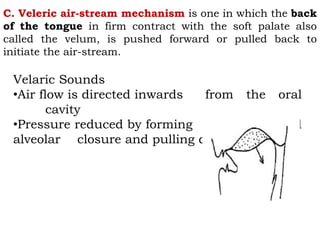
Velaric Sounds
•Air flow is directed inwards from the oral
cavity
•Pressure reduced by forming velaric and
alveolar closure and pulling down tongue
C. Veleric air-stream mechanism is one in which the back
of the tongue in firm contract with the soft palate also
called the velum, is pushed forward or pulled back to
initiate the air-stream.
• (5) The Types of Air-stream
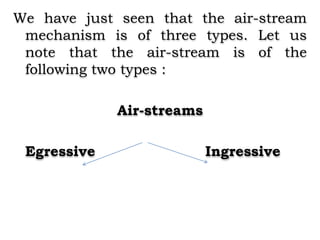
We have just seen that the air-stream
mechanism is of three types. Let us
note that the air-stream is of the
following two types :
Air-streams
Egressive Ingressive
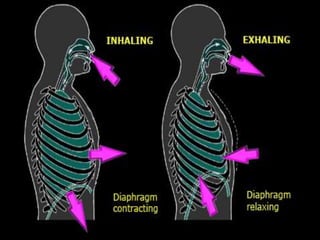
1. The Egressive air-stream is one in which
the air is pushed out (It must be
remembered that for the sounds of English
and most of the Indian languages, we
generally make use of an egressive pulmonic
air-stream, that is, the air is pushed out of
the lungs).
2. The ingressive an-streams is one in which
the air is pulled out (It is interesting to note
that Sindhi language has some sounds
produced with an ingressive glottalic air-
stream.)
• (6) Speech Sounds
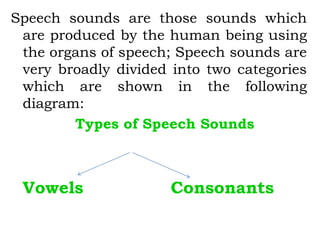
Speech sounds are those sounds which
are produced by the human being using
the organs of speech; Speech sounds are
very broadly divided into two categories
which are shown in the following
diagram:
Types of Speech Sounds
Vowels Consonants
1. Vowel Sounds: The vowel sounds are those
sounds during the production of which the air
escapes through the mouth freely and we do
not hear any friction. In other words vowel-
sounds are made without audiable stopping of
the breath by the tongue, lips, etc.,
For instance, /i/, /e/, /u/, are vowel-sounds.
2. Consonant Sounds: Consonant Sounds are
those speech sounds during the production of
which, the air escapes through the mouth
with friction. In other words, consonant
sounds are produced by completely or partially
obstructing the air being breathed out through
the mouth. For example, /b/, /f/, /t/, etc. are
consonant sounds.
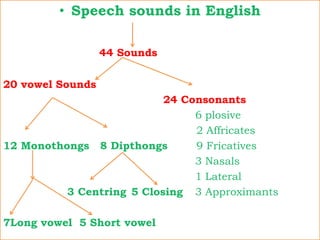
3. Speech Sounds in English :
In English we have 44 sounds Of these 22
sounds, 24 are consonant sounds and
20 are vowel sounds. Of the 20 vowel
sounds, 12 are pure vowels
(monothongs) and 8 are called dipthongs
(glides). Out of the 12 pure vowels, 5 are
long vowels and 7 are short vowels. Of
the 8 dipthongs, 3 are centring dipthongs
and 5 are closing dipthongs.
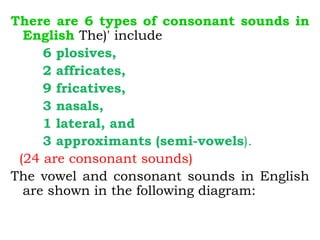
There are 6 types of consonant sounds in
English The)' include
6 plosives,
2 affricates,
9 fricatives,
3 nasals,
1 lateral, and
3 approximants (semi-vowels).
(24 are consonant sounds)
The vowel and consonant sounds in English
are shown in the following diagram:
• Speech sounds in English
44 Sounds
20 vowel Sounds
24 Consonants
6 plosive
2 Affricates
12 Monothongs 8 Dipthongs 9 Fricatives
3 Nasals
1 Lateral
3 Centring 5 Closing 3 Approximants
7Long vowel 5 Short vowel

Basic phonetics

  • 1.
    Basic Phonetics Dr.S.Sundarabalu,M.A;M.A;Ph.D Assistant Professor Departmentof Linguistics Bharathiar University,Coimbatore-46 sunder_balu@yahoo.co.in
  • 2.
    • What islanguage? Speech is the representation of the experience of the mind -Aristotle • What is linguistics? It is the scientific study of language. • What is science? It is the knowledge based on facts that are proven logically and systematically. • How many vowels and consonants exist in the English language? • Who stated the above facts? • On what grounds have they been stated? 2
  • 3.
     Language -defines the actions that occur in the world.  Language is thus composed of sign, letter, sentence, gesture, sound, light, movements, space, silence, function and the like.  Language is rightly used by those who intently observe the events of the world.  The growth of the brain should not be associated with a corresponding growth of knowledge, as knowledge can develop only when the brain is trained by constant intellectual musing .  What is required for the proper growth of the body?  Food.  What is required for the proper growth of the brain?  Thinking. 3
  • 4.
    LANGUAGE AS ASYSTEM • Language as a system consists of two parts:
  • 5.
    (1) expression and (2)content (Gleason,1961- p.67).
  • 6.
    • Expression refersto the form of the language mainly spoken, sometimes written, in the case of languages, which have developed a writing system. • The structure of sentences, phrases, words, and morphemes referred to above which are all meaningful and phonemes or sound units of which these higher units are made of represent the expression system.
  • 7.
    • The contentsystem is concerned with the study of how these units of the expression system become 'meaningful' or relate to the various types of activities of the human beings, their surroundings, their ideas, organizations, social, cultural, political etc., or the 'world'.
  • 8.
    • Of thedifferent aspects of the expression system sentence structure is studied by the branch or level of linguistics called, syntax, word and morpheme structure by morphology, sound structure by the branches phonemics and phonetics together called phonology and content structure is studied by semantics.
  • 9.
    Levels of LinguisticsAnalysis . 9 Phonetics Phonology Sounds of language Linguistics Grammar Morphology Syntax Meaning Semantics Pragmatics
  • 10.
  • 11.
    The Prague School •Prague School is originally known as the Prague Linguistic Circle, a group of scholars with a common approach to linguistics who were working in Prague in the late 1920s and early 1930s. • This School was founded in 1926 by Vilém Mathesius (1882 - 1945), who was a professor of English at the Caroline University of Prague. ( Vilém Mathesius (1882-1945), founder of the Prague Linguistic Circle (PLC), was a representative of functional linguistics.)Although most of its members were Czech linguists, two of its most influential figures were Russian: Nikolai Trubetzkoi and Roman Jakobson, who were among its founders in 1926.
  • 12.
    • Vilém Mathesius,(born August 3, 1882, Pardubice, Bohemia, Austria-Hungary [now in Czech Republic]— died April 12, 1945, Prague, Czech.), Czech linguist and scholar of English language and literature. He was the founder (1926) and president of the Prague Linguistic Circle, famous for its influence on structural linguistics and for its phonological studies. Mathesius taught at Charles University in Prague, beginning in 1909 after he had received his degree in Germanic and Romance studies. He became its first professor of Anglistics in 1912 and was promoted to full professor in 1919. • He also published a two-volume history of English literature (Dějiny anglické literatury; 1910–15) and several Shakespearean studies rather
  • 13.
    • The Pragueansproduced a set of principles that were pretty generally agreed upon by members of the group and have been widely accepted elsewhere.
  • 14.
    The Pragueans produceda set of principles that were pretty generally agreed upon by members of the group and have been widely accepted elsewhere. 1.The separation of phonetics and phonemics as two subfields of phonology – Phonetics deals with the production, transmission and perception of sounds whereas phonemics studies the classes of sounds and their use in a language according to their distribution and function. 2.The idea of the phoneme (the simple units of sound that distinguish one word from another) as the minimal functional element of language was expounded by Trubetzkoy and became a Praguean concept. 3.Each of the phonemes that appear in the lexicon of a language may be classified in terms of a set of phonetic properties, or features.
  • 15.
    • 4.The “minimalpairs” • 5.They also developed the notion of “functional load”— • 6.“Binarity” was also a Prague idea, where the phonemes are specified by plusses and minuses applied to each feature, illustrates this principle; • 7.Markedness is a way of expressing the amount of information that is coded in a form.
  • 16.
    Nikolai Trubetzkoy: Born1890, Moscow / Died 1938, Vienna Nikolai Trubetzkoy was the first to develop a model of distinctive features...
  • 17.
    Trubetzkoy’s contributions, basicallyin the field of phonology and phonetics are very important: Trubetzkoy redefined the phoneme functionally as the smallest distinctive unit within the structure of a given language, and he further broke these phonemes into their distinctive features. To understand the phoneme, we have to know two concepts that are strictly related to the concept of the phoneme: .Opposition: in features that could distinguish the meaning, e.g. pit and bit, + & – voice. .Distinctiveness: features could be differentiated from each other to create a difference in meaning. • If two features are in opposition and are distinctive, then they are phonemes. If one feature is in opposition with another and they are not distinctive, then they are not phonemes, probably allophones. Therefore, any phoneme has to be a member of phonological opposition and it has to be distinctively opposed.
  • 18.
    • In orderto determine whether the sound is a phoneme or a variation of a phoneme, Trubetzkoy gives us four practical rules: 1.Free variation: 2.Opposition: 3.Complementary distribution: 4.Non-predictability:
  • 19.
  • 20.
  • 21.
    1. Phonetics 2. Organsof Speech 3. The Air-stream Mechanism 4. The Types of Air-stream 5. Speech Sounds 6. Description and Classification of Vowels Sounds 7. Description and Classification of Consonants
  • 22.
    • Phonetics isthe study of the sounds of human speech. • Phonetics (pronounced as [fəˈnɛtɪks], from the Greek: φωνή, phōnē, 'sound, voice') is a branch of linguistics that comprises the study of the sounds of human speech. • It is concerned with the physical properties of speech sounds or signs (phones): their physiological production, acoustic properties, auditory perception, and neurophysiological status. • The field of phonetics is a multiple layered subject of linguistics that focuses on speech
  • 23.
    Why is PhoneticsImportant? • It gives birth to language • Without sounds we would be unable to create or understand words that make up languages • It’s the precursor to phonemic awareness (which helps us to decode words and develop reading fluency)
  • 24.
    •Phonetics also dealswith the physical properties of sounds (Acoustic Phonetics) Symbols + Sounds = Phonetics  +  = Phonetics Phonetics: study of speech sounds; how we pronounce individual letters or the sound associated with a combination of letters
  • 25.
    . Sentence Structure acoust ic Phonetics Pragmatics Language Usages Syntax Sounds Knowledgeof language & Linguistics SemanticsMorphology Words Phonology audit ory Articul atory Sound systems Rules for Combinin g Sound Word formation Internal Structure meaning of words Whole Words meaning Rules for Grammar How Context & Situation Affect meaning How we say Sounds How we perceive or Hears sounds
  • 26.
    Main branches ofphonetics 1. Articulatory phonetics 2. Acousitc phonetics 3.Auditory Phonetics
  • 27.
    • 1. Articulatoryphonetics • Study of the vocal organs and how they produce speech sounds • 2. Acoustic phonetics • A study of the physical properties of speech sounds as sound waves. • 3.Auditory Phonetics • Study of how speech sounds in the form of sound waves are perceived and processed by ears , nervous system, and brain.
  • 28.
  • 29.
  • 30.
  • 31.
  • 32.
  • 33.
  • 34.
    The Names ofthe Organs of Speech
  • 35.
    Lungs Trachea Vocal Cords (withinthe Larynx) Pharynx Nasal Cavity
  • 37.
    Vocal cords (withoutoverlaying muscles and tissue). front back
  • 38.
    Coronal slice throughthe larynx; rear portion removed, leaving front portion. (Viewed from behind.)
  • 43.
  • 46.
  • 47.
    Fig. 1. Fivestages and three levels in chain of speech transmission from brain of Speaker to brain of Listener. (From Fig. 1.1 of Denes and Pinson 2000:5) 2speaker transforms message into speech sounds 4.Listener receives message through perceiving sound waves 5.Message is processed and interpreted in Listener’s brain 3.Speech sounds are transmitted as sound waves through air 1.Message begins as idea in Speaker’s brain
  • 48.
    • Five Stageof speech Communication • 1. Conception: Spear’s brain conceives the idea to be expressed verbally • 2. Production: Speaker uses his/ her vocal apparatus (vocal organs, muscles, articulators)to transform the idea into the corresponding words as represented by speech sounds of his/ her language. • 3.Transmission: Speech sounds travel through the air . • 4.Reception: Listener’s ears hear the speech sounds. • 5.Interpretation: Listener’s brain processes and interprets the incoming speech sounds as the speaker’s verbal message
  • 49.
    • Three Levelsof Speaking • 1. Linguistic Level Speech begins in the brain when the speaker thinks of something that s/he wants to say 2. Physiological Level: Nerve impulses from speaker’s brain active vocal muscles that control vocal cords , tongue, jaw, etc.. To produce speech sounds that represent the speaker’s verbal message. 3. Acoustic level: Speech sounds travel through the air as sound waves
  • 50.
    • Consonants –Manners of Articulation • Lateral • Trill • Tap • Nasal • Approximant • Affricate • Fricative • Stop
  • 51.
  • 52.
  • 53.
    • 3. Organsof Speech
  • 54.
    • Groups ofOrgans of Speech • Respiratory system • Phonatory system • Articularosy system
  • 55.
    1. The RespiratorySystem consists of the following organs: A. The lungs B. The muscles of chest. C. The wind-pipe ('trachea'). 2. The phonatory system: is formed by the larynx. It is generally called 'voice-box' It is box like space at the top of the wind-pipe, containing the vocal cords which produce the voice. 3. The Articulatory System: Its consists of the following organs: A. The nose B. The mouth. The mouth includes the following: A. The tongue B. The teeth C. The roof of the mouth D. the lips.
  • 56.
    The schematic diagramgiven below depicts the organs of speech:
  • 57.
    (1) the Larynx". When we produce speech sound with the vocal cords drawn separately, such sounds are called breathed or voiceless sounds. In other words, voiceless sounds are produced when the vocal cords do not vibrate. For example, as in pin - p tin - t kin - k chin - tʃ fin - f thin - θ sin - s shin - ʃ him - h
  • 58.
    If the vocalcords are held loosely together, the pressure of the air coming from the lungs makes them vibrate, that is, they open and close regularly many times a second. This vibration of the vocal cords produces a musical note called voice, and sounds produced in this way are called voiced sounds. In other words, voiced sound are produced when the vocal cords vibrate. For example all vowel sounds and the consonants () as in the English words
  • 59.
    bin, din, gun, join, vain, them, . zoo, pleasure, mine, near sing, love, red, yellow and win. Thenumber of times the vocal cords open and close in one second is known as the frequency of vibration, and this decide the pitch of the voice.
  • 60.
    (2) The Pharynx:The pharynx or pharyngal cavity is the voice box. This acts as a vibrating cavity for the sounds produced by the vibration of the vocal cords. The partial or complete stoppage of the air-stream can be achieved by modifying the shape of this cavity that makes the soft-palate or the tongue act. In the head we have the organs of articulation and two cavities. : (i) the oral cavity, and (ii) the nasal cavity. The oral cavity is the mouth and the nasal cavity is the nose. The shape of the mouth cavity depends on the positions of the tongue and the lips. The roof of the mouth can be divided into the following three parts;
  • 61.
    1.the alveolar ridgeor teeth ridge having hard convex surface just behind the upper teeth; ALVEOLAR RIDGE A short distance behind the upper teeth is a change in the angle of the roof of the mouth. This is the alveolar ridge. Sounds which involve the area between the upper teeth and this ridge are called alveolars. 2.the hard palate, (the hard concave surface); (HARD) PALATE The hard portion of the roof of the mouth. The term "palate" by itself usually refers to the hard palate.
  • 62.
    3.the soft-palate orthe velum at the back, with the uvula at its end SOFT PALATE/VELUM The soft portion of the roof of the mouth, lying behind the hard palate. The tongue hits the velum in the sounds [k], [g], and [N]. The velum can also move: if it lowers, it creates an opening that allows air to flow out through the nose; if it stays raised, the opening is blocked, and no air can flow through the nose. 4. UVULA The small, dangly thing at the back of the soft palate. The uvula vibrates during the r sound in many French dialects. 5. PHARYNX The cavity between the root of the tongue and the walls of the upper throat.
  • 63.
    (3) The Tongue;The tongue is a very important organ of speech. It can take up a very large number of different positions for the articulation of different vowel and consonant sounds. The tongue has five parts which are as follows: A. the tip B, the blade C. the front D. the back E. the root. The extreme edge of the tongue is called the tip. Immediately after the tip is the blade and it is the part of the tongue that lies opposite the teeth- ridge when the speech organs are at rest. Beyond the blade is the front of the tongue which lies opposite the hard palate when the speech- organs are at rest. • 6. TONGUE BLADE The flat surface of the tongue just behind the tip. • 7. TONGUE BODY/DORSUM The main part of the tongue, lying below the hard and soft palate. The body, specifically the back part of the body, moves to make vowels and many consonants. • 8. TONGUE ROOT The lowest part of the tongue in the throat.
  • 64.
    • (4) TheLips: The lips play their part in the articulation of certain consonants. For example, the initial sound in the English words, pill, bil1 and mill are produced with the lips tightly close. Also, the lips play an important part during the articulation of vowel sounds. The lips assume different positions-spread, neutral, or rounded-for different vowel sounds. For example, the vowel in the English word see is produced with spread lips, that in the word sat is produced with neutral lips and that in the word shop is produced with rounded lips.
  • 65.
    10. VOCAL FOLDS/VOCALCORDS Folds of tissue stretched across the airway to the lungs. They can vibrate against each other, providing much of the sound during speech. 11. GLOTTIS The opening between the vocal cords. During a glottal stop, the vocal cords are held together and there is no opening between them. 9. EPIGLOTTIS The fold of tissue below the root of the tongue. The epiglottis helps cover the larynx during swallowing, making sure (usually!) that food goes into the stomach and not the lungs. A few languages use the epiglottis in making sounds. English is fortunately not one of them.
  • 66.
    VOCAL FOLDS PRODUCINGA SOUND AT TWO DIFFERENT PITCHES
  • 67.
    • There aresome sounds during the articulation of which the air escapes simultaneously through the nose and the mouth. That is, the velum is lowered, thereby opening the nasal passage, and the oral passage is so open. Such sounds are called nasalized sounds. Many Indian languages have such sounds. For example. the vowel in the Hindi word [a~ : kh] is a nasalized vowel. • Nasalization is marked in phonetic transcription by adding the tilde [~] above the vowel symbol. •
  • 68.
  • 69.
  • 70.
  • 71.
    We breathe inand breathe out air. When we breathe in air, no sound is produced but it is not so in the case of breathe outing air form the lungs. Sound is produced when air is puff out form the lungs. Technically speaking, for the production of speech we need air stream mechanism. There are three types of air-stream mechanism. They are as follows : A. Pulmonic B. Glottalic C. Veleric
  • 72.
    A. Pulmonic air-streammechanism is one which consists of the lungs and the respiratory muscles, which set the sir- stream in motion. • Pulmonic Sounds • Air flow is directed outwards towards the oral cavity • Pressure built by compression of lungs • English [p], [n], [s], [l], [e]
  • 73.
    •Glottic Egressive Sounds •Airflow is directed outwards towards the oral Cavity • Pressure built by pushing up closed glottis [p’], [t’], [k’] B. Glottalic air-stream mechanism is one in which the larynx, with the glottis firmly closed, is moved up or down to initiate the air-stream.
  • 74.
    Velaric Sounds •Air flowis directed inwards from the oral cavity •Pressure reduced by forming velaric and alveolar closure and pulling down tongue C. Veleric air-stream mechanism is one in which the back of the tongue in firm contract with the soft palate also called the velum, is pushed forward or pulled back to initiate the air-stream.
  • 75.
    • (5) TheTypes of Air-stream
  • 76.
    We have justseen that the air-stream mechanism is of three types. Let us note that the air-stream is of the following two types : Air-streams Egressive Ingressive
  • 77.
    1. The Egressiveair-stream is one in which the air is pushed out (It must be remembered that for the sounds of English and most of the Indian languages, we generally make use of an egressive pulmonic air-stream, that is, the air is pushed out of the lungs). 2. The ingressive an-streams is one in which the air is pulled out (It is interesting to note that Sindhi language has some sounds produced with an ingressive glottalic air- stream.)
  • 79.
  • 80.
    Speech sounds arethose sounds which are produced by the human being using the organs of speech; Speech sounds are very broadly divided into two categories which are shown in the following diagram: Types of Speech Sounds Vowels Consonants
  • 81.
    1. Vowel Sounds:The vowel sounds are those sounds during the production of which the air escapes through the mouth freely and we do not hear any friction. In other words vowel- sounds are made without audiable stopping of the breath by the tongue, lips, etc., For instance, /i/, /e/, /u/, are vowel-sounds. 2. Consonant Sounds: Consonant Sounds are those speech sounds during the production of which, the air escapes through the mouth with friction. In other words, consonant sounds are produced by completely or partially obstructing the air being breathed out through the mouth. For example, /b/, /f/, /t/, etc. are consonant sounds.
  • 82.
    3. Speech Soundsin English : In English we have 44 sounds Of these 22 sounds, 24 are consonant sounds and 20 are vowel sounds. Of the 20 vowel sounds, 12 are pure vowels (monothongs) and 8 are called dipthongs (glides). Out of the 12 pure vowels, 5 are long vowels and 7 are short vowels. Of the 8 dipthongs, 3 are centring dipthongs and 5 are closing dipthongs.
  • 83.
    There are 6types of consonant sounds in English The)' include 6 plosives, 2 affricates, 9 fricatives, 3 nasals, 1 lateral, and 3 approximants (semi-vowels). (24 are consonant sounds) The vowel and consonant sounds in English are shown in the following diagram:
  • 84.
    • Speech soundsin English 44 Sounds 20 vowel Sounds 24 Consonants 6 plosive 2 Affricates 12 Monothongs 8 Dipthongs 9 Fricatives 3 Nasals 1 Lateral 3 Centring 5 Closing 3 Approximants 7Long vowel 5 Short vowel