FOƱNI:M ƏND
DɪSTɪŊ(K)TɪV
FI:TƩƏR ΘI:ƏRI:


phoneme and distinctive
    feature theory
Presenters


             2
DIFFERENCE?
                                               /k/


   kit                           [ko]
                                 after s
                                                     [kh]
                                                     Initial
                                                               [k]
                                                               elsewhere


                     k
                   s ill

                                   sac     k
We pronounce them differently but we know they are the
  same sound.
How do we know two sounds are the same or different?                3
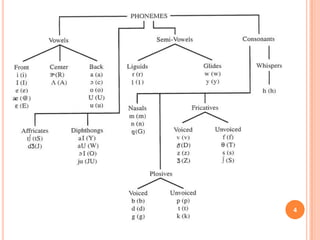
4
PHONOLOGY
   Phonology is how speech sounds are organized and
    affect one another in pronunciation.


   Key terms:
     Phone
     Phoneme
     allophone


   This organization is explained in phonological rules

                                                           5
CONCEPTUALITY

Articulatory phonetics   •   Phonology

Real sounds = phones     •   system and rules of sound
                             patterns
•    [p], [t], [k]
                         •   Abstractions = phoneme
•    [i], [æ]
                         •   /p/, /t/, /k/
                         •   /i/, /æ/

                         •   Inventory of sounds and
                             how they are realized.


                                                       6
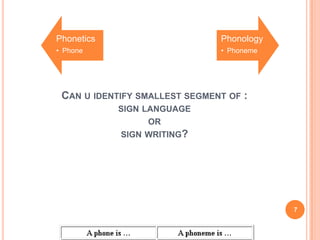
Phonetics                      Phonology
• Phone                        • Phoneme


 CAN U IDENTIFY SMALLEST SEGMENT OF :
            SIGN LANGUAGE
                 OR
            SIGN WRITING?


                                           7
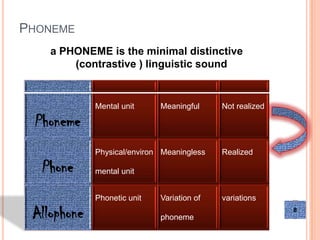
PHONEME
    a PHONEME is the minimal distinctive
        (contrastive ) linguistic sound


             Mental unit     Meaningful     Not realized

  Phoneme
             Physical/environ Meaningless   Realized

   Phone     mental unit


             Phonetic unit   Variation of   variations

 Allophone                   phoneme
                                                           8
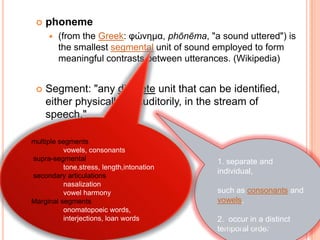
   phoneme
        (from the Greek: φώνημα, phōnēma, "a sound uttered") is
         the smallest segmental unit of sound employed to form
         meaningful contrasts between utterances. (Wikipedia)


    Segment: "any discrete unit that can be identified,
     either physically or auditorily, in the stream of
     speech."

multiple segments
           vowels, consonants
supra-segmental                              1. separate and
           tone,stress, length,intonation
                                             individual,
secondary articulations
           nasalization
           vowel harmony                     such as consonants and
Marginal segments                            vowels,
           onomatopoeic words,                                        9
           interjections, loan words         2. occur in a distinct
                                               Source: Wikipedia
                                             temporal order
PHONEME

   A unit of speech that can be used to differentiate
    words(e.g.“cat”/kaet/vs.“bat”/baet/).


   Phonemes identify minimal pairs in a language.


   The set of phonemes in a language subject to interpretation;
    most languages have 20 to 40 phonemes.


   The phoneme cannot therefore be acoustically defined. The
    phoneme is instead a feature of language structure.            10
Defining
phoneme
  Easy?


 NO        11
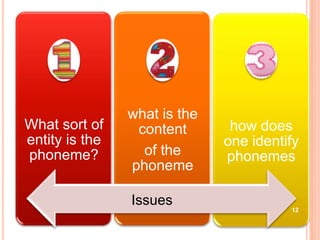
what is the
What sort of     content       how does
entity is the                 one identify
phoneme?          of the      phonemes
                phoneme

                Issues
                                        12
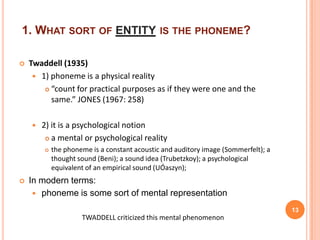
1. WHAT SORT OF ENTITY IS THE PHONEME?

   Twaddell (1935)
      1) phoneme is a physical reality
         “count for practical purposes as if they were one and the

          same.” JONES (1967: 258)

       2) it is a psychological notion
          a mental or psychological reality

           the phoneme is a constant acoustic and auditory image (Sommerfelt); a
            thought sound (Beni); a sound idea (Trubetzkoy); a psychological
            equivalent of an empirical sound (UÓaszyn);
   In modern terms:
      phoneme is some sort of mental representation

                                                                                    13
                     TWADDELL criticized this mental phenomenon
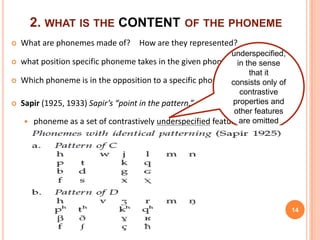
2. WHAT IS THE CONTENT OF THE PHONEME
   What are phonemes made of? How are they represented?
                                                             underspecified,
   what position specific phoneme takes in the given phonemicin the sense
                                                                system.
                                                                  that it
   Which phoneme is in the opposition to a specific phonemeconsists only of
                                                                contrastive
   Sapir (1925, 1933) Sapir’s “point in the pattern.”        properties and
                                                              other features
      phoneme as a set of contrastively underspecified features omitted
                                                               are

       This notion further corresponded to the theory of Distinctive feature


    ⇒ this underspecification theory has been proposed under generative
        phonology under the name Modified Contrastive Specification
                                                                                14
CONTINUE…
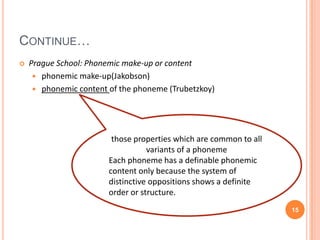
   Prague School: Phonemic make-up or content
      phonemic make-up(Jakobson)
      phonemic content of the phoneme (Trubetzkoy)


                         those properties which are common to all
                                   variants of a phoneme
                        Each phoneme has a definable phonemic
                        content only because the system of
                        distinctive oppositions shows a definite
                        order or structure.
                                                                    15
16
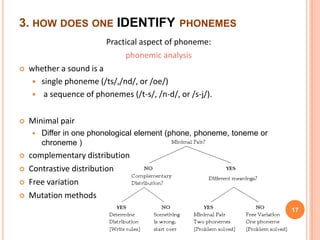
3. HOW DOES ONE IDENTIFY PHONEMES
                         Practical aspect of phoneme:
                              phonemic analysis
   whether a sound is a
      single phoneme (/ts/,/nd/, or /oe/)
      a sequence of phonemes (/t-s/, /n-d/, or /s-j/).


   Minimal pair
       Differ in one phonological element (phone, phoneme, toneme or
        chroneme )
   complementary distribution
   Contrastive distribution
   Free variation
   Mutation methods
                                                                        17
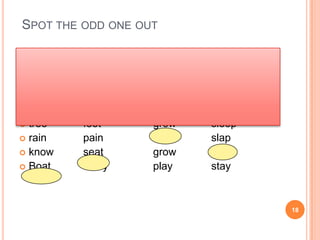
SPOT THE ODD ONE OUT

 Look carefully at the words below.
 Can you spot the phoneme that is common to each
  set?
 Which word doesn’t share the common phoneme?


 tree      feet         grew       sleep
 rain      pain         mail       slap
 know      seat         grow       show
 Boat      away         play       stay


                                                    18
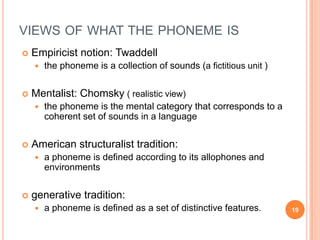
VIEWS OF WHAT THE PHONEME IS
   Empiricist notion: Twaddell
       the phoneme is a collection of sounds (a fictitious unit )


   Mentalist: Chomsky ( realistic view)
       the phoneme is the mental category that corresponds to a
        coherent set of sounds in a language


   American structuralist tradition:
       a phoneme is defined according to its allophones and
        environments


   generative tradition:
       a phoneme is defined as a set of distinctive features.       19
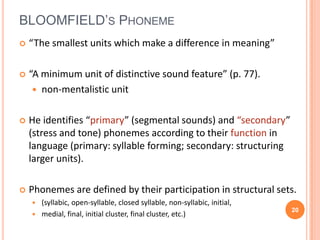
BLOOMFIELD’S PHONEME
   “The smallest units which make a difference in meaning”

   “A minimum unit of distinctive sound feature” (p. 77).
      non-mentalistic unit


   He identifies “primary” (segmental sounds) and “secondary”
    (stress and tone) phonemes according to their function in
    language (primary: syllable forming; secondary: structuring
    larger units).

   Phonemes are defined by their participation in structural sets.
     (syllabic, open-syllable, closed syllable, non-syllabic, initial,
                                                                          20
     medial, final, initial cluster, final cluster, etc.)
COMMON PHONEMIC RULES
 Aspiration [h]
 Unreleased   Stop [ ̚ ]
 Flap   [ɾ]
 Dental Consonants [⊓]
 Velarization [ɫ]

 Voicelessness [˚]

 Vowel lengthening [ ]
 Vowel nasalization [~]

                            21
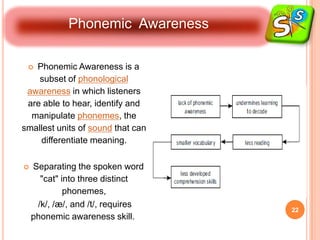
Phonemic Awareness

  Phonemic Awareness is a
    subset of phonological
 awareness in which listeners
 are able to hear, identify and
  manipulate phonemes, the
smallest units of sound that can
    differentiate meaning.

   Separating the spoken word
      "cat" into three distinct
             phonemes,
     /k/, /æ/, and /t/, requires
                                   22
    phonemic awareness skill.
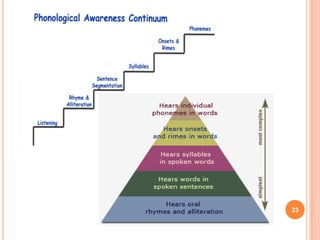
23
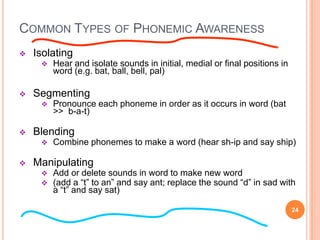
COMMON TYPES OF PHONEMIC AWARENESS
   Isolating
        Hear and isolate sounds in initial, medial or final positions in
         word (e.g. bat, ball, bell, pal)

   Segmenting
        Pronounce each phoneme in order as it occurs in word (bat
         >> b-a-t)

   Blending
        Combine phonemes to make a word (hear sh-ip and say ship)

   Manipulating
        Add or delete sounds in word to make new word
        (add a “t” to an” and say ant; replace the sound “d” in sad with
         a “t” and say sat)

                                                                            24
THEORETICAL TIMELINE OF PHONEME

   Ancient forerunners of modern descriptive linguistics (P¯ANINI, PATAÑJALI

    (India), the Greeks & “Anon” (Iceland, 12th C.)) clearly recognized the

    systematic nature between distinctive sound properties and the identity of

    words in their languages


   DE SAUSSURE (1857-1913) used “phonème”, first as a term for speech
    sounds, later as a purely functional entity.


   A. Dufriche-Desgenettes 1873
                                                                                   25
        French   word phonème as a speech sound
                                                         Source: B. Elan Dresher
TIMELINE…
   Structuralism (Ferdinand de Saussure(1879), E. Sapir, and L. Bloomfield)

        Tried to eliminate cognitive and psycholinguistic function of phoneme

        Used to refer to a hypothesized sound in a proto-language together with its
         reflexes in the daughter languages


   Polish Kazan school (Jan Niecisław Baudouin de Courtenay and MikoÓaj Kruszewski
    1875–1895)

        As an abstract set of alternating invariant psycho phonetic elements : fonema,

   Prague School 1926–1935

        the first group to formulate an explicit phonological theory


   Generative linguistics (Noam Chomsky and Morris Halle)
                                                                                          26
   modern phonology

Phoneme my intro

  • 1.
  • 2.
  • 3.
    DIFFERENCE? /k/ kit [ko] after s [kh] Initial [k] elsewhere k s ill sac k We pronounce them differently but we know they are the same sound. How do we know two sounds are the same or different? 3
  • 4.
  • 5.
    PHONOLOGY  Phonology is how speech sounds are organized and affect one another in pronunciation.  Key terms:  Phone  Phoneme  allophone  This organization is explained in phonological rules 5
  • 6.
    CONCEPTUALITY Articulatory phonetics • Phonology Real sounds = phones • system and rules of sound patterns • [p], [t], [k] • Abstractions = phoneme • [i], [æ] • /p/, /t/, /k/ • /i/, /æ/ • Inventory of sounds and how they are realized. 6
  • 7.
    Phonetics Phonology • Phone • Phoneme CAN U IDENTIFY SMALLEST SEGMENT OF : SIGN LANGUAGE OR SIGN WRITING? 7
  • 8.
    PHONEME a PHONEME is the minimal distinctive (contrastive ) linguistic sound Mental unit Meaningful Not realized Phoneme Physical/environ Meaningless Realized Phone mental unit Phonetic unit Variation of variations Allophone phoneme 8
  • 9.
    phoneme  (from the Greek: φώνημα, phōnēma, "a sound uttered") is the smallest segmental unit of sound employed to form meaningful contrasts between utterances. (Wikipedia)  Segment: "any discrete unit that can be identified, either physically or auditorily, in the stream of speech." multiple segments vowels, consonants supra-segmental 1. separate and tone,stress, length,intonation individual, secondary articulations nasalization vowel harmony such as consonants and Marginal segments vowels, onomatopoeic words, 9 interjections, loan words 2. occur in a distinct Source: Wikipedia temporal order
  • 10.
    PHONEME  A unit of speech that can be used to differentiate words(e.g.“cat”/kaet/vs.“bat”/baet/).  Phonemes identify minimal pairs in a language.  The set of phonemes in a language subject to interpretation; most languages have 20 to 40 phonemes.  The phoneme cannot therefore be acoustically defined. The phoneme is instead a feature of language structure. 10
  • 11.
  • 12.
    what is the Whatsort of content how does entity is the one identify phoneme? of the phonemes phoneme Issues 12
  • 13.
    1. WHAT SORTOF ENTITY IS THE PHONEME?  Twaddell (1935)  1) phoneme is a physical reality  “count for practical purposes as if they were one and the same.” JONES (1967: 258)  2) it is a psychological notion  a mental or psychological reality  the phoneme is a constant acoustic and auditory image (Sommerfelt); a thought sound (Beni); a sound idea (Trubetzkoy); a psychological equivalent of an empirical sound (UÓaszyn);  In modern terms:  phoneme is some sort of mental representation 13 TWADDELL criticized this mental phenomenon
  • 14.
    2. WHAT ISTHE CONTENT OF THE PHONEME  What are phonemes made of? How are they represented? underspecified,  what position specific phoneme takes in the given phonemicin the sense system. that it  Which phoneme is in the opposition to a specific phonemeconsists only of contrastive  Sapir (1925, 1933) Sapir’s “point in the pattern.” properties and other features  phoneme as a set of contrastively underspecified features omitted are  This notion further corresponded to the theory of Distinctive feature ⇒ this underspecification theory has been proposed under generative phonology under the name Modified Contrastive Specification 14
  • 15.
    CONTINUE…  Prague School: Phonemic make-up or content  phonemic make-up(Jakobson)  phonemic content of the phoneme (Trubetzkoy) those properties which are common to all variants of a phoneme Each phoneme has a definable phonemic content only because the system of distinctive oppositions shows a definite order or structure. 15
  • 16.
  • 17.
    3. HOW DOESONE IDENTIFY PHONEMES Practical aspect of phoneme: phonemic analysis  whether a sound is a  single phoneme (/ts/,/nd/, or /oe/)  a sequence of phonemes (/t-s/, /n-d/, or /s-j/).  Minimal pair  Differ in one phonological element (phone, phoneme, toneme or chroneme )  complementary distribution  Contrastive distribution  Free variation  Mutation methods 17
  • 18.
    SPOT THE ODDONE OUT  Look carefully at the words below.  Can you spot the phoneme that is common to each set?  Which word doesn’t share the common phoneme?  tree feet grew sleep  rain pain mail slap  know seat grow show  Boat away play stay 18
  • 19.
    VIEWS OF WHATTHE PHONEME IS  Empiricist notion: Twaddell  the phoneme is a collection of sounds (a fictitious unit )  Mentalist: Chomsky ( realistic view)  the phoneme is the mental category that corresponds to a coherent set of sounds in a language  American structuralist tradition:  a phoneme is defined according to its allophones and environments  generative tradition:  a phoneme is defined as a set of distinctive features. 19
  • 20.
    BLOOMFIELD’S PHONEME  “The smallest units which make a difference in meaning”  “A minimum unit of distinctive sound feature” (p. 77).  non-mentalistic unit  He identifies “primary” (segmental sounds) and “secondary” (stress and tone) phonemes according to their function in language (primary: syllable forming; secondary: structuring larger units).  Phonemes are defined by their participation in structural sets.  (syllabic, open-syllable, closed syllable, non-syllabic, initial, 20  medial, final, initial cluster, final cluster, etc.)
  • 21.
    COMMON PHONEMIC RULES Aspiration [h]  Unreleased Stop [ ̚ ]  Flap [ɾ]  Dental Consonants [⊓]  Velarization [ɫ]  Voicelessness [˚]  Vowel lengthening [ ]  Vowel nasalization [~] 21
  • 22.
    Phonemic Awareness Phonemic Awareness is a subset of phonological awareness in which listeners are able to hear, identify and manipulate phonemes, the smallest units of sound that can differentiate meaning.  Separating the spoken word "cat" into three distinct phonemes, /k/, /æ/, and /t/, requires 22 phonemic awareness skill.
  • 23.
  • 24.
    COMMON TYPES OFPHONEMIC AWARENESS  Isolating  Hear and isolate sounds in initial, medial or final positions in word (e.g. bat, ball, bell, pal)  Segmenting  Pronounce each phoneme in order as it occurs in word (bat >> b-a-t)  Blending  Combine phonemes to make a word (hear sh-ip and say ship)  Manipulating  Add or delete sounds in word to make new word  (add a “t” to an” and say ant; replace the sound “d” in sad with a “t” and say sat) 24
  • 25.
    THEORETICAL TIMELINE OFPHONEME  Ancient forerunners of modern descriptive linguistics (P¯ANINI, PATAÑJALI (India), the Greeks & “Anon” (Iceland, 12th C.)) clearly recognized the systematic nature between distinctive sound properties and the identity of words in their languages  DE SAUSSURE (1857-1913) used “phonème”, first as a term for speech sounds, later as a purely functional entity.  A. Dufriche-Desgenettes 1873 25  French word phonème as a speech sound Source: B. Elan Dresher
  • 26.
    TIMELINE…  Structuralism (Ferdinand de Saussure(1879), E. Sapir, and L. Bloomfield)  Tried to eliminate cognitive and psycholinguistic function of phoneme  Used to refer to a hypothesized sound in a proto-language together with its reflexes in the daughter languages  Polish Kazan school (Jan Niecisław Baudouin de Courtenay and MikoÓaj Kruszewski 1875–1895)  As an abstract set of alternating invariant psycho phonetic elements : fonema,  Prague School 1926–1935  the first group to formulate an explicit phonological theory  Generative linguistics (Noam Chomsky and Morris Halle) 26  modern phonology

Editor's Notes

  • #5 We all know them very well but is it all we know about phoneme? No its notta as simple as it looks like there is much to be explored yet
  • #6 Source:
  • #8 Sign language: visualsSign writing: graphemehttp://www.sil.org/linguistics/GlossaryOfLinguisticTerms/WhatIsAPhoneme.htm
  • #10 Segments are called discreet bec they are separate and individual and occur in a distinct temporal order.
  • #13 Like other linguistic notions, such as “sentence,”“syllable,” and “topic,” what starts out as a relatively unproblematic intuitiveconcept inevitably gets caught up in theory-internal considerations. In the caseof the phoneme, three issues have been particularly contentious: (i) what sort ofentity is the phoneme (physical, psychological, other); (ii) what is the contentof the phoneme; and (iii) how does one identify phonemes?
  • #14 SAPIR(1933): “the phonemic attitude is more basic, psychologically speaking,than the more strictly phonetic one,”
  • #15 Representing the underspecified phoneme. The remarks concerning Sapir, Jakobson,and Trubetzkoy above suggest a view of the phoneme as having a single representation,from which other variants, or allophones, are derived. Moreover, ifthe interpretation of these proposals given above is correct, it would appearthat this one representation of the phoneme is underspecified, in the sense that itconsists only of contrastive properties (chapter 7: feature specification andunderspecification). Underspecified phonemic representations were proposedby Jakobson and his colleagues (see, among others, Jakobsonet al. 1952 and Jakobsonand Halle 1956). They proposed that contrastive features are assigned by successivelydividing up an inventory until each phoneme has been assigned a uniquerepresentation. This theory has been taken up within generative phonology underthe name Modified Contrastive Specification (MCS; Dresher et al. 1994; D. C. Hall2007; Dresher 2009).
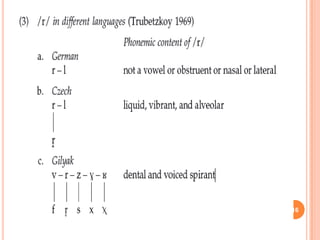
  • #17 Jakobson notes (1962: 224) that the presence of /æ/ in Slovak, though “a mere detailfrom a phonetic point of view . . . determines the phonemic make-up of all the shortvowels.” Thus all the short vowels in Standard Slovak come in pairs that contrastin the frontness/backness dimension, so that the vowels /i e æ/ are contrastivelyfront (acute, in terms of Jakobson’s features), and /u o a/ are contrastively back(grave). Lip rounding, though present phonetically in /u/ and /o/, is not contrastiveand therefore does not enter into the phonemic make-up of these vowels.This concept can be illustrated with respect to the phoneme /r/ in three differentlanguages. German has two liquids, /r/ and /l/, which are set apart fromall other consonants by being liquids (3a). Trubetzkoy (1969: 73) observes that thephonemic content of German /r/ is “very poor, actually purely negative: it is nota vowel, not a specific obstruent, not a nasal, nor an l. Consequently, it also variesgreatly with respect to its realization” (see also chapter 30: the representationof rhotics). By “purely negative,” Trubetzkoy means that the contrastivespecifications of /r/ are all the unmarked members of their respective contrasts.He proposes that because /r/ is not contrastively specified for place or specificmanner of articulation, some speakers pronounce it as a dental vibrant, some asa uvular vibrant, some as a noiseless guttural spirant, and it varies a great dealin different contexts as well. By contrast, “Czech /r/ has a much richer phonemiccontent,” because it stands in a relation not only to /l/ but to /Å/ (3b): /r/is distinguished from /Å/ in that it is not an obstruent but a liquid, and from /l/in that it is a vibrant. “For this reason, Czech r is always, and in all positions,pronounced as a clear and energetically trilled sonorant.”3 In Gilyak (also calledNivkh, a language isolate spoken in Russia along the Amur River and on SakhalinIsland) (3c), /r/ is opposed to a voiceless spirant, and the two fall into place as thedental members of a series of oppositions between voiced and voiceless spirants,from which it follows that Gilyak /r/ is always dental (the Gilyak phonemes arelisted as in Gruzdeva 1998: 10).
  • #18 Chroneme: word IPA meaning pala /ˈpala/ shovel palla /ˈpalla/ ball
  • #21 Bloomfield recognised the need for underlying forms tosimplify the description of morphopho202020nemicalternations.Only later (1939) did he call for a separate discipline calledmorphophonemics whose basic units weremorphophonemes.He chose the forms and used ordered rules to achieve thesimplest possible description.He even set up “artificial” underlying forms to achieve asimpler description.Post-Bloomfieldians were strictly insistent on theseparation of levels (morphophonemics from phonology)and did not accept ordered rules.