Downloaded 17 times
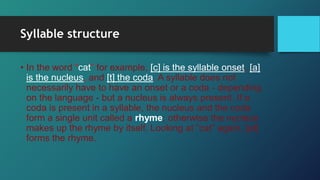
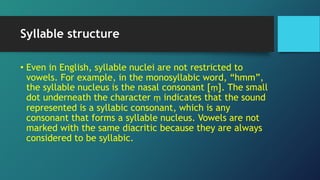

Syllables have three possible parts - an onset, nucleus, and coda. The onset is a consonant or consonant cluster at the start of a syllable. The nucleus forms the core and is usually a vowel or vowel combination. The coda is a consonant or consonant cluster at the end. In the word "cat", [c] is the onset, [a] is the nucleus, and [t] is the coda. The nucleus and any coda together form the rhyme of a syllable. Even in English, consonants like [á1ƒ] can be syllable nuclei.


