8/24/2016
Dr.S.Sundarabalu
NLP Practitioner
Department of Linguistics
Bharathiar University
Coimbatore-46 India
Neuro-Semantics
• Introduction
1) How dose our brain observe the lexical meaning of
a word?
2) How doses the lexical sense and human sense
combined to form the knowledge required by the
brain from the external world?
3) How does a word and its sense express language
thought?
These questions are to be discussed with the help
of neurolinguistics and semantics.
2
• What is language?
Speech is the representation of the experience
of the mind -Aristotle
• What is linguistics?
It is the scientific study of language.
• What is science?
It is the knowledge based on facts that are
proved logically and systematically.
• How many vowels and consonants exist in the
English language?
• Who stated the above facts?
• On what grounds have they been stated? 3
 Language - defines the actions that occur in the world.
 Language is thus composed of sign, letter, sentence,
gesture, sound, light, movements, space, silence, function
and the like.
 Language is rightly used by those who intently observe
the events of the world.
 The growth of the brain should not be associated with a
corresponding growth of knowledge, as knowledge can
develop only when the brain is trained by constant
intellectual musing .
 What is required for the proper growth of the body?
 Food.
 What is required for the proper growth of the brain?
 Thinking. 4
• Language: Language mainly has two functions,
1) External exchange (sound)
2) Internal exchange (electrical signals)
• We have to properly connect the internal and
external things.
1. The relationship between the external world
events and sense organs.
2. The relationship between the sense organs and
the brain.
5
• The two types of language expressions are:
• 1. The language spoken to oneself under the command
of one’s brain.
• 2. The language commanded to others by one’s brain.
(These two aspects are studied by semantics and
linguistics.)
6
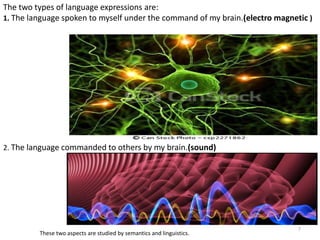
The two types of language expressions are:
1. The language spoken to myself under the command of my brain.(electro magnetic )
2. The language commanded to others by my brain.(sound)
These two aspects are studied by semantics and linguistics.
7
Fig. 1. Five stages and three levels in chain of speech
transmission from brain of Speaker to brain of Listener. (From Fig. 1.1 of Denes and Pinson 2000:5)
2speaker transforms message
into speech sounds
4.Listener receives
message through
perceiving sound
waves
5.Message is processed and
interpreted in Listener’s
brain
3.Speech sounds are
transmitted as sound
waves through air
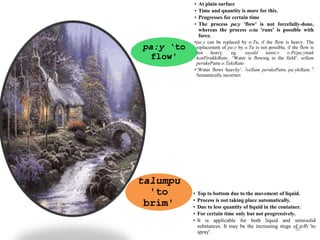
1.Message begins as idea in
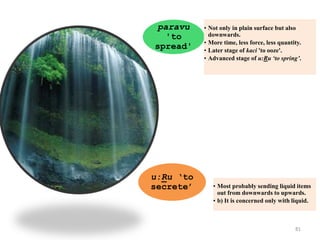
Speaker’s brain
8
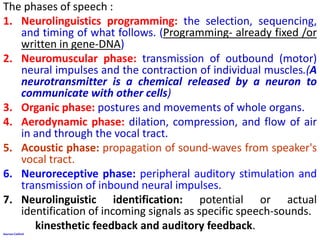
The phases of speech :
1. Neurolinguistics programming: the selection, sequencing,
and timing of what follows. (Programming- already fixed /or
written in gene-DNA)
2. Neuromuscular phase: transmission of outbound (motor)
neural impulses and the contraction of individual muscles.(A
neurotransmitter is a chemical released by a neuron to
communicate with other cells)
3. Organic phase: postures and movements of whole organs.
4. Aerodynamic phase: dilation, compression, and flow of air
in and through the vocal tract.
5. Acoustic phase: propagation of sound-waves from speaker's
vocal tract.
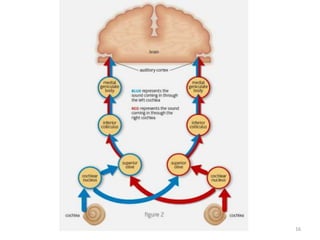
6. Neuroreceptive phase: peripheral auditory stimulation and
transmission of inbound neural impulses.
7. Neurolinguistic identification: potential or actual
identification of incoming signals as specific speech-sounds.
kinesthetic feedback and auditory feedback.Sources-Catford
Phonetics
Phonology
Morphology
Syntax
Semantics
Branches of Linguistics
10
• Phonetics can be classified into three groups:
• 1. Articulatory phonetics: It deals with the movements of the speech organs in the
production of speech sounds.
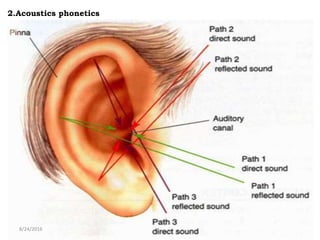
• 2. Acoustic phonetics: The transmission of sound from the speaker to the listener is studied
by acoustic analysis.
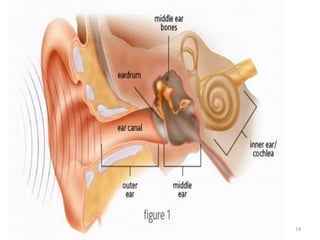
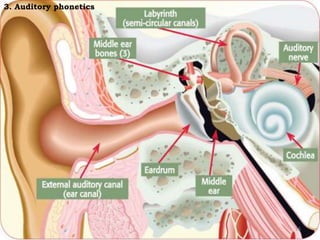
• 3. Auditory phonetics: It studies the reception and
perception of speech sounds.
11
1.Articulatory phonetics
12
2.Acoustics phonetics
8/24/2016
14
3. Auditory phonetics
15
16
17
• That is why,
• Meaning [noun] (exists as an idea or feeling )
• 1. It is non-living and exists in the solid/ liquid state
(substance)
• 2. Money, wealth etc. (My father went to Sri Lanka
in search of wealth)
• 3. A word or a sentence signifies or denotes
meaning (sense of a word lexical meaning)
• 4.Meaning- Significance
• 5. Feeling, action etc. (or a work of art that gives a
message which reveals its meaning)
• Can you explain the meaning of the painting? 18
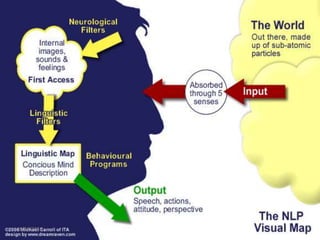
• Therefore, meaning is acquired from the sense
organs.
• How do we acquire knowledge? Knowledge is
acquired when it is sent to the brain from the
external world through the sense organs. Thus,
sense organs are fundamental for language skills.
19
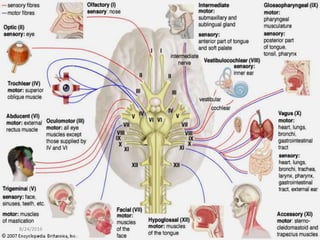
• What is sense?
• Sense: n. an ability to understand, recognize, value
or react to something, especially any of the five
physical abilities to see, hear, smell, taste and feel.
• The above mentioned senses are associated with
the eyes, ears, nose, tongue and body. Therefore,
language/ knowledge is perceived by the brain
through these sense organs.
• (Sense/feeling : The firm/ strong/ doubt-free/
clear awareness of something.)
20
8/24/2016
22
8/24/2016
CN I
CN III
CN VII
CN IX
CN XI
CN II
CN IV
CN VI
CN VIII
CN X
CN XII
CN V
Parts of Cranial Nerves
8/24/2016
8/24/2016
8/24/2016
27
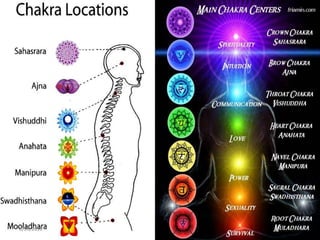
Touch Skin Illusion Na
Muladh
ara
Taste Tongue Arroga
nce
Ma
Svadhis
htana
Sight Eye God Ci
Navel
Center
Smell Nose Power Va
Heart
Center
Ear Sound Soul Ya
Throat
Center
Eye-brow Center- Aum -2701
8/24/2016
7. Crown Center – Top of head towards
back; Connection to divinity, spirit, bliss;
Drive to transcend.
6. Third Eye – Slightly above midpoint
between eyes; Intuition, metaphysical
wisdom, stillness; Drive to know.
5. Throat Chakra – Center of throat;
Self-expression, speaking truth; Drive to
communicate.
4. Heart Chakra – Center of chest at
breastbone; Love, compassion, beauty,
joy, balance; Drive to connect.
3. Navel Chakra – Just below navel;
Personal power, self-definition,
boundaries; Drive to act successfully.
2. Sacral Chakra – Internal reproductive
organs; Sensuality, creativity,
abundance, passion; Drive to create.
1. Root Chakra – Tailbone; Connection
to earth, nature, physicality; Drive to
survive.
8/24/2016
8/24/2016
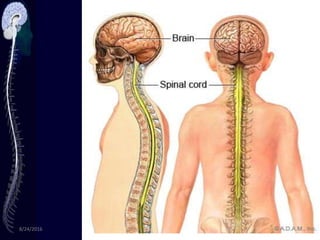
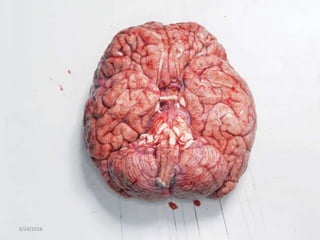
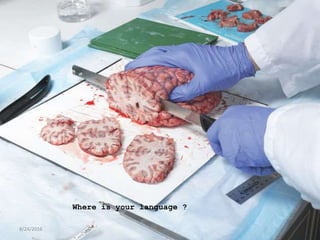
Where is your language ?
8/24/2016
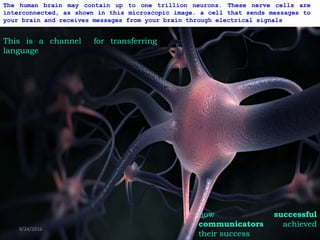
The human brain may contain up to one trillion neurons. These nerve cells are
interconnected, as shown in this microscopic image. a cell that sends messages to
your brain and receives messages from your brain through electrical signals
This is a channel for transferring
language
how successful
communicators achieved
their success
8/24/2016
8/24/2016
ax·on-that process of a neuron by which impulses
travel away from the cell body;
synapse / the site of functional apposition
between neurons, where an impulse
is transmitted from one to another,
usually by a chemical
neurotransmitter released by the
axon terminal of the presynaptic
neuron.
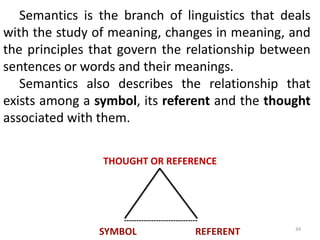
Semantics is the branch of linguistics that deals
with the study of meaning, changes in meaning, and
the principles that govern the relationship between
sentences or words and their meanings.
Semantics also describes the relationship that
exists among a symbol, its referent and the thought
associated with them.
34
THOUGHT OR REFERENCE
------------------------------
SYMBOL REFERENT
35
பூ
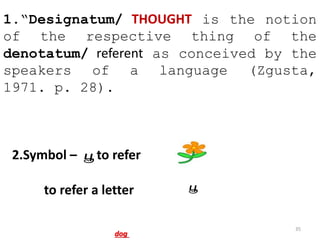
1.“Designatum/ THOUGHT is the notion
of the respective thing of the
denotatum/ referent as conceived by the
speakers of a language (Zgusta,
1971. p. 28).
2.Symbol – பூ to refer
to refer a letter
dog
3.REFERENT (world things)
• The word denotatum refers not only
to class of objects but to class of
actions, events, ideas, feelings,
institutions, concepts etc., of the
world or reality which are referred
to by particular words.
• Walk – what is the world meaning of this word?
• Love – what is the world meaning of this word? 36
37
• There are two boundaries in language:
• 1. Sound
• 2. Meaning.
• Both sound and meaning are stable components of
language, it is natural and abstract. Words/
sentences are man-made creations and artificial in
nature.
• When a sound is born, it is born with its meaning. A
sound without meaning is useless.
• A sound can convey meaning if it stands alone or as
a group (word).
38
• Language exchange occurs in two modes:
• 1. We can understand meaning through language.
• 2. We can obtain victory by making others
understand the meaning of language.
• While speaking, the inner sense meanings of the
speakers are revealed, not only through their words
but also by their non-verbal signals, and by
listening and realizing naturally, the minds of the
speakers and listeners enable them to understand
what has happened, and is explained.
• It is based on a series of underlying
assumptions about how the mind works and
how people act and interact 39
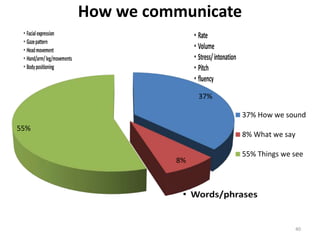
How we communicate
37%
8%
55%
37% How we sound
8% What we say
55% Things we see
40
• Meaning denotes, the sense of the word, and is understood by
the listener’s sense organs. The meaning as intended by the
speaker should be carefully understood in the exact ratio by
the listener, otherwise, it would lead to difficulty in the
comprehension by both (The speaker waits for his listener to
reach the complete level of his intended meaning in every
word).
• This difficulty would lead to the incorrect meaning of each utterance, thus
producing meaningless words.
• A word journeys through its meaning. Meaning is supported by the word.
• Lexical sense – it is the collection of all the semantic features
of the linguistic form, by the society.
41
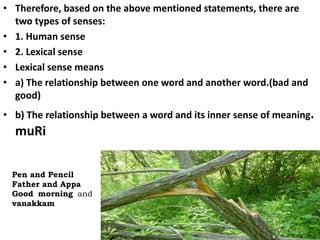
• Therefore, based on the above mentioned statements, there are
two types of senses:
• 1. Human sense
• 2. Lexical sense
• Lexical sense means
• a) The relationship between one word and another word.(bad and
good)
• b) The relationship between a word and its inner sense of meaning.
muRi
42
Pen and Pencil
Father and Appa
Good morning and
vanakkam
• Human sense refers to:
1. The relationship between the external world and
the sense organs.
2. The relationship between sense organs and brain.
• How is there a relationship between lexical sense
and human sense? It is composed of knowledge and
is delineated by neurosemantics.
43
– When do words denote meaning? it happens when
meaning sense and human sense connect properly with
each other.
– When a word is received by the brain, it should be
received along with its internal meaning. But, do all
words possess internal meaning? If they do, then all
words have meaning, if not, the vocabulary is
meaningless.
44
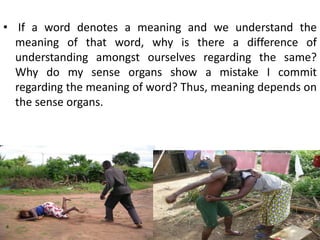
• If a word denotes a meaning and we understand the
meaning of that word, why is there a difference of
understanding amongst ourselves regarding the same?
Why do my sense organs show a mistake I commit
regarding the meaning of word? Thus, meaning depends on
the sense organs.
45
• Therefore, meaning is revealed by the sense
organs.
• How is the knowledge I possess, sent to my brain
from the external world?.
• Knowledge/ linguistic knowledge is transferred
only through the sense organs. Thus, sense
organs are vital for linguistic knowledge.
• If we have to properly understand meaning sense,
it should properly exist in our human sense.
• Otherwise,
46
1. Don’t you understand me at all?
2. There is a sudden misunderstanding between him and myself.
3. He does not understand the meaning of what I am saying.
4. There is no harmony between her and myself.
5. I have a different mindset and he has different mindset.
6. What is the meaning of his words?
7. It seems that I have misunderstood.
8. I am saying one thing and he, another.
9. He is contradicting whatever I say.
10. He does not even have proper discipline; you go and speak to him.
11. He is not a good person; he says one thing today and another to him?
47
12. He does not understand anything, how can anyone
speak to him?
13.There is no relation between what he speaks, and
what he does.
14.He treats himself in one way, and others, in a different
way.
15.Do not speak without understanding my words.
16.I do not like what he says because; he does not live as
he should.
17.Is he speaking in a mature manner?
18.He does not know what respect is.
19.What do you think about myself?
20. Do you know who you are speaking to? (Satisfactory)48
21. He will change only after I teach him a lesson.
22. You can understand everyone, but, your family.
23. How can you call yourself a human being when you cannot even
understand what I am feeling?
24. I do not want to hear your explanation, just listen to what I say.
25. You can understand only what he says and not what I say.
26. He is fifty years old and still does not know how to speak.
27. I mean one thing and he does another.
28. Is this how you speak before others? Speak according to the
situation.
29. Do not you understand? Do I have to repeat myself over and
over again? 49
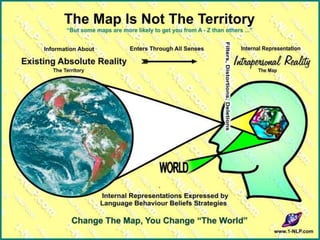
• We cannot survive in the world without meaning.
• The world is constructed by meaning.
• If one goes beyond the boundary of meaning of
another, both of them will suffer.
• You cannot physically see meaning just as you
cannot see language.
• Clarity in the understanding of meaning leads to
the growth of knowledge.
50
51
741: Life Wasted Away in Pursuit of Worldly Knowledge
Knowledge that comes of senses five,
Knowledge that comes of discrimination that is sixth
Knowledge that comes of judgement that is seventh
Knowledge that comes by learning that is eighth,
Knowledge that comes from experience that is ninth
Knowledge that comes from attachment that is tenth
--Thus does knowledge that comes in diverse ways,
But erode life span in succession;
Knowing this not, they perish away.
-thirumanthiram
• Knowledge:
• மெய்ப்ம ொருள் கொண் து அறிவு
• Meyporul kaanpathu aRivu
– To grasp the Truth from everywhere 423
– From everyone is wisdom fair.(eporul)
• Truth is not a common concept for all : the truth may differ
from people to people and mind to mind
• Self-Knowledge is True Knowledge
•
• தன்னை அறிவது என்பது உண்னையாை அறிவு
52
2671: God's Form
As mouth, eye, body and life
The Yoga-God is;
Beyond earth, water, fire, wind and sky
Void His Form is.
2671உண்ணும் வாயும் உடலும் உயிருமாய்க்
கண்ணுமா யயாகக் கடவுள் இருப்பது
மண்ணு நீரனல் கால ாடு வானுமாய்
விண்ணு மின்றி லவளியாயனார் யமனியய.
earth
space
air
fire
water
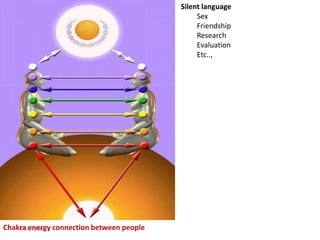
8/24/2016Chakra energy connection between people
Silent language
Sex
Friendship
Research
Evaluation
Etc..,
• When can one understand the meaning of life?
• we can understand the meaning of life only when
we fully comprehend the meaning of every word we
speak.
• How many semantic domains can I classify my
vocabulary into?
55
Basic vocabulary
Department related words
Family related words
Relationship
Consciousness
Friend related
Enemy related
Harm related
Mind disturbance
Anger related
Life
Other Language
8/24/2016
Department related words
• Office – staff
• Things ( document) related
– files
• Common education
• Special subject
• Students
• Occupation related –
teachers
Family related words
• Family structure –
grandfather
• Marriage related
• Savings and expenses
• Travel, budget ( schedule)
• Money, wealth, buying,
selling
• House maintenance, tax,
deed
• Beliefs, temples, worship
• Yield, love, habits
57
• Relationship
• My family structure
• Relationship through
father and mother
• Relationship through
uncle
• Relationship through
children
• Relationship through
spouse
• Relationship through
sibling
• Consciousness
• Happiness
• Death
• Body parts/organs
• Covert feelings
• Human sense
• Discipline, personal,
Impersonal ( general)
58
• Friend related
• Related to male
friendship
• Related to female
friendship
• Related to family
friendship
• Related to neighbor’s
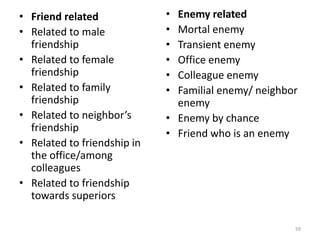
friendship
• Related to friendship in
the office/among
colleagues
• Related to friendship
towards superiors
• Enemy related
• Mortal enemy
• Transient enemy
• Office enemy
• Colleague enemy
• Familial enemy/ neighbor
enemy
• Enemy by chance
• Friend who is an enemy
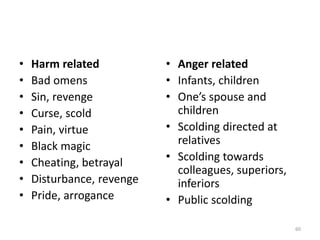
59
• Harm related
• Bad omens
• Sin, revenge
• Curse, scold
• Pain, virtue
• Black magic
• Cheating, betrayal
• Disturbance, revenge
• Pride, arrogance
• Anger related
• Infants, children
• One’s spouse and
children
• Scolding directed at
relatives
• Scolding towards
colleagues, superiors,
inferiors
• Public scolding
60
Identification of semantics features
8/24/2016
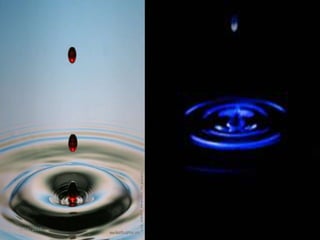
A Drop- Nanosemantics views
8/24/2016
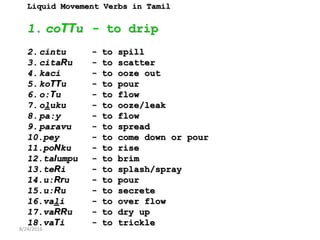
Liquid Movement Verbs in Tamil
1. coTTu - to drip
2.cintu - to spill
3.citaRu - to scatter
4.kaci - to ooze out
5.koTTu - to pour
6.o:Tu - to flow
7.oluku - to ooze/leak
8.pa:y - to flow
9.paravu - to spread
10.pey - to come down or pour
11.poNku - to rise
12.talumpu - to brim
13.teRi - to splash/spray
14.u:Rru - to pour
15.u:Ru - to secrete
16.vali - to over flow
17.vaRRu - to dry up
18.vaTi - to trickle
8/24/2016
• A verb
• Denotes a verb
• Denotes an object, but object denoting a verb
is not compulsory
64
• Drip
• (Verb) [liquid] - to fall in small drops
• (noun) [liquid] – a small drop of liquid that falls
from something
• 1. Very small,( our village has not seen even a
single drop of rain.)
65
8/24/2016
8/24/2016
8/24/2016
8/24/2016
8/24/2016
cottu 'to
drip'
• from top to bottom and also
advanced or later at the stage of
ooze, but the quantity of some liquid
is very less. Therefore, it flows down
drop by drop.
8/24/2016
8/24/2016
A drop is formed by its previous and
succeeding state.
An event gains its identity owing to its previous
and succeeding states.
For example, walk and run are related to each
other based on their successive stage of
movement.
To explain something, we need the help of
another and should be careful to maintain the
boundaries of both.
In the same way, we should note the previous
and succeeding stages of a drop8/24/2016
74
kaci ' to
oozeout'
• Not only from top to bottom but also the same level or
evenness floor.
• Progressing for a certain time/period.
• When a very tiny quantity of liquid ooze a out
• If there is a small hole in the container of storing/in a thing
• Advanced stage of spreading liquid
• The next stage of this action may be the stage of
vaTi 'to trickle' or coTTu 'to drip'.
oluku
‘to
ooze/leak
'
• from top to bottom and also either
advanced or later at the stage of coTTu
'to drop '.Mostly, a tiny quantity of
some liquid is slowly dripping out but
progressively
teRi 'to
splash/
spray'
• Not only from top to bottom and also
side-wards
• The quantity of the liquid is more or less
than a drop.
• The starting and reaching places are not
same ie. different places.
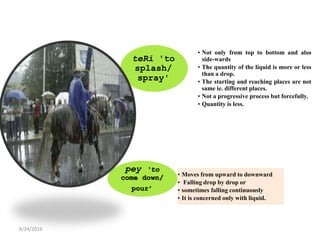
• Not a progressive process but forcefully.
• Quantity is less.
pey ‘to
come down/
pour’
• Moves from upward to downward
• Falling drop by drop or
• sometimes falling continuously
• It is concerned only with liquid.
8/24/2016
76
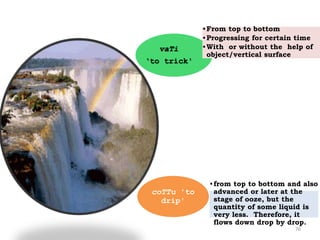
vaTi
‘to trick'
•From top to bottom
•Progressing for certain time
•With or without the help of
object/vertical surface
coTTu 'to
drip'
•from top to bottom and also
advanced or later at the
stage of ooze, but the
quantity of some liquid is
very less. Therefore, it
flows down drop by drop.
77
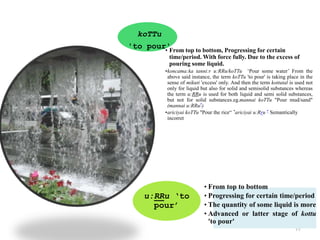
koTTu
'to pour'• From top to bottom, Progressing for certain
time/period. With force fully. Due to the excess of
pouring some liquid.
•koncama:ka tanni:r u:RRu/koTTu ‘Pour some water’ From the
above said instance, the term koTTu 'to pour' is taking place in the
sense of mikuti 'excess' only. And then the term kottutal is used not
only for liquid but also for solid and semisolid substances whereas
the term u:RRu is used for both liquid and semi solid substances,
but not for solid substances.eg.mannai koTTu "Pour mud/sand"
(mannai u:RRu*)
•ariciyai koTTu "Pour the rice“ *ariciyai u:Rru * Semantically
incorret
u:RRu ‘to
pour’
• From top to bottom
• Progressing for certain time/period
• The quantity of some liquid is more
• Advanced or latter stage of kottu
'to pour'
78
poṅku
'to
rise'
•Foam rising up and down due
to the high pressure
•Progressing for certain time
•While comparing the drops of
water the quantity of some
liquid is more.
vali 'to
overflow
'
•After filling up the container
of storing some liquid.
•Overflowing at any side of the
container/object
•The quantity of some liquid is
more.
•Progressing for certain time.
vaRRu
'to dry
up'
•The sources of water or any
container of storing liquid
becoming dry up due to the steam
from boiled water or from the
petrol etc when exposed to air.
•It may be done when the soil
absorbed the water in the field.
•It is mostly done due to the inner
functioning.
79
cintu
'to spill'
• From the top to bottom due to stirring/shaking of
the container
• It is applicable for both liquid and non-liquid
• A tiny quantity of some liquid spilling down quickly
• The advance stage of citaru 'scatter‘. There is no
continuity.
• It is not applicable for countable items and weighty
object.
•*puttakam cintiyullatu,‘The book spilts out’. puttakam viluntu
viPPatu .‘The book has fallen down’ * Semantically incorrect.
citaRu
'to
scatter'
• At the plain surface, rising up and spreads
in side-wards. It falls in all the places.
• The next stage of cintu 'to spill'
• A tiny quantity of some liquid
• A quick process in a particular time
• It is applicable for both liquid and non-
liquid.
• The liquid is scattering at a particular place.
o:Tu 'to
run’
• At plain surface
• Due to the pressure, low lying area, and the
quantity of liquid can be more or less
• It gives the meaning of flowing out and
progressing for certain time
•o:Tu 'to run' is used to denote nirampu 'to fill' and kollu 'to
contain' whereas vaTi 'to trick' is used to denote only the
liquid is coming out. Some places o:Tu 'to run' is replaced
by vaTi 'to trick' but it is not replaced in all places.
•vellam perukkePuttu o:TukiRatu ‘Water flows heavily’.
vellam perukkePuttu vaTikiRatu*
•* Semantically incorrect
80
pa:y ‘to
flow'
• At plain surface
• Time and quantity is more for this.
• Progresses for certain time
• The process pa:y 'flow' is not forcefully-done,
whereas the process o:tu 'runs' is possible with
force.
•pa:y can be replaced by o:Tu, if the flow is heavy. The
replacement of pa:y by o:Tu is not possible, if the flow is
not heavy. eg. vayalil tanni:r o:Pi/pa:yntuk
konPirukkiRatu.. ‘Water is flowing in the field’. vellam
perukePuttu o:TukiRatu
•‘Water flows heavily’. *vellam perukePuttu pa:ykiRatu *
Semantically incorrect
talumpu
'to
brim'
• Top to bottom due to the movement of liquid.
• Process is not taking place automatically.
• Due to less quantity of liquid in the container.
• For certain time only but not progressively.
• It is applicable for both liquid and semisolid
substances. It may be the increasing stage of teRi 'to
spray'.
81
paravu
'to
spread'
• Not only in plain surface but also
downwards.
• More time, less force, less quantity.
• Later stage of kaci 'to ooze'.
• Advanced stage of u:Ru ‘to spring’.
u:Ru ‘to
secrete’ • Most probably sending liquid items
out from downwards to upwards.
• b) It is concerned only with liquid.
Learning or speaking a language is useless, unless, one is aware of the inner/ deeper
meaning of the words stored in one’s repository and use the same accordingly in an effective
manner.
ந ன் றி
Meaning and vocabulary is acquired
through the five senses. If the human
internal senses are not clearly
formulated/ stimulated, the purpose of
our communication is..?.
8/24/2016
317: Avoid The Unlearned
The fools, of learning devoid, unfit for us even to see
The fools, of learning devoid, their words unfit to hear
The fools, of learning devoid, in fools find their friends,
The fools, of learned devoid, to wisdom come no near.

Neurosemantics

  • 1.
    8/24/2016 Dr.S.Sundarabalu NLP Practitioner Department ofLinguistics Bharathiar University Coimbatore-46 India Neuro-Semantics
  • 2.
    • Introduction 1) Howdose our brain observe the lexical meaning of a word? 2) How doses the lexical sense and human sense combined to form the knowledge required by the brain from the external world? 3) How does a word and its sense express language thought? These questions are to be discussed with the help of neurolinguistics and semantics. 2
  • 3.
    • What islanguage? Speech is the representation of the experience of the mind -Aristotle • What is linguistics? It is the scientific study of language. • What is science? It is the knowledge based on facts that are proved logically and systematically. • How many vowels and consonants exist in the English language? • Who stated the above facts? • On what grounds have they been stated? 3
  • 4.
     Language -defines the actions that occur in the world.  Language is thus composed of sign, letter, sentence, gesture, sound, light, movements, space, silence, function and the like.  Language is rightly used by those who intently observe the events of the world.  The growth of the brain should not be associated with a corresponding growth of knowledge, as knowledge can develop only when the brain is trained by constant intellectual musing .  What is required for the proper growth of the body?  Food.  What is required for the proper growth of the brain?  Thinking. 4
  • 5.
    • Language: Languagemainly has two functions, 1) External exchange (sound) 2) Internal exchange (electrical signals) • We have to properly connect the internal and external things. 1. The relationship between the external world events and sense organs. 2. The relationship between the sense organs and the brain. 5
  • 6.
    • The twotypes of language expressions are: • 1. The language spoken to oneself under the command of one’s brain. • 2. The language commanded to others by one’s brain. (These two aspects are studied by semantics and linguistics.) 6
  • 7.
    The two typesof language expressions are: 1. The language spoken to myself under the command of my brain.(electro magnetic ) 2. The language commanded to others by my brain.(sound) These two aspects are studied by semantics and linguistics. 7
  • 8.
    Fig. 1. Fivestages and three levels in chain of speech transmission from brain of Speaker to brain of Listener. (From Fig. 1.1 of Denes and Pinson 2000:5) 2speaker transforms message into speech sounds 4.Listener receives message through perceiving sound waves 5.Message is processed and interpreted in Listener’s brain 3.Speech sounds are transmitted as sound waves through air 1.Message begins as idea in Speaker’s brain 8
  • 9.
    The phases ofspeech : 1. Neurolinguistics programming: the selection, sequencing, and timing of what follows. (Programming- already fixed /or written in gene-DNA) 2. Neuromuscular phase: transmission of outbound (motor) neural impulses and the contraction of individual muscles.(A neurotransmitter is a chemical released by a neuron to communicate with other cells) 3. Organic phase: postures and movements of whole organs. 4. Aerodynamic phase: dilation, compression, and flow of air in and through the vocal tract. 5. Acoustic phase: propagation of sound-waves from speaker's vocal tract. 6. Neuroreceptive phase: peripheral auditory stimulation and transmission of inbound neural impulses. 7. Neurolinguistic identification: potential or actual identification of incoming signals as specific speech-sounds. kinesthetic feedback and auditory feedback.Sources-Catford
  • 10.
  • 11.
    • Phonetics canbe classified into three groups: • 1. Articulatory phonetics: It deals with the movements of the speech organs in the production of speech sounds. • 2. Acoustic phonetics: The transmission of sound from the speaker to the listener is studied by acoustic analysis. • 3. Auditory phonetics: It studies the reception and perception of speech sounds. 11
  • 12.
  • 13.
  • 14.
  • 15.
  • 16.
  • 17.
  • 18.
    • That iswhy, • Meaning [noun] (exists as an idea or feeling ) • 1. It is non-living and exists in the solid/ liquid state (substance) • 2. Money, wealth etc. (My father went to Sri Lanka in search of wealth) • 3. A word or a sentence signifies or denotes meaning (sense of a word lexical meaning) • 4.Meaning- Significance • 5. Feeling, action etc. (or a work of art that gives a message which reveals its meaning) • Can you explain the meaning of the painting? 18
  • 19.
    • Therefore, meaningis acquired from the sense organs. • How do we acquire knowledge? Knowledge is acquired when it is sent to the brain from the external world through the sense organs. Thus, sense organs are fundamental for language skills. 19
  • 20.
    • What issense? • Sense: n. an ability to understand, recognize, value or react to something, especially any of the five physical abilities to see, hear, smell, taste and feel. • The above mentioned senses are associated with the eyes, ears, nose, tongue and body. Therefore, language/ knowledge is perceived by the brain through these sense organs. • (Sense/feeling : The firm/ strong/ doubt-free/ clear awareness of something.) 20
  • 21.
  • 22.
  • 23.
  • 24.
    CN I CN III CNVII CN IX CN XI CN II CN IV CN VI CN VIII CN X CN XII CN V Parts of Cranial Nerves 8/24/2016
  • 25.
  • 26.
  • 27.
    27 Touch Skin IllusionNa Muladh ara Taste Tongue Arroga nce Ma Svadhis htana Sight Eye God Ci Navel Center Smell Nose Power Va Heart Center Ear Sound Soul Ya Throat Center Eye-brow Center- Aum -2701
  • 28.
  • 29.
    7. Crown Center– Top of head towards back; Connection to divinity, spirit, bliss; Drive to transcend. 6. Third Eye – Slightly above midpoint between eyes; Intuition, metaphysical wisdom, stillness; Drive to know. 5. Throat Chakra – Center of throat; Self-expression, speaking truth; Drive to communicate. 4. Heart Chakra – Center of chest at breastbone; Love, compassion, beauty, joy, balance; Drive to connect. 3. Navel Chakra – Just below navel; Personal power, self-definition, boundaries; Drive to act successfully. 2. Sacral Chakra – Internal reproductive organs; Sensuality, creativity, abundance, passion; Drive to create. 1. Root Chakra – Tailbone; Connection to earth, nature, physicality; Drive to survive. 8/24/2016
  • 30.
  • 31.
    Where is yourlanguage ? 8/24/2016
  • 32.
    The human brainmay contain up to one trillion neurons. These nerve cells are interconnected, as shown in this microscopic image. a cell that sends messages to your brain and receives messages from your brain through electrical signals This is a channel for transferring language how successful communicators achieved their success 8/24/2016
  • 33.
    8/24/2016 ax·on-that process ofa neuron by which impulses travel away from the cell body; synapse / the site of functional apposition between neurons, where an impulse is transmitted from one to another, usually by a chemical neurotransmitter released by the axon terminal of the presynaptic neuron.
  • 34.
    Semantics is thebranch of linguistics that deals with the study of meaning, changes in meaning, and the principles that govern the relationship between sentences or words and their meanings. Semantics also describes the relationship that exists among a symbol, its referent and the thought associated with them. 34 THOUGHT OR REFERENCE ------------------------------ SYMBOL REFERENT
  • 35.
    35 பூ 1.“Designatum/ THOUGHT isthe notion of the respective thing of the denotatum/ referent as conceived by the speakers of a language (Zgusta, 1971. p. 28). 2.Symbol – பூ to refer to refer a letter dog
  • 36.
    3.REFERENT (world things) •The word denotatum refers not only to class of objects but to class of actions, events, ideas, feelings, institutions, concepts etc., of the world or reality which are referred to by particular words. • Walk – what is the world meaning of this word? • Love – what is the world meaning of this word? 36
  • 37.
  • 38.
    • There aretwo boundaries in language: • 1. Sound • 2. Meaning. • Both sound and meaning are stable components of language, it is natural and abstract. Words/ sentences are man-made creations and artificial in nature. • When a sound is born, it is born with its meaning. A sound without meaning is useless. • A sound can convey meaning if it stands alone or as a group (word). 38
  • 39.
    • Language exchangeoccurs in two modes: • 1. We can understand meaning through language. • 2. We can obtain victory by making others understand the meaning of language. • While speaking, the inner sense meanings of the speakers are revealed, not only through their words but also by their non-verbal signals, and by listening and realizing naturally, the minds of the speakers and listeners enable them to understand what has happened, and is explained. • It is based on a series of underlying assumptions about how the mind works and how people act and interact 39
  • 40.
    How we communicate 37% 8% 55% 37%How we sound 8% What we say 55% Things we see 40
  • 41.
    • Meaning denotes,the sense of the word, and is understood by the listener’s sense organs. The meaning as intended by the speaker should be carefully understood in the exact ratio by the listener, otherwise, it would lead to difficulty in the comprehension by both (The speaker waits for his listener to reach the complete level of his intended meaning in every word). • This difficulty would lead to the incorrect meaning of each utterance, thus producing meaningless words. • A word journeys through its meaning. Meaning is supported by the word. • Lexical sense – it is the collection of all the semantic features of the linguistic form, by the society. 41
  • 42.
    • Therefore, basedon the above mentioned statements, there are two types of senses: • 1. Human sense • 2. Lexical sense • Lexical sense means • a) The relationship between one word and another word.(bad and good) • b) The relationship between a word and its inner sense of meaning. muRi 42 Pen and Pencil Father and Appa Good morning and vanakkam
  • 43.
    • Human senserefers to: 1. The relationship between the external world and the sense organs. 2. The relationship between sense organs and brain. • How is there a relationship between lexical sense and human sense? It is composed of knowledge and is delineated by neurosemantics. 43
  • 44.
    – When dowords denote meaning? it happens when meaning sense and human sense connect properly with each other. – When a word is received by the brain, it should be received along with its internal meaning. But, do all words possess internal meaning? If they do, then all words have meaning, if not, the vocabulary is meaningless. 44
  • 45.
    • If aword denotes a meaning and we understand the meaning of that word, why is there a difference of understanding amongst ourselves regarding the same? Why do my sense organs show a mistake I commit regarding the meaning of word? Thus, meaning depends on the sense organs. 45
  • 46.
    • Therefore, meaningis revealed by the sense organs. • How is the knowledge I possess, sent to my brain from the external world?. • Knowledge/ linguistic knowledge is transferred only through the sense organs. Thus, sense organs are vital for linguistic knowledge. • If we have to properly understand meaning sense, it should properly exist in our human sense. • Otherwise, 46
  • 47.
    1. Don’t youunderstand me at all? 2. There is a sudden misunderstanding between him and myself. 3. He does not understand the meaning of what I am saying. 4. There is no harmony between her and myself. 5. I have a different mindset and he has different mindset. 6. What is the meaning of his words? 7. It seems that I have misunderstood. 8. I am saying one thing and he, another. 9. He is contradicting whatever I say. 10. He does not even have proper discipline; you go and speak to him. 11. He is not a good person; he says one thing today and another to him? 47
  • 48.
    12. He doesnot understand anything, how can anyone speak to him? 13.There is no relation between what he speaks, and what he does. 14.He treats himself in one way, and others, in a different way. 15.Do not speak without understanding my words. 16.I do not like what he says because; he does not live as he should. 17.Is he speaking in a mature manner? 18.He does not know what respect is. 19.What do you think about myself? 20. Do you know who you are speaking to? (Satisfactory)48
  • 49.
    21. He willchange only after I teach him a lesson. 22. You can understand everyone, but, your family. 23. How can you call yourself a human being when you cannot even understand what I am feeling? 24. I do not want to hear your explanation, just listen to what I say. 25. You can understand only what he says and not what I say. 26. He is fifty years old and still does not know how to speak. 27. I mean one thing and he does another. 28. Is this how you speak before others? Speak according to the situation. 29. Do not you understand? Do I have to repeat myself over and over again? 49
  • 50.
    • We cannotsurvive in the world without meaning. • The world is constructed by meaning. • If one goes beyond the boundary of meaning of another, both of them will suffer. • You cannot physically see meaning just as you cannot see language. • Clarity in the understanding of meaning leads to the growth of knowledge. 50
  • 51.
    51 741: Life WastedAway in Pursuit of Worldly Knowledge Knowledge that comes of senses five, Knowledge that comes of discrimination that is sixth Knowledge that comes of judgement that is seventh Knowledge that comes by learning that is eighth, Knowledge that comes from experience that is ninth Knowledge that comes from attachment that is tenth --Thus does knowledge that comes in diverse ways, But erode life span in succession; Knowing this not, they perish away. -thirumanthiram
  • 52.
    • Knowledge: • மெய்ப்மொருள் கொண் து அறிவு • Meyporul kaanpathu aRivu – To grasp the Truth from everywhere 423 – From everyone is wisdom fair.(eporul) • Truth is not a common concept for all : the truth may differ from people to people and mind to mind • Self-Knowledge is True Knowledge • • தன்னை அறிவது என்பது உண்னையாை அறிவு 52
  • 53.
    2671: God's Form Asmouth, eye, body and life The Yoga-God is; Beyond earth, water, fire, wind and sky Void His Form is. 2671உண்ணும் வாயும் உடலும் உயிருமாய்க் கண்ணுமா யயாகக் கடவுள் இருப்பது மண்ணு நீரனல் கால ாடு வானுமாய் விண்ணு மின்றி லவளியாயனார் யமனியய. earth space air fire water
  • 54.
    8/24/2016Chakra energy connectionbetween people Silent language Sex Friendship Research Evaluation Etc..,
  • 55.
    • When canone understand the meaning of life? • we can understand the meaning of life only when we fully comprehend the meaning of every word we speak. • How many semantic domains can I classify my vocabulary into? 55
  • 56.
    Basic vocabulary Department relatedwords Family related words Relationship Consciousness Friend related Enemy related Harm related Mind disturbance Anger related Life Other Language 8/24/2016
  • 57.
    Department related words •Office – staff • Things ( document) related – files • Common education • Special subject • Students • Occupation related – teachers Family related words • Family structure – grandfather • Marriage related • Savings and expenses • Travel, budget ( schedule) • Money, wealth, buying, selling • House maintenance, tax, deed • Beliefs, temples, worship • Yield, love, habits 57
  • 58.
    • Relationship • Myfamily structure • Relationship through father and mother • Relationship through uncle • Relationship through children • Relationship through spouse • Relationship through sibling • Consciousness • Happiness • Death • Body parts/organs • Covert feelings • Human sense • Discipline, personal, Impersonal ( general) 58
  • 59.
    • Friend related •Related to male friendship • Related to female friendship • Related to family friendship • Related to neighbor’s friendship • Related to friendship in the office/among colleagues • Related to friendship towards superiors • Enemy related • Mortal enemy • Transient enemy • Office enemy • Colleague enemy • Familial enemy/ neighbor enemy • Enemy by chance • Friend who is an enemy 59
  • 60.
    • Harm related •Bad omens • Sin, revenge • Curse, scold • Pain, virtue • Black magic • Cheating, betrayal • Disturbance, revenge • Pride, arrogance • Anger related • Infants, children • One’s spouse and children • Scolding directed at relatives • Scolding towards colleagues, superiors, inferiors • Public scolding 60
  • 61.
    Identification of semanticsfeatures 8/24/2016
  • 62.
    A Drop- Nanosemanticsviews 8/24/2016
  • 63.
    Liquid Movement Verbsin Tamil 1. coTTu - to drip 2.cintu - to spill 3.citaRu - to scatter 4.kaci - to ooze out 5.koTTu - to pour 6.o:Tu - to flow 7.oluku - to ooze/leak 8.pa:y - to flow 9.paravu - to spread 10.pey - to come down or pour 11.poNku - to rise 12.talumpu - to brim 13.teRi - to splash/spray 14.u:Rru - to pour 15.u:Ru - to secrete 16.vali - to over flow 17.vaRRu - to dry up 18.vaTi - to trickle 8/24/2016
  • 64.
    • A verb •Denotes a verb • Denotes an object, but object denoting a verb is not compulsory 64
  • 65.
    • Drip • (Verb)[liquid] - to fall in small drops • (noun) [liquid] – a small drop of liquid that falls from something • 1. Very small,( our village has not seen even a single drop of rain.) 65
  • 66.
  • 67.
  • 68.
  • 69.
  • 70.
  • 71.
    cottu 'to drip' • fromtop to bottom and also advanced or later at the stage of ooze, but the quantity of some liquid is very less. Therefore, it flows down drop by drop. 8/24/2016
  • 72.
    8/24/2016 A drop isformed by its previous and succeeding state.
  • 73.
    An event gainsits identity owing to its previous and succeeding states. For example, walk and run are related to each other based on their successive stage of movement. To explain something, we need the help of another and should be careful to maintain the boundaries of both. In the same way, we should note the previous and succeeding stages of a drop8/24/2016
  • 74.
    74 kaci ' to oozeout' •Not only from top to bottom but also the same level or evenness floor. • Progressing for a certain time/period. • When a very tiny quantity of liquid ooze a out • If there is a small hole in the container of storing/in a thing • Advanced stage of spreading liquid • The next stage of this action may be the stage of vaTi 'to trickle' or coTTu 'to drip'. oluku ‘to ooze/leak ' • from top to bottom and also either advanced or later at the stage of coTTu 'to drop '.Mostly, a tiny quantity of some liquid is slowly dripping out but progressively
  • 75.
    teRi 'to splash/ spray' • Notonly from top to bottom and also side-wards • The quantity of the liquid is more or less than a drop. • The starting and reaching places are not same ie. different places. • Not a progressive process but forcefully. • Quantity is less. pey ‘to come down/ pour’ • Moves from upward to downward • Falling drop by drop or • sometimes falling continuously • It is concerned only with liquid. 8/24/2016
  • 76.
    76 vaTi ‘to trick' •From topto bottom •Progressing for certain time •With or without the help of object/vertical surface coTTu 'to drip' •from top to bottom and also advanced or later at the stage of ooze, but the quantity of some liquid is very less. Therefore, it flows down drop by drop.
  • 77.
    77 koTTu 'to pour'• Fromtop to bottom, Progressing for certain time/period. With force fully. Due to the excess of pouring some liquid. •koncama:ka tanni:r u:RRu/koTTu ‘Pour some water’ From the above said instance, the term koTTu 'to pour' is taking place in the sense of mikuti 'excess' only. And then the term kottutal is used not only for liquid but also for solid and semisolid substances whereas the term u:RRu is used for both liquid and semi solid substances, but not for solid substances.eg.mannai koTTu "Pour mud/sand" (mannai u:RRu*) •ariciyai koTTu "Pour the rice“ *ariciyai u:Rru * Semantically incorret u:RRu ‘to pour’ • From top to bottom • Progressing for certain time/period • The quantity of some liquid is more • Advanced or latter stage of kottu 'to pour'
  • 78.
    78 poṅku 'to rise' •Foam rising upand down due to the high pressure •Progressing for certain time •While comparing the drops of water the quantity of some liquid is more. vali 'to overflow ' •After filling up the container of storing some liquid. •Overflowing at any side of the container/object •The quantity of some liquid is more. •Progressing for certain time. vaRRu 'to dry up' •The sources of water or any container of storing liquid becoming dry up due to the steam from boiled water or from the petrol etc when exposed to air. •It may be done when the soil absorbed the water in the field. •It is mostly done due to the inner functioning.
  • 79.
    79 cintu 'to spill' • Fromthe top to bottom due to stirring/shaking of the container • It is applicable for both liquid and non-liquid • A tiny quantity of some liquid spilling down quickly • The advance stage of citaru 'scatter‘. There is no continuity. • It is not applicable for countable items and weighty object. •*puttakam cintiyullatu,‘The book spilts out’. puttakam viluntu viPPatu .‘The book has fallen down’ * Semantically incorrect. citaRu 'to scatter' • At the plain surface, rising up and spreads in side-wards. It falls in all the places. • The next stage of cintu 'to spill' • A tiny quantity of some liquid • A quick process in a particular time • It is applicable for both liquid and non- liquid. • The liquid is scattering at a particular place. o:Tu 'to run’ • At plain surface • Due to the pressure, low lying area, and the quantity of liquid can be more or less • It gives the meaning of flowing out and progressing for certain time •o:Tu 'to run' is used to denote nirampu 'to fill' and kollu 'to contain' whereas vaTi 'to trick' is used to denote only the liquid is coming out. Some places o:Tu 'to run' is replaced by vaTi 'to trick' but it is not replaced in all places. •vellam perukkePuttu o:TukiRatu ‘Water flows heavily’. vellam perukkePuttu vaTikiRatu* •* Semantically incorrect
  • 80.
    80 pa:y ‘to flow' • Atplain surface • Time and quantity is more for this. • Progresses for certain time • The process pa:y 'flow' is not forcefully-done, whereas the process o:tu 'runs' is possible with force. •pa:y can be replaced by o:Tu, if the flow is heavy. The replacement of pa:y by o:Tu is not possible, if the flow is not heavy. eg. vayalil tanni:r o:Pi/pa:yntuk konPirukkiRatu.. ‘Water is flowing in the field’. vellam perukePuttu o:TukiRatu •‘Water flows heavily’. *vellam perukePuttu pa:ykiRatu * Semantically incorrect talumpu 'to brim' • Top to bottom due to the movement of liquid. • Process is not taking place automatically. • Due to less quantity of liquid in the container. • For certain time only but not progressively. • It is applicable for both liquid and semisolid substances. It may be the increasing stage of teRi 'to spray'.
  • 81.
    81 paravu 'to spread' • Not onlyin plain surface but also downwards. • More time, less force, less quantity. • Later stage of kaci 'to ooze'. • Advanced stage of u:Ru ‘to spring’. u:Ru ‘to secrete’ • Most probably sending liquid items out from downwards to upwards. • b) It is concerned only with liquid.
  • 82.
    Learning or speakinga language is useless, unless, one is aware of the inner/ deeper meaning of the words stored in one’s repository and use the same accordingly in an effective manner. ந ன் றி Meaning and vocabulary is acquired through the five senses. If the human internal senses are not clearly formulated/ stimulated, the purpose of our communication is..?. 8/24/2016 317: Avoid The Unlearned The fools, of learning devoid, unfit for us even to see The fools, of learning devoid, their words unfit to hear The fools, of learning devoid, in fools find their friends, The fools, of learned devoid, to wisdom come no near.