TAJWEED


Saffar 1433
January 2012
               Al-Mahdi Islamic Center   London - Ontario
Definition of Tajweed

   By linguistic definition: Betterment
   Applied definition: Articulating every letter from its
    articulation point and giving the letter its rights and
    dues of characteristics.
   The Goal of Learning Tajweed
     It is preserving the tongue from mistakes in
    pronunciation of the Glorious Qur'an during
    reading.
Learning Tajweed

 Mistakes Done while reading holy Quran are of two
 kinds:
     Obvious mistakes: those are done while pronouncing
      the letters or the signs on the letters. Almost, anyone
      should be able to recognize these mistakes.
     Unobvious: are the ones that are done with the
      tajweed rules. Only those who studied tajwed are
      able to distinquish them.
    Learning Tajweed is WAJEB on every muslim.
    Teaching Tajweed is only wajeb when there is no
     one else doing so.
How to learn Tajweed
 Its principles
The knowledge of tajweed is contingent on four
  matters:

    1. Knowledge of the articulation points of the letters
    2. Knowledge of the characteristics of the letters
    3. Knowledge of the rules of tajweed (what change
    in the letters due to the order of letters)
    4. Exercising the tongue and a lot of repetition.
The articulation point of the arabic
letters
   The articulation point of a letter is the place the
    letter is emitted. Using the correct articulation point
    of a letter is necessary to utter the letter correctly.

    The no. of articulation points in Arabic are 17
   To learn the articulation point of a letter
     Pronounce the letter with a Sukoon and put a hamzah
      before the letter
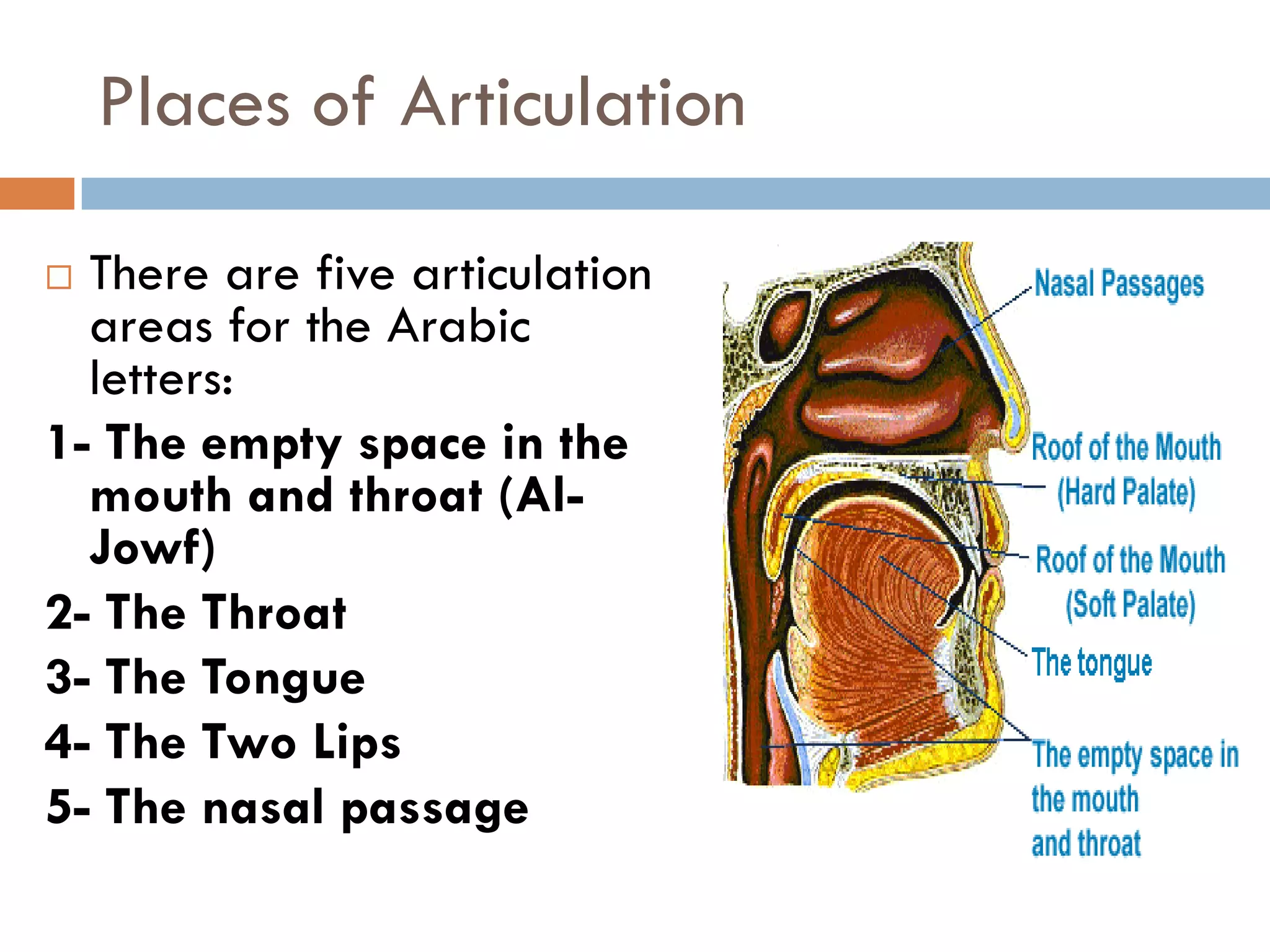
Places of Articulation

 There are five articulation
  areas for the Arabic
  letters:
1- The empty space in the
  mouth and throat (Al-
  Jowf)
2- The Throat
3- The Tongue
4- The Two Lips
5- The nasal passage
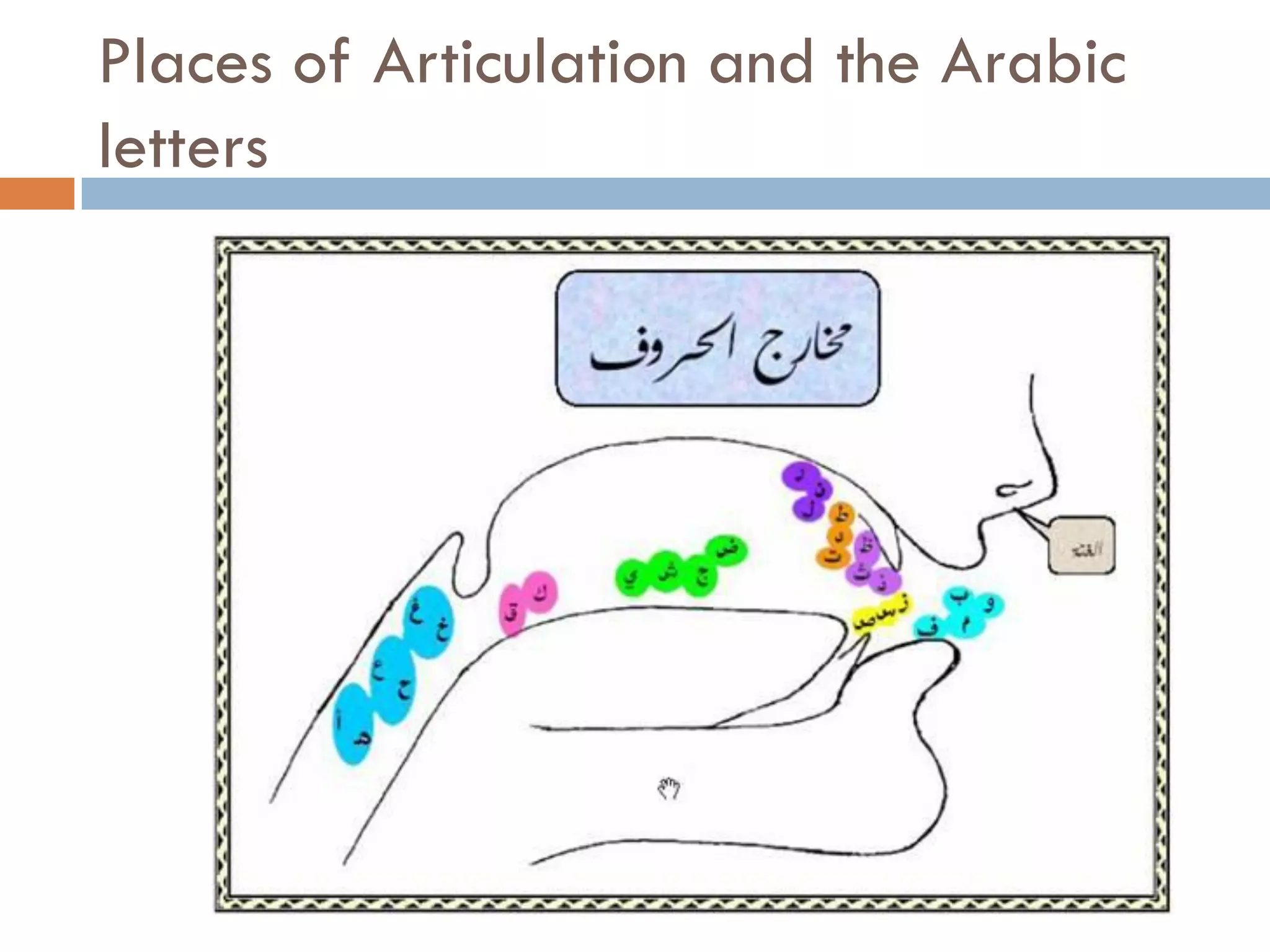
Places of Articulation
Places of Articulation and the Arabic
letters
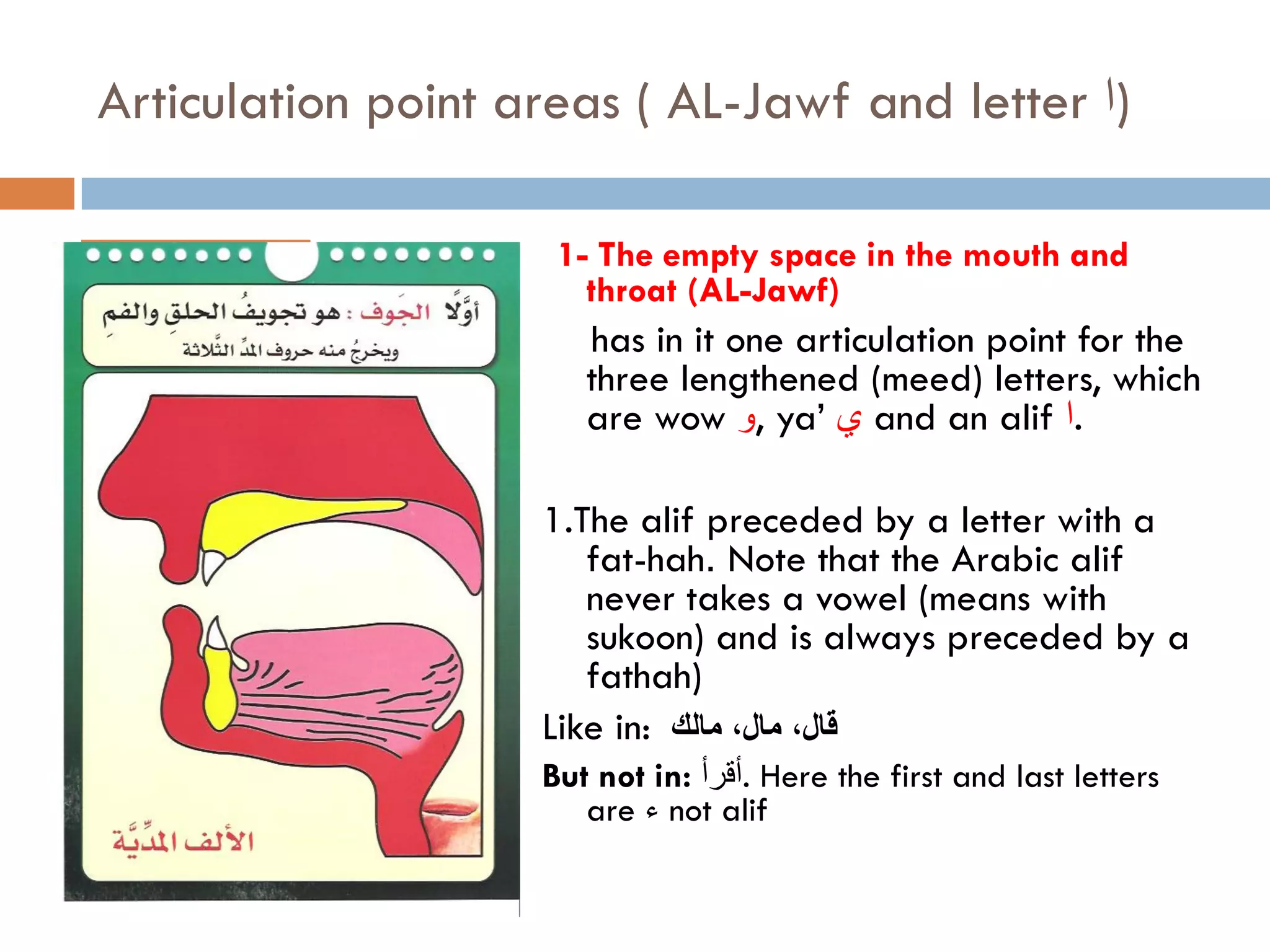
Articulation point areas ( AL-Jawf and letter ‫)ا‬

                     1- The empty space in the mouth and
                       throat (AL-Jawf)
                       has in it one articulation point for the
                       three lengthened (meed) letters, which
                       are wow ‫ ,و‬ya’ ‫ ي‬and an alif ‫.ا‬

                    1.The alif preceded by a letter with a
                       fat-hah. Note that the Arabic alif
                       never takes a vowel (means with
                       sukoon) and is always preceded by a
                       fathah)
                    Like in: ‫قال، مال، مالك‬
                    But not in: ‫ .أقرأ‬Here the first and last letters
                       are ‫ ء‬not alif
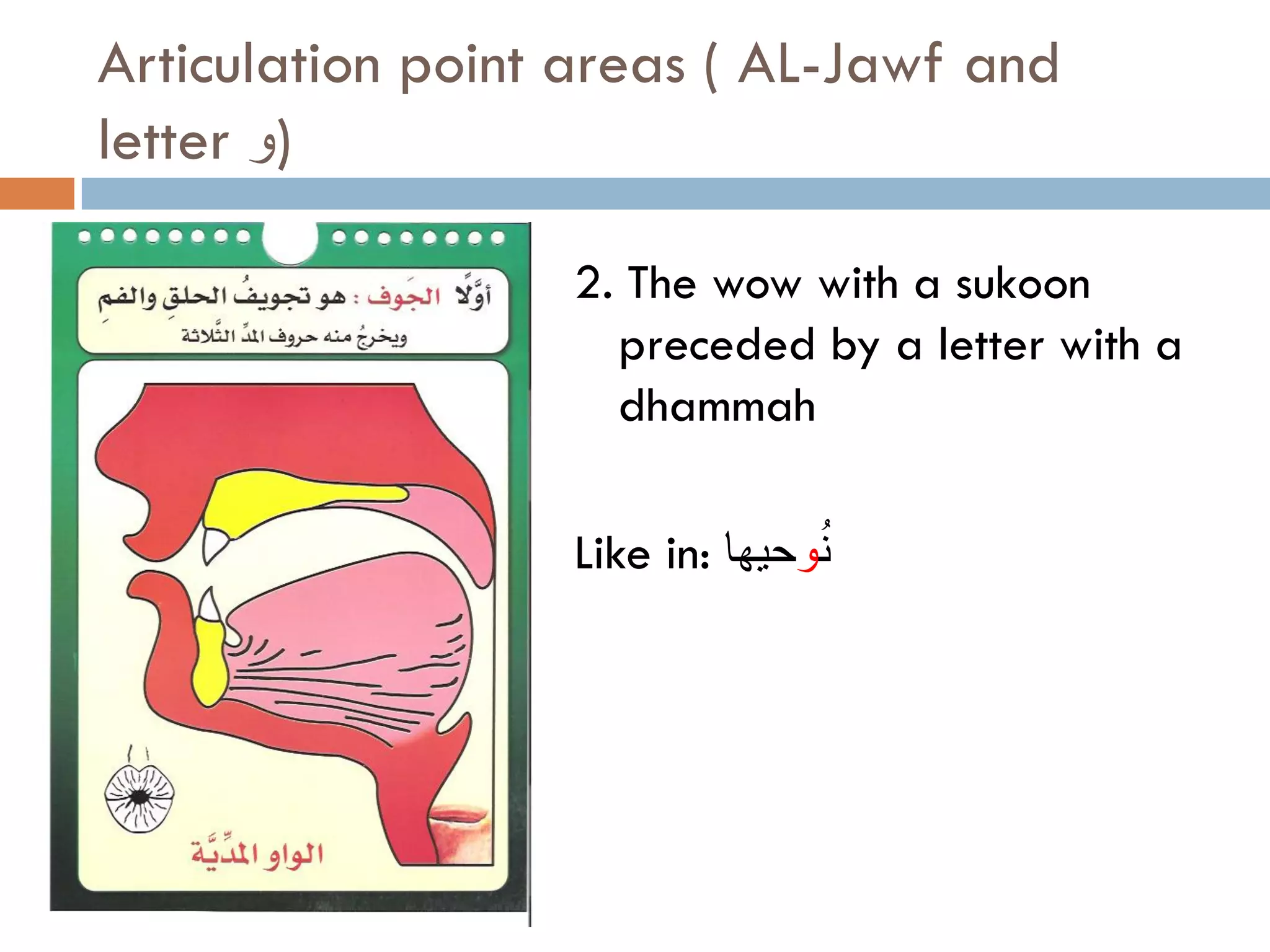
Articulation point areas ( AL-Jawf and
letter ‫)و‬

                  2. The wow with a sukoon
                    preceded by a letter with a
                    dhammah

                  Like in: ‫نوحيها‬
Articulation point areas ( AL-Jawf and
                               letter ‫)ي‬
                 3. The ya’ with a sukoon
                    preceded by a letter with a
                    kasrah
                 Like in: ‫نوحيها‬
The articulation points of the throat (the
hamzah (‫ )ء‬and the ha’ (‫))هاء‬

                  2- The Throat: there are three
                     places of articulation in the
                     throat, each place has two letters
                     emitted from therein.
                  1. The deepest part of the throat
                    The deepest part of the throat is
                     the furthest away from the mouth
                     and the closest to the chest. Two
                     letters are articulated from
                     here. They are the hamzah (‫)ء‬
                     and the ha’ (‫)هاء‬
The articulation points of the throat ( ‫ع‬
                                 and ‫)ح‬

               2. The middle part of the throat
                 The middle part of the throat
                 lies half way in between the
                 beginning and the end of the
                 throat. The two letters that
                 are emitted from here are: ‫ع‬
                 and ‫.ح‬
The articulation points of the throat
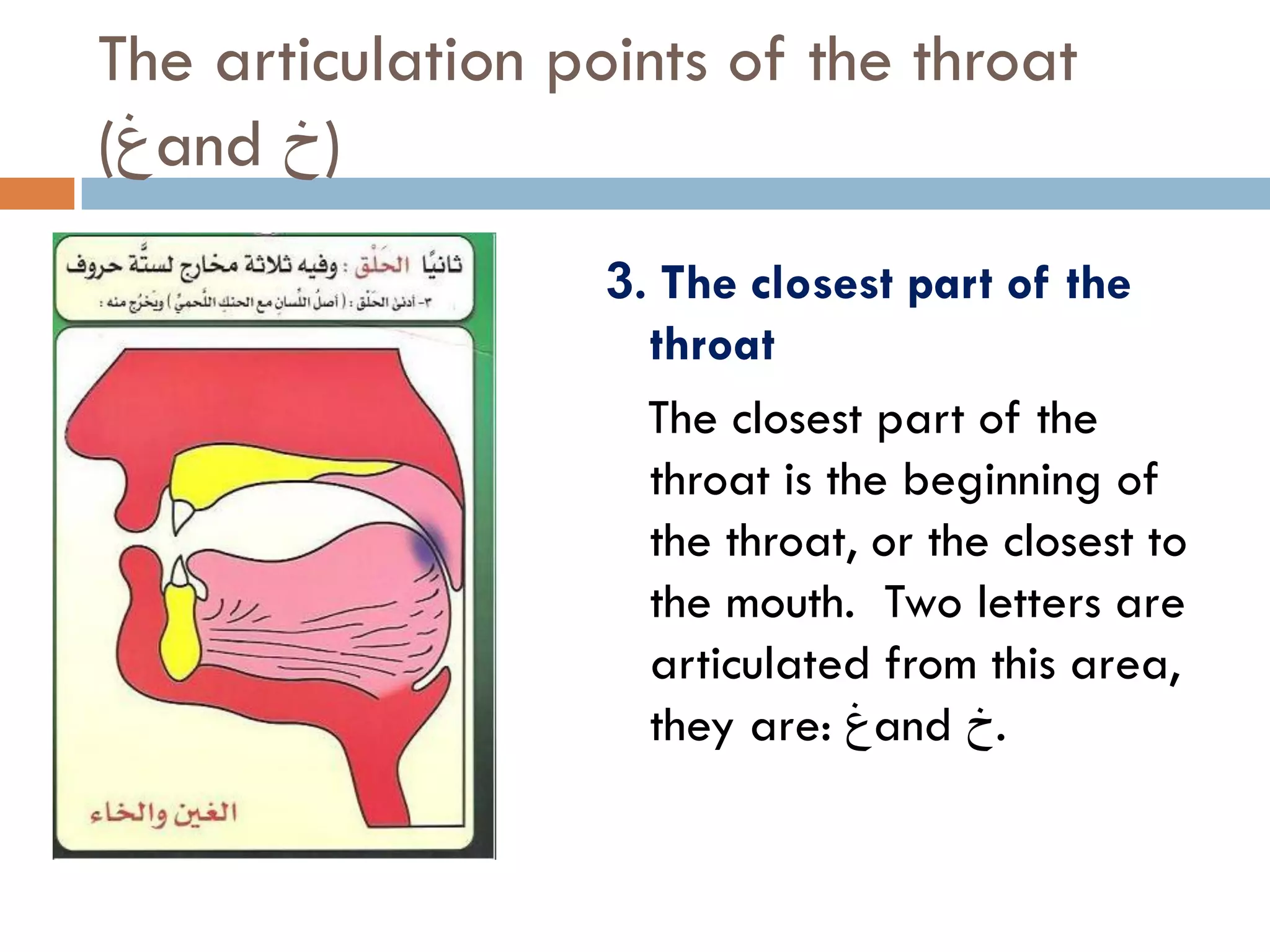
(‫غ‬and ‫)خ‬
                   3. The closest part of the
                     throat
                     The closest part of the
                     throat is the beginning of
                     the throat, or the closest to
                     the mouth. Two letters are
                     articulated from this area,
                     they are: ‫غ‬and ‫.خ‬
The articulation points of the tongue (‫)ق‬
                 3- The tongue : It has ten
                      articulation points for eighteen
                      letters

                 1.      There are two letters that use
                        the deepest part of the tongue
                        in articulation. They are ‫ ق‬and
                        ‫.ك‬
                      ‫ ق‬is articulated from the deepest
                      part of the tongue and what lies
                      opposite to it from the roof of
                      the mouth in the area of the soft
                      palate.
The articulation points of the tongue
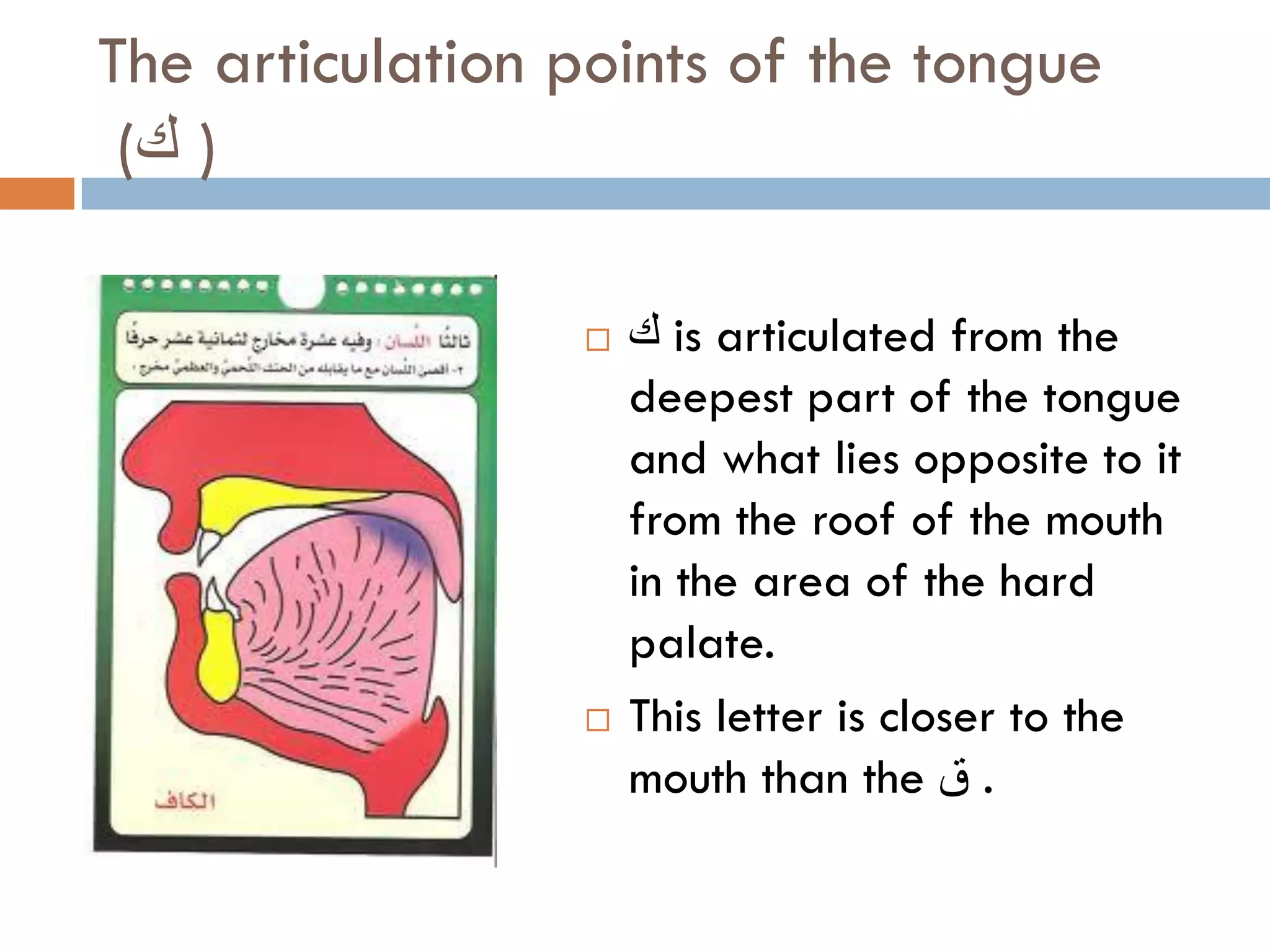
 (‫) ك‬

                    ‫ ك‬is articulated from the
                     deepest part of the tongue
                     and what lies opposite to it
                     from the roof of the mouth
                     in the area of the hard
                     palate.
                    This letter is closer to the
                     mouth than the ‫. ق‬
Areas of the tongue
   Areas of the tongue used for articulation There are
    four areas of the tongue used for articulation. The
    deepest part, the middle, the sides, and the tip. The
    following picture helps pinpoint these areas.
The articulation points of the tongue
 (‫) ي , ش , ج‬
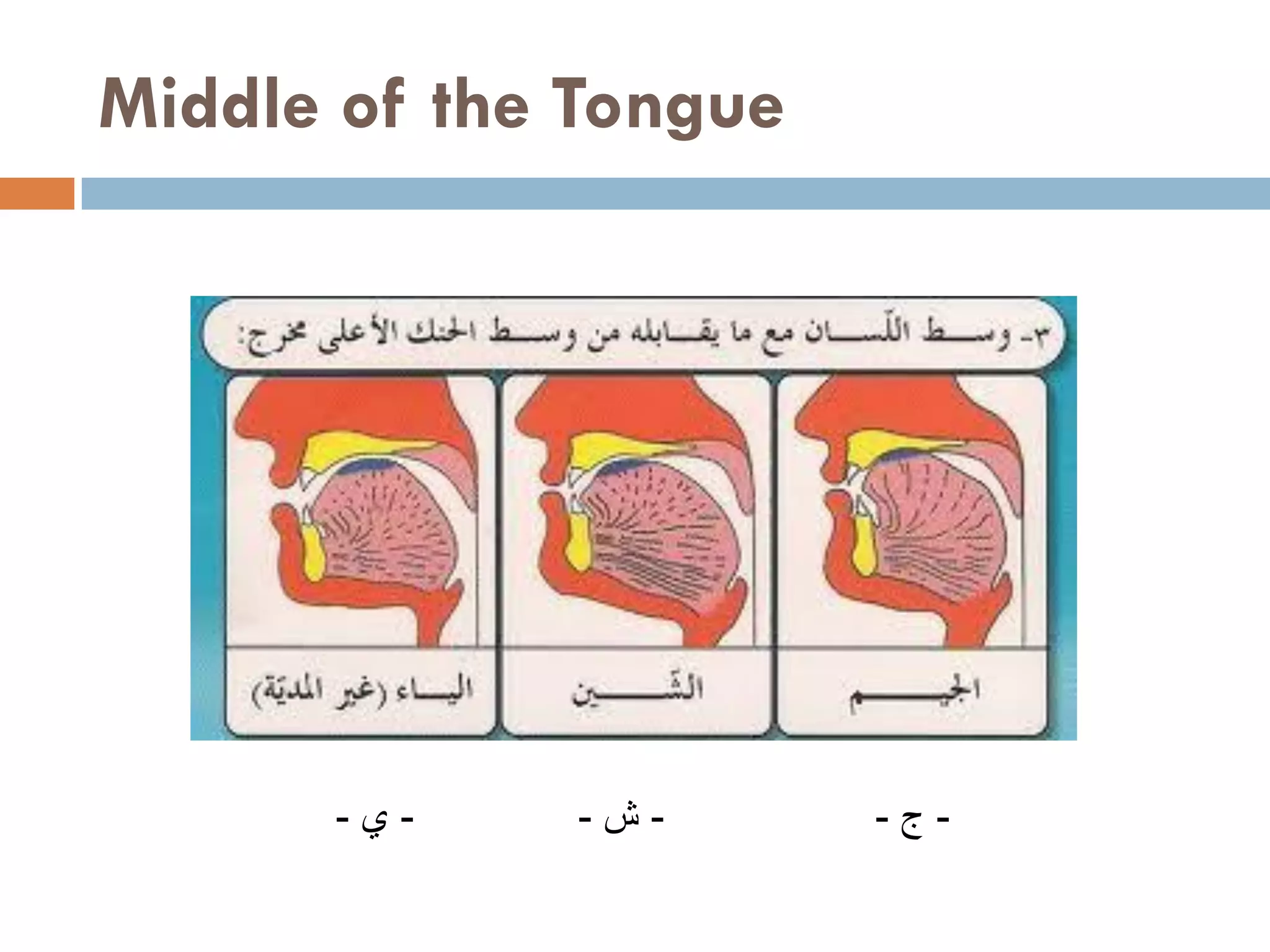
2. Middle of the Tongue
 Three letters use the middle of the tongue for their
   articulation. They are ‫( ي , ش ,ج‬without a medd).
 These three letters are articulated from the middle of the
   tongue and what lies opposite to it from the roof of the
   mouth.
 The ya’ here is not the medd letter ya’, which is articulated
   from Al-Jwaf. The medd letter ya’ is a ya’ saakinah
   preceded by a kasrah, NOT a fath.

   The ya’ saakinah is preceded by a fath is discussed here.
    Like in : ‫ علَيهم‬and ‫الريب‬
                           َ
Middle of the Tongue


      -‫-ي‬    -‫-ش‬       -‫-ج‬
The Teeth
The articulation points of the tongue
(‫)ض‬
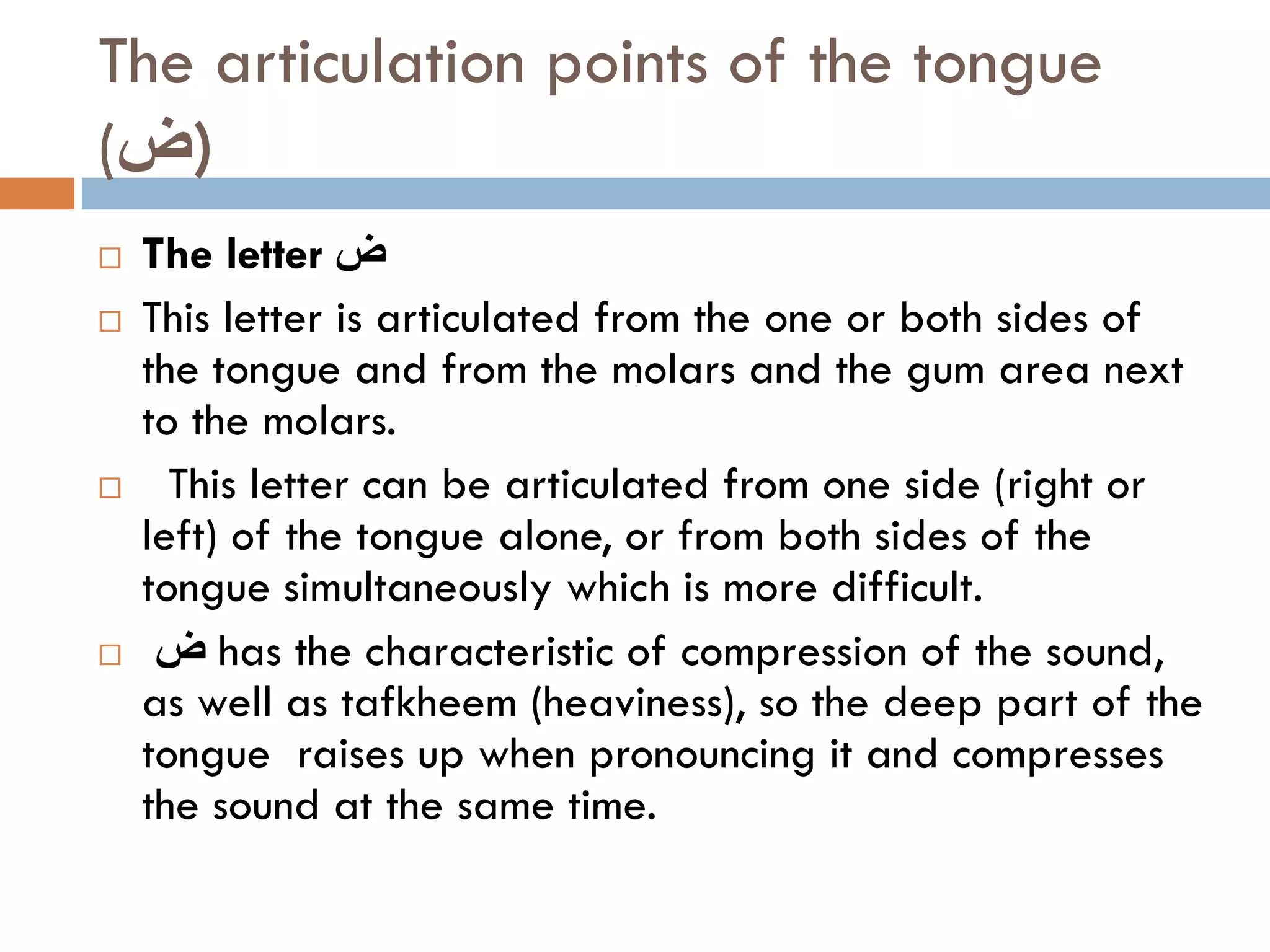
   The letter ‫ض‬
   This letter is articulated from the one or both sides of
    the tongue and from the molars and the gum area next
    to the molars.
     This letter can be articulated from one side (right or
    left) of the tongue alone, or from both sides of the
    tongue simultaneously which is more difficult.
    ‫ ض‬has the characteristic of compression of the sound,
    as well as tafkheem (heaviness), so the deep part of the
    tongue raises up when pronouncing it and compresses
    the sound at the same time.
The letter ‫ض‬
The articulation points of the tongue
(‫)ل‬
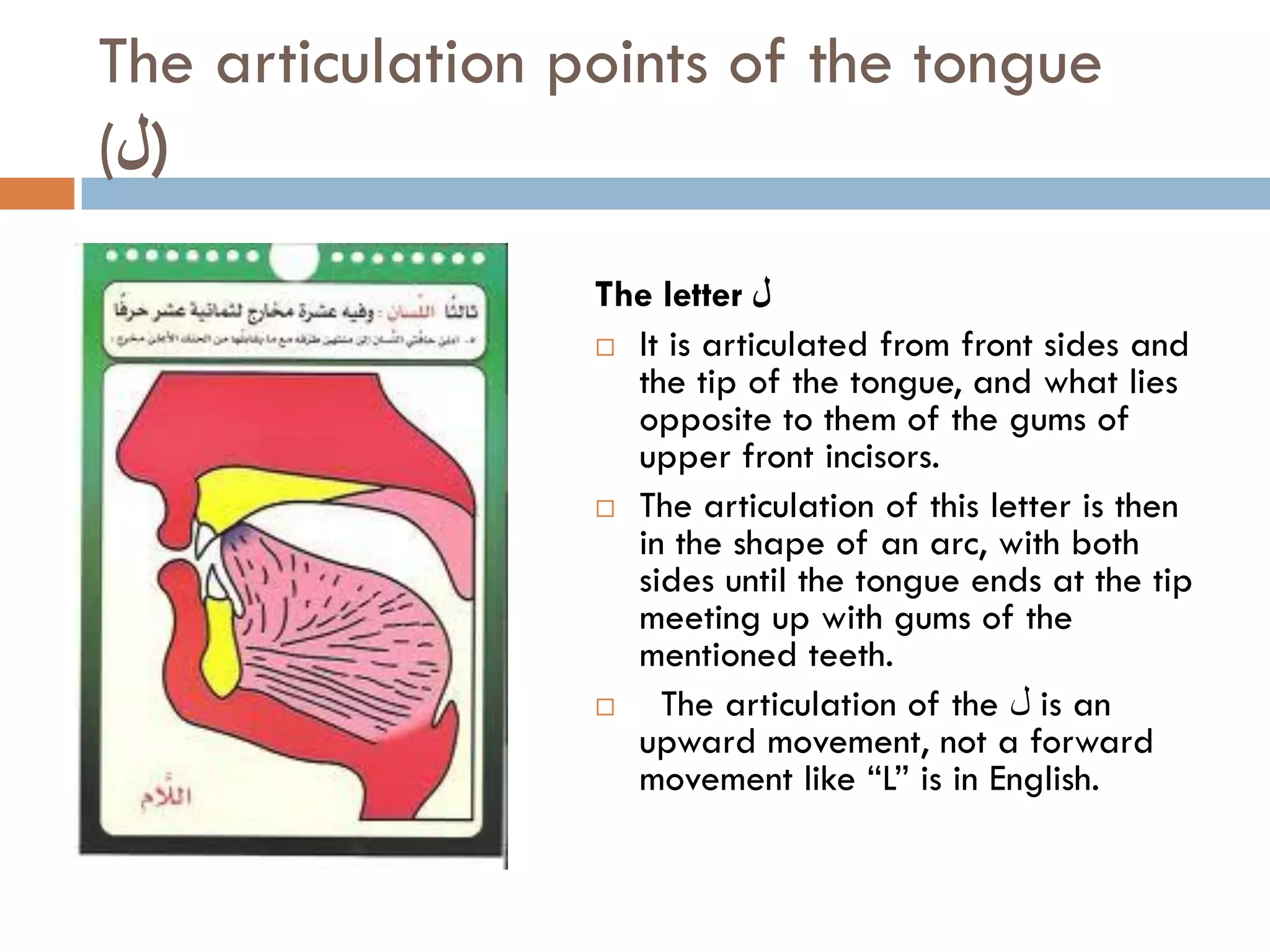
                  The letter ‫ل‬
                   It is articulated from front sides and
                    the tip of the tongue, and what lies
                    opposite to them of the gums of
                    upper front incisors.
                   The articulation of this letter is then
                    in the shape of an arc, with both
                    sides until the tongue ends at the tip
                    meeting up with gums of the
                    mentioned teeth.
                     The articulation of the ‫ ل‬is an
                    upward movement, not a forward
                    movement like “L” is in English.
The articulation points of the tongue (‫)ن‬
Articulation points of the Tip of the Tongue and the
The letter ‫ن‬
   This letter is articulated from the tip of the tongue and
  what lies opposite to it from the gum of the two front
  top incisors, a bit forward from the place of the letter ‫ل‬
   on the gum.

  It’s pronounced from this point only if it has a sukoon on
  it and is followed by one of the following six letters: ‫ء‬
  ‫ .،هاء، ع، ح، غ، خ‬This rule will be explained later, insha’
  Allah.
The articulation points of the tongue (‫)ن‬
The articulation points of the tongue (‫)ر‬

   The letter ‫ر‬
   This letter is emitted from the tip of the tongue with
    the top of the tip and what lies opposite to it of the
    gums of the two front top incisors (the palate).
   The tip with the top of the tip need to strike the
    gums to produce this sound correctly.
The articulation points of the tongue (‫)ر‬
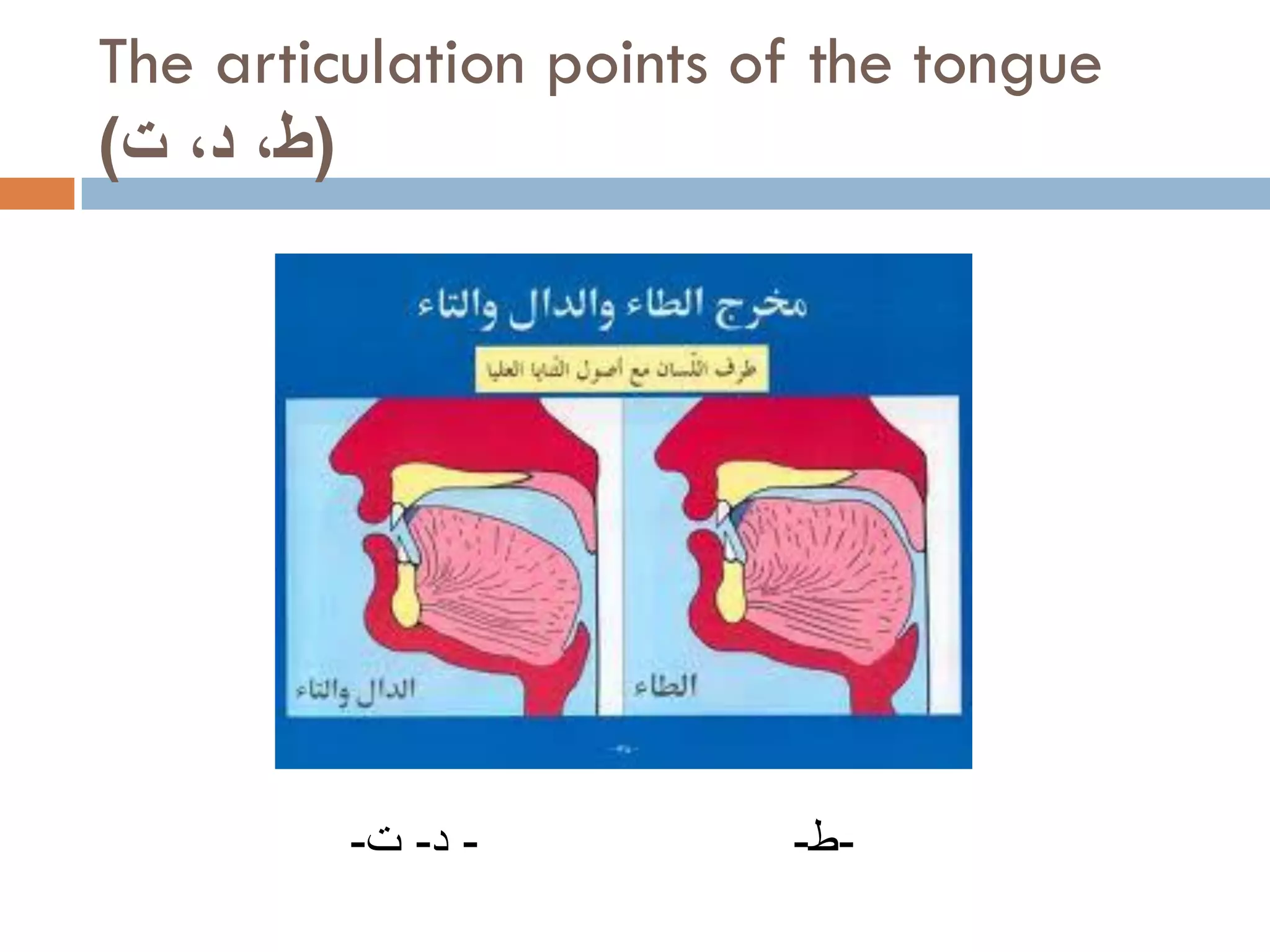
The articulation points of the tongue
)‫(ط، د، ت‬
   The articulation point of the ‫ط، د، ت‬
   These letters are pronounced from the top side of
    the tip of the tongue and the gum line of the two
    front upper incisors.
The articulation points of the tongue
)‫(ط، د، ت‬


         -‫- د- ت‬         -‫-ط‬
The articulation points of the tongue
)‫(ص، ز، س‬
   Articulation points of the ‫ص، ز، س‬
   These three letters are emitted from the tip of the
    tongue and the top edge of the two front lower
    incisors.
    There is a little space left in between the tip of the
    tongue and the plates of the teeth when
    pronouncing these letters.
   When these letters are emitted properly, a whistle
    type sound should be heard accompanying their
    sound.
The articulation points of the tongue
)‫(ص، ز، س‬


        -‫- س - ز‬         - ‫-ص‬
The articulation points of the tongue
)‫(ظ، ذ، ث‬
   Articulation point of the ‫ظ، ذ، ث‬
   These letters are emitted from the tip of the tongue
    (from the top side of the tip) and the bottom edges
    of the two top front incisors.
    Care should be taken to make sure the top of the
    tip is really colliding or separating with the edges
    of the teeth and not the plates of the teeth.
The articulation points of the tongue
)‫(ظ، ذ، ث‬


         - ‫- ذ- ث‬       -‫-ظ‬
The articulation points of the Lips (the
letter ‫)ف‬
2- The Lips
The lips have two articulation points for four letters.
   Articulation point of the letter ‫ف‬
   The articulation point of the ‫ ف‬is between the inside of
    the lower lip and the tips (or edges) of the two top front
    incisors.
   There is a meeting of these two parts of articulation to
    make the correct sound of this letter.
The articulation points of the Lips (the
letter ‫)ف‬
The articulation points of the Lips (the
letter ‫)م، ب، و‬
   Articulation point of the two lips ‫م، ب، و‬
   There are three letters that are articulated from the
    two lips, but they do not all three share the same
    mechanism in articulation.
   The unlengthened ‫ و‬is articulated by forming a
    circle of the two lips without the two lips meeting
    completely.
   The ‫ م‬is articulated by closing the two lips together
   The letter ‫ ب‬is articulated by closing the two lips
    together, but a stronger closing than the meem.
The articulation points of the Lips (the
letter ‫)م، ب، و‬

  ‫ب‬                                   ‫ف‬


  ‫و‬                                    ‫م‬
The articulation points of the Nasal
Passage (the ghunnah ‫ ن‬and ‫)م‬
5- The nasal passage
    From the hole of nose towards the inside of the mouth,
    here there is one articulation point, that of the ghunnah.

   The ghunnah is defined as: a nasal sound that is emitted
    from the nose. This is a required characteristic of the
    ‫ ن‬and ‫.م‬
   The ghunnah is not a letter but a characteristic of these
    two letters, but it has its own distinct place of
    articulation.
The articulation points of the Nasal
Passage (the ghunnah ‫ ن‬and ‫)م‬


             -‫-م‬          -‫-ن‬
References

 http://www.abouttajweed.com/
Useful videos
 http://www.youtube.com/watch?v=8FZRQEEdGuo&
  feature=related
 http://www.youtube.com/watch?v=NbI6_neGiX0&f
  eature=related
 http://www.youtube.com/watch?v=AjXHMxaR-
  sM&feature=related

Tajweed lessons-points ofarticulation-english

  • 1.
    TAJWEED Saffar 1433 January 2012 Al-Mahdi Islamic Center London - Ontario
  • 2.
    Definition of Tajweed  By linguistic definition: Betterment  Applied definition: Articulating every letter from its articulation point and giving the letter its rights and dues of characteristics.  The Goal of Learning Tajweed It is preserving the tongue from mistakes in pronunciation of the Glorious Qur'an during reading.
  • 3.
    Learning Tajweed MistakesDone while reading holy Quran are of two kinds:  Obvious mistakes: those are done while pronouncing the letters or the signs on the letters. Almost, anyone should be able to recognize these mistakes.  Unobvious: are the ones that are done with the tajweed rules. Only those who studied tajwed are able to distinquish them.  Learning Tajweed is WAJEB on every muslim.  Teaching Tajweed is only wajeb when there is no one else doing so.
  • 4.
    How to learnTajweed  Its principles The knowledge of tajweed is contingent on four matters: 1. Knowledge of the articulation points of the letters 2. Knowledge of the characteristics of the letters 3. Knowledge of the rules of tajweed (what change in the letters due to the order of letters) 4. Exercising the tongue and a lot of repetition.
  • 5.
    The articulation pointof the arabic letters  The articulation point of a letter is the place the letter is emitted. Using the correct articulation point of a letter is necessary to utter the letter correctly.  The no. of articulation points in Arabic are 17  To learn the articulation point of a letter  Pronounce the letter with a Sukoon and put a hamzah before the letter
  • 6.
    Places of Articulation There are five articulation areas for the Arabic letters: 1- The empty space in the mouth and throat (Al- Jowf) 2- The Throat 3- The Tongue 4- The Two Lips 5- The nasal passage
  • 7.
  • 8.
    Places of Articulationand the Arabic letters
  • 9.
    Articulation point areas( AL-Jawf and letter ‫)ا‬ 1- The empty space in the mouth and throat (AL-Jawf) has in it one articulation point for the three lengthened (meed) letters, which are wow ‫ ,و‬ya’ ‫ ي‬and an alif ‫.ا‬ 1.The alif preceded by a letter with a fat-hah. Note that the Arabic alif never takes a vowel (means with sukoon) and is always preceded by a fathah) Like in: ‫قال، مال، مالك‬ But not in: ‫ .أقرأ‬Here the first and last letters are ‫ ء‬not alif
  • 10.
    Articulation point areas( AL-Jawf and letter ‫)و‬ 2. The wow with a sukoon preceded by a letter with a dhammah Like in: ‫نوحيها‬
  • 11.
    Articulation point areas( AL-Jawf and letter ‫)ي‬ 3. The ya’ with a sukoon preceded by a letter with a kasrah Like in: ‫نوحيها‬
  • 12.
    The articulation pointsof the throat (the hamzah (‫ )ء‬and the ha’ (‫))هاء‬ 2- The Throat: there are three places of articulation in the throat, each place has two letters emitted from therein. 1. The deepest part of the throat The deepest part of the throat is the furthest away from the mouth and the closest to the chest. Two letters are articulated from here. They are the hamzah (‫)ء‬ and the ha’ (‫)هاء‬
  • 13.
    The articulation pointsof the throat ( ‫ع‬ and ‫)ح‬ 2. The middle part of the throat The middle part of the throat lies half way in between the beginning and the end of the throat. The two letters that are emitted from here are: ‫ع‬ and ‫.ح‬
  • 14.
    The articulation pointsof the throat (‫غ‬and ‫)خ‬ 3. The closest part of the throat The closest part of the throat is the beginning of the throat, or the closest to the mouth. Two letters are articulated from this area, they are: ‫غ‬and ‫.خ‬
  • 15.
    The articulation pointsof the tongue (‫)ق‬ 3- The tongue : It has ten articulation points for eighteen letters 1. There are two letters that use the deepest part of the tongue in articulation. They are ‫ ق‬and ‫.ك‬ ‫ ق‬is articulated from the deepest part of the tongue and what lies opposite to it from the roof of the mouth in the area of the soft palate.
  • 16.
    The articulation pointsof the tongue (‫) ك‬  ‫ ك‬is articulated from the deepest part of the tongue and what lies opposite to it from the roof of the mouth in the area of the hard palate.  This letter is closer to the mouth than the ‫. ق‬
  • 17.
    Areas of thetongue  Areas of the tongue used for articulation There are four areas of the tongue used for articulation. The deepest part, the middle, the sides, and the tip. The following picture helps pinpoint these areas.
  • 18.
    The articulation pointsof the tongue (‫) ي , ش , ج‬ 2. Middle of the Tongue  Three letters use the middle of the tongue for their articulation. They are ‫( ي , ش ,ج‬without a medd).  These three letters are articulated from the middle of the tongue and what lies opposite to it from the roof of the mouth.  The ya’ here is not the medd letter ya’, which is articulated from Al-Jwaf. The medd letter ya’ is a ya’ saakinah preceded by a kasrah, NOT a fath.  The ya’ saakinah is preceded by a fath is discussed here. Like in : ‫ علَيهم‬and ‫الريب‬ َ
  • 19.
    Middle of theTongue -‫-ي‬ -‫-ش‬ -‫-ج‬
  • 20.
  • 21.
    The articulation pointsof the tongue (‫)ض‬  The letter ‫ض‬  This letter is articulated from the one or both sides of the tongue and from the molars and the gum area next to the molars.  This letter can be articulated from one side (right or left) of the tongue alone, or from both sides of the tongue simultaneously which is more difficult.  ‫ ض‬has the characteristic of compression of the sound, as well as tafkheem (heaviness), so the deep part of the tongue raises up when pronouncing it and compresses the sound at the same time.
  • 22.
  • 23.
    The articulation pointsof the tongue (‫)ل‬ The letter ‫ل‬  It is articulated from front sides and the tip of the tongue, and what lies opposite to them of the gums of upper front incisors.  The articulation of this letter is then in the shape of an arc, with both sides until the tongue ends at the tip meeting up with gums of the mentioned teeth.  The articulation of the ‫ ل‬is an upward movement, not a forward movement like “L” is in English.
  • 24.
    The articulation pointsof the tongue (‫)ن‬ Articulation points of the Tip of the Tongue and the The letter ‫ن‬ This letter is articulated from the tip of the tongue and what lies opposite to it from the gum of the two front top incisors, a bit forward from the place of the letter ‫ل‬ on the gum. It’s pronounced from this point only if it has a sukoon on it and is followed by one of the following six letters: ‫ء‬ ‫ .،هاء، ع، ح، غ، خ‬This rule will be explained later, insha’ Allah.
  • 25.
    The articulation pointsof the tongue (‫)ن‬
  • 26.
    The articulation pointsof the tongue (‫)ر‬  The letter ‫ر‬  This letter is emitted from the tip of the tongue with the top of the tip and what lies opposite to it of the gums of the two front top incisors (the palate).  The tip with the top of the tip need to strike the gums to produce this sound correctly.
  • 27.
    The articulation pointsof the tongue (‫)ر‬
  • 28.
    The articulation pointsof the tongue )‫(ط، د، ت‬  The articulation point of the ‫ط، د، ت‬  These letters are pronounced from the top side of the tip of the tongue and the gum line of the two front upper incisors.
  • 29.
    The articulation pointsof the tongue )‫(ط، د، ت‬ -‫- د- ت‬ -‫-ط‬
  • 30.
    The articulation pointsof the tongue )‫(ص، ز، س‬  Articulation points of the ‫ص، ز، س‬  These three letters are emitted from the tip of the tongue and the top edge of the two front lower incisors.  There is a little space left in between the tip of the tongue and the plates of the teeth when pronouncing these letters.  When these letters are emitted properly, a whistle type sound should be heard accompanying their sound.
  • 31.
    The articulation pointsof the tongue )‫(ص، ز، س‬ -‫- س - ز‬ - ‫-ص‬
  • 32.
    The articulation pointsof the tongue )‫(ظ، ذ، ث‬  Articulation point of the ‫ظ، ذ، ث‬  These letters are emitted from the tip of the tongue (from the top side of the tip) and the bottom edges of the two top front incisors.  Care should be taken to make sure the top of the tip is really colliding or separating with the edges of the teeth and not the plates of the teeth.
  • 33.
    The articulation pointsof the tongue )‫(ظ، ذ، ث‬ - ‫- ذ- ث‬ -‫-ظ‬
  • 34.
    The articulation pointsof the Lips (the letter ‫)ف‬ 2- The Lips The lips have two articulation points for four letters.  Articulation point of the letter ‫ف‬  The articulation point of the ‫ ف‬is between the inside of the lower lip and the tips (or edges) of the two top front incisors.  There is a meeting of these two parts of articulation to make the correct sound of this letter.
  • 35.
    The articulation pointsof the Lips (the letter ‫)ف‬
  • 36.
    The articulation pointsof the Lips (the letter ‫)م، ب، و‬  Articulation point of the two lips ‫م، ب، و‬  There are three letters that are articulated from the two lips, but they do not all three share the same mechanism in articulation.  The unlengthened ‫ و‬is articulated by forming a circle of the two lips without the two lips meeting completely.  The ‫ م‬is articulated by closing the two lips together  The letter ‫ ب‬is articulated by closing the two lips together, but a stronger closing than the meem.
  • 37.
    The articulation pointsof the Lips (the letter ‫)م، ب، و‬ ‫ب‬ ‫ف‬ ‫و‬ ‫م‬
  • 38.
    The articulation pointsof the Nasal Passage (the ghunnah ‫ ن‬and ‫)م‬ 5- The nasal passage From the hole of nose towards the inside of the mouth, here there is one articulation point, that of the ghunnah.  The ghunnah is defined as: a nasal sound that is emitted from the nose. This is a required characteristic of the ‫ ن‬and ‫.م‬  The ghunnah is not a letter but a characteristic of these two letters, but it has its own distinct place of articulation.
  • 39.
    The articulation pointsof the Nasal Passage (the ghunnah ‫ ن‬and ‫)م‬ -‫-م‬ -‫-ن‬
  • 40.
    References  http://www.abouttajweed.com/ Useful videos http://www.youtube.com/watch?v=8FZRQEEdGuo& feature=related  http://www.youtube.com/watch?v=NbI6_neGiX0&f eature=related  http://www.youtube.com/watch?v=AjXHMxaR- sM&feature=related