COMPONENTS OF LEXICAL MEANING
Dr.Sundarabalu
Dept. of Linguistics
Bharathiar University
Coimbatore-46
alpasibalu@gmail.com
COMPONENTS OF LEXICAL MEANING
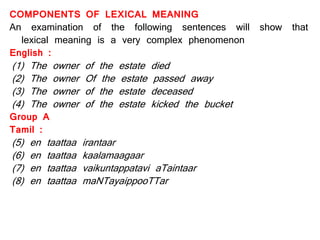
An examination of the following sentences will show that
lexical meaning is a very complex phenomenon
English :
(1) The owner of the estate died
(2) The owner Of the estate passed away
(3) The owner of the estate deceased
(4) The owner of the estate kicked the bucket
Group A
Tamil :
(5) en taattaa irantaar
(6) en taattaa kaalamaagaar
(7) en taattaa vaikuntappatavi aTaintaar
(8) en taattaa maNTayaippooTTar
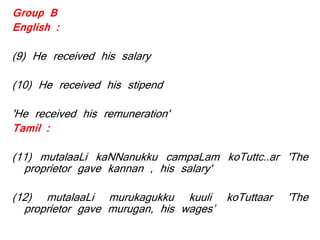
Group B
English :
(9) He received his salary
(10) He received his stipend
'He received his remuneration'
Tamil :
(11) mutalaaLi kaNNanukku campaLam koTuttc..ar 'The
proprietor gave kannan , his salary'
(12) mutalaaLi murukagukku kuuli koTuttaar 'The
proprietor gave murugan, his wages’
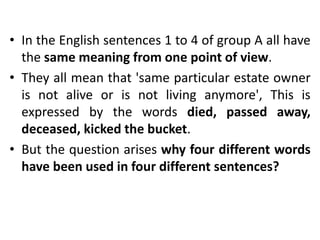
• In the English sentences 1 to 4 of group A all have
the same meaning from one point of view.
• They all mean that 'same particular estate owner
is not alive or is not living anymore', This is
expressed by the words died, passed away,
deceased, kicked the bucket.
• But the question arises why four different words
have been used in four different sentences?
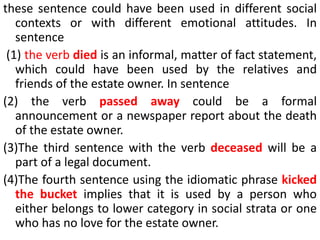
these sentence could have been used in different social
contexts or with different emotional attitudes. In
sentence
(1) the verb died is an informal, matter of fact statement,
which could have been used by the relatives and
friends of the estate owner. In sentence
(2) the verb passed away could be a formal
announcement or a newspaper report about the death
of the estate owner.
(3)The third sentence with the verb deceased will be a
part of a legal document.
(4)The fourth sentence using the idiomatic phrase kicked
the bucket implies that it is used by a person who
either belongs to lower category in social strata or one
who has no love for the estate owner.
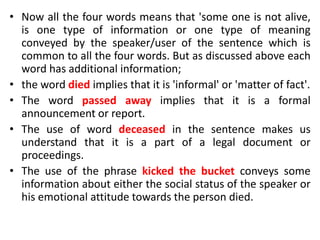
• Now all the four words means that 'some one is not alive,
is one type of information or one type of meaning
conveyed by the speaker/user of the sentence which is
common to all the four words. But as discussed above each
word has additional information;
• the word died implies that it is 'informal' or 'matter of fact'.
• The word passed away implies that it is a formal
announcement or report.
• The use of word deceased in the sentence makes us
understand that it is a part of a legal document or
proceedings.
• The use of the phrase kicked the bucket conveys some
information about either the social status of the speaker or
his emotional attitude towards the person died.
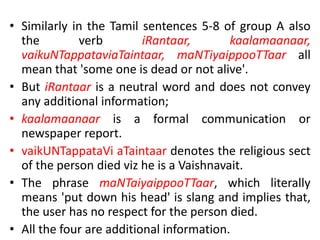
• Similarly in the Tamil sentences 5-8 of group A also
the verb iRantaar, kaalamaanaar,
vaikuNTappataviaTaintaar, maNTiyaippooTTaar all
mean that 'some one is dead or not alive'.
• But iRantaar is a neutral word and does not convey
any additional information;
• kaalamaanaar is a formal communication or
newspaper report.
• vaikUNTappataVi aTaintaar denotes the religious sect
of the person died viz he is a Vaishnavait.
• The phrase maNTaiyaippooTTaar, which literally
means 'put down his head' is slang and implies that,
the user has no respect for the person died.
• All the four are additional information.
• Therefore, we understand that these English
and Tamil words have in their meaning two
types of information or 'components'.
• The shared common information, which is
related to the reality of 'some one not being
alive', is the basic information.
• The others are informations or components
added to the basic information.
• The first is called designation. The second
category is called connotation.
• Range of application
• Now if we examine the English and Tamil sentences
included in-group B, we find another type of
information, which is included in the meanings of a
word. In the English sentence 9 and 10, the words
salary or stipend have the same meaning as they refer
to the 'remuneration' or 'wages' given for the work
done by some one.
• But these words are not interchangeable in all the
contexts.
• Use of the word salary or stipend depends upon the
nature of the work of the person who does it.
• Stipend refers to the remuneration received by a
religious father or pastor (clergyman) or a public official
(Concise Oxford dictionary).
• It cannot be used for the remuneration received by other
types of employees in which case the word salary is used.
Similarly in Tamil the word campaLam (11) and kuuli used in
(12) refer to the wages for the work done by some one.
• As in English, here also there is restriction in use. kuuli is used
only for physical casual work normally done on daily or
weekly basis. campaLam is used to refer to the remuneration
given for work done on regular monthly or weekly basis.
• Therefore, we understand that there is restriction in the use
or application of the pairs of English and Tamil words which in
one point of view have the same meaning.
• The sameness of meaning is what we called above as
designation, i.e. these pairs of words have same designation.
But they differ in what semanticists call the 'range of
application' or restriction on their use. This is also a part or
component lexical meaning.
DESIGNATION
• The content system of a language is concerned with
the study of how the expression system relate to
the various types of the activities of human beings
their surroundings etc., or the 'world'. Designation
is concerned with how lexemes or words are related to the
parts of the world.
• To be exact it "is the relation which is existing
between single words and single parts of extra
linguistic world as conceived by the speakers of a
particular language (Zgusta, 1971 ,p,27)".
• For examples the English word Table is related
designatively to all different types of objects, which
can be called as tables.
• To understand designation, we have to find out how these
relations exist in a particular language. The class of different types
of objects to which the word is related is called denotatum or
referent.
• The word denotatum refers to not only to class of objects but to
class of actions, events, ideas, feelings, institutions, concepts
etc., of the world or reality which are referred to by particular
words .
• For example the English word run has as its denotatum, the
different types of movements from the slowest to the fastest to
refer to which the word can be used.
• The word love has as its denotatum, all the different types of
feelings such as those of parents to children, husband to wife, that
exist between friends, master to servant, master to his pet animal
etc.
• The word government may have as its denotata,
different governmental institutions like
democratically elected governments, totalitarian
governments, governments run by military
dictators, governments run by kings or monarchy.
• Therefore, designation is the relation between
different words and different types of denotata
,which they refer to. But this relation is not a
direct relation. It is mediated through
designatum. “
• Designatum is the notion of the respective thing of the denotatum as conceived
buy the speakers of a language (Zgusta, 1971. p. 28).
• The designatum is also referred to as to as concept or notion or idea of the
denotatum as conceived by the speakers of a language.
• The denotata of a word has several properties.
For example the English word table includes class of objects which
are made of wood, steel, stone etc., they may belong to different sizes like
square, rectangle, oval, round, etc., they may stand on one or many legs.
They may be used for different purpose like putting things on them,
sitting around them as a group and discuss, perform some work etc. Of these
varying properties of a class of objects called table, only certain properties or
features are shared by or common to all the members of the class of objects.
They will also be shared by any object which may be created in the future and which
help the speaker to identify the object as a table. Such properties or features will
be called criterial or contrastive features.
They will help differentiate this class of objects from similar class of
objects. Sum or total of these properties or features constitute the
designatum. In the case of table the material by which it is made of,
size, shape, number of legs, colour etc., may vary. Only the following
properties are shared by all the objects which are called table,
which belong to a class of objects called furniture:
(1) having flat or horizontal top,
(2) standing on one or more legs,
(3) used for putting things on or sitting around.
These are the criterial features and these features together constitute
the desingnatum of the English word table. Thus we can see that the
relation between word form say English table; through the
designatum i.e. the sum of criterial or contrastive features given
above to the denotatum i.e. the class of objects referred to by the
word form constitute the relation of designation.
• Finding out the criterial or contrastive features is the
most important aspect of the study of lexical meaning.
• This is because for the same denotatum, criterial
features may differ from language to language. For
example,
we listed above the criterial features of
English word table. The Tamil equivalent is meesai for
table. But the Tamil meesai can be used for any piece of
furniture, having flattop, standing on legs even if it is
used for reading, writing or working.
But in English the piece of furniture with flat
(or sloping) top if it is used for reading and writing or
working, then it is called desk. The purpose for which
the piece of furniture is used is a criterial feature in
English and that belongs to another word Viz., desk.
But it is not so in Tamil.
• Any piece of furniture having flattop, standing on
one or more legs, whatever purpose it used will
be 'meesai' in Tamil. The difference between
English hand and Tamil kai which are partial
equivalents and the difference between colour
terms where the same colours of the spectrum
are classified differently in different languages
and even in different periods in the same
language. This is because of difference in the
organization of the criterial features and their by
the designatum.
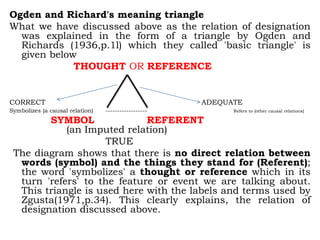
Ogden and Richard's meaning triangle
What we have discussed above as the relation of designation
was explained in the form of a triangle by Ogden and
Richards (1936,p.1l) which they called 'basic triangle' is
given below
THOUGHT OR REFERENCE
CORRECT ADEQUATE
Symbolizes (a causal relation) ------------------ Refers to (other causal relations)
SYMBOL REFERENT
(an Imputed relation)
TRUE
The diagram shows that there is no direct relation between
words (symbol) and the things they stand for (Referent);
the word 'symbolizes' a thought or reference which in its
turn 'refers' to the feature or event we are talking about.
This triangle is used here with the labels and terms used by
Zgusta(1971,p.34). This clearly explains, the relation of
designation discussed above.
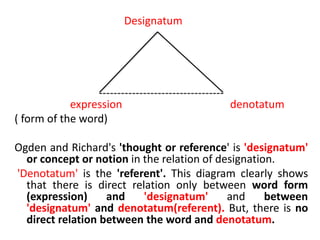
Designatum
----------------------------------
expression denotatum
( form of the word)
Ogden and Richard's 'thought or reference' is 'designatum'
or concept or notion in the relation of designation.
'Denotatum' is the 'referent'. This diagram clearly shows
that there is direct relation only between word form
(expression) and 'designatum' and between
'designatum' and denotatum(referent). But, there is no
direct relation between the word and denotatum.
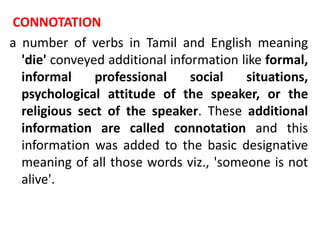
CONNOTATION
a number of verbs in Tamil and English meaning
'die' conveyed additional information like formal,
informal professional social situations,
psychological attitude of the speaker, or the
religious sect of the speaker. These additional
information are called connotation and this
information was added to the basic designative
meaning of all those words viz., 'someone is not
alive'.
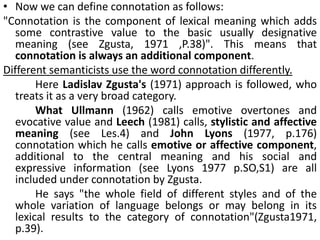
• Now we can define connotation as follows:
"Connotation is the component of lexical meaning which adds
some contrastive value to the basic usually designative
meaning (see Zgusta, 1971 ,P.38)". This means that
connotation is always an additional component.
Different semanticists use the word connotation differently.
Here Ladislav Zgusta's (1971) approach is followed, who
treats it as a very broad category.
What Ullmann (1962) calls emotive overtones and
evocative value and Leech (1981) calls, stylistic and affective
meaning (see Les.4) and John Lyons (1977, p.176)
connotation which he calls emotive or affective component,
additional to the central meaning and his social and
expressive information (see Lyons 1977 p.SO,S1) are all
included under connotation by Zgusta.
He says "the whole field of different styles and of the
whole variation of language belongs or may belong in its
lexical results to the category of connotation"(Zgusta1971,
p.39).
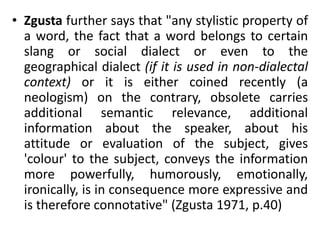
• Zgusta further says that "any stylistic property of
a word, the fact that a word belongs to certain
slang or social dialect or even to the
geographical dialect (if it is used in non-dialectal
context) or it is either coined recently (a
neologism) on the contrary, obsolete carries
additional semantic relevance, additional
information about the speaker, about his
attitude or evaluation of the subject, gives
'colour' to the subject, conveys the information
more powerfully, humorously, emotionally,
ironically, is in consequence more expressive and
is therefore connotative" (Zgusta 1971, p.40)
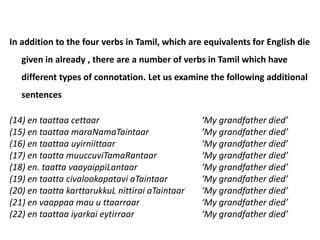
In addition to the four verbs in Tamil, which are equivalents for English die
given in already , there are a number of verbs in Tamil which have
different types of connotation. Let us examine the following additional
sentences
(14) en taattaa cettaar ‘My grandfather died’
(15) en taattaa maraNamaTaintaar ‘My grandfather died’
(16) en taattaa uyirniittaar ‘My grandfather died’
(17) en taatta muuccuviTamaRantaar ‘My grandfather died’
(18) en. taatta vaayaippiLantaar ‘My grandfather died’
(19) en taatta civalookapatavi aTaintaar ‘My grandfather died’
(20) en taatta karttarukkuL nittirai aTaintaar ‘My grandfather died’
(21) en vaappaa mau u ttaarraar ‘My grandfather died’
(22) en taattaa iyarkai eytirraar ‘My grandfather died’
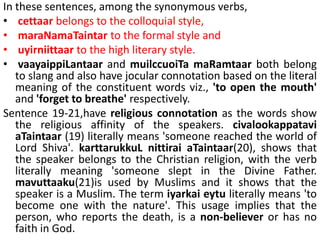
In these sentences, among the synonymous verbs,
• cettaar belongs to the colloquial style,
• maraNamaTaintar to the formal style and
• uyirniittaar to the high literary style.
• vaayaippiLantaar and muilccuoiTa maRamtaar both belong
to slang and also have jocular connotation based on the literal
meaning of the constituent words viz., 'to open the mouth'
and 'forget to breathe' respectively.
Sentence 19-21,have religious connotation as the words show
the religious affinity of the speakers. civalookappatavi
aTaintaar (19) literally means 'someone reached the world of
Lord Shiva'. karttarukkuL nittirai aTaintaar(20), shows that
the speaker belongs to the Christian religion, with the verb
literally meaning 'someone slept in the Divine Father.
mavuttaaku(21)is used by Muslims and it shows that the
speaker is a Muslim. The term iyarkai eytu literally means 'to
become one with the nature'. This usage implies that the
person, who reports the death, is a non-believer or has no
faith in God.
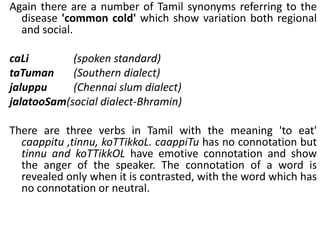
Again there are a number of Tamil synonyms referring to the
disease 'common cold' which show variation both regional
and social.
caLi (spoken standard)
taTuman (Southern dialect)
jaluppu (Chennai slum dialect)
jalatooSam(social dialect-Bhramin)
There are three verbs in Tamil with the meaning 'to eat'
caappitu ,tinnu, koTTikkoL. caappiTu has no connotation but
tinnu and koTTikkOL have emotive connotation and show
the anger of the speaker. The connotation of a word is
revealed only when it is contrasted, with the word which has
no connotation or neutral.
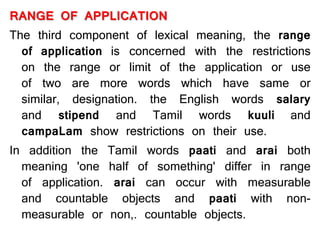
RANGE OF APPLICATION
The third component of lexical meaning, the range
of application is concerned with the restrictions
on the range or limit of the application or use
of two are more words which have same or
similar, designation. the English words salary
and stipend and Tamil words kuuli and
campaLam show restrictions on their use.
In addition the Tamil words paati and arai both
meaning 'one half of something' differ in range
of application. arai can occur with measurable
and countable objects and paati with non-
measurable or non,. countable objects.
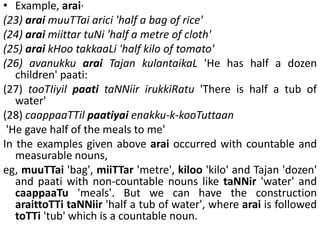
• Example, arai·
(23) arai muuTTai arici 'half a bag of rice'
(24) arai miittar tuNi 'half a metre of cloth'
(25) arai kHoo takkaaLi 'half kilo of tomato'
(26) avanukku arai Tajan kulantaikaL 'He has half a dozen
children' paati:
(27) tooTIiyil paati taNNiir irukkiRatu 'There is half a tub of
water'
(28) caappaaTTil paatiyai enakku-k-kooTuttaan
'He gave half of the meals to me'
In the examples given above arai occurred with countable and
measurable nouns,
eg, muuTTai 'bag', miiTTar 'metre', kiloo 'kilo' and Tajan 'dozen'
and paati with non-countable nouns like taNNir 'water' and
caappaaTu 'meals'. But we can have the construction
araittoTTi taNNiir 'half a tub of water', where arai is followed
toTTi 'tub' which is a countable noun.
• It is interesting to note that the noun caappaaTu
'meals' which is a uncountable and unmeasurable
noun, when used in the home context, becomes
measurable in the context of a restaurant where
the expression aria-c-ccaappaaTu 'half meals' and
muluc caappaaTu 'full meals' are used.
• This is because in the restaurant, they measure
the meals (cooked rice) using measuring cups, or
plates. In fact this construction has to be treated
as an elliptical form of arai kap caappaaTu 'half a
cup of meals 'or arai piLet caappaaTu 'half a plate
of meals'.
• As range of application is based on co-occurrence or
collocational restrictions of words it is also cal1ed as
collocational meaning (Singh, 1982, P.36).
• But the word collocation is a broad category referring
to restrictions on the coming together of words of
different types some of which cannot be called range of
application.
• For example, the words referring to the cries of animals
and birds differ showing restriction. Eg. English 'the lion
roars, horse neighs, elephant trumpets, cock crows,
and Tamil dnkam karjikkum 'Lion will roar' kutirai
kanaiKKum ' The horse will neigh', yaanai piLirum, ' The
elephant will trumpet', kaakam karaiyum ' The crow will
caw'.
• Here the collocational restrictions will become part of
the designative meaning of particular words rather
than an additional component.
• For examples
• roar has to be defined as 'loud sound like that made
by lions', neigh 'make a long cry as of a horse'.
• When we compare the meanings of words salary and
stipend given in the dictionary 'fixed sum of money
paid regularly' will be the designative meaning, shared
by both the words. Additional explanations added for
salary is 'paid to especially, employees doing official or
professional work', and for stipend it is 'paid especially
to priest or minister' are additional components showing
the difference in range. Therefore one has to
differentiate between collocational restriction and range
of application.
• Of the three components of lexical meaning designation,
which is also called, as denotative or cognitive or
referential meaning is the most important and basic
component. The other two components are additional
components.
VAGUENESS OF MEANING
• We described it as though lexical meaning is precise
and clearly definable interms of the three components.
In reality it is not so. It is not similar to scientific
concepts which are clearly definable in terms of their
clear characteristics.
• This is because lexical meaning is derived from
thousands of sentences in which they are used by
thousands of speakers of the particular language. This
also has to account for the future use of these words in
newer contexts, based on the productivity of language
(see Hockett, 1970 (1958) p.575).
• All these lead to what is called 'vagueness' or
generality of meaning ( see Ullmann 1962 p.118-128,
Zgusta 1971. p 47). The following factors will make
clear this aspect of meaning.
• (1) The designatum which is derived from the denotata
is applicable to a large class of things which are
grouped together by a few criterial or common
features.
For example the English word game refers to
various types of games like board-games, card-games,
ball-games, olympiccgames etc., (see Ullmann, 1962
p.118). The word flower will apply to hundred of
different types of flowers. So also Tamil word maram
'tree' is used to refer to trees with branches, without
branches (coconut, palm plantain etc).
• (2) The designata are broad i.e. different types of
things are included within a single designatum.
For example English word furniture includes
chairs, benches, tables, desks, sofas, settees etc., used
in houses, offices, theatres etc.,
• (3) The designata overlap. The adjectives big and
large are synonymous and substitutable in some
contexts but cannot be substituted in some other
thus showing overlapping of their designatum
e.g. big house, large house, big city, large city.
But big man, big idea are possible but not *large
man, * large idea. In literary Tamil niiNTa and
neTiya are substitutable in niiNta caalai / neTiya
caalai 'long road'; but only *neTiya malai 'tall
mountain' and not niiNta malai
• (4) Sometimes both the designata and denotata of
the words lack clear-cut boundaries. This happens
in the case words with both, abstract and concrete
meanings. Tamil words niiti justice' and niyaayam
'fairness, naturalness, justice, belong to this
category.
• In the concrete domain body part words show this
lack of clear boundary. Tamil words denoting
different areas of the human face show this aspect.
e.g. kannan 'cheek', taaTai 'jaw', mukavaay/ naaTi
'chin'. The boundaries of these parts which are
overlapping cannot be marked clearly, though
central portions can be differentiated
• (5) Over and above all those aspects, multiple
meaning of lexemes i.e. a single word form
having a number of meanings, (which will be
discussed in detail ,leads to ambiguity ,and is a
source of vagueness of meaning. But in spite of
this inherent vagueness or generality of meaning
effective communication goes on successfully due
to safeguards either in-built in the language
system or external, devised by the speakers
• Source at Prof.K Balasubramaniam
• Annamalainagar

Components of lexical meaning

  • 1.
    COMPONENTS OF LEXICALMEANING Dr.Sundarabalu Dept. of Linguistics Bharathiar University Coimbatore-46 alpasibalu@gmail.com
  • 2.
    COMPONENTS OF LEXICALMEANING An examination of the following sentences will show that lexical meaning is a very complex phenomenon English : (1) The owner of the estate died (2) The owner Of the estate passed away (3) The owner of the estate deceased (4) The owner of the estate kicked the bucket Group A Tamil : (5) en taattaa irantaar (6) en taattaa kaalamaagaar (7) en taattaa vaikuntappatavi aTaintaar (8) en taattaa maNTayaippooTTar
  • 3.
    Group B English : (9)He received his salary (10) He received his stipend 'He received his remuneration' Tamil : (11) mutalaaLi kaNNanukku campaLam koTuttc..ar 'The proprietor gave kannan , his salary' (12) mutalaaLi murukagukku kuuli koTuttaar 'The proprietor gave murugan, his wages’
  • 4.
    • In theEnglish sentences 1 to 4 of group A all have the same meaning from one point of view. • They all mean that 'same particular estate owner is not alive or is not living anymore', This is expressed by the words died, passed away, deceased, kicked the bucket. • But the question arises why four different words have been used in four different sentences?
  • 5.
    these sentence couldhave been used in different social contexts or with different emotional attitudes. In sentence (1) the verb died is an informal, matter of fact statement, which could have been used by the relatives and friends of the estate owner. In sentence (2) the verb passed away could be a formal announcement or a newspaper report about the death of the estate owner. (3)The third sentence with the verb deceased will be a part of a legal document. (4)The fourth sentence using the idiomatic phrase kicked the bucket implies that it is used by a person who either belongs to lower category in social strata or one who has no love for the estate owner.
  • 6.
    • Now allthe four words means that 'some one is not alive, is one type of information or one type of meaning conveyed by the speaker/user of the sentence which is common to all the four words. But as discussed above each word has additional information; • the word died implies that it is 'informal' or 'matter of fact'. • The word passed away implies that it is a formal announcement or report. • The use of word deceased in the sentence makes us understand that it is a part of a legal document or proceedings. • The use of the phrase kicked the bucket conveys some information about either the social status of the speaker or his emotional attitude towards the person died.
  • 7.
    • Similarly inthe Tamil sentences 5-8 of group A also the verb iRantaar, kaalamaanaar, vaikuNTappataviaTaintaar, maNTiyaippooTTaar all mean that 'some one is dead or not alive'. • But iRantaar is a neutral word and does not convey any additional information; • kaalamaanaar is a formal communication or newspaper report. • vaikUNTappataVi aTaintaar denotes the religious sect of the person died viz he is a Vaishnavait. • The phrase maNTaiyaippooTTaar, which literally means 'put down his head' is slang and implies that, the user has no respect for the person died. • All the four are additional information.
  • 8.
    • Therefore, weunderstand that these English and Tamil words have in their meaning two types of information or 'components'. • The shared common information, which is related to the reality of 'some one not being alive', is the basic information. • The others are informations or components added to the basic information. • The first is called designation. The second category is called connotation.
  • 9.
    • Range ofapplication • Now if we examine the English and Tamil sentences included in-group B, we find another type of information, which is included in the meanings of a word. In the English sentence 9 and 10, the words salary or stipend have the same meaning as they refer to the 'remuneration' or 'wages' given for the work done by some one. • But these words are not interchangeable in all the contexts. • Use of the word salary or stipend depends upon the nature of the work of the person who does it. • Stipend refers to the remuneration received by a religious father or pastor (clergyman) or a public official (Concise Oxford dictionary).
  • 10.
    • It cannotbe used for the remuneration received by other types of employees in which case the word salary is used. Similarly in Tamil the word campaLam (11) and kuuli used in (12) refer to the wages for the work done by some one. • As in English, here also there is restriction in use. kuuli is used only for physical casual work normally done on daily or weekly basis. campaLam is used to refer to the remuneration given for work done on regular monthly or weekly basis. • Therefore, we understand that there is restriction in the use or application of the pairs of English and Tamil words which in one point of view have the same meaning. • The sameness of meaning is what we called above as designation, i.e. these pairs of words have same designation. But they differ in what semanticists call the 'range of application' or restriction on their use. This is also a part or component lexical meaning.
  • 11.
    DESIGNATION • The contentsystem of a language is concerned with the study of how the expression system relate to the various types of the activities of human beings their surroundings etc., or the 'world'. Designation is concerned with how lexemes or words are related to the parts of the world. • To be exact it "is the relation which is existing between single words and single parts of extra linguistic world as conceived by the speakers of a particular language (Zgusta, 1971 ,p,27)". • For examples the English word Table is related designatively to all different types of objects, which can be called as tables.
  • 12.
    • To understanddesignation, we have to find out how these relations exist in a particular language. The class of different types of objects to which the word is related is called denotatum or referent. • The word denotatum refers to not only to class of objects but to class of actions, events, ideas, feelings, institutions, concepts etc., of the world or reality which are referred to by particular words . • For example the English word run has as its denotatum, the different types of movements from the slowest to the fastest to refer to which the word can be used. • The word love has as its denotatum, all the different types of feelings such as those of parents to children, husband to wife, that exist between friends, master to servant, master to his pet animal etc.
  • 13.
    • The wordgovernment may have as its denotata, different governmental institutions like democratically elected governments, totalitarian governments, governments run by military dictators, governments run by kings or monarchy. • Therefore, designation is the relation between different words and different types of denotata ,which they refer to. But this relation is not a direct relation. It is mediated through designatum. “
  • 14.
    • Designatum isthe notion of the respective thing of the denotatum as conceived buy the speakers of a language (Zgusta, 1971. p. 28). • The designatum is also referred to as to as concept or notion or idea of the denotatum as conceived by the speakers of a language. • The denotata of a word has several properties. For example the English word table includes class of objects which are made of wood, steel, stone etc., they may belong to different sizes like square, rectangle, oval, round, etc., they may stand on one or many legs. They may be used for different purpose like putting things on them, sitting around them as a group and discuss, perform some work etc. Of these varying properties of a class of objects called table, only certain properties or features are shared by or common to all the members of the class of objects. They will also be shared by any object which may be created in the future and which help the speaker to identify the object as a table. Such properties or features will be called criterial or contrastive features.
  • 15.
    They will helpdifferentiate this class of objects from similar class of objects. Sum or total of these properties or features constitute the designatum. In the case of table the material by which it is made of, size, shape, number of legs, colour etc., may vary. Only the following properties are shared by all the objects which are called table, which belong to a class of objects called furniture: (1) having flat or horizontal top, (2) standing on one or more legs, (3) used for putting things on or sitting around. These are the criterial features and these features together constitute the desingnatum of the English word table. Thus we can see that the relation between word form say English table; through the designatum i.e. the sum of criterial or contrastive features given above to the denotatum i.e. the class of objects referred to by the word form constitute the relation of designation.
  • 16.
    • Finding outthe criterial or contrastive features is the most important aspect of the study of lexical meaning. • This is because for the same denotatum, criterial features may differ from language to language. For example, we listed above the criterial features of English word table. The Tamil equivalent is meesai for table. But the Tamil meesai can be used for any piece of furniture, having flattop, standing on legs even if it is used for reading, writing or working. But in English the piece of furniture with flat (or sloping) top if it is used for reading and writing or working, then it is called desk. The purpose for which the piece of furniture is used is a criterial feature in English and that belongs to another word Viz., desk. But it is not so in Tamil.
  • 17.
    • Any pieceof furniture having flattop, standing on one or more legs, whatever purpose it used will be 'meesai' in Tamil. The difference between English hand and Tamil kai which are partial equivalents and the difference between colour terms where the same colours of the spectrum are classified differently in different languages and even in different periods in the same language. This is because of difference in the organization of the criterial features and their by the designatum.
  • 18.
    Ogden and Richard'smeaning triangle What we have discussed above as the relation of designation was explained in the form of a triangle by Ogden and Richards (1936,p.1l) which they called 'basic triangle' is given below THOUGHT OR REFERENCE CORRECT ADEQUATE Symbolizes (a causal relation) ------------------ Refers to (other causal relations) SYMBOL REFERENT (an Imputed relation) TRUE The diagram shows that there is no direct relation between words (symbol) and the things they stand for (Referent); the word 'symbolizes' a thought or reference which in its turn 'refers' to the feature or event we are talking about. This triangle is used here with the labels and terms used by Zgusta(1971,p.34). This clearly explains, the relation of designation discussed above.
  • 19.
    Designatum ---------------------------------- expression denotatum ( formof the word) Ogden and Richard's 'thought or reference' is 'designatum' or concept or notion in the relation of designation. 'Denotatum' is the 'referent'. This diagram clearly shows that there is direct relation only between word form (expression) and 'designatum' and between 'designatum' and denotatum(referent). But, there is no direct relation between the word and denotatum.
  • 20.
    CONNOTATION a number ofverbs in Tamil and English meaning 'die' conveyed additional information like formal, informal professional social situations, psychological attitude of the speaker, or the religious sect of the speaker. These additional information are called connotation and this information was added to the basic designative meaning of all those words viz., 'someone is not alive'.
  • 21.
    • Now wecan define connotation as follows: "Connotation is the component of lexical meaning which adds some contrastive value to the basic usually designative meaning (see Zgusta, 1971 ,P.38)". This means that connotation is always an additional component. Different semanticists use the word connotation differently. Here Ladislav Zgusta's (1971) approach is followed, who treats it as a very broad category. What Ullmann (1962) calls emotive overtones and evocative value and Leech (1981) calls, stylistic and affective meaning (see Les.4) and John Lyons (1977, p.176) connotation which he calls emotive or affective component, additional to the central meaning and his social and expressive information (see Lyons 1977 p.SO,S1) are all included under connotation by Zgusta. He says "the whole field of different styles and of the whole variation of language belongs or may belong in its lexical results to the category of connotation"(Zgusta1971, p.39).
  • 22.
    • Zgusta furthersays that "any stylistic property of a word, the fact that a word belongs to certain slang or social dialect or even to the geographical dialect (if it is used in non-dialectal context) or it is either coined recently (a neologism) on the contrary, obsolete carries additional semantic relevance, additional information about the speaker, about his attitude or evaluation of the subject, gives 'colour' to the subject, conveys the information more powerfully, humorously, emotionally, ironically, is in consequence more expressive and is therefore connotative" (Zgusta 1971, p.40)
  • 23.
    In addition tothe four verbs in Tamil, which are equivalents for English die given in already , there are a number of verbs in Tamil which have different types of connotation. Let us examine the following additional sentences (14) en taattaa cettaar ‘My grandfather died’ (15) en taattaa maraNamaTaintaar ‘My grandfather died’ (16) en taattaa uyirniittaar ‘My grandfather died’ (17) en taatta muuccuviTamaRantaar ‘My grandfather died’ (18) en. taatta vaayaippiLantaar ‘My grandfather died’ (19) en taatta civalookapatavi aTaintaar ‘My grandfather died’ (20) en taatta karttarukkuL nittirai aTaintaar ‘My grandfather died’ (21) en vaappaa mau u ttaarraar ‘My grandfather died’ (22) en taattaa iyarkai eytirraar ‘My grandfather died’
  • 24.
    In these sentences,among the synonymous verbs, • cettaar belongs to the colloquial style, • maraNamaTaintar to the formal style and • uyirniittaar to the high literary style. • vaayaippiLantaar and muilccuoiTa maRamtaar both belong to slang and also have jocular connotation based on the literal meaning of the constituent words viz., 'to open the mouth' and 'forget to breathe' respectively. Sentence 19-21,have religious connotation as the words show the religious affinity of the speakers. civalookappatavi aTaintaar (19) literally means 'someone reached the world of Lord Shiva'. karttarukkuL nittirai aTaintaar(20), shows that the speaker belongs to the Christian religion, with the verb literally meaning 'someone slept in the Divine Father. mavuttaaku(21)is used by Muslims and it shows that the speaker is a Muslim. The term iyarkai eytu literally means 'to become one with the nature'. This usage implies that the person, who reports the death, is a non-believer or has no faith in God.
  • 25.
    Again there area number of Tamil synonyms referring to the disease 'common cold' which show variation both regional and social. caLi (spoken standard) taTuman (Southern dialect) jaluppu (Chennai slum dialect) jalatooSam(social dialect-Bhramin) There are three verbs in Tamil with the meaning 'to eat' caappitu ,tinnu, koTTikkoL. caappiTu has no connotation but tinnu and koTTikkOL have emotive connotation and show the anger of the speaker. The connotation of a word is revealed only when it is contrasted, with the word which has no connotation or neutral.
  • 26.
    RANGE OF APPLICATION Thethird component of lexical meaning, the range of application is concerned with the restrictions on the range or limit of the application or use of two are more words which have same or similar, designation. the English words salary and stipend and Tamil words kuuli and campaLam show restrictions on their use. In addition the Tamil words paati and arai both meaning 'one half of something' differ in range of application. arai can occur with measurable and countable objects and paati with non- measurable or non,. countable objects.
  • 27.
    • Example, arai· (23)arai muuTTai arici 'half a bag of rice' (24) arai miittar tuNi 'half a metre of cloth' (25) arai kHoo takkaaLi 'half kilo of tomato' (26) avanukku arai Tajan kulantaikaL 'He has half a dozen children' paati: (27) tooTIiyil paati taNNiir irukkiRatu 'There is half a tub of water' (28) caappaaTTil paatiyai enakku-k-kooTuttaan 'He gave half of the meals to me' In the examples given above arai occurred with countable and measurable nouns, eg, muuTTai 'bag', miiTTar 'metre', kiloo 'kilo' and Tajan 'dozen' and paati with non-countable nouns like taNNir 'water' and caappaaTu 'meals'. But we can have the construction araittoTTi taNNiir 'half a tub of water', where arai is followed toTTi 'tub' which is a countable noun.
  • 28.
    • It isinteresting to note that the noun caappaaTu 'meals' which is a uncountable and unmeasurable noun, when used in the home context, becomes measurable in the context of a restaurant where the expression aria-c-ccaappaaTu 'half meals' and muluc caappaaTu 'full meals' are used. • This is because in the restaurant, they measure the meals (cooked rice) using measuring cups, or plates. In fact this construction has to be treated as an elliptical form of arai kap caappaaTu 'half a cup of meals 'or arai piLet caappaaTu 'half a plate of meals'.
  • 29.
    • As rangeof application is based on co-occurrence or collocational restrictions of words it is also cal1ed as collocational meaning (Singh, 1982, P.36). • But the word collocation is a broad category referring to restrictions on the coming together of words of different types some of which cannot be called range of application. • For example, the words referring to the cries of animals and birds differ showing restriction. Eg. English 'the lion roars, horse neighs, elephant trumpets, cock crows, and Tamil dnkam karjikkum 'Lion will roar' kutirai kanaiKKum ' The horse will neigh', yaanai piLirum, ' The elephant will trumpet', kaakam karaiyum ' The crow will caw'. • Here the collocational restrictions will become part of the designative meaning of particular words rather than an additional component.
  • 30.
    • For examples •roar has to be defined as 'loud sound like that made by lions', neigh 'make a long cry as of a horse'. • When we compare the meanings of words salary and stipend given in the dictionary 'fixed sum of money paid regularly' will be the designative meaning, shared by both the words. Additional explanations added for salary is 'paid to especially, employees doing official or professional work', and for stipend it is 'paid especially to priest or minister' are additional components showing the difference in range. Therefore one has to differentiate between collocational restriction and range of application. • Of the three components of lexical meaning designation, which is also called, as denotative or cognitive or referential meaning is the most important and basic component. The other two components are additional components.
  • 31.
    VAGUENESS OF MEANING •We described it as though lexical meaning is precise and clearly definable interms of the three components. In reality it is not so. It is not similar to scientific concepts which are clearly definable in terms of their clear characteristics. • This is because lexical meaning is derived from thousands of sentences in which they are used by thousands of speakers of the particular language. This also has to account for the future use of these words in newer contexts, based on the productivity of language (see Hockett, 1970 (1958) p.575). • All these lead to what is called 'vagueness' or generality of meaning ( see Ullmann 1962 p.118-128, Zgusta 1971. p 47). The following factors will make clear this aspect of meaning.
  • 32.
    • (1) Thedesignatum which is derived from the denotata is applicable to a large class of things which are grouped together by a few criterial or common features. For example the English word game refers to various types of games like board-games, card-games, ball-games, olympiccgames etc., (see Ullmann, 1962 p.118). The word flower will apply to hundred of different types of flowers. So also Tamil word maram 'tree' is used to refer to trees with branches, without branches (coconut, palm plantain etc). • (2) The designata are broad i.e. different types of things are included within a single designatum. For example English word furniture includes chairs, benches, tables, desks, sofas, settees etc., used in houses, offices, theatres etc.,
  • 33.
    • (3) Thedesignata overlap. The adjectives big and large are synonymous and substitutable in some contexts but cannot be substituted in some other thus showing overlapping of their designatum e.g. big house, large house, big city, large city. But big man, big idea are possible but not *large man, * large idea. In literary Tamil niiNTa and neTiya are substitutable in niiNta caalai / neTiya caalai 'long road'; but only *neTiya malai 'tall mountain' and not niiNta malai
  • 34.
    • (4) Sometimesboth the designata and denotata of the words lack clear-cut boundaries. This happens in the case words with both, abstract and concrete meanings. Tamil words niiti justice' and niyaayam 'fairness, naturalness, justice, belong to this category. • In the concrete domain body part words show this lack of clear boundary. Tamil words denoting different areas of the human face show this aspect. e.g. kannan 'cheek', taaTai 'jaw', mukavaay/ naaTi 'chin'. The boundaries of these parts which are overlapping cannot be marked clearly, though central portions can be differentiated
  • 35.
    • (5) Overand above all those aspects, multiple meaning of lexemes i.e. a single word form having a number of meanings, (which will be discussed in detail ,leads to ambiguity ,and is a source of vagueness of meaning. But in spite of this inherent vagueness or generality of meaning effective communication goes on successfully due to safeguards either in-built in the language system or external, devised by the speakers • Source at Prof.K Balasubramaniam • Annamalainagar