FUNCTIONAL LINGUISTICS:
THE PRAGUE SCHOOL

                Neyda Noheli Alvarez Avila
                Luis Angel De León Rangel
                     Ricardo Misael García
               Luis Pablo Tamez Sarmiento
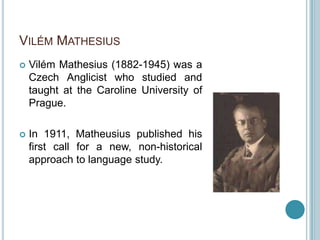
VILÉM MATHESIUS
   Vilém Mathesius (1882-1945) was a
    Czech Anglicist who studied and
    taught at the Caroline University of
    Prague.

   In 1911, Matheusius published his
    first call for a new, non-historical
    approach to language study.
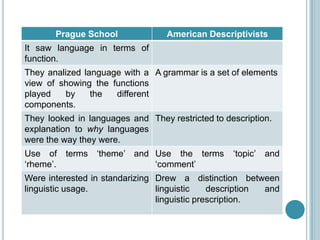
Prague School              American Descriptivists
It saw language in terms of
function.
They analized language with a A grammar is a set of elements
view of showing the functions
played   by     the  different
components.
They looked in languages and They restricted to description.
explanation to why languages
were the way they were.
Use of terms     „theme‟ and Use the terms        „topic‟ and
„rheme‟.                     „comment‟
Were interested in standarizing Drew a distinction between
linguistic usage.               linguistic    description and
                                linguistic prescription.
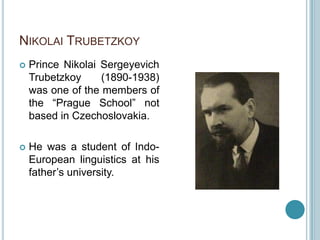
NIKOLAI TRUBETZKOY
   Prince Nikolai Sergeyevich
    Trubetzkoy     (1890-1938)
    was one of the members of
    the “Prague School” not
    based in Czechoslovakia.

   He was a student of Indo-
    European linguistics at his
    father‟s university.
   Trubetzkoyan phonology gives a central role to the
    phoneme; Trubetzkoy, and the Prague School in
    general, where intersted primarily in the
    paradigmatic relation between phonemes.

   In the Principles, establishes a rather sophisticated
    system of phonological typology, a system which
    enables us to say what kind of phonology a
    language has, rather than simply treating its
    phonological structure in the take-it-or-leave-it
    American fashion as a set of isolated facts.
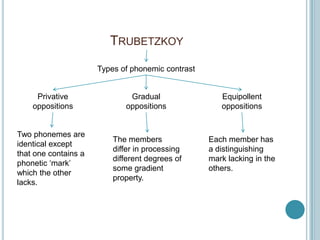
TRUBETZKOY
                      Types of phonemic contrast


     Privative                Gradual                 Equipollent
    oppositions              oppositions              oppositions


Two phonemes are
                          The members              Each member has
identical except
                          differ in processing     a distinguishing
that one contains a
                          different degrees of     mark lacking in the
phonetic „mark‟
                          some gradient            others.
which the other
                          property.
lacks.
   Trubetzkoy distinguished various functions that can
    be served by a phonological opposition:

   Delimitative function: it helps the hearer locate
    word-boundaries in the speech signal, which is
    something he needs to do if he is to make sense of
    what he hears.

   Culminative function: it tells the hearer how many
    words he must segment the signal into, although it
    does not tell him where to make the cuts.
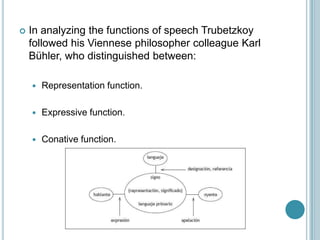
   In analyzing the functions of speech Trubetzkoy
    followed his Viennese philosopher colleague Karl
    Bühler, who distinguished between:

       Representation function.

       Expressive function.

       Conative function.
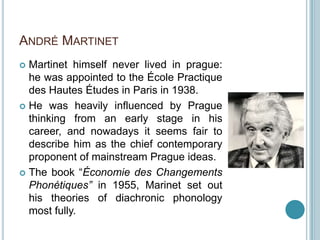
ANDRÉ MARTINET
 Martinet himself never lived in prague:
  he was appointed to the École Practique
  des Hautes Études in Paris in 1938.
 He was heavily influenced by Prague
  thinking from an early stage in his
  career, and nowadays it seems fair to
  describe him as the chief contemporary
  proponent of mainstream Prague ideas.
 The book “Économie des Changements
  Phonétiques” in 1955, Marinet set out
  his theories of diachronic phonology
  most fully.
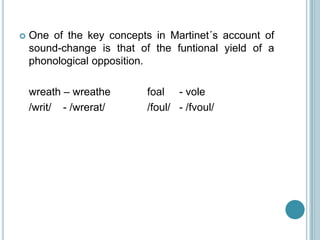
   One of the key concepts in Martinet´s account of
    sound-change is that of the funtional yield of a
    phonological opposition.

    wreath – wreathe       foal - vole
    /writ/ - /wrerat/      /foul/ - /fvoul/
MANDARIN CHINESE
   The history in Mandarin Chinese has been one of
    repeated      massive      losses    of  phonological
    distinctions: final strops dropped, the voice contrast
    in initial consonants was lost, final m merged with n,
    the vowel system was greatly simplified.

   The modern Mandarin has so few phonologically
    distinct syllables that on average each syllable is
    ambiguos as between three or four etymologically
    distinct morphemes in current use.
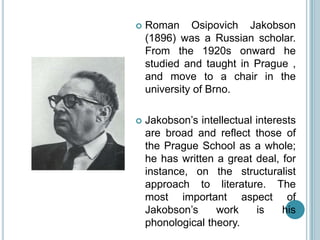
   Roman Osipovich Jakobson
    (1896) was a Russian scholar.
    From the 1920s onward he
    studied and taught in Prague ,
    and move to a chair in the
    university of Brno.

   Jakobson‟s intellectual interests
    are broad and reflect those of
    the Prague School as a whole;
    he has written a great deal, for
    instance, on the structuralist
    approach to literature. The
    most important aspect of
    Jakobson‟s     work     is    his
    phonological theory.
   As Trubestzkoy, he is interested in the analysis of
    phonemes into their components features rather
    than in the distribution of phonemes. but his view
    represent a special development which takes to
    their logical extreme ideas that are found only
    briefly and tentatively adumbrated in the work of
    Jakobson‟s approach to phonology is the notion
    that there is a relatively simple, orderly, universal,
    „psychological system‟ of sounds underlying the
    chaotic wealth of different kind of sound observed
    by the phonetician.
   In the text is described some articulatory
    parameters as the „close‟, „open‟ parameters of a
    vowel and „front‟ „back‟ too. The word „feature‟ is
    used ambiguously by various writers to mean either
    „parameter‟ or „parameter-value‟ (And Bloomfield
    even used it in third term „minimum unit of
    distinctive sound-feature‟.
 The articulatory phonetics‟ lesson is that human
  vocal anatomy provides a very large range of
  different phonetic parameters.
 English distinguished three degrees of aperture in
  pure vowels, as in Pit/pet/pat; in French are 4 and
  is said that Tswana have six.
 The Descriptivist‟s tended to see all phonetic
  parameters and all sounds as intrinsically equal in
  their potential for use in language. This approach to
  phonology might be described metaphorically as
  „democratic‟.
 At Jacobson‟s view, only a small group of phonetic
  parameters seem to play a linguistically distinctive
  role.
   Jacobson published a book were he described the
    twelve „distinctive features‟ called Preliminaries to
    Speech Analysis (1952).

   In order to substantiate his belief that the phonological
    universal he discusses are determined by „deep
    „psychological principles rather than by relatively
    uninteresting facts about oral anatomy or the like
    Jakobson devotes considerable space to discussion of
    synaesthetic effect.

   To probe his paper he based in the German
    psychologist K. Langenbeck, who suggested that he
    „saw‟ the vowel as red because the first toy Wagen he
    was given was red one: if this were the reason, the
    universality of these sound/color correspondences
    would be inexplicable.

Tl2 school ofprague

  • 1.
    FUNCTIONAL LINGUISTICS: THE PRAGUESCHOOL Neyda Noheli Alvarez Avila Luis Angel De León Rangel Ricardo Misael García Luis Pablo Tamez Sarmiento
  • 2.
    VILÉM MATHESIUS  Vilém Mathesius (1882-1945) was a Czech Anglicist who studied and taught at the Caroline University of Prague.  In 1911, Matheusius published his first call for a new, non-historical approach to language study.
  • 3.
    Prague School American Descriptivists It saw language in terms of function. They analized language with a A grammar is a set of elements view of showing the functions played by the different components. They looked in languages and They restricted to description. explanation to why languages were the way they were. Use of terms „theme‟ and Use the terms „topic‟ and „rheme‟. „comment‟ Were interested in standarizing Drew a distinction between linguistic usage. linguistic description and linguistic prescription.
  • 4.
    NIKOLAI TRUBETZKOY  Prince Nikolai Sergeyevich Trubetzkoy (1890-1938) was one of the members of the “Prague School” not based in Czechoslovakia.  He was a student of Indo- European linguistics at his father‟s university.
  • 5.
    Trubetzkoyan phonology gives a central role to the phoneme; Trubetzkoy, and the Prague School in general, where intersted primarily in the paradigmatic relation between phonemes.  In the Principles, establishes a rather sophisticated system of phonological typology, a system which enables us to say what kind of phonology a language has, rather than simply treating its phonological structure in the take-it-or-leave-it American fashion as a set of isolated facts.
  • 6.
    TRUBETZKOY Types of phonemic contrast Privative Gradual Equipollent oppositions oppositions oppositions Two phonemes are The members Each member has identical except differ in processing a distinguishing that one contains a different degrees of mark lacking in the phonetic „mark‟ some gradient others. which the other property. lacks.
  • 7.
    Trubetzkoy distinguished various functions that can be served by a phonological opposition:  Delimitative function: it helps the hearer locate word-boundaries in the speech signal, which is something he needs to do if he is to make sense of what he hears.  Culminative function: it tells the hearer how many words he must segment the signal into, although it does not tell him where to make the cuts.
  • 8.
    In analyzing the functions of speech Trubetzkoy followed his Viennese philosopher colleague Karl Bühler, who distinguished between:  Representation function.  Expressive function.  Conative function.
  • 9.
    ANDRÉ MARTINET  Martinethimself never lived in prague: he was appointed to the École Practique des Hautes Études in Paris in 1938.  He was heavily influenced by Prague thinking from an early stage in his career, and nowadays it seems fair to describe him as the chief contemporary proponent of mainstream Prague ideas.  The book “Économie des Changements Phonétiques” in 1955, Marinet set out his theories of diachronic phonology most fully.
  • 10.
    One of the key concepts in Martinet´s account of sound-change is that of the funtional yield of a phonological opposition. wreath – wreathe foal - vole /writ/ - /wrerat/ /foul/ - /fvoul/
  • 11.
    MANDARIN CHINESE  The history in Mandarin Chinese has been one of repeated massive losses of phonological distinctions: final strops dropped, the voice contrast in initial consonants was lost, final m merged with n, the vowel system was greatly simplified.  The modern Mandarin has so few phonologically distinct syllables that on average each syllable is ambiguos as between three or four etymologically distinct morphemes in current use.
  • 12.
    Roman Osipovich Jakobson (1896) was a Russian scholar. From the 1920s onward he studied and taught in Prague , and move to a chair in the university of Brno.  Jakobson‟s intellectual interests are broad and reflect those of the Prague School as a whole; he has written a great deal, for instance, on the structuralist approach to literature. The most important aspect of Jakobson‟s work is his phonological theory.
  • 13.
    As Trubestzkoy, he is interested in the analysis of phonemes into their components features rather than in the distribution of phonemes. but his view represent a special development which takes to their logical extreme ideas that are found only briefly and tentatively adumbrated in the work of Jakobson‟s approach to phonology is the notion that there is a relatively simple, orderly, universal, „psychological system‟ of sounds underlying the chaotic wealth of different kind of sound observed by the phonetician.
  • 14.
    In the text is described some articulatory parameters as the „close‟, „open‟ parameters of a vowel and „front‟ „back‟ too. The word „feature‟ is used ambiguously by various writers to mean either „parameter‟ or „parameter-value‟ (And Bloomfield even used it in third term „minimum unit of distinctive sound-feature‟.
  • 15.
     The articulatoryphonetics‟ lesson is that human vocal anatomy provides a very large range of different phonetic parameters.  English distinguished three degrees of aperture in pure vowels, as in Pit/pet/pat; in French are 4 and is said that Tswana have six.  The Descriptivist‟s tended to see all phonetic parameters and all sounds as intrinsically equal in their potential for use in language. This approach to phonology might be described metaphorically as „democratic‟.  At Jacobson‟s view, only a small group of phonetic parameters seem to play a linguistically distinctive role.
  • 16.
    Jacobson published a book were he described the twelve „distinctive features‟ called Preliminaries to Speech Analysis (1952).  In order to substantiate his belief that the phonological universal he discusses are determined by „deep „psychological principles rather than by relatively uninteresting facts about oral anatomy or the like Jakobson devotes considerable space to discussion of synaesthetic effect.  To probe his paper he based in the German psychologist K. Langenbeck, who suggested that he „saw‟ the vowel as red because the first toy Wagen he was given was red one: if this were the reason, the universality of these sound/color correspondences would be inexplicable.