ENGLISH PHONETICS AND PHONOLOGY I
Prof. Adriana Gonzalez
THE ENGLISH SYLLABLE
WHAT IS IT?
It is a very important unit. Phonetically (in relation to the way
we produce then and the way they sound), syllables are usually
described as consisting of a centre which has little or no
obstruction to airflow and which sounds comparatively loud,
before and after this centre (at the beginning or at the end of
the syllable). There will be greater obstruction to airflow and/or
less loud sound.
ELEMENTS OF A SYLLABLE
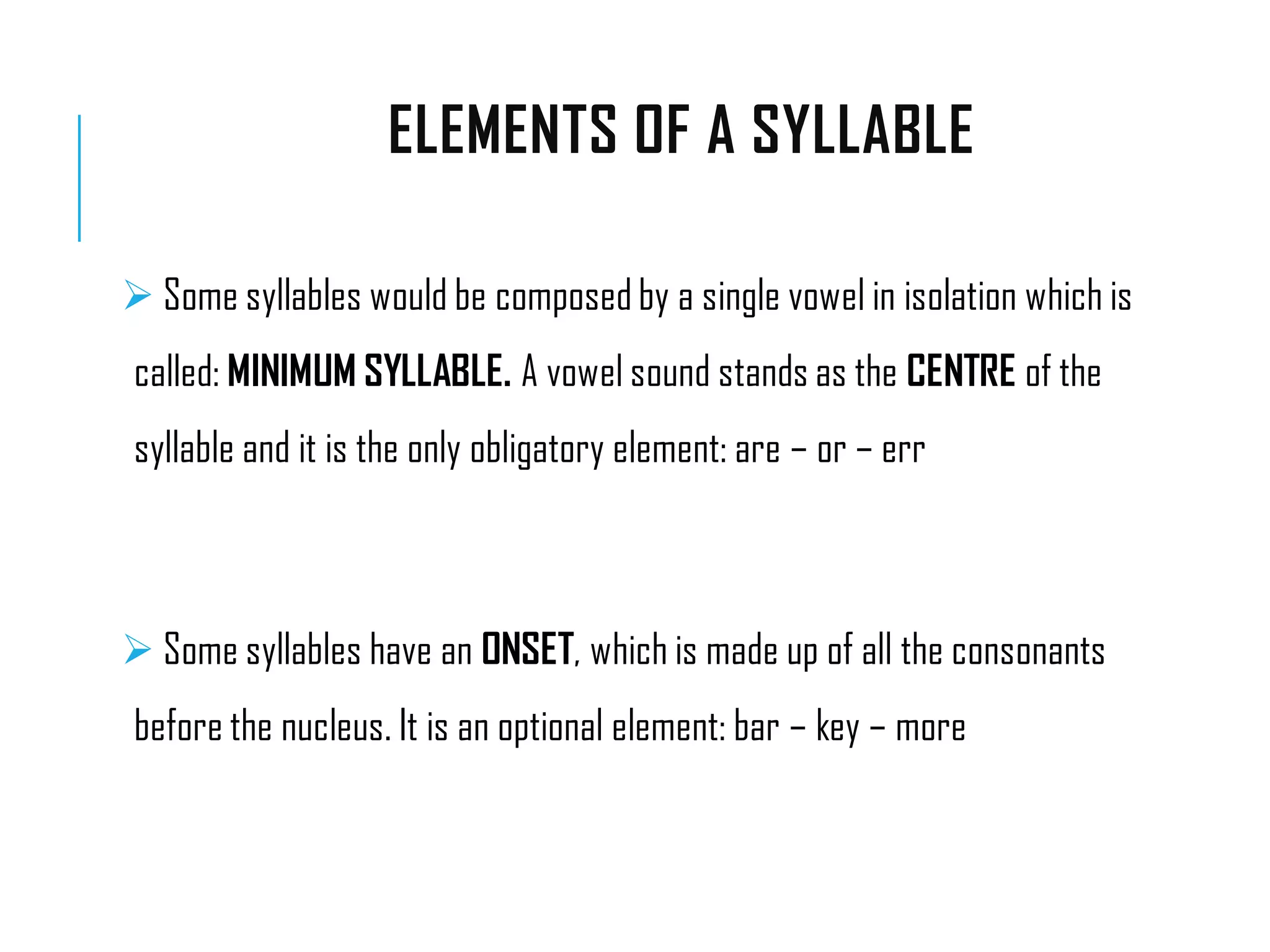
 Some syllables would be composed by a single vowel in isolation which is
called: MINIMUM SYLLABLE. A vowel sound stands as the CENTRE of the
syllable and it is the only obligatory element: are – or – err

 Some syllables have an ONSET, which is made up of all the consonants
before the nucleus. It is an optional element: bar – key – more
ELEMENTS OF A SYLLABLE
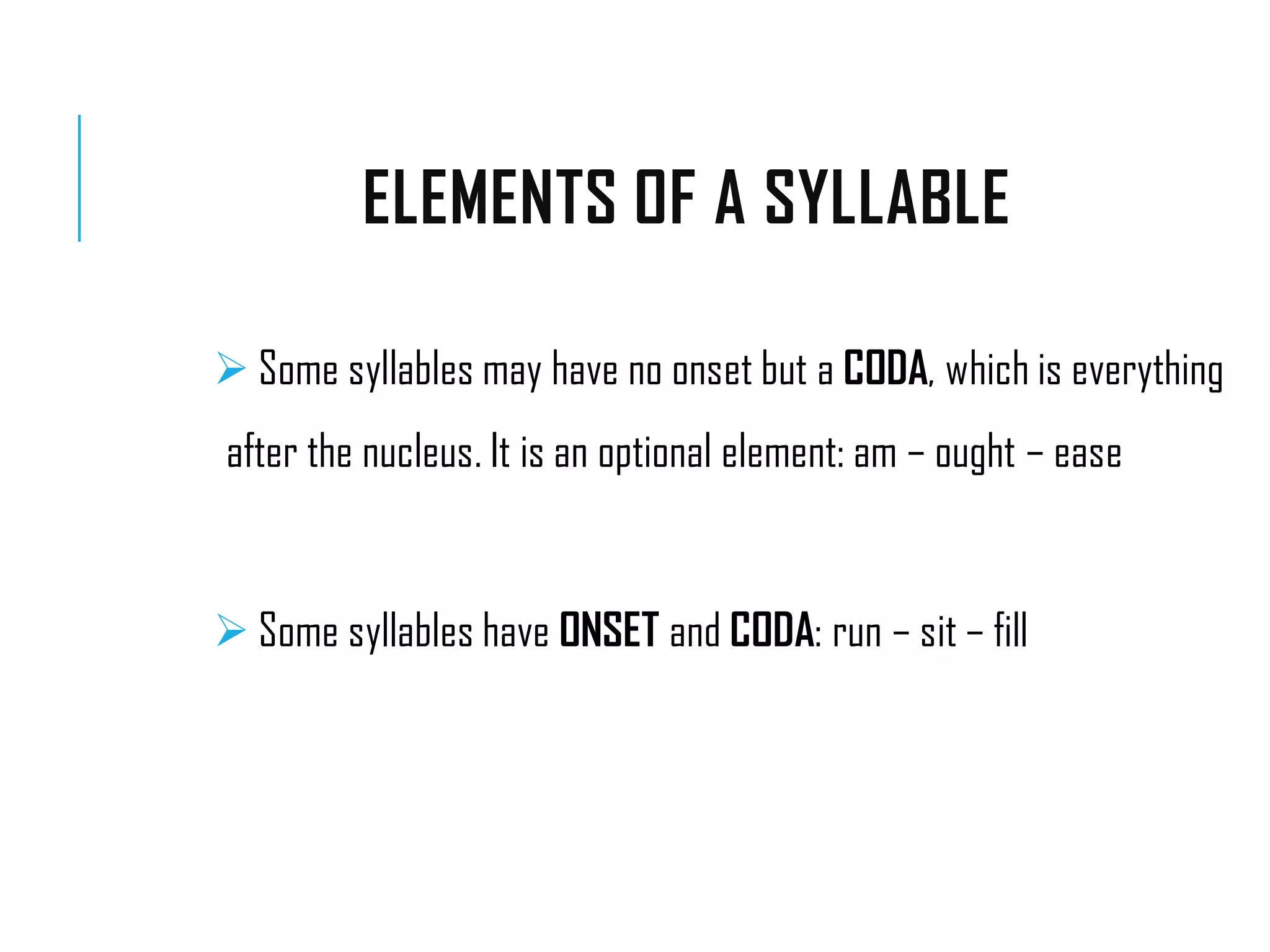
 Some syllables may have no onset but a CODA, which is everything
after the nucleus. It is an optional element: am – ought – ease

 Some syllables have ONSET and CODA: run – sit – fill
STRUCTURE OF THE ENGLISH SYLLABLE
The English Syllable consists of a vowel as the centre of the syllabe and a possible

combination of three consonant sounds before the vowel and a possible combination of
four consonant sounds after the vowel.
STRUCTURE OF THE ENGLISH SYLLABLE

CCC

V

CCCC

C3

vowel

C4

SPRAY /sprei/
RUN /rn/
TEXTS /teksts/
SYLLABIC CONSONANT
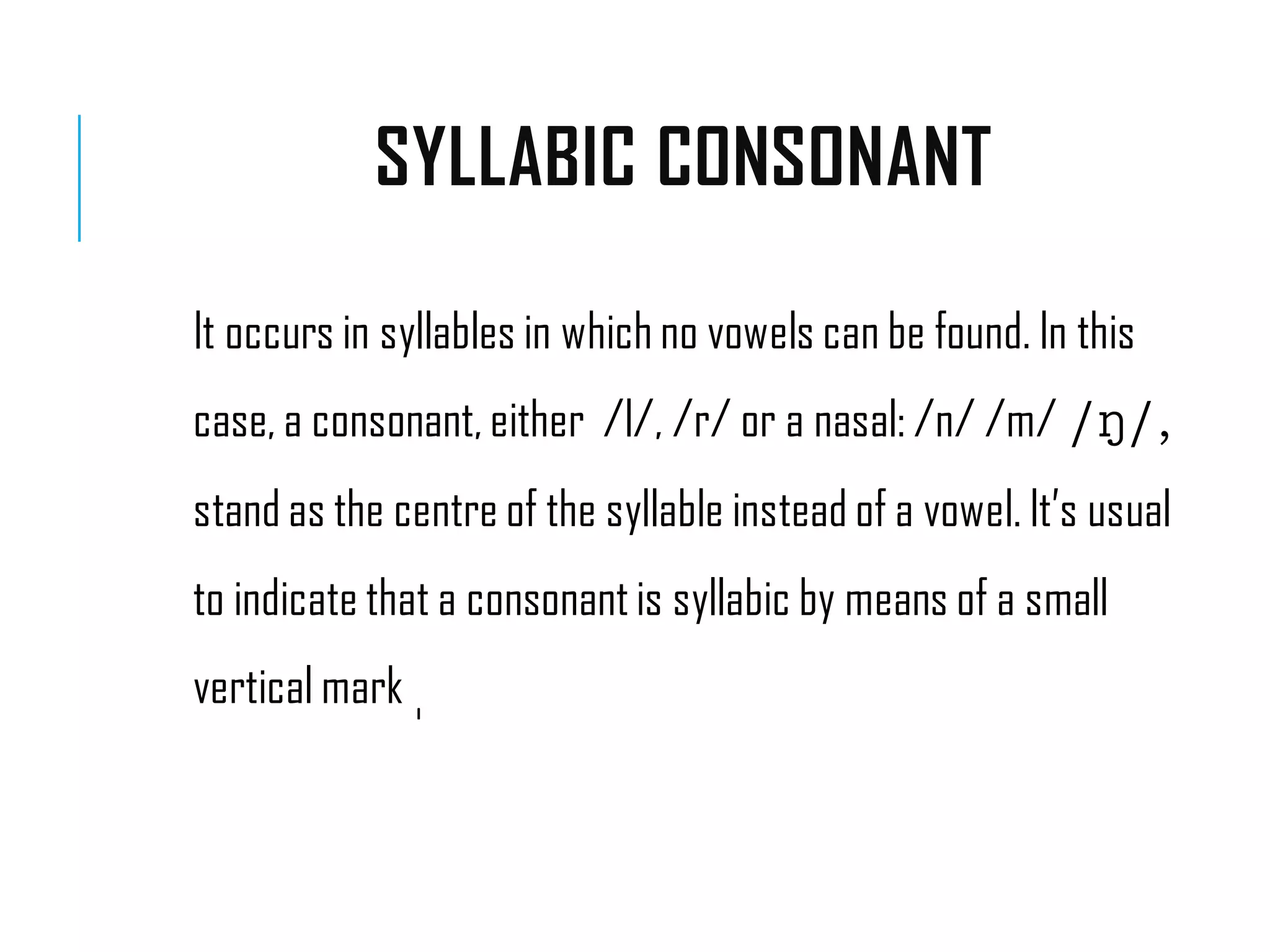
It occurs in syllables in which no vowels can be found. In this
case, a consonant, either /l/, /r/ or a nasal: /n/ /m/ //,
stand as the centre of the syllable instead of a vowel. It’s usual
to indicate that a consonant is syllabic by means of a small
vertical mark 

The English Syllable

  • 1.
    ENGLISH PHONETICS ANDPHONOLOGY I Prof. Adriana Gonzalez
  • 2.
  • 3.
    WHAT IS IT? Itis a very important unit. Phonetically (in relation to the way we produce then and the way they sound), syllables are usually described as consisting of a centre which has little or no obstruction to airflow and which sounds comparatively loud, before and after this centre (at the beginning or at the end of the syllable). There will be greater obstruction to airflow and/or less loud sound.
  • 4.
    ELEMENTS OF ASYLLABLE  Some syllables would be composed by a single vowel in isolation which is called: MINIMUM SYLLABLE. A vowel sound stands as the CENTRE of the syllable and it is the only obligatory element: are – or – err  Some syllables have an ONSET, which is made up of all the consonants before the nucleus. It is an optional element: bar – key – more
  • 5.
    ELEMENTS OF ASYLLABLE  Some syllables may have no onset but a CODA, which is everything after the nucleus. It is an optional element: am – ought – ease  Some syllables have ONSET and CODA: run – sit – fill
  • 6.
    STRUCTURE OF THEENGLISH SYLLABLE The English Syllable consists of a vowel as the centre of the syllabe and a possible combination of three consonant sounds before the vowel and a possible combination of four consonant sounds after the vowel.
  • 7.
    STRUCTURE OF THEENGLISH SYLLABLE CCC V CCCC C3 vowel C4 SPRAY /sprei/ RUN /rn/ TEXTS /teksts/
  • 8.
    SYLLABIC CONSONANT It occursin syllables in which no vowels can be found. In this case, a consonant, either /l/, /r/ or a nasal: /n/ /m/ //, stand as the centre of the syllable instead of a vowel. It’s usual to indicate that a consonant is syllabic by means of a small vertical mark 