PERIMETRY
Dr SHREEJI
SHRESTHA
Presentation layout
Introduction of visual field
Perimetry - types
Important terms
bedside perimetry
Formal perimetry
Defects
Short wavelength automated perimetry
Frequency doubling technology
Introduction of visual field
• environment wherein a steadily fixating eye
can detect visual stimulus.
•BASIS - presence of Photoreceptors with its
visual pathways upto the periphery of retina
away from point of fixation i.e fovea.
•IMPORTANCE – mapping extend - disorder or
optic nerve and visual pathway
Extend
contour
Blind spot
•Corresponding to optic nerve
head
•no photoreceptors
•10-15 deg temporal to point of
fixation
•Span – 5 deg horizontal
-- 7 deg vertical
•2 portion- absolute scotoma
- relative scotoma
Definition of Perimetry
■ Measurement of visual functions of the
eye at topographically defined loci in the
visual field1
■ Measures differential light sensitivity, or the
ability of a subject to distinguish a stimulus
light from background illumination2
Factors affecting
sensitivityPupil size - miosis
Refractive error - myopia - posterior staphyloma -
refraction scotoma. (glaucomatous field defect)
Hypermetropia - alter threshold
sensitivity
Age- 20years
Sensitivity dec - age (10yrs - 0.5-1 db)
Clarity of ocular media
Fatigue
types of perimetry
According to the principal:
• Kinetic
• Static
Clinically
• Automated static perimetry
• Manual kinetic and static perimetry using a
Goldmann type bowl perimeter
Kinetic perimetry:
• outer visual field is determined by moving objects from the
non-seeing area to the center.
• Uses a moving object of a fixed size and intensity.
Advantages:
• Allows large areas to be traversed in a fairly short period.
• less expensive and durable.
• Perimetrist is constantly communicating with the patient so
it is more comfortable.
Disadvantage:
• Reproducibility and reliability is not constant in the manual
kinetic perimetry.
Static perimetry:
• The outer boundary of the island of vision determined by
measuring the retinal sensitivity at each point.
• The test location is fixed while the intensity of the test
object of known size is varied.
• Octopus and Humphrey perimeters.
Advantage:
• Reliability and reproducibility
Disadvantage:
• Manual static perimetry is tedious.
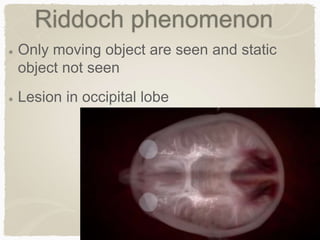
Riddoch phenomenon
Only moving object are seen and static
object not seen
Lesion in occipital lobe
Terms in perimetry
Threshold:
• differential light sensitivity at which a stimulus of a given size and
duration of presentation is seen 50%
• dimmest spot detected during testing.
Suprathreshold:
• 95% of the projected times.
• stimulus - made suprathreshold - increasing size or duration.
Infrathreshold:
• Low intensity stimulus - 5%
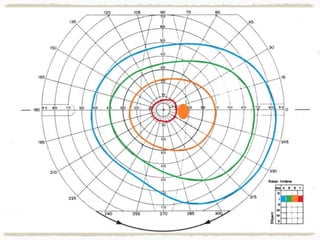
Isopter: a line on a visual field representation – connecting
points with the same threshold.
Depression: a decrease in retinal sensitivity
scotoma: an area of decreased retinal sensitivity within the visual
field surrounded by an area of greater sensitivity.
Decibel (dB):
• Its value depends on the maximum illumination of the
perimeter.
• log units of attenuation of the maximum light intensity
available in the perimeter being used.
• OdB is maximum stimulus intensity
variables
Patient:
• attentiveness and fatigue
Perimetrist:
• manual perimetry
Fixation:
• fixation is off centered
• It is especially true in automated static tests.
Background luminace:
• luminace of the surface on which stimulus is projected
• background luminance of 4-31.5 apostilbs.
sensitivity is greatest at fixation
Stimulus luminance
• greater size, duration, brighter- stimulus- visible
Size of stimulus:
Standard stimulus - 0= 1/16mm2, 1= 1/14 mm2, 11 =
1mm2, 111 = 4mm2, 1v = 16mm2, v= 24mm2
Presentation time: longer time, the more visible a given
stimulus(0.2)
Speed of stimulus movement:
• if a kinetic target = quickly, by the time the patient
responds, the target may have gone beyond its location
• The time period between visualization and response is
termed the latency period or visual reaction time.
Bedside perimetry
PR
hand motion
finger counting
Hand identification
Testing with neurological pin
red desaturation
Amsler grid
• For Central 10 deg ( static )
• Other eye occluded
• Near correction given
• Chart at held 28-30 cm – each small square subtends angle of 1 deg
• Patient fixates at central dot – tells whether all corners are seen simultaneously and
about lines- parallel, distorted, missing
• Can be used for mapping blind spot – patient fixates at edge of grid
• Macular scarring- lines bow outward
• macular edema - lines appear closer
Perimetry
HFA
Zone 1-Parameters
Teststrategy
Fullthreshold- eachpointstimulated 5times,longduration
SITA-standard-90%pointtested- remaining10%nottested
SITAfast-80%pointtested
SITArelies onmodelofVF
Region/pattern used
➢30-2 (test points = 76points) , 24-2(54) ,
10-2(68points)
Patientdetails
➢dateof birth,dateof VF,pupil size,
test time, VA,correction, eye tested
Zone 1- Reliability
• Fixation monitor
• Fixation target – central, small diamond
• Test duration
• Reliability indices
Fixation losses <20 %
False positives < 33%
False negatives < 33 %
Foveal threshold
Fixation loss
Stimulus flashed in blind spot
Limited value in patient with large defect surrounding
blind spot
sees stimulus
Patient is not fixating at center and moving eye
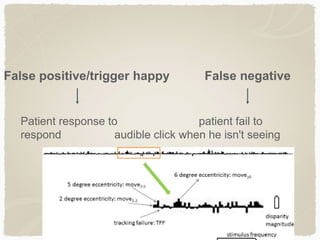
Patient response to patient fail to
respond audible click when he isn't seeing
False positive/trigger happy False negative
Compare total & pattern deviation
3.Age Corrected plots
HumphreyTM
Zero in on the probability plots
HumphreyTM
Compare total & pattern
deviation
actual local defect
Media opacity
Zone 4: global indices
single numbers to denote whole field
• MEAN DEVIATION : average loss of sensitivity from normal age
matched population along with probability
calculated from total deviation plot
• PATTERN STANDARD DEVIATION : range over which change of
sensitivity at all the points has occurred, along with probability
compensates for effect of generalized depression or elevation
of field on mean deviation value
local defects affect PSD > MD
Mean deviation
Pattern
standard
deviation
Visual field
Normal Normal Normal
Abnormal Normal Generalized depression
normal Abnormal
Localized defect in one
location
4.Glaucoma hemifield
test
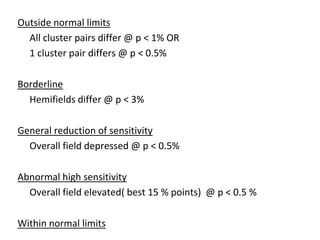
Outside normal limits
All cluster pairs differ @ p < 1% OR
1 cluster pair differs @ p < 0.5%
Borderline
Hemifields differ @ p < 3%
General reduction of sensitivity
Overall field depressed @ p < 0.5%
Abnormal high sensitivity
Overall field elevated( best 15 % points) @ p < 0.5 %
Within normal limits
Octopus HFA
Bowl Spherical Aspherical
stimulus
size
Goldman 111 v 1-v
Duration 100ms 200ms
Luminance
for 0dB
4800asb 10,000asb
test strategy 4-2-1 bracketing
4-2
bracketing
Fixation
loss
Automatically
discount
Present
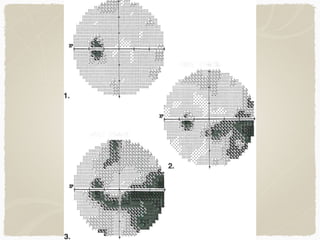
Early Glaucoma Defect
• 18 pts)below 5% and (10 pts)below 1%
Moderate Glaucoma Defect
• <50% (37 pts) <5% level and <25% (20pts) <1 % level
• Only 1 hemi field has point with sensitivity <15dB in the central 5 degree
Severe Glaucoma Defect
• On PD plot
> 50% of pts < 5%level
> 25% of pts < 1%level
• Both hemi-fields w/ pt(s) w/ sensitivity< 15 dB w/in th central 50
visual field defect
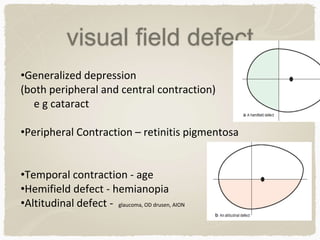
•Generalized depression
(both peripheral and central contraction)
e g cataract
•Peripheral Contraction – retinitis pigmentosa
•Temporal contraction - age
•Hemifield defect - hemianopia
•Altitudinal defect - glaucoma, OD drusen, AION
Progression in glaucoma
Development of new defect
Deepening or enlargement of preexisting defect
Diffuse loss of sensitivity
for follow up, 6 visual field examination in first 2 years
for consistent baseline and RO aggressive disease
then reduced to once/twice yearly
clover leaf artifact
Parietal lobe/pie in
floor/BAUM loop
Temporal lobe/ Meyer loop
Sup
Sup
inf
Short wavelength automated
perimetryBlue stimulus
Yellow light- background - reduces sensitivity of RED
and GREEN cones.
Detect glaucomatous field defect early
Frequency doubling
technologyBased on frequency doubling illusion
stimulus - series of black and white bands flickering at
25Hz
Mediated by large ganglian cells (M ganglion cells) -
magnocellular visual pathway
M cells - sensitive to motion and contrast -
glaucomatous damage
Portable, inexpensive
Also advocated for use in
children
Screening
Visual field easy app
Reference
Jakobiec principle and practice of ophthalmology - 3rd
edition - neuroophthalmology
Shields textbook of glaucoma- assessment of visual
field
Ophthalmology investigation and examination
technique-bruce James , Larry Benjamin
AAO - glaucoma - section 10-
pearls of glaucoma management- giaconi, law

Perimetry

  • 1.
  • 2.
    Presentation layout Introduction ofvisual field Perimetry - types Important terms bedside perimetry Formal perimetry Defects Short wavelength automated perimetry Frequency doubling technology
  • 3.
    Introduction of visualfield • environment wherein a steadily fixating eye can detect visual stimulus. •BASIS - presence of Photoreceptors with its visual pathways upto the periphery of retina away from point of fixation i.e fovea. •IMPORTANCE – mapping extend - disorder or optic nerve and visual pathway
  • 4.
  • 5.
  • 6.
    Blind spot •Corresponding tooptic nerve head •no photoreceptors •10-15 deg temporal to point of fixation •Span – 5 deg horizontal -- 7 deg vertical •2 portion- absolute scotoma - relative scotoma
  • 7.
    Definition of Perimetry ■Measurement of visual functions of the eye at topographically defined loci in the visual field1 ■ Measures differential light sensitivity, or the ability of a subject to distinguish a stimulus light from background illumination2
  • 8.
    Factors affecting sensitivityPupil size- miosis Refractive error - myopia - posterior staphyloma - refraction scotoma. (glaucomatous field defect) Hypermetropia - alter threshold sensitivity Age- 20years Sensitivity dec - age (10yrs - 0.5-1 db) Clarity of ocular media Fatigue
  • 9.
    types of perimetry Accordingto the principal: • Kinetic • Static Clinically • Automated static perimetry • Manual kinetic and static perimetry using a Goldmann type bowl perimeter
  • 10.
    Kinetic perimetry: • outervisual field is determined by moving objects from the non-seeing area to the center. • Uses a moving object of a fixed size and intensity. Advantages: • Allows large areas to be traversed in a fairly short period. • less expensive and durable. • Perimetrist is constantly communicating with the patient so it is more comfortable. Disadvantage: • Reproducibility and reliability is not constant in the manual kinetic perimetry.
  • 11.
    Static perimetry: • Theouter boundary of the island of vision determined by measuring the retinal sensitivity at each point. • The test location is fixed while the intensity of the test object of known size is varied. • Octopus and Humphrey perimeters. Advantage: • Reliability and reproducibility Disadvantage: • Manual static perimetry is tedious.
  • 12.
    Riddoch phenomenon Only movingobject are seen and static object not seen Lesion in occipital lobe
  • 13.
    Terms in perimetry Threshold: •differential light sensitivity at which a stimulus of a given size and duration of presentation is seen 50% • dimmest spot detected during testing. Suprathreshold: • 95% of the projected times. • stimulus - made suprathreshold - increasing size or duration. Infrathreshold: • Low intensity stimulus - 5%
  • 14.
    Isopter: a lineon a visual field representation – connecting points with the same threshold. Depression: a decrease in retinal sensitivity scotoma: an area of decreased retinal sensitivity within the visual field surrounded by an area of greater sensitivity. Decibel (dB): • Its value depends on the maximum illumination of the perimeter. • log units of attenuation of the maximum light intensity available in the perimeter being used. • OdB is maximum stimulus intensity
  • 15.
    variables Patient: • attentiveness andfatigue Perimetrist: • manual perimetry Fixation: • fixation is off centered • It is especially true in automated static tests. Background luminace: • luminace of the surface on which stimulus is projected • background luminance of 4-31.5 apostilbs. sensitivity is greatest at fixation Stimulus luminance • greater size, duration, brighter- stimulus- visible
  • 16.
    Size of stimulus: Standardstimulus - 0= 1/16mm2, 1= 1/14 mm2, 11 = 1mm2, 111 = 4mm2, 1v = 16mm2, v= 24mm2 Presentation time: longer time, the more visible a given stimulus(0.2) Speed of stimulus movement: • if a kinetic target = quickly, by the time the patient responds, the target may have gone beyond its location • The time period between visualization and response is termed the latency period or visual reaction time.
  • 17.
    Bedside perimetry PR hand motion fingercounting Hand identification Testing with neurological pin red desaturation
  • 18.
    Amsler grid • ForCentral 10 deg ( static ) • Other eye occluded • Near correction given • Chart at held 28-30 cm – each small square subtends angle of 1 deg • Patient fixates at central dot – tells whether all corners are seen simultaneously and about lines- parallel, distorted, missing • Can be used for mapping blind spot – patient fixates at edge of grid • Macular scarring- lines bow outward • macular edema - lines appear closer
  • 19.
  • 21.
  • 22.
    Zone 1-Parameters Teststrategy Fullthreshold- eachpointstimulated5times,longduration SITA-standard-90%pointtested- remaining10%nottested SITAfast-80%pointtested SITArelies onmodelofVF Region/pattern used ➢30-2 (test points = 76points) , 24-2(54) , 10-2(68points) Patientdetails ➢dateof birth,dateof VF,pupil size, test time, VA,correction, eye tested
  • 24.
    Zone 1- Reliability •Fixation monitor • Fixation target – central, small diamond • Test duration • Reliability indices Fixation losses <20 % False positives < 33% False negatives < 33 % Foveal threshold
  • 25.
    Fixation loss Stimulus flashedin blind spot Limited value in patient with large defect surrounding blind spot sees stimulus Patient is not fixating at center and moving eye
  • 26.
    Patient response topatient fail to respond audible click when he isn't seeing False positive/trigger happy False negative
  • 27.
    Compare total &pattern deviation 3.Age Corrected plots HumphreyTM Zero in on the probability plots
  • 28.
    HumphreyTM Compare total &pattern deviation actual local defect Media opacity
  • 29.
    Zone 4: globalindices single numbers to denote whole field • MEAN DEVIATION : average loss of sensitivity from normal age matched population along with probability calculated from total deviation plot • PATTERN STANDARD DEVIATION : range over which change of sensitivity at all the points has occurred, along with probability compensates for effect of generalized depression or elevation of field on mean deviation value local defects affect PSD > MD
  • 30.
    Mean deviation Pattern standard deviation Visual field NormalNormal Normal Abnormal Normal Generalized depression normal Abnormal Localized defect in one location
  • 31.
  • 32.
    Outside normal limits Allcluster pairs differ @ p < 1% OR 1 cluster pair differs @ p < 0.5% Borderline Hemifields differ @ p < 3% General reduction of sensitivity Overall field depressed @ p < 0.5% Abnormal high sensitivity Overall field elevated( best 15 % points) @ p < 0.5 % Within normal limits
  • 33.
    Octopus HFA Bowl SphericalAspherical stimulus size Goldman 111 v 1-v Duration 100ms 200ms Luminance for 0dB 4800asb 10,000asb test strategy 4-2-1 bracketing 4-2 bracketing Fixation loss Automatically discount Present
  • 35.
    Early Glaucoma Defect •18 pts)below 5% and (10 pts)below 1%
  • 36.
    Moderate Glaucoma Defect •<50% (37 pts) <5% level and <25% (20pts) <1 % level • Only 1 hemi field has point with sensitivity <15dB in the central 5 degree
  • 37.
    Severe Glaucoma Defect •On PD plot > 50% of pts < 5%level > 25% of pts < 1%level • Both hemi-fields w/ pt(s) w/ sensitivity< 15 dB w/in th central 50
  • 38.
    visual field defect •Generalizeddepression (both peripheral and central contraction) e g cataract •Peripheral Contraction – retinitis pigmentosa •Temporal contraction - age •Hemifield defect - hemianopia •Altitudinal defect - glaucoma, OD drusen, AION
  • 42.
    Progression in glaucoma Developmentof new defect Deepening or enlargement of preexisting defect Diffuse loss of sensitivity for follow up, 6 visual field examination in first 2 years for consistent baseline and RO aggressive disease then reduced to once/twice yearly
  • 46.
  • 47.
    Parietal lobe/pie in floor/BAUMloop Temporal lobe/ Meyer loop Sup Sup inf
  • 49.
    Short wavelength automated perimetryBluestimulus Yellow light- background - reduces sensitivity of RED and GREEN cones. Detect glaucomatous field defect early
  • 50.
    Frequency doubling technologyBased onfrequency doubling illusion stimulus - series of black and white bands flickering at 25Hz Mediated by large ganglian cells (M ganglion cells) - magnocellular visual pathway M cells - sensitive to motion and contrast - glaucomatous damage Portable, inexpensive Also advocated for use in children Screening
  • 51.
  • 52.
    Reference Jakobiec principle andpractice of ophthalmology - 3rd edition - neuroophthalmology Shields textbook of glaucoma- assessment of visual field Ophthalmology investigation and examination technique-bruce James , Larry Benjamin AAO - glaucoma - section 10- pearls of glaucoma management- giaconi, law