Phylum Protozoa: Characters
and Classification
Submitted By: Submitted To:
Amit (2991710035) Dr. Asha Kiran Jain
B.Sc.(Biotech)
INTRODUCTION
 The animals included in phylum Protozoa can be defined as microscopic and
acellular animals without tissues and organs.
 First protozoans were discovered by A. V. Leeuwenhoek.
 Term Protozoa (From Greek, protos=first, zoon = animals) was given
by Goldfass.
 According to five-kingdom classification system, protozoans belong to the
kingdom Protista.
 Protozoa exist either singly or in colonies. Almost about 50,000 species are
known till date.
GENERAL CHARACTERS
 They are known as acellular or non-cellular organism. A protozoan body
consists of only mass of protoplasm, so they are called acellular animals.
 Habitat: mostly aquatic, either free living or parasitic or commensal.
 Grade of organization: protoplasmic grade of organization. Single cell
performs all the vital activities thus the single cell acts like a whole body.
 Body of protozoa is either naked or covered by a pellicle.
 Locomotion: Locomotory organ are pseudopodia (false foot) or cilia or
flagella.
 Nutrition: Nutrition are autotropic (like plant) or holozoic (like animal) or
saprophytic or parasitic.
 These are solitary (Euglena), or colonial (Proteospongia).
 Digestion: digestion is intracellular, occurs in food vacuoles.
 Excretion occurs by diffusion across general body surface or by contractile
vacuoles. Contractile vacuoles serve mainly for Osmoregulation and are
common in freshwater forms.
 Respiration: through the body surface.
 Osmoregulation: Contractile vacuoles helps in osmoregulation.
 Reproduction:
 Asexually reproduction is through binary fission or budding.
 Sexual reproduction is by syngamy and conjugation.
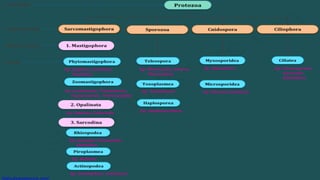
PROTOZOA CLASSIFIED INTO FOUR
SUB-PHYLA
1. SARCO- MASTIGOPHORA
2. SPOROZOA
3. CNIDOSPORA
4. CILIOPHORA
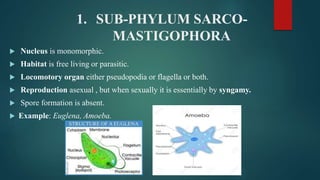
1. SUB-PHYLUM SARCO-
MASTIGOPHORA
 Nucleus is monomorphic.
 Habitat is free living or parasitic.
 Locomotory organ either pseudopodia or flagella or both.
 Reproduction asexual , but when sexually it is essentially by syngamy.
 Spore formation is absent.
 Example: Euglena, Amoeba.
SUB-PHLYUM SARCO-
MASTIGOPHORA
It is divided into three super-classes:
 Mastigophora
 Oplinata
 Sarcodina
SUPER-CLASS MASTIGOPHORA
Charcaters:
 Organelles of locomotion: One or more flagella, so
are called flagellates.
 Body is covered by pellicle.
 Nucleus is Generally one but two in Giardia.
 Reproduction is asexual by binary fission
[longitudinal]
 Example: Trypanosomes.
CLASSES OF SUPER-CLASS
MASTIGOPHPORA
Phytomastigophora
Zoomastigophora
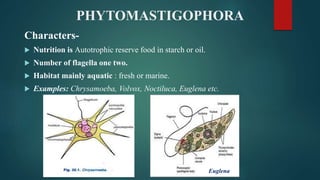
PHYTOMASTIGOPHORA
Characters-
 Nutrition is Autotrophic reserve food in starch or oil.
 Number of flagella one two.
 Habitat mainly aquatic : fresh or marine.
 Examples: Chrysamoeba, Volvox, Noctiluca, Euglena etc.
Euglena
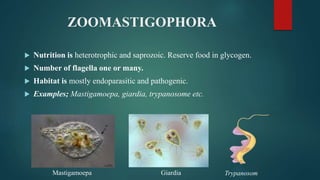
ZOOMASTIGOPHORA
 Nutrition is heterotrophic and saprozoic. Reserve food in glycogen.
 Number of flagella one or many.
 Habitat is mostly endoparasitic and pathogenic.
 Examples; Mastigamoepa, giardia, trypanosome etc.
Trypanosom
Giardia
Mastigamoepa
SUPER-CLASS OPALINATA
It is characterized by
 Body is covered by a firm pellicle.
 Organelles of locomotion are many small sized cilia-like
flagella.
 Two to many monomorphic nuclei.
 Cytostome is absent so show saprozoic nutrition.
 Asexual reproduction by binary fission called
plasmotomy.
 Sexual reproduction by syngamy, e.g. opalina. Opalina
SUPER-CLASS SARCODINA
 Organelles of locomotion by Pseudopodia.
 Body is covered by generally plasma-membrane. Some are shelled.
 Generally one nucleus but many in pelomyxa.
 Reproduction is asexual by binary fission [irregular].
SUPER-CLASS SARCODINA DIVIDED INTO TWO CLASS
 Class Rhizopodea
 Class Actinopodea
CLASS RHIZOPODEA
CHARACTERS:
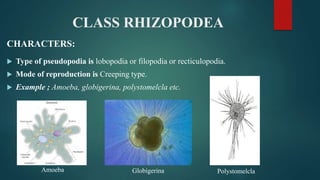
 Type of pseudopodia is lobopodia or filopodia or recticulopodia.
 Mode of reproduction is Creeping type.
 Example ; Amoeba, globigerina, polystomelcla etc.
Amoeba Polystomelcla
Globigerina
CLASS ACTINOPODEA
Characters:
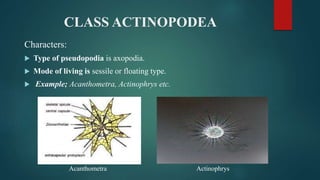
 Type of pseudopodia is axopodia.
 Mode of living is sessile or floating type.
 Example; Acanthometra, Actinophrys etc.
Actinophrys
Acanthometra
2. SUB-PHYLUM SPOROZOA
 Organelles of locomotion are absent.
 Nucleus is monomorphic.
 Habitat is all parasitic.
 Sexual reproduction is by syngamy.
 In Spore Formation, infective sprozoites are formed.
 Example: Gregarine.
CLASSES OF SUB-PHYLUM
SPOROZOA
 Class Telosporea
 Class Toxoplasmea
 Class Halosporea
CLASS TELOSPOREA
Characters:
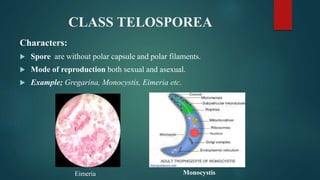
 Spore are without polar capsule and polar filaments.
 Mode of reproduction both sexual and asexual.
 Example; Gregarina, Monocystis, Eimeria etc.
Monocystis
Eimeria
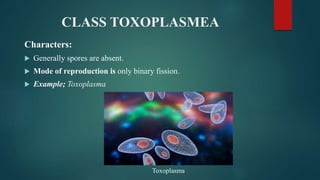
CLASS TOXOPLASMEA
Characters:
 Generally spores are absent.
 Mode of reproduction is only binary fission.
 Example; Toxoplasma
Toxoplasma
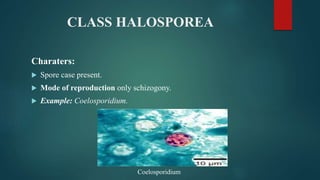
CLASS HALOSPOREA
Charaters:
 Spore case present.
 Mode of reproduction only schizogony.
 Example: Coelosporidium.
Coelosporidium
3. SUB-PHYLUM CNIDOSPORA
 Organelles of locomotion are absent.
 Nucleus is monomorphic
 Habitat is parasitic
 Sexual reproduction is by syngamy.
 Spore have one or more polar filament and one or more sporoplasms.
SUB-PHYLUM CNIDOSPORA DIVIDED INTO TWO CLASSES
 Class Myxosporidea
 Class Microsporidea
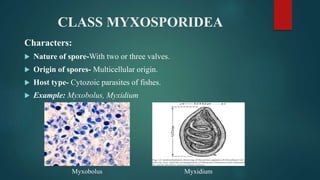
CLASS MYXOSPORIDEA
Characters:
 Nature of spore-With two or three valves.
 Origin of spores- Multicellular origin.
 Host type- Cytozoic parasites of fishes.
 Example: Myxobolus, Myxidium
Myxobolus Myxidium
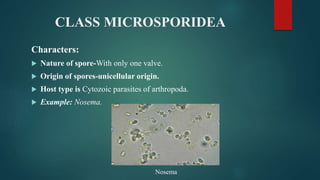
CLASS MICROSPORIDEA
Characters:
 Nature of spore-With only one valve.
 Origin of spores-unicellular origin.
 Host type is Cytozoic parasites of arthropoda.
 Example: Nosema.
Nosema
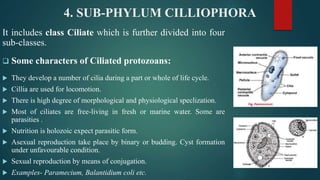
4. SUB-PHYLUM CILLIOPHORA
It includes class Ciliate which is further divided into four
sub-classes.
 Some characters of Ciliated protozoans:
 They develop a number of cilia during a part or whole of life cycle.
 Cillia are used for locomotion.
 There is high degree of morphological and physiological speclization.
 Most of ciliates are free-living in fresh or marine water. Some are
parasities .
 Nutrition is holozoic expect parasitic form.
 Asexual reproduction take place by binary or budding. Cyst formation
under unfavourable condition.
 Sexual reproduction by means of conjugation.
 Examples- Paramecium, Balantidium coli etc.
Protozoa by Amit Rulhania

Protozoa by Amit Rulhania

  • 1.
    Phylum Protozoa: Characters andClassification Submitted By: Submitted To: Amit (2991710035) Dr. Asha Kiran Jain B.Sc.(Biotech)
  • 2.
    INTRODUCTION  The animalsincluded in phylum Protozoa can be defined as microscopic and acellular animals without tissues and organs.  First protozoans were discovered by A. V. Leeuwenhoek.  Term Protozoa (From Greek, protos=first, zoon = animals) was given by Goldfass.  According to five-kingdom classification system, protozoans belong to the kingdom Protista.  Protozoa exist either singly or in colonies. Almost about 50,000 species are known till date.
  • 4.
    GENERAL CHARACTERS  Theyare known as acellular or non-cellular organism. A protozoan body consists of only mass of protoplasm, so they are called acellular animals.  Habitat: mostly aquatic, either free living or parasitic or commensal.  Grade of organization: protoplasmic grade of organization. Single cell performs all the vital activities thus the single cell acts like a whole body.  Body of protozoa is either naked or covered by a pellicle.  Locomotion: Locomotory organ are pseudopodia (false foot) or cilia or flagella.  Nutrition: Nutrition are autotropic (like plant) or holozoic (like animal) or saprophytic or parasitic.
  • 5.
     These aresolitary (Euglena), or colonial (Proteospongia).  Digestion: digestion is intracellular, occurs in food vacuoles.  Excretion occurs by diffusion across general body surface or by contractile vacuoles. Contractile vacuoles serve mainly for Osmoregulation and are common in freshwater forms.  Respiration: through the body surface.  Osmoregulation: Contractile vacuoles helps in osmoregulation.  Reproduction:  Asexually reproduction is through binary fission or budding.  Sexual reproduction is by syngamy and conjugation.
  • 6.
    PROTOZOA CLASSIFIED INTOFOUR SUB-PHYLA 1. SARCO- MASTIGOPHORA 2. SPOROZOA 3. CNIDOSPORA 4. CILIOPHORA
  • 7.
    1. SUB-PHYLUM SARCO- MASTIGOPHORA Nucleus is monomorphic.  Habitat is free living or parasitic.  Locomotory organ either pseudopodia or flagella or both.  Reproduction asexual , but when sexually it is essentially by syngamy.  Spore formation is absent.  Example: Euglena, Amoeba.
  • 8.
    SUB-PHLYUM SARCO- MASTIGOPHORA It isdivided into three super-classes:  Mastigophora  Oplinata  Sarcodina
  • 9.
    SUPER-CLASS MASTIGOPHORA Charcaters:  Organellesof locomotion: One or more flagella, so are called flagellates.  Body is covered by pellicle.  Nucleus is Generally one but two in Giardia.  Reproduction is asexual by binary fission [longitudinal]  Example: Trypanosomes.
  • 10.
  • 11.
    PHYTOMASTIGOPHORA Characters-  Nutrition isAutotrophic reserve food in starch or oil.  Number of flagella one two.  Habitat mainly aquatic : fresh or marine.  Examples: Chrysamoeba, Volvox, Noctiluca, Euglena etc. Euglena
  • 12.
    ZOOMASTIGOPHORA  Nutrition isheterotrophic and saprozoic. Reserve food in glycogen.  Number of flagella one or many.  Habitat is mostly endoparasitic and pathogenic.  Examples; Mastigamoepa, giardia, trypanosome etc. Trypanosom Giardia Mastigamoepa
  • 13.
    SUPER-CLASS OPALINATA It ischaracterized by  Body is covered by a firm pellicle.  Organelles of locomotion are many small sized cilia-like flagella.  Two to many monomorphic nuclei.  Cytostome is absent so show saprozoic nutrition.  Asexual reproduction by binary fission called plasmotomy.  Sexual reproduction by syngamy, e.g. opalina. Opalina
  • 14.
    SUPER-CLASS SARCODINA  Organellesof locomotion by Pseudopodia.  Body is covered by generally plasma-membrane. Some are shelled.  Generally one nucleus but many in pelomyxa.  Reproduction is asexual by binary fission [irregular]. SUPER-CLASS SARCODINA DIVIDED INTO TWO CLASS  Class Rhizopodea  Class Actinopodea
  • 15.
    CLASS RHIZOPODEA CHARACTERS:  Typeof pseudopodia is lobopodia or filopodia or recticulopodia.  Mode of reproduction is Creeping type.  Example ; Amoeba, globigerina, polystomelcla etc. Amoeba Polystomelcla Globigerina
  • 16.
    CLASS ACTINOPODEA Characters:  Typeof pseudopodia is axopodia.  Mode of living is sessile or floating type.  Example; Acanthometra, Actinophrys etc. Actinophrys Acanthometra
  • 17.
    2. SUB-PHYLUM SPOROZOA Organelles of locomotion are absent.  Nucleus is monomorphic.  Habitat is all parasitic.  Sexual reproduction is by syngamy.  In Spore Formation, infective sprozoites are formed.  Example: Gregarine.
  • 18.
    CLASSES OF SUB-PHYLUM SPOROZOA Class Telosporea  Class Toxoplasmea  Class Halosporea
  • 19.
    CLASS TELOSPOREA Characters:  Sporeare without polar capsule and polar filaments.  Mode of reproduction both sexual and asexual.  Example; Gregarina, Monocystis, Eimeria etc. Monocystis Eimeria
  • 20.
    CLASS TOXOPLASMEA Characters:  Generallyspores are absent.  Mode of reproduction is only binary fission.  Example; Toxoplasma Toxoplasma
  • 21.
    CLASS HALOSPOREA Charaters:  Sporecase present.  Mode of reproduction only schizogony.  Example: Coelosporidium. Coelosporidium
  • 22.
    3. SUB-PHYLUM CNIDOSPORA Organelles of locomotion are absent.  Nucleus is monomorphic  Habitat is parasitic  Sexual reproduction is by syngamy.  Spore have one or more polar filament and one or more sporoplasms. SUB-PHYLUM CNIDOSPORA DIVIDED INTO TWO CLASSES  Class Myxosporidea  Class Microsporidea
  • 23.
    CLASS MYXOSPORIDEA Characters:  Natureof spore-With two or three valves.  Origin of spores- Multicellular origin.  Host type- Cytozoic parasites of fishes.  Example: Myxobolus, Myxidium Myxobolus Myxidium
  • 24.
    CLASS MICROSPORIDEA Characters:  Natureof spore-With only one valve.  Origin of spores-unicellular origin.  Host type is Cytozoic parasites of arthropoda.  Example: Nosema. Nosema
  • 25.
    4. SUB-PHYLUM CILLIOPHORA Itincludes class Ciliate which is further divided into four sub-classes.  Some characters of Ciliated protozoans:  They develop a number of cilia during a part or whole of life cycle.  Cillia are used for locomotion.  There is high degree of morphological and physiological speclization.  Most of ciliates are free-living in fresh or marine water. Some are parasities .  Nutrition is holozoic expect parasitic form.  Asexual reproduction take place by binary or budding. Cyst formation under unfavourable condition.  Sexual reproduction by means of conjugation.  Examples- Paramecium, Balantidium coli etc.