Earth’s Atmosphere


Energy from the
SUN – INcoming
SOLAr
radiaTION
Through the
seasons, it heats
our world, some
parts more and
some less and this
drives both
climate (global)
and weather
(local).
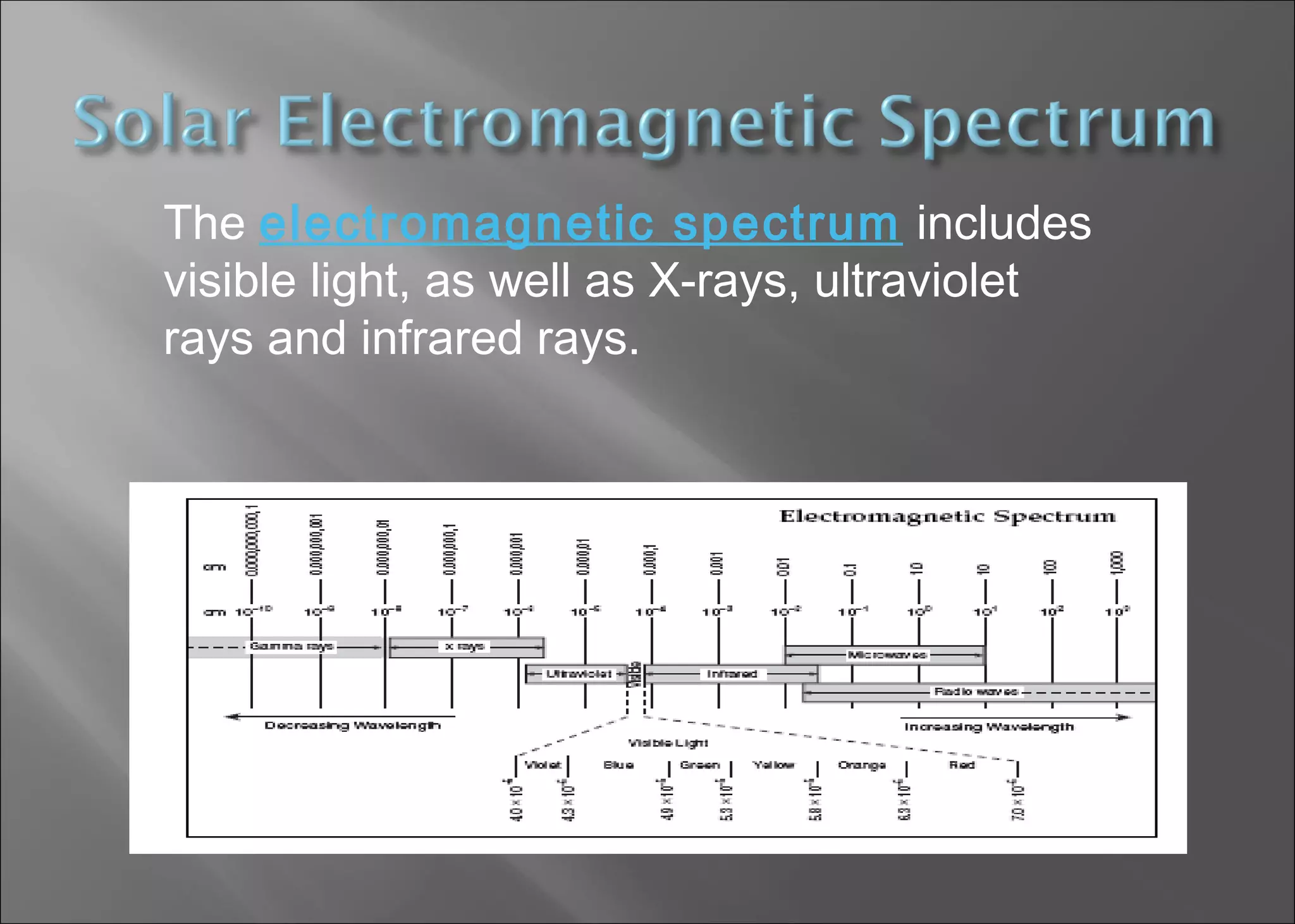
The electromagnetic spectrum includes
visible light, as well as X-rays, ultraviolet
rays and infrared rays.
Climate is the average
temperature and
moisture conditions
over a long period of
time.

Water Budget – a
system of accounting
for moisture income,
storage, and outgo for
the soil in a specific
area.
Humid climates are those in which the total amount of
precipitation is greater than the total amount of Potential
Evapotranspiration (Loss of water to atmosphere)
Arid climates have significantly more total Potential
Evapotranspiration than Precipitation
Latitude
•
Most important
factor in
determining
climate, especially
temperatures
•
As latitude
increases, yearly
temperature range
(difference between
highest and lowest
temperature)
increases.
•


As elevation
increases,
average
yearly
temperature
decreases.
Marine

Continental

Location:

Ocean/large lake

Interior (land)

Winds from:

OCEAN

LAND

Summers:

Cooler than
Average (Mild)
Warmer than Ave.
(Mild)

Warmer than
average (HOT)
Colder than Ave.
(Harsh)
Kansas, NE, IA,
Syracuse

Winters:

Example:

San Francisco, LA,
DC
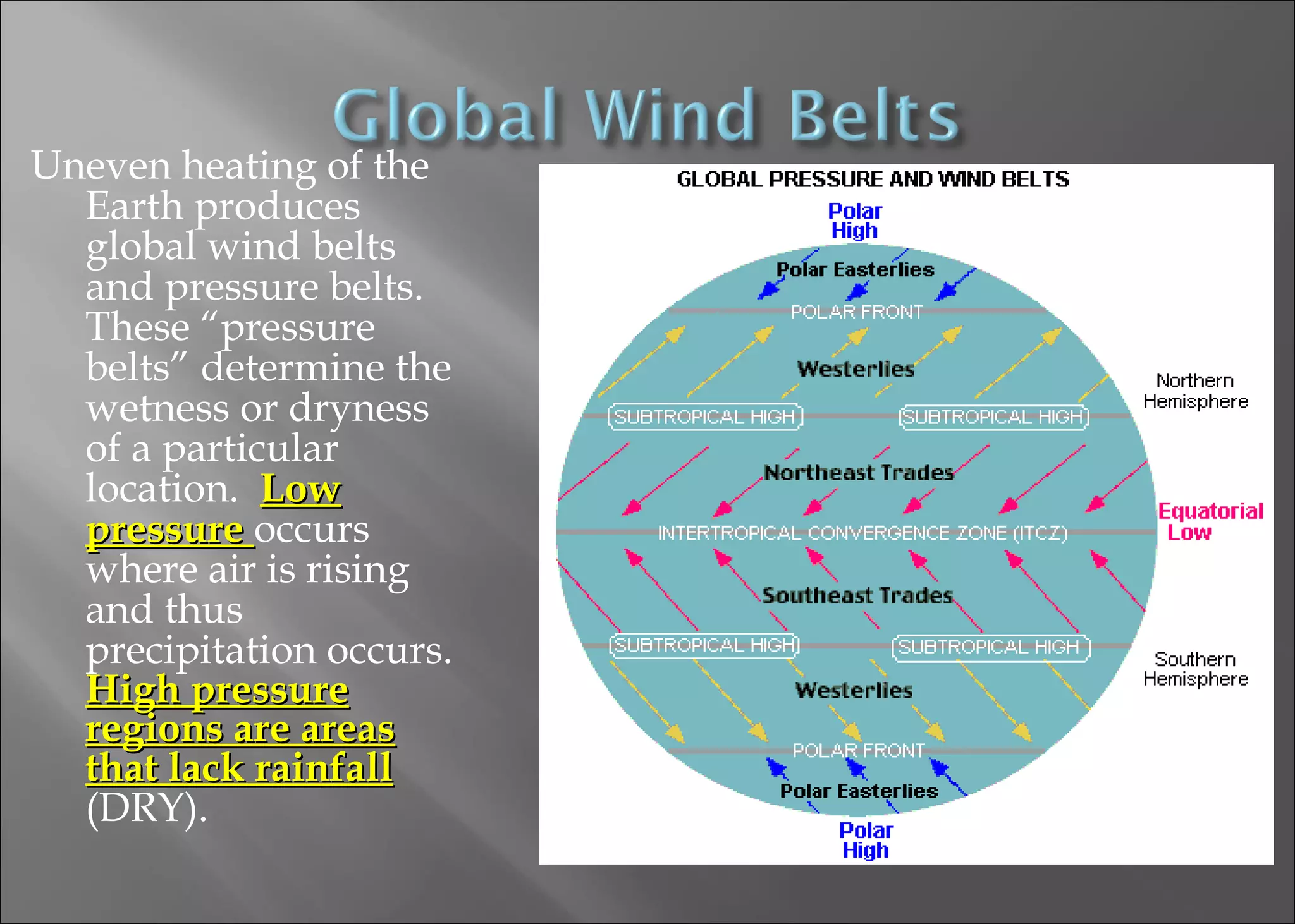
Uneven heating of the
Earth produces
global wind belts
and pressure belts.
These “pressure
belts” determine the
wetness or dryness
of a particular
location. Low
pressure occurs
where air is rising
and thus
precipitation occurs.
High pressure
regions are areas
that lack rainfall
(DRY).


The "Global Conveyer Belt" shows how the oceans move
energy from the tropics to the poles and back again in order
to moderate Earth's climate. This is accomplished through
long-term ocean circulation.

•Interesting

fact: It takes up
to 1000 years
for water to
completely
circulate the
oceans!


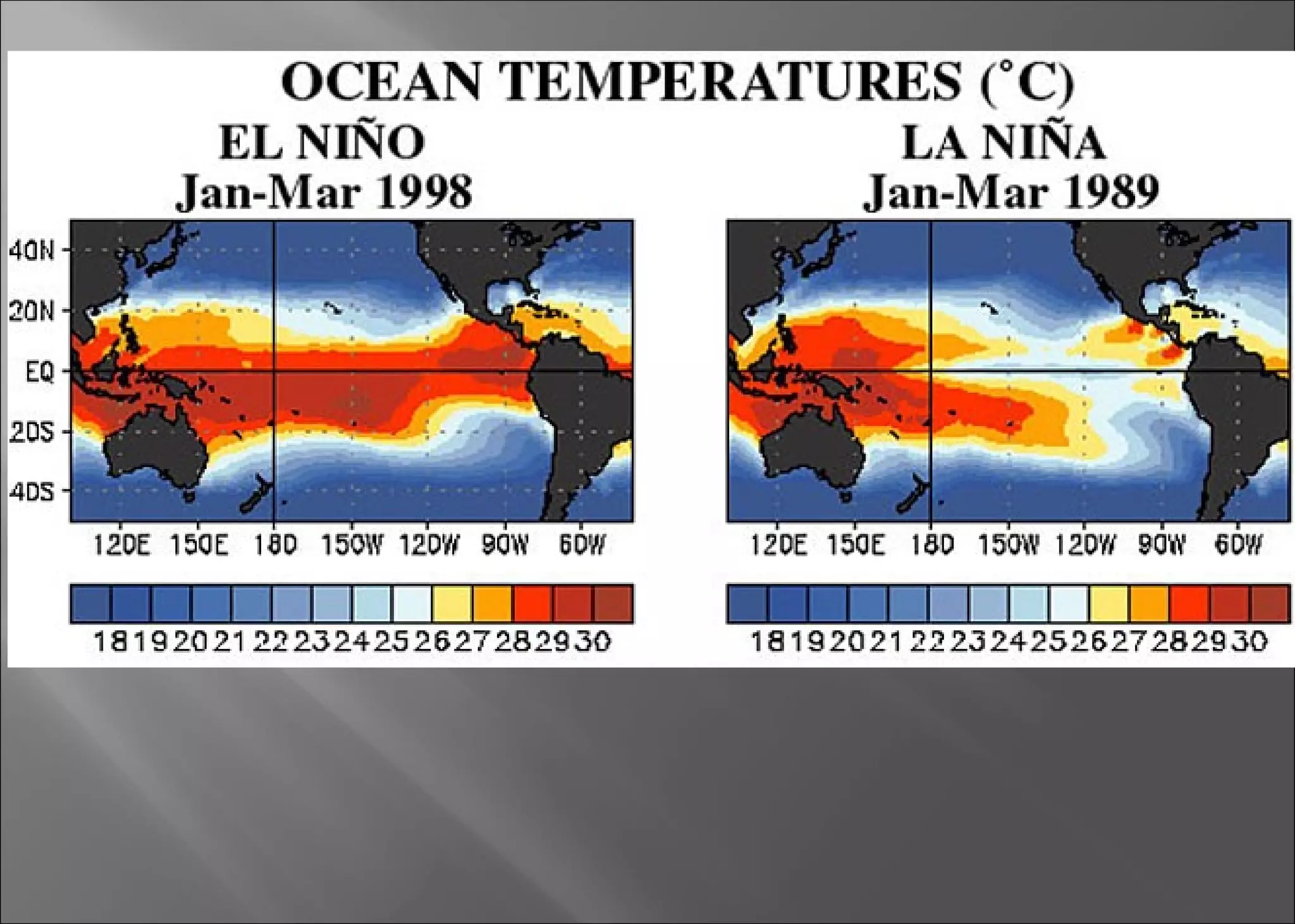
A warm ocean current resulting from a reversal of
the ocean current in the Pacific which results in
climate variability around the globe.





Orographic Effect – Mountains act as barriers
to prevailing winds. As the wind hits the
windward side of a mountain, the air is forced
up, cools, condenses and forms clouds with
precipitation.
Windward side – Side of the mountain that is
exposed to the wind. WET
Leeward Side – Descending air warms and it
holds more moisture, making it DRY.
*Why does rising air cool?

*As air temperature decreases,
its ability to hold water___DECREASES______
DECREASES

*Why does falling air warm?

Si

s,
Co Ex
ol pan
s
ds

r
Ai

&

Condensation
& Precipitation

pr

Ai
rR
ise

m
Co
s,
nk
s
se
es

WINDWARD

&
W
s

Topography

m
ar

Prevailing Wind

Cascade Mountains
LEEWARD
Weather = the condition of the atmospheric variables, such as

temperature, air pressure, wind, and water vapor, at a particular
location for a relatively short period of time.




Direct result of TILT &
parallelism in orbit
distribute energy from
vertical to oblique rays
Tilt (inclination)
spreads concentration
of energy over broader
area
This UNEVEN
HEATING
causes earth’s
atmosphere to
react and
become a
gigantic engine
that produces
an infinite
variety of
WEATHER.
1.
2.
3.
4.

Temperature
Air Pressure
Moisture Conditions (Precipitation & Humidity)
Wind (Speed & Direction)


Barometer – measures
AIR PRESSURE


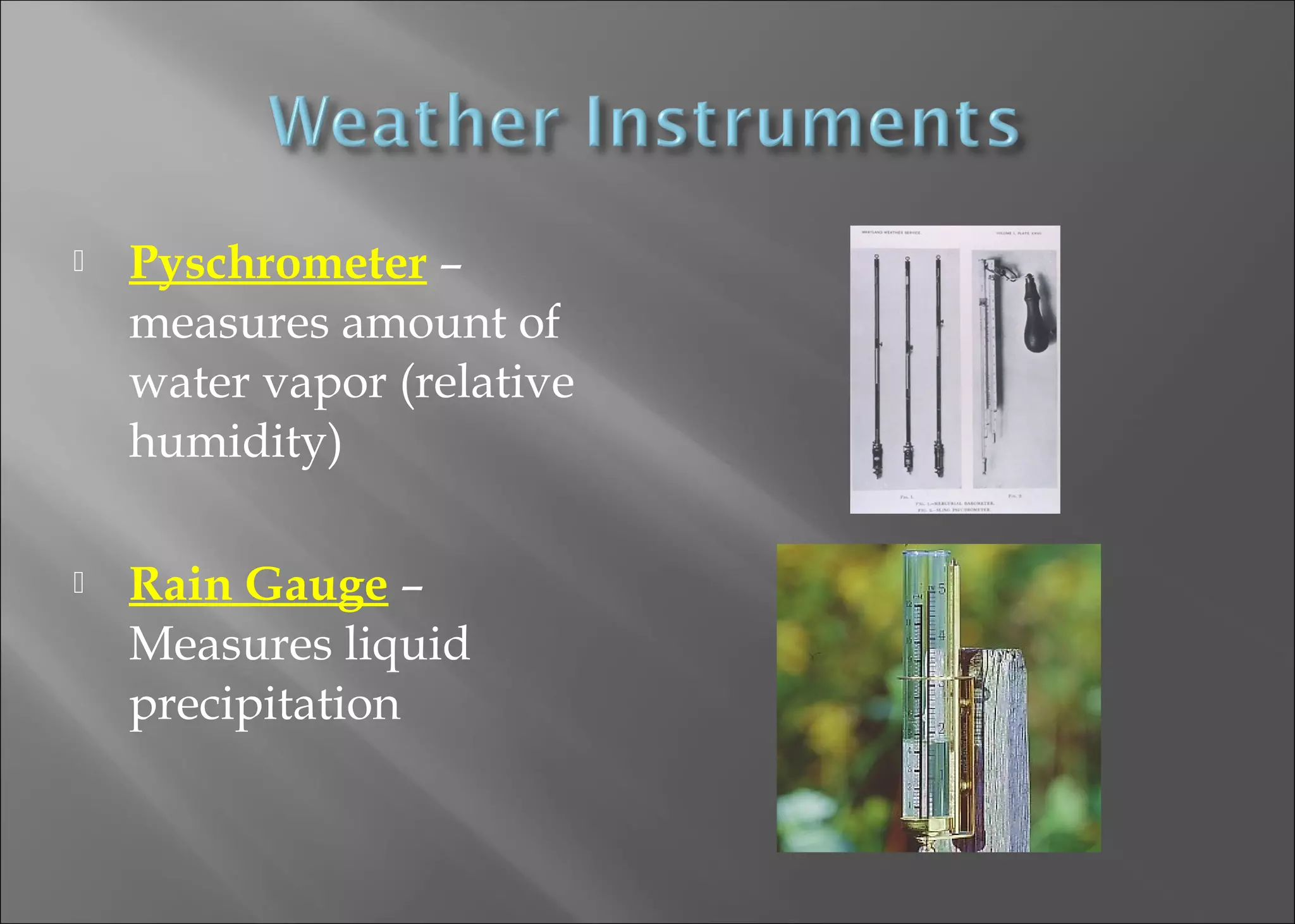
Pyschrometer –
measures amount of
water vapor (relative
humidity)



Rain Gauge –
Measures liquid
precipitation


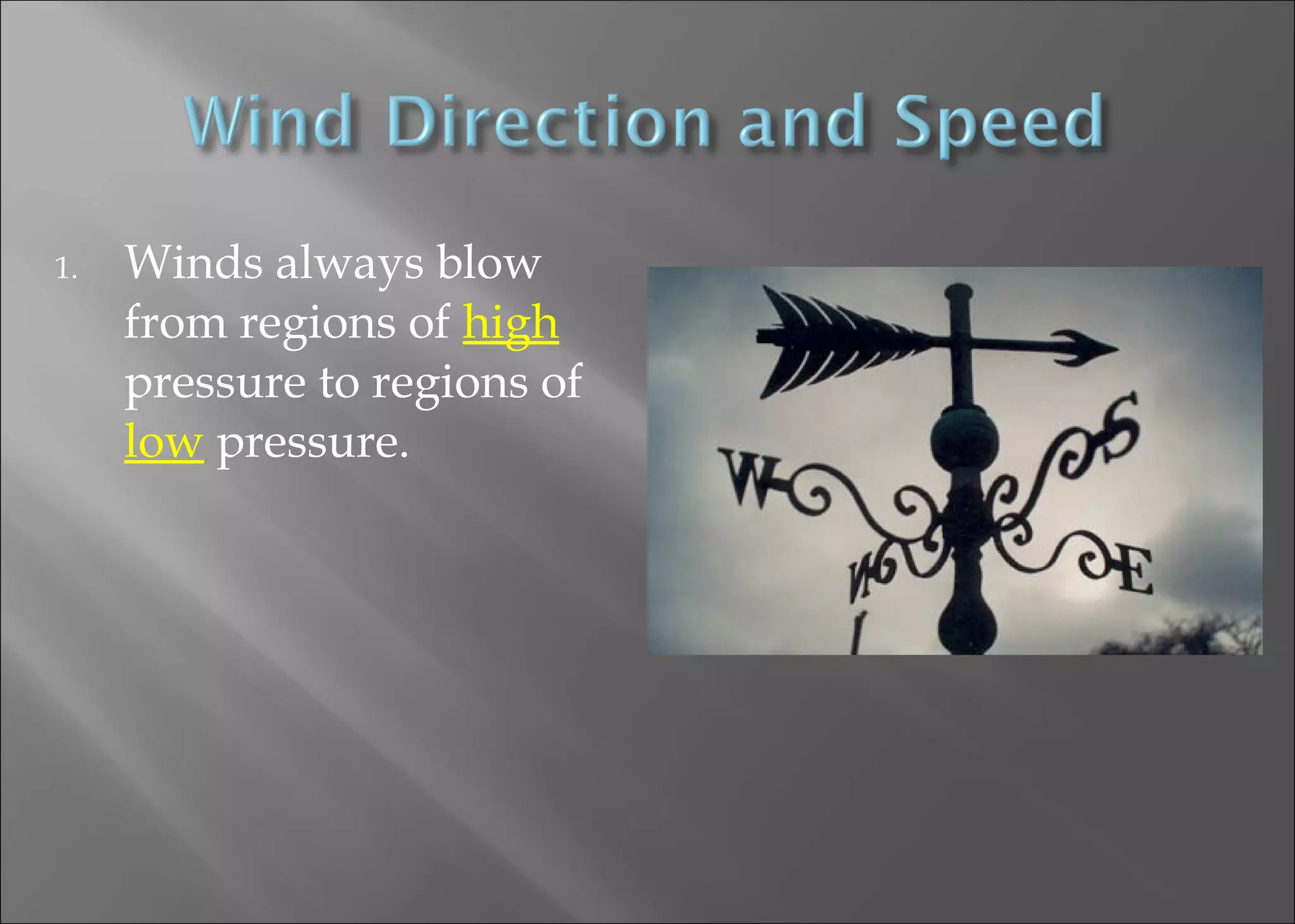
Wind Vane –
measures wind
direction



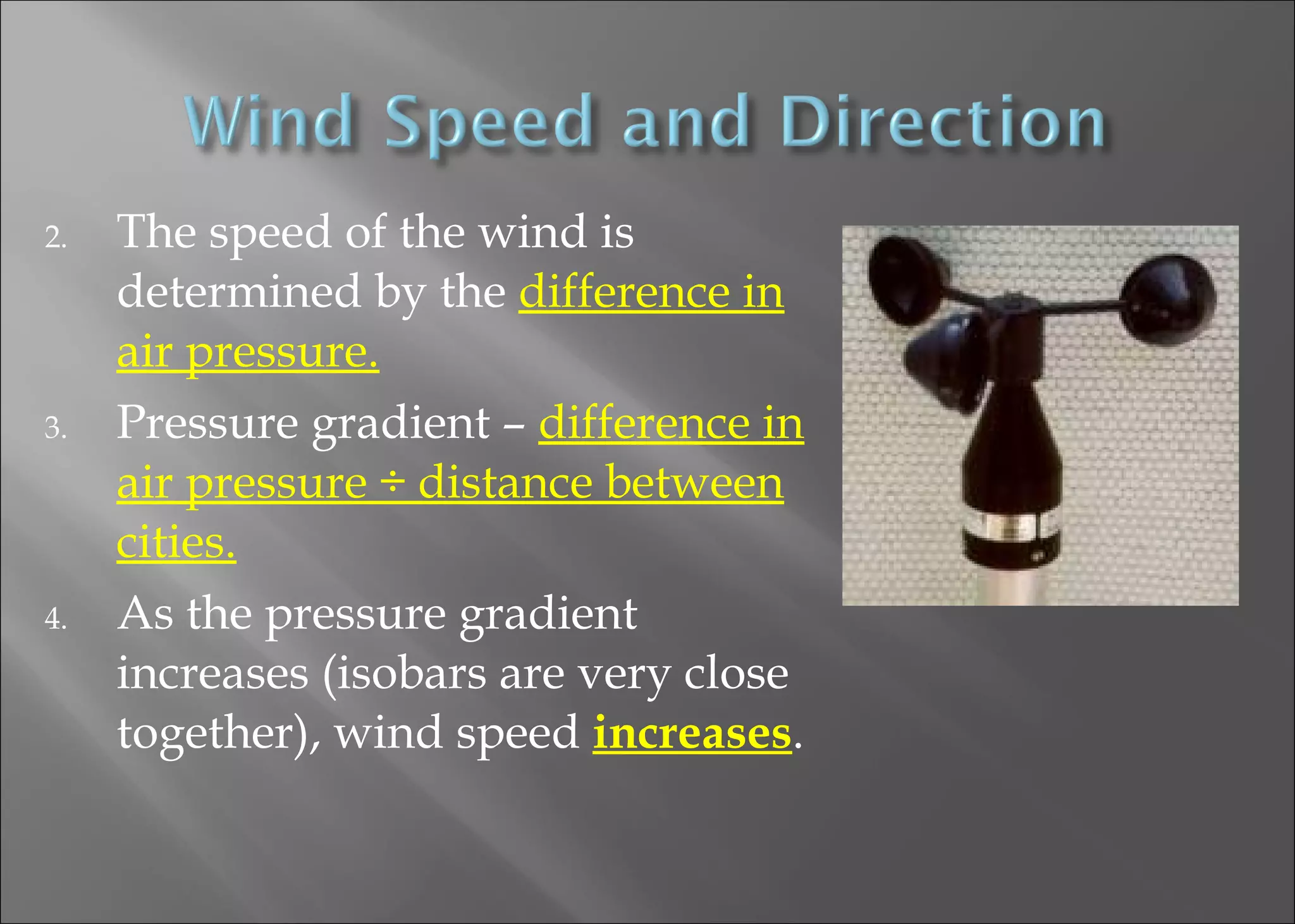
Anemometer –
measures wind speed


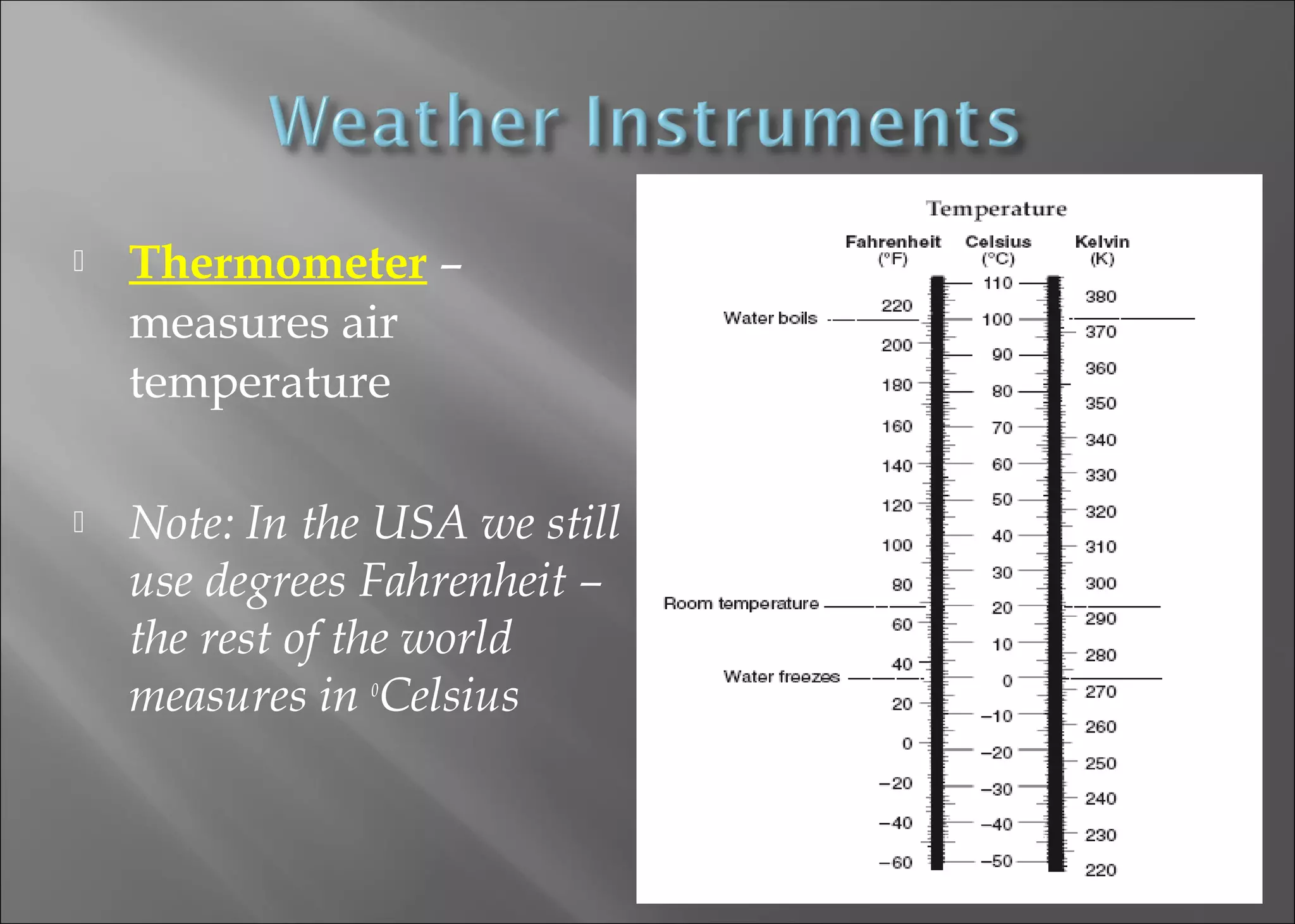
Thermometer –
measures air
temperature



Note: In the USA we still
use degrees Fahrenheit –
the rest of the world
measures in oCelsius


Atmosphere



Complete the questions in the note packet while
you watch!









Composition of the lower atmosphere
(troposphere):
1. Nitrogen = 78% used by bacteria in soil
to make nitrates
2. Oxygen = 21% used by humans and
animals for respiration
3. Argon = 0.84%
4. Carbon Dioxide = 0.03% used by green
plants to make food


5. Others = 0.01% which include:


Helium, Hydrogen, Ozone, Krypton, neon and xenon

6. Also: water vapor, dust particles and pollution


What is Ozone?
 O3

– we breathe O2

 It

occurs naturally in trace amounts in the
stratosphere.
protects life on Earth from the Sun’s UV
radiation.

 Ozone
 Ozone

is created naturally when sunlight splits
apart O2 into single O atoms – these then bond to
form more O2 or O3





NO!!
The ozone molecules are randomly scattered
among other particles in the stratosphere layer
Ozone molecules are exceedingly rare: In every
one million molecules of air, fewer than 10 are
ozone




Filters out harmful UV radiation, which can cause
skin cancer, cataracts, faster aging & weakened
immune systems
UV is also harmful to plants & marine life and it
can disrupt the food chain
CFC – chlorofluorocarbons, which are used in:
1.
2.
3.

Coolants in refrigerators
Propellants in aerosol cans
Electronic cleaning solvents


Ground-level ozone triggers chest pain, nausea,
bronchitis, reduced lung capacity, and aggravates asthma

Air Quality Index

An index for reporting daily air quality

Focuses on health effects that can happen within a few
days of breathing polluted air

Used for: ground level ozone, particulate matter, carbon
dioxide, sulfur dioxide, and nitrogen dioxide
AIR POLLUTION
-any substance in the atmosphere that is harmful ( usually produce long term health
effects and can cause death )
Main Sources – burning fossil fuels ( coal and petroleum )
Ex: SOx, CO ( carbon monoxide ), lead, various hydrocarbons

Acid Rain ( precipitation ) – side effect of air pollution
- gases from burning fossil fuels combine with water in the air to
produce acids, then falls back to the earth as precipitation
Long Term effects: kills fish, soil contamination, destruction of plants,
and crops
Mt. Mitchell, NC 

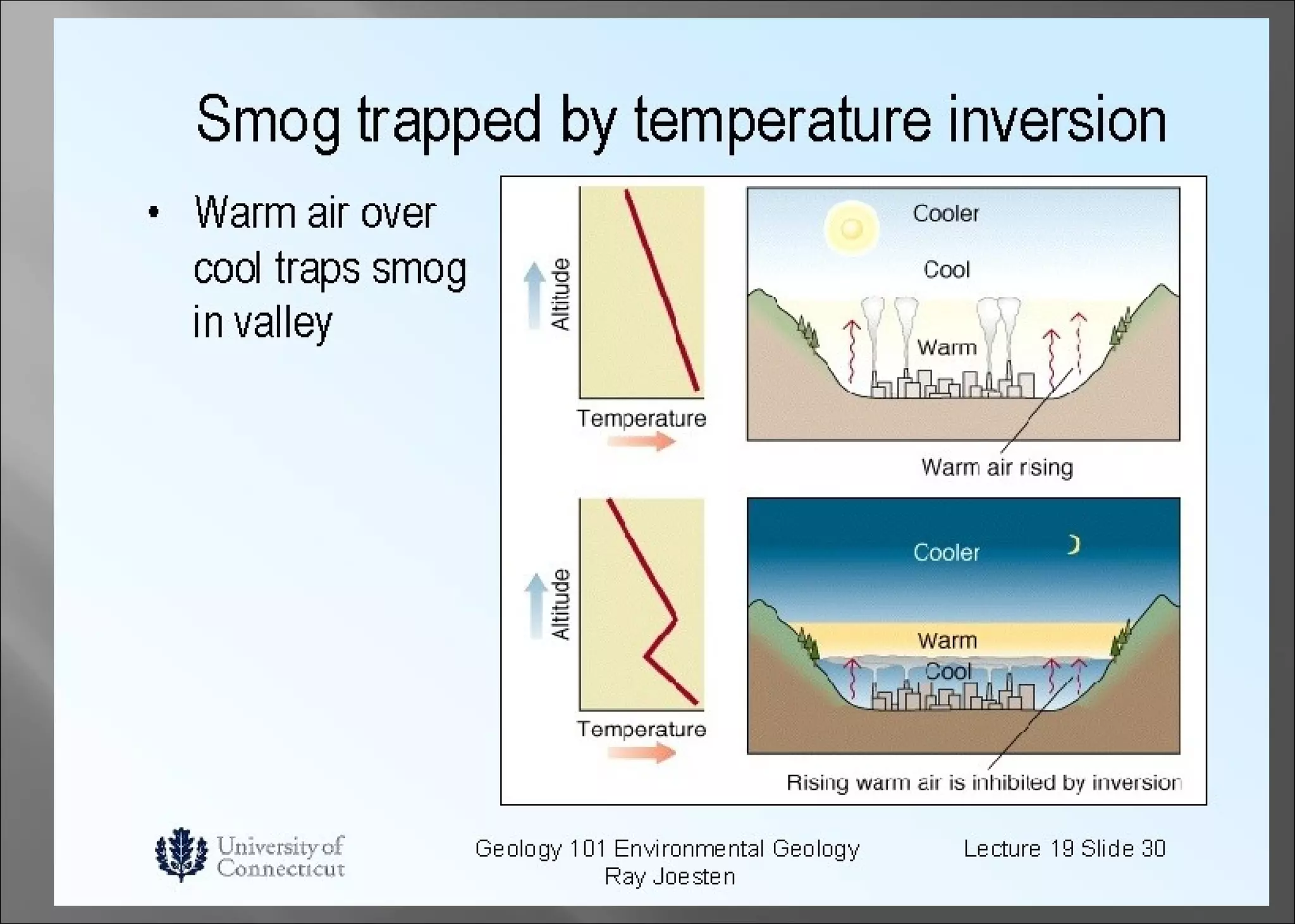
Temperature Inversion ( very serious problem )

trees,


In order for this reaction to occur, it must be
extremely cold. Conditions for this reaction are
perfect over Antarctica in the winter months.
Can we fix it??
 The ozone hole will fix itself given enough time
 Many major countries, including the U.S., have
placed heavy restrictions on ozone-polluting
substances
December
2013
The false-color view
of the monthlyaveraged total ozone
over the Antarctic
pole. The blue and
purple colors are
where there is the
least ozone, and the
yellows and reds are
where there is more
ozone.
1.

2.
3.

4.
5.

6.

6% reflected from
atmospheric scattering
(aerosols)
20% reflected by clouds
4% Reradiation:
Reflected by Earth’s
surface
3% Absorbed by clouds
51% Absorbed by Earth’s
surface
16% Absorbed by
atmosphere








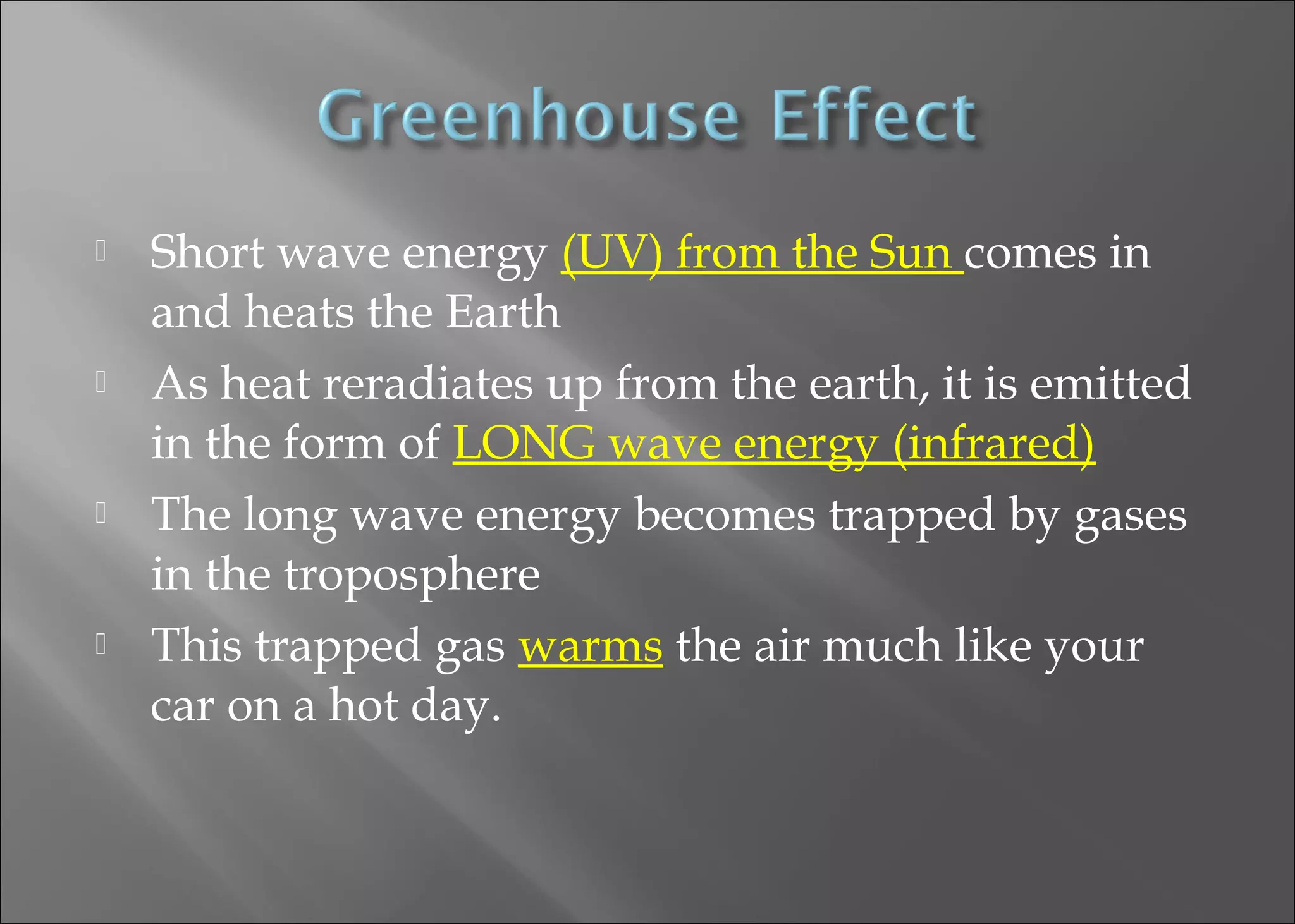
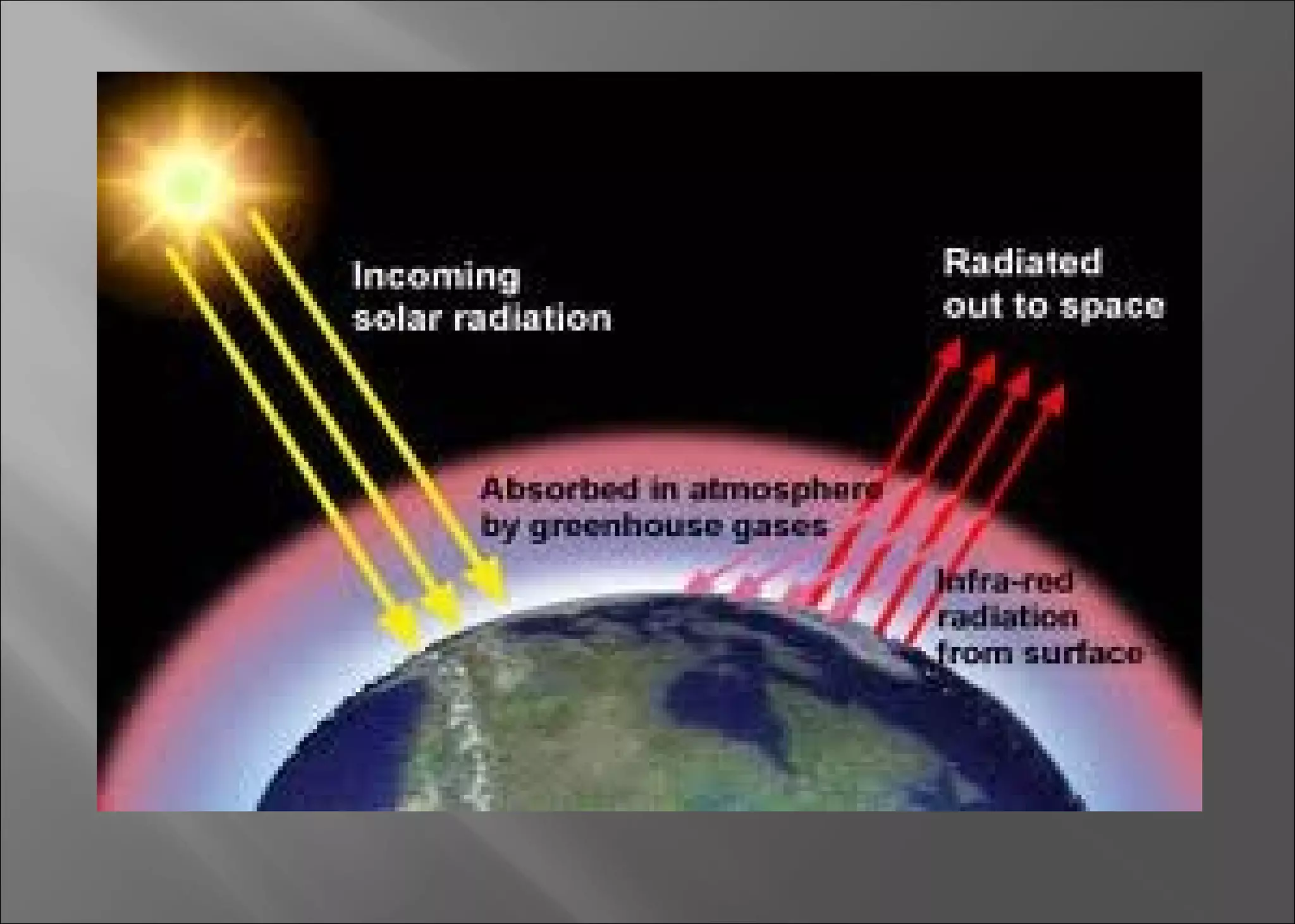
Short wave energy (UV) from the Sun comes in
and heats the Earth
As heat reradiates up from the earth, it is emitted
in the form of LONG wave energy (infrared)
The long wave energy becomes trapped by gases
in the troposphere
This trapped gas warms the air much like your
car on a hot day.






Water vapor
Methane (CH4)
Carbon dioxide
Nitrous oxide
CFCs (chlorofluorocarbons)
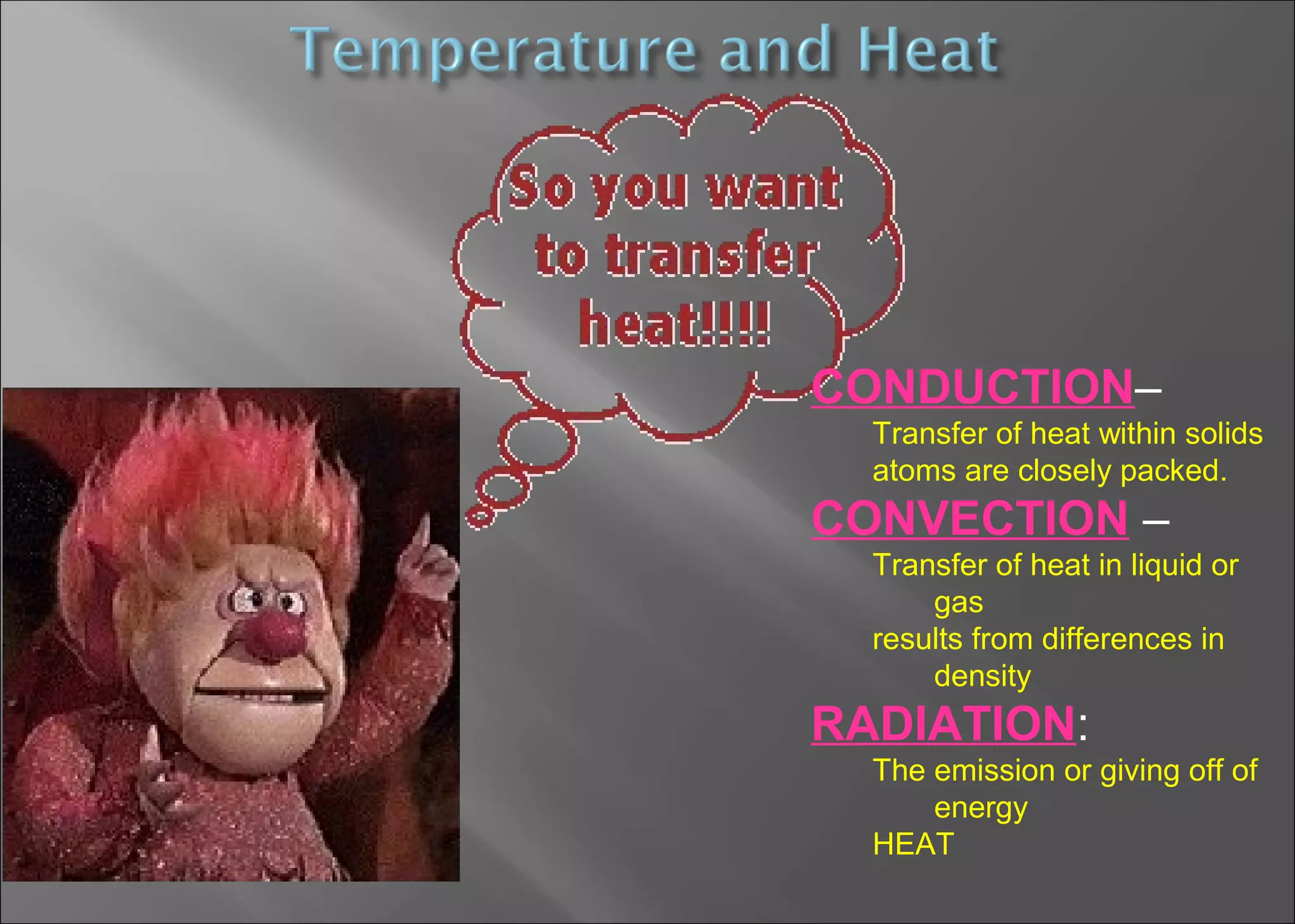
CONDUCTION–
Transfer of heat within solids
atoms are closely packed.

CONVECTION –
Transfer of heat in liquid or
gas
results from differences in
density

RADIATION:
The emission or giving off of
energy
HEAT
Heat in the atmosphere is recorded as a
temperature reading and can then be plotted on a
map to see a picture of change.
•

ISOTHERMS are lines that connect points of equal
temperature. Showing temperature distribution in
this way making patterns easier to see.
Why do the isotherms seem to run E – W across the map?
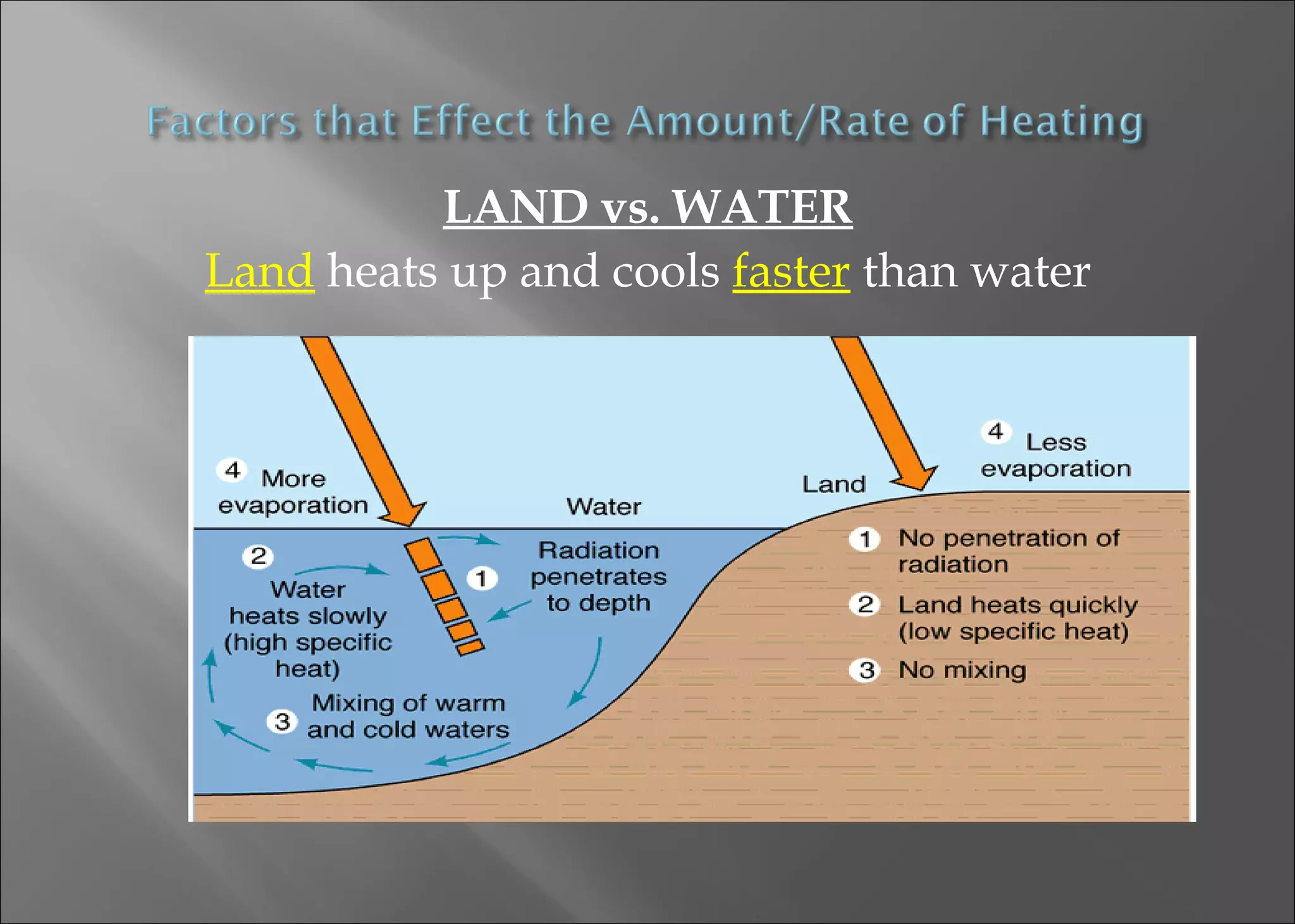
LAND vs. WATER
Land heats up and cools faster than water
Color
DARK vs. LIGHT
Darker colors tend to absorb more insolation than they reflect.
Surfaces with lighter colors tend to reflect more insolation than
they absorb.
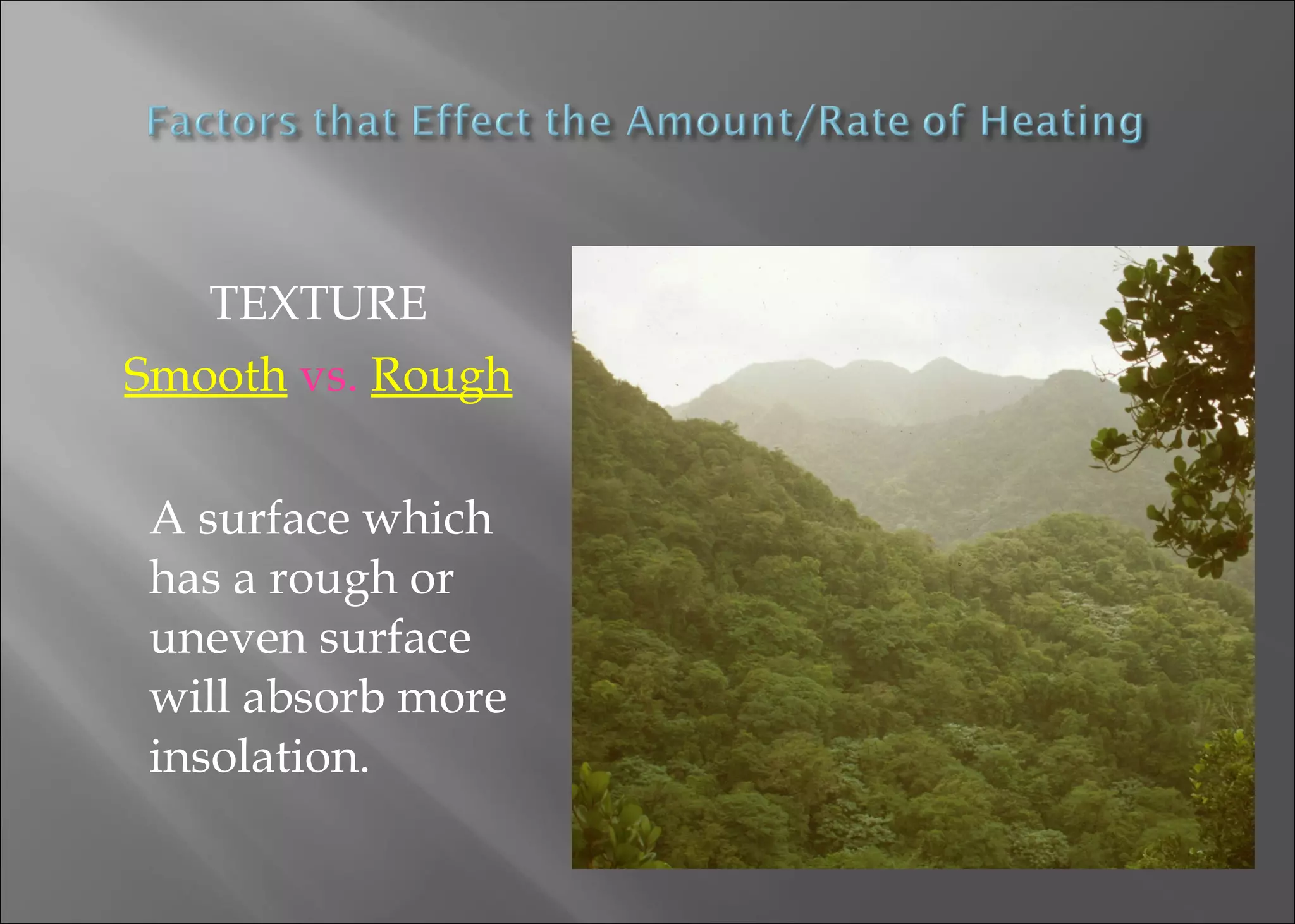
TEXTURE
Smooth vs. Rough
A surface which
has a rough or
uneven surface
will absorb more
insolation.
Phase Change Diagram
The primary source of moisture for the atmosphere
are the OCEANS.
Other sources include:

Lakes, Rivers, streams
Transpiration

Moisture in the atmosphere exists in all three
states/phases.

1) Gas – known as water vapor
2) Liquid – tiny droplets suspended in the air that
form clouds
3) Solid – tiny crystals suspended in the air that
form clouds
HUMIDITY is the general term used to describe the
amount of water vapor in the air

Temperature determines the amount of water
vapor the air can hold.


e)



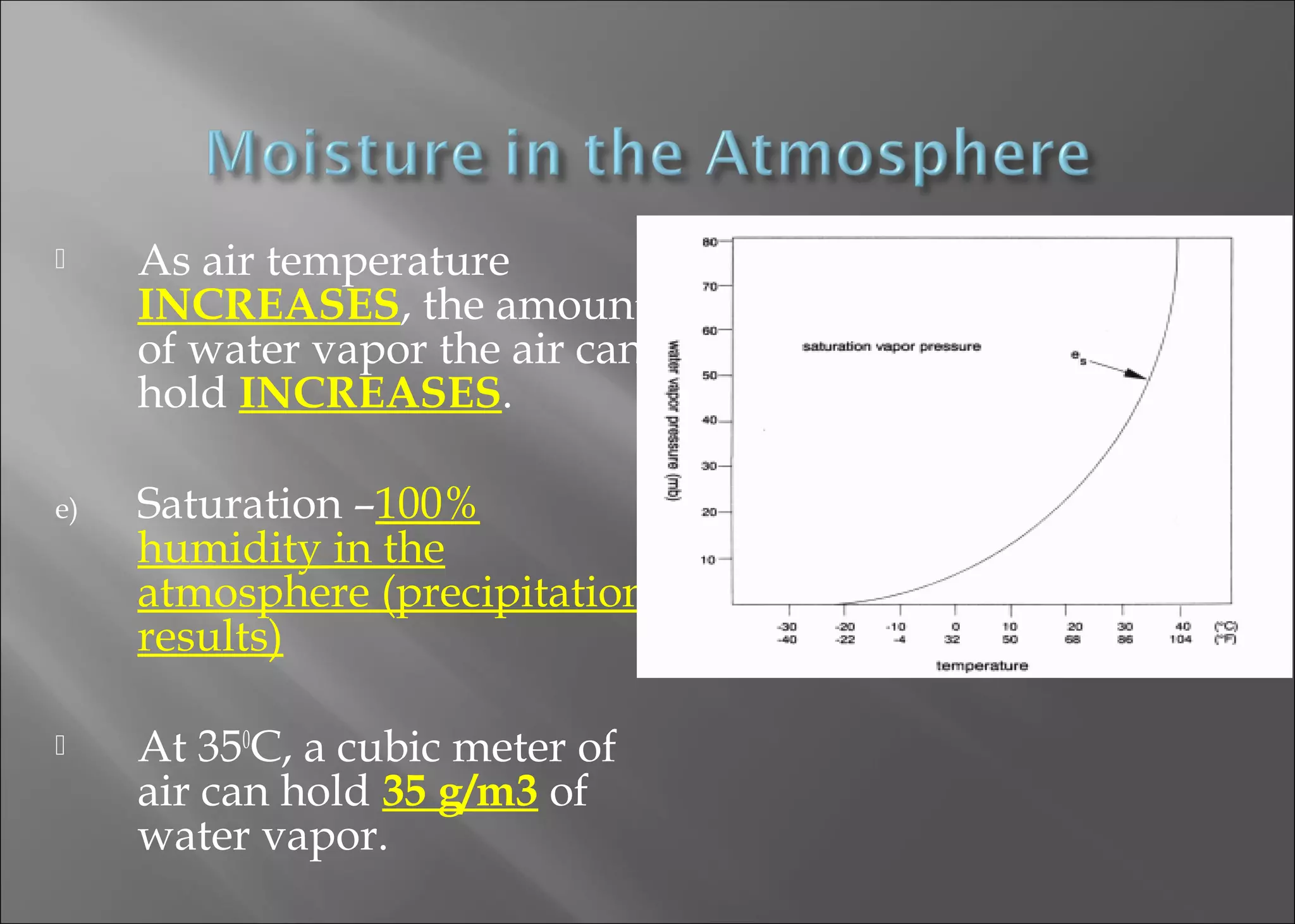
As air temperature
INCREASES, the amount
of water vapor the air can
hold INCREASES.
Saturation –100%
humidity in the
atmosphere (precipitation
results)
At 350C, a cubic meter of
air can hold 35 g/m3 of
water vapor.
Temperature – As temperature increases,
evaporation increases
Wind – As wind increases, evaporation increases
Surface Area – As surface area increases,
evaporation increases
Humidity – As humidity goes UP, evaporation rates
go DOWN




The temperature to
which air must be
cooled to reach
saturation. And
Condense…….and
make clouds!
If the air temp drops down
to the dew point,
condensation will occur.
The dew point can tell us
how high clouds will form.
Clouds form where
condensation is occurring.
a)

The drier the air, the faster/more evaporation
will occur resulting in greater/more cooling. In
turn, the difference in temperature between the
dry bulb and wet bulb will be greater/more.
b.

c.

The more humid the air, the LESS evaporation
will occur resulting in LESS cooling of the wet
bulb thermometer. In turn, the difference in
temperature between the dry bulb and wet bulb
will be LESS
At saturation (100% humidity), the temperature
difference between the dry bulb and wet bulb
would be zero and precipitation will usually
occur!.


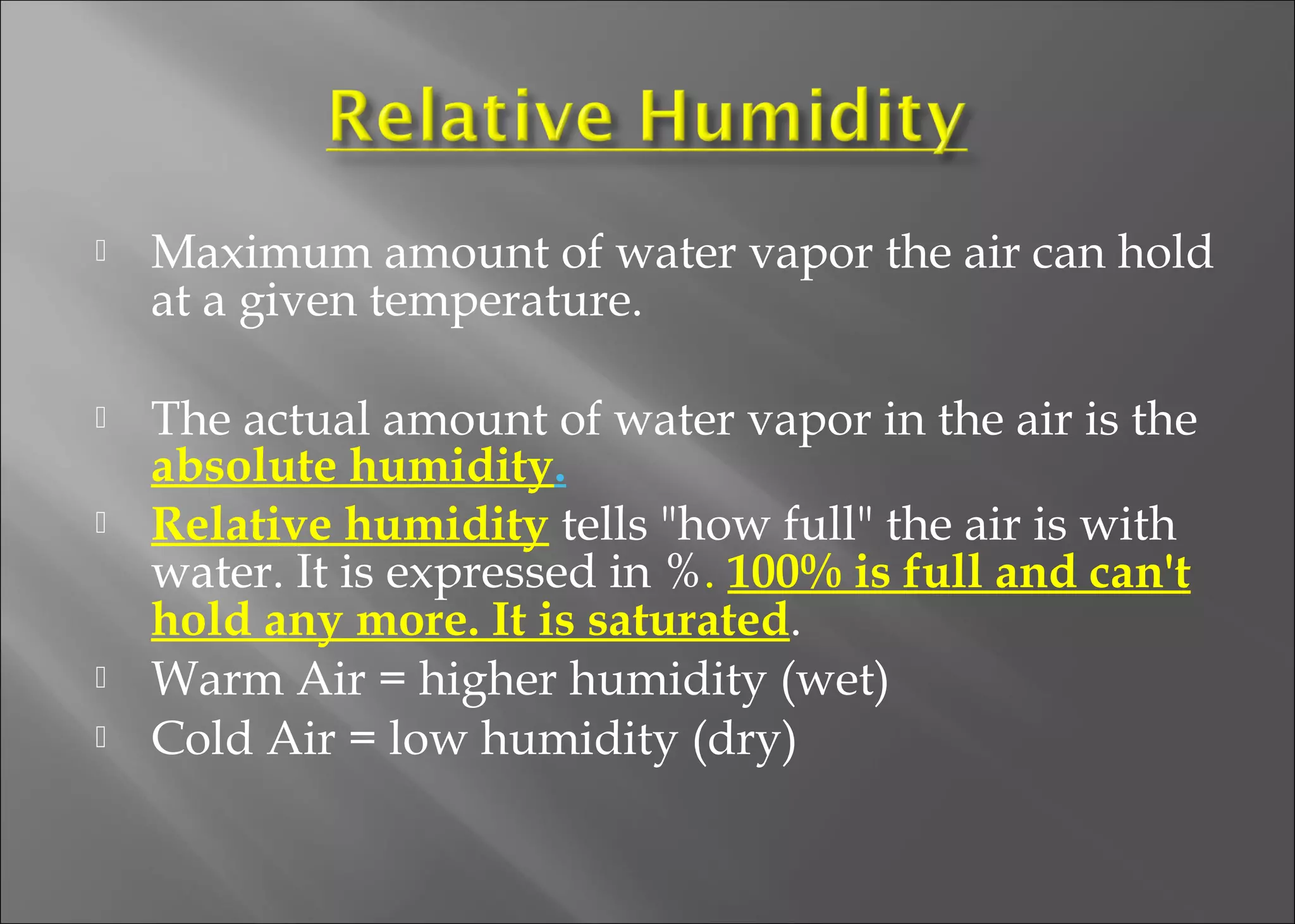
Maximum amount of water vapor the air can hold
at a given temperature.



The actual amount of water vapor in the air is the
absolute humidity.
Relative humidity tells "how full" the air is with
water. It is expressed in %. 100% is full and can't
hold any more. It is saturated.
Warm Air = higher humidity (wet)
Cold Air = low humidity (dry)





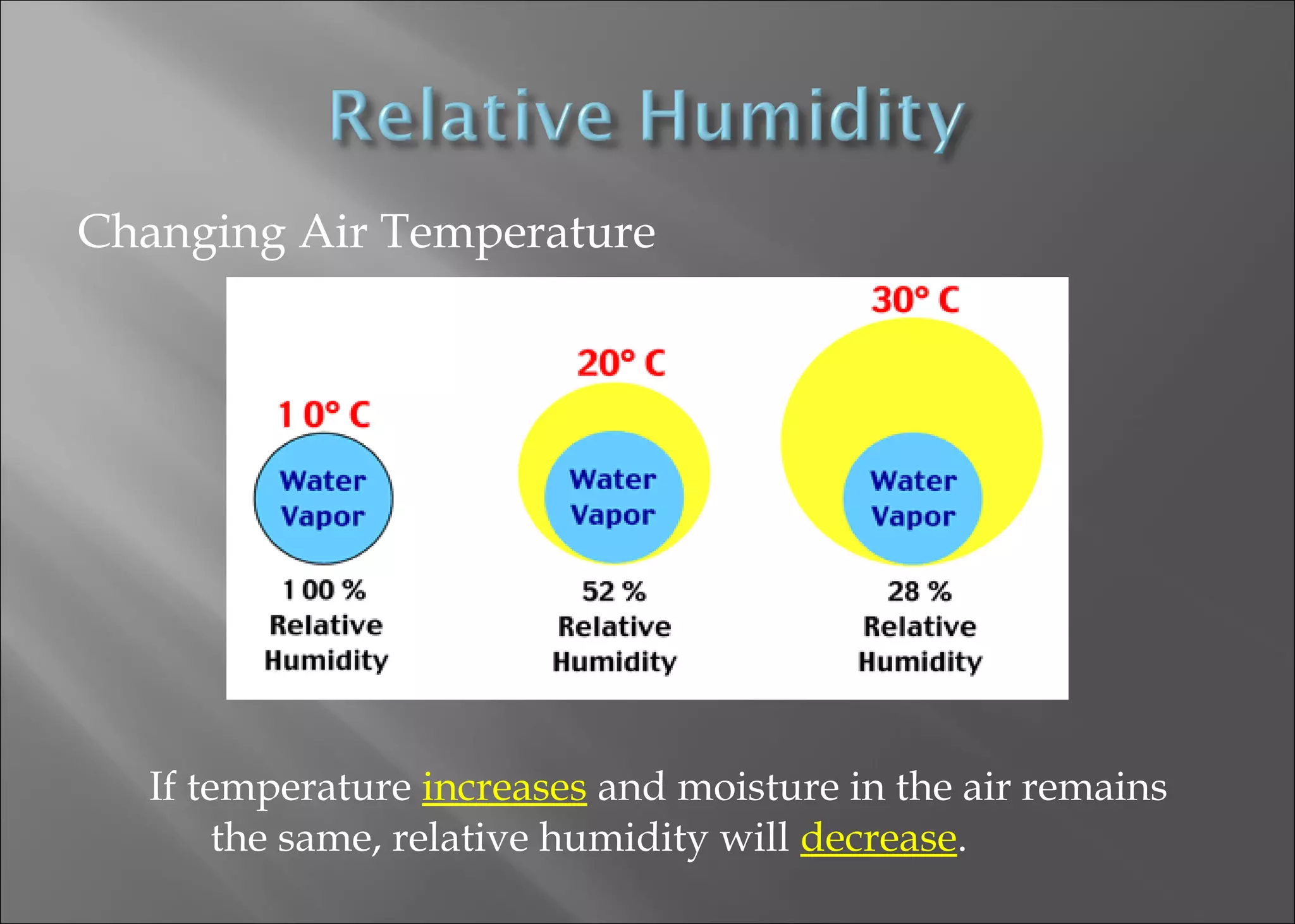
Changing Air Temperature

If temperature increases and moisture in the air remains
the same, relative humidity will decrease.
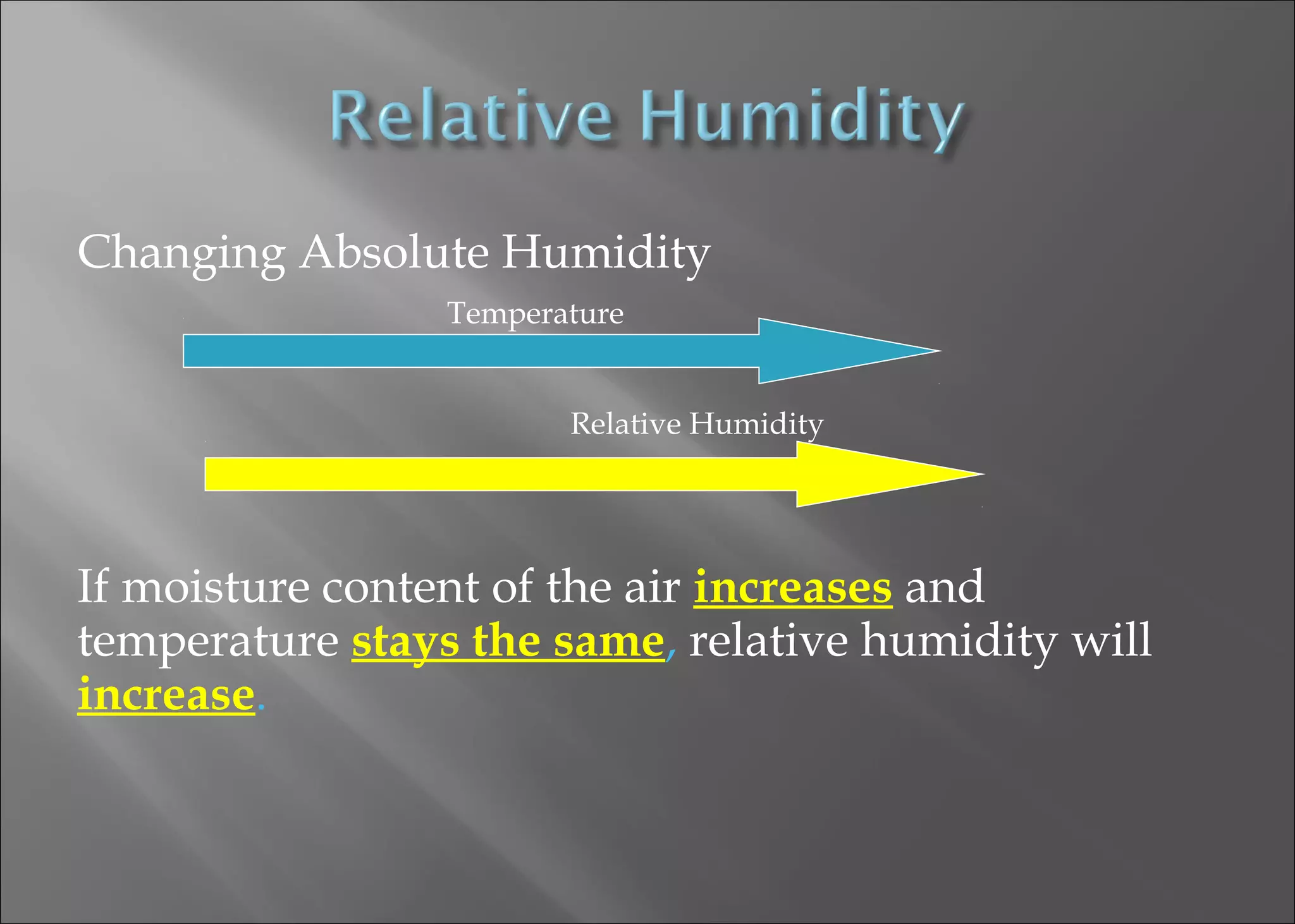
Changing Absolute Humidity
Temperature
Relative Humidity

If moisture content of the air increases and
temperature stays the same, relative humidity will
increase.
Complete the worksheet while watching!
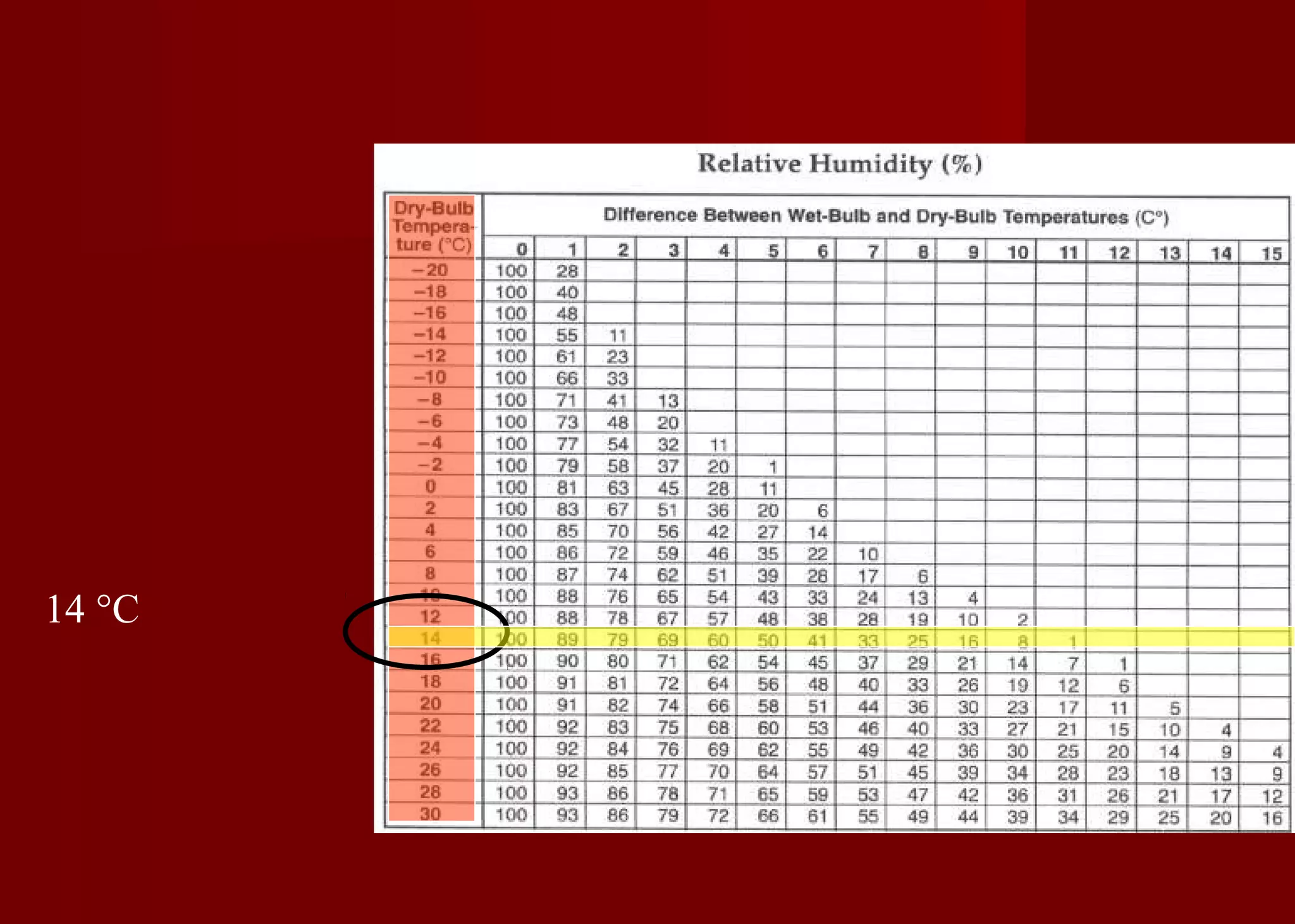
Using the chart to determine Dew
Point & Relative Humidity


It’s easy; if…..
–
–
–

You have ½ a brain
Pay attention
Do your practice!
The “Dry Bulb”
 Don’t let it fool you.

It
is just a thermometer.
 It measures the air
temperature.
 Duh!

20°C
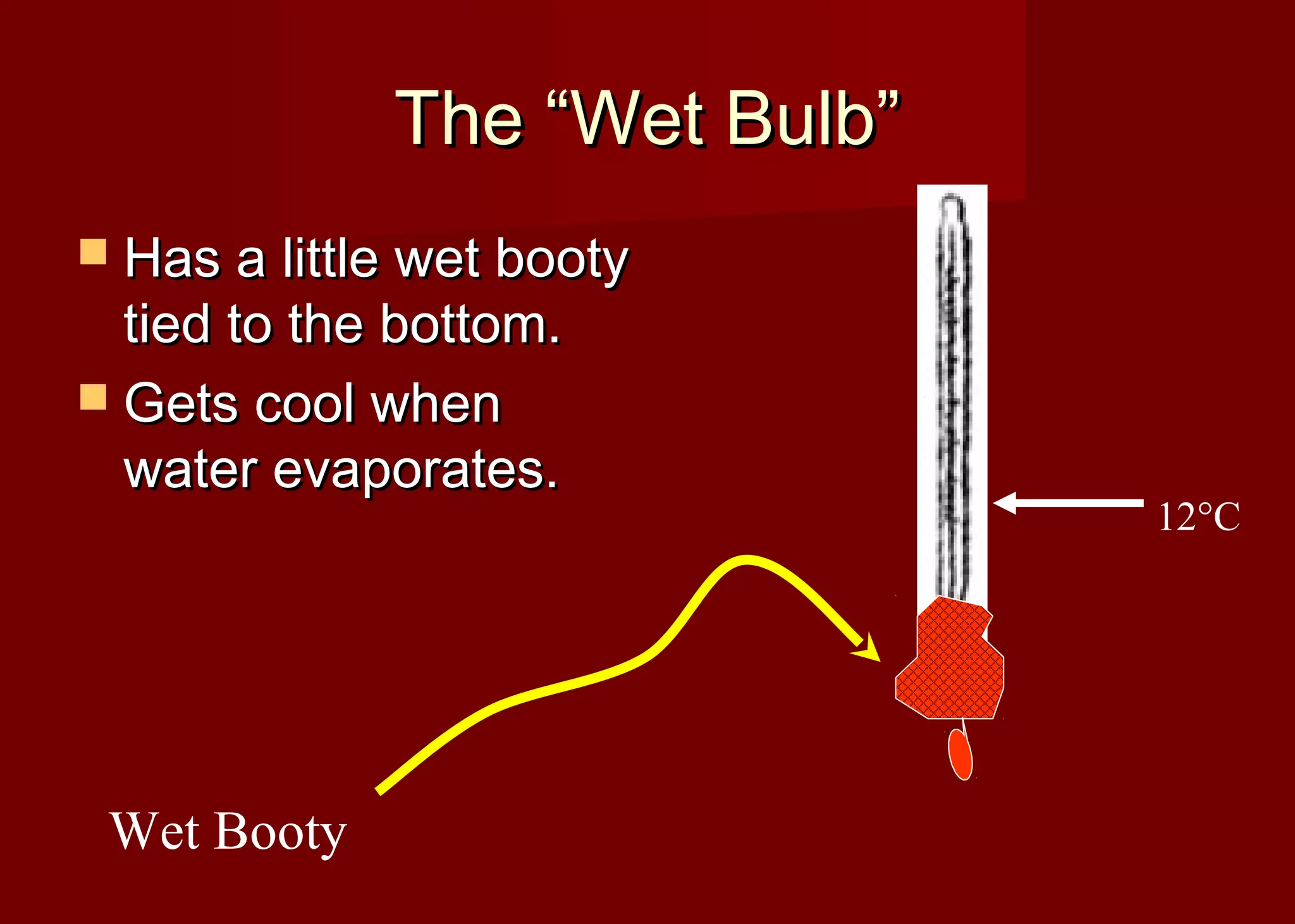
The “Wet Bulb”
 Has a little wet booty

tied to the bottom.
 Gets cool when
water evaporates.

Wet Booty

12°C
A Dry Day…
 A lot of moisture will

evaporate.
 The wet bulb will be
a lot cooler than the
dry bulb.

20°C

Difference between wet bulb &
dry bulb is 12 °C.

20°C
14°C
12°C

8°C
A Humid Day…
 A little bit of moisture

will evaporate.
 The wet bulb will not
be much cooler than
the dry bulb.

20°C

Difference between wet bulb &
dry bulb is 6 °C.

14°C
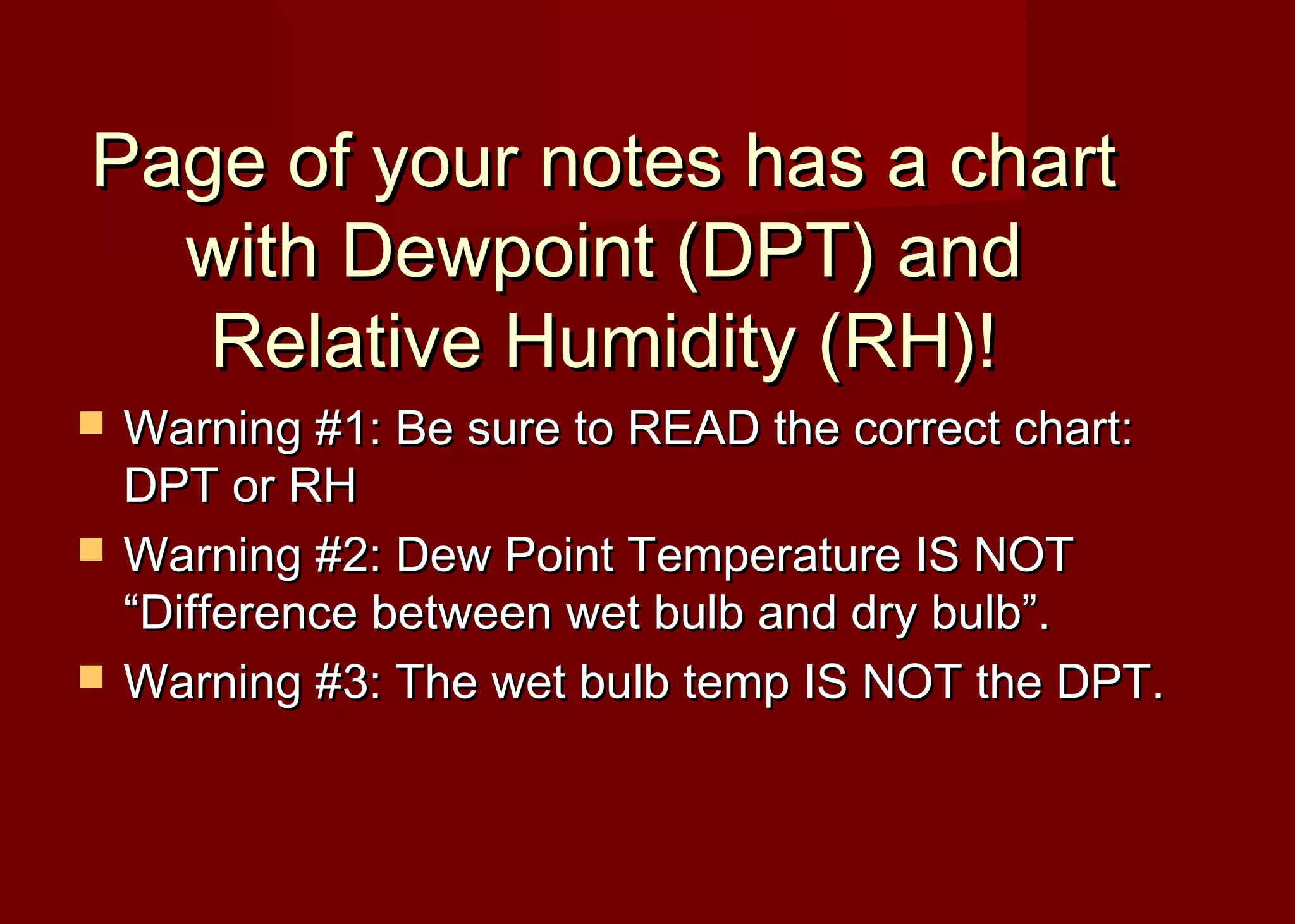
Page of your notes has a chart
with Dewpoint (DPT) and
Relative Humidity (RH)!




Warning #1: Be sure to READ the correct chart:
DPT or RH
Warning #2: Dew Point Temperature IS NOT
“Difference between wet bulb and dry bulb”.
Warning #3: The wet bulb temp IS NOT the DPT.
Dry-bulb temperature is your air temperature.

20 °C
14 °C
4 °C
Subtract (the difference) between the dry bulb and wet bulb
20°C

14°C

20-14=6
18°C

16°C

18-16=2
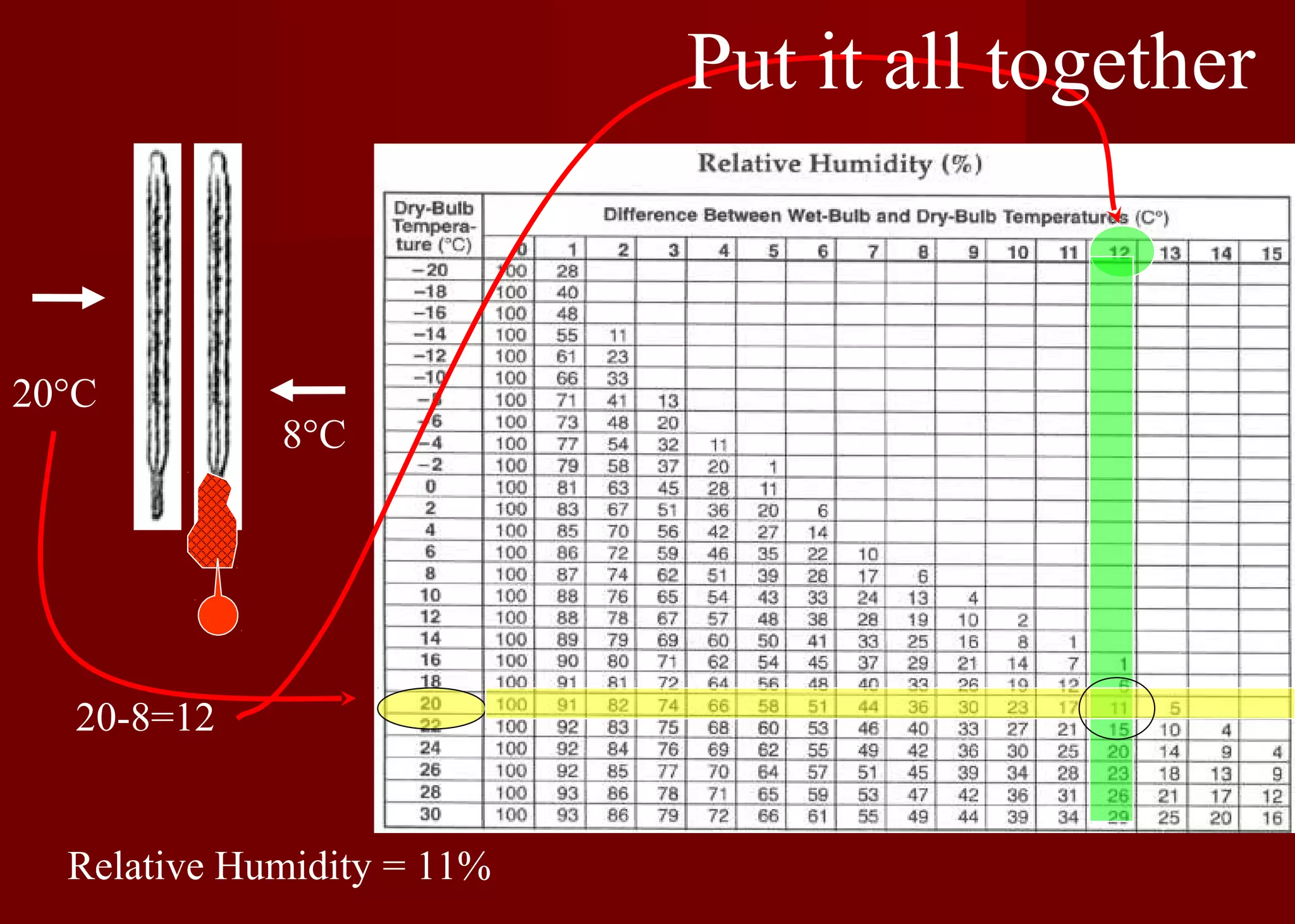
Put it all together

20°C

8°C

20-8=12

Relative Humidity = 11%
14°C

10°C

14-10=4

Relative Humidity = 60%
The Dew Point Chart works the same way

14°C

10°C

14-10=4

Dew Point = 6°C
Try These.
Dry Bulb

Wet Bulb

26°C

20 °C

6 °C

5 °C

12 °C

8 °C

R Humidity

57%
86%
57%

DPT

17 °C
4 °C
4 °C

Now do the worksheet for homework on
the next page of your notes
How Do
Clouds Form?

Expan
si on &
C ooli
ng

R ising AIR

Con
den
s ati
on
Nu
Re
clei
De a c
wP hin
oi g t
nt
h
Te e
mP
.

W
ate
rV
ap
or


Adiabatic Cooling As air rises, the
atmospheric
pressure
surrounding the
parcel of air
decreases.
Therefore, the
parcel of air
expands as it rises.


As it expands, it
becomes cooler.
When the
temperature of this
parcel of air falls to
its dew point
temperature, the
water vapor in the
air condenses and a
cloud appears in the
sky.
Air pressure acts equally in all directions; it also exists
within any object containing air like a building, the
human body and “empty” bottles.
When you mess with the pressure – “bad” things
happen!~
CRUSH!
a.

b.

Factors/Variables that cause
atmospheric pressure to
change:
Temperature
Moisture
Altitude
Effect of temperature on air
pressure:
As air temperature increases;
(air molecules move further
apart/become less dense) –
the air pressure decreases
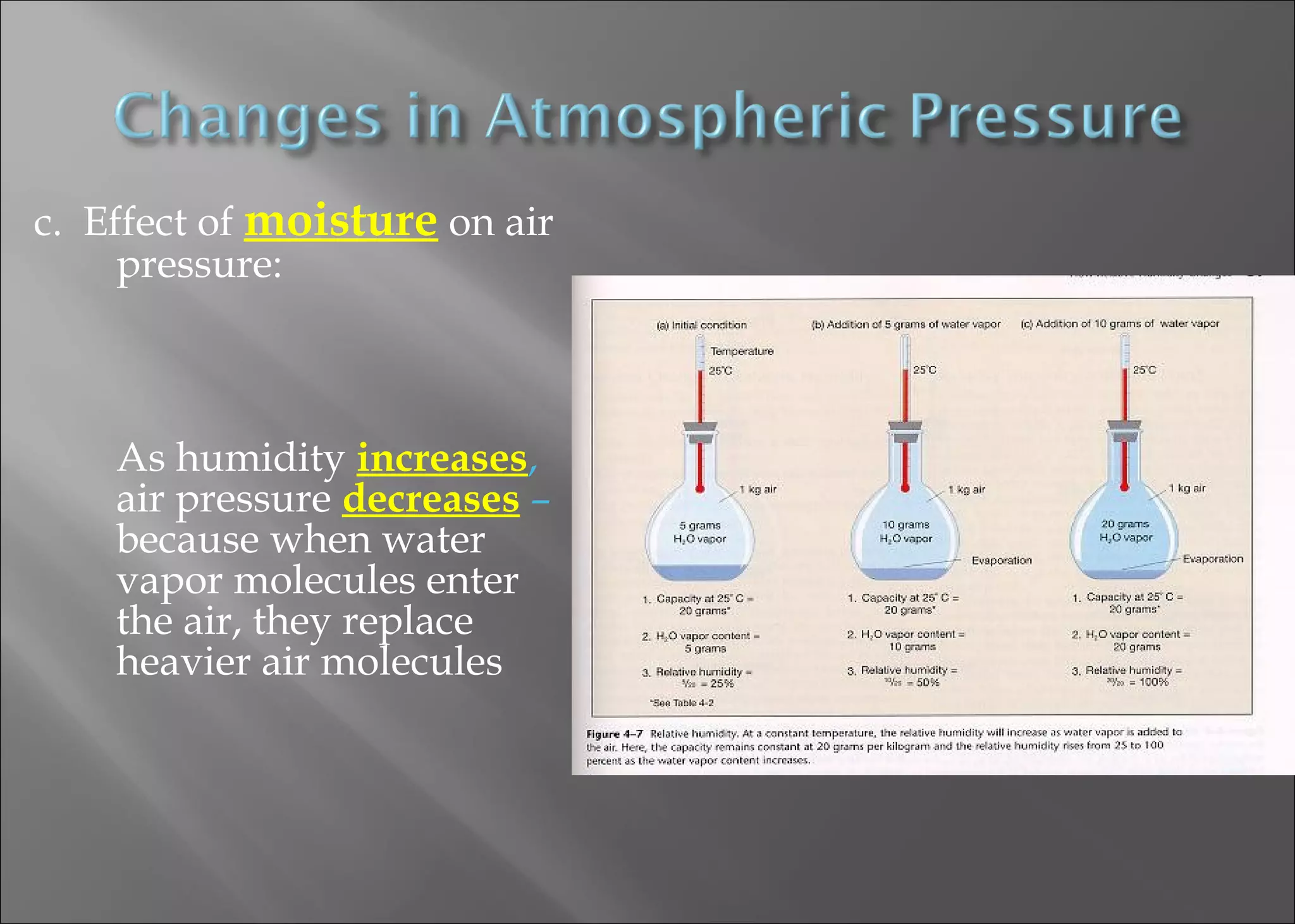
c. Effect of moisture on air
pressure:

As humidity increases,
air pressure decreases –
because when water
vapor molecules enter
the air, they replace
heavier air molecules
d.

Effect of altitude on
air pressure


As altitude
increases, air
pressure decreases
(less air is above and
air is less dense
a.

Isobars are lines that
connect points of equal air
pressure. Showing air
pressure distribution in
this way makes patterns
easier to see.
On U.S. Weather Bureau
maps, the interval
between isobars is 4 mb.
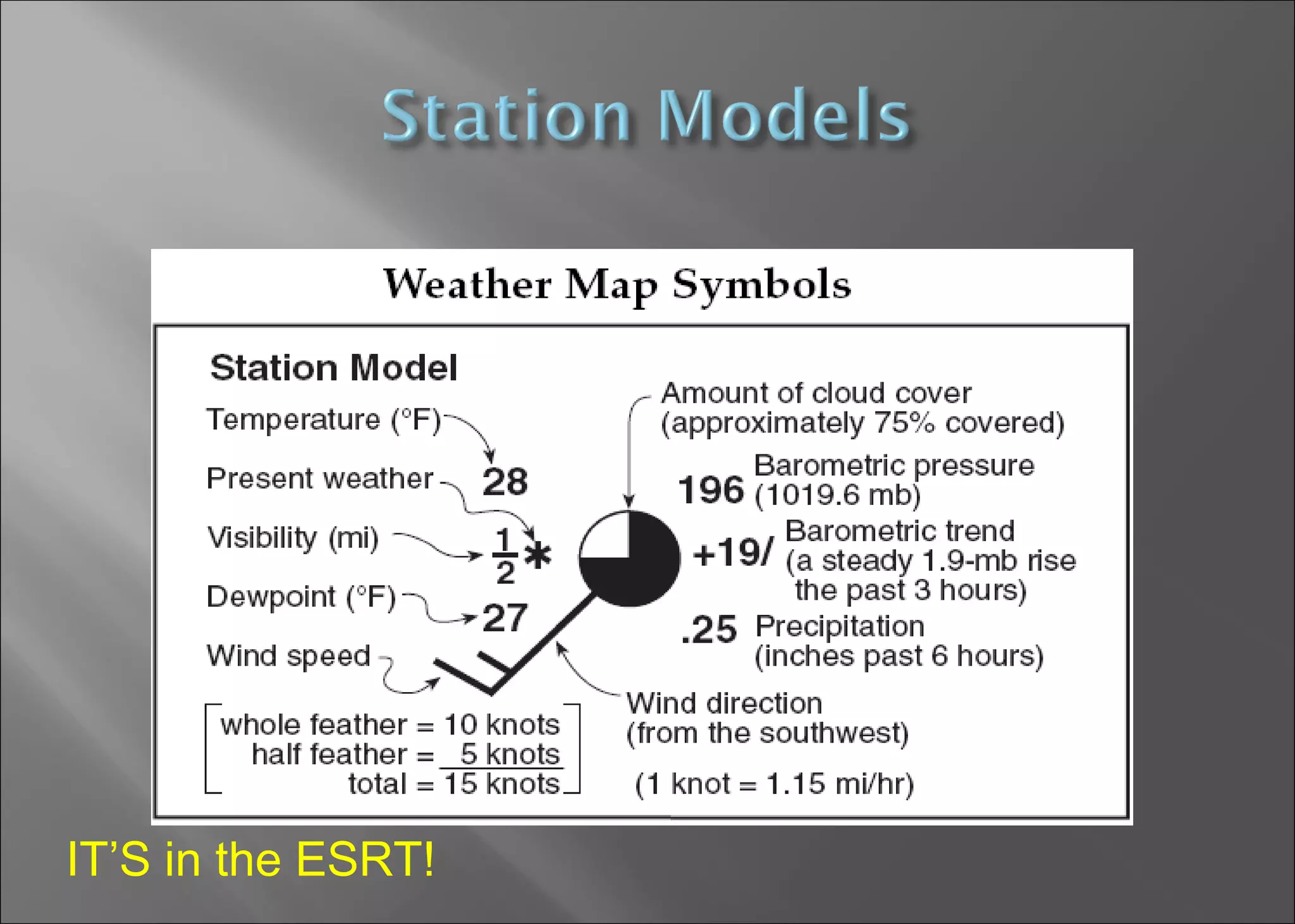
On weather maps, barometric pressure is
represented by a three-digit number to the upper
right of a circle; this circle represents a city on the
map.
053


Rules to follow to determine the value of this
number:
 A decimal point is omitted between the last 2 digits on the
right.
 The number 9 or 10 is omitted in front of this number. If the
original number is above 500, place a 9 in front. If it is
below500, place a 10 in front. (Hint: use whichever will give a
result closest to 1000 mb)
 Example: 053 – 1005.3
Components of Weather

High Pressure System: Anticyclone




Winds blow in a
clockwise direction
and away from the
center
Caused by: More
dense air “falling”
Components of Weather

Low Pressure System: Depression
or Cyclone


Winds move
Counterclockwise and
IN towards the center



Therefore – once they
get to the middle, there
is nowhere to go but

UP




The horizontal
movement of air
parallel to Earth’s
surface.
All wind deflects to the
RIGHT in the
Northern Hemisphere!
How is Wind Formed?

As air cools
it can no
longer rise

Air rises and
cools in the
atmosphere

Cold air
sinks

Ground
heats air
WIND moves from high to low
pressure

HIGH

LOW

Sun heats
ground
1.
2.

Uneven heating at Earth’s surface
Examples:
a.
b.
c.

Land vs. water
Poles vs. equator
Dark forest vs. snow field
1.

Winds always blow
from regions of high
pressure to regions of
low pressure.
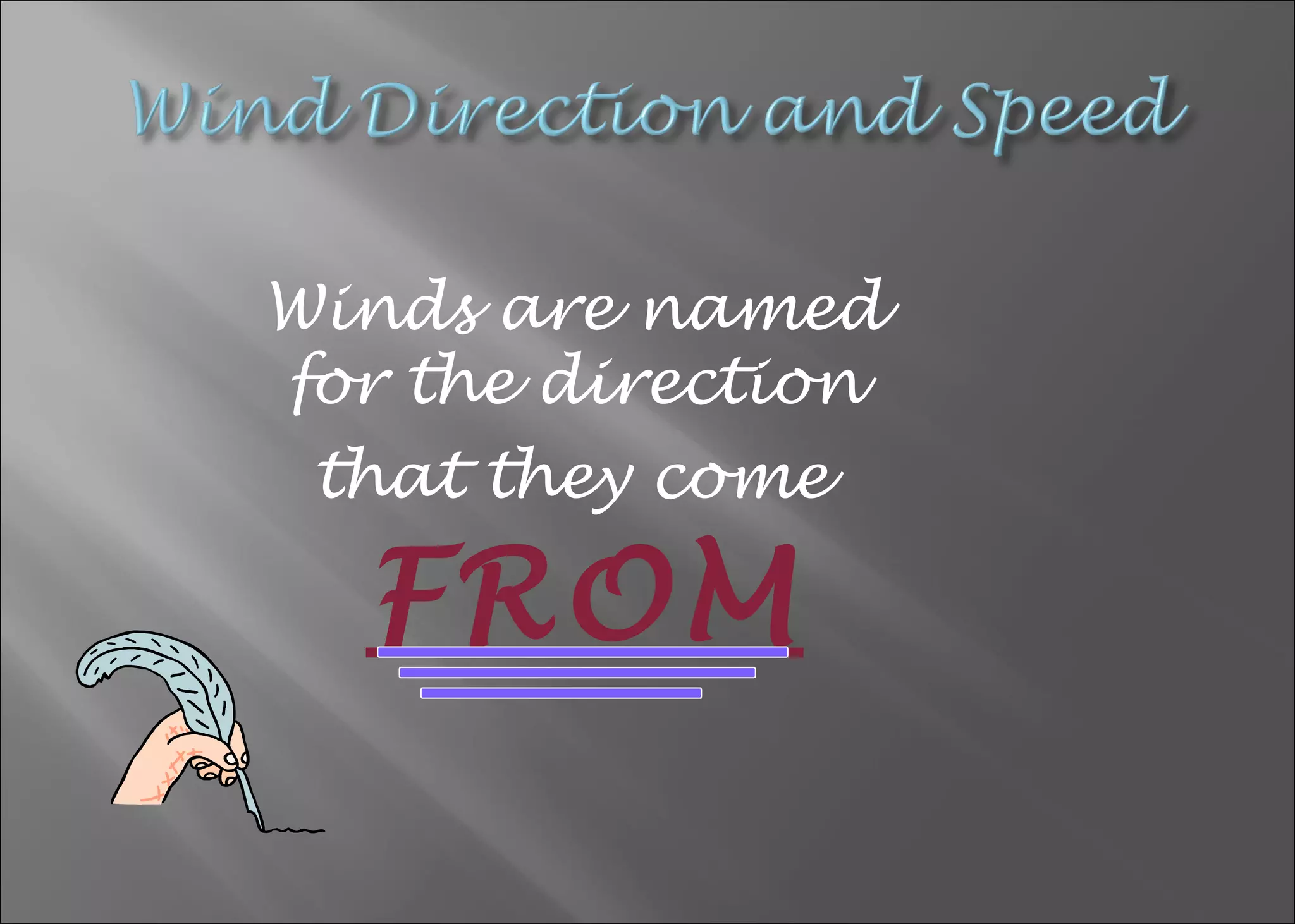
Winds are named
for the direction
that they come

FROM
feather





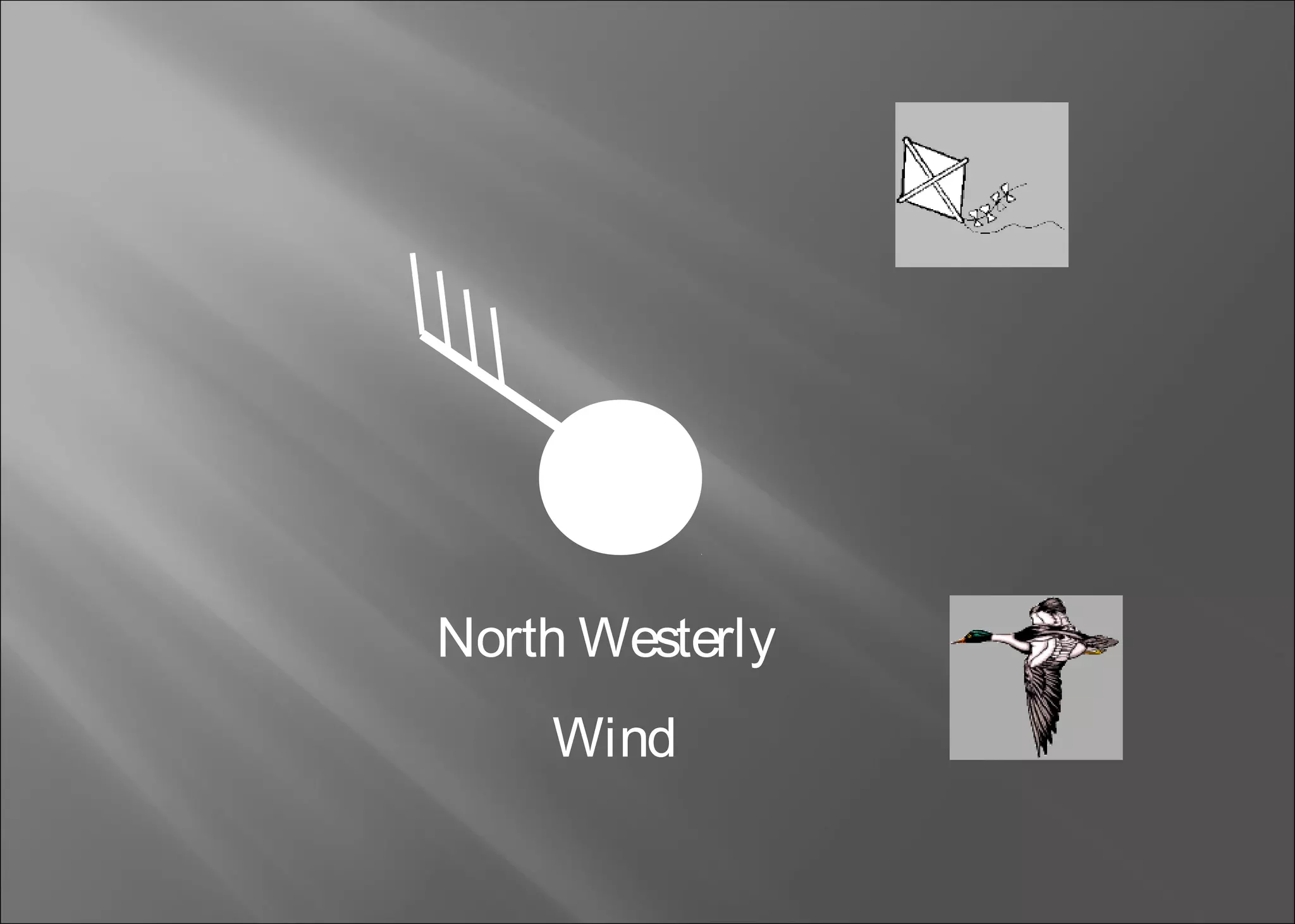
The direction of the line always points to the center of the
circle (in this case pointing east) and indicates the direction
in which the wind is blowing at this location.
Each “feather” represents the wind speed –



Whole feather = 10 knots
Half feather = 5 knots
North Westerly
Wind
2.

3.

4.

The speed of the wind is
determined by the difference in
air pressure.
Pressure gradient – difference in
air pressure ÷ distance between
cities.
As the pressure gradient
increases (isobars are very close
together), wind speed increases.
a.

The coriolis effect –
Earth’s rotation on it’s
axis causes winds to be
deflected to the right in
the northern
hemisphere and to the
left in the southern
hemisphere.




The unequal distribution
of Insolation causes
unequal heating of the
Earth which causes
differences in pressure
which result in winds.
Cooler air, being more
dense, sinks toward
Earth due to gravity,
causing warmer, less

dense air to rise


Earth’s rotation
causes the Coriolis
Effect which results
in the three (or six)
cell circulation of
winds as illustrated
in your notes.
Components of Weather

Air Masses
What is an Air Mass?
An air mass is a large body of air in the
troposphere moving in a particular direction,
with the same temperature, pressure and
humidity throughout.
Components of Weather
Air Masses Affecting the U.S.
2. Types of Air Masses
a)

b)

c)

Tropical – originates in the tropics (low
latitudes). Characterized by warm air.
Polar – originates in polar regions (high
latitudes). It is characterized by cold air.
Arctic – originates in ice covered arctic
regions (winter only). It is very cold and
dry.
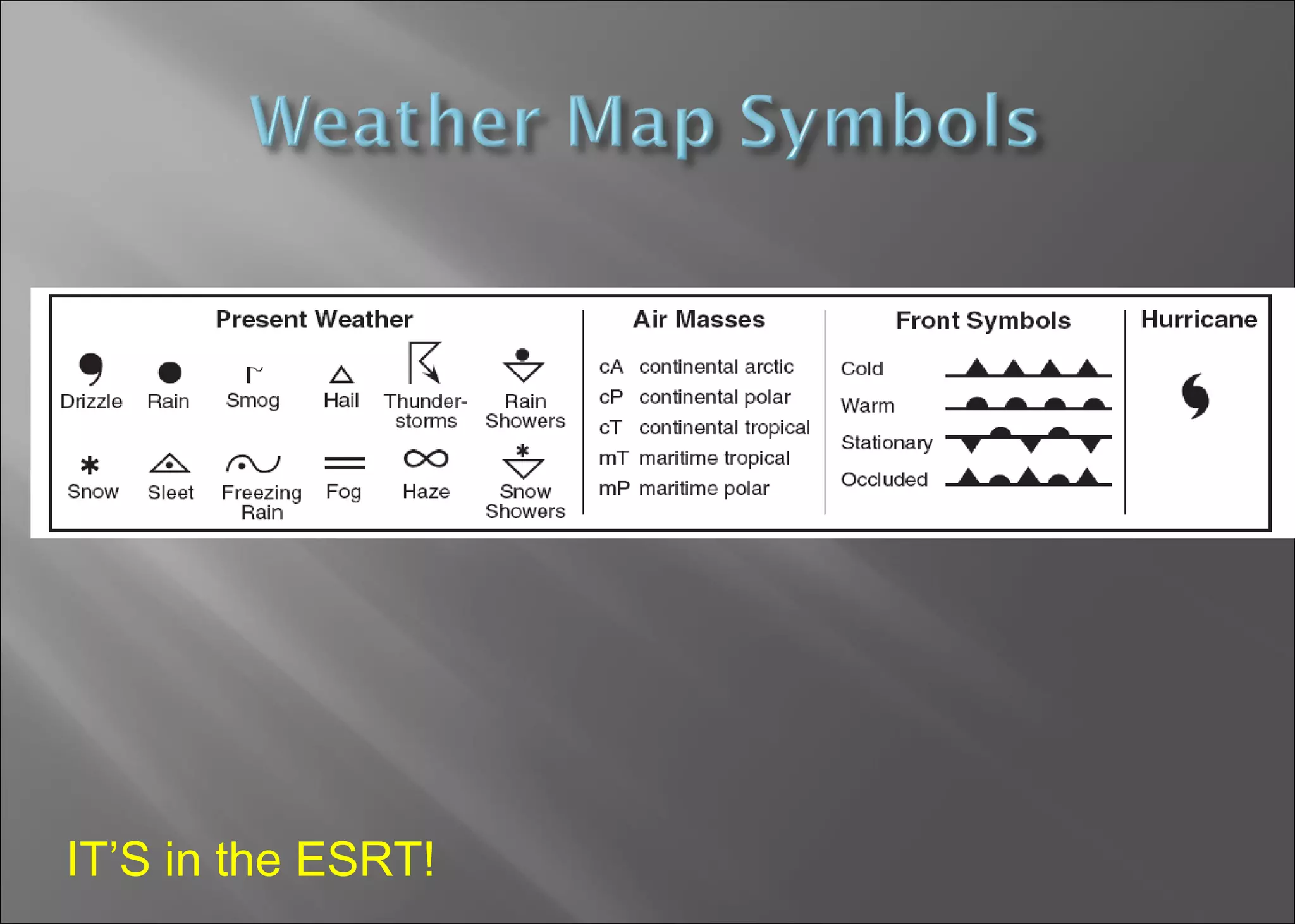
It’s right here in ESRT
d.

Continental – think LAND.
It is dry.

e. Maritime – think SEA. It is
wet.
3. Air masses are a combination
of temperature and moisture
conditions.
Types of Fronts
a.
Cold
b.
Warm
c.
Stationary
d.
Occluded
IT’S in the ESRT!
IT’S in the ESRT!
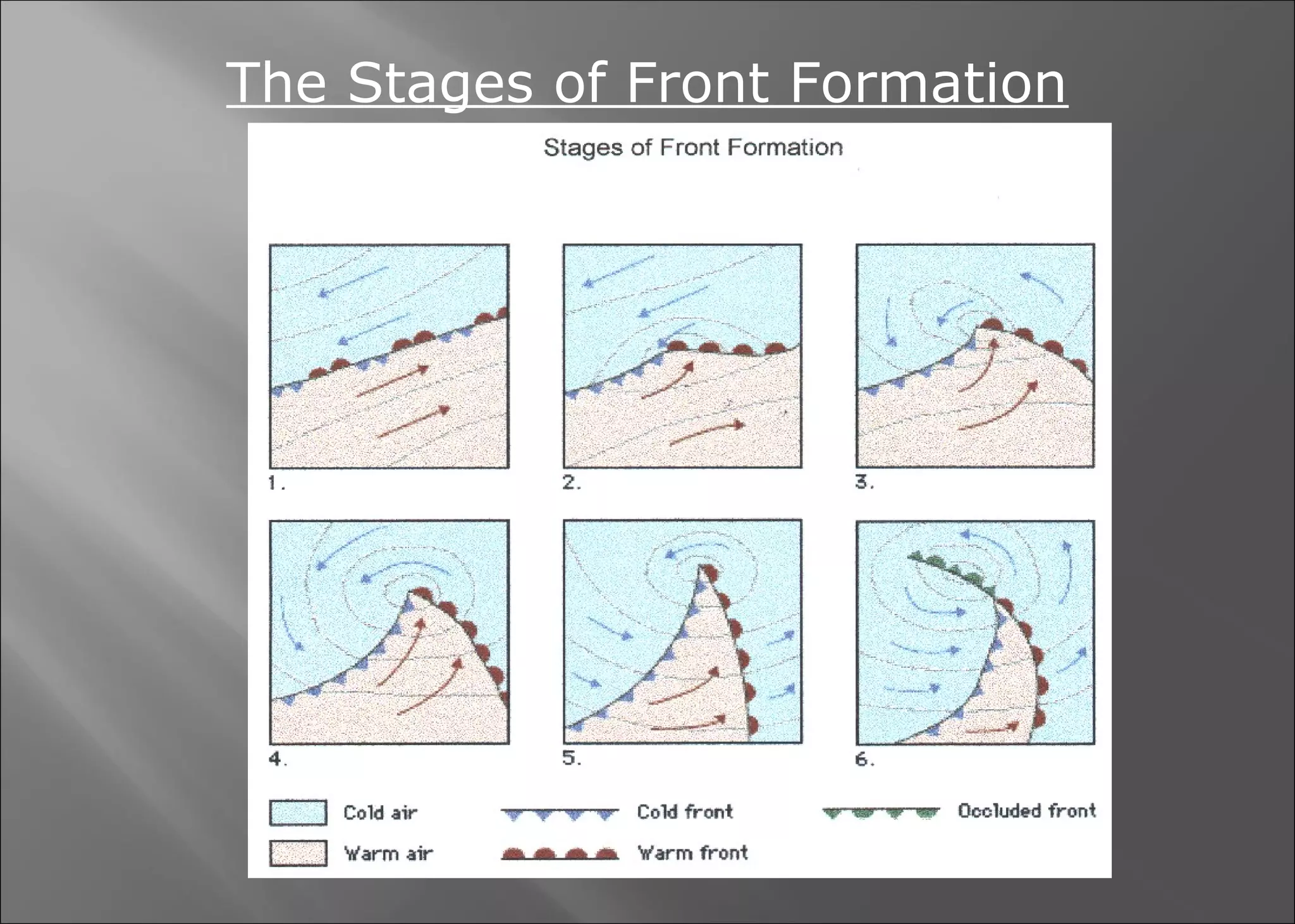
The Stages of Front Formation
Table is on page 26
of notes!

Warm Front

Cold Front

Occluded Front

Warm air

Cold Air –moves fast

Cold air meets warm
air and mixes

Showers for long
period

Air is dense and hugs the
ground

precipitation

Lots of Clouds as air
rises up

“bullies” the warm air UP
quickly

Wind changes

Covers wide area

Brings intense change –
brief periods of stormy
weather (severe)
Thunderstorms, lightning,
tornadoes

Stationary Front: Warm and Cold air meet head on and neither gives way. Low pressure usually


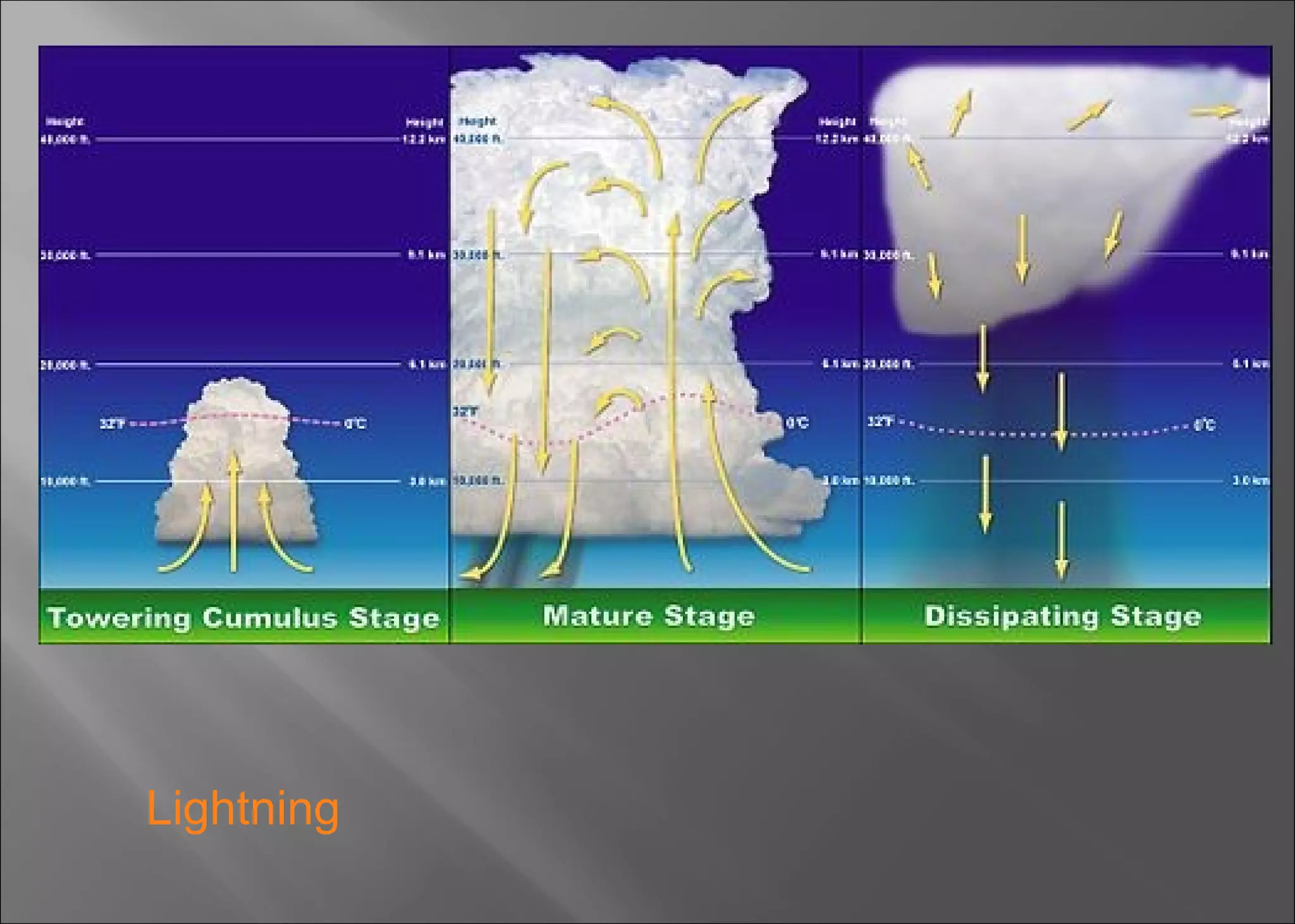
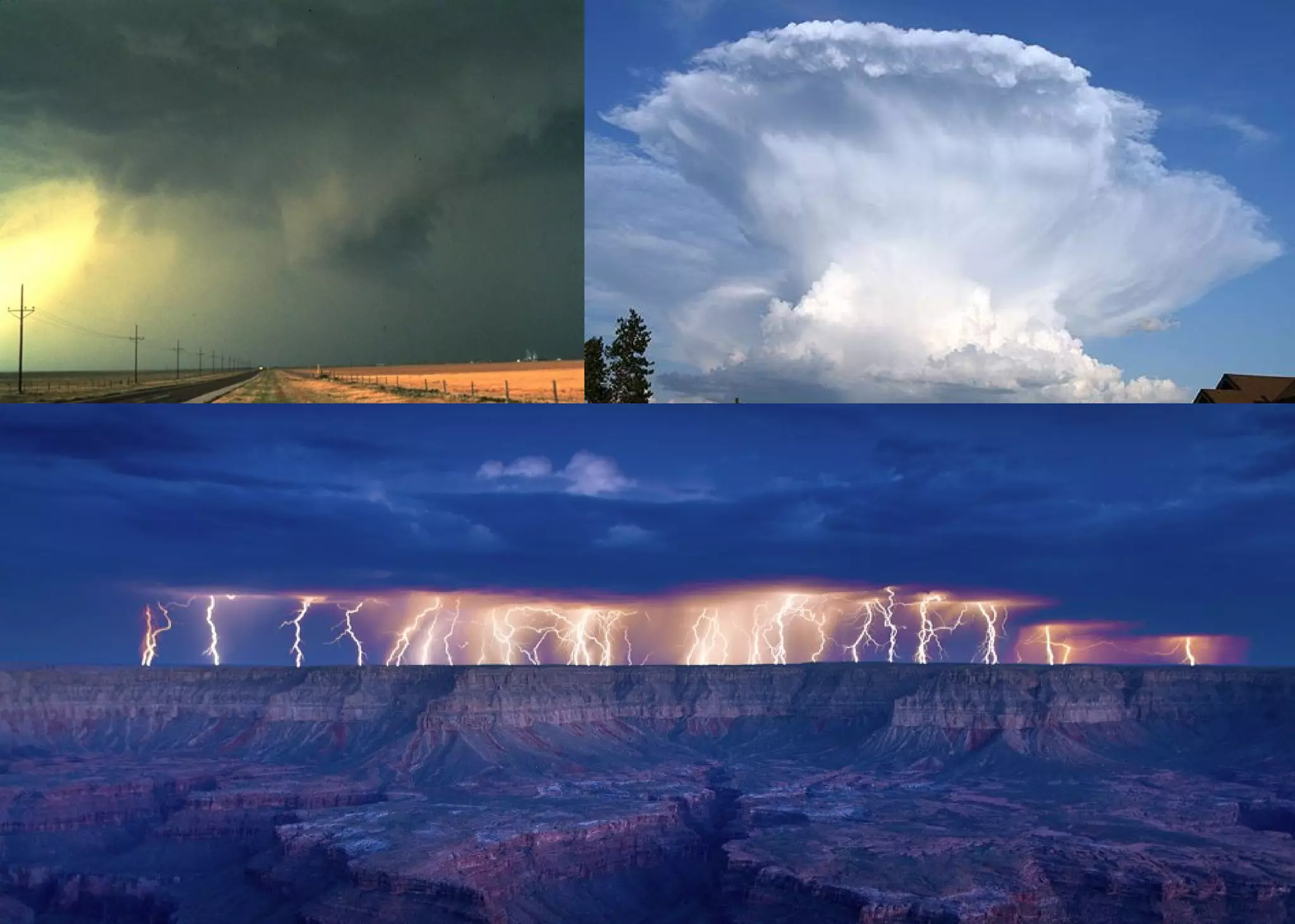
Thunderstorms:
A storm that generates lightning and thunder.
 Frequently produce strong winds, heavy rain, and hail.
 At any given time, there are an estimated 2000
thunderstorms in progress on Earth.
 In the US, Florida and the eastern Gulf Coast region
experience the most activity.
 Develop when warm, humid air rises in an unstable
environment.

Lightning


Tornadoes
Violent windstorms that take the form of a rotating
column of air called a vortex, which extends downward
from a cumulonimbus cloud.
 The US experiences approximately 700 tornadoes each
year.
 Greatest occurrence is from April-June (but can happen
anytime).
 Most frequently in the Central USA! Unique…..
 Measured using the Enhanced Fujita Scale.

The Birth of a Tornado
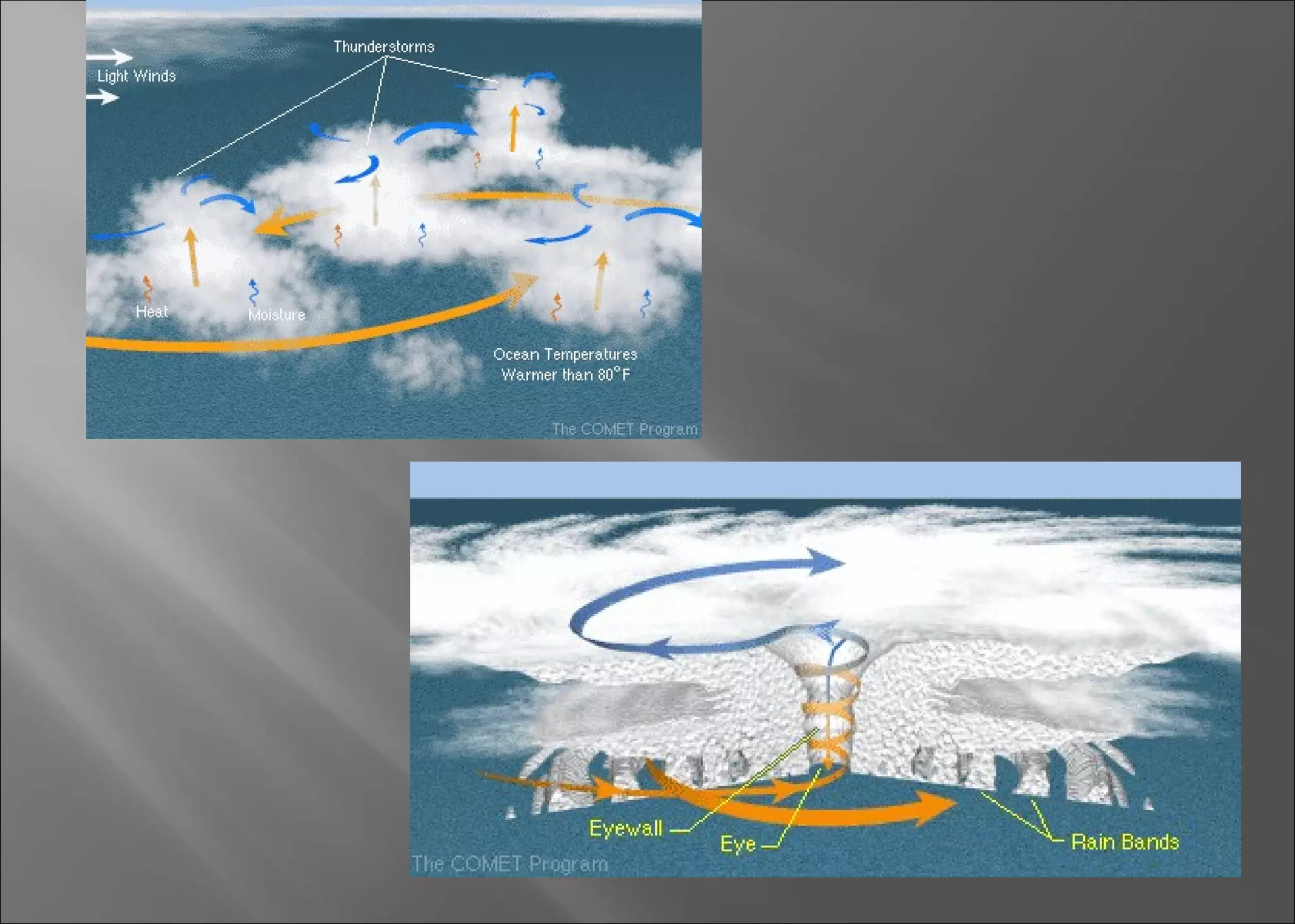
A hurricane is a heat engine that gets its energy from warm
ocean water. These storms develop from tropical depressions
which form off the coast of Africa in the warm Atlantic waters.
When water vapor evaporates it absorbs energy in the form of
heat. As the vapor rises it cools within the tropical depression, it
condenses, releasing heat which sustains the system.
•A tropical depression becomes a hurricane when its sustained
recorded winds reach 74 mph.
•Although hurricane forecasting has improved over the years
tremendously, the path of these storms may only be
approximated.
What do you
mean there are
no more Earth
Science
notes??

Meteorology

  • 1.
  • 2.
     Energy from the SUN– INcoming SOLAr radiaTION Through the seasons, it heats our world, some parts more and some less and this drives both climate (global) and weather (local).
  • 3.
    The electromagnetic spectrumincludes visible light, as well as X-rays, ultraviolet rays and infrared rays.
  • 5.
    Climate is theaverage temperature and moisture conditions over a long period of time.  Water Budget – a system of accounting for moisture income, storage, and outgo for the soil in a specific area.
  • 6.
    Humid climates arethose in which the total amount of precipitation is greater than the total amount of Potential Evapotranspiration (Loss of water to atmosphere)
  • 7.
    Arid climates havesignificantly more total Potential Evapotranspiration than Precipitation
  • 8.
    Latitude • Most important factor in determining climate,especially temperatures • As latitude increases, yearly temperature range (difference between highest and lowest temperature) increases. •
  • 9.
  • 10.
    Marine Continental Location: Ocean/large lake Interior (land) Windsfrom: OCEAN LAND Summers: Cooler than Average (Mild) Warmer than Ave. (Mild) Warmer than average (HOT) Colder than Ave. (Harsh) Kansas, NE, IA, Syracuse Winters: Example: San Francisco, LA, DC
  • 11.
    Uneven heating ofthe Earth produces global wind belts and pressure belts. These “pressure belts” determine the wetness or dryness of a particular location. Low pressure occurs where air is rising and thus precipitation occurs. High pressure regions are areas that lack rainfall (DRY).
  • 12.
     The "Global ConveyerBelt" shows how the oceans move energy from the tropics to the poles and back again in order to moderate Earth's climate. This is accomplished through long-term ocean circulation. •Interesting fact: It takes up to 1000 years for water to completely circulate the oceans!
  • 13.
     A warm oceancurrent resulting from a reversal of the ocean current in the Pacific which results in climate variability around the globe.
  • 15.
       Orographic Effect –Mountains act as barriers to prevailing winds. As the wind hits the windward side of a mountain, the air is forced up, cools, condenses and forms clouds with precipitation. Windward side – Side of the mountain that is exposed to the wind. WET Leeward Side – Descending air warms and it holds more moisture, making it DRY.
  • 16.
    *Why does risingair cool? *As air temperature decreases, its ability to hold water___DECREASES______ DECREASES *Why does falling air warm? Si s, Co Ex ol pan s ds r Ai & Condensation & Precipitation pr Ai rR ise m Co s, nk s se es WINDWARD & W s Topography m ar Prevailing Wind Cascade Mountains LEEWARD
  • 17.
    Weather = thecondition of the atmospheric variables, such as temperature, air pressure, wind, and water vapor, at a particular location for a relatively short period of time.
  • 18.
      Direct result ofTILT & parallelism in orbit distribute energy from vertical to oblique rays Tilt (inclination) spreads concentration of energy over broader area
  • 19.
    This UNEVEN HEATING causes earth’s atmosphereto react and become a gigantic engine that produces an infinite variety of WEATHER.
  • 20.
    1. 2. 3. 4. Temperature Air Pressure Moisture Conditions(Precipitation & Humidity) Wind (Speed & Direction)
  • 21.
  • 22.
     Pyschrometer – measures amountof water vapor (relative humidity)  Rain Gauge – Measures liquid precipitation
  • 23.
     Wind Vane – measureswind direction  Anemometer – measures wind speed
  • 24.
     Thermometer – measures air temperature  Note:In the USA we still use degrees Fahrenheit – the rest of the world measures in oCelsius
  • 25.
     Atmosphere  Complete the questionsin the note packet while you watch!
  • 26.
         Composition of thelower atmosphere (troposphere): 1. Nitrogen = 78% used by bacteria in soil to make nitrates 2. Oxygen = 21% used by humans and animals for respiration 3. Argon = 0.84% 4. Carbon Dioxide = 0.03% used by green plants to make food
  • 27.
     5. Others =0.01% which include:  Helium, Hydrogen, Ozone, Krypton, neon and xenon 6. Also: water vapor, dust particles and pollution
  • 28.
     What is Ozone? O3 – we breathe O2  It occurs naturally in trace amounts in the stratosphere. protects life on Earth from the Sun’s UV radiation.  Ozone  Ozone is created naturally when sunlight splits apart O2 into single O atoms – these then bond to form more O2 or O3
  • 29.
       NO!! The ozone moleculesare randomly scattered among other particles in the stratosphere layer Ozone molecules are exceedingly rare: In every one million molecules of air, fewer than 10 are ozone
  • 30.
      Filters out harmfulUV radiation, which can cause skin cancer, cataracts, faster aging & weakened immune systems UV is also harmful to plants & marine life and it can disrupt the food chain
  • 31.
    CFC – chlorofluorocarbons,which are used in: 1. 2. 3. Coolants in refrigerators Propellants in aerosol cans Electronic cleaning solvents
  • 32.
     Ground-level ozone triggerschest pain, nausea, bronchitis, reduced lung capacity, and aggravates asthma Air Quality Index  An index for reporting daily air quality  Focuses on health effects that can happen within a few days of breathing polluted air  Used for: ground level ozone, particulate matter, carbon dioxide, sulfur dioxide, and nitrogen dioxide
  • 33.
    AIR POLLUTION -any substancein the atmosphere that is harmful ( usually produce long term health effects and can cause death ) Main Sources – burning fossil fuels ( coal and petroleum ) Ex: SOx, CO ( carbon monoxide ), lead, various hydrocarbons Acid Rain ( precipitation ) – side effect of air pollution - gases from burning fossil fuels combine with water in the air to produce acids, then falls back to the earth as precipitation Long Term effects: kills fish, soil contamination, destruction of plants, and crops Mt. Mitchell, NC  Temperature Inversion ( very serious problem ) trees,
  • 35.
     In order forthis reaction to occur, it must be extremely cold. Conditions for this reaction are perfect over Antarctica in the winter months. Can we fix it??  The ozone hole will fix itself given enough time  Many major countries, including the U.S., have placed heavy restrictions on ozone-polluting substances
  • 36.
    December 2013 The false-color view ofthe monthlyaveraged total ozone over the Antarctic pole. The blue and purple colors are where there is the least ozone, and the yellows and reds are where there is more ozone.
  • 37.
    1. 2. 3. 4. 5. 6. 6% reflected from atmosphericscattering (aerosols) 20% reflected by clouds 4% Reradiation: Reflected by Earth’s surface 3% Absorbed by clouds 51% Absorbed by Earth’s surface 16% Absorbed by atmosphere
  • 38.
        Short wave energy(UV) from the Sun comes in and heats the Earth As heat reradiates up from the earth, it is emitted in the form of LONG wave energy (infrared) The long wave energy becomes trapped by gases in the troposphere This trapped gas warms the air much like your car on a hot day.
  • 40.
         Water vapor Methane (CH4) Carbondioxide Nitrous oxide CFCs (chlorofluorocarbons)
  • 41.
    CONDUCTION– Transfer of heatwithin solids atoms are closely packed. CONVECTION – Transfer of heat in liquid or gas results from differences in density RADIATION: The emission or giving off of energy HEAT
  • 42.
    Heat in theatmosphere is recorded as a temperature reading and can then be plotted on a map to see a picture of change. • ISOTHERMS are lines that connect points of equal temperature. Showing temperature distribution in this way making patterns easier to see.
  • 43.
    Why do theisotherms seem to run E – W across the map?
  • 44.
    LAND vs. WATER Landheats up and cools faster than water
  • 45.
    Color DARK vs. LIGHT Darkercolors tend to absorb more insolation than they reflect. Surfaces with lighter colors tend to reflect more insolation than they absorb.
  • 46.
    TEXTURE Smooth vs. Rough Asurface which has a rough or uneven surface will absorb more insolation.
  • 48.
  • 49.
    The primary sourceof moisture for the atmosphere are the OCEANS. Other sources include: Lakes, Rivers, streams Transpiration Moisture in the atmosphere exists in all three states/phases. 1) Gas – known as water vapor 2) Liquid – tiny droplets suspended in the air that form clouds 3) Solid – tiny crystals suspended in the air that form clouds
  • 50.
    HUMIDITY is thegeneral term used to describe the amount of water vapor in the air Temperature determines the amount of water vapor the air can hold.
  • 51.
     e)  As air temperature INCREASES,the amount of water vapor the air can hold INCREASES. Saturation –100% humidity in the atmosphere (precipitation results) At 350C, a cubic meter of air can hold 35 g/m3 of water vapor.
  • 52.
    Temperature – Astemperature increases, evaporation increases Wind – As wind increases, evaporation increases Surface Area – As surface area increases, evaporation increases Humidity – As humidity goes UP, evaporation rates go DOWN
  • 53.
      The temperature to whichair must be cooled to reach saturation. And Condense…….and make clouds! If the air temp drops down to the dew point, condensation will occur. The dew point can tell us how high clouds will form. Clouds form where condensation is occurring.
  • 54.
    a) The drier theair, the faster/more evaporation will occur resulting in greater/more cooling. In turn, the difference in temperature between the dry bulb and wet bulb will be greater/more.
  • 55.
    b. c. The more humidthe air, the LESS evaporation will occur resulting in LESS cooling of the wet bulb thermometer. In turn, the difference in temperature between the dry bulb and wet bulb will be LESS At saturation (100% humidity), the temperature difference between the dry bulb and wet bulb would be zero and precipitation will usually occur!.
  • 56.
     Maximum amount ofwater vapor the air can hold at a given temperature.  The actual amount of water vapor in the air is the absolute humidity. Relative humidity tells "how full" the air is with water. It is expressed in %. 100% is full and can't hold any more. It is saturated. Warm Air = higher humidity (wet) Cold Air = low humidity (dry)   
  • 57.
    Changing Air Temperature Iftemperature increases and moisture in the air remains the same, relative humidity will decrease.
  • 58.
    Changing Absolute Humidity Temperature RelativeHumidity If moisture content of the air increases and temperature stays the same, relative humidity will increase.
  • 59.
    Complete the worksheetwhile watching!
  • 60.
    Using the chartto determine Dew Point & Relative Humidity  It’s easy; if….. – – – You have ½ a brain Pay attention Do your practice!
  • 61.
    The “Dry Bulb” Don’t let it fool you. It is just a thermometer.  It measures the air temperature.  Duh! 20°C
  • 62.
    The “Wet Bulb” Has a little wet booty tied to the bottom.  Gets cool when water evaporates. Wet Booty 12°C
  • 63.
    A Dry Day… A lot of moisture will evaporate.  The wet bulb will be a lot cooler than the dry bulb. 20°C Difference between wet bulb & dry bulb is 12 °C. 20°C 14°C 12°C 8°C
  • 64.
    A Humid Day… A little bit of moisture will evaporate.  The wet bulb will not be much cooler than the dry bulb. 20°C Difference between wet bulb & dry bulb is 6 °C. 14°C
  • 65.
    Page of yournotes has a chart with Dewpoint (DPT) and Relative Humidity (RH)!    Warning #1: Be sure to READ the correct chart: DPT or RH Warning #2: Dew Point Temperature IS NOT “Difference between wet bulb and dry bulb”. Warning #3: The wet bulb temp IS NOT the DPT.
  • 66.
    Dry-bulb temperature isyour air temperature. 20 °C
  • 67.
  • 68.
  • 69.
    Subtract (the difference)between the dry bulb and wet bulb
  • 70.
  • 71.
  • 72.
    Put it alltogether 20°C 8°C 20-8=12 Relative Humidity = 11%
  • 73.
  • 74.
    The Dew PointChart works the same way 14°C 10°C 14-10=4 Dew Point = 6°C
  • 75.
    Try These. Dry Bulb WetBulb 26°C 20 °C 6 °C 5 °C 12 °C 8 °C R Humidity 57% 86% 57% DPT 17 °C 4 °C 4 °C Now do the worksheet for homework on the next page of your notes
  • 76.
    How Do Clouds Form? Expan sion & C ooli ng R ising AIR Con den s ati on Nu Re clei De a c wP hin oi g t nt h Te e mP . W ate rV ap or
  • 77.
     Adiabatic Cooling Asair rises, the atmospheric pressure surrounding the parcel of air decreases. Therefore, the parcel of air expands as it rises.
  • 78.
     As it expands,it becomes cooler. When the temperature of this parcel of air falls to its dew point temperature, the water vapor in the air condenses and a cloud appears in the sky.
  • 80.
    Air pressure actsequally in all directions; it also exists within any object containing air like a building, the human body and “empty” bottles. When you mess with the pressure – “bad” things happen!~ CRUSH!
  • 81.
    a. b. Factors/Variables that cause atmosphericpressure to change: Temperature Moisture Altitude Effect of temperature on air pressure: As air temperature increases; (air molecules move further apart/become less dense) – the air pressure decreases
  • 82.
    c. Effect ofmoisture on air pressure: As humidity increases, air pressure decreases – because when water vapor molecules enter the air, they replace heavier air molecules
  • 83.
    d. Effect of altitudeon air pressure  As altitude increases, air pressure decreases (less air is above and air is less dense
  • 84.
    a. Isobars are linesthat connect points of equal air pressure. Showing air pressure distribution in this way makes patterns easier to see. On U.S. Weather Bureau maps, the interval between isobars is 4 mb.
  • 85.
    On weather maps,barometric pressure is represented by a three-digit number to the upper right of a circle; this circle represents a city on the map. 053
  • 86.
     Rules to followto determine the value of this number:  A decimal point is omitted between the last 2 digits on the right.  The number 9 or 10 is omitted in front of this number. If the original number is above 500, place a 9 in front. If it is below500, place a 10 in front. (Hint: use whichever will give a result closest to 1000 mb)  Example: 053 – 1005.3
  • 88.
    Components of Weather HighPressure System: Anticyclone
  • 89.
      Winds blow ina clockwise direction and away from the center Caused by: More dense air “falling”
  • 90.
    Components of Weather LowPressure System: Depression or Cyclone
  • 91.
     Winds move Counterclockwise and INtowards the center  Therefore – once they get to the middle, there is nowhere to go but UP
  • 92.
      The horizontal movement ofair parallel to Earth’s surface. All wind deflects to the RIGHT in the Northern Hemisphere!
  • 93.
    How is WindFormed? As air cools it can no longer rise Air rises and cools in the atmosphere Cold air sinks Ground heats air WIND moves from high to low pressure HIGH LOW Sun heats ground
  • 94.
    1. 2. Uneven heating atEarth’s surface Examples: a. b. c. Land vs. water Poles vs. equator Dark forest vs. snow field
  • 96.
    1. Winds always blow fromregions of high pressure to regions of low pressure.
  • 97.
    Winds are named forthe direction that they come FROM
  • 98.
    feather   The direction ofthe line always points to the center of the circle (in this case pointing east) and indicates the direction in which the wind is blowing at this location. Each “feather” represents the wind speed –   Whole feather = 10 knots Half feather = 5 knots
  • 99.
  • 100.
    2. 3. 4. The speed ofthe wind is determined by the difference in air pressure. Pressure gradient – difference in air pressure ÷ distance between cities. As the pressure gradient increases (isobars are very close together), wind speed increases.
  • 102.
    a. The coriolis effect– Earth’s rotation on it’s axis causes winds to be deflected to the right in the northern hemisphere and to the left in the southern hemisphere.
  • 104.
      The unequal distribution ofInsolation causes unequal heating of the Earth which causes differences in pressure which result in winds. Cooler air, being more dense, sinks toward Earth due to gravity, causing warmer, less dense air to rise
  • 105.
     Earth’s rotation causes theCoriolis Effect which results in the three (or six) cell circulation of winds as illustrated in your notes.
  • 106.
    Components of Weather AirMasses What is an Air Mass? An air mass is a large body of air in the troposphere moving in a particular direction, with the same temperature, pressure and humidity throughout.
  • 107.
    Components of Weather AirMasses Affecting the U.S.
  • 108.
    2. Types ofAir Masses a) b) c) Tropical – originates in the tropics (low latitudes). Characterized by warm air. Polar – originates in polar regions (high latitudes). It is characterized by cold air. Arctic – originates in ice covered arctic regions (winter only). It is very cold and dry.
  • 109.
    It’s right herein ESRT d. Continental – think LAND. It is dry. e. Maritime – think SEA. It is wet. 3. Air masses are a combination of temperature and moisture conditions.
  • 110.
  • 111.
  • 112.
  • 113.
    The Stages ofFront Formation
  • 114.
    Table is onpage 26 of notes! Warm Front Cold Front Occluded Front Warm air Cold Air –moves fast Cold air meets warm air and mixes Showers for long period Air is dense and hugs the ground precipitation Lots of Clouds as air rises up “bullies” the warm air UP quickly Wind changes Covers wide area Brings intense change – brief periods of stormy weather (severe) Thunderstorms, lightning, tornadoes Stationary Front: Warm and Cold air meet head on and neither gives way. Low pressure usually
  • 115.
     Thunderstorms: A storm thatgenerates lightning and thunder.  Frequently produce strong winds, heavy rain, and hail.  At any given time, there are an estimated 2000 thunderstorms in progress on Earth.  In the US, Florida and the eastern Gulf Coast region experience the most activity.  Develop when warm, humid air rises in an unstable environment. 
  • 116.
  • 118.
     Tornadoes Violent windstorms thattake the form of a rotating column of air called a vortex, which extends downward from a cumulonimbus cloud.  The US experiences approximately 700 tornadoes each year.  Greatest occurrence is from April-June (but can happen anytime).  Most frequently in the Central USA! Unique…..  Measured using the Enhanced Fujita Scale. 
  • 120.
    The Birth ofa Tornado The Birth of a Tornado
  • 121.
    A hurricane isa heat engine that gets its energy from warm ocean water. These storms develop from tropical depressions which form off the coast of Africa in the warm Atlantic waters. When water vapor evaporates it absorbs energy in the form of heat. As the vapor rises it cools within the tropical depression, it condenses, releasing heat which sustains the system. •A tropical depression becomes a hurricane when its sustained recorded winds reach 74 mph. •Although hurricane forecasting has improved over the years tremendously, the path of these storms may only be approximated.
  • 124.
    What do you meanthere are no more Earth Science notes??

Editor's Notes

  • #39 Hot car example: sun’s energy streams into car, seats absorb and change light energy into heat energy, heat is trapped by glass windows Greenhouses: use glass since it traps sun’s energy, grow plants in warm air, even when it is cold outside