Radiate Animals
Chapter 13
Radiate Animals
Phylum Cnidaria & Phylum Ctenophora
Radial Symmetry
Diploblastic – 2 embryonic tissue layers
Phylum Cnidaria
All animals except
sponges belong to
the clade
Eumetazoa, the
animals with true
tissues.
Phylum Cnidaria
Phylum Cnidaria is
one of the oldest
groups in this clade.
Fossil history back
700 MY.
Phylum Cnidaria
Cnidarians have:
Radial symmetry
Gastrovascular cavity – extracellular digestion
Tissues – derived from two embryonic germ layers
Cnidocytes – special cells with stinging organelles
called nematocysts.
Phylum Cnidaria
Cnidarians have
diversified into a wide
range of both sessile
and floating forms
including jellies,
corals, and hydras.
Polymorphism –
some species exist
as both polyps and
medusae during their
life cycles.
Phylum Cnidaria
The basic body plan of a cnidarian is a sac with
a central digestive compartment, the
gastrovascular cavity.
A single opening functions as both mouth and anus.
Phylum Cnidaria
In colonial forms
that share a
gastrovascular
cavity, polyps may
be specialized for
feeding,
reproduction, or
defense.
Body Wall
Cnidarians have an
outer tissue layer,
the epidermis,
derived from
ectoderm, and an
inner gastrodermis,
derived from
endoderm, with
jellylike mesoglea in
between.
Body Wall
The epidermal layer contains several types of
cells organized into tissues.
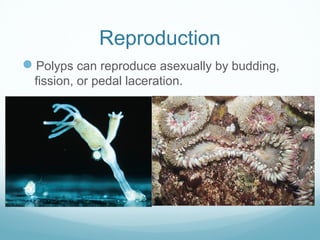
Reproduction
Polyps can reproduce asexually by budding,
fission, or pedal laceration.
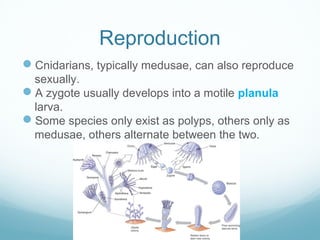
Reproduction
Cnidarians, typically medusae, can also reproduce
sexually.
A zygote usually develops into a motile planula
larva.
Some species only exist as polyps, others only as
medusae, others alternate between the two.
Feeding
Cnidarians are carnivores that use tentacles to
capture prey.
The tentacles are armed with cnidocytes – unique
cells that function in defense and the capture of prey.
Nematocysts contain toxins used for prey capture and
defense.
Feeding
Nematocysts are
used to inject a
toxin.
Variable in form.
May be used for prey
capture or defense.
Feeding
Extracellular digestion begins in the
gastrovascular cavity, but is completed within
the cells of the gastrodermis.
Some cnidarians supplement their diet with
nutrients collected from algal symbionts
(zooxanthellae).
Nerve Net
Cnidarians have a diffuse nervous system.
Nerve cells forming two interconnected nerve nets in
the epidermis and gastrodermis.
No concentrated grouping of nerve cells forming a
central nervous system.
CNS does not provide advantage for radially
symmetrical animals where stimuli approach from
all sides.
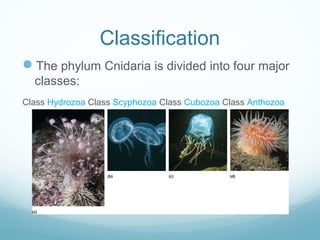
Classification
The phylum Cnidaria is divided into four major
classes:
Class Hydrozoa Class Scyphozoa Class Cubozoa Class Anthozoa
Classification
A fifth class, Staurozoa, has been proposed.
No medusae in life cycle but polyp topped by
medusa-like region.
Phylum Cnidaria
Class Staurozoa
 Commonly called stauromedusans
No medusa stage.
Solitary polyp body that is
stalked.
Uses adhesive disk to attach to
seaweeds, and objects on sea
bottom.
Polyp top resembles a medusa
with eight extensions (“arms”)
ending in tentacle clusters
surrounding mouth.
Reproduce sexually.
Class Hydrozoa
Hydrozoans are
variable in form.
Mostly marine.
Usually colonial,
sometimes solitary.
http://youtu.be/MpSPdeTN74I
Class Hydrozoa – Typical Life Cycle
Most hydrozoans alternate between polyp and
medusa forms.
Some have only polyps.
Some have only medusae.
Class Hydrozoa - Polyps
Typical hydroids have a
base, a stalk, and one or
more terminal zooids
(individual polyp
animals).
Thecate – presence of a
protective cup around
the polyp.
Obelia
Athecate – no such
protection.
Ectopleura
Class Hydrozoa - Medusae
Hydroid medusae are usually
smaller than those in the class
Scyphozoa.
Gastrovascular cavity is
continuous from mouth to
tentacles and is lined by
gastrodermis.
Velum, inward projection of the
bell, is present.
Specialized organs:
Statocysts – equilibrium
Ocelli – light sensitive
Class Hydrozoa
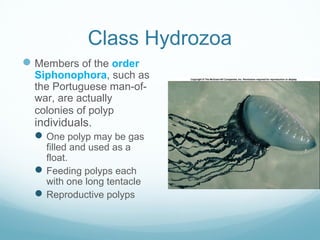
Members of the order
Siphonophora, such as
the Portuguese man-of-
war, are actually
colonies of polyp
individuals.
One polyp may be gas
filled and used as a
float.
Feeding polyps each
with one long tentacle
Reproductive polyps
Class Hydrozoa
Hydrocorals
resemble true
corals.
Calcareous
skeleton
Fire coral
Class Scyphozoa
In the class
Scyphozoa, jellies
(medusae) are the
prevalent form of the
life cycle.
No velum present.
Rhopalium –
sense organ
containing
statocysts and
sometimes ocelli.
Class Scyphozoa
Tentacles around
the periphery of the
bell contain
nematocysts used to
paralyze prey
animals.
In the center are
four frilly oral arms
used to capture and
ingest prey.
http://youtu.be/aJUuotjE3u8
Class Scyphozoa – Typical Life
Cycle
Planula larvae
develop into a
polyp-like form.
Saucer-like buds
called ephyrae
are produced by
strobilation.
Class Cubozoa
In the class
Cubozoa, which
includes box jellies
and sea wasps, the
medusa is box-
shaped and has
complex eyes.
Polyps are tiny and
develop directly into
medusae.
http://youtu.be/CCuNMIT67y8
Class Cubozoa
Class Anthozoa
Class Anthozoa
includes the corals
and sea anemones
which occur only as
polyps – no medusa
stage.
All marine
Solitary or colonial
Sea Anemones – Order
Actinaria
Found in coastal
waters all around the
world.
Attach to rocks
using their pedal
disc.
Feed on fish or any
other food of
suitable size.
Sea Anemones – Order
Actinaria
Sea anemones usually move by gliding slowly
along on their pedal discs.
When a predator approaches, most withdraw.
Stomphia detaches its disc and “swims” away.
http://youtu.be/Dm98n3908QM
Sea Anemones – Order
Actinaria
Tentacles arranged around the central mouth.
The gastrovascular cavity is divided into six
radial chambers.
Increases the surface area of the gastrodermis.
Mutualisms
Sea anemones sometimes harbor zooxanthellae
(photosynthetic protists) like hard corals do.
Some crabs will decorate their shells with anemones.
Mutualisms
Some damselfish (anemone fishes) form
associations with large anemones.
Fish gains protection from living in the anemone.
The fish may help ventilate the anemone, or
keep it free of sediment.
Hexacorallian Corals
Hexacorallian
corals (Order
Scleractinia)
are the true or
stony corals.
Like tiny
anemones
living in
calcareous
cups.
Hexacorallian Corals
Hexacorallians
(Subclass
Hexacorallia) have
a gastrovascular
cavity subdivided by
septa in multiples of
six.
The calcium
carbonate skeleton
is secreted below
living tissue.
Hexacorallian Corals
Polyps may be retracted into the skeleton.
Often retracted during the day.
The polyps expand for feeding.
Tube Anemones and Thorny Corals
Members of
subclass
Ceriantipatharia.
Have coupled but
unpaired septa.
Tube anemones
Solitary and live in
soft sediments.
Tube Anemones and Thorny Corals
Thorny or black corals
Colonial and attach to firm substrata.
Both groups have few species and live in
warmer seas.
Octocorallian Corals
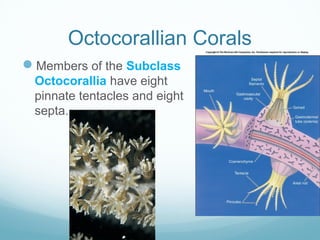
Members of the Subclass
Octocorallia have eight
pinnate tentacles and eight
septa.
Octocorallian Corals
Sea fans, sea pens & sea pansies belong to
this group.
Often beautifully colored.
Cnidaria
Medusozoa
Anthozoa Staurozoa Scyphozoa Cubozoa Hydrozoa
Trachyline-
like
hydrozoaGut with
septal
filaments
Siphonoglyph
Anthozoan
pharynx
Hexaradial
and
octaradial
symmetry
Creeping
planula
without cilia
Strobilation Complex eyes
Velarium
Boxlike
medusa body Polyp lost
Velum in medusae
Medusae produced by
lateral
budding and entocodonMedusoid body form
Motor nerve net
Primary polyp tentacles hollow
Mouth surrounded by solid tentacles
Planula larva
Cnidocytes
Radial, polypoid body form
Rhopalium
Polyp
reduced
or lost
Hydroids Man-of-war Other
hydrozoa
Phylum Cnidaria
Coral Reefs
Coral reefs are one of the most productive and
diverse ecosystems on Earth.
Found in shallow tropical seas.
They require warm water.
Sunlight required for symbiotic zooxanthellae.
Coral Reefs
The main structure of
the reef is calcium
carbonate secreted by
hermatypic (reef-
building) corals and
coralline algae.
Coral Reefs
Octocorallian corals and some hydrozoans
(those known as fire coral) also contribute
calcium carbonate.
Types of Reefs
Fringing reefs are close to a landmass with no
lagoon or a narrow lagoon.
Types of Reefs
Barrier reefs run parallel to shore and have a
wide, deep lagoon.
Types of Reefs
Atolls are reefs that encircle a lagoon, but not
an island.
Types of Reefs
Patch reefs are scattered throughout a lagoon.
Reef Zones
The fore reef slope, or reef front, is the side that
faces the sea.
Slopes into deeper water.
The reef crest is the shallow or even slightly emergent
top of the reef.
The reef flat is the shallow back reef area that slopes
into the lagoon.
Coral Reefs
Nutrients from fertilizer and
sewage threaten coral
reefs with excessive algal
growth.
Coral reefs in many areas
are threatened by factors
mostly of human origin.
Higher atmospheric concentrations of carbon dioxide
(from burning hydrocarbon fuels) tends to acidify
ocean water, which makes precipitation of CaCO3 by
corals more difficult metabolically.
http://www.youtube.com/watch?v=QAaRJKKTOys
Coral Reefs
Symbiosis between
zooxanthellae and corals
is threatened by global
warming.
Warmer water damages the
photosynthetic mechanism
in zooxanthellae.
Coral tissues turn white and
brittle, this is called coral
bleaching.
Zooxanthellae die or are
expelled by corals.
Phylum Ctenophora
Phylum
Ctenophora are the
comb jellies.
No nematocysts.
Tissue level of
organization, like
cnidarians.
Mostly free
swimming.
Phylum Ctenophora
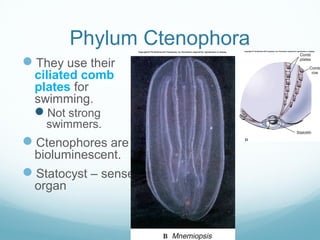
They use their
ciliated comb
plates for
swimming.
Not strong
swimmers.
Ctenophores are
bioluminescent.
Statocyst – sense
organ
Phylogeny
Cnidarians may have evolved from a radially
symmetrical planula-like ancestor.
Trichocysts and toxicysts found in some
ciliates may be precursors to nematocysts.

13. radiate animals

  • 1.
  • 2.
    Radiate Animals Phylum Cnidaria& Phylum Ctenophora Radial Symmetry Diploblastic – 2 embryonic tissue layers
  • 3.
    Phylum Cnidaria All animalsexcept sponges belong to the clade Eumetazoa, the animals with true tissues.
  • 4.
    Phylum Cnidaria Phylum Cnidariais one of the oldest groups in this clade. Fossil history back 700 MY.
  • 5.
    Phylum Cnidaria Cnidarians have: Radialsymmetry Gastrovascular cavity – extracellular digestion Tissues – derived from two embryonic germ layers Cnidocytes – special cells with stinging organelles called nematocysts.
  • 6.
    Phylum Cnidaria Cnidarians have diversifiedinto a wide range of both sessile and floating forms including jellies, corals, and hydras. Polymorphism – some species exist as both polyps and medusae during their life cycles.
  • 7.
    Phylum Cnidaria The basicbody plan of a cnidarian is a sac with a central digestive compartment, the gastrovascular cavity. A single opening functions as both mouth and anus.
  • 8.
    Phylum Cnidaria In colonialforms that share a gastrovascular cavity, polyps may be specialized for feeding, reproduction, or defense.
  • 9.
    Body Wall Cnidarians havean outer tissue layer, the epidermis, derived from ectoderm, and an inner gastrodermis, derived from endoderm, with jellylike mesoglea in between.
  • 10.
    Body Wall The epidermallayer contains several types of cells organized into tissues.
  • 11.
    Reproduction Polyps can reproduceasexually by budding, fission, or pedal laceration.
  • 12.
    Reproduction Cnidarians, typically medusae,can also reproduce sexually. A zygote usually develops into a motile planula larva. Some species only exist as polyps, others only as medusae, others alternate between the two.
  • 13.
    Feeding Cnidarians are carnivoresthat use tentacles to capture prey. The tentacles are armed with cnidocytes – unique cells that function in defense and the capture of prey. Nematocysts contain toxins used for prey capture and defense.
  • 14.
    Feeding Nematocysts are used toinject a toxin. Variable in form. May be used for prey capture or defense.
  • 15.
    Feeding Extracellular digestion beginsin the gastrovascular cavity, but is completed within the cells of the gastrodermis. Some cnidarians supplement their diet with nutrients collected from algal symbionts (zooxanthellae).
  • 16.
    Nerve Net Cnidarians havea diffuse nervous system. Nerve cells forming two interconnected nerve nets in the epidermis and gastrodermis. No concentrated grouping of nerve cells forming a central nervous system. CNS does not provide advantage for radially symmetrical animals where stimuli approach from all sides.
  • 17.
    Classification The phylum Cnidariais divided into four major classes: Class Hydrozoa Class Scyphozoa Class Cubozoa Class Anthozoa
  • 18.
    Classification A fifth class,Staurozoa, has been proposed. No medusae in life cycle but polyp topped by medusa-like region.
  • 19.
    Phylum Cnidaria Class Staurozoa Commonly called stauromedusans No medusa stage. Solitary polyp body that is stalked. Uses adhesive disk to attach to seaweeds, and objects on sea bottom. Polyp top resembles a medusa with eight extensions (“arms”) ending in tentacle clusters surrounding mouth. Reproduce sexually.
  • 20.
    Class Hydrozoa Hydrozoans are variablein form. Mostly marine. Usually colonial, sometimes solitary. http://youtu.be/MpSPdeTN74I
  • 21.
    Class Hydrozoa –Typical Life Cycle Most hydrozoans alternate between polyp and medusa forms. Some have only polyps. Some have only medusae.
  • 22.
    Class Hydrozoa -Polyps Typical hydroids have a base, a stalk, and one or more terminal zooids (individual polyp animals). Thecate – presence of a protective cup around the polyp. Obelia Athecate – no such protection. Ectopleura
  • 23.
    Class Hydrozoa -Medusae Hydroid medusae are usually smaller than those in the class Scyphozoa. Gastrovascular cavity is continuous from mouth to tentacles and is lined by gastrodermis. Velum, inward projection of the bell, is present. Specialized organs: Statocysts – equilibrium Ocelli – light sensitive
  • 25.
    Class Hydrozoa Members ofthe order Siphonophora, such as the Portuguese man-of- war, are actually colonies of polyp individuals. One polyp may be gas filled and used as a float. Feeding polyps each with one long tentacle Reproductive polyps
  • 26.
  • 27.
    Class Scyphozoa In theclass Scyphozoa, jellies (medusae) are the prevalent form of the life cycle. No velum present. Rhopalium – sense organ containing statocysts and sometimes ocelli.
  • 28.
    Class Scyphozoa Tentacles around theperiphery of the bell contain nematocysts used to paralyze prey animals. In the center are four frilly oral arms used to capture and ingest prey. http://youtu.be/aJUuotjE3u8
  • 29.
    Class Scyphozoa –Typical Life Cycle Planula larvae develop into a polyp-like form. Saucer-like buds called ephyrae are produced by strobilation.
  • 30.
    Class Cubozoa In theclass Cubozoa, which includes box jellies and sea wasps, the medusa is box- shaped and has complex eyes. Polyps are tiny and develop directly into medusae. http://youtu.be/CCuNMIT67y8
  • 31.
  • 32.
    Class Anthozoa Class Anthozoa includesthe corals and sea anemones which occur only as polyps – no medusa stage. All marine Solitary or colonial
  • 33.
    Sea Anemones –Order Actinaria Found in coastal waters all around the world. Attach to rocks using their pedal disc. Feed on fish or any other food of suitable size.
  • 34.
    Sea Anemones –Order Actinaria Sea anemones usually move by gliding slowly along on their pedal discs. When a predator approaches, most withdraw. Stomphia detaches its disc and “swims” away. http://youtu.be/Dm98n3908QM
  • 35.
    Sea Anemones –Order Actinaria Tentacles arranged around the central mouth. The gastrovascular cavity is divided into six radial chambers. Increases the surface area of the gastrodermis.
  • 36.
    Mutualisms Sea anemones sometimesharbor zooxanthellae (photosynthetic protists) like hard corals do. Some crabs will decorate their shells with anemones.
  • 37.
    Mutualisms Some damselfish (anemonefishes) form associations with large anemones. Fish gains protection from living in the anemone. The fish may help ventilate the anemone, or keep it free of sediment.
  • 38.
    Hexacorallian Corals Hexacorallian corals (Order Scleractinia) arethe true or stony corals. Like tiny anemones living in calcareous cups.
  • 39.
    Hexacorallian Corals Hexacorallians (Subclass Hexacorallia) have agastrovascular cavity subdivided by septa in multiples of six. The calcium carbonate skeleton is secreted below living tissue.
  • 40.
    Hexacorallian Corals Polyps maybe retracted into the skeleton. Often retracted during the day. The polyps expand for feeding.
  • 41.
    Tube Anemones andThorny Corals Members of subclass Ceriantipatharia. Have coupled but unpaired septa. Tube anemones Solitary and live in soft sediments.
  • 42.
    Tube Anemones andThorny Corals Thorny or black corals Colonial and attach to firm substrata. Both groups have few species and live in warmer seas.
  • 43.
    Octocorallian Corals Members ofthe Subclass Octocorallia have eight pinnate tentacles and eight septa.
  • 44.
    Octocorallian Corals Sea fans,sea pens & sea pansies belong to this group. Often beautifully colored.
  • 45.
    Cnidaria Medusozoa Anthozoa Staurozoa ScyphozoaCubozoa Hydrozoa Trachyline- like hydrozoaGut with septal filaments Siphonoglyph Anthozoan pharynx Hexaradial and octaradial symmetry Creeping planula without cilia Strobilation Complex eyes Velarium Boxlike medusa body Polyp lost Velum in medusae Medusae produced by lateral budding and entocodonMedusoid body form Motor nerve net Primary polyp tentacles hollow Mouth surrounded by solid tentacles Planula larva Cnidocytes Radial, polypoid body form Rhopalium Polyp reduced or lost Hydroids Man-of-war Other hydrozoa Phylum Cnidaria
  • 46.
    Coral Reefs Coral reefsare one of the most productive and diverse ecosystems on Earth. Found in shallow tropical seas. They require warm water. Sunlight required for symbiotic zooxanthellae.
  • 47.
    Coral Reefs The mainstructure of the reef is calcium carbonate secreted by hermatypic (reef- building) corals and coralline algae.
  • 48.
    Coral Reefs Octocorallian coralsand some hydrozoans (those known as fire coral) also contribute calcium carbonate.
  • 49.
    Types of Reefs Fringingreefs are close to a landmass with no lagoon or a narrow lagoon.
  • 50.
    Types of Reefs Barrierreefs run parallel to shore and have a wide, deep lagoon.
  • 51.
    Types of Reefs Atollsare reefs that encircle a lagoon, but not an island.
  • 52.
    Types of Reefs Patchreefs are scattered throughout a lagoon.
  • 53.
    Reef Zones The forereef slope, or reef front, is the side that faces the sea. Slopes into deeper water. The reef crest is the shallow or even slightly emergent top of the reef. The reef flat is the shallow back reef area that slopes into the lagoon.
  • 54.
    Coral Reefs Nutrients fromfertilizer and sewage threaten coral reefs with excessive algal growth. Coral reefs in many areas are threatened by factors mostly of human origin. Higher atmospheric concentrations of carbon dioxide (from burning hydrocarbon fuels) tends to acidify ocean water, which makes precipitation of CaCO3 by corals more difficult metabolically. http://www.youtube.com/watch?v=QAaRJKKTOys
  • 55.
    Coral Reefs Symbiosis between zooxanthellaeand corals is threatened by global warming. Warmer water damages the photosynthetic mechanism in zooxanthellae. Coral tissues turn white and brittle, this is called coral bleaching. Zooxanthellae die or are expelled by corals.
  • 56.
    Phylum Ctenophora Phylum Ctenophora arethe comb jellies. No nematocysts. Tissue level of organization, like cnidarians. Mostly free swimming.
  • 57.
    Phylum Ctenophora They usetheir ciliated comb plates for swimming. Not strong swimmers. Ctenophores are bioluminescent. Statocyst – sense organ
  • 58.
    Phylogeny Cnidarians may haveevolved from a radially symmetrical planula-like ancestor. Trichocysts and toxicysts found in some ciliates may be precursors to nematocysts.