Phylum Cnidaria
• Allhave nematocysts (cnidae)
• Have radial symmetry
• 2 layers (epidermis and gastrodermis)
• Mesoglea between epidermis and gastrodemrmis is a
non-living layer
• All have tentacles surrounding the mouth and
only a single opening to the digestive system
5.
Phylum Cnidaria
• BodyPlan: medusa and polyp
• Planula larvae in the life cycle
• Have muscles and nerves
• Muscles are not true muscles—
epitheliomuscular cells
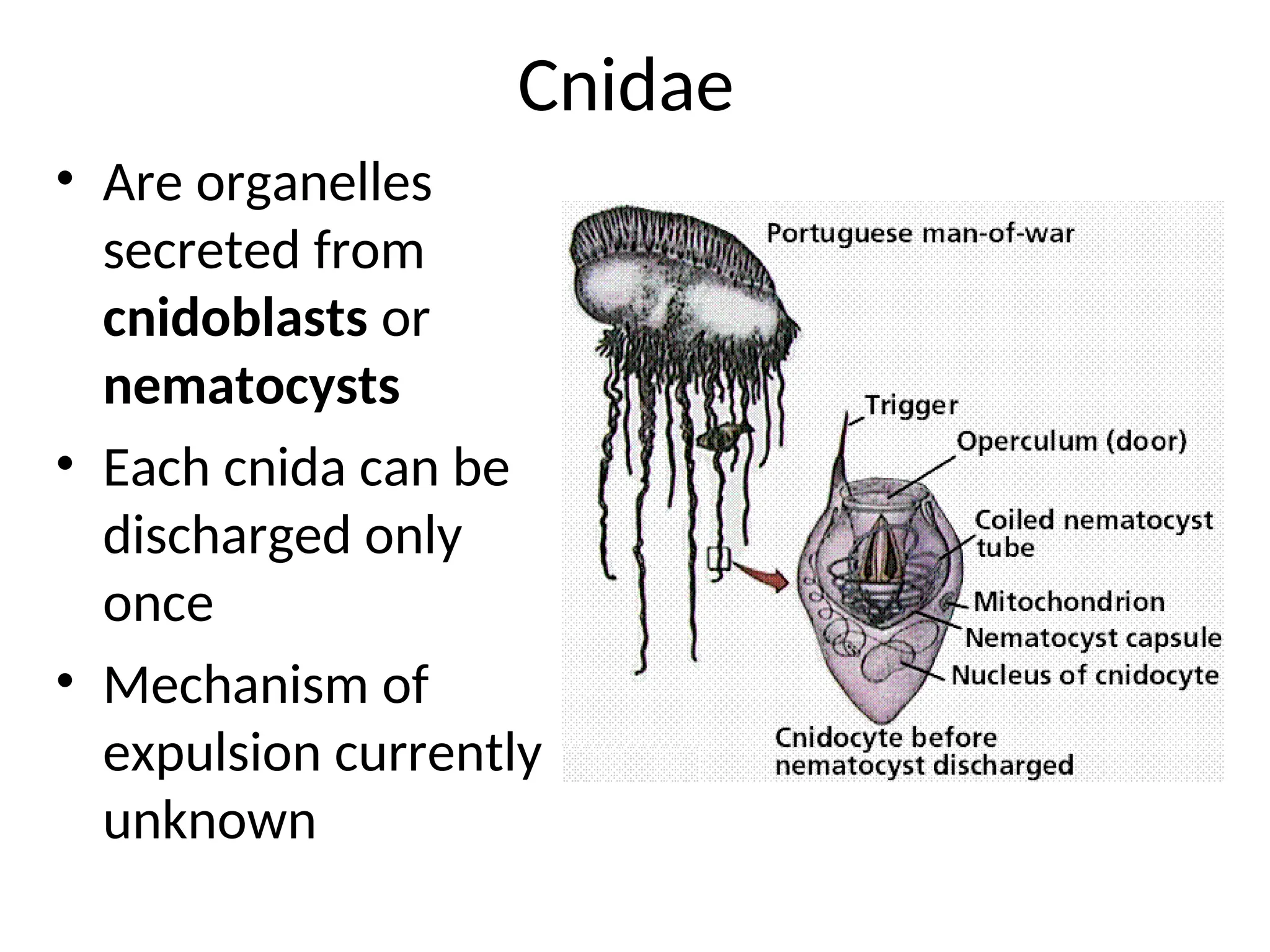
Cnidae
• Are organelles
secretedfrom
cnidoblasts or
nematocysts
• Each cnida can be
discharged only
once
• Mechanism of
expulsion currently
unknown
8.
Class Scyphozoa
(Asexual reproductionby strobilation (budding))
• The true jellies
• Monoecious
• Sperm+egg=
planula
Manubrium - muscular
cylinder that ends in the
mouth
Class Cubozoa
(medusa wboxlike body; rhopalia with complex, lensed eyes)
• Box jellyfish/ seawasp (cubomedusae)
• Restricted to tropical and subtropical waters
• Most derived cnidarians
Chironex fleckeri
11.
Jellyfish Emergency
• Pourvinegar over
affected part, NEVER
alcohol or water
• Children must be brought
to the hospital ASAP for
medical treatment
12.
Class Hydrozoa
• Polypform predominates
• Portuguese man of war
• Hydrocorals– very much like
corals
13.
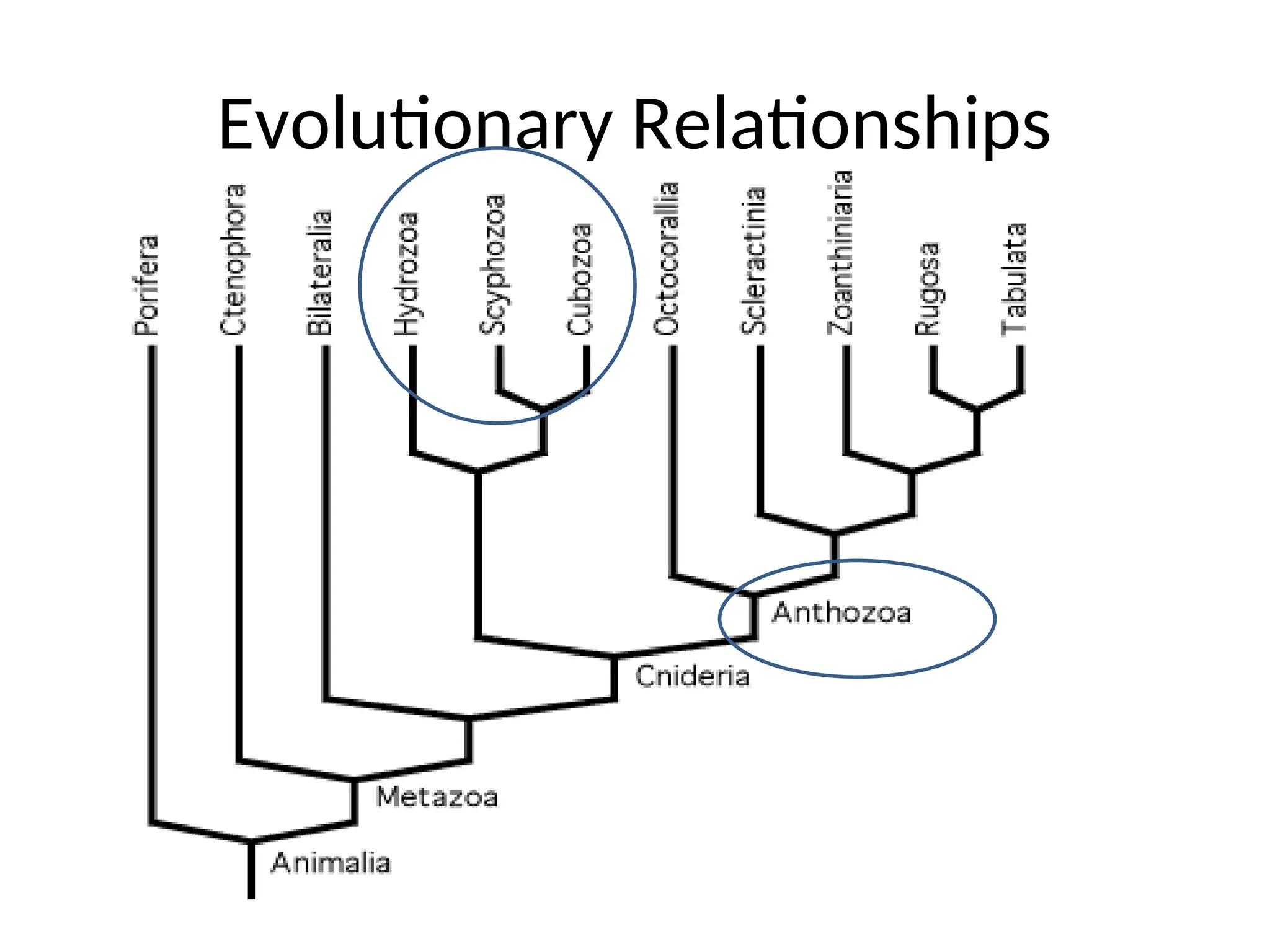
Class Hydrozoa
• OrderHydroidea (hydra)
• Order Siphonophora
– Portuguese man-o-war Physalia sp.
– Floating colony of polymorphic hydrozoans
• nectophores,phyllozooids, gastrozooids, gonozooids,
dactylozooids
• Order Hydrocorallina
14.
Class Anthozoa
(reef-building corals,anemones, sea fans, sea pansies)
• Absence of medusa
• Sea anemones and corals
• 70% of all cnidarian species
• Subclass Hexacorallia
• Subclass Octocorallia
• Coral wars
Anatomy of a polyp (Source: NOAA)
Subclass Hexacorallia
• Canbe ahermatypic or hermatypic (reef-
building corals)
• Endosymbiont photosynthetic dinoflagellates
called zooxanthellae (Symbiodinium) play an
important role in coral growth.
• The symbiosis is quite fragile and can be thrown
off balance by stressors in the environment.
Coral Reefs
• Coralsin a reef are not stationary—there is a
war for space going on all the time.
• The complex interactions and many micro
habitats in a coral reef are key to its high
species diversity.
• This ecosystem is being threatened by
pollution, ocean acidification, and bleaching
higher sea surface temperatures.