





design thinking
eurib design management in 4 dagen
29 november 2013
!

erik roscam abbing | zilver innovation | TU delft
design thinking
what is it?
what designers solve
how designers think
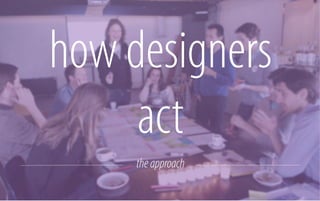
how designers act
cases with tools
sources
what is
design thinking?
and what is it not?
Design thinking is a mindset and an approach to solve problems.
A certain mindset and a certain approach to solve certain problems.
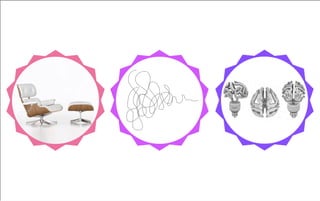
when we talk about

design
we mean:

© 2011 Proto Partners. Confidential & Proprietary.
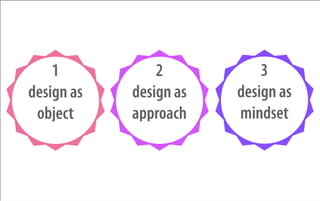
1
design as
object

© 2011 Proto Partners. Confidential & Proprietary.

2
design as
approach

3
design as
mindset
© 2011 Proto Partners. Confidential & Proprietary.
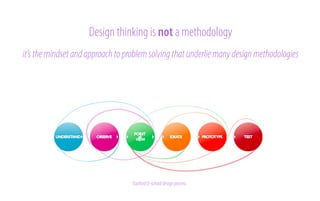
Design thinking is not a methodology
it’s the mindset and approach to problem solving that underlie many design methodologies

Stanford D-school design process
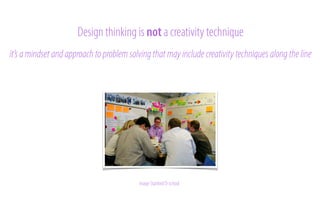
Design thinking is not a creativity technique
it’s a mindset and approach to problem solving that may include creativity techniques along the line

image Stanford D-school
Design thinking is not user centered design
it’s a mindset and approach to problem solving that has user centeredness as one of many traits

http://thepu.sh/
what designers
solve
the problems
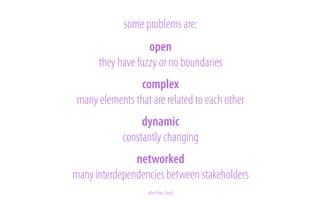
some problems are:
!
!
open
they have fuzzy or no boundaries
!
!
complex
many elements that are related to each other
!
!
dynamic
constantly! changing
!
networked
many interdependencies between stakeholders

after Kees Dorst
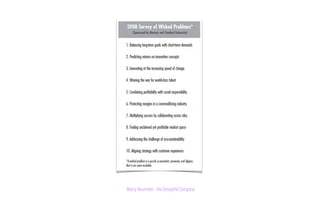
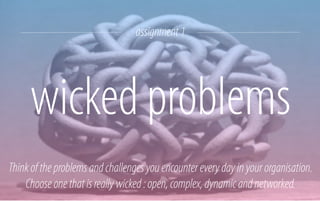
wicked problems
“These are the kinds of problems you can’t manage your way out of;
you have to design your way out of them.”

Marty Neumeier - the Designful Company
assignment 1

wicked problems
Think of the problems and challenges you encounter every day in your organisation.
Choose one that is really wicked : open, complex, dynamic and networked.
how designers
think
the mindset
design thinking is a way of thinking
that is very suitable for solving wicked problems.
!

some designers are good at it, some not
Design thinkers are comfortable with uncertainty and complexity
this allows for the problem and solution to co-evolve
it allows for trial and error: mistakes are learning leaps
thinking in paradoxes, not dilemmas
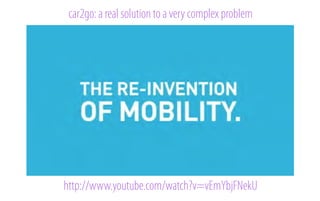
car2go: a real solution to a very complex problem

http://www.youtube.com/watch?v=vEmYbjFNekU
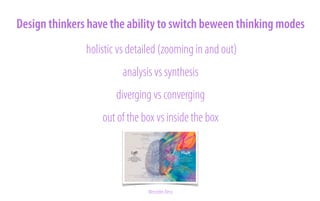
Design thinkers have the ability to switch beween thinking modes
holistic vs detailed (zooming in and out)
analysis vs synthesis
diverging vs converging
out of the box vs inside the box

Mercedes Benz
google loon: a very wild idea, made real through a very scientific approach

http://www.google.com/loon/how/
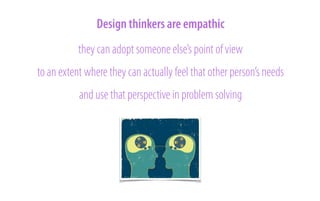
Design thinkers are empathic
they can adopt someone else’s point of view
to an extent where they can actually feel that other person’s needs
and use that perspective in problem solving
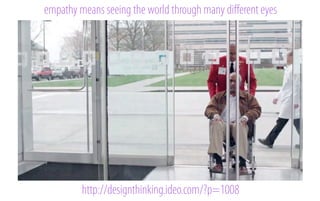
empathy means seeing the world through many different eyes

http://designthinking.ideo.com/?p=1008
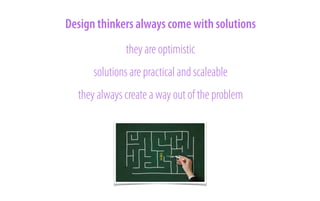
Design thinkers always come with solutions
they are optimistic
solutions are practical and scaleable
they always create a way out of the problem
thinking in small realizable and scalable steps

http://vimeo.com/29602888
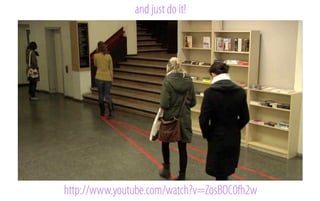
and just do it!

http://www.youtube.com/watch?v=ZosBOC0fh2w
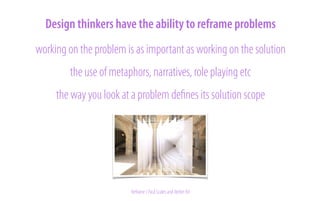
Design thinkers have the ability to reframe problems
working on the problem is as important as working on the solution
the use of metaphors, narratives, role playing etc
the way you look at a problem defines its solution scope

Reframe / Paul Scales and Atelier Kit
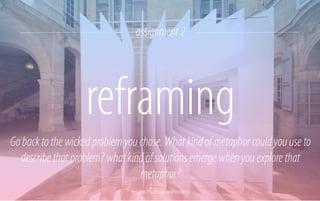
assignment 2

reframing
Go back to the wicked problem you chose. What kind of metaphor could you use to
describe that problem? what kind of solutions emerge when you explore that
metaphor?
Reframe / Paul Scales and Atelier Kit
how designers
act
the approach
the design thinking mindset supports an approach to problem solving
that is very suitable to work on wicked problems
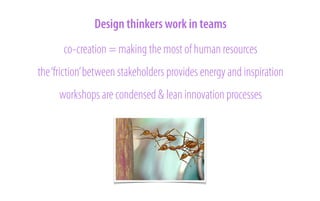
Design thinkers work in teams
co-creation = making the most of human resources
the ‘friction’ between stakeholders provides energy and inspiration
workshops are condensed & lean innovation processes
!
the highline, NYC

http://www.youtube.com/watch?v=F1tVsezifw4
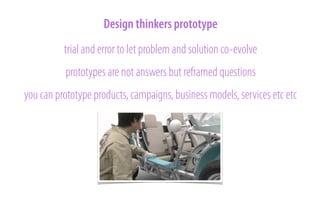
Design thinkers prototype
trial and error to let problem and solution co-evolve
prototypes are not answers but reframed questions
you can prototype products, campaigns, business models, services etc etc
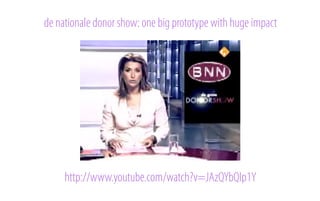
de nationale donor show: one big prototype with huge impact

http://www.youtube.com/watch?v=JAzQYbQlp1Y
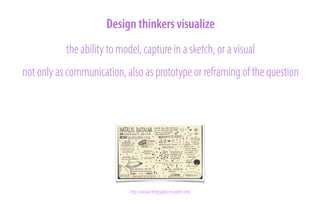
Design thinkers visualize
the ability to model, capture in a sketch, or a visual
not only as communication, also as prototype or reframing of the question

http://www.thegraphicrecorder.com/
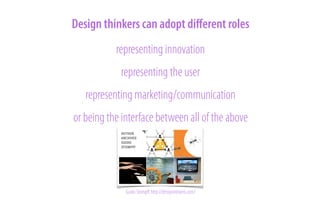
Design thinkers can adopt different roles
representing innovation
representing the user
representing marketing/communication
or being the interface between all of the above

Guido Stompff, http://designinteams.com/
role playing at Virgin Mobile’s Manilla call center. Proto Partners / Zilver project
assignment 3

role playing
Choose some of the key stakeholders in the wicked problem you chose. Appoint people
in the group to play that stakeholder. Now act out some situations. You’re the director.
Keep in mind the metaphor and the ‘ways out’ that you encountered.
Reframe / Paul Scales and Atelier Kit
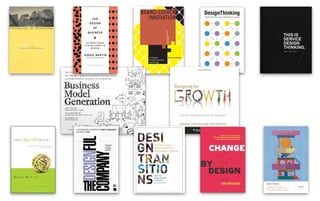
sources
!

of endless wisdom
www.zilverinnovation.com
www.branddriveninnovation.com
www.7daysinmylife.com
www.designthenewbusiness.com
erik@zilverinnovation.com
@roscamabbing

Zilver on design thinking

  • 1.
    design thinking eurib designmanagement in 4 dagen 29 november 2013 ! erik roscam abbing | zilver innovation | TU delft
  • 3.
    design thinking what isit? what designers solve how designers think how designers act cases with tools sources
  • 4.
  • 5.
    Design thinking isa mindset and an approach to solve problems. A certain mindset and a certain approach to solve certain problems.
  • 6.
    when we talkabout design we mean: © 2011 Proto Partners. Confidential & Proprietary.
  • 7.
    1 design as object © 2011Proto Partners. Confidential & Proprietary. 2 design as approach 3 design as mindset
  • 8.
    © 2011 ProtoPartners. Confidential & Proprietary.
  • 9.
    Design thinking isnot a methodology it’s the mindset and approach to problem solving that underlie many design methodologies Stanford D-school design process
  • 10.
    Design thinking isnot a creativity technique it’s a mindset and approach to problem solving that may include creativity techniques along the line image Stanford D-school
  • 11.
    Design thinking isnot user centered design it’s a mindset and approach to problem solving that has user centeredness as one of many traits http://thepu.sh/
  • 12.
  • 13.
    some problems are: ! ! open theyhave fuzzy or no boundaries ! ! complex many elements that are related to each other ! ! dynamic constantly! changing ! networked many interdependencies between stakeholders after Kees Dorst
  • 14.
  • 15.
    “These are thekinds of problems you can’t manage your way out of; you have to design your way out of them.” Marty Neumeier - the Designful Company
  • 16.
    Marty Neumeier -the Designful Company
  • 17.
    assignment 1 wicked problems Thinkof the problems and challenges you encounter every day in your organisation. Choose one that is really wicked : open, complex, dynamic and networked.
  • 18.
  • 19.
    design thinking isa way of thinking that is very suitable for solving wicked problems. ! some designers are good at it, some not
  • 20.
    Design thinkers arecomfortable with uncertainty and complexity this allows for the problem and solution to co-evolve it allows for trial and error: mistakes are learning leaps thinking in paradoxes, not dilemmas
  • 21.
    car2go: a realsolution to a very complex problem http://www.youtube.com/watch?v=vEmYbjFNekU
  • 22.
    Design thinkers havethe ability to switch beween thinking modes holistic vs detailed (zooming in and out) analysis vs synthesis diverging vs converging out of the box vs inside the box Mercedes Benz
  • 23.
    google loon: avery wild idea, made real through a very scientific approach http://www.google.com/loon/how/
  • 24.
    Design thinkers areempathic they can adopt someone else’s point of view to an extent where they can actually feel that other person’s needs and use that perspective in problem solving
  • 25.
    empathy means seeingthe world through many different eyes http://designthinking.ideo.com/?p=1008
  • 26.
    Design thinkers alwayscome with solutions they are optimistic solutions are practical and scaleable they always create a way out of the problem
  • 27.
    thinking in smallrealizable and scalable steps http://vimeo.com/29602888
  • 28.
    and just doit! http://www.youtube.com/watch?v=ZosBOC0fh2w
  • 29.
    Design thinkers havethe ability to reframe problems working on the problem is as important as working on the solution the use of metaphors, narratives, role playing etc the way you look at a problem defines its solution scope Reframe / Paul Scales and Atelier Kit
  • 31.
    assignment 2 reframing Go backto the wicked problem you chose. What kind of metaphor could you use to describe that problem? what kind of solutions emerge when you explore that metaphor? Reframe / Paul Scales and Atelier Kit
  • 32.
  • 33.
    the design thinkingmindset supports an approach to problem solving that is very suitable to work on wicked problems
  • 34.
    Design thinkers workin teams co-creation = making the most of human resources the ‘friction’ between stakeholders provides energy and inspiration workshops are condensed & lean innovation processes !
  • 35.
  • 36.
    Design thinkers prototype trialand error to let problem and solution co-evolve prototypes are not answers but reframed questions you can prototype products, campaigns, business models, services etc etc
  • 37.
    de nationale donorshow: one big prototype with huge impact http://www.youtube.com/watch?v=JAzQYbQlp1Y
  • 38.
    Design thinkers visualize theability to model, capture in a sketch, or a visual not only as communication, also as prototype or reframing of the question http://www.thegraphicrecorder.com/
  • 39.
    Design thinkers canadopt different roles representing innovation representing the user representing marketing/communication or being the interface between all of the above Guido Stompff, http://designinteams.com/
  • 40.
    role playing atVirgin Mobile’s Manilla call center. Proto Partners / Zilver project
  • 41.
    assignment 3 role playing Choosesome of the key stakeholders in the wicked problem you chose. Appoint people in the group to play that stakeholder. Now act out some situations. You’re the director. Keep in mind the metaphor and the ‘ways out’ that you encountered. Reframe / Paul Scales and Atelier Kit
  • 42.
  • 46.