
DESIGN THINKING
A talk on …
Marcel Zwiers
@marcelzwiers
linkedin.com/in/zwiers
marcel@31volts.com
short introduction
Marcel Zwiers, Founder and Creative Director at 31Volts,
First Service Design practice in the Netherlands.
1995. Graduation project that looks like a cardboard bicycle design, but turned
out to be of strategic value to sponsor Fokker Aircraft.
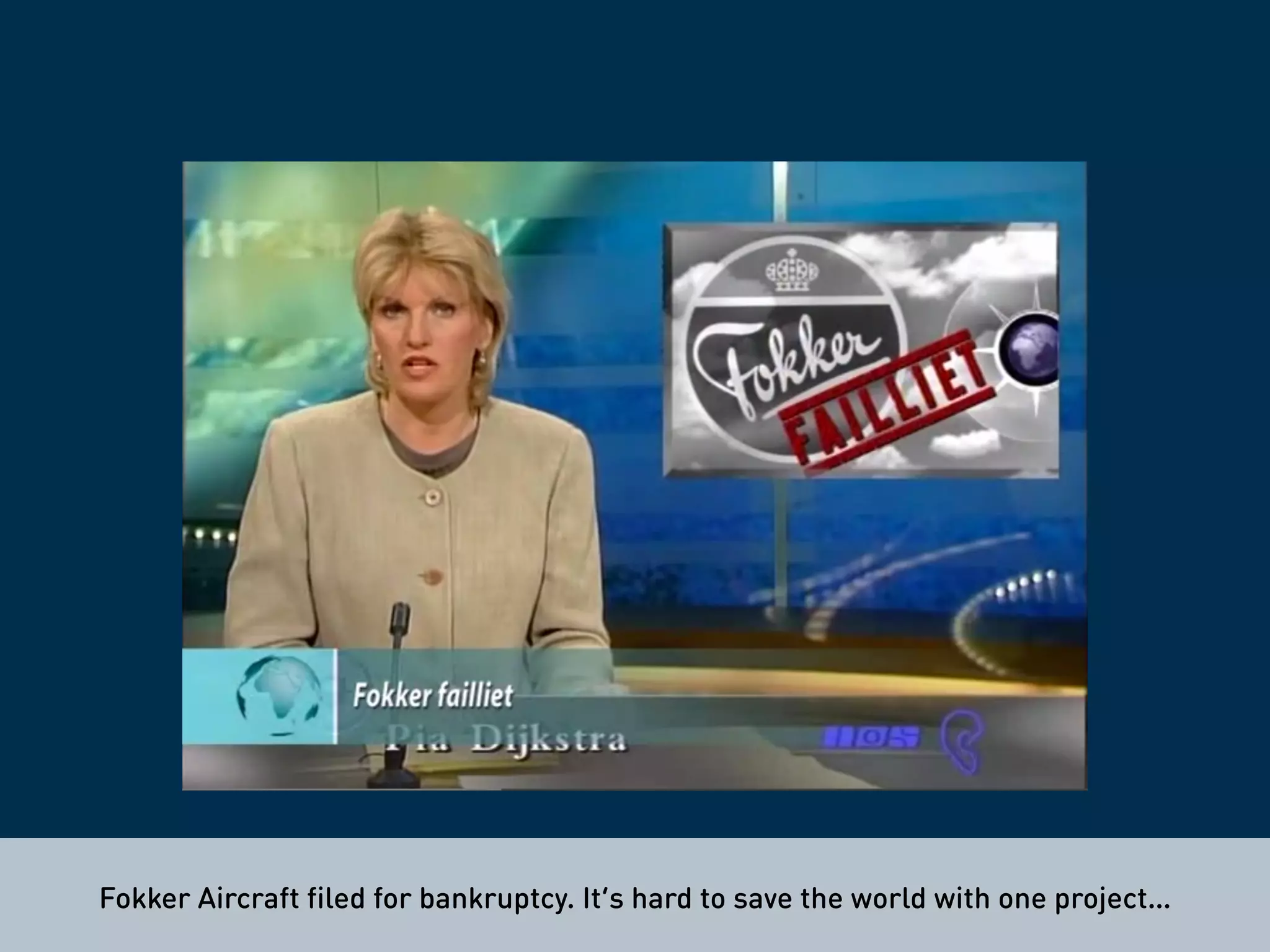
Fokker Aircraft filed for bankruptcy. It’s hard to save the world with one project…
The current design practice at 31Volts is very dynamic with lots of interactions with client
teams and their customers. New service concepts are created by designing with people.
… and by Design Research to better understand people, …
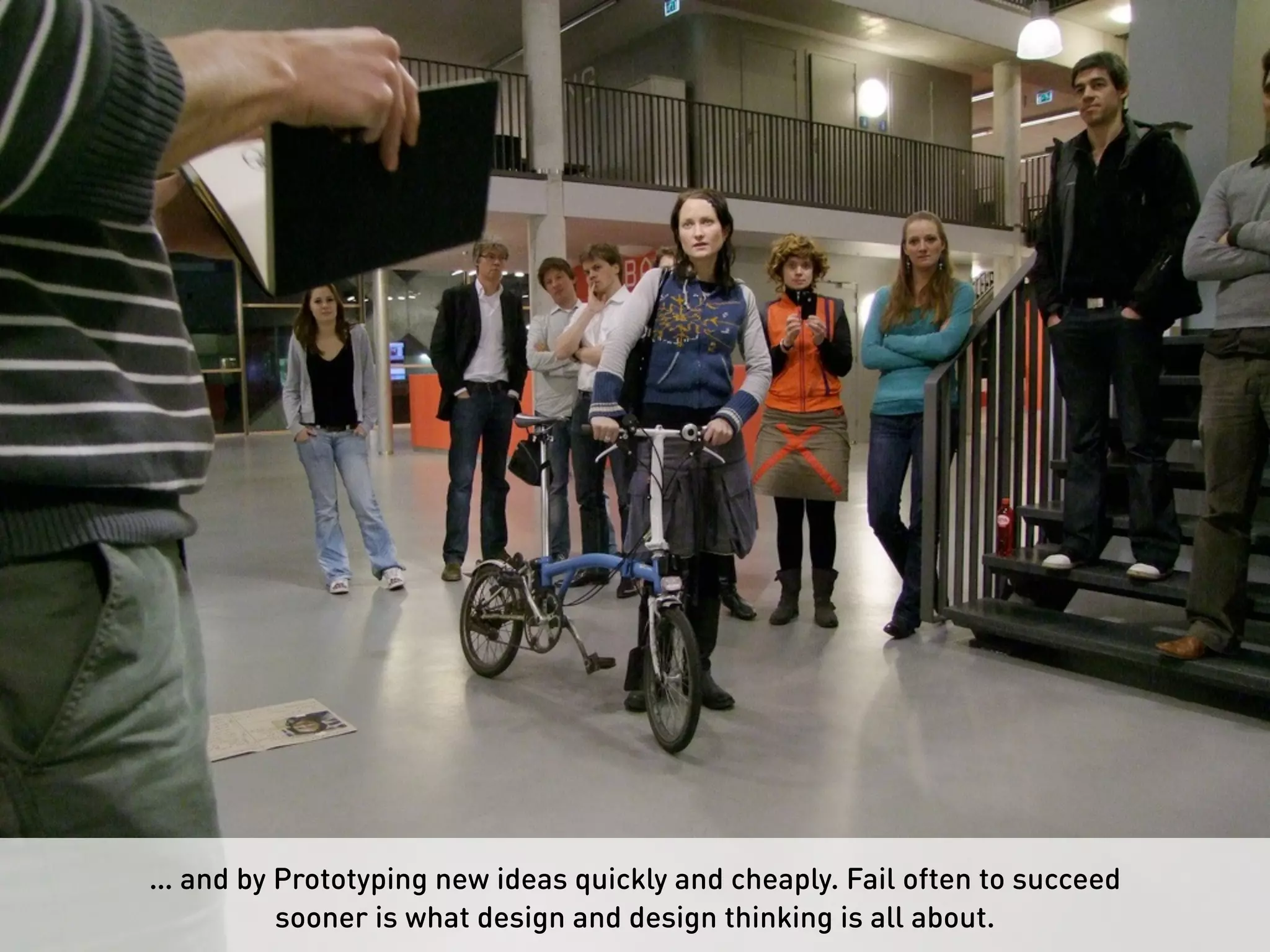
… and by Prototyping new ideas quickly and cheaply. Fail often to succeed
sooner is what design and design thinking is all about.
Incomplete history of Design
Incomplete theory of Design Thinking
How Design Thinking works
The Values of Design
Book & Video Tips
slide 10
slide 23
slide 50
slide 60
slide 68
Content
DESIGN
Incomplete history of
The stone spear heads, dating back 500.000 years, might be the first sign of a
product that has been created with a human centric use case and purpose in mind.
Louis Henry Sullivan "father of skyscrapers"
(September 3, 1856 – April 14, 1924)
Price of Steel at Bessemer
Steel Rails 1867 to 1895
1867- $166 ($/ton)
1870- $107
1875- $69
1880- $68
1885- $29
1890- $32
1895- $32
Prudential Building, Buffalo, New York, 1894
Different dynamics in society (people moving to cities), economics (cheap materials) and
new technologies (mass produced steel beams) created opportunities for architects.
The re-invention of Multiplex by Immanuel Nobel (1801–1872) provided new
opportunities for designing and building furniture.
Not only is design used to build a brand, the designer also created an entirely new
way of consumption. More individual and free of a fixt location (bar).
Designer Dieter Rams was not only the main designer of BRAUN, creating beautiful
products, he also understood the need for optimism in post WW2 Germany.
In the 80-ties and 90-ties of the last century, the designers became more and more
rockstars. You didn't buy a new chair, you bought a Philippe Starck.
With products like televisions and computers some product became less important (like
this remote) because they are just interfaces for something else.
Smart phones are nice examples of products that are valuable through installed software.
Helping you find your way around, take notes, stay in contact with others and much more ..
21st century
Design in the
Design in the 21st century is still about beauty, form & function, etc.
However…
… the starting point is often very complex. The way people think and do, their values, needs
and other intangible aspects that are becoming more important.
DESIGN THINKING
Incomplete theory of
”Unlike analytical thinking, design thinking
is a creative process based around the
"building up" of ideas. There are no
judgments early on in design thinking. This
eliminates the fear of failure and encourages
maximum input and participation in the
ideation and prototype phases.”
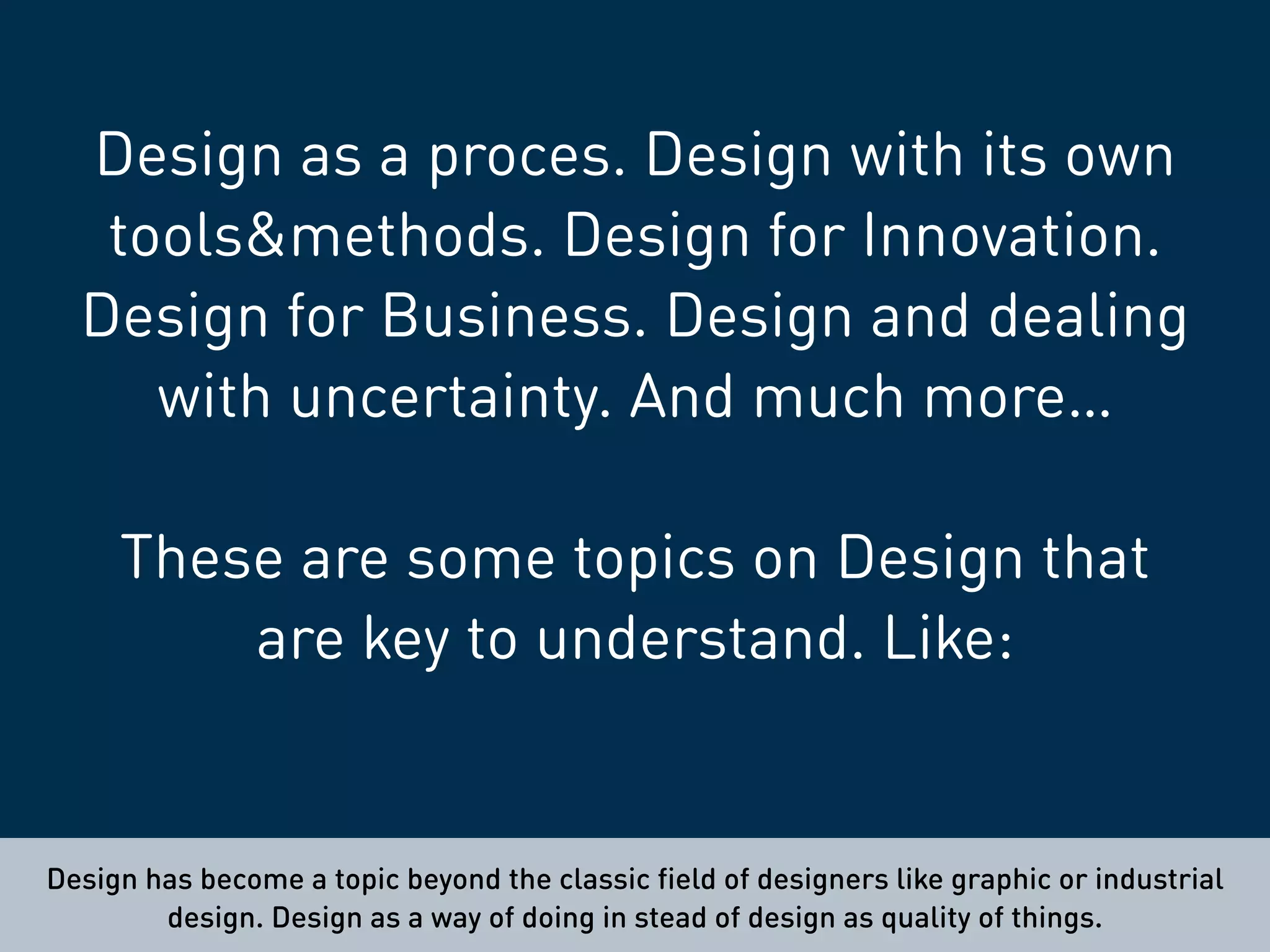
Design as a proces. Design with its own
tools&methods. Design for Innovation.
Design for Business. Design and dealing
with uncertainty. And much more…
These are some topics on Design that
are key to understand. Like:
Design has become a topic beyond the classic field of designers like graphic or industrial
design. Design as a way of doing in stead of design as quality of things.
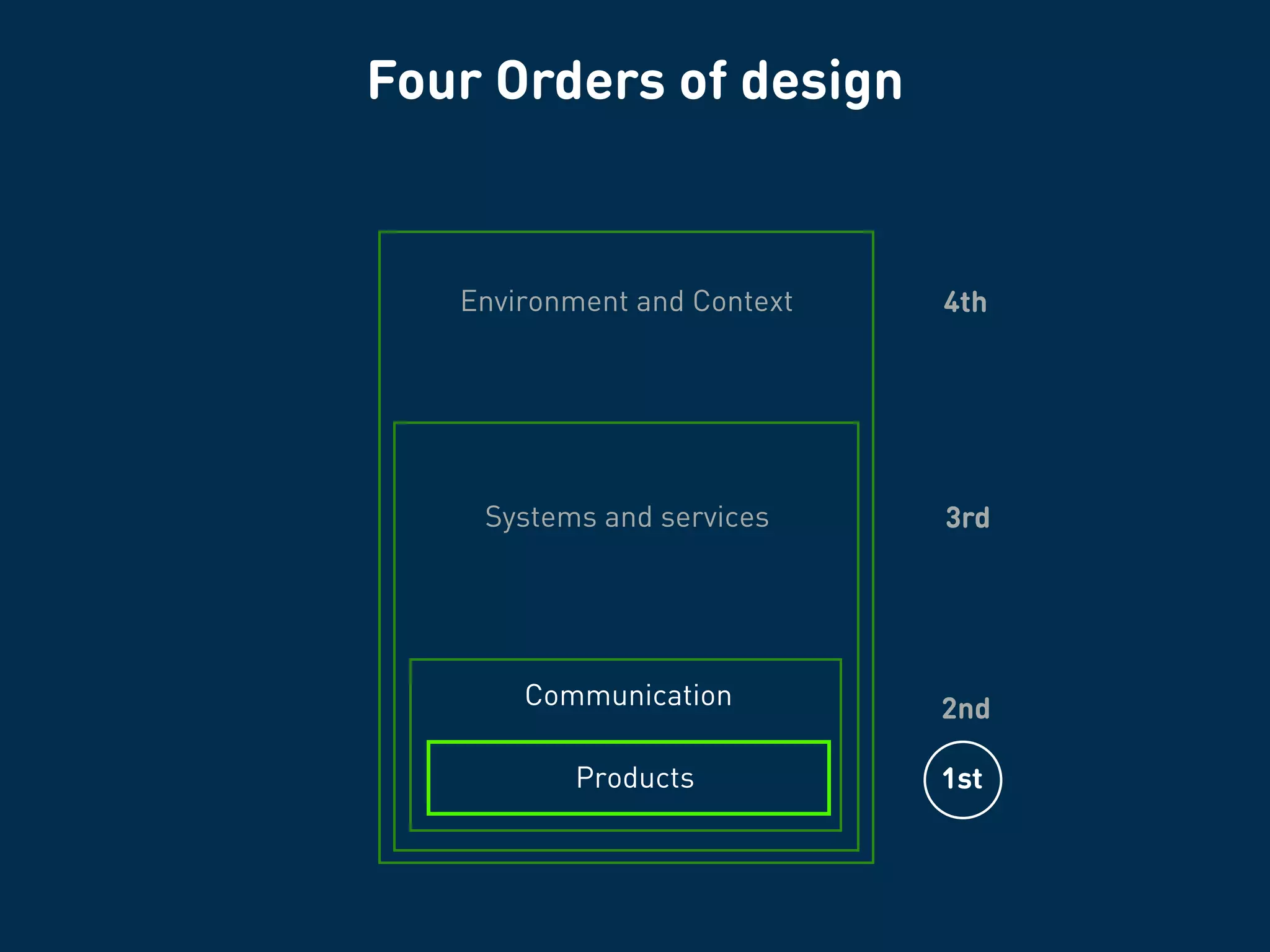
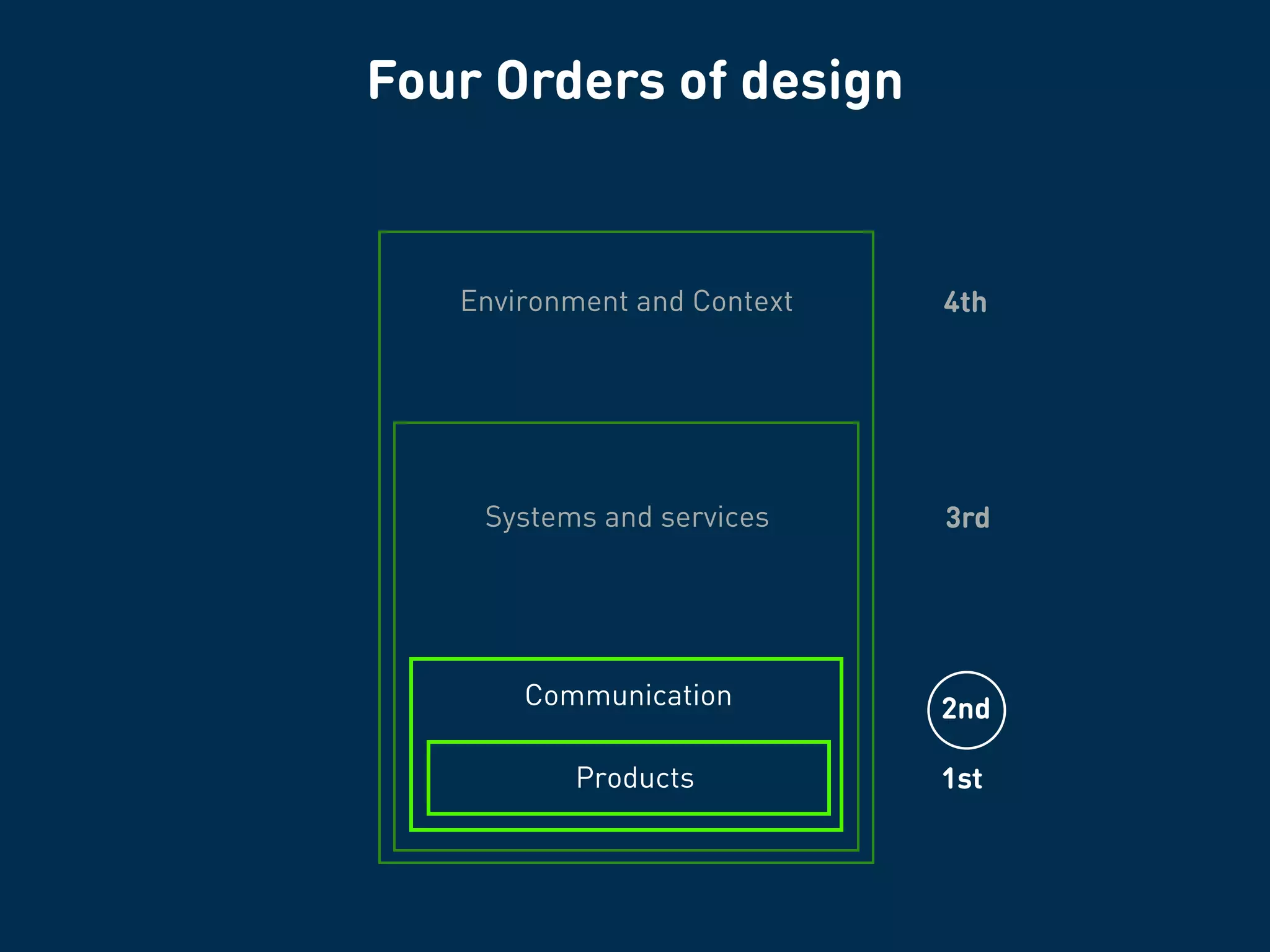
Richard Buchanan introduced an approach of design challenges
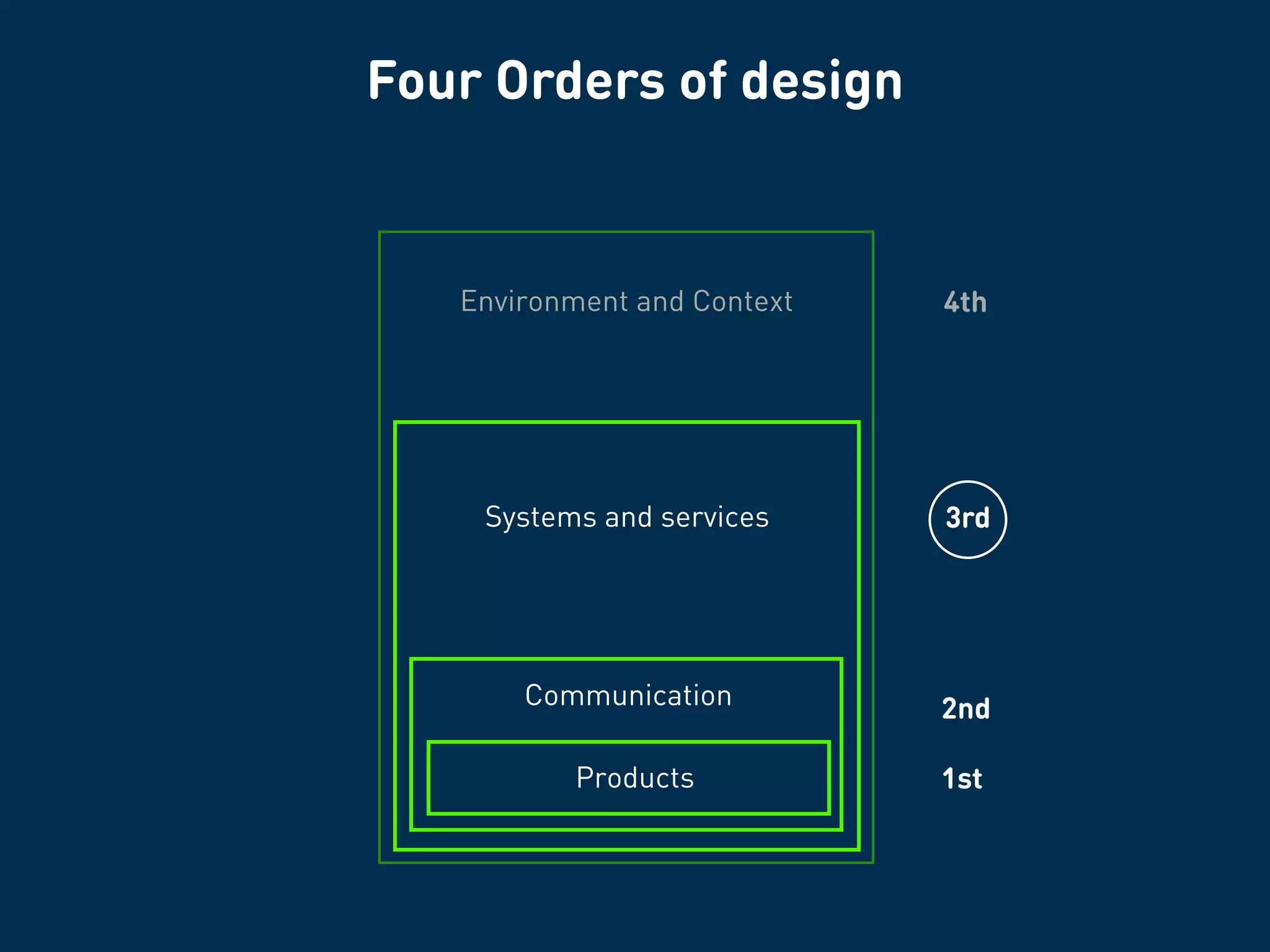
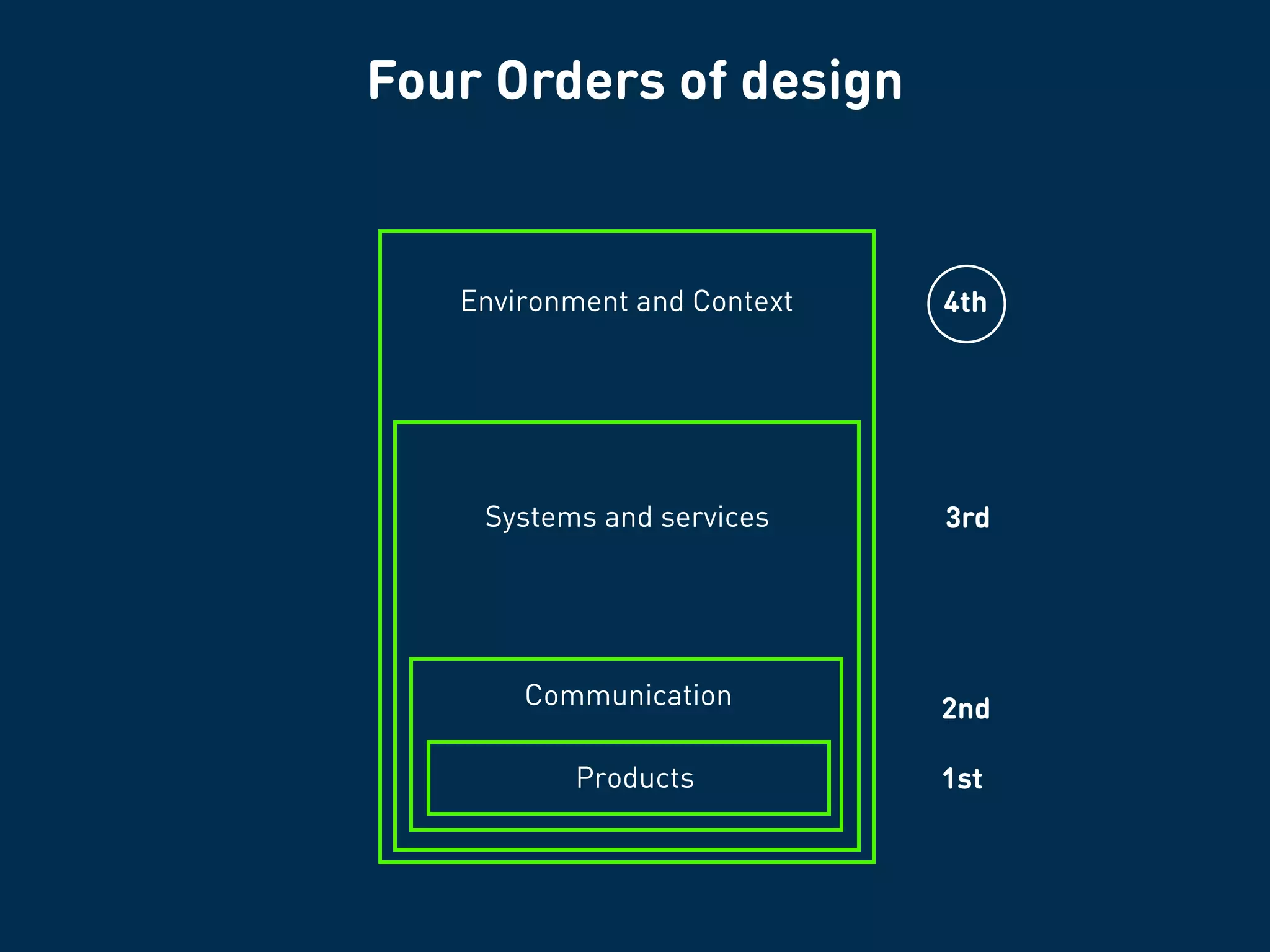
he called: The Four orders of Design:
note: we prefer to switch the first with the second order…
Four Order of Design
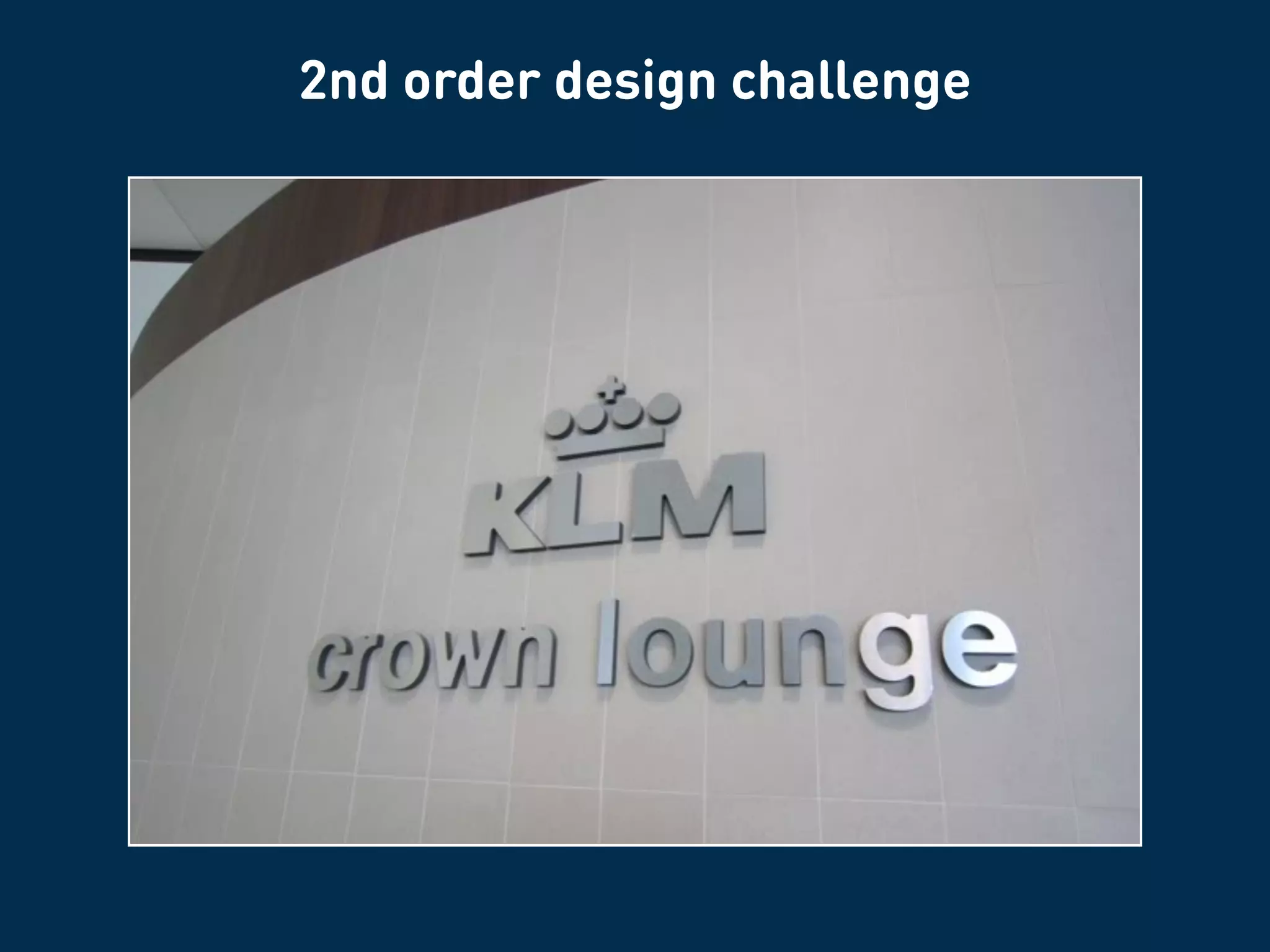
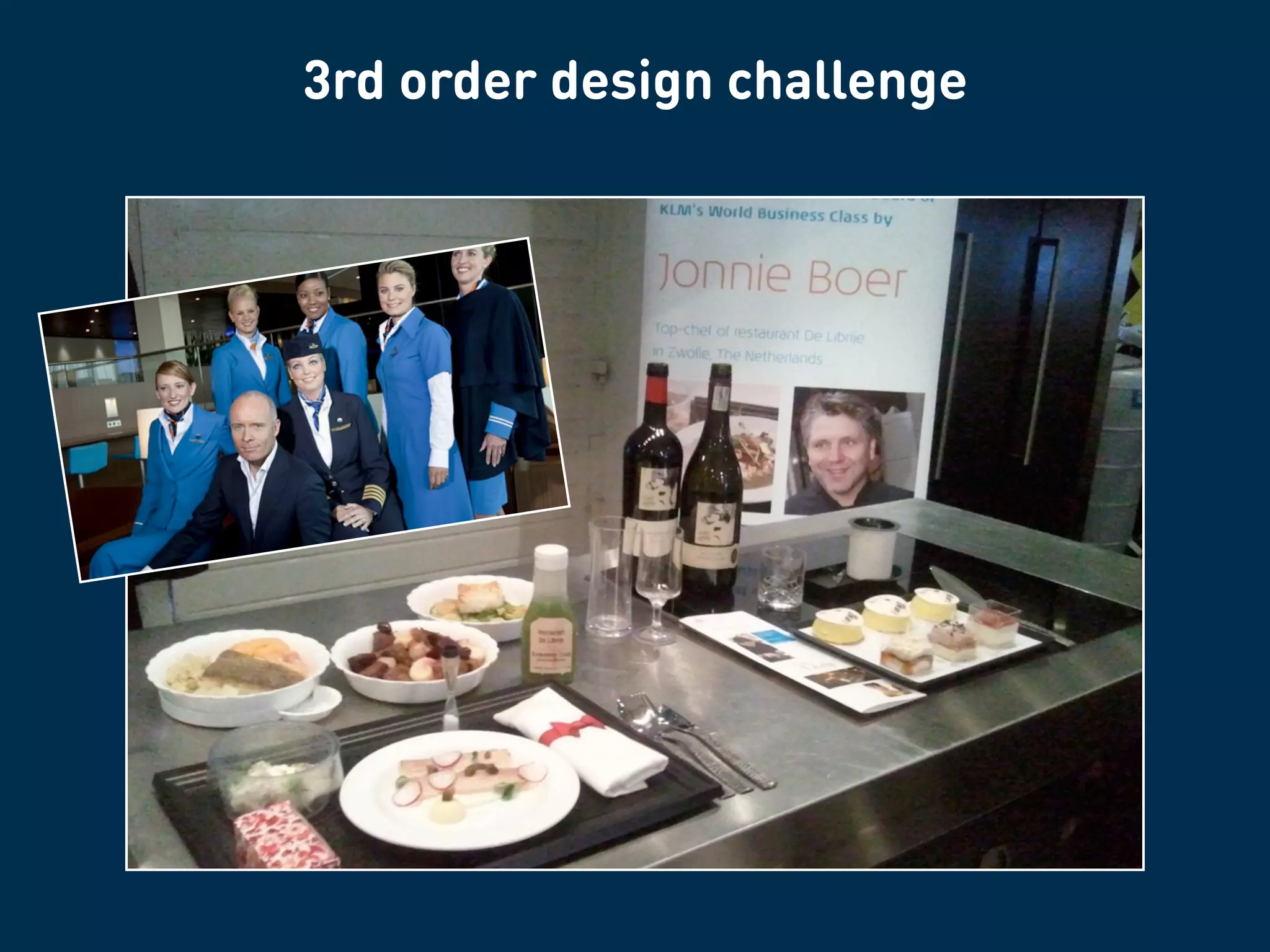
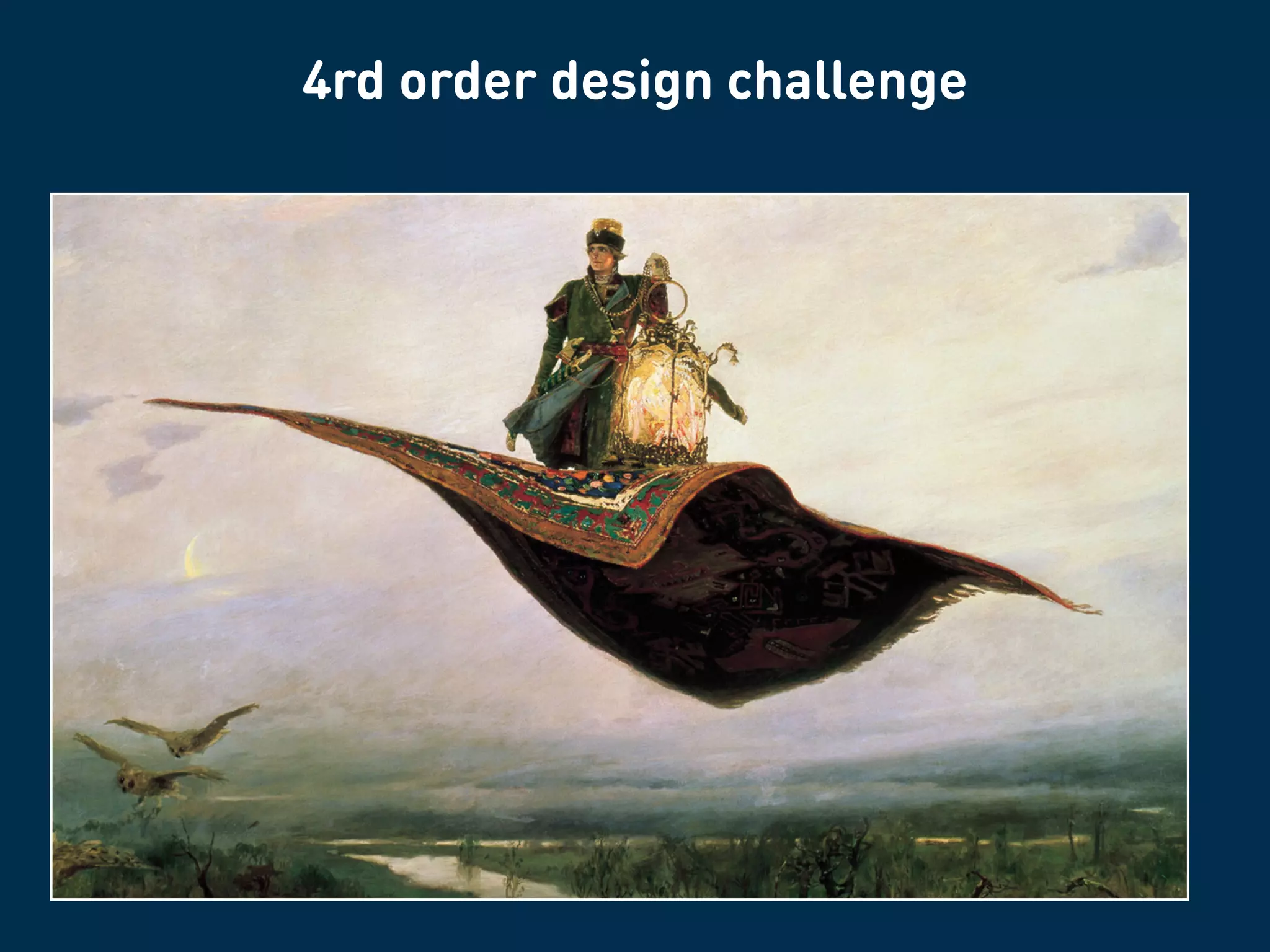
The following example deals with an
airline that wants to improve the waiting
experience. Most practical (1st) is to
provide chairs so people can sit while
waiting. The last (4th) is to eliminate
waiting completely because that is not
what customers are paying for.
Communication
Products
Four Orders of design
Systems and Services
Environment and Context
1st
3rd
4th
2nd
1st order design challenge
Communication
Products
Systems and Services
Environment and Context
1st
3rd
4th
2nd
Four Orders of design
2nd order design challenge
Communication
Products
Systems and Services
Environment and Context
1st
3rd
4th
2nd
Four Orders of design
3rd order design challenge
Communication
Products
Systems and Services
Environment and Context
1st
3rd
4th
2nd
Four Orders of design
4rd order design challenge
Design is not only useful for designing
products and communication, the classic
areas of use. In this time of accelerated
change and a world full of wicked
problems, design might be key to succes.
Thinking in these four orders will help
designers and their customers better
formulate their design challenge!
link to Keynote Richard Buchanan
Four Orders of design
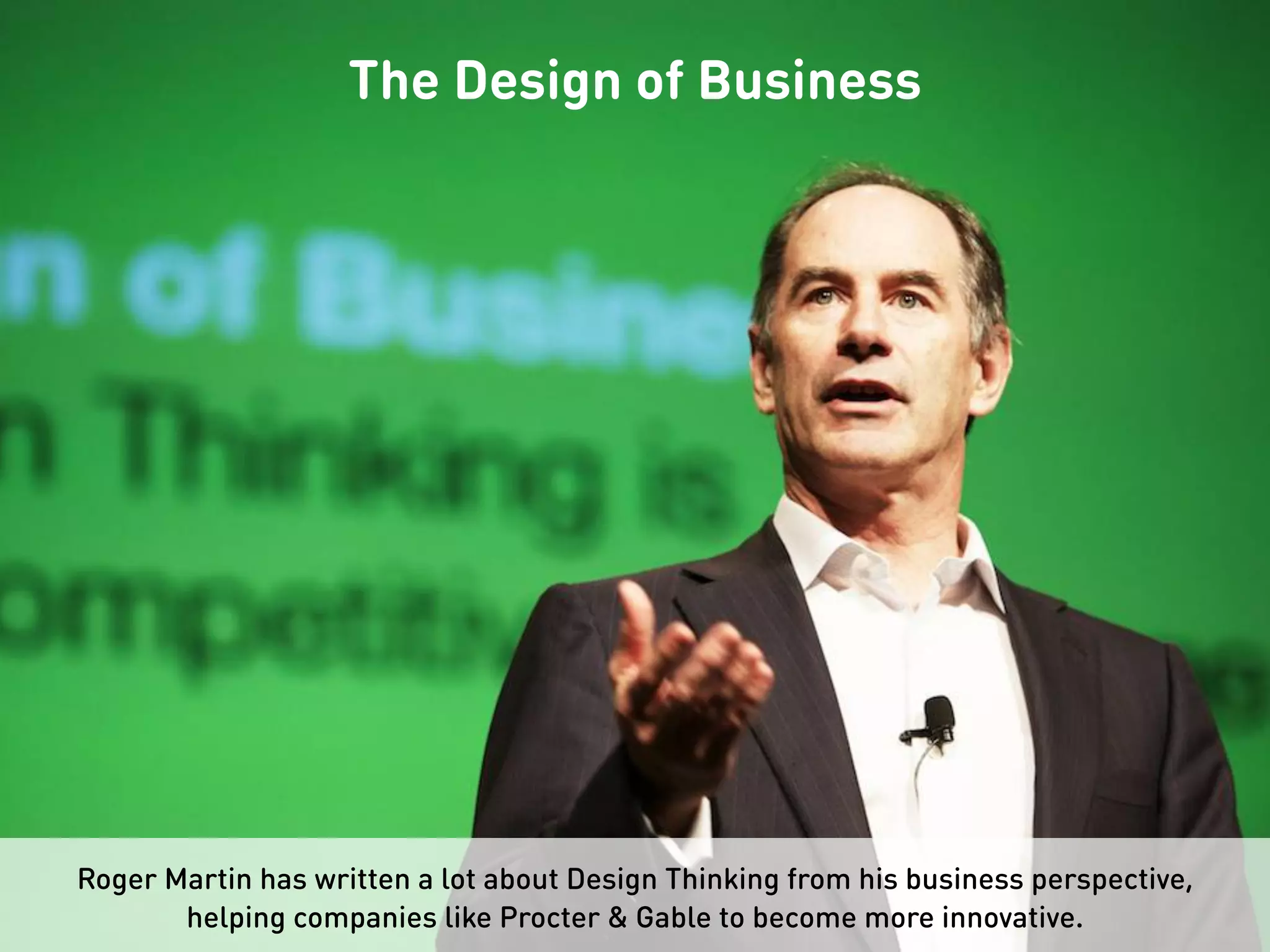
Roger Martin has written a lot about Design Thinking from his business perspective,
helping companies like Procter & Gable to become more innovative.
The Design of Business
In THE DESIGN OF BUSINESS he introduces the three kinds of reasoning.
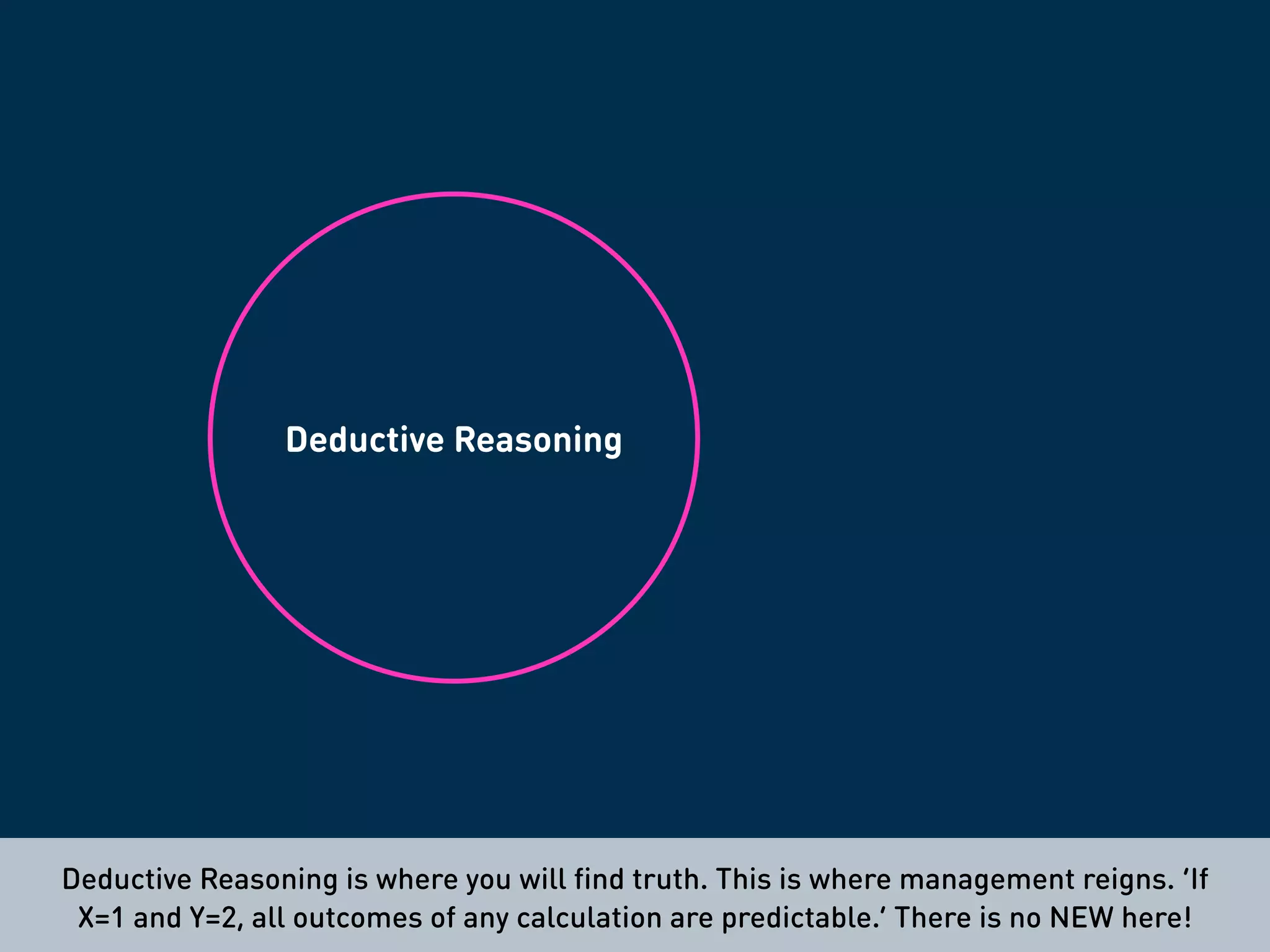
Deductive Reasoning
Deductive Reasoning is where you will find truth. This is where management reigns. ’If
X=1 and Y=2, all outcomes of any calculation are predictable.’ There is no NEW here!
Inductive Reasoning
Inductive Reasoning is where intuition lives and where hypotheses are born.
’If all swans you’ve ever seen are white, all swans must be white…’ (gut feeling)
InductiveAbductiveDeductive
In the overlap you will find Abductive Reasoning or; What can be: ’The process of
discovery of new ideas that arise when data doesn’t fit the existing models.’
InductiveAbductiveDeductive
Here you will find Design (Thinking). Take a chair for example: It will fit the human body
and weight, but there are many versions (designs) of a chair .
DESIGN
Three ways of Reasoning
Understanding these three ways of
reasoning will help you better understand
the value of design as an approach
towards challenges for innovation.
link to Roger Martin
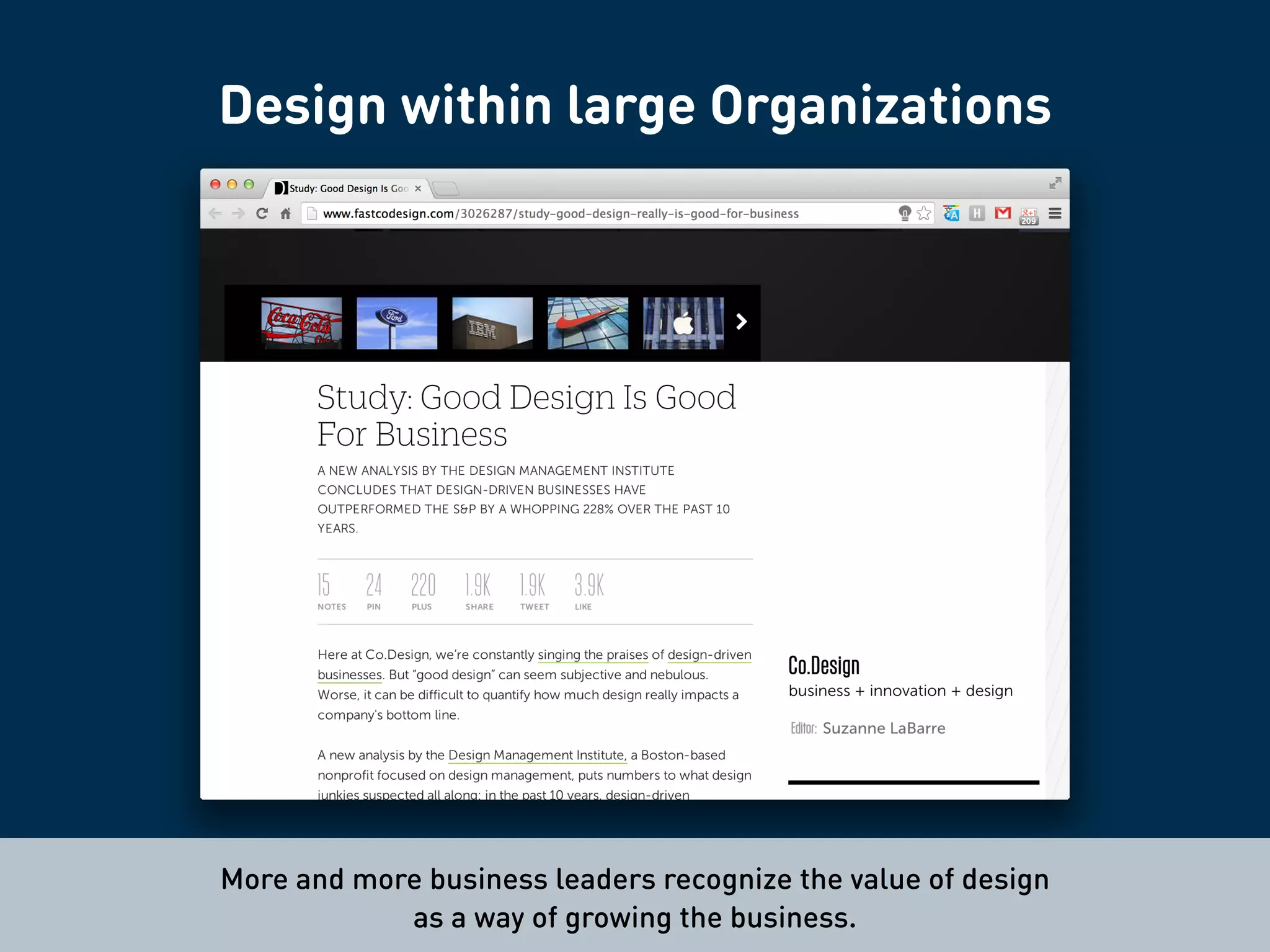
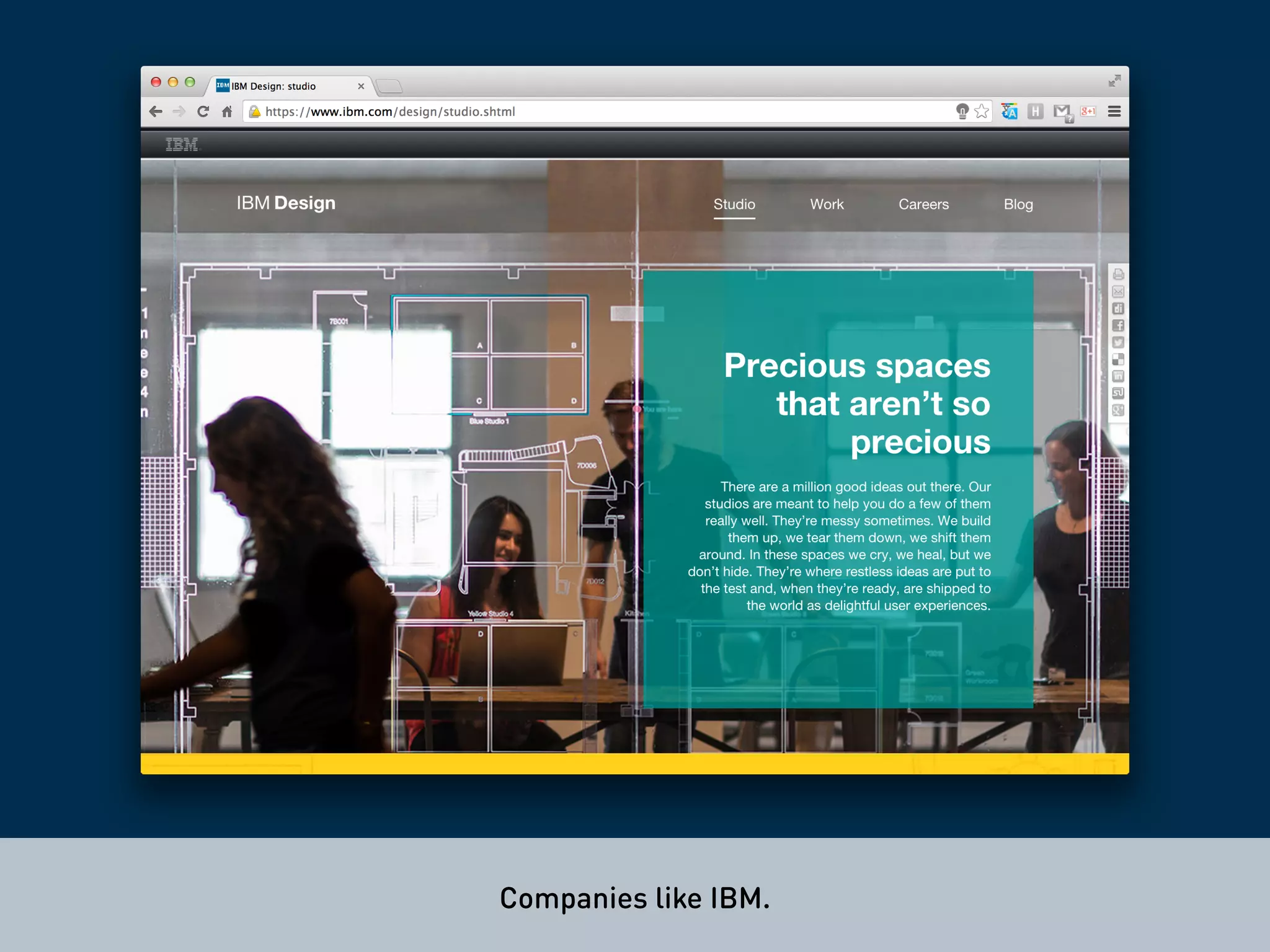
More and more business leaders recognize the value of design
as a way of growing the business.
Design within large Organizations
Companies like IBM.
Download
In 2010 IBM conducted a research project in which they interviewed 1500 CEO’s about
what they think would be valuable in the near future for business.
Embody
creative
leadership
Build
operating
dexterity
Reinvent
customer
relationships
This is what they found. Download the report here. #goodread
Design within large Organizations
Apple is often named as a design centric
company fostering the values of design
throughout the whole organization.
However, they are not alone. Ebay,
Procter & Gamble, Herman Miller,
Schneider Electric and IBM have also
invested strategically in design.
Link to Capitalising on Complexity (download)
Link to Design Driven Companies index on DMI
WORKS
How Design Thinking
INSIGHTS OPPORTUNITIES
OBSERVATIONS SOLUTIONS
ABSTRACT
CONCRETE
NOW FUTURE
Design Thinking is all about the detour. Go slow to go fast. Too often solutions are selected
based on the first (obvious) observation, missing the context of the real issue.
INSIGHTS OPPORTUNITIES
OBSERVATIONS SOLUTIONS
ABSTRACT
CONCRETE
NOW FUTURE
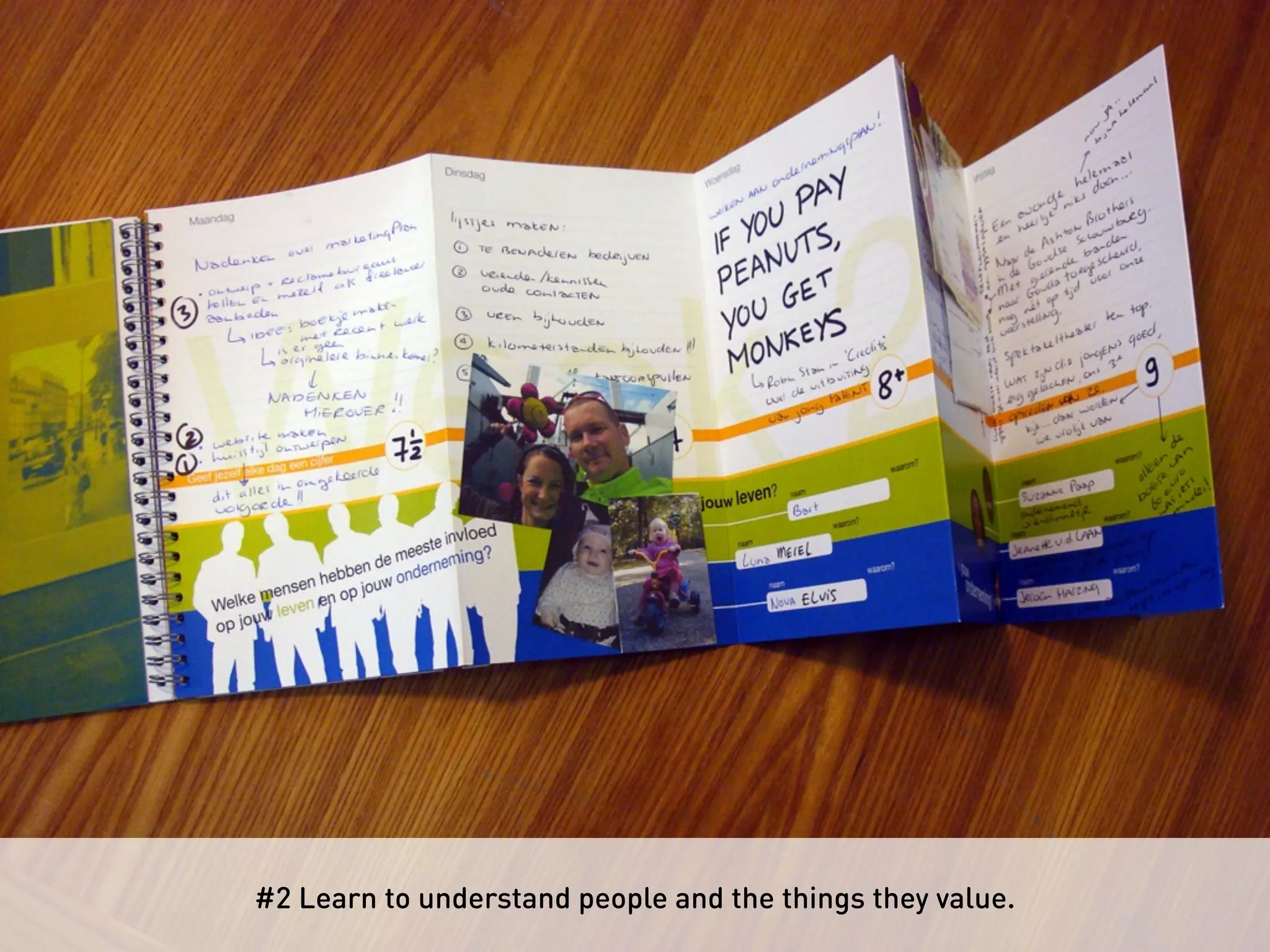
By investing time in learning about peoples (their lives, behaviors and more..),
opportunities will emerge, creating truly sustainable solutions.
INSIGHTS OPPORTUNITIES
OBSERVATIONS SOLUTIONS
ABSTRACT
CONCRETE
NOW FUTURE
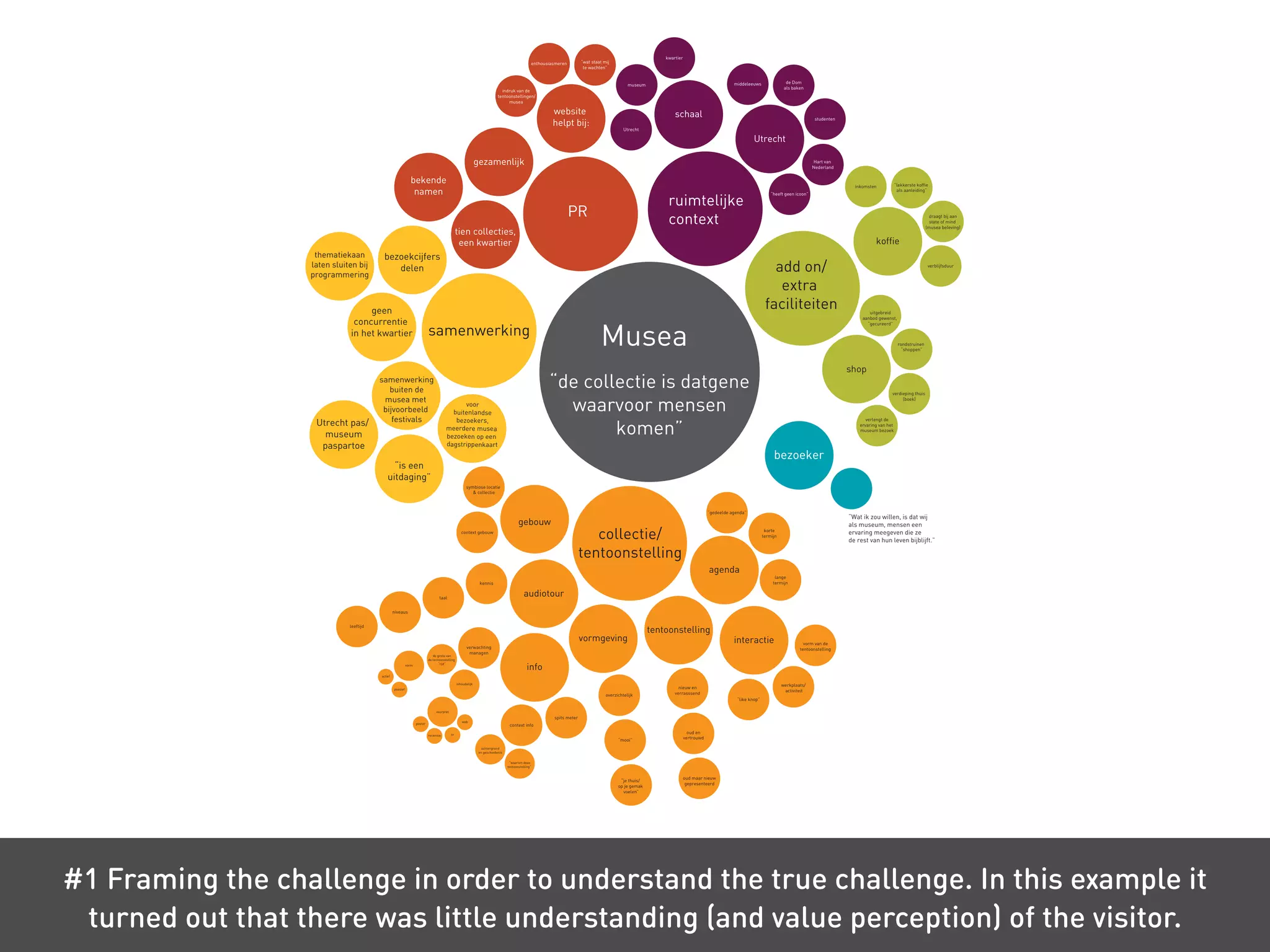
#1 FRAME
#2 LEARN
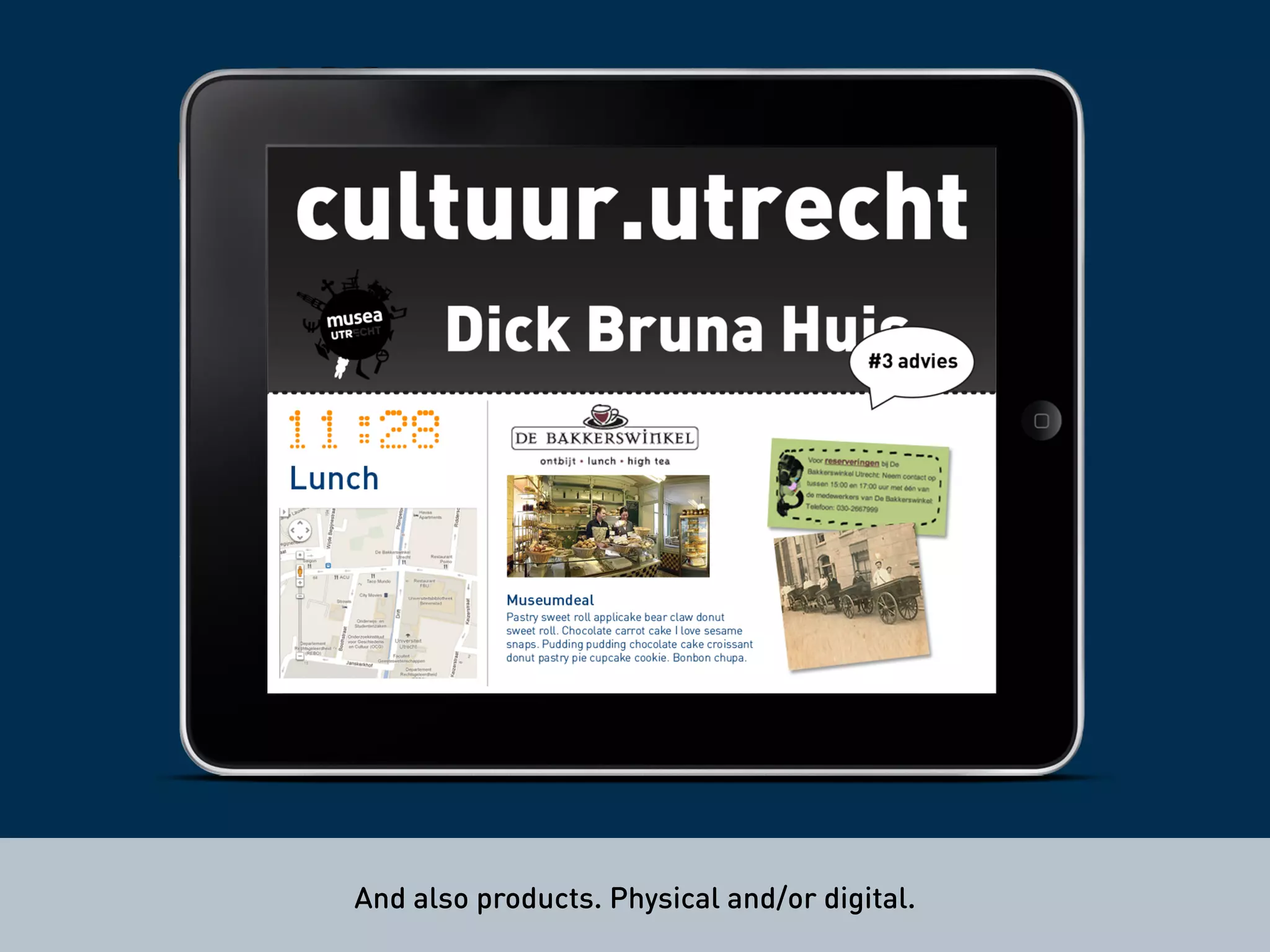
#4 DELIVER
#3 CREATE
Design Thinking has transformed this model into a proces.
Musea
“de collectie is datgene
waarvoor mensen
komen”
ruimtelijke
context
collectie/
tentoonstelling
Utrecht
middeleeuws de Dom
als baken
studenten
Hart van
Nederland
“heeft geen icoon”
schaal
kwartier
Utrecht
museum
bezoeker
samenwerking
thematiekaan
laten sluiten bij
programmering
bezoekcijfers
delen
geen
concurrentie
in het kwartier
Utrecht pas/
museum
paspartoe
gebouw
audiotour
vormgeving
info
interactie
tentoonstelling
agenda
voor
buitenlandse
bezoekers,
meerdere musea
bezoeken op een
dagstrippenkaart
“is een
uitdaging”
samenwerking
buiten de
musea met
bijvoorbeeld
festivals
website
helpt bij:
enthousiasmeren “wat staat mij
te wachten”
indruk van de
tentoonstellingen/
musea
PR
bekende
namen
gezamenlijk
tien collecties,
een kwartier
add on/
extra
faciliteiten
koffie
inkomsten
verblijfsduur
“lekkerste koffie
als aanleiding”
draagt bij aan
state of mind
(musea beleving)
“gedeelde agenda”
kennis
taal
niveaus
symbiose locatie
& collectie
context gebouw
leeftijd
verwachting
managen
de grote van
de tentoonstelling
“tijd”vorm
actief
passief
voorpret
poster
recensie tv
web
inhoudelijk
achtergrond
en geschiedenis
“waarom deze
tentoonstelling”
overzichtelijk
“mooi”
“je thuis/
op je gemak
voelen”
nieuw en
verrasssend
oud en
vertrouwd
oud maar nieuw
gepresenteerd
context info
spits meter
vorm van de
tentoonstelling
“like knop”
werkplaats/
activiteit
korte
termijn
lange
termijn
shop
“Wat ik zou willen, is dat wij
als museum, mensen een
ervaring meegeven die ze
de rest van hun leven bijblijft.”
verdieping thuis
(boek)
uitgebreid
aanbod gewenst,
“gecureerd”
verlengt de
ervaring van het
museum bezoek
rondstruinen
“shoppen”
#1 Framing the challenge in order to understand the true challenge. In this example it
turned out that there was little understanding (and value perception) of the visitor.
visitor
#2 Learn to understand people and the things they value.
#3 Co-create with people. Have them participate in the
design proces to create solutions that matter.
#4 Deliver practical solutions, service scenario’s or strategies for change.
And products. Physical and/or digital.
VALUESof Design Thinking
HUMAN CENTERED
HOLISTIC
PROTOTYPING
CO-CREATION
VISUAL WORKING
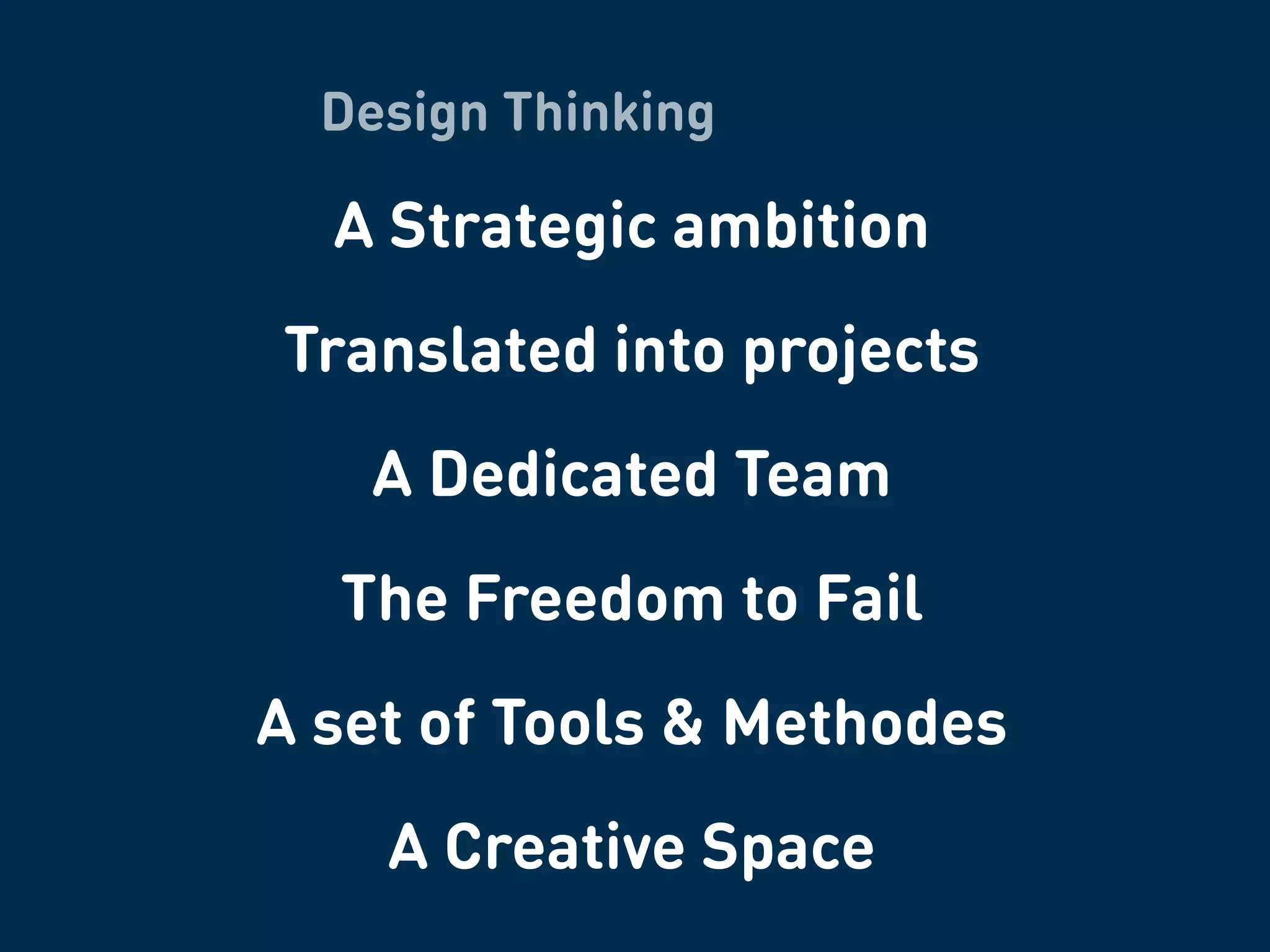
Design Thinking is
A Strategic ambition
Translated into projects
A Dedicated Team
The Freedom to Fail
A set of Tools & Methodes
A Creative Space
Design Thinking Requires
‘Design is about what
could be, not about
what already is.’
‘Design is a verb, more
then a characteristic.’
‘Design is about being
a strategic maker.’
‘Design is too important
to be left to designers.’
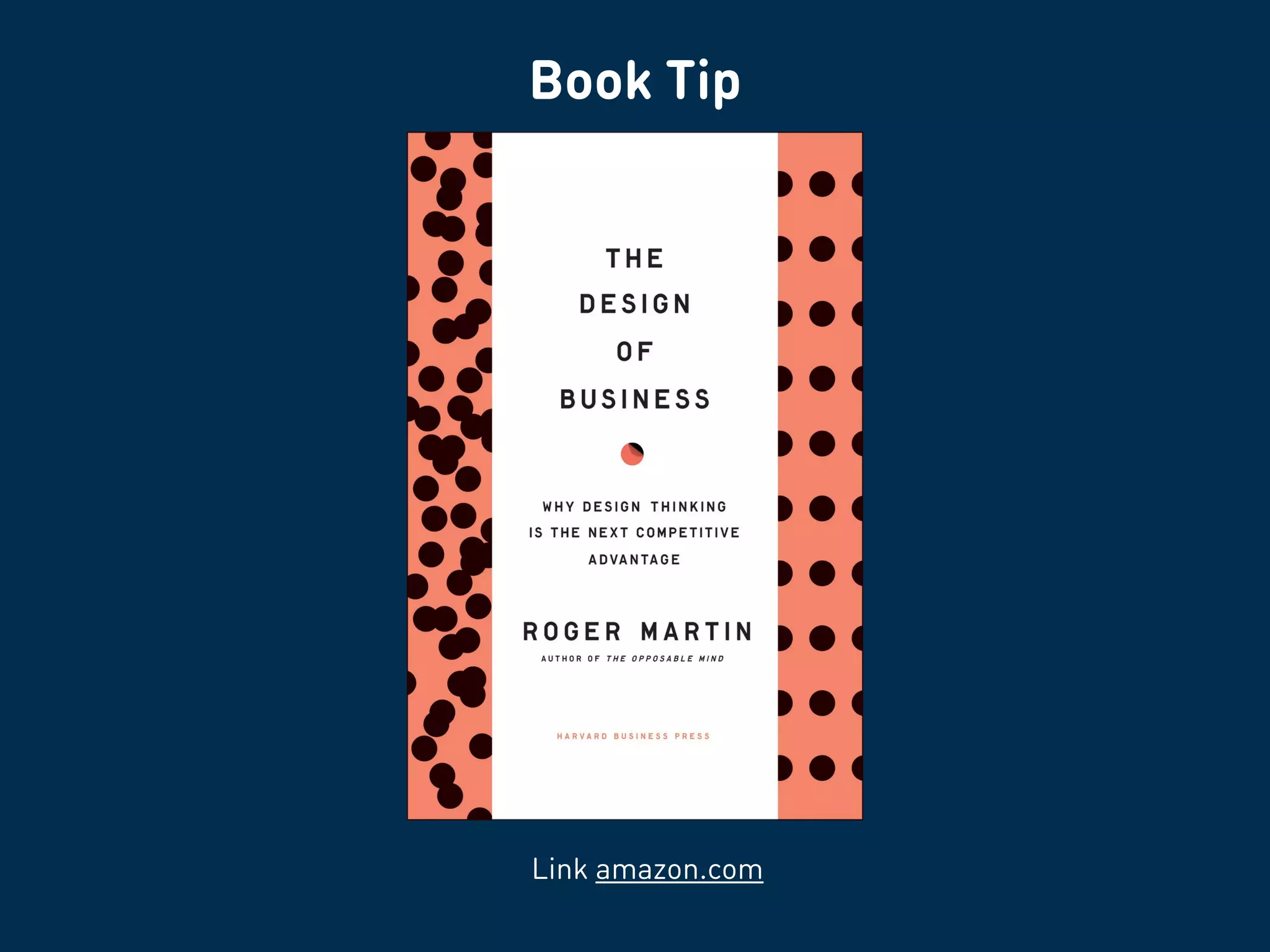
Book & Video Tipson Design Thinking
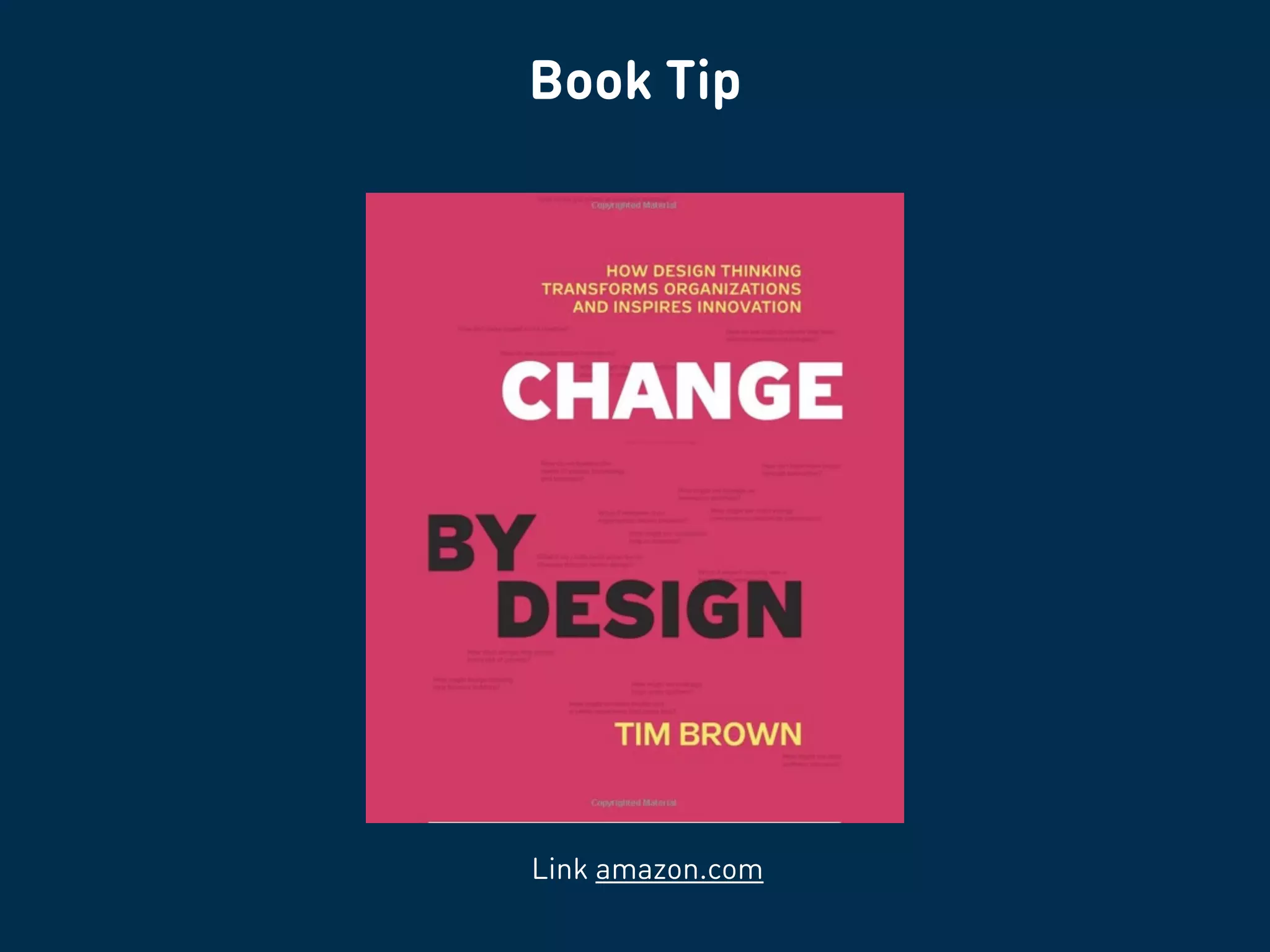
Book Tip
Link amazon.com
Book Tip
Link amazon.com
Book Tip
Link amazon.com
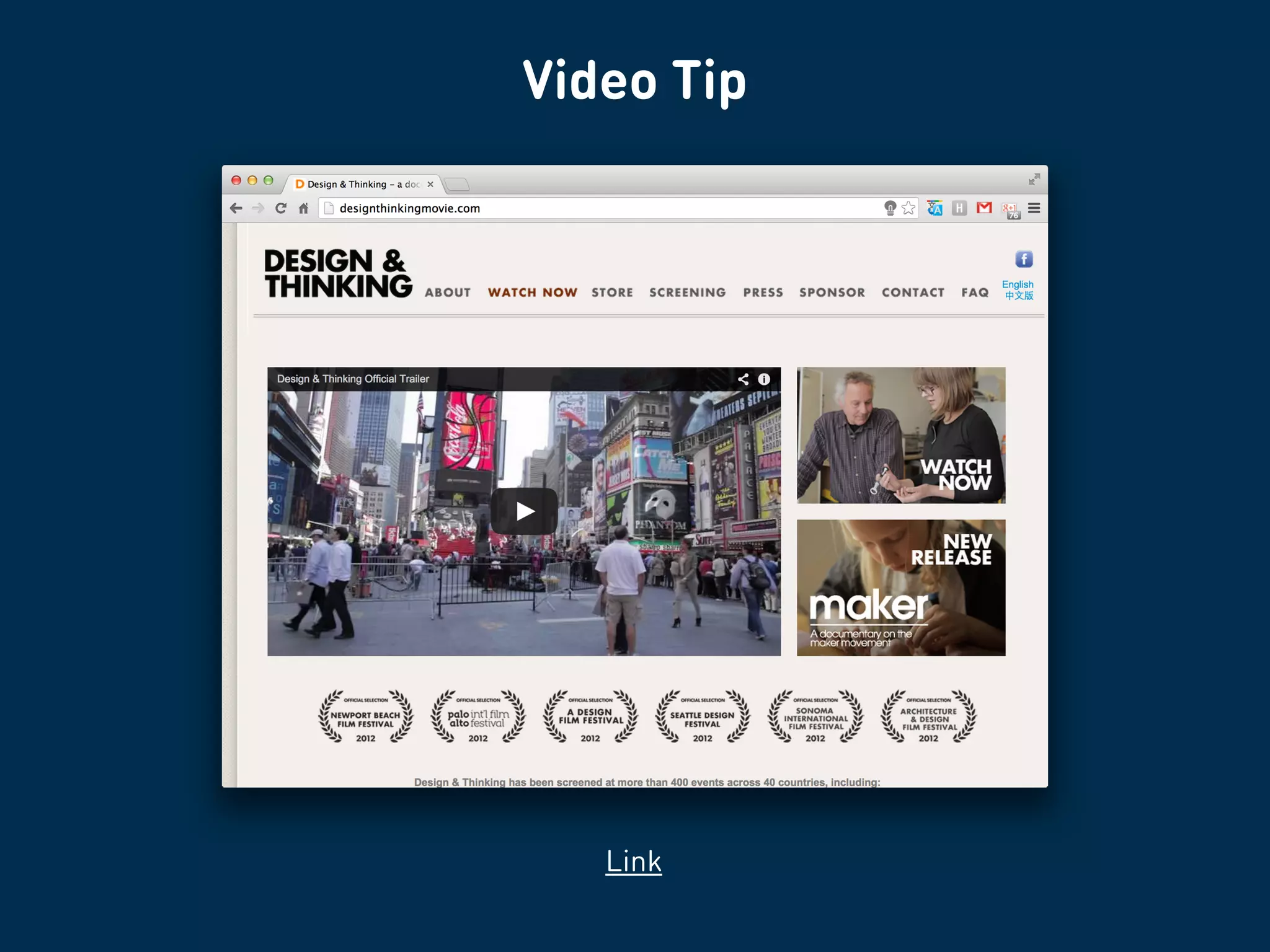
Video Tip
Link
by 31Volts
Video Tip
Link
Video Tip
Link
Marcel Zwiers
@marcelzwiers
linkedin.com/in/zwiers
marcel@31volts.com
WHAT DOES
DESIGN MEAN
TO YOU?

My take on Design [Thinking]

  • 1.
    DESIGN THINKING A talkon … Marcel Zwiers @marcelzwiers linkedin.com/in/zwiers marcel@31volts.com
  • 2.
  • 3.
    Marcel Zwiers, Founderand Creative Director at 31Volts, First Service Design practice in the Netherlands.
  • 4.
    1995. Graduation projectthat looks like a cardboard bicycle design, but turned out to be of strategic value to sponsor Fokker Aircraft.
  • 5.
    Fokker Aircraft filedfor bankruptcy. It’s hard to save the world with one project…
  • 6.
    The current designpractice at 31Volts is very dynamic with lots of interactions with client teams and their customers. New service concepts are created by designing with people.
  • 7.
    … and byDesign Research to better understand people, …
  • 8.
    … and byPrototyping new ideas quickly and cheaply. Fail often to succeed sooner is what design and design thinking is all about.
  • 9.
    Incomplete history ofDesign Incomplete theory of Design Thinking How Design Thinking works The Values of Design Book & Video Tips slide 10 slide 23 slide 50 slide 60 slide 68 Content
  • 11.
  • 12.
    The stone spearheads, dating back 500.000 years, might be the first sign of a product that has been created with a human centric use case and purpose in mind.
  • 13.
    Louis Henry Sullivan"father of skyscrapers" (September 3, 1856 – April 14, 1924) Price of Steel at Bessemer Steel Rails 1867 to 1895 1867- $166 ($/ton) 1870- $107 1875- $69 1880- $68 1885- $29 1890- $32 1895- $32 Prudential Building, Buffalo, New York, 1894 Different dynamics in society (people moving to cities), economics (cheap materials) and new technologies (mass produced steel beams) created opportunities for architects.
  • 14.
    The re-invention ofMultiplex by Immanuel Nobel (1801–1872) provided new opportunities for designing and building furniture.
  • 15.
    Not only isdesign used to build a brand, the designer also created an entirely new way of consumption. More individual and free of a fixt location (bar).
  • 16.
    Designer Dieter Ramswas not only the main designer of BRAUN, creating beautiful products, he also understood the need for optimism in post WW2 Germany.
  • 17.
    In the 80-tiesand 90-ties of the last century, the designers became more and more rockstars. You didn't buy a new chair, you bought a Philippe Starck.
  • 18.
    With products liketelevisions and computers some product became less important (like this remote) because they are just interfaces for something else.
  • 19.
    Smart phones arenice examples of products that are valuable through installed software. Helping you find your way around, take notes, stay in contact with others and much more ..
  • 20.
  • 21.
    Design in the21st century is still about beauty, form & function, etc. However…
  • 22.
    … the startingpoint is often very complex. The way people think and do, their values, needs and other intangible aspects that are becoming more important.
  • 24.
  • 25.
    ”Unlike analytical thinking,design thinking is a creative process based around the "building up" of ideas. There are no judgments early on in design thinking. This eliminates the fear of failure and encourages maximum input and participation in the ideation and prototype phases.”
  • 26.
    Design as aproces. Design with its own tools&methods. Design for Innovation. Design for Business. Design and dealing with uncertainty. And much more… These are some topics on Design that are key to understand. Like: Design has become a topic beyond the classic field of designers like graphic or industrial design. Design as a way of doing in stead of design as quality of things.
  • 27.
    Richard Buchanan introducedan approach of design challenges he called: The Four orders of Design: note: we prefer to switch the first with the second order… Four Order of Design
  • 28.
    The following exampledeals with an airline that wants to improve the waiting experience. Most practical (1st) is to provide chairs so people can sit while waiting. The last (4th) is to eliminate waiting completely because that is not what customers are paying for.
  • 29.
    Communication Products Four Orders ofdesign Systems and Services Environment and Context 1st 3rd 4th 2nd
  • 30.
  • 31.
    Communication Products Systems and Services Environmentand Context 1st 3rd 4th 2nd Four Orders of design
  • 32.
  • 33.
    Communication Products Systems and Services Environmentand Context 1st 3rd 4th 2nd Four Orders of design
  • 34.
  • 35.
    Communication Products Systems and Services Environmentand Context 1st 3rd 4th 2nd Four Orders of design
  • 36.
  • 37.
    Design is notonly useful for designing products and communication, the classic areas of use. In this time of accelerated change and a world full of wicked problems, design might be key to succes. Thinking in these four orders will help designers and their customers better formulate their design challenge! link to Keynote Richard Buchanan Four Orders of design
  • 38.
    Roger Martin haswritten a lot about Design Thinking from his business perspective, helping companies like Procter & Gable to become more innovative. The Design of Business
  • 39.
    In THE DESIGNOF BUSINESS he introduces the three kinds of reasoning.
  • 40.
    Deductive Reasoning Deductive Reasoningis where you will find truth. This is where management reigns. ’If X=1 and Y=2, all outcomes of any calculation are predictable.’ There is no NEW here!
  • 41.
    Inductive Reasoning Inductive Reasoningis where intuition lives and where hypotheses are born. ’If all swans you’ve ever seen are white, all swans must be white…’ (gut feeling)
  • 42.
    InductiveAbductiveDeductive In the overlapyou will find Abductive Reasoning or; What can be: ’The process of discovery of new ideas that arise when data doesn’t fit the existing models.’
  • 43.
    InductiveAbductiveDeductive Here you willfind Design (Thinking). Take a chair for example: It will fit the human body and weight, but there are many versions (designs) of a chair . DESIGN
  • 44.
    Three ways ofReasoning Understanding these three ways of reasoning will help you better understand the value of design as an approach towards challenges for innovation. link to Roger Martin
  • 45.
    More and morebusiness leaders recognize the value of design as a way of growing the business. Design within large Organizations
  • 46.
  • 47.
    Download In 2010 IBMconducted a research project in which they interviewed 1500 CEO’s about what they think would be valuable in the near future for business.
  • 48.
  • 49.
    Design within largeOrganizations Apple is often named as a design centric company fostering the values of design throughout the whole organization. However, they are not alone. Ebay, Procter & Gamble, Herman Miller, Schneider Electric and IBM have also invested strategically in design. Link to Capitalising on Complexity (download) Link to Design Driven Companies index on DMI
  • 51.
  • 52.
    INSIGHTS OPPORTUNITIES OBSERVATIONS SOLUTIONS ABSTRACT CONCRETE NOWFUTURE Design Thinking is all about the detour. Go slow to go fast. Too often solutions are selected based on the first (obvious) observation, missing the context of the real issue.
  • 53.
    INSIGHTS OPPORTUNITIES OBSERVATIONS SOLUTIONS ABSTRACT CONCRETE NOWFUTURE By investing time in learning about peoples (their lives, behaviors and more..), opportunities will emerge, creating truly sustainable solutions.
  • 54.
    INSIGHTS OPPORTUNITIES OBSERVATIONS SOLUTIONS ABSTRACT CONCRETE NOWFUTURE #1 FRAME #2 LEARN #4 DELIVER #3 CREATE Design Thinking has transformed this model into a proces.
  • 55.
    Musea “de collectie isdatgene waarvoor mensen komen” ruimtelijke context collectie/ tentoonstelling Utrecht middeleeuws de Dom als baken studenten Hart van Nederland “heeft geen icoon” schaal kwartier Utrecht museum bezoeker samenwerking thematiekaan laten sluiten bij programmering bezoekcijfers delen geen concurrentie in het kwartier Utrecht pas/ museum paspartoe gebouw audiotour vormgeving info interactie tentoonstelling agenda voor buitenlandse bezoekers, meerdere musea bezoeken op een dagstrippenkaart “is een uitdaging” samenwerking buiten de musea met bijvoorbeeld festivals website helpt bij: enthousiasmeren “wat staat mij te wachten” indruk van de tentoonstellingen/ musea PR bekende namen gezamenlijk tien collecties, een kwartier add on/ extra faciliteiten koffie inkomsten verblijfsduur “lekkerste koffie als aanleiding” draagt bij aan state of mind (musea beleving) “gedeelde agenda” kennis taal niveaus symbiose locatie & collectie context gebouw leeftijd verwachting managen de grote van de tentoonstelling “tijd”vorm actief passief voorpret poster recensie tv web inhoudelijk achtergrond en geschiedenis “waarom deze tentoonstelling” overzichtelijk “mooi” “je thuis/ op je gemak voelen” nieuw en verrasssend oud en vertrouwd oud maar nieuw gepresenteerd context info spits meter vorm van de tentoonstelling “like knop” werkplaats/ activiteit korte termijn lange termijn shop “Wat ik zou willen, is dat wij als museum, mensen een ervaring meegeven die ze de rest van hun leven bijblijft.” verdieping thuis (boek) uitgebreid aanbod gewenst, “gecureerd” verlengt de ervaring van het museum bezoek rondstruinen “shoppen” #1 Framing the challenge in order to understand the true challenge. In this example it turned out that there was little understanding (and value perception) of the visitor. visitor
  • 56.
    #2 Learn tounderstand people and the things they value.
  • 57.
    #3 Co-create withpeople. Have them participate in the design proces to create solutions that matter.
  • 58.
    #4 Deliver practicalsolutions, service scenario’s or strategies for change.
  • 59.
    And products. Physicaland/or digital.
  • 61.
  • 62.
  • 63.
    A Strategic ambition Translatedinto projects A Dedicated Team The Freedom to Fail A set of Tools & Methodes A Creative Space Design Thinking Requires
  • 64.
    ‘Design is aboutwhat could be, not about what already is.’
  • 65.
    ‘Design is averb, more then a characteristic.’
  • 66.
    ‘Design is aboutbeing a strategic maker.’
  • 67.
    ‘Design is tooimportant to be left to designers.’
  • 69.
    Book & VideoTipson Design Thinking
  • 70.
  • 71.
  • 72.
  • 73.
  • 74.
  • 75.
  • 77.