
Where I am from, and what I do
The Association for the
Advancement of Computing in
Education (AACE), founded in
1981, serves the edtech
community with international
conferences, journals, digital
library and social media
channels (AACE Review).
As the largest university-based
local government training,
advisory, and research
organization in the United States,
the School of Government serves
more than 12,000 public officials
each year.
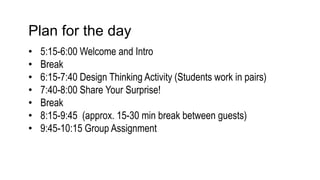
Plan for the day
• 5:15-6:00 Welcome and Intro
• Break
• 6:15-7:40 Design Thinking Activity (Students work in pairs)
• 7:40-8:00 Share Your Surprise!
• Break
• 8:15-9:45 (approx. 15-30 min break between guests)
• 9:45-10:15 Group Assignment
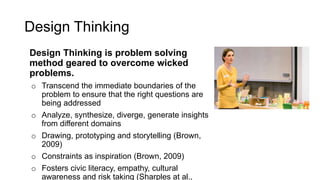
What’s the idea? Design Thinking
Design Thinking is problem solving
method geared to overcome wicked
problems.
o Transcend the immediate boundaries of the
problem to ensure that the right questions are
being addressed
o Analyze, synthesize, diverge, generate insights
from different domains
o Drawing, prototyping and storytelling (Brown,
2009)
o Constraints as inspiration (Brown, 2009)
o Fosters civic literacy, empathy, cultural
awareness and risk taking (Sharples at al.,
Design Thinking
What’s the id- ea? Design Thinking
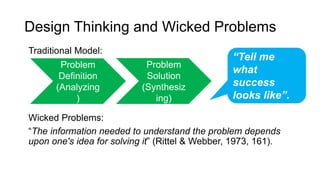
Design Thinking and Wicked Problems
Traditional Model:
Wicked Problems:
“The information needed to understand the problem depends
upon one's idea for solving it” (Rittel & Webber, 1973, 161).
Problem
Definition
(Analyzing
)
Problem
Solution
(Synthesiz
ing)
“Tell me
what
success
looks like”.
Wicked Problem Checklist
https://goo.gl/AbwfWz
Designing to Let Go: Fail fast, fail often
Develop like a believer, test like a sceptic
• Most educators like to be right.
• Good designers know they are mostly wrong.
• Practicing design thinking teaches to let ideas go.
• Wicked problem solutions cannot be computed – they do not
follow directly from data / evidence, have many, possibly
interdependent variables, known unknowns and unknown
unknowns
• That does not mean solutions cannot be tested with rigor (i.e.
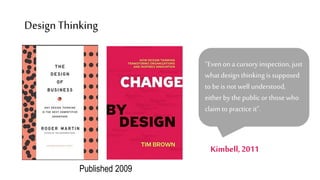
“Even on a cursory inspection, just
what design thinkingis supposed
to be is not well understood,
either by the public or those who
claim to practice it”.
Kimbell,2011
Design Thinking
Published 2009
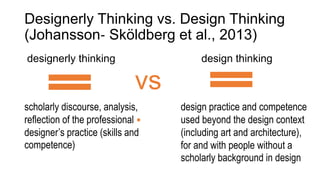
Designerly Thinking vs. Design Thinking
(Johansson‐ Sköldberg et al., 2013)
designerly thinking
scholarly discourse, analysis,
reflection of the professional
designer’s practice (skills and
competence)
design thinking
design practice and competence
used beyond the design context
(including art and architecture),
for and with people without a
scholarly background in design
vs
.
Related Approaches
o Participatory Design
o Bricolage or Tinkering
o LEGO Serious Play (LPS)
o Makerspace / Maker Culture
o Tacit Experiences
o Creative Empowerment
o Process and Product
o Users as Co-Designers
o Empowerment
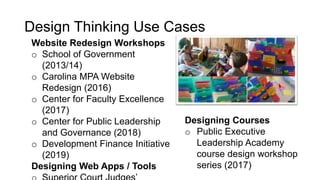
Design Thinking Use Cases
Website Redesign Workshops
o School of Government
(2013/14)
o Carolina MPA Website
Redesign (2016)
o Center for Faculty Excellence
(2017)
o Center for Public Leadership
and Governance (2018)
o Development Finance Initiative
(2019)
Designing Web Apps / Tools
Designing Courses
o Public Executive
Leadership Academy
course design workshop
series (2017)
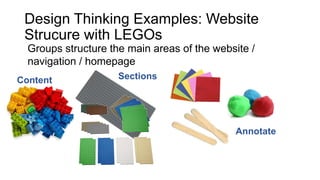
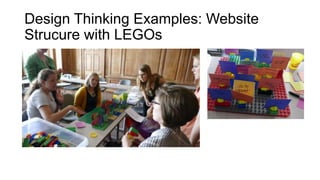
Design Thinking Examples: Website
Strucure with LEGOs
Content Sections
Annotate
Groups structure the main areas of the website /
navigation / homepage
Design Thinking Examples: Website
Strucure with LEGOs
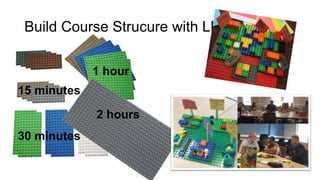
1 hour
30 minutes
15 minutes
2 hours
Build Course Strucure with LEGOs
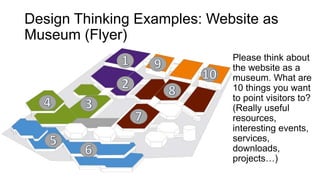
Please think about
the website as a
museum. What are
10 things you want
to point visitors to?
(Really useful
resources,
interesting events,
services,
downloads,
projects…)
Design Thinking Examples: Website as
Museum (Flyer)
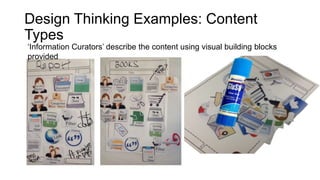
Design Thinking Examples: Content
Types
‘Information Curators’ describe the content using visual building blocks
provided
Audience: Pwebsite ersonas
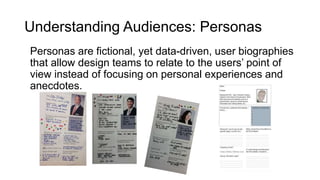
Personas are fictional, yet data-driven, user biographies
that allow design teams to relate to the users’ point of
view instead of focusing on personal experiences and
anecdotes.
Understanding Audiences: Personas
o February 2018: Design thinking
workshop at Muenster University of
Applied Sciences (Germany)
o Workshop theme: Inclusive community
development - designing
neighborhoods for engagement, social
cohesion and inclusion
o 15 participants
o Part of the research cluster ‘participation
and well-being’
o Faculty from different disciplines, city
Research Workshop: Inclusive
Community Development
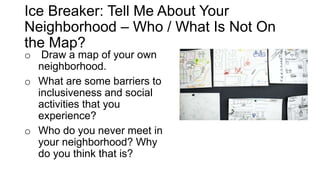
Ice Breaker: Tell Me About Your
Neighborhood – Who / What Is Not On
the Map?
o Draw a map of your own
neighborhood.
o What are some barriers to
inclusiveness and social
activities that you
experience?
o Who do you never meet in
your neighborhood? Why
do you think that is?
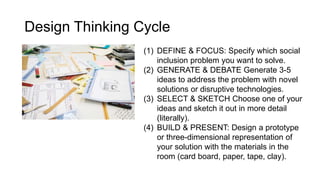
(1) DEFINE & FOCUS: Specify which social
inclusion problem you want to solve.
(2) GENERATE & DEBATE Generate 3-5
ideas to address the problem with novel
solutions or disruptive technologies.
(3) SELECT & SKETCH Choose one of your
ideas and sketch it out in more detail
(literally).
(4) BUILD & PRESENT: Design a prototype
or three-dimensional representation of
your solution with the materials in the
room (card board, paper, tape, clay).
Design Thinking Cycle
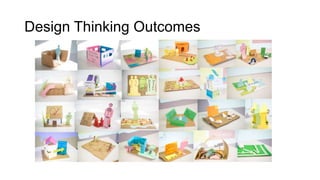
Design Thinking Outcomes
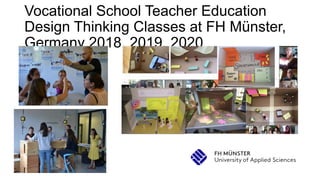
Vocational School Teacher Education
Design Thinking Classes at FH Münster,
Germany 2018, 2019, 2020
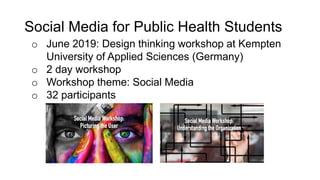
o June 2019: Design thinking workshop at Kempten
University of Applied Sciences (Germany)
o 2 day workshop
o Workshop theme: Social Media
o 32 participants
Social Media for Public Health Students
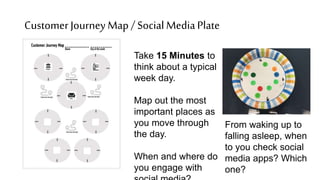
Customer JourneyMap / SocialMediaPlate
Take 15 Minutes to
think about a typical
week day.
Map out the most
important places as
you move through
the day.
When and where do
you engage with
From waking up to
falling asleep, when
to you check social
media apps? Which
one?
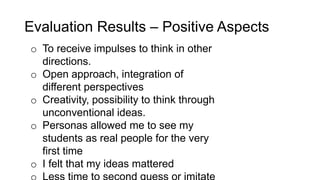
Evaluation Results – Positive Aspects
o To receive impulses to think in other
directions.
o Open approach, integration of
different perspectives
o Creativity, possibility to think through
unconventional ideas.
o Personas allowed me to see my
students as real people for the very
first time
o I felt that my ideas mattered
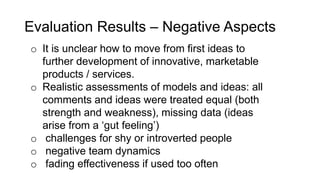
Evaluation Results – Negative Aspects
o It is unclear how to move from first ideas to
further development of innovative, marketable
products / services.
o Realistic assessments of models and ideas: all
comments and ideas were treated equal (both
strength and weakness), missing data (ideas
arise from a ‘gut feeling’)
o challenges for shy or introverted people
o negative team dynamics
o fading effectiveness if used too often
Design Thinking For Education: Special
Issue
https://www.degruyter.com/view/journals/edu/1/1/edu.1.issue-1.xml
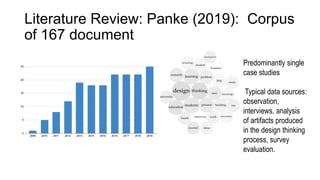
Literature Review: Panke (2019): Corpus
of 167 document
Predominantly single
case studies
Typical data sources:
observation,
interviews, analysis
of artifacts produced
in the design thinking
process, survey
evaluation.
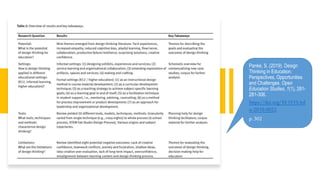
Panke, S. (2019). Design
Thinking in Education:
Perspectives, Opportunities
and Challenges. Open
Education Studies, 1(1), 281-
281-306.
https://doi.org/10.1515/ed
u-2019-0022
p.302
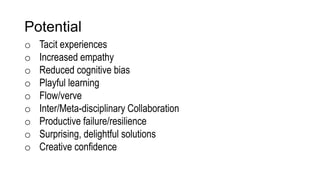
Potential
o Tacit experiences
o Increased empathy
o Reduced cognitive bias
o Playful learning
o Flow/verve
o Inter/Meta-disciplinary Collaboration
o Productive failure/resilience
o Surprising, delightful solutions
o Creative confidence
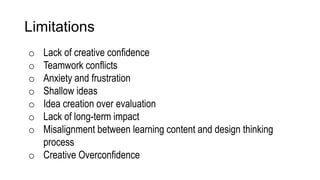
Limitations
o Lack of creative confidence
o Teamwork conflicts
o Anxiety and frustration
o Shallow ideas
o Idea creation over evaluation
o Lack of long-term impact
o Misalignment between learning content and design thinking
process
o Creative Overconfidence
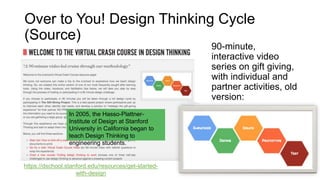
https://dschool.stanford.edu/resources/get-started-
with-design
90-minute,
interactive video
series on gift giving,
with individual and
partner activities, old
version:
https://vimeo.com/180433845
Over to You! Design Thinking Cycle
(Source)
In 2005, the Hasso-Plattner-
Institute of Design at Stanford
University in California began to
teach Design Thinking to
engineering students.
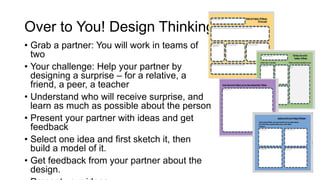
• Grab a partner: You will work in teams of
two
• Your challenge: Help your partner by
designing a surprise – for a relative, a
friend, a peer, a teacher
• Understand who will receive surprise, and
learn as much as possible about the person
• Present your partner with ideas and get
feedback
• Select one idea and first sketch it, then
build a model of it.
• Get feedback from your partner about the
design.
Over to You! Design Thinking Cycle
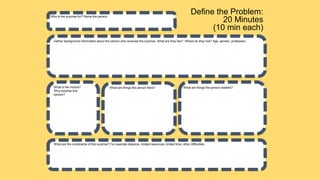
Define the Problem:
20 Minutes
(10 min each)
Gather background information about the person who receives the surprise. What are they like? Where do they live? Age, gender, profession.
What is the motive?
Why surprise this
person?
What are things the person likes?
What are the constraints of this surprise? For example distance, limited resources, limited time, other difficulties.
a
Who is the surprise for? Name the person.
What are things the person dislikes?
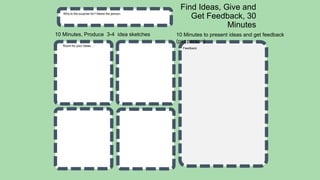
Find Ideas, Give and
Get Feedback, 30
Minutes
Who is the surprise for? Name the person.
Room for your Ideas....
Feedback:
10 Minutes, Produce 3-4 idea sketches 10 Minutes to present ideas and get feedback
(per person)
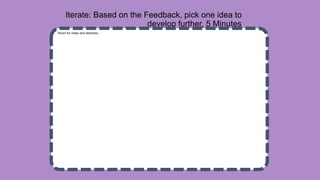
Iterate: Based on the Feedback, pick one idea to
develop further, 5 Minutes
Room for notes and sketches....
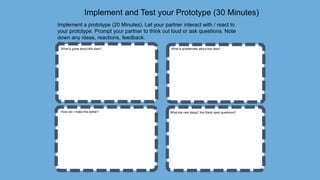
Implement and Test your Prototype (30 Minutes)
Implement a prototype (20 Minutes). Let your partner interact with / react to
your prototype. Prompt your partner to think out loud or ask questions. Note
down any ideas, reactions, feedback.
5 minutes each.
What is great about this idea? What is problematic about this idea?
How can I make this better? What are next steps? Are there open questions?

Design thinking for Education, AUW Session 1

  • 2.
    Where I amfrom, and what I do The Association for the Advancement of Computing in Education (AACE), founded in 1981, serves the edtech community with international conferences, journals, digital library and social media channels (AACE Review). As the largest university-based local government training, advisory, and research organization in the United States, the School of Government serves more than 12,000 public officials each year.
  • 3.
    Plan for theday • 5:15-6:00 Welcome and Intro • Break • 6:15-7:40 Design Thinking Activity (Students work in pairs) • 7:40-8:00 Share Your Surprise! • Break • 8:15-9:45 (approx. 15-30 min break between guests) • 9:45-10:15 Group Assignment
  • 4.
    What’s the idea?Design Thinking Design Thinking is problem solving method geared to overcome wicked problems. o Transcend the immediate boundaries of the problem to ensure that the right questions are being addressed o Analyze, synthesize, diverge, generate insights from different domains o Drawing, prototyping and storytelling (Brown, 2009) o Constraints as inspiration (Brown, 2009) o Fosters civic literacy, empathy, cultural awareness and risk taking (Sharples at al., Design Thinking
  • 5.
    What’s the id-ea? Design Thinking Design Thinking and Wicked Problems Traditional Model: Wicked Problems: “The information needed to understand the problem depends upon one's idea for solving it” (Rittel & Webber, 1973, 161). Problem Definition (Analyzing ) Problem Solution (Synthesiz ing) “Tell me what success looks like”.
  • 6.
  • 7.
    Designing to LetGo: Fail fast, fail often Develop like a believer, test like a sceptic • Most educators like to be right. • Good designers know they are mostly wrong. • Practicing design thinking teaches to let ideas go. • Wicked problem solutions cannot be computed – they do not follow directly from data / evidence, have many, possibly interdependent variables, known unknowns and unknown unknowns • That does not mean solutions cannot be tested with rigor (i.e.
  • 8.
    “Even on acursory inspection, just what design thinkingis supposed to be is not well understood, either by the public or those who claim to practice it”. Kimbell,2011 Design Thinking Published 2009
  • 9.
    Designerly Thinking vs.Design Thinking (Johansson‐ Sköldberg et al., 2013) designerly thinking scholarly discourse, analysis, reflection of the professional designer’s practice (skills and competence) design thinking design practice and competence used beyond the design context (including art and architecture), for and with people without a scholarly background in design vs .
  • 10.
    Related Approaches o ParticipatoryDesign o Bricolage or Tinkering o LEGO Serious Play (LPS) o Makerspace / Maker Culture o Tacit Experiences o Creative Empowerment o Process and Product o Users as Co-Designers o Empowerment
  • 11.
    Design Thinking UseCases Website Redesign Workshops o School of Government (2013/14) o Carolina MPA Website Redesign (2016) o Center for Faculty Excellence (2017) o Center for Public Leadership and Governance (2018) o Development Finance Initiative (2019) Designing Web Apps / Tools Designing Courses o Public Executive Leadership Academy course design workshop series (2017)
  • 12.
    Design Thinking Examples:Website Strucure with LEGOs Content Sections Annotate Groups structure the main areas of the website / navigation / homepage
  • 13.
    Design Thinking Examples:Website Strucure with LEGOs
  • 14.
    1 hour 30 minutes 15minutes 2 hours Build Course Strucure with LEGOs
  • 15.
    Please think about thewebsite as a museum. What are 10 things you want to point visitors to? (Really useful resources, interesting events, services, downloads, projects…) Design Thinking Examples: Website as Museum (Flyer)
  • 16.
    Design Thinking Examples:Content Types ‘Information Curators’ describe the content using visual building blocks provided
  • 17.
    Audience: Pwebsite ersonas Personasare fictional, yet data-driven, user biographies that allow design teams to relate to the users’ point of view instead of focusing on personal experiences and anecdotes. Understanding Audiences: Personas
  • 18.
    o February 2018:Design thinking workshop at Muenster University of Applied Sciences (Germany) o Workshop theme: Inclusive community development - designing neighborhoods for engagement, social cohesion and inclusion o 15 participants o Part of the research cluster ‘participation and well-being’ o Faculty from different disciplines, city Research Workshop: Inclusive Community Development
  • 19.
    Ice Breaker: TellMe About Your Neighborhood – Who / What Is Not On the Map? o Draw a map of your own neighborhood. o What are some barriers to inclusiveness and social activities that you experience? o Who do you never meet in your neighborhood? Why do you think that is?
  • 20.
    (1) DEFINE &FOCUS: Specify which social inclusion problem you want to solve. (2) GENERATE & DEBATE Generate 3-5 ideas to address the problem with novel solutions or disruptive technologies. (3) SELECT & SKETCH Choose one of your ideas and sketch it out in more detail (literally). (4) BUILD & PRESENT: Design a prototype or three-dimensional representation of your solution with the materials in the room (card board, paper, tape, clay). Design Thinking Cycle
  • 21.
  • 22.
    Vocational School TeacherEducation Design Thinking Classes at FH Münster, Germany 2018, 2019, 2020
  • 23.
    o June 2019:Design thinking workshop at Kempten University of Applied Sciences (Germany) o 2 day workshop o Workshop theme: Social Media o 32 participants Social Media for Public Health Students
  • 24.
    Customer JourneyMap /SocialMediaPlate Take 15 Minutes to think about a typical week day. Map out the most important places as you move through the day. When and where do you engage with From waking up to falling asleep, when to you check social media apps? Which one?
  • 25.
    Evaluation Results –Positive Aspects o To receive impulses to think in other directions. o Open approach, integration of different perspectives o Creativity, possibility to think through unconventional ideas. o Personas allowed me to see my students as real people for the very first time o I felt that my ideas mattered
  • 26.
    Evaluation Results –Negative Aspects o It is unclear how to move from first ideas to further development of innovative, marketable products / services. o Realistic assessments of models and ideas: all comments and ideas were treated equal (both strength and weakness), missing data (ideas arise from a ‘gut feeling’) o challenges for shy or introverted people o negative team dynamics o fading effectiveness if used too often
  • 27.
    Design Thinking ForEducation: Special Issue https://www.degruyter.com/view/journals/edu/1/1/edu.1.issue-1.xml
  • 28.
    Literature Review: Panke(2019): Corpus of 167 document Predominantly single case studies Typical data sources: observation, interviews, analysis of artifacts produced in the design thinking process, survey evaluation.
  • 29.
    Panke, S. (2019).Design Thinking in Education: Perspectives, Opportunities and Challenges. Open Education Studies, 1(1), 281- 281-306. https://doi.org/10.1515/ed u-2019-0022 p.302
  • 30.
    Potential o Tacit experiences oIncreased empathy o Reduced cognitive bias o Playful learning o Flow/verve o Inter/Meta-disciplinary Collaboration o Productive failure/resilience o Surprising, delightful solutions o Creative confidence
  • 31.
    Limitations o Lack ofcreative confidence o Teamwork conflicts o Anxiety and frustration o Shallow ideas o Idea creation over evaluation o Lack of long-term impact o Misalignment between learning content and design thinking process o Creative Overconfidence
  • 32.
    https://dschool.stanford.edu/resources/get-started- with-design 90-minute, interactive video series ongift giving, with individual and partner activities, old version: https://vimeo.com/180433845 Over to You! Design Thinking Cycle (Source) In 2005, the Hasso-Plattner- Institute of Design at Stanford University in California began to teach Design Thinking to engineering students.
  • 33.
    • Grab apartner: You will work in teams of two • Your challenge: Help your partner by designing a surprise – for a relative, a friend, a peer, a teacher • Understand who will receive surprise, and learn as much as possible about the person • Present your partner with ideas and get feedback • Select one idea and first sketch it, then build a model of it. • Get feedback from your partner about the design. Over to You! Design Thinking Cycle
  • 34.
    Define the Problem: 20Minutes (10 min each) Gather background information about the person who receives the surprise. What are they like? Where do they live? Age, gender, profession. What is the motive? Why surprise this person? What are things the person likes? What are the constraints of this surprise? For example distance, limited resources, limited time, other difficulties. a Who is the surprise for? Name the person. What are things the person dislikes?
  • 35.
    Find Ideas, Giveand Get Feedback, 30 Minutes Who is the surprise for? Name the person. Room for your Ideas.... Feedback: 10 Minutes, Produce 3-4 idea sketches 10 Minutes to present ideas and get feedback (per person)
  • 36.
    Iterate: Based onthe Feedback, pick one idea to develop further, 5 Minutes Room for notes and sketches....
  • 37.
    Implement and Testyour Prototype (30 Minutes) Implement a prototype (20 Minutes). Let your partner interact with / react to your prototype. Prompt your partner to think out loud or ask questions. Note down any ideas, reactions, feedback. 5 minutes each. What is great about this idea? What is problematic about this idea? How can I make this better? What are next steps? Are there open questions?

Editor's Notes

  • #5 Design thinking is a problem solving method geared to overcome wicked problems, that have no right or wrong solution and resist traditional scientific and engineering approaches, as “the information needed to understand the problem depends upon one's idea for solving it” (Rittel & Webber, 1973, 161). Design thinking aims at transcending the immediate boundaries of the problem to ensure that the right questions are being addressed. The process foresees steps that allow participants to analyze, synthesize, diverge and generate insights from different domains through drawing, prototyping and storytelling (Brown, 2009). During the design thinking process, the facilitator encourages learners to see constraints as inspiration (Brown & Wyatt, 2010). The results are typically not directed toward a technological "quick fix” but toward new integrations of signs, things, actions, and environments (Buchanan, 1992). The essence of design thinking is to put learners into contexts that make them think and work like an expert designer, and thereby foster civic literacy, empathy, cultural awareness and risk taking (Sharples et al., 2016).  
  • #6 Design thinking is a problem solving method geared to overcome wicked problems, that have no right or wrong solution and resist traditional scientific and engineering approaches, as “the information needed to understand the problem depends upon one's idea for solving it” (Rittel & Webber, 1973, 161). Wicked problems have a wide, unbound problem space and complexity, are open for interpretation, surrounded by competing or conflicting opinions for solutions, and unlikely to ever be completely solved  
  • #18 We used the personas approach as a narrative tool to give workshop participants an authentic glimpse into the everyday life of people living in a prototypical neighborhood. Personas are an immersive way for bringing abstract target group information to life through the presence of a specific, fictional personality (Junior & Filgueiras, 2005). Acting as a “projection screen”, personas aid in identifying needs and possible behavioral patterns (Panke, Gaiser & Werner, 2007). After a brief overview of statistical data on typical demographics in a German neighborhood, participants worked in teams of 3, and designed 1-2 portraits, that outlined characteristics of each persona.
  • #19 In February 2018 the authors of this article were involved in a design thinking workshop at Muenster University of Applied Sciences (Germany) in the roles of facilitator and participant. Our case study analysis reflects both perspectives, and uses evaluation results to further illuminate how the workshop structure fostered creativity and empathy. A central aspect of the research cluster 'participation and well-being' at the Münster University of Applied Sciences is to seek ideas of how to develop the living quarters and neighborhoods in Germany cities. Despite the predominantly excellent digital infrastructure, the excellent health care and manifold assisted living offers in Germany, the potential of inclusion, equal co-existence and social coherence are not sufficiently supported.
  • #20 Since design thinking is a visual and haptic approach, we started the workshop with an exercise that tapped into the visualization and spatial thinking skills of the participants by asking them to draw a map of their quarter. Specifically, the task was to map out barriers to inclusion and participation.
  • #21 The personas and their legends delivered the necessary context for design decisions and priorities in the next step of the creative process, the design thinking cycle. During the design thinking process participants cycle rapidly through a series of tasks that prompt them to observe, brainstorm, synthesize, prototype and discuss. Each participant worked in a dyadic team. The partners went through four design sheets with structured prompts: DEFINE & FOCUS: Pick one of the personas and specify which social inclusion problem you want to solve for this person. Remember that how you describe the problem affects the solution, so pay attention to precise, concise and action-oriented language. Present to your partner. GENERATE & DEBATE Generate 3-5 ideas to address the problem with novel solutions or disruptive technologies. Aim for a large effect, broad reach and replicable results. Present to your partner. SELECT & SKETCH Choose one of your ideas and sketch it out in more detail (literally). Select the best-received, the most interesting to you, the most likely to be implemented, the most unusual or the solution with the most options for collaborating with others. Present to your partner. BUILD & PRESENT: Design a prototype or three-dimensional representation of your solution with the materials in the room (card board, paper, tape, clay). Let your partner / the gropup react to the prototype. Both express and receive positive and negative feedback, ideas for improvement or extension, and open questions.
  • #22 We went through two cycles of the design thinking process so that each participant developed, discussed, sketched, and built out two ideas. After the first round, we re-formed the teams, so that everyone worked with two different people, ideally each from a different context. While the conceptual idea stages where developed in a dyadic setting, each participant presented their prototypes to the whole group and got feedback from the plenum. Community Engagement can happen in different spaces and places, through events or programs, facilitated by technology and public infrastructure, comprising public, commercial and private spheres. The workshop participants developed 28 different design ideas.
  • #33 In 2005, the Hasso-Plattner-Institute of Design at Stanford University in California began to teach Design Thinking to engineering students. The philosophy behind this venture was the conviction that it is possible to train engineers and scientists to become innovators.
  • #34 In 2005, the Hasso-Plattner-Institute of Design at Stanford University in California began to teach Design Thinking to engineering students. The philosophy behind this venture was the conviction that it is possible to train engineers and scientists to become innovators.