Internet Pictures Clips Maps News Shop Email more

PQM - PPT
Philosophies of Quality (W.Edwards Deming & Joseph M.Juran)
Search

I’m Feeling Lucky

Presentation By(Roll no.)- 180,191,1015,1036,1049
Acknowledgement
We would like to thank Samir Sir for
giving us this opportunity and
enlightening us on this topic.
Contents
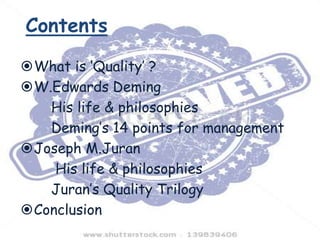
What is ‘Quality’ ?
W.Edwards Deming
His life & philosophies
Deming’s 14 points for management
Joseph M.Juran
His life & philosophies
Juran’s Quality Trilogy
Conclusion
Internet Pictures Clips Maps News Shop Email more

Web Search
What does the word “quality” mean to you?
Search

Your text here

Google.co.in offered in: Hindi Bengali Telugu Marathi Tamil Gujarati Punjabi
Internet Pictures Clips Maps News Shop Email more
Web Search
Web Search
Pictures
Clips
Maps
News
Shop
Email

What does the word “quality” mean to you?

Search

Insert Your Picture

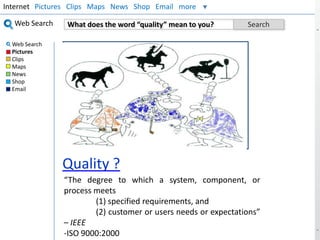
Quality ?
“The degree to which a system, component, or
process meets
(1) specified requirements, and
(2) customer or users needs or expectations”
– IEEE
-ISO 9000:2000
Achieving Quality
• Companies should direct efforts towards:
– Innovation of products.
– Innovation of processes.
– Improvement of existing products.
– Improvement of existing processes.
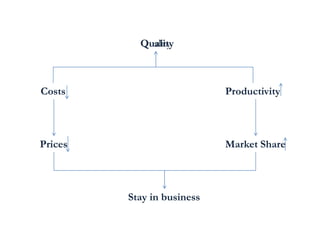
Quality
Quality

Costs

Productivity

Prices

Market Share

Stay in business
Internet Pictures Clips Maps News Shop Email more

PQM - PPT
W. Edwards Deming & his philosophies
Search

Your text here

Google.co.in offered in: Hindi Bengali Telugu Marathi Tamil Gujarati Punjabi
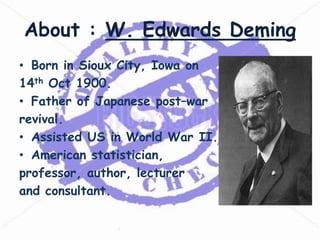
About : W. Edwards Deming
• Born in Sioux City, Iowa on
14th Oct 1900.
• Father of Japanese post–war
revival.
• Assisted US in World War II.
• American statistician,
professor, author, lecturer
and consultant.
His Philosophies
• Established the system of profound
knowledge.
• Suggested quality concept about
designing products.
• Enumerated a 14-point management
philosophy.
• Promoted importance of leadership.
• 85% of production faults responsibility
of management, not workers.
Deming’s 14 principles
•

•
•
•
•
•
•

Create constancy of purpose for improving
products and service
Adopt the new philosophy.
Cease dependence on inspection to achieve
quality.
End the practice of awarding business on
price alone; instead, minimize total cost by
working with a single supplier.
improve constantly and forever every process
for
planning, production and service.
Institute training on job
Adopt and institute leadership.
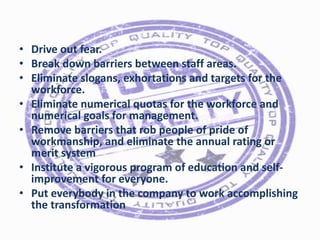
• Drive out fear.
• Break down barriers between staff areas.
• Eliminate slogans, exhortations and targets for the
workforce.
• Eliminate numerical quotas for the workforce and
numerical goals for management.
• Remove barriers that rob people of pride of
workmanship, and eliminate the annual rating or
merit system
• Institute a vigorous program of education and selfimprovement for everyone.
• Put everybody in the company to work accomplishing
the transformation
Internet Pictures Clips Maps News Shop Email more

PQM - PPT
Joseph M. Juran & his Quality trilogy.
Search

Your text here

Google.co.in offered in: Hindi Bengali Telugu Marathi Tamil Gujarati Punjabi
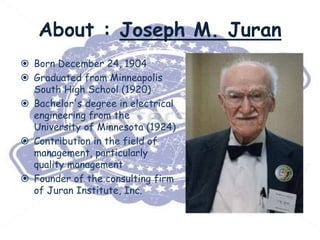
About : Joseph M. Juran
 Born December 24, 1904
 Graduated from Minneapolis
South High School (1920)
 Bachelor's degree in electrical
engineering from the
University of Minnesota (1924)
 Contribution in the field of
management, particularly
quality management
 Founder of the consulting firm
of Juran Institute, Inc.
His Philosophies
Developed the idea of trilogy
•
•
•

Quality Planning
Quality Improvement
Quality Control

Revolutionized the Japanese philosophy on Quality

management & in no small way worked to help shape
their economy into industrial leader it is today.
First to incorporate the human aspect of quality
management, which is referred to as Total Quality
Management.
In 1951, the first edition of Juran’s quality control
handbook was published

In the field of quality management for 70 years.
Standard & classical reference work for quality managers
Juran’s Quality Trilogy
• A useful framework refered to as “A Universal
Thought Process”
• Trilogy shows how an organization can improve
every aspect by better understanding of the
relationship between processes that plan, control
and improve quality as well as business results
• The concept of the Quality Trilogy is managing for
quality.
• Managing for quality consists of three quality
oriented processes
• Quality Planning
• Quality Control
• Quality Improvement
Quality Planning








Establish quality goals
Identify who the customers are
Determine the needs of the customers
Develop product features that respond to customer’s needs
Develop processes able to produce the product features
Establish process

Quality Improvement







Prove the need Establish the infrastructure
Establish project teams
Provide the team with resources, training & motivation to :
Diagnose the causes Stimulate
Establish controls to hold the gains remedies

Quality Control
 Evaluate actual performance
 Compare actual performance with quality goals
 Act on difference
Companies following Juran’s
theory
•AT&T
•AT&T Wireless
•AtlantAbengoa
•ic Copper
•Becton Dickinson
•Black & Decker
•BP
•Computer Science
Corp.
•ConocoPhillips
•DuPont

•Lipton
•Littelfuse
•Microsoft
•NOKIA Mobile Phones
•Norsk Hydro Agri
•Pemex
•Prosegur
•Unilever - Best Foods
•Samsung Electronics
•Sun Chemical
Strength of Juran’s Trilogy
• The methodology allows
the use different quality
tools to cover the steps
of Juran’s Trilogy. It
allows a better
understanding of the
relationships of every
stage of the company
• The methodology is well
structured and allows the
companies that implement
it, an easy understanding
and application

Weakness of Juran’s
Trilogy
 To have quality control it is
necessary to have a trained
person with knowledge in
statistical processes or train
a special person to be in
charge of quality
 The program is focus in the
company process and not in
labor force
 Analyzing the requirements
of the program we found
that the companies who
apply the program have a
complex level of organization
THANK YOU !

philosophies of quality (Deming's and juran's philosophies)

  • 1.
    Internet Pictures ClipsMaps News Shop Email more PQM - PPT Philosophies of Quality (W.Edwards Deming & Joseph M.Juran) Search I’m Feeling Lucky Presentation By(Roll no.)- 180,191,1015,1036,1049
  • 2.
    Acknowledgement We would liketo thank Samir Sir for giving us this opportunity and enlightening us on this topic.
  • 3.
    Contents What is ‘Quality’? W.Edwards Deming His life & philosophies Deming’s 14 points for management Joseph M.Juran His life & philosophies Juran’s Quality Trilogy Conclusion
  • 4.
    Internet Pictures ClipsMaps News Shop Email more Web Search What does the word “quality” mean to you? Search Your text here Google.co.in offered in: Hindi Bengali Telugu Marathi Tamil Gujarati Punjabi
  • 5.
    Internet Pictures ClipsMaps News Shop Email more Web Search Web Search Pictures Clips Maps News Shop Email What does the word “quality” mean to you? Search Insert Your Picture Quality ? “The degree to which a system, component, or process meets (1) specified requirements, and (2) customer or users needs or expectations” – IEEE -ISO 9000:2000
  • 6.
    Achieving Quality • Companiesshould direct efforts towards: – Innovation of products. – Innovation of processes. – Improvement of existing products. – Improvement of existing processes.
  • 7.
  • 8.
    Internet Pictures ClipsMaps News Shop Email more PQM - PPT W. Edwards Deming & his philosophies Search Your text here Google.co.in offered in: Hindi Bengali Telugu Marathi Tamil Gujarati Punjabi
  • 9.
    About : W.Edwards Deming • Born in Sioux City, Iowa on 14th Oct 1900. • Father of Japanese post–war revival. • Assisted US in World War II. • American statistician, professor, author, lecturer and consultant.
  • 10.
    His Philosophies • Establishedthe system of profound knowledge. • Suggested quality concept about designing products. • Enumerated a 14-point management philosophy. • Promoted importance of leadership. • 85% of production faults responsibility of management, not workers.
  • 11.
    Deming’s 14 principles • • • • • • • Createconstancy of purpose for improving products and service Adopt the new philosophy. Cease dependence on inspection to achieve quality. End the practice of awarding business on price alone; instead, minimize total cost by working with a single supplier. improve constantly and forever every process for planning, production and service. Institute training on job Adopt and institute leadership.
  • 12.
    • Drive outfear. • Break down barriers between staff areas. • Eliminate slogans, exhortations and targets for the workforce. • Eliminate numerical quotas for the workforce and numerical goals for management. • Remove barriers that rob people of pride of workmanship, and eliminate the annual rating or merit system • Institute a vigorous program of education and selfimprovement for everyone. • Put everybody in the company to work accomplishing the transformation
  • 13.
    Internet Pictures ClipsMaps News Shop Email more PQM - PPT Joseph M. Juran & his Quality trilogy. Search Your text here Google.co.in offered in: Hindi Bengali Telugu Marathi Tamil Gujarati Punjabi
  • 14.
    About : JosephM. Juran  Born December 24, 1904  Graduated from Minneapolis South High School (1920)  Bachelor's degree in electrical engineering from the University of Minnesota (1924)  Contribution in the field of management, particularly quality management  Founder of the consulting firm of Juran Institute, Inc.
  • 15.
    His Philosophies Developed theidea of trilogy • • • Quality Planning Quality Improvement Quality Control Revolutionized the Japanese philosophy on Quality management & in no small way worked to help shape their economy into industrial leader it is today. First to incorporate the human aspect of quality management, which is referred to as Total Quality Management. In 1951, the first edition of Juran’s quality control handbook was published In the field of quality management for 70 years. Standard & classical reference work for quality managers
  • 16.
    Juran’s Quality Trilogy •A useful framework refered to as “A Universal Thought Process” • Trilogy shows how an organization can improve every aspect by better understanding of the relationship between processes that plan, control and improve quality as well as business results • The concept of the Quality Trilogy is managing for quality. • Managing for quality consists of three quality oriented processes • Quality Planning • Quality Control • Quality Improvement
  • 17.
    Quality Planning       Establish qualitygoals Identify who the customers are Determine the needs of the customers Develop product features that respond to customer’s needs Develop processes able to produce the product features Establish process Quality Improvement      Prove the need Establish the infrastructure Establish project teams Provide the team with resources, training & motivation to : Diagnose the causes Stimulate Establish controls to hold the gains remedies Quality Control  Evaluate actual performance  Compare actual performance with quality goals  Act on difference
  • 18.
    Companies following Juran’s theory •AT&T •AT&TWireless •AtlantAbengoa •ic Copper •Becton Dickinson •Black & Decker •BP •Computer Science Corp. •ConocoPhillips •DuPont •Lipton •Littelfuse •Microsoft •NOKIA Mobile Phones •Norsk Hydro Agri •Pemex •Prosegur •Unilever - Best Foods •Samsung Electronics •Sun Chemical
  • 19.
    Strength of Juran’sTrilogy • The methodology allows the use different quality tools to cover the steps of Juran’s Trilogy. It allows a better understanding of the relationships of every stage of the company • The methodology is well structured and allows the companies that implement it, an easy understanding and application Weakness of Juran’s Trilogy  To have quality control it is necessary to have a trained person with knowledge in statistical processes or train a special person to be in charge of quality  The program is focus in the company process and not in labor force  Analyzing the requirements of the program we found that the companies who apply the program have a complex level of organization
  • 20.