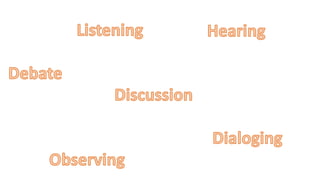
LISTENING DIALOGUE OBSERVATION
"To listen is to give attention to sound or action."
Oxford Dictionary
When listening:
• One hears what others say
• Try to understand what it means
The act of listening involves
• Complex affective
• Cognitive
• Behavioral processes
Listening
Hearing Listening
Refers to one's ability to perceive sounds,
by receiving vibrations through ears.
Done consciously, that involves analysis
and understanding of the sounds.
An Ability A Skill
Physiological Psychological
Receipt of message through ears
Interpretation of message received by the
ears
Passive bodily process (sub-conscious level) Active mental process (conscious level)
Listening is an art that requires
attention over talent, spirit over ego,
others over self.
Dean
Jackson
Dialogue
Dialogue
Dialogue is about deep listening to each other without biases and judgment. The process
of Dialogue enables everyone to express his/her opinion and then move towards Design
conversations. It brings multiple alternatives and it’s progressive.
Debate is about expressing ‘my’ view point. It is boxing of thoughts of ‘me’ versus
‘others’. The final outcome is ‘who’ is right.
Dialogue versus Debate
Observation
9
Observation
9
IMMERSION &
OBSERVATIO
N
• Active and engaged observation powered by empathy
• In a way it is the core tenet of the first phase of Design Thinking
• Observer participates as he or she observes, talking with stakeholders and participating
in project activities
WHAT IS IMMERSION ANDOBSERVATION?
Types of Observer
(1) Complete Observer
(3) Participant as Observer
(2) Observer as Participant
(4) Complete Participant
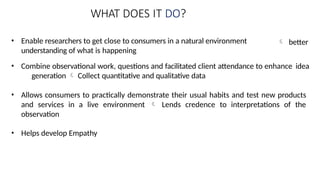
WHAT DOES IT DO?
• Enable researchers to get close to consumers in a natural environment
understanding of what is happening
 better
• Combine observational work, questions and facilitated client attendance to enhance idea
generation  Collect quantitative and qualitative data
• Allows consumers to practically demonstrate their usual habits and test new products
and services in a live environment  Lends credence to interpretations of the
observation
• Helps develop Empathy
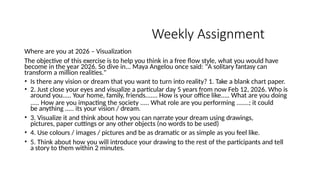
Weekly Assignment
Where are you at 2026 – Visualization
The objective of this exercise is to help you think in a free flow style, what you would have
become in the year 2026. So dive in... Maya Angelou once said: "A solitary fantasy can
transform a million realities."
• Is there any vision or dream that you want to turn into reality? 1. Take a blank chart paper.
• 2. Just close your eyes and visualize a particular day 5 years from now Feb 12, 2026. Who is
around you..... Your home, family, friends....... How is your office like..... What are you doing
..... How are you impacting the society ..... What role are you performing .......; it could
be anything ..... its your vision / dream.
• 3. Visualize it and think about how you can narrate your dream using drawings,
pictures, paper cuttings or any other objects (no words to be used)
• 4. Use colours / images / pictures and be as dramatic or as simple as you feel like.
• 5. Think about how you will introduce your drawing to the rest of the participants and tell
a story to them within 2 minutes.
Quiz
1. Design Thinking is:
• Thinking about design
• Designing ways in which people think
• Asking users to solve problems
• Defining, framing and solving problems from users' perspectives
2. Design Thinking is a Linear Process. True or False?
• True
• False
3. Which of the below firm is associated the most with Design
Thinking?
• Ikea
• Ideo
• Idea
• Ikei
THE DIFFERENTIATOR
• Traditional Thinking
• What is the right answer?
• More talk
• Data
• Events
• Talk about facts
• Design Thinking
• What is the right question?
• More Listen
• Stories
• Experiences
• Talk about feelings
Source:interaction-design.org
Thank
You!
Examples of Good
Design
Examples of great
Design
Examples of Bad
Design
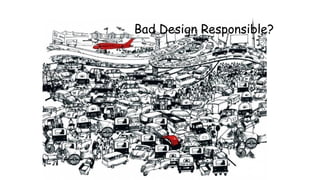
Bad Design Responsible?
Design of Roads : New York vs Bengaluru
Grid
Pattern
Star
Pattern
Traffic Distribution : Star vs Grid
What all can we
DESIGN
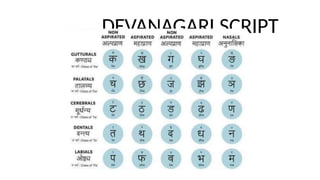
DEVANAGARI SCRIPT
SOUTH
INDIAN
FOOD
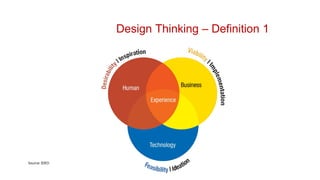
Source: IDEO
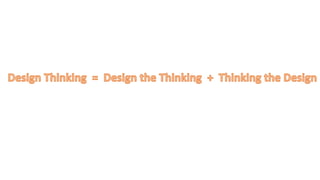
Design Thinking – Definition 1
Source: The Design of Business, Roger Martin,
2009
Design Thinking – Definition 2
16
Understanding
Requirements
Observing
Connecting
The Dots
Unearthing
Blind spots
Stated
Unstated
Patterns
Anti-patterns
Within the Box
Outside the Box
Don’t know
what I Don’t know
Design Thinking – Definition 3
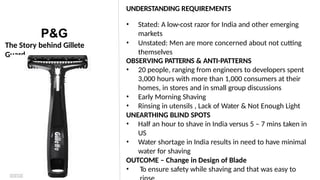
P&G
The Story behind Gillete
Guard
UNDERSTANDING REQUIREMENTS
• Stated: A low-cost razor for India and other emerging
markets
• Unstated: Men are more concerned about not cutting
themselves
OBSERVING PATTERNS & ANTI-PATTERNS
• 20 people, ranging from engineers to developers spent
3,000 hours with more than 1,000 consumers at their
homes, in stores and in small group discussions
• Early Morning Shaving
• Rinsing in utensils , Lack of Water & Not Enough Light
UNEARTHING BLIND SPOTS
• Half an hour to shave in India versus 5 – 7 mins taken in
US
• Water shortage in India results in need to have minimal
water for shaving
OUTCOME – Change in Design of Blade
• To ensure safety while shaving and that was easy to
What is Design Thinking?
• Human Centered
• Future Focused
• Creates Value
THE BASIC RULE OFDESIGN
Design is a process of working to develop solutions in a conscious and
innovative way in which both functional and aesthetic requirements are
included based on user needs
EMPATHY……..
Questioning Assumptions
A restaurant
has menus.
serves food.
charges for the food they serve.
What are YOUR
assumptions?
The chef can prepare any dish of customer’s
choice based on available ingredients
The restaurant has a good interior. People can
bring their own food and enjoy a picnic.
Select food is free. The customers are
charged
on the time spent at the restaurant.
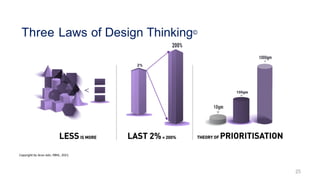
Three Laws of Design Thinking©
25
Copyright by Arun Jain, PBHL, 2021.
History of Design
Thinking
Design Thinking
Historical Overview –Global
Perspective
1960s
1970s
1980s
2000s
1990s
•Attempts to “Scientise” Design
•Technologist Buckminster Fuller called for “Design Science Revolution” to overcome
human and environmental problems
• The word “Wicked Problems” was coined
•Nobel Laureate & Cognitive Scientist Herbert Simon emphasised on
Testing through
Observation & Rapid prototyping
• Engineer & Artist Robert Kim researched on Left & Right brain for Problem Solving
and incorporated Design Thinking as a holistic problem solving approach
• “Designerly Way” of Solving problems – Paper by Nigel Cross
•Prof. Bryan Lawson’s Experiment – Post Graduate Architectural Students
(Designers) vs Post Graduate Science Students (Scientists)
• Solution Focused problem solvers vs Problem Focused Problem Solvers
•Design becomes mainstream thanks to IDEO
• Adopted by Graduate Schools, B-Schools
and Corporations alike
Examples of Wicked Problems:
• Poverty
• Climate Change
• Homelessness
• Environment Sustainability
Design-Way to address?
• Break down information
into nodes and links.
•Visualize the information.
• Collaborate and include
stakeholders in the process.
• Release solutions
quickly and gather
continuous feedback.
•Carry out multiple
The term “wicked problem” was first coined by Horst Rittel, design theorist and professor of
design methodology at the Ulm School of Design, Germany.
What Is a Wicked Problem?
A wicked problem is a social or cultural problem that’s difficult or impossible to solve—normally because
of its complex and interconnected nature. Wicked problems lack clarity in both their aims and solutions, and
are subject to real-world constraints which hinder risk-free attempts to find a solution.
Wicked problems are problems with many interdependent factors making them seem impossible to solve.
In the paper “Dilemmas in a General Theory of Planning,” he describes ten characteristics of wicked problems:
1. There is no definitive formula for a wicked problem.
2. Wicked problems have no stopping rule, as in there’s no way to know your solution is final.
3. Solutions to wicked problems are not true-or-false; they can only be good-or-bad.
4. There is no immediate test of a solution to a wicked problem.
5. Every solution to a wicked problem is a "one-shot operation"; because there is no opportunity to learn by trial-and-error,
every attempt counts significantly.
6. Wicked problems do not have a set number of potential solutions.
7. Every wicked problem is essentially unique.
8. Every wicked problem can be considered a symptom of another problem.
9. There is always more than one explanation for a wicked problem because the explanations vary greatly depending on the
individual perspective.
10. Planners/designers have no right to be wrong and must be fully responsible for their actions.
3 Core Design Thinking Principles
Design Mindset for Innovation
Design Culture Encompasses
Design
Mind
Design
Space
Design
Frameworks
Design
Process
Innovation and Creativity
Innovation and
creativity in the
have
workplace
become
increasingly
important
determinants of-
1. Organizatio
nal
performance
2. Success
3. Longer-term
survival.
Creativity is a complex interaction between the individual and their work situation at different levels of
organization.
1. At the individual level: individual creativity is the result of antecedent conditions (e.g., biographical
variables), cognitive style and ability (e.g., divergent thinking), personality (e.g., self-esteem), relevant
knowledge, motivation, social influences (e.g., rewards), and contextual influences (e.g., physical
environment).
2. At the team level: creativity is a consequence of individual creative behavior, the interaction between the
group members (e.g., group composition), group characteristics (e.g., norms, size), team processes, and
contextual influences (e.g., organizational culture, reward systems).
3. At the organizational level: innovation is a function of both individual and group creativity (Woodman et
al., 1993). This has been one of the most frequently used conceptual frameworks in emphasizing
the
interactions between the contextual and individual factors that might enhance or inhibit creativity at work
Creativity at different level of organization
Framework for Creativity and Innovation
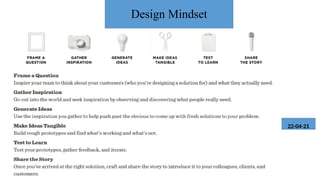
Design Mindset
22-04-21
Musica
l
Note
s
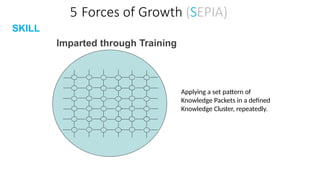
5 Forces of Growth (SEPIA)
SKILL
Imparted through Training
Applying a set pattern of
Knowledge Packets in a defined
Knowledge Cluster, repeatedly.
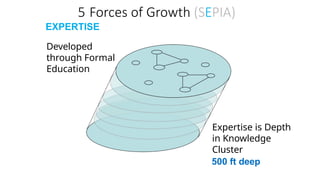
5 Forces of Growth (SEPIA)
EXPERTISE
Developed
through Formal
Education
Expertise is Depth
in Knowledge
Cluster
500 ft deep
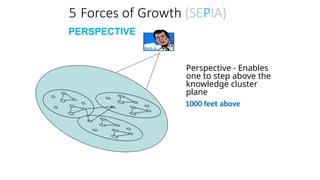
PERSPECTIVE
Perspective - Enables
one to step above the
knowledge cluster
plane
1000 feet above
5 Forces of Growth (SEPIA)
IDEA – Connection of knowledge packets in new arrangement.
(different from accepted norms)
IDEA
TECHNOLOGY
Container
Intra-space
Idea
Inter-space
Idea
BUSINESS DOMAIN
Container
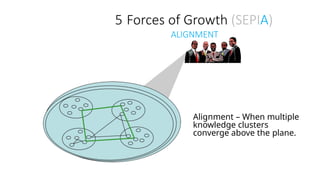
Alignment – When multiple
knowledge clusters
converge above the plane.
5 Forces of Growth (SEPIA)
ALIGNMENT
© Copyright by Arun Jain, Polaris Banyan Holding Private Limited, 2021
All rights reserved. Any use or copy of the same shall be upon written permission from the copyright
owner.
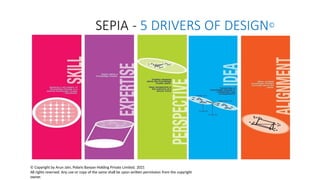
SEPIA - 5 DRIVERS OF DESIGN©
• Just Not Clear
• Uncertain
• Indecisive
Trusting
yourself
APPROVAL
5 Frictional Forces(DCAFE)
DOUBT
OPINION
• PERSPECTIVE
• EXPECTATION
• Difference of …
DIALOGUE
5 Frictional Forces(DCAFE)
CONFLICT
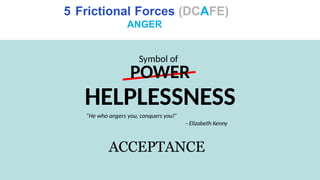
5 Frictional Forces (DCAFE)
ANGER
Symbol of
POWER
HELPLESSNESS
“He who angers you, conquers you!”
- Elizabeth Kenny
ACCEPTANCE
... of going wrong
… of failure
… of commitment
… of the ‘unknown’
COURAGE
5 Frictional Forces(DCAFE)
FEAR
Road Block for
Learning
outside
Comfort Zone
or
Outside
current
Knowledge
Container
5 Frictional Forces(DCAFE)
EGO
I KNOW IT ALL HUMILITY
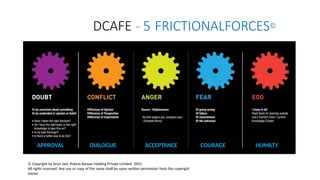
DCAFE - 5 FRICTIONALFORCES©
© Copyright by Arun Jain, Polaris Banyan Holding Private Limited, 2021
All rights reserved. Any use or copy of the same shall be upon written permission from the copyright
owner.
APPROVAL DIALOGUE ACCEPTANCE COURAGE HUMILTY
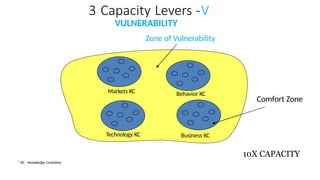
3 Capacity
Levers
Comfort Zone
Behavior KC
Markets KC
Technology KC Business KC
* KC - Knowledge Container
10X CAPACITY
3 Capacity Levers -VAL
VULNERABILITY
Zone of Vulnerability
Positive
Reinforcement
Appreciation KPs
MAIN HOON NA ….!
3 Capacity Levers– A
APPRECIATION
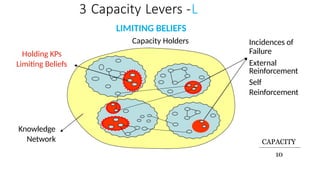
3 Capacity Levers -L
LIMITING BELIEFS
Capacity Holders Incidences of
Failure
External
Reinforcement
Self
Reinforcement
Knowledge
Network
Holding KPs
Limiting Beliefs
CAPACITY
10
VAL - 3 CAPACITYLEVERS©
© Copyright by Arun Jain, Polaris Banyan Holding Private Limited, 2021
All rights reserved. Any use or copy of the same shall be upon written permission from the copyright
owner.
10X THINKING 10X CAPACITY 10X CAPACITY
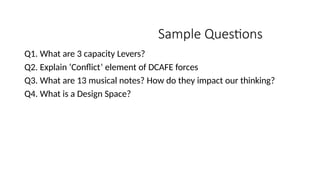
Sample Questions
Q1. What are 3 capacity Levers?
Q2. Explain ‘Conflict’ element of DCAFE forces
Q3. What are 13 musical notes? How do they impact our thinking?
Q4. What is a Design Space?
Design
Approaches
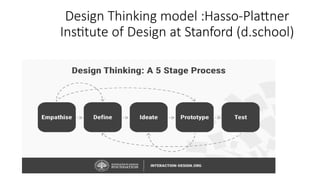
Design Thinking model :Hasso-Plattner
Institute of Design at Stanford (d.school)
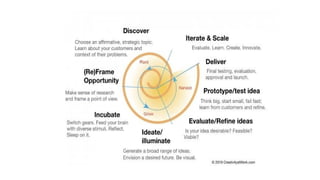
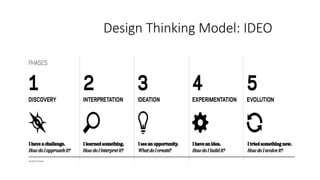
Design Thinking Model: IDEO
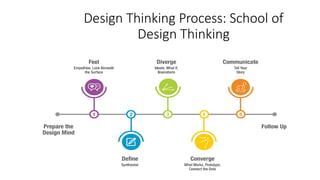
Design Thinking Process: School of
Design Thinking
MCQ
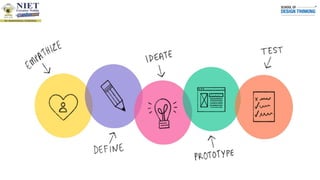
1. What are the steps of Design Thinking Process?
• Understand > Draw > Ideate > Create > Test
• Empathise > Define > Ideate > Prototype > Test
• Empathise > Design > Implement > Produce > Test
• Understand > Define > Ideate > Produce > Try
2. The final step in the Design Process is to .
• Test
• Define
• Ideate
• Empathize
References
Design of Roads : New York vs Bengaluru
https://uxdesign.cc/bangalore-traffic-short-case-study-7206b53ccc40
South Indian Food System
https://www.linkedin.com/pulse/20140809081100-
24337284-design-thinking-and-south-indian-
food/
Gillete Case
https://www.dailymail.co.uk/news/article-2443191/Gillette-spent-
fortune-Indian-razor-forgetting-
countrys-running-water.html
References
•https://www.customerguru.in/amazingly-shocking-
customer-experience-story-ritz-carlton-does-it- again/
•Wicked Problems
•https://www.interaction-design.org/literature/topics/wicked-problems
•Different Examples on 3 Laws of Design Thinking
https://www.independent.co.uk/news/world/americas/starbucks-barista-learns-sign-language-to- talk-to-
deaf- customer-a6890606.html
Thank You!

DTI Unit 1 for engineering students.pptx

  • 3.
  • 4.
    "To listen isto give attention to sound or action." Oxford Dictionary When listening: • One hears what others say • Try to understand what it means The act of listening involves • Complex affective • Cognitive • Behavioral processes Listening
  • 5.
    Hearing Listening Refers toone's ability to perceive sounds, by receiving vibrations through ears. Done consciously, that involves analysis and understanding of the sounds. An Ability A Skill Physiological Psychological Receipt of message through ears Interpretation of message received by the ears Passive bodily process (sub-conscious level) Active mental process (conscious level)
  • 6.
    Listening is anart that requires attention over talent, spirit over ego, others over self. Dean Jackson
  • 7.
  • 8.
  • 9.
    Dialogue is aboutdeep listening to each other without biases and judgment. The process of Dialogue enables everyone to express his/her opinion and then move towards Design conversations. It brings multiple alternatives and it’s progressive. Debate is about expressing ‘my’ view point. It is boxing of thoughts of ‘me’ versus ‘others’. The final outcome is ‘who’ is right. Dialogue versus Debate
  • 10.
  • 11.
  • 12.
  • 13.
    • Active andengaged observation powered by empathy • In a way it is the core tenet of the first phase of Design Thinking • Observer participates as he or she observes, talking with stakeholders and participating in project activities WHAT IS IMMERSION ANDOBSERVATION? Types of Observer (1) Complete Observer (3) Participant as Observer (2) Observer as Participant (4) Complete Participant
  • 14.
    WHAT DOES ITDO? • Enable researchers to get close to consumers in a natural environment understanding of what is happening  better • Combine observational work, questions and facilitated client attendance to enhance idea generation  Collect quantitative and qualitative data • Allows consumers to practically demonstrate their usual habits and test new products and services in a live environment  Lends credence to interpretations of the observation • Helps develop Empathy
  • 15.
    Weekly Assignment Where areyou at 2026 – Visualization The objective of this exercise is to help you think in a free flow style, what you would have become in the year 2026. So dive in... Maya Angelou once said: "A solitary fantasy can transform a million realities." • Is there any vision or dream that you want to turn into reality? 1. Take a blank chart paper. • 2. Just close your eyes and visualize a particular day 5 years from now Feb 12, 2026. Who is around you..... Your home, family, friends....... How is your office like..... What are you doing ..... How are you impacting the society ..... What role are you performing .......; it could be anything ..... its your vision / dream. • 3. Visualize it and think about how you can narrate your dream using drawings, pictures, paper cuttings or any other objects (no words to be used) • 4. Use colours / images / pictures and be as dramatic or as simple as you feel like. • 5. Think about how you will introduce your drawing to the rest of the participants and tell a story to them within 2 minutes.
  • 16.
    Quiz 1. Design Thinkingis: • Thinking about design • Designing ways in which people think • Asking users to solve problems • Defining, framing and solving problems from users' perspectives 2. Design Thinking is a Linear Process. True or False? • True • False 3. Which of the below firm is associated the most with Design Thinking? • Ikea • Ideo • Idea • Ikei
  • 21.
    THE DIFFERENTIATOR • TraditionalThinking • What is the right answer? • More talk • Data • Events • Talk about facts • Design Thinking • What is the right question? • More Listen • Stories • Experiences • Talk about feelings
  • 22.
  • 23.
  • 25.
  • 29.
  • 33.
  • 35.
  • 36.
    Design of Roads: New York vs Bengaluru Grid Pattern Star Pattern
  • 37.
  • 38.
    What all canwe DESIGN
  • 40.
  • 41.
  • 42.
  • 44.
    Source: The Designof Business, Roger Martin, 2009 Design Thinking – Definition 2
  • 45.
  • 46.
    Understanding Requirements Observing Connecting The Dots Unearthing Blind spots Stated Unstated Patterns Anti-patterns Withinthe Box Outside the Box Don’t know what I Don’t know Design Thinking – Definition 3
  • 48.
    P&G The Story behindGillete Guard UNDERSTANDING REQUIREMENTS • Stated: A low-cost razor for India and other emerging markets • Unstated: Men are more concerned about not cutting themselves OBSERVING PATTERNS & ANTI-PATTERNS • 20 people, ranging from engineers to developers spent 3,000 hours with more than 1,000 consumers at their homes, in stores and in small group discussions • Early Morning Shaving • Rinsing in utensils , Lack of Water & Not Enough Light UNEARTHING BLIND SPOTS • Half an hour to shave in India versus 5 – 7 mins taken in US • Water shortage in India results in need to have minimal water for shaving OUTCOME – Change in Design of Blade • To ensure safety while shaving and that was easy to
  • 49.
    What is DesignThinking? • Human Centered • Future Focused • Creates Value
  • 50.
    THE BASIC RULEOFDESIGN Design is a process of working to develop solutions in a conscious and innovative way in which both functional and aesthetic requirements are included based on user needs
  • 51.
  • 52.
    Questioning Assumptions A restaurant hasmenus. serves food. charges for the food they serve. What are YOUR assumptions? The chef can prepare any dish of customer’s choice based on available ingredients The restaurant has a good interior. People can bring their own food and enjoy a picnic. Select food is free. The customers are charged on the time spent at the restaurant.
  • 53.
    Three Laws ofDesign Thinking© 25 Copyright by Arun Jain, PBHL, 2021.
  • 54.
  • 56.
  • 57.
    1960s 1970s 1980s 2000s 1990s •Attempts to “Scientise”Design •Technologist Buckminster Fuller called for “Design Science Revolution” to overcome human and environmental problems • The word “Wicked Problems” was coined •Nobel Laureate & Cognitive Scientist Herbert Simon emphasised on Testing through Observation & Rapid prototyping • Engineer & Artist Robert Kim researched on Left & Right brain for Problem Solving and incorporated Design Thinking as a holistic problem solving approach • “Designerly Way” of Solving problems – Paper by Nigel Cross •Prof. Bryan Lawson’s Experiment – Post Graduate Architectural Students (Designers) vs Post Graduate Science Students (Scientists) • Solution Focused problem solvers vs Problem Focused Problem Solvers •Design becomes mainstream thanks to IDEO • Adopted by Graduate Schools, B-Schools and Corporations alike
  • 58.
    Examples of WickedProblems: • Poverty • Climate Change • Homelessness • Environment Sustainability Design-Way to address? • Break down information into nodes and links. •Visualize the information. • Collaborate and include stakeholders in the process. • Release solutions quickly and gather continuous feedback. •Carry out multiple
  • 59.
    The term “wickedproblem” was first coined by Horst Rittel, design theorist and professor of design methodology at the Ulm School of Design, Germany. What Is a Wicked Problem? A wicked problem is a social or cultural problem that’s difficult or impossible to solve—normally because of its complex and interconnected nature. Wicked problems lack clarity in both their aims and solutions, and are subject to real-world constraints which hinder risk-free attempts to find a solution. Wicked problems are problems with many interdependent factors making them seem impossible to solve.
  • 60.
    In the paper“Dilemmas in a General Theory of Planning,” he describes ten characteristics of wicked problems: 1. There is no definitive formula for a wicked problem. 2. Wicked problems have no stopping rule, as in there’s no way to know your solution is final. 3. Solutions to wicked problems are not true-or-false; they can only be good-or-bad. 4. There is no immediate test of a solution to a wicked problem. 5. Every solution to a wicked problem is a "one-shot operation"; because there is no opportunity to learn by trial-and-error, every attempt counts significantly. 6. Wicked problems do not have a set number of potential solutions. 7. Every wicked problem is essentially unique. 8. Every wicked problem can be considered a symptom of another problem. 9. There is always more than one explanation for a wicked problem because the explanations vary greatly depending on the individual perspective. 10. Planners/designers have no right to be wrong and must be fully responsible for their actions.
  • 61.
    3 Core DesignThinking Principles
  • 62.
  • 63.
  • 64.
  • 65.
    Innovation and creativity inthe have workplace become increasingly important determinants of- 1. Organizatio nal performance 2. Success 3. Longer-term survival.
  • 66.
    Creativity is acomplex interaction between the individual and their work situation at different levels of organization. 1. At the individual level: individual creativity is the result of antecedent conditions (e.g., biographical variables), cognitive style and ability (e.g., divergent thinking), personality (e.g., self-esteem), relevant knowledge, motivation, social influences (e.g., rewards), and contextual influences (e.g., physical environment). 2. At the team level: creativity is a consequence of individual creative behavior, the interaction between the group members (e.g., group composition), group characteristics (e.g., norms, size), team processes, and contextual influences (e.g., organizational culture, reward systems). 3. At the organizational level: innovation is a function of both individual and group creativity (Woodman et al., 1993). This has been one of the most frequently used conceptual frameworks in emphasizing the interactions between the contextual and individual factors that might enhance or inhibit creativity at work Creativity at different level of organization
  • 67.
  • 69.
  • 72.
  • 73.
    5 Forces ofGrowth (SEPIA) SKILL Imparted through Training Applying a set pattern of Knowledge Packets in a defined Knowledge Cluster, repeatedly.
  • 74.
    5 Forces ofGrowth (SEPIA) EXPERTISE Developed through Formal Education Expertise is Depth in Knowledge Cluster 500 ft deep
  • 75.
    PERSPECTIVE Perspective - Enables oneto step above the knowledge cluster plane 1000 feet above 5 Forces of Growth (SEPIA)
  • 76.
    5 Forces ofGrowth (SEPIA) IDEA – Connection of knowledge packets in new arrangement. (different from accepted norms) IDEA TECHNOLOGY Container Intra-space Idea Inter-space Idea BUSINESS DOMAIN Container
  • 77.
    Alignment – Whenmultiple knowledge clusters converge above the plane. 5 Forces of Growth (SEPIA) ALIGNMENT
  • 78.
    © Copyright byArun Jain, Polaris Banyan Holding Private Limited, 2021 All rights reserved. Any use or copy of the same shall be upon written permission from the copyright owner. SEPIA - 5 DRIVERS OF DESIGN©
  • 79.
    • Just NotClear • Uncertain • Indecisive Trusting yourself APPROVAL 5 Frictional Forces(DCAFE) DOUBT
  • 80.
    OPINION • PERSPECTIVE • EXPECTATION •Difference of … DIALOGUE 5 Frictional Forces(DCAFE) CONFLICT
  • 81.
    5 Frictional Forces(DCAFE) ANGER Symbol of POWER HELPLESSNESS “He who angers you, conquers you!” - Elizabeth Kenny ACCEPTANCE
  • 82.
    ... of goingwrong … of failure … of commitment … of the ‘unknown’ COURAGE 5 Frictional Forces(DCAFE) FEAR
  • 83.
    Road Block for Learning outside ComfortZone or Outside current Knowledge Container 5 Frictional Forces(DCAFE) EGO I KNOW IT ALL HUMILITY
  • 84.
    DCAFE - 5FRICTIONALFORCES© © Copyright by Arun Jain, Polaris Banyan Holding Private Limited, 2021 All rights reserved. Any use or copy of the same shall be upon written permission from the copyright owner. APPROVAL DIALOGUE ACCEPTANCE COURAGE HUMILTY
  • 85.
  • 86.
    Comfort Zone Behavior KC MarketsKC Technology KC Business KC * KC - Knowledge Container 10X CAPACITY 3 Capacity Levers -VAL VULNERABILITY Zone of Vulnerability
  • 87.
    Positive Reinforcement Appreciation KPs MAIN HOONNA ….! 3 Capacity Levers– A APPRECIATION
  • 88.
    3 Capacity Levers-L LIMITING BELIEFS Capacity Holders Incidences of Failure External Reinforcement Self Reinforcement Knowledge Network Holding KPs Limiting Beliefs CAPACITY 10
  • 89.
    VAL - 3CAPACITYLEVERS© © Copyright by Arun Jain, Polaris Banyan Holding Private Limited, 2021 All rights reserved. Any use or copy of the same shall be upon written permission from the copyright owner. 10X THINKING 10X CAPACITY 10X CAPACITY
  • 90.
    Sample Questions Q1. Whatare 3 capacity Levers? Q2. Explain ‘Conflict’ element of DCAFE forces Q3. What are 13 musical notes? How do they impact our thinking? Q4. What is a Design Space?
  • 91.
  • 92.
    Design Thinking model:Hasso-Plattner Institute of Design at Stanford (d.school)
  • 93.
  • 95.
    Design Thinking Process:School of Design Thinking
  • 102.
    MCQ 1. What arethe steps of Design Thinking Process? • Understand > Draw > Ideate > Create > Test • Empathise > Define > Ideate > Prototype > Test • Empathise > Design > Implement > Produce > Test • Understand > Define > Ideate > Produce > Try 2. The final step in the Design Process is to . • Test • Define • Ideate • Empathize
  • 103.
    References Design of Roads: New York vs Bengaluru https://uxdesign.cc/bangalore-traffic-short-case-study-7206b53ccc40 South Indian Food System https://www.linkedin.com/pulse/20140809081100- 24337284-design-thinking-and-south-indian- food/ Gillete Case https://www.dailymail.co.uk/news/article-2443191/Gillette-spent- fortune-Indian-razor-forgetting- countrys-running-water.html
  • 104.
    References •https://www.customerguru.in/amazingly-shocking- customer-experience-story-ritz-carlton-does-it- again/ •Wicked Problems •https://www.interaction-design.org/literature/topics/wicked-problems •DifferentExamples on 3 Laws of Design Thinking https://www.independent.co.uk/news/world/americas/starbucks-barista-learns-sign-language-to- talk-to- deaf- customer-a6890606.html
  • 105.