Design Thinking
Ahmed Alaraj & Khaleel Arbeji
Decision & Management Project
Master of Web Science / SS 2017
Prof. Dr. Jan Karpe
Introduction
Definition of Design Thinking
The process of Design Thinking
Case Study / IDEO
Challenges
Future Outlook
Conclusion/Results
References
Agenda
What would be the first thing that comes
to your mind?
If I give you a piece of paper and tell you to cut it
A QUESTION
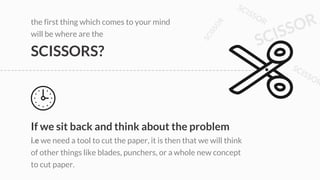
the first thing which comes to your mind
will be where are the
SCISSORS?
If we sit back and think about the problem
i.e we need a tool to cut the paper, it is then that we will think
of other things like blades, punchers, or a whole new concept
to cut paper.
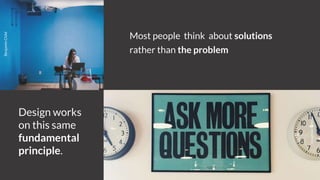
Most people think about solutions
rather than the problem
Design works
on this same
fundamental
principle.
BenjaminChild
JonathanSimcoe
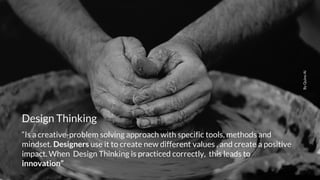
“Is a creative-problem solving approach with specific tools, methods and
mindset. Designers use it to create new different values , and create a positive
impact. When Design Thinking is practiced correctly, this leads to
innovation”
ByQuinoAl
Design Thinking
Thinking Outside the Box: The
Innovative Process of Design
Thinking
ImthazAhamed
How to get the truck out?
Emergency personnel
dismantle parts of the truck ?
Engineers
dismantle chip away parts of the bridge?
Firefighters, truck drivers
gathering to negotiate various solutions to
dislodging the truck.
A boy walking by..
he think out of the box and..
Why
Design
Thinking?
A new way for tackling problems
Explore new alternatives, new
solutions, new ideas
Re-frame the problem in human-
centric ways
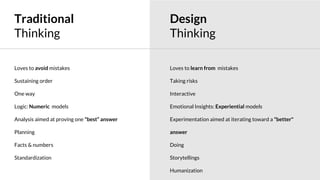
Traditional
Thinking
Loves to avoid mistakes
Sustaining order
One way
Logic: Numeric models
Analysis aimed at proving one "best” answer
Planning
Facts & numbers
Standardization
Caleb Jones
Design
Thinking
Loves to learn from mistakes
Taking risks
Interactive
Emotional Insights: Experiential models
Experimentation aimed at iterating toward a "better"
answer
Doing
Storytellings
Humanization
LendelaCruz
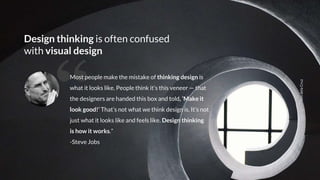
Design thinking is often confused
with visual design
“Most people make the mistake of thinking design is
what it looks like. People think it’s this veneer — that
the designers are handed this box and told, ‘Make it
look good!’ That’s not what we think design is. It’s not
just what it looks like and feels like. Design thinking
is how it works.”
-Steve Jobs
ClemOnojeghuo
Design thinking is less about
thinking and more about doing
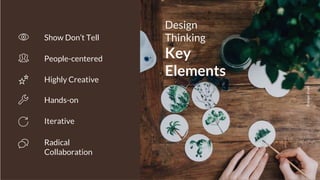
People-centered
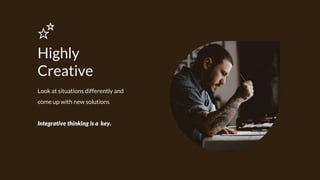
Highly Creative
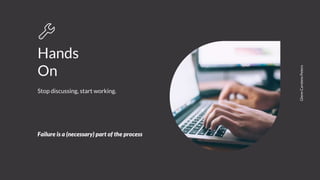
Hands-on
RomanKraft
Design
Thinking
Key
Elements
Iterative
Radical
Collaboration
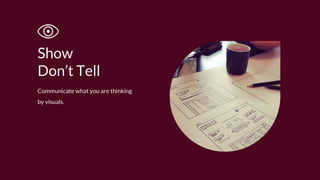
Show Don’t Tell
Communicate what you are thinking
by visuals.
Show
Don’t Tell
people, users, customers, consumers,
etc., need or want to do.
Empathy is a key.
People
Centered
Look at situations differently and
come up with new solutions
Integrative thinking is a key.
Highly
Creative
Stop discussing, start working.
Failure is a (necessary) part of the process
GlennCarstensPeters
Hands
On
The road to success does not
follow a straight line
MarkusSpiske
Iterative
Bringing together designers and
innovators from different
backgrounds and varied interests
and viewpoints.
Helloquence
Radical
Collaboration
Design Thinking
Methodologies
Double Diamond 4D DeepDive5D Stage-Gate
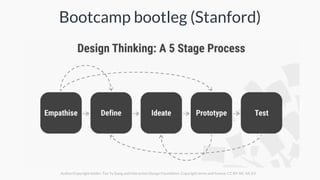
Bootcamp bootleg (Stanford)Stuart Pugh Simon Herbert
IDEO
Author/Copyright holder: Teo Yu Siang and Interaction Design Foundation. Copyright terms and licence: CC BY-NC-SA 3.0
Bootcamp bootleg (Stanford)
Author/Copyright holder: Teo Yu Siang and Interaction Design Foundation. Copyright terms and licence: CC BY-NC-SA 3.0
GALAK POWERPOINT
G
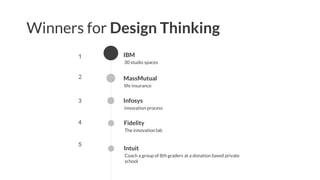
30 studio spaces
IBM
life insurance
MassMutual
innovation process
Infosys
The innovation lab
Fidelity
1
2
4
5
Winners for Design Thinking
Coach a group of 8th graders at a donation based private
school
Intuit
3
GALAK POWERPOINT
G
DariaNepriakhina
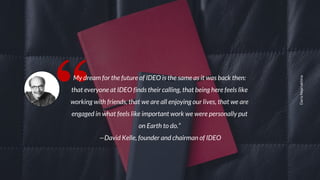
“My dream for the future of IDEO is the same as it was back then:
that everyone at IDEO finds their calling, that being here feels like
working with friends, that we are all enjoying our lives, that we are
engaged in what feels like important work we were personally put
on Earth to do.”
—David Kelle, founder and chairman of IDEO
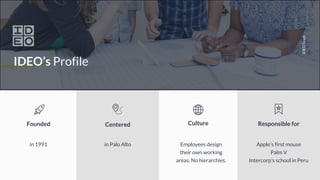
IDEO’s Profile
IDEOTeam
Responsible forFounded Centered Culture
in 1991 in Palo Alto Employees design
their own working
areas. No hierarchies.
Apple's first mouse
Palm V
Intercorp's school in Peru
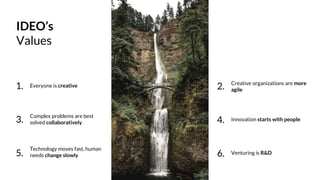
IDEO’s
Values
Everyone is creative1.
Complex problems are best
solved collaboratively3.
Technology moves fast, human
needs change slowly5.
Creative organizations are more
agile2.
Innovation starts with people4.
Venturing is R&D6.
Caleb Jones
GALAK POWERPOINT
G
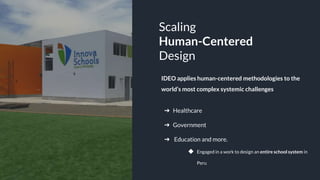
Scaling
Human-Centered
Design
➔ Healthcare
➔ Government
➔ Education and more.
◆ Engaged in a work to design an entire school system in
Peru
IDEO applies human-centered methodologies to the
world’s most complex systemic challenges
GALAK POWERPOINT
G
DariaNepriakhina
“Design thinking is a human-centered approach to innovation that
draws from the designer's toolkit to integrate the needs of people,
the possibilities of technology, and the requirements for business
success.”
—Tim Brown, President and CEO of IDEO
GALAK POWERPOINT
G
1 2 3 4 5
Understand Observe Visualize Evaluate Implement
The Process of IDEO
Understand
➔ The Market
➔ The client
➔ The Technology
NikMacMillan
Phase 1
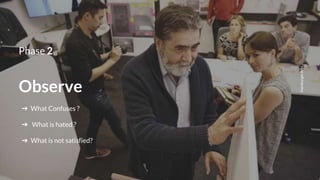
Observe
➔ What Confuses ?
➔ What is hated ?
➔ What is not satisfied?
HamburgerArts
Phase 2
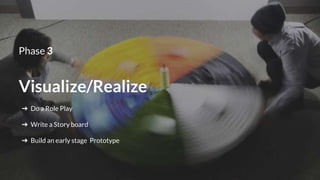
Visualize/Realize
➔ Do a Role Play
➔ Write a Story board
➔ Build an early stage Prototype
Phase 3
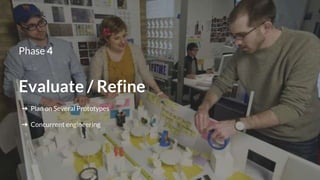
Evaluate / Refine
➔ Plan on Several Prototypes
➔ Concurrent engineering
Phase 4
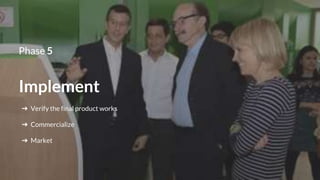
Implement
➔ Verify the final product works
➔ Commercialize
➔ Market
Phase 5
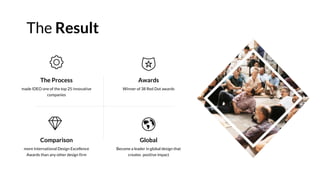
The Process
made IDEO one of the top 25 innovative
companies
Awards
Winner of 38 Red Dot awards
Comparison
more International Design Excellence
Awards than any other design firm
Global
Become a leader in global design that
creates positive impact
The Result
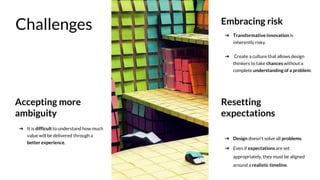
Challenges Embracing risk
Resetting
expectations
➔ Design doesn’t solve all problems.
➔ Even if expectations are set
appropriately, they must be aligned
around a realistic timeline.
➔ Transformative innovation is
inherently risky.
➔ Create a culture that allows design
thinkers to take chances without a
complete understanding of a problem.
Accepting more
ambiguity
➔ It is difficult to understand how much
value will be delivered through a
better experience.
Challenges Design Integration
Collaboration
➔ When it comes to very complex
artifacts, the problems of
integrating a new design loom
larger still.
Design Attention
➔ The business model itself may even
need to be changed.
➔ How will insurers work with
manufacturers and users to analyze
risk?
➔ How will the collected data be shared
while protecting privacy?
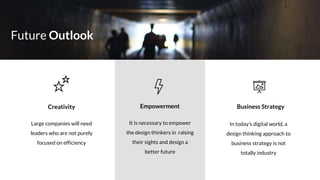
Creativity
Large companies will need
leaders who are not purely
focused on efficiency
Empowerment
It is necessary to empower
the design thinkers in raising
their sights and design a
better future
Business Strategy
In today’s digital world, a
design thinking approach to
business strategy is not
totally industry
Future Outlook
Conclusion
➔ Design thinking is a user-centered approach to problem solving.
➔ Designers have started to apply their collective skills to big global challenges.
➔ Design thinking is a step-by-step process that is repeated over multiple iterations.
➔ Design thinking is especially helpful for "Wicked" problems.
➔ The only way that you can get organizations to change is to give them different tools.
➔ Design Thinking is for Everyone.
References
➔ Design for Action
https://hbr.org/2015/09/design-for-action
➔ Design Thinking Comes of Age
https://hbr.org/2015/09/design-thinking-comes-of-age
➔ Capitalism Needs Design Thinking
https://hbr.org/2014/12/democratic-capitalism-needs-design-thinking
➔ Don’t just think. Act.
http://specialreports.theaustralian.com.au/705736/tim-brown/
➔ 5 Big Organizations Winning with Design Thinking
https://www.fastcompany.com/most-innovative-companies/2017
➔ IDEO
https://www.ideo.com
➔ Why design thinking drives digital transformation
https://www.mycustomer.com/marketing/technology/why-design-thinking-drives-digital-
transformation
References
➔ Design Thinking as a Strategy for Innovation
http://www.creativityatwork.com/design-thinking-strategy-for-innovation/
➔ What is Design Thinking and Why is It so Popular?
https://www.interaction-design.org/literature/article/what-is-design-thinking-and-why-is-it-so-popular
➔ The future of Design Thinking
https://www.theguardian.com/ing-direct-being-human-in-a-digital-world/2016/dec/05/the-future-of-design-thinking
➔ Design thinking methodologies
http://designthinkingmethodology.weebly.com/methodologies.html
➔ David Kelley: From Design to Design Thinking at Stanford and IDEO
http://www.sciencedirect.com/science/article/pii/S2405872616300065