Presentation
topic is
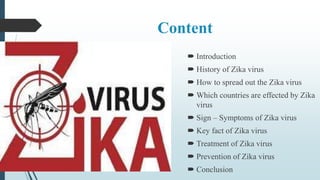
ZIKA VIRUS
Presented
By
Apu Marma
Reg: WUB14/17/19/666
Roll: 566
Batch: 19th
Department of pharmacy
Content
 Introduction
 History of Zika virus
 How to spread out the Zika virus
 Which countries are effected by Zika
virus
 Sign – Symptoms of Zika virus
 Key fact of Zika virus
 Treatment of Zika virus
 Prevention of Zika virus
 Conclusion
Introduction
 Zika virus (ZIKV) is a member of the virus family Flaviviridae. It is spread
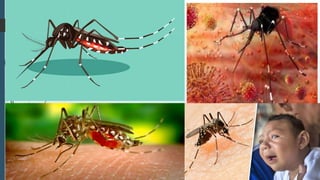
by daytime - active Aedes mosquitoes, such as A. Aegypti and A. albopictus.
Its name comes from the Zika Forest of Uganda. The Zika virus is a
mosquito-borne viral infection that primarily occurs in tropical and
subtropical areas of the world. Most people infected with the Zika virus have
no signs and symptoms, while others report mild fever, rash and muscle pain.
Other signs and symptoms may include headache, red eyes (conjunctivitis)
and a general feeling of discomfort. Zika virus is also called Zika or Zika
virus disease.
 Zika virus infections during pregnancy have been linked to miscarriage and
can cause microcephaly, a potentially fatal congenital brain condition. The
Zika virus also may cause other neurological disorders such as Guillain-Barre
syndrome.
 Researchers are working on a Zika virus vaccine. For now the best prevention
is to prevent mosquito bites and reduce mosquito habitats.
History of Zika Virus
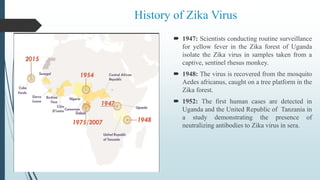
 1947: Scientists conducting routine surveillance
for yellow fever in the Zika forest of Uganda
isolate the Zika virus in samples taken from a
captive, sentinel rhesus monkey.
 1948: The virus is recovered from the mosquito
Aedes africanus, caught on a tree platform in the
Zika forest.
 1952: The first human cases are detected in
Uganda and the United Republic of Tanzania in
a study demonstrating the presence of
neutralizing antibodies to Zika virus in sera.
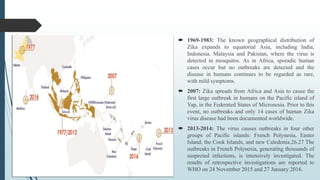
 1969-1983: The known geographical distribution of
Zika expands to equatorial Asia, including India,
Indonesia. Malaysia and Pakistan, where the virus is
detected in mosquitos. As in Africa, sporadic human
cases occur but no outbreaks are detected and the
disease in humans continues to be regarded as rare,
with mild symptoms.
 2007: Zika spreads from Africa and Asia to cause the
first large outbreak in humans on the Pacific island of
Yap, in the Federated States of Micronesia. Prior to this
event, no outbreaks and only 14 cases of human Zika
virus disease had been documented worldwide.
 2013-2014: The virus causes outbreaks in four other
groups of Pacific islands: French Polynesia, Easter
Island, the Cook Islands, and new Caledonia.26.27 The
outbreaks in French Polynesia, generating thousands of
suspected infections, is intensively investigated. The
results of retrospective investigations are reported to
WHO on 24 November 2015 and 27 January 2016.
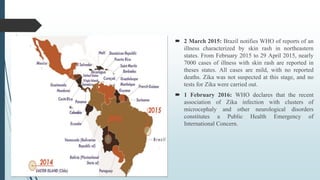
 2 March 2015: Brazil notifies WHO of reports of an
illness characterized by skin rash in northeastern
states. From February 2015 to 29 April 2015, nearly
7000 cases of illness with skin rash are reported in
theses states. All cases are mild, with no reported
deaths. Zika was not suspected at this stage, and no
tests for Zika were carried out.
 1 February 2016: WHO declares that the recent
association of Zika infection with clusters of
microcephaly and other neurological disorders
constitutes a Public Health Emergency of
International Concern.
How to spread out the Zika virus
 Mosquito: Zika is primarily spread by the female Aedes aegypti mosquito, which is
active mostly in the daytime. The mosquitos must feed on blood to lay eggs. The virus
has also been isolated from a number of arboreal mosquito species in the genus Aedes,
such as A. africanus, A. apicoargenteus, A. furcifer, A. hensilli, A. luteocephalus,
and A. vittatus, with an extrinsic incubation period in mosquitoes around 10 days.
 Sexual: Zika can be transmitted from men and women to their sexual partners; most
known cases involve transmission from symptomatic men to women.As of April 2016,
sexual transmission of Zika has been documented in six countries – Argentina, Chile,
France, Italy, New Zealand, and the United States – during the 2015 outbreak.
 Since October 2016, the CDC has advised men who have traveled to an area with Zika
should use condoms or not have sex for at least six months after their return as the
virus is still transmissible even if symptoms never develop.
 Pregnancy: The Zika virus can spread by vertical (or "mother-to-child") transmission,
during pregnancy or at delivery. An infection during pregnancy has been linked to
changes in neuronal development of the unborn child. Severe progressions of infection
have been linked to the development of microcephaly in the unborn child, while mild
infections potentially can lead to neurocognitive disorders in adulthood. Congenital
brain abnormalities other than microcephaly have also been reported after a Zika
outbreak. Studies in mice have suggested that maternal immunity to dengue virus may
enhance fetal infection with Zika, worsen the microcephaly phenotype and/or enhance
damage during pregnancy, but it is unknown whether this occurs in humans.
 Blood transfusion: As of April 2016, two cases of Zika transmission through blood
transfusions have been reported globally, both from Brazil, after which the US Food
and Drug Administration (FDA) recommended screening blood donors and deferring
high-risk donors for 4 weeks. A potential risk had been suspected based on a blood-
donor screening study during the French Polynesian Zika outbreak, in which 2.8% (42)
of donors from November 2013 and February 2014 tested positive for Zika RNA and
were all asymptomatic at the time of blood donation. Eleven of the positive donors
reported symptoms of Zika fever after their donation, but only three of 34 samples grew
in culture.
Which countries are effected by Zika virus
 Zika virus is a mosquito-borne flavivirus that was first identified in Uganda in 1947 in
monkeys. It was later identified in humans in 1952 in Uganda and the United Republic of
Tanzania.
 Outbreaks of Zika virus disease have been recorded in Africa, the Americas, Asia and the
Pacific. From the 1960s to 1980s, rare sporadic cases of human infections were found
across Africa and Asia, typically accompanied by mild illness.
 The first recorded outbreak of Zika virus disease was reported from the Island of Yap
(Federated States of Micronesia) in 2007. This was followed by a large outbreak of Zika
virus infection in French Polynesia in 2013 and other countries and territories in the
Pacific. In March 2015, Brazil reported a large outbreak of rash illness, soon identified as
Zika virus infection, and in July 2015, found to be associated with Guillain-Barré
syndrome.
 In October 2015, Brazil reported an association between Zika virus infection and
microcephaly. Outbreaks and evidence of transmission soon appeared throughout the
Americas, Africa, and other regions of the world. To date, a total of 86 countries and
territories have reported evidence of mosquito-transmitted Zika infection.
County risk of Zika Virus
Zika Virus is present in Mexico, Central America, South
America, the Caribbean, tropical areas of Southeast Asia,
Oceania, and parts of Africa. All travelers are at risk.
Long-term travelers and aid or missionary workers going
to areas where Zika Virus is endemic are at greater risk.
Zika Virus is associated with neurological complications:
Guillain-Barré syndrome (progressive muscle weakness
that can lead to temporary paralysis) and microcephaly
(decreased head size which may lead to developmental
delays) in infants born to pregnant women infected with
the virus.
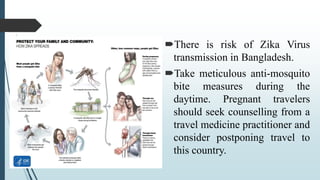
There is risk of Zika Virus
transmission in Bangladesh.
Take meticulous anti-mosquito
bite measures during the
daytime. Pregnant travelers
should seek counselling from a
travel medicine practitioner and
consider postponing travel to
this country.
Sign – Symptoms of Zika virus
 As many as 4 out of 5 people infected with the Zika virus have no
signs or symptoms. When symptoms do occur, they usually begin
two to seven days after a person is bitten by an infected mosquito.
Signs and symptoms of the Zika virus most commonly include:
 Mild fever
 Rash
 Joint or muscle pain
 Other signs and symptoms may include:
 Headache
 Red eyes (conjunctivitis)
 Most people recover fully, with symptoms resolving in about a
week.
Key fact of Zika virus
 Zika virus disease is caused by a virus transmitted primarily by
Aedes mosquitoes, which bite during the day.
 Symptoms are generally mild and include fever, rash, conjunctivitis,
muscle and joint pain, malaise or headache. Symptoms typically last
for 2–7 days. Most people with Zika virus infection do not develop
symptoms.
 Zika virus infection during pregnancy can cause infants to be born
with microcephaly and other congenital malformations, known as
congenital Zika syndrome. Infection with Zika virus is also
associated with other complications of pregnancy including preterm
birth and miscarriage.
 An increased risk of neurologic complications is associated with
Zika virus infection in adults and children, including Guillain-Barré
syndrome, neuropathy and myelitis.
Treatment of Zika virus
 There is no treatment available for Zika virus infection or its
associated diseases.
 Symptoms of Zika virus infection are usually mild. People
with symptoms such as fever, rash, or arthralgia should get plenty
of rest, drink fluids, and treat pain and fever with common
medicines. If symptoms worsen, they should seek medical care and
advice.
 Pregnant women living in areas with Zika transmission or who
develop symptoms of Zika virus infection should seek medical
attention for laboratory testing and other clinical care.
Prevention of Zika virus
 There is no vaccine to protect against the Zika virus.
 The CDC (Centers for Disease Control and Prevention) recommends all
pregnant women avoid traveling to areas where there is an outbreak of the Zika
virus. If you have a partner who lives in or has traveled to an area where there
is an outbreak of the Zika virus, the CDC recommends abstaining from sex
during pregnancy or using a condom during sexual contact.
 If you are trying to become pregnant, talk to your doctor about any upcoming
travel plans and the risk of getting infected with the Zika virus. Your doctor
may suggest you and your partner wait to try to conceive for several months.
 During sexual contact, use a condom to reduce the risk of getting or spreading
the Zika virus if you or your partner lives in or has traveled to an area where
there is an outbreak of Zika virus. Or avoid sexual contact.
 If you are living or traveling in tropical areas where the Zika virus is known to
be, these tips may help reduce your risk of mosquito bites:
 Stay in air-conditioned or well-screened housing. The mosquitoes that carry the
Zika virus are most active from dawn to dusk, but they can also bite at night.
Consider sleeping under a mosquito bed net, especially if you are outside.
 Wear protective clothing. When you go into mosquito-infested areas, wear a
long-sleeved shirt, long pants, socks and shoes.
 Use mosquito repellent. Permethrin can be applied to your clothing, shoes,
camping gear and bed netting. You also can buy clothing made with permethrin
already in it. For your skin, use a repellent containing at least a 10 percent
concentration of DEET (N,N-Diethyl-3-methylbenzamide).
 When used as directed, insect repellents that are registered with the
Environmental Protection Agency (EPA) are proven safe and effective for
pregnant and breast-feeding women.
 Reduce mosquito habitat. The mosquitoes that carry the Zika virus typically live
in and around houses, breeding in standing water that can collect in such things as
animal dishes, flower pots and used automobile tires. Reduce the breeding habitat
to lower mosquito populations.
Conclusion
 Zika virus (ZIKV) is a member of the virus family Flaviviridae. It is spread by daytime -
active Aedes mosquitoes. There is no vaccine to protect against the Zika virus. During
sexual contact, should use a condom to reduce the risk of getting or spreading the Zika
virus. Stay in the air-conditioned or well-screened house.
 We have to stay with carefully with family, friends. Then we will be safe from Zika virus.
Thank you for
patient hearing

Zika virus

  • 1.
    Presentation topic is ZIKA VIRUS Presented By ApuMarma Reg: WUB14/17/19/666 Roll: 566 Batch: 19th Department of pharmacy
  • 2.
    Content  Introduction  Historyof Zika virus  How to spread out the Zika virus  Which countries are effected by Zika virus  Sign – Symptoms of Zika virus  Key fact of Zika virus  Treatment of Zika virus  Prevention of Zika virus  Conclusion
  • 4.
    Introduction  Zika virus(ZIKV) is a member of the virus family Flaviviridae. It is spread by daytime - active Aedes mosquitoes, such as A. Aegypti and A. albopictus. Its name comes from the Zika Forest of Uganda. The Zika virus is a mosquito-borne viral infection that primarily occurs in tropical and subtropical areas of the world. Most people infected with the Zika virus have no signs and symptoms, while others report mild fever, rash and muscle pain. Other signs and symptoms may include headache, red eyes (conjunctivitis) and a general feeling of discomfort. Zika virus is also called Zika or Zika virus disease.  Zika virus infections during pregnancy have been linked to miscarriage and can cause microcephaly, a potentially fatal congenital brain condition. The Zika virus also may cause other neurological disorders such as Guillain-Barre syndrome.  Researchers are working on a Zika virus vaccine. For now the best prevention is to prevent mosquito bites and reduce mosquito habitats.
  • 5.
    History of ZikaVirus  1947: Scientists conducting routine surveillance for yellow fever in the Zika forest of Uganda isolate the Zika virus in samples taken from a captive, sentinel rhesus monkey.  1948: The virus is recovered from the mosquito Aedes africanus, caught on a tree platform in the Zika forest.  1952: The first human cases are detected in Uganda and the United Republic of Tanzania in a study demonstrating the presence of neutralizing antibodies to Zika virus in sera.
  • 6.
     1969-1983: Theknown geographical distribution of Zika expands to equatorial Asia, including India, Indonesia. Malaysia and Pakistan, where the virus is detected in mosquitos. As in Africa, sporadic human cases occur but no outbreaks are detected and the disease in humans continues to be regarded as rare, with mild symptoms.  2007: Zika spreads from Africa and Asia to cause the first large outbreak in humans on the Pacific island of Yap, in the Federated States of Micronesia. Prior to this event, no outbreaks and only 14 cases of human Zika virus disease had been documented worldwide.  2013-2014: The virus causes outbreaks in four other groups of Pacific islands: French Polynesia, Easter Island, the Cook Islands, and new Caledonia.26.27 The outbreaks in French Polynesia, generating thousands of suspected infections, is intensively investigated. The results of retrospective investigations are reported to WHO on 24 November 2015 and 27 January 2016.
  • 7.
     2 March2015: Brazil notifies WHO of reports of an illness characterized by skin rash in northeastern states. From February 2015 to 29 April 2015, nearly 7000 cases of illness with skin rash are reported in theses states. All cases are mild, with no reported deaths. Zika was not suspected at this stage, and no tests for Zika were carried out.  1 February 2016: WHO declares that the recent association of Zika infection with clusters of microcephaly and other neurological disorders constitutes a Public Health Emergency of International Concern.
  • 8.
    How to spreadout the Zika virus  Mosquito: Zika is primarily spread by the female Aedes aegypti mosquito, which is active mostly in the daytime. The mosquitos must feed on blood to lay eggs. The virus has also been isolated from a number of arboreal mosquito species in the genus Aedes, such as A. africanus, A. apicoargenteus, A. furcifer, A. hensilli, A. luteocephalus, and A. vittatus, with an extrinsic incubation period in mosquitoes around 10 days.  Sexual: Zika can be transmitted from men and women to their sexual partners; most known cases involve transmission from symptomatic men to women.As of April 2016, sexual transmission of Zika has been documented in six countries – Argentina, Chile, France, Italy, New Zealand, and the United States – during the 2015 outbreak.  Since October 2016, the CDC has advised men who have traveled to an area with Zika should use condoms or not have sex for at least six months after their return as the virus is still transmissible even if symptoms never develop.
  • 9.
     Pregnancy: TheZika virus can spread by vertical (or "mother-to-child") transmission, during pregnancy or at delivery. An infection during pregnancy has been linked to changes in neuronal development of the unborn child. Severe progressions of infection have been linked to the development of microcephaly in the unborn child, while mild infections potentially can lead to neurocognitive disorders in adulthood. Congenital brain abnormalities other than microcephaly have also been reported after a Zika outbreak. Studies in mice have suggested that maternal immunity to dengue virus may enhance fetal infection with Zika, worsen the microcephaly phenotype and/or enhance damage during pregnancy, but it is unknown whether this occurs in humans.  Blood transfusion: As of April 2016, two cases of Zika transmission through blood transfusions have been reported globally, both from Brazil, after which the US Food and Drug Administration (FDA) recommended screening blood donors and deferring high-risk donors for 4 weeks. A potential risk had been suspected based on a blood- donor screening study during the French Polynesian Zika outbreak, in which 2.8% (42) of donors from November 2013 and February 2014 tested positive for Zika RNA and were all asymptomatic at the time of blood donation. Eleven of the positive donors reported symptoms of Zika fever after their donation, but only three of 34 samples grew in culture.
  • 10.
    Which countries areeffected by Zika virus  Zika virus is a mosquito-borne flavivirus that was first identified in Uganda in 1947 in monkeys. It was later identified in humans in 1952 in Uganda and the United Republic of Tanzania.  Outbreaks of Zika virus disease have been recorded in Africa, the Americas, Asia and the Pacific. From the 1960s to 1980s, rare sporadic cases of human infections were found across Africa and Asia, typically accompanied by mild illness.  The first recorded outbreak of Zika virus disease was reported from the Island of Yap (Federated States of Micronesia) in 2007. This was followed by a large outbreak of Zika virus infection in French Polynesia in 2013 and other countries and territories in the Pacific. In March 2015, Brazil reported a large outbreak of rash illness, soon identified as Zika virus infection, and in July 2015, found to be associated with Guillain-Barré syndrome.  In October 2015, Brazil reported an association between Zika virus infection and microcephaly. Outbreaks and evidence of transmission soon appeared throughout the Americas, Africa, and other regions of the world. To date, a total of 86 countries and territories have reported evidence of mosquito-transmitted Zika infection.
  • 11.
    County risk ofZika Virus Zika Virus is present in Mexico, Central America, South America, the Caribbean, tropical areas of Southeast Asia, Oceania, and parts of Africa. All travelers are at risk. Long-term travelers and aid or missionary workers going to areas where Zika Virus is endemic are at greater risk. Zika Virus is associated with neurological complications: Guillain-Barré syndrome (progressive muscle weakness that can lead to temporary paralysis) and microcephaly (decreased head size which may lead to developmental delays) in infants born to pregnant women infected with the virus.
  • 12.
    There is riskof Zika Virus transmission in Bangladesh. Take meticulous anti-mosquito bite measures during the daytime. Pregnant travelers should seek counselling from a travel medicine practitioner and consider postponing travel to this country.
  • 13.
    Sign – Symptomsof Zika virus  As many as 4 out of 5 people infected with the Zika virus have no signs or symptoms. When symptoms do occur, they usually begin two to seven days after a person is bitten by an infected mosquito. Signs and symptoms of the Zika virus most commonly include:  Mild fever  Rash  Joint or muscle pain  Other signs and symptoms may include:  Headache  Red eyes (conjunctivitis)  Most people recover fully, with symptoms resolving in about a week.
  • 14.
    Key fact ofZika virus  Zika virus disease is caused by a virus transmitted primarily by Aedes mosquitoes, which bite during the day.  Symptoms are generally mild and include fever, rash, conjunctivitis, muscle and joint pain, malaise or headache. Symptoms typically last for 2–7 days. Most people with Zika virus infection do not develop symptoms.  Zika virus infection during pregnancy can cause infants to be born with microcephaly and other congenital malformations, known as congenital Zika syndrome. Infection with Zika virus is also associated with other complications of pregnancy including preterm birth and miscarriage.  An increased risk of neurologic complications is associated with Zika virus infection in adults and children, including Guillain-Barré syndrome, neuropathy and myelitis.
  • 15.
    Treatment of Zikavirus  There is no treatment available for Zika virus infection or its associated diseases.  Symptoms of Zika virus infection are usually mild. People with symptoms such as fever, rash, or arthralgia should get plenty of rest, drink fluids, and treat pain and fever with common medicines. If symptoms worsen, they should seek medical care and advice.  Pregnant women living in areas with Zika transmission or who develop symptoms of Zika virus infection should seek medical attention for laboratory testing and other clinical care.
  • 16.
    Prevention of Zikavirus  There is no vaccine to protect against the Zika virus.  The CDC (Centers for Disease Control and Prevention) recommends all pregnant women avoid traveling to areas where there is an outbreak of the Zika virus. If you have a partner who lives in or has traveled to an area where there is an outbreak of the Zika virus, the CDC recommends abstaining from sex during pregnancy or using a condom during sexual contact.  If you are trying to become pregnant, talk to your doctor about any upcoming travel plans and the risk of getting infected with the Zika virus. Your doctor may suggest you and your partner wait to try to conceive for several months.  During sexual contact, use a condom to reduce the risk of getting or spreading the Zika virus if you or your partner lives in or has traveled to an area where there is an outbreak of Zika virus. Or avoid sexual contact.  If you are living or traveling in tropical areas where the Zika virus is known to be, these tips may help reduce your risk of mosquito bites:
  • 17.
     Stay inair-conditioned or well-screened housing. The mosquitoes that carry the Zika virus are most active from dawn to dusk, but they can also bite at night. Consider sleeping under a mosquito bed net, especially if you are outside.  Wear protective clothing. When you go into mosquito-infested areas, wear a long-sleeved shirt, long pants, socks and shoes.  Use mosquito repellent. Permethrin can be applied to your clothing, shoes, camping gear and bed netting. You also can buy clothing made with permethrin already in it. For your skin, use a repellent containing at least a 10 percent concentration of DEET (N,N-Diethyl-3-methylbenzamide).  When used as directed, insect repellents that are registered with the Environmental Protection Agency (EPA) are proven safe and effective for pregnant and breast-feeding women.  Reduce mosquito habitat. The mosquitoes that carry the Zika virus typically live in and around houses, breeding in standing water that can collect in such things as animal dishes, flower pots and used automobile tires. Reduce the breeding habitat to lower mosquito populations.
  • 18.
    Conclusion  Zika virus(ZIKV) is a member of the virus family Flaviviridae. It is spread by daytime - active Aedes mosquitoes. There is no vaccine to protect against the Zika virus. During sexual contact, should use a condom to reduce the risk of getting or spreading the Zika virus. Stay in the air-conditioned or well-screened house.  We have to stay with carefully with family, friends. Then we will be safe from Zika virus.
  • 19.