IoT Protocols
January, 20th
2017 @ CoderBunker
Gwenole Gendrot – gwenole.gendrot@gmail.com
Definition
● the IoT (Internet of Things) is an
ecosystem where sensors, devices,
and equipment are connected to the
global network and can transmit and
receive data for tracking, analysis,
and action.
(from DELL)
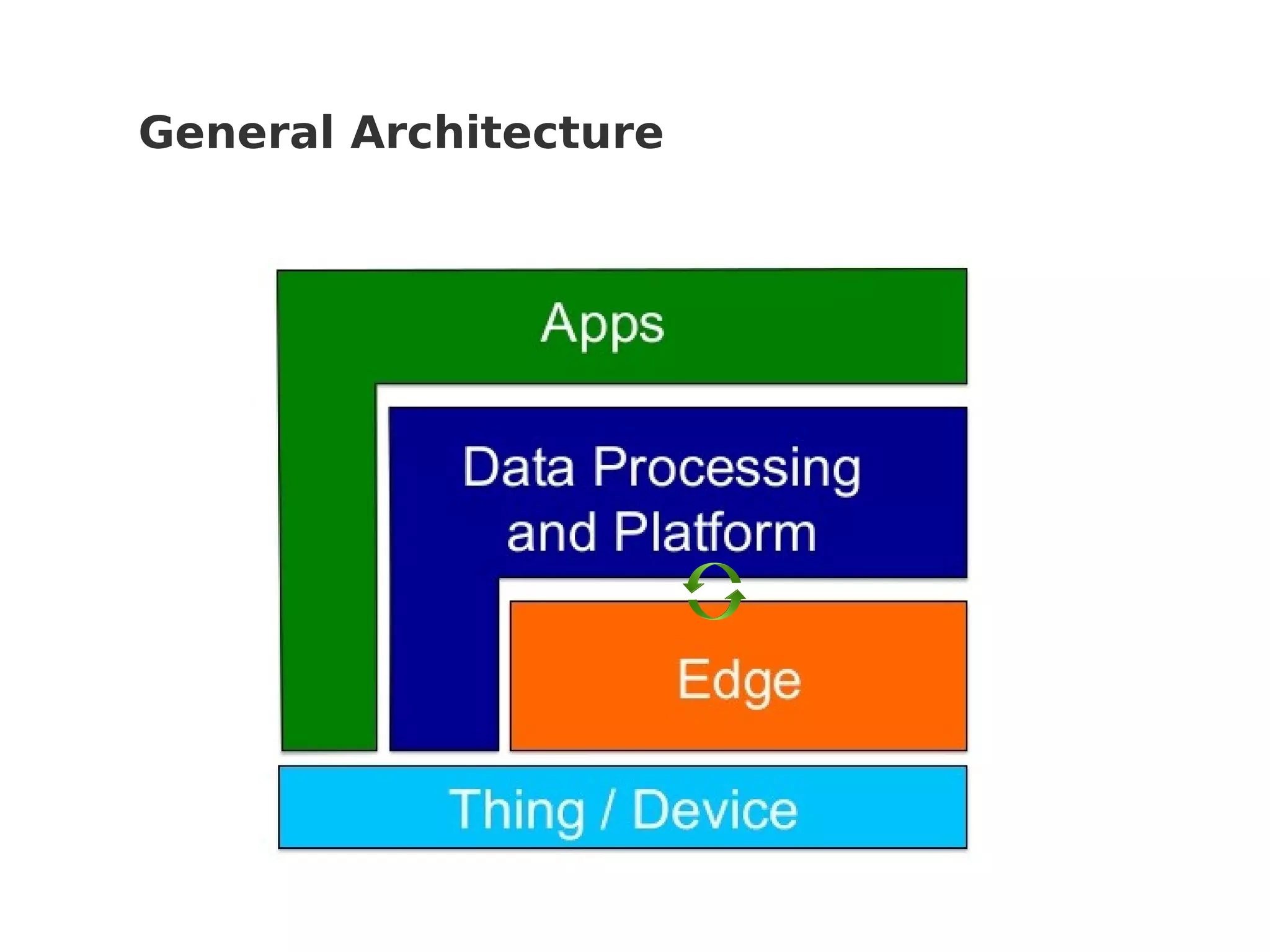
General Architecture
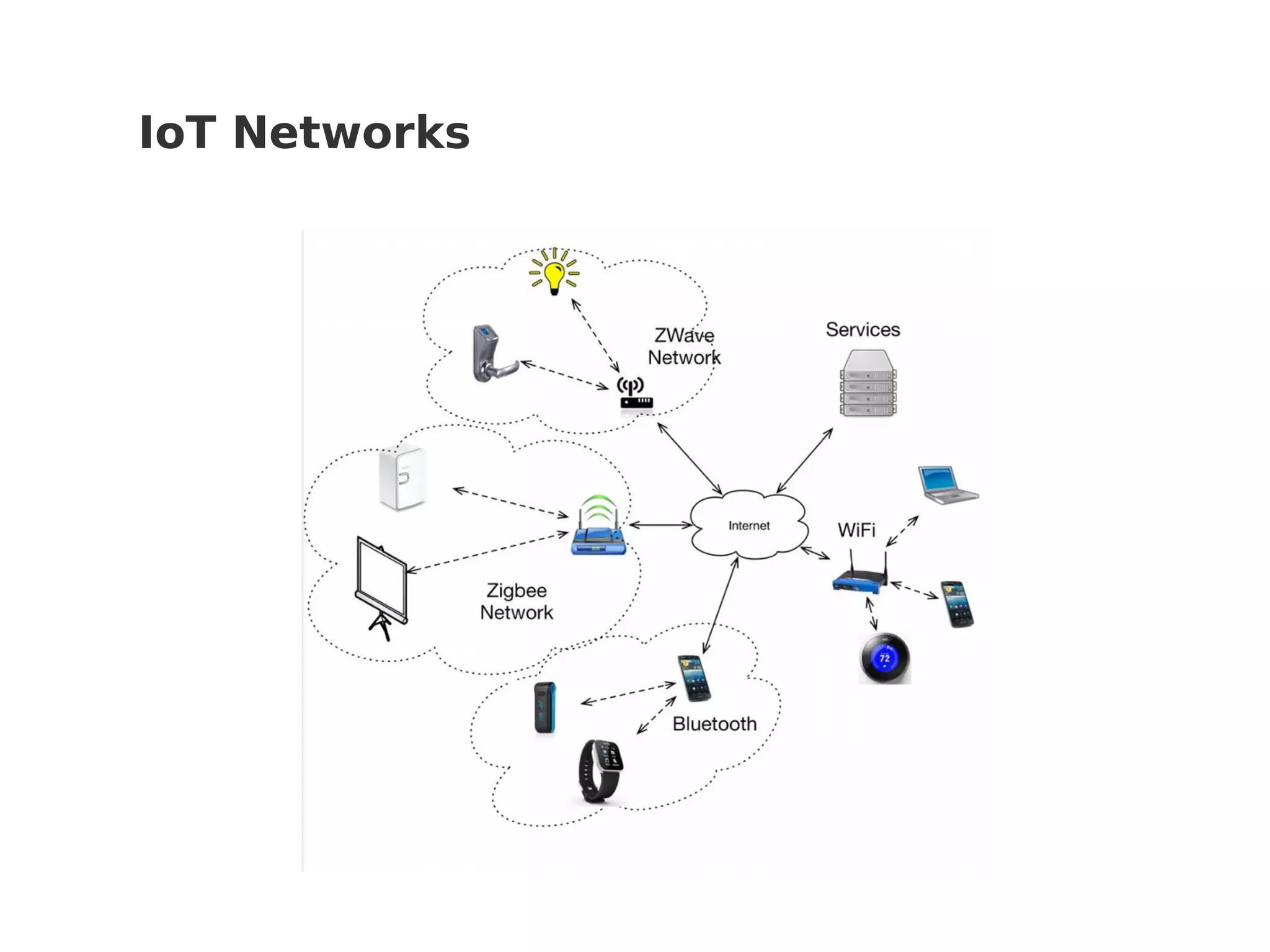
IoT Networks
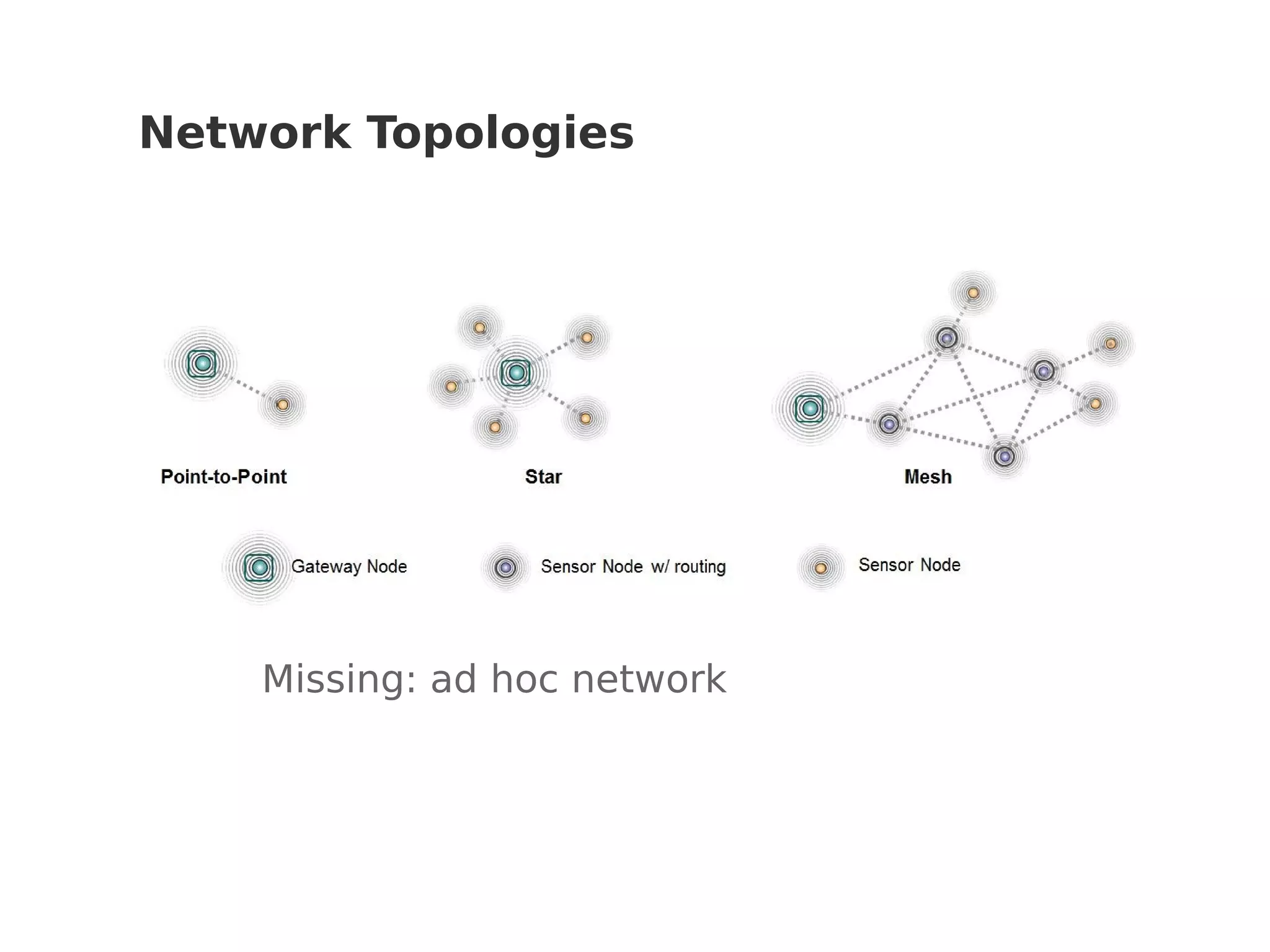
Network Topologies
Missing: ad hoc network
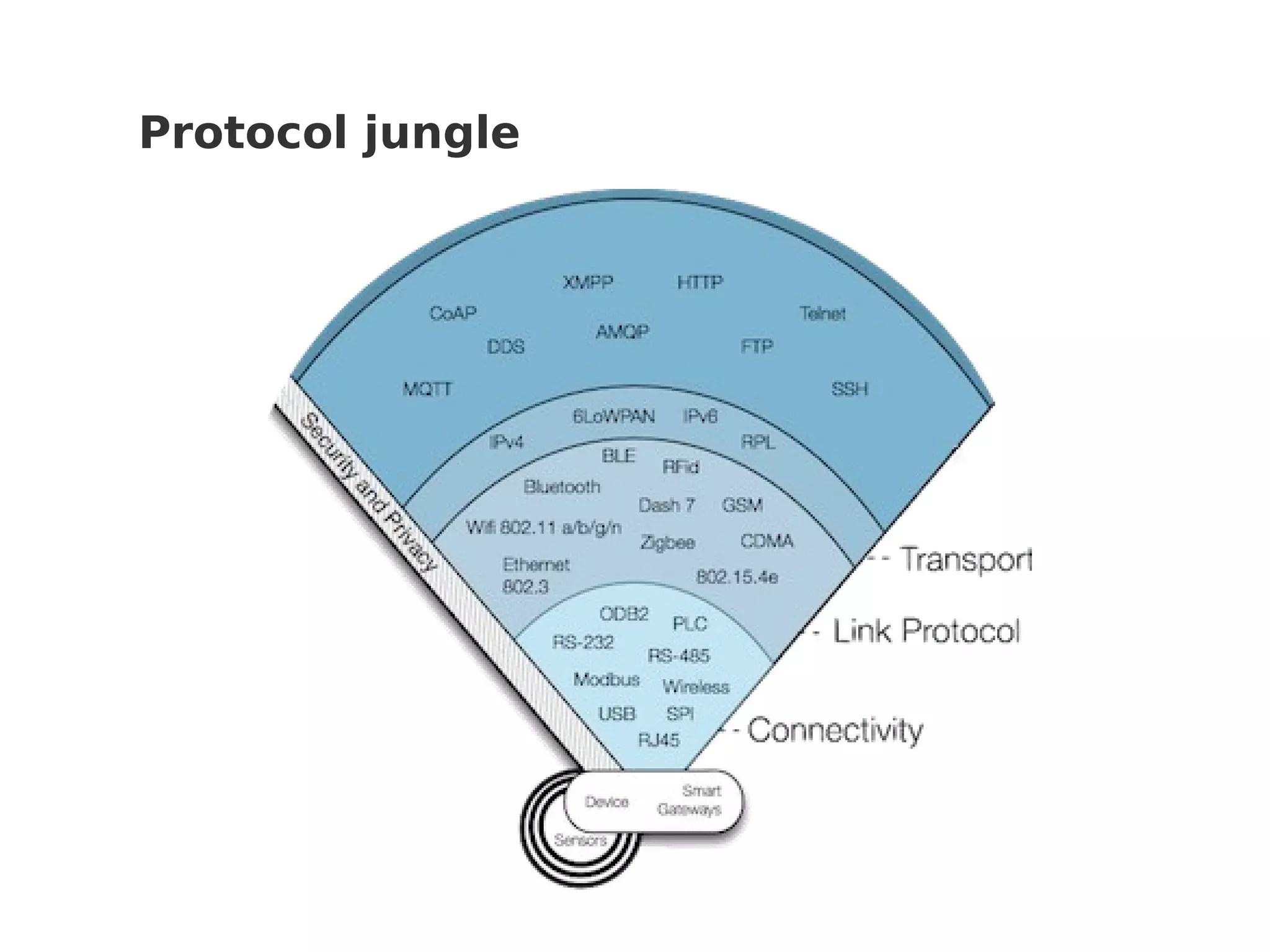
Protocol jungle
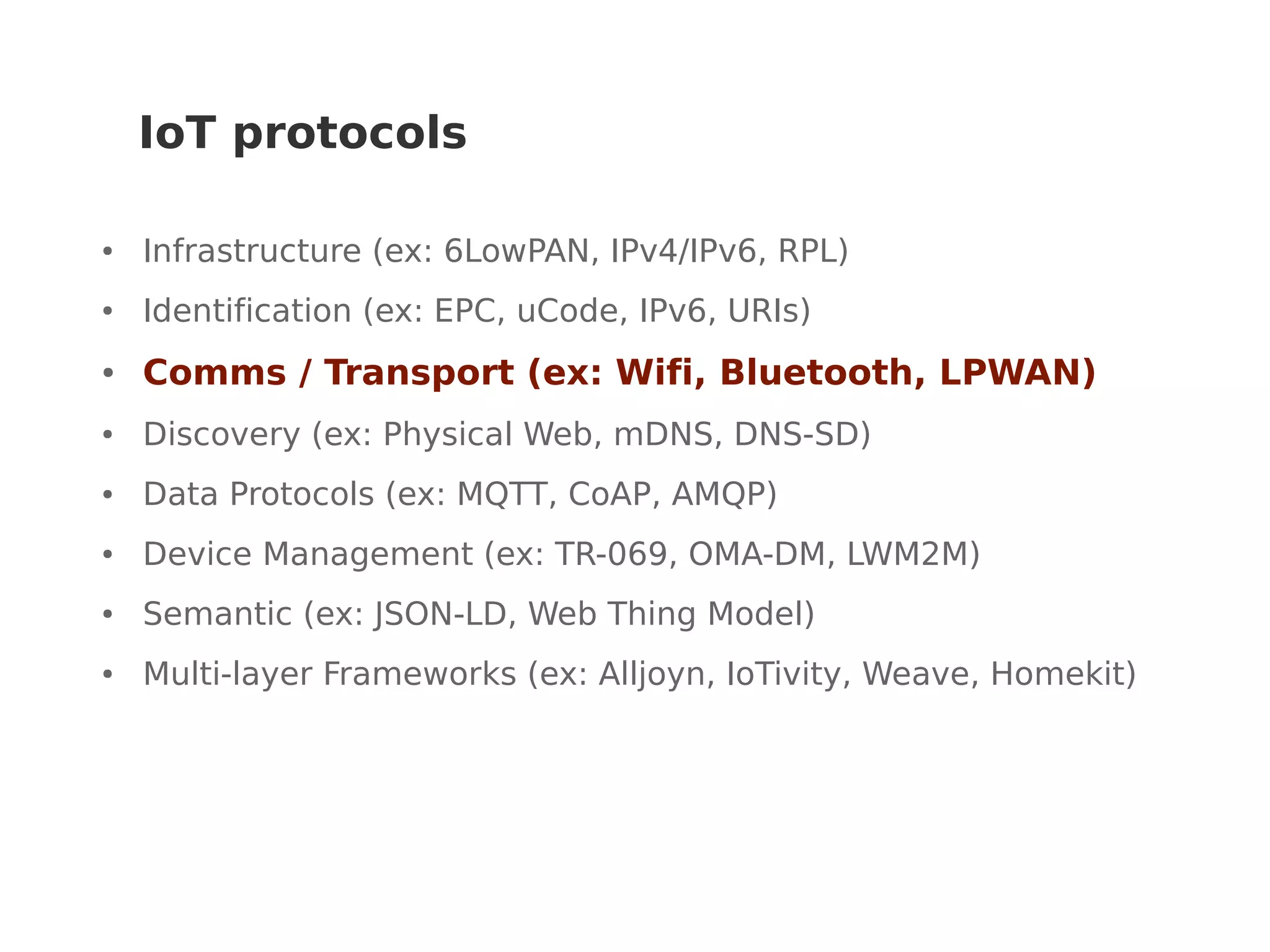
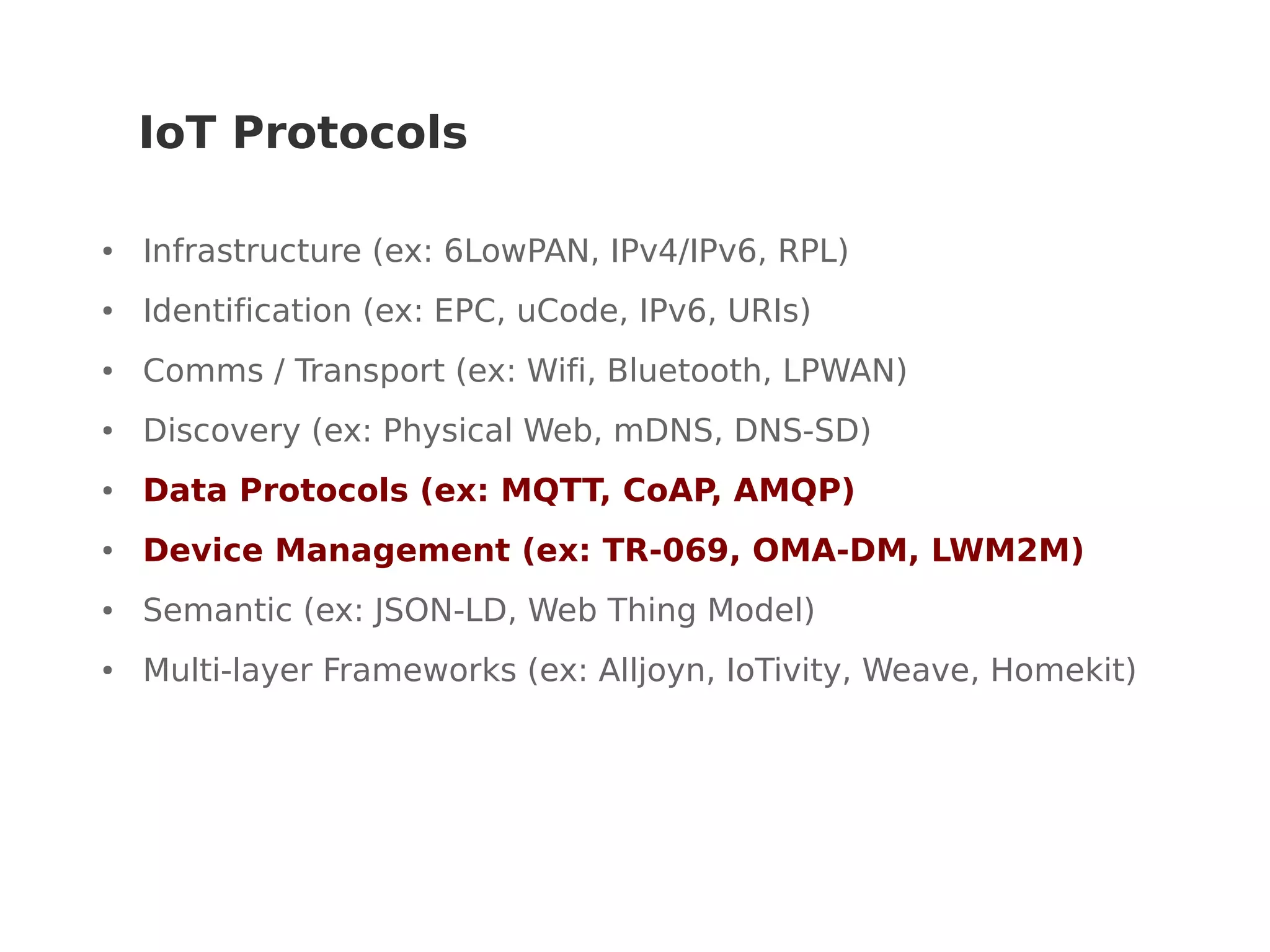
IoT protocols
● Infrastructure (ex: 6LowPAN, IPv4/IPv6, RPL)
● Identification (ex: EPC, uCode, IPv6, URIs)
● Comms / Transport (ex: Wifi, Bluetooth, LPWAN)
● Discovery (ex: Physical Web, mDNS, DNS-SD)
● Data Protocols (ex: MQTT, CoAP, AMQP)
● Device Management (ex: TR-069, OMA-DM, LWM2M)
● Semantic (ex: JSON-LD, Web Thing Model)
● Multi-layer Frameworks (ex: Alljoyn, IoTivity, Weave, Homekit)
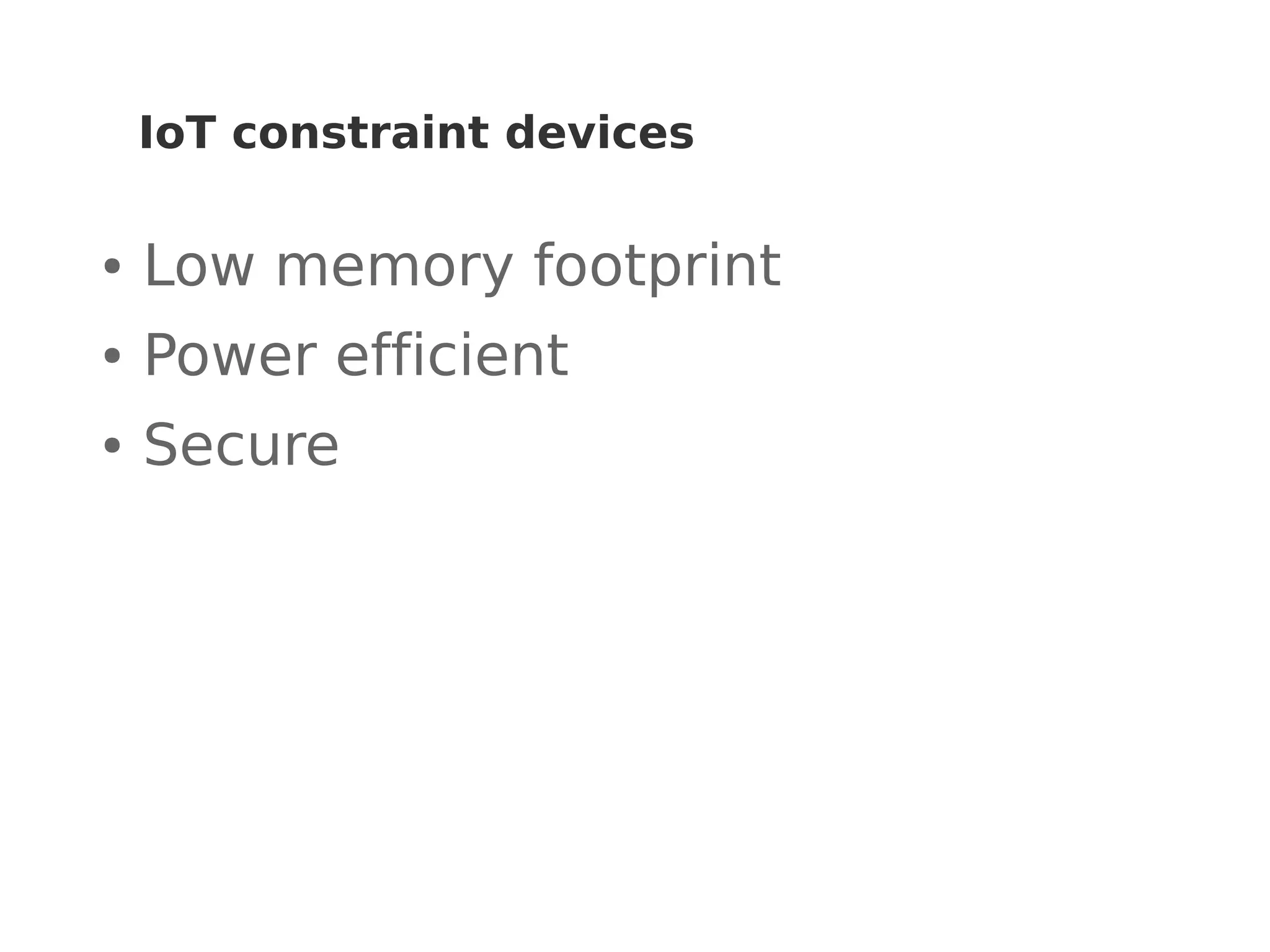
IoT constraint devices
● Low memory footprint
● Power efficient
● Secure
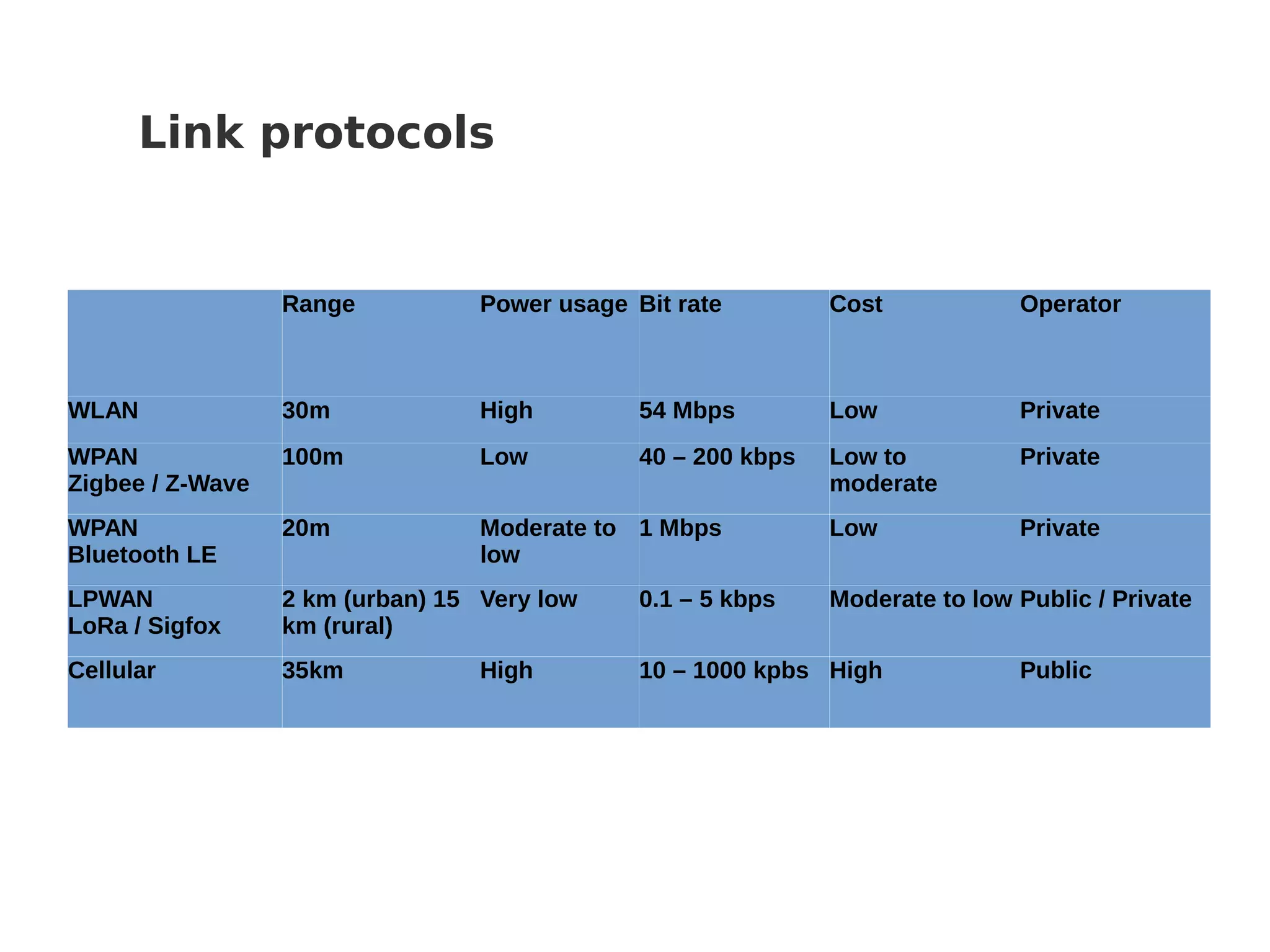
Link protocols
Range Power usage Bit rate Cost Operator
WLAN 30m High 54 Mbps Low Private
WPAN
Zigbee / Z-Wave
100m Low 40 – 200 kbps Low to
moderate
Private
WPAN
Bluetooth LE
20m Moderate to
low
1 Mbps Low Private
LPWAN
LoRa / Sigfox
2 km (urban) 15
km (rural)
Very low 0.1 – 5 kbps Moderate to low Public / Private
Cellular 35km High 10 – 1000 kpbs High Public
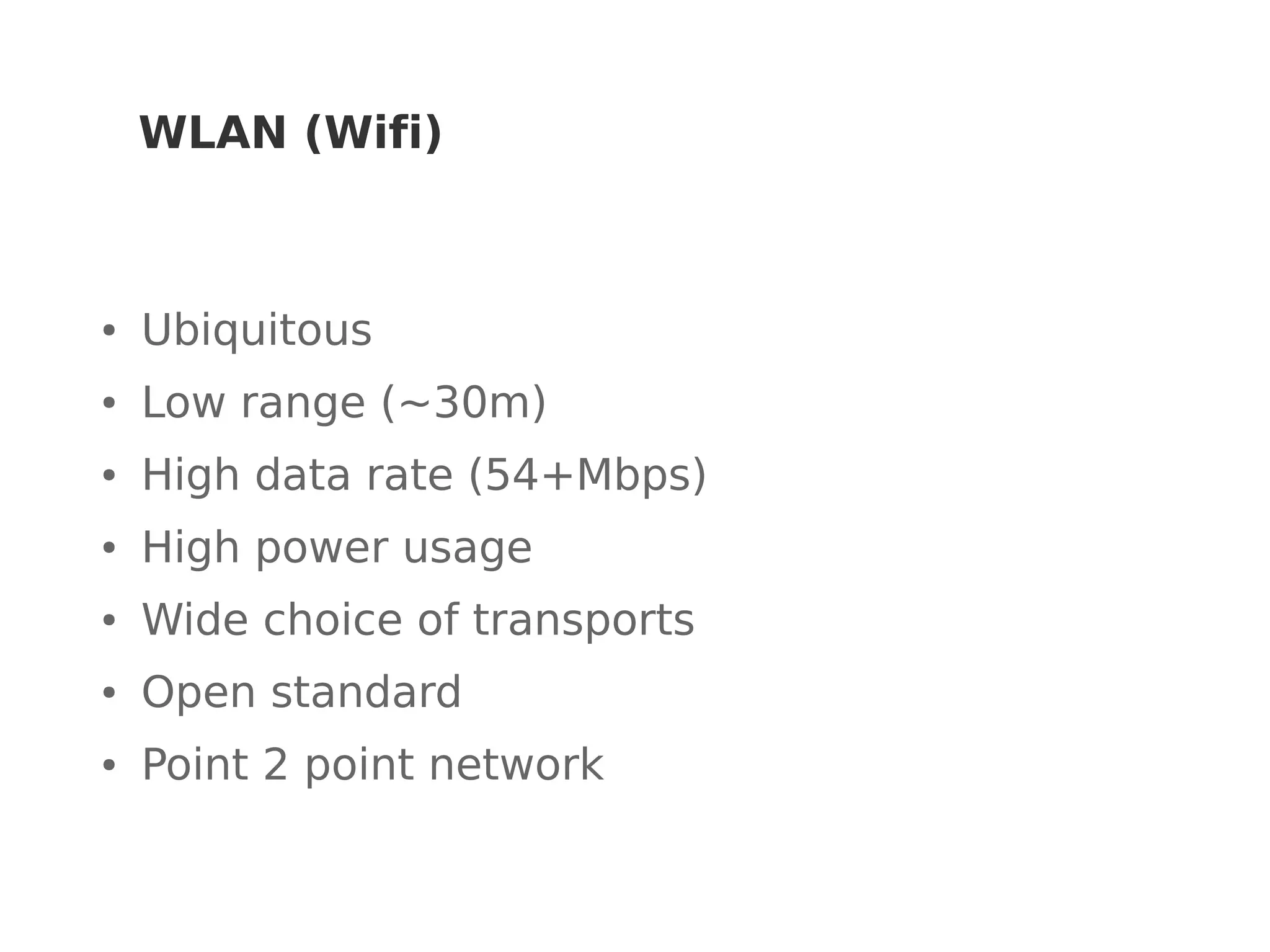
WLAN (Wifi)
● Ubiquitous
● Low range (~30m)
● High data rate (54+Mbps)
● High power usage
● Wide choice of transports
● Open standard
● Point 2 point network
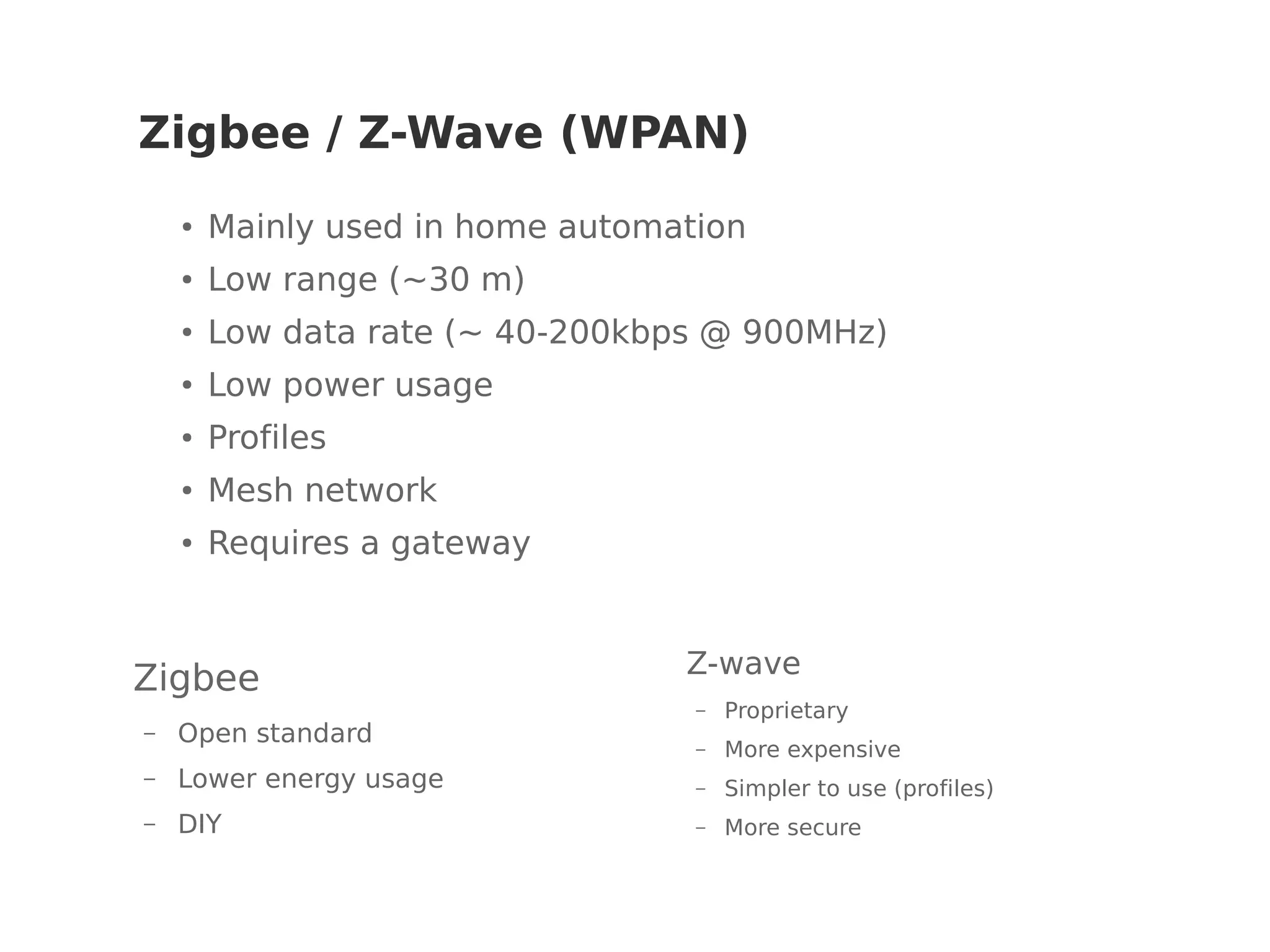
Zigbee / Z-Wave (WPAN)
Zigbee
– Open standard
– Lower energy usage
– DIY
Z-wave
– Proprietary
– More expensive
– Simpler to use (profiles)
– More secure
●
Mainly used in home automation
● Low range (~30 m)
●
Low data rate (~ 40-200kbps @ 900MHz)
●
Low power usage
● Profiles
●
Mesh network
● Requires a gateway
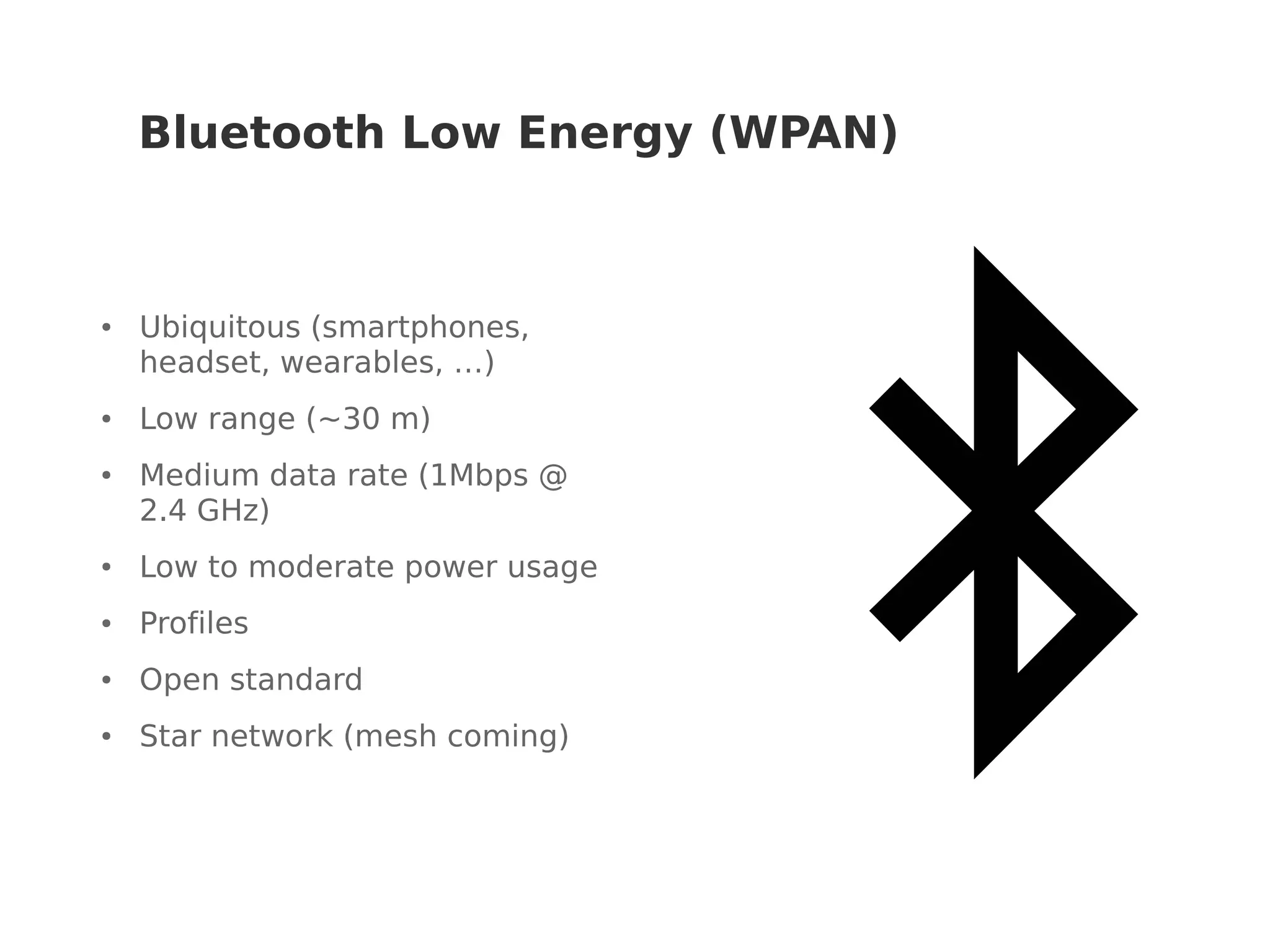
Bluetooth Low Energy (WPAN)
● Ubiquitous (smartphones,
headset, wearables, …)
● Low range (~30 m)
● Medium data rate (1Mbps @
2.4 GHz)
● Low to moderate power usage
● Profiles
● Open standard
● Star network (mesh coming)
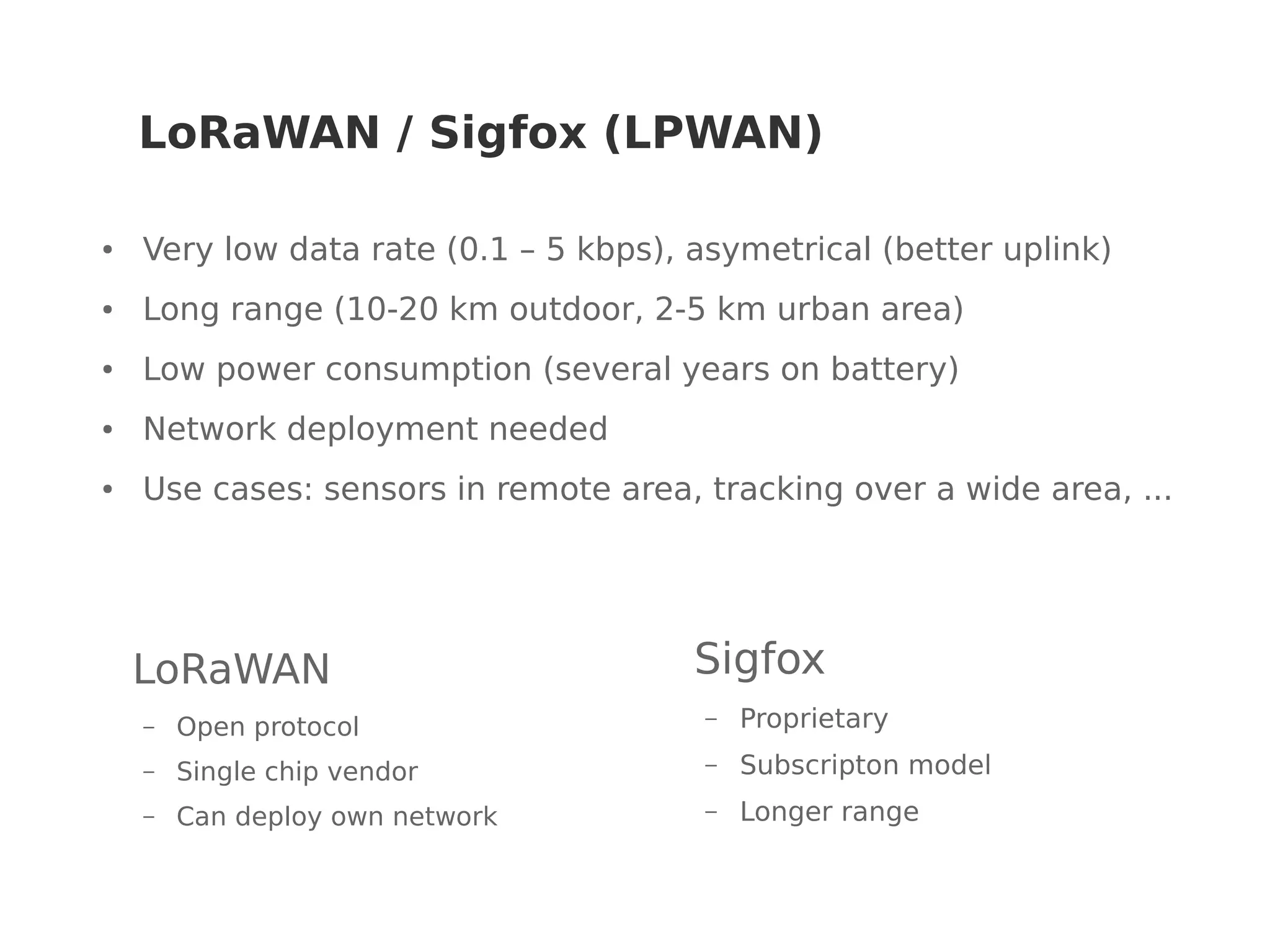
LoRaWAN / Sigfox (LPWAN)
● Very low data rate (0.1 – 5 kbps), asymetrical (better uplink)
● Long range (10-20 km outdoor, 2-5 km urban area)
● Low power consumption (several years on battery)
● Network deployment needed
● Use cases: sensors in remote area, tracking over a wide area, ...
Sigfox
– Proprietary
– Subscripton model
– Longer range
LoRaWAN
– Open protocol
– Single chip vendor
– Can deploy own network
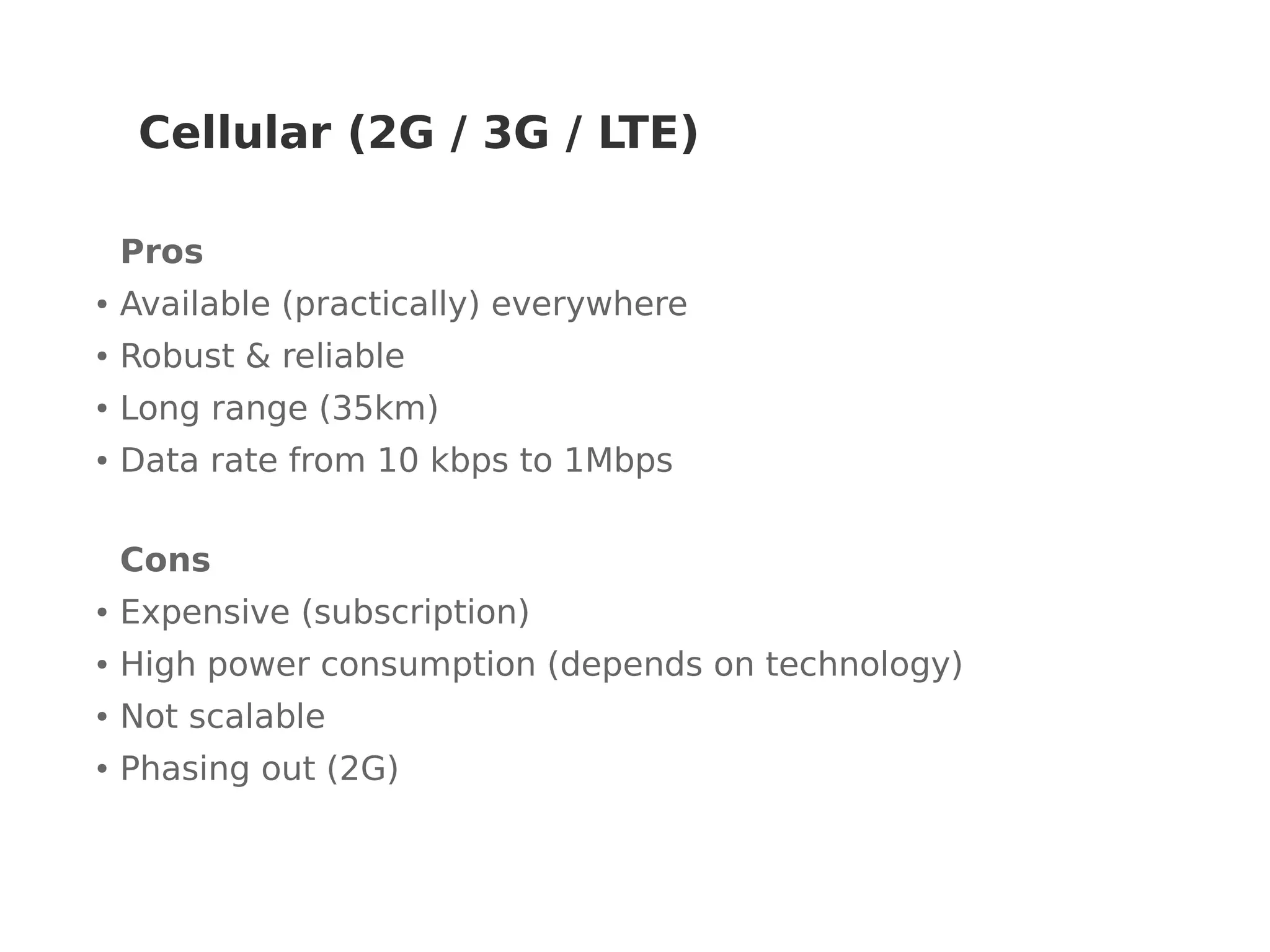
Cellular (2G / 3G / LTE)
Pros
● Available (practically) everywhere
● Robust & reliable
● Long range (35km)
● Data rate from 10 kbps to 1Mbps
Cons
● Expensive (subscription)
● High power consumption (depends on technology)
● Not scalable
● Phasing out (2G)
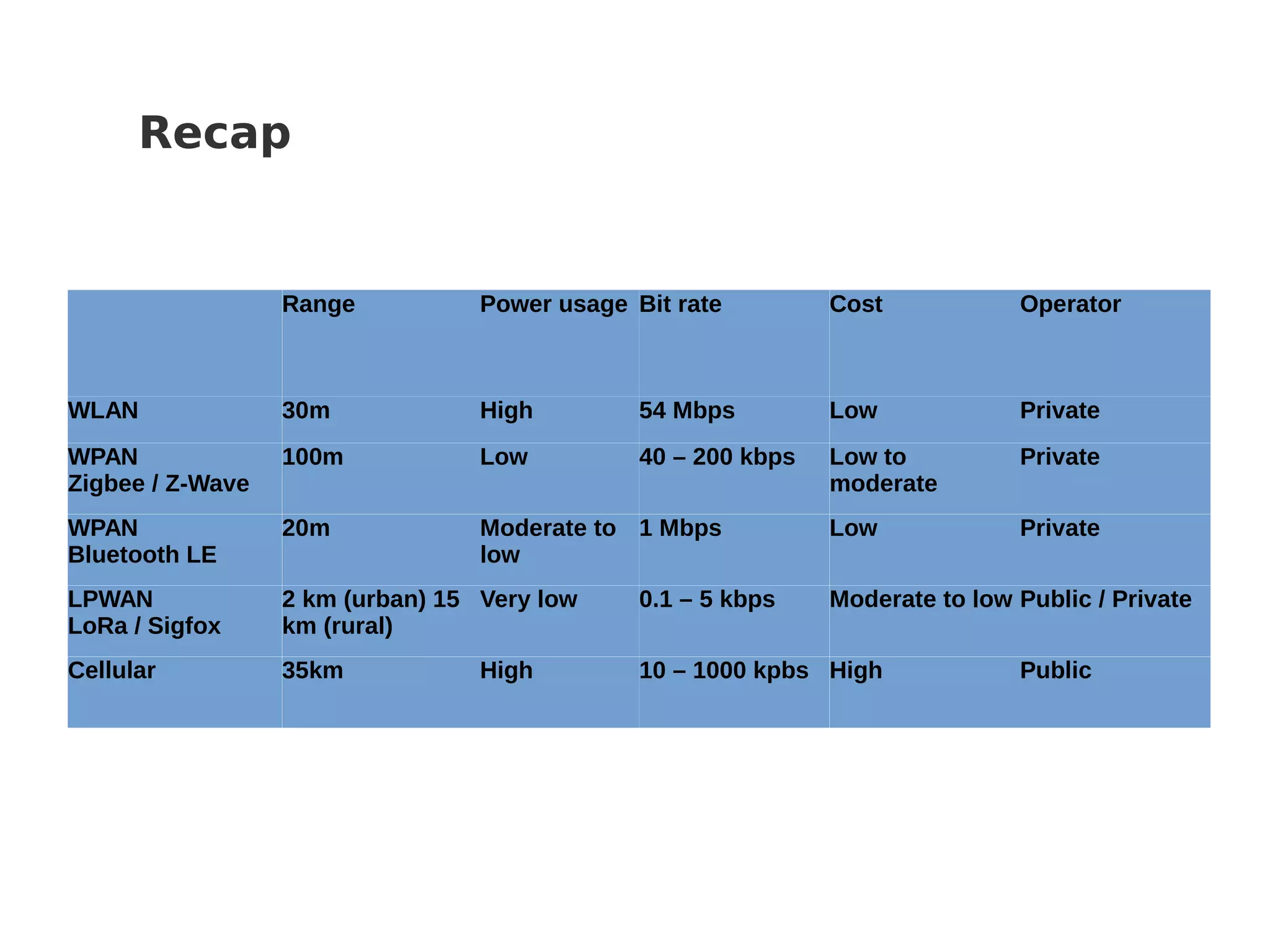
Recap
Range Power usage Bit rate Cost Operator
WLAN 30m High 54 Mbps Low Private
WPAN
Zigbee / Z-Wave
100m Low 40 – 200 kbps Low to
moderate
Private
WPAN
Bluetooth LE
20m Moderate to
low
1 Mbps Low Private
LPWAN
LoRa / Sigfox
2 km (urban) 15
km (rural)
Very low 0.1 – 5 kbps Moderate to low Public / Private
Cellular 35km High 10 – 1000 kpbs High Public
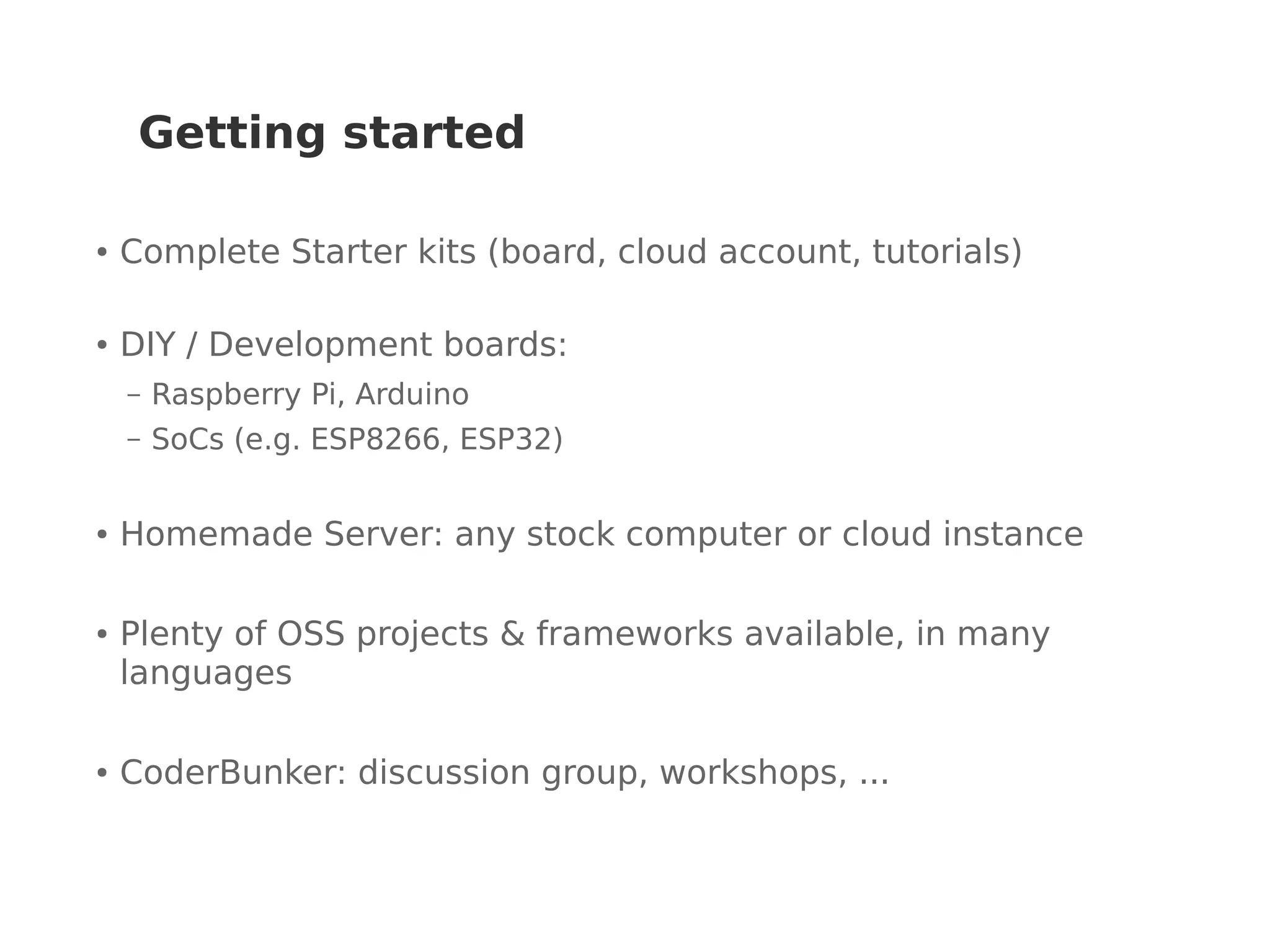
Getting started
● Complete Starter kits (board, cloud account, tutorials)
● DIY / Development boards:
– Raspberry Pi, Arduino
– SoCs (e.g. ESP8266, ESP32)
● Homemade Server: any stock computer or cloud instance
● Plenty of OSS projects & frameworks available, in many
languages
● CoderBunker: discussion group, workshops, ...
IoT Protocols
● Infrastructure (ex: 6LowPAN, IPv4/IPv6, RPL)
● Identification (ex: EPC, uCode, IPv6, URIs)
● Comms / Transport (ex: Wifi, Bluetooth, LPWAN)
● Discovery (ex: Physical Web, mDNS, DNS-SD)
● Data Protocols (ex: MQTT, CoAP, AMQP)
● Device Management (ex: TR-069, OMA-DM, LWM2M)
● Semantic (ex: JSON-LD, Web Thing Model)
● Multi-layer Frameworks (ex: Alljoyn, IoTivity, Weave, Homekit)
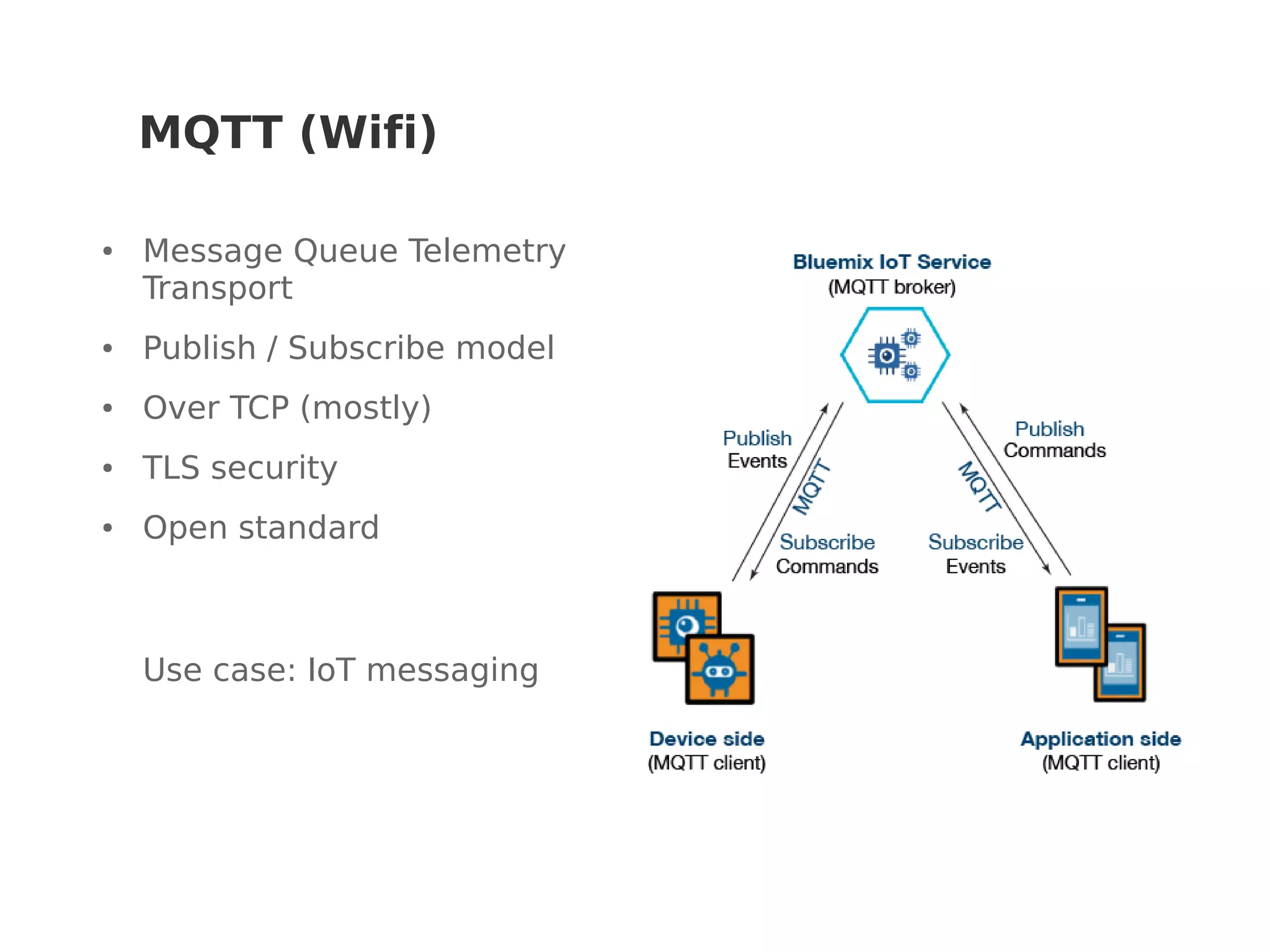
MQTT (Wifi)
● Message Queue Telemetry
Transport
● Publish / Subscribe model
● Over TCP (mostly)
● TLS security
● Open standard
Use case: IoT messaging
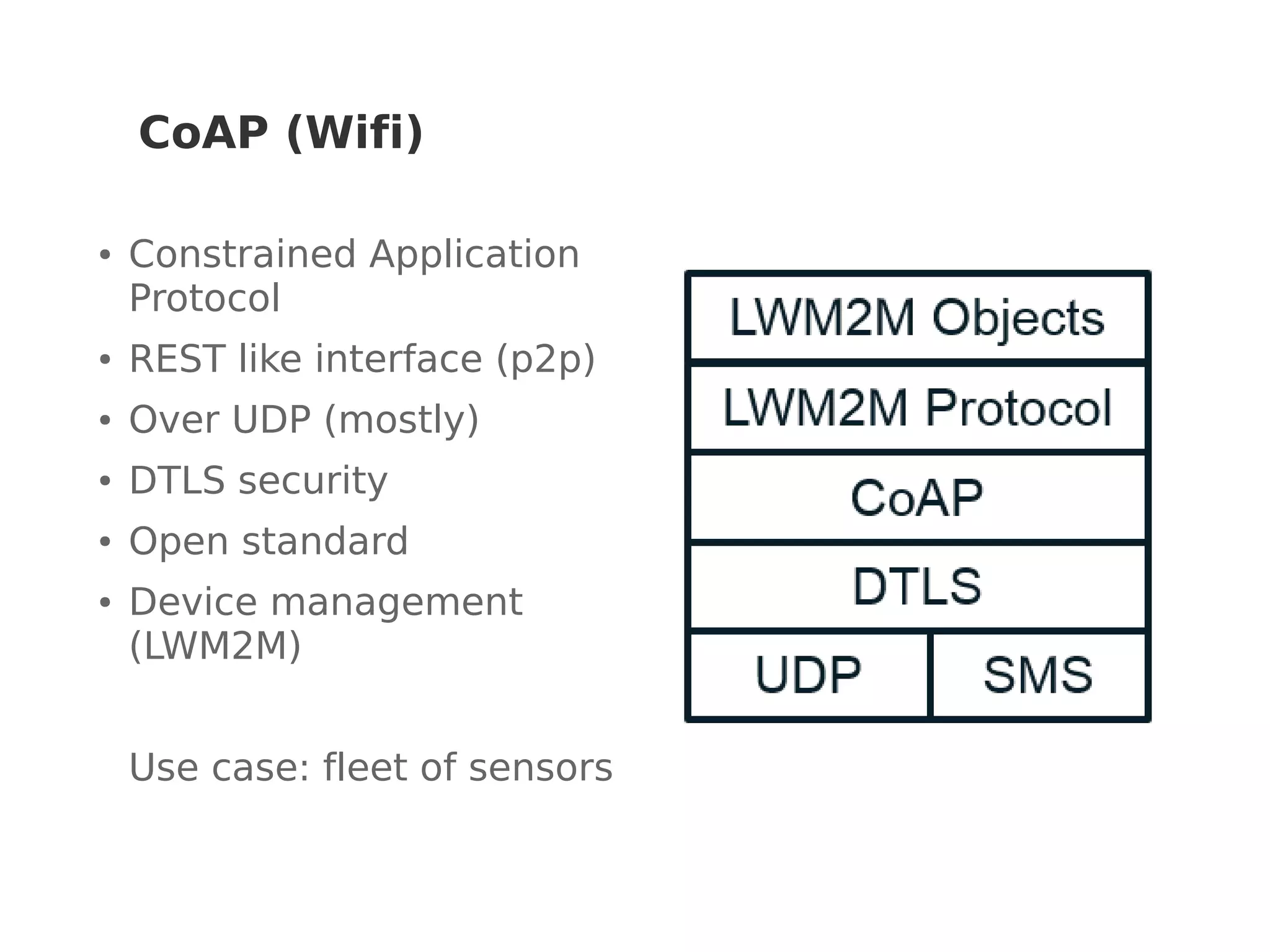
CoAP (Wifi)
● Constrained Application
Protocol
● REST like interface (p2p)
● Over UDP (mostly)
● DTLS security
● Open standard
● Device management
(LWM2M)
Use case: fleet of sensors
Questions ?

IoT transport protocols

  • 1.
    IoT Protocols January, 20th 2017@ CoderBunker Gwenole Gendrot – gwenole.gendrot@gmail.com
  • 2.
    Definition ● the IoT(Internet of Things) is an ecosystem where sensors, devices, and equipment are connected to the global network and can transmit and receive data for tracking, analysis, and action. (from DELL)
  • 3.
  • 4.
  • 5.
  • 6.
  • 7.
    IoT protocols ● Infrastructure(ex: 6LowPAN, IPv4/IPv6, RPL) ● Identification (ex: EPC, uCode, IPv6, URIs) ● Comms / Transport (ex: Wifi, Bluetooth, LPWAN) ● Discovery (ex: Physical Web, mDNS, DNS-SD) ● Data Protocols (ex: MQTT, CoAP, AMQP) ● Device Management (ex: TR-069, OMA-DM, LWM2M) ● Semantic (ex: JSON-LD, Web Thing Model) ● Multi-layer Frameworks (ex: Alljoyn, IoTivity, Weave, Homekit)
  • 8.
    IoT constraint devices ●Low memory footprint ● Power efficient ● Secure
  • 9.
    Link protocols Range Powerusage Bit rate Cost Operator WLAN 30m High 54 Mbps Low Private WPAN Zigbee / Z-Wave 100m Low 40 – 200 kbps Low to moderate Private WPAN Bluetooth LE 20m Moderate to low 1 Mbps Low Private LPWAN LoRa / Sigfox 2 km (urban) 15 km (rural) Very low 0.1 – 5 kbps Moderate to low Public / Private Cellular 35km High 10 – 1000 kpbs High Public
  • 10.
    WLAN (Wifi) ● Ubiquitous ●Low range (~30m) ● High data rate (54+Mbps) ● High power usage ● Wide choice of transports ● Open standard ● Point 2 point network
  • 11.
    Zigbee / Z-Wave(WPAN) Zigbee – Open standard – Lower energy usage – DIY Z-wave – Proprietary – More expensive – Simpler to use (profiles) – More secure ● Mainly used in home automation ● Low range (~30 m) ● Low data rate (~ 40-200kbps @ 900MHz) ● Low power usage ● Profiles ● Mesh network ● Requires a gateway
  • 12.
    Bluetooth Low Energy(WPAN) ● Ubiquitous (smartphones, headset, wearables, …) ● Low range (~30 m) ● Medium data rate (1Mbps @ 2.4 GHz) ● Low to moderate power usage ● Profiles ● Open standard ● Star network (mesh coming)
  • 13.
    LoRaWAN / Sigfox(LPWAN) ● Very low data rate (0.1 – 5 kbps), asymetrical (better uplink) ● Long range (10-20 km outdoor, 2-5 km urban area) ● Low power consumption (several years on battery) ● Network deployment needed ● Use cases: sensors in remote area, tracking over a wide area, ... Sigfox – Proprietary – Subscripton model – Longer range LoRaWAN – Open protocol – Single chip vendor – Can deploy own network
  • 14.
    Cellular (2G /3G / LTE) Pros ● Available (practically) everywhere ● Robust & reliable ● Long range (35km) ● Data rate from 10 kbps to 1Mbps Cons ● Expensive (subscription) ● High power consumption (depends on technology) ● Not scalable ● Phasing out (2G)
  • 15.
    Recap Range Power usageBit rate Cost Operator WLAN 30m High 54 Mbps Low Private WPAN Zigbee / Z-Wave 100m Low 40 – 200 kbps Low to moderate Private WPAN Bluetooth LE 20m Moderate to low 1 Mbps Low Private LPWAN LoRa / Sigfox 2 km (urban) 15 km (rural) Very low 0.1 – 5 kbps Moderate to low Public / Private Cellular 35km High 10 – 1000 kpbs High Public
  • 16.
    Getting started ● CompleteStarter kits (board, cloud account, tutorials) ● DIY / Development boards: – Raspberry Pi, Arduino – SoCs (e.g. ESP8266, ESP32) ● Homemade Server: any stock computer or cloud instance ● Plenty of OSS projects & frameworks available, in many languages ● CoderBunker: discussion group, workshops, ...
  • 17.
    IoT Protocols ● Infrastructure(ex: 6LowPAN, IPv4/IPv6, RPL) ● Identification (ex: EPC, uCode, IPv6, URIs) ● Comms / Transport (ex: Wifi, Bluetooth, LPWAN) ● Discovery (ex: Physical Web, mDNS, DNS-SD) ● Data Protocols (ex: MQTT, CoAP, AMQP) ● Device Management (ex: TR-069, OMA-DM, LWM2M) ● Semantic (ex: JSON-LD, Web Thing Model) ● Multi-layer Frameworks (ex: Alljoyn, IoTivity, Weave, Homekit)
  • 18.
    MQTT (Wifi) ● MessageQueue Telemetry Transport ● Publish / Subscribe model ● Over TCP (mostly) ● TLS security ● Open standard Use case: IoT messaging
  • 19.
    CoAP (Wifi) ● ConstrainedApplication Protocol ● REST like interface (p2p) ● Over UDP (mostly) ● DTLS security ● Open standard ● Device management (LWM2M) Use case: fleet of sensors
  • 20.

Editor's Notes

  • #2 [email_address] [email_address] AMQP What kind of audience (IoT people, SW people, people curious about IoT) Better an exchange than one way presentation: ask questions, add comments (hope not too many people) NB: shall I insert plan? Chapters? Talk for technical people. Don’t hesitate to ask questions, add comments. See this more as an excange than a presentation
  • #3 - emphasis on ecosystem: heterogeneous system with diversity of services, users, devices… => several actors, it is true from technical & business side - connected (e.g. access card: not iot unless the lock sends data) - tracking / action: bi-directional - analysis: alusion to the cloud - umbrella term => [- self introduction] not an expert - IIoT, Industry 4.0, Manufacturing 4.0 Internet of Things ecosystem: All the components that enable businesses, governments, and consumers to connect to their IoT devices, including remotes, dashboards, networks, gateways, analytics, data storage, and security. => keycard picture
  • #4 - anecdote on locked services: local device unavailable if no internet connection - fog computing (cisco) ? - ADD RED ARROW
  • #7 Move to 1st
  • #13 NB: BLE also needs gateway, but smartphones & tablets every where...