FLIP CLASS
• Infrared
• Bluetooth
• ZigBee
• Wi-Fi
Infrared
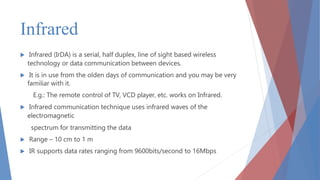
 Infrared (IrDA) is a serial, half duplex, line of sight based wireless
technology or data communication between devices.
 It is in use from the olden days of communication and you may be very
familiar with it.
E.g.: The remote control of TV, VCD player, etc. works on Infrared.
 Infrared communication technique uses infrared waves of the
electromagnetic
spectrum for transmitting the data
 Range – 10 cm to 1 m
 IR supports data rates ranging from 9600bits/second to 16Mbps
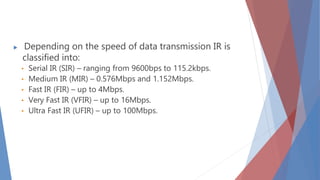
 Depending on the speed of data transmission IR is
classified into:
• Serial IR (SIR) – ranging from 9600bps to 115.2kbps.
• Medium IR (MIR) – 0.576Mbps and 1.152Mbps.
• Fast IR (FIR) – up to 4Mbps.
• Very Fast IR (VFIR) – up to 16Mbps.
• Ultra Fast IR (UFIR) – up to 100Mbps.
Uses of Infrared
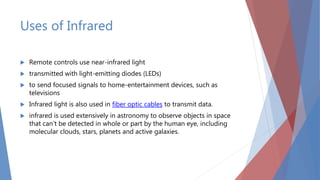
 Remote controls use near-infrared light
 transmitted with light-emitting diodes (LEDs)
 to send focused signals to home-entertainment devices, such as
televisions
 Infrared light is also used in fiber optic cables to transmit data.
 infrared is used extensively in astronomy to observe objects in space
that can't be detected in whole or part by the human eye, including
molecular clouds, stars, planets and active galaxies.
Bluetooth
 Bluetooth is a low cost, low power, short range wireless technology for
data and voice communication.
 Bluetooth was first proposed by Ericsson in 1994.
 Bluetooth operates at 2.4GHz of the Radio Frequency spectrum and
uses the Frequency Hopping Spread Spectrum (FHSS) technique for
communication.
 It supports a data rate of up to 1Mbps and a range of approximately 30
feet for data communication.
 Bluetooth enabled devices essentially contain a Bluetooth wireless radio
for the transmission and reception of data.
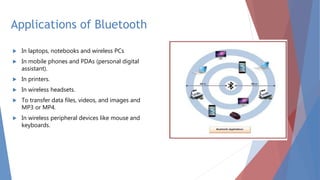
Applications of Bluetooth
 In laptops, notebooks and wireless PCs
 In mobile phones and PDAs (personal digital
assistant).
 In printers.
 In wireless headsets.
 To transfer data files, videos, and images and
MP3 or MP4.
 In wireless peripheral devices like mouse and
keyboards.
ZigBee
 ZigBee is a wireless networking technology.
 ZigBee is the set of specifications built around the IEEE 802.15.4 wireless
protocol.
 ZigBee technology is a low data rate, low power consumption, low cost,
wireless networking protocol targeted towards automation and remote
control applications.
 ZigBee operates worldwide at the licensed bands of Radio spectrum at 2.400
to 2.484 GHz, 902 to 928 MHz and 868.0 to 868.6 MHz.
 Range- up to 100 metres
 data rate of 20 to 250 Kbps.
 There are three different ZigBee device types
ZigBee Coordinator (ZC)/Network Coordinator
ZigBee Router (ZR)/Full function Device (FFD)
ZigBee End Device (ZED)/Reduced Function Device (RFD)
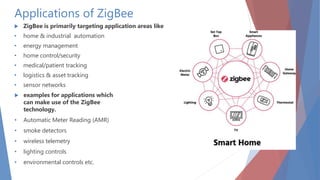
Applications of ZigBee
 ZigBee is primarily targeting application areas like
• home & industrial automation
• energy management
• home control/security
• medical/patient tracking
• logistics & asset tracking
• sensor networks
 examples for applications which
can make use of the ZigBee
technology.
• Automatic Meter Reading (AMR)
• smoke detectors
• wireless telemetry
• lighting controls
• environmental controls etc.
Wi-Fi
 Wi-Fi or Wireless Fidelity is the popular wireless communication
technique for networked communication of devices.
 Wi-Fi follows the IEEE 802.11 standard.
 Wi-Fi is intended for network communication and it supports
Internet Protocol (IP) based communication.
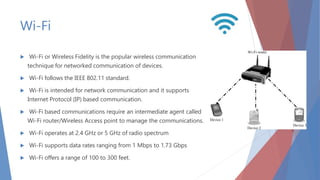
 Wi-Fi based communications require an intermediate agent called
Wi-Fi router/Wireless Access point to manage the communications.
 Wi-Fi operates at 2.4 GHz or 5 GHz of radio spectrum
 Wi-Fi supports data rates ranging from 1 Mbps to 1.73 Gbps
 Wi-Fi offers a range of 100 to 300 feet.
Uses of Wi-Fi
 helps devices to exchange information with one another by creating a
network.
 Helps in using the Internet of Things devices.
 Acts as a hotspot to offer temporary access to Wi-Fi enabled devices so
that they do not know about the details of main network
 Enables VoWi-Fi to call anyone, even in areas where there is no mobile
network.
 Acts as positioning system to recognize the area of a device by
detecting the placement of Wi-Fi hotspots.
 Constructs simple wireless connections called Point to Point networks to
connect two locations that cannot be accessed through the wire.

FLIP CLASS on wifi, zigbee, bluetooth, infrared.pptx

  • 1.
    FLIP CLASS • Infrared •Bluetooth • ZigBee • Wi-Fi
  • 2.
    Infrared  Infrared (IrDA)is a serial, half duplex, line of sight based wireless technology or data communication between devices.  It is in use from the olden days of communication and you may be very familiar with it. E.g.: The remote control of TV, VCD player, etc. works on Infrared.  Infrared communication technique uses infrared waves of the electromagnetic spectrum for transmitting the data  Range – 10 cm to 1 m  IR supports data rates ranging from 9600bits/second to 16Mbps
  • 3.
     Depending onthe speed of data transmission IR is classified into: • Serial IR (SIR) – ranging from 9600bps to 115.2kbps. • Medium IR (MIR) – 0.576Mbps and 1.152Mbps. • Fast IR (FIR) – up to 4Mbps. • Very Fast IR (VFIR) – up to 16Mbps. • Ultra Fast IR (UFIR) – up to 100Mbps.
  • 4.
    Uses of Infrared Remote controls use near-infrared light  transmitted with light-emitting diodes (LEDs)  to send focused signals to home-entertainment devices, such as televisions  Infrared light is also used in fiber optic cables to transmit data.  infrared is used extensively in astronomy to observe objects in space that can't be detected in whole or part by the human eye, including molecular clouds, stars, planets and active galaxies.
  • 5.
    Bluetooth  Bluetooth isa low cost, low power, short range wireless technology for data and voice communication.  Bluetooth was first proposed by Ericsson in 1994.  Bluetooth operates at 2.4GHz of the Radio Frequency spectrum and uses the Frequency Hopping Spread Spectrum (FHSS) technique for communication.  It supports a data rate of up to 1Mbps and a range of approximately 30 feet for data communication.  Bluetooth enabled devices essentially contain a Bluetooth wireless radio for the transmission and reception of data.
  • 6.
    Applications of Bluetooth In laptops, notebooks and wireless PCs  In mobile phones and PDAs (personal digital assistant).  In printers.  In wireless headsets.  To transfer data files, videos, and images and MP3 or MP4.  In wireless peripheral devices like mouse and keyboards.
  • 7.
    ZigBee  ZigBee isa wireless networking technology.  ZigBee is the set of specifications built around the IEEE 802.15.4 wireless protocol.  ZigBee technology is a low data rate, low power consumption, low cost, wireless networking protocol targeted towards automation and remote control applications.  ZigBee operates worldwide at the licensed bands of Radio spectrum at 2.400 to 2.484 GHz, 902 to 928 MHz and 868.0 to 868.6 MHz.  Range- up to 100 metres  data rate of 20 to 250 Kbps.  There are three different ZigBee device types ZigBee Coordinator (ZC)/Network Coordinator ZigBee Router (ZR)/Full function Device (FFD) ZigBee End Device (ZED)/Reduced Function Device (RFD)
  • 8.
    Applications of ZigBee ZigBee is primarily targeting application areas like • home & industrial automation • energy management • home control/security • medical/patient tracking • logistics & asset tracking • sensor networks  examples for applications which can make use of the ZigBee technology. • Automatic Meter Reading (AMR) • smoke detectors • wireless telemetry • lighting controls • environmental controls etc.
  • 9.
    Wi-Fi  Wi-Fi orWireless Fidelity is the popular wireless communication technique for networked communication of devices.  Wi-Fi follows the IEEE 802.11 standard.  Wi-Fi is intended for network communication and it supports Internet Protocol (IP) based communication.  Wi-Fi based communications require an intermediate agent called Wi-Fi router/Wireless Access point to manage the communications.  Wi-Fi operates at 2.4 GHz or 5 GHz of radio spectrum  Wi-Fi supports data rates ranging from 1 Mbps to 1.73 Gbps  Wi-Fi offers a range of 100 to 300 feet.
  • 10.
    Uses of Wi-Fi helps devices to exchange information with one another by creating a network.  Helps in using the Internet of Things devices.  Acts as a hotspot to offer temporary access to Wi-Fi enabled devices so that they do not know about the details of main network  Enables VoWi-Fi to call anyone, even in areas where there is no mobile network.  Acts as positioning system to recognize the area of a device by detecting the placement of Wi-Fi hotspots.  Constructs simple wireless connections called Point to Point networks to connect two locations that cannot be accessed through the wire.