


Radio Frequency Protocols of
The Internet of Things
Jonathan Brewer
Network Startup Resource Center
jon@nsrc.org
These materials are licensed under the Creative Commons
Attribution-NonCommercial 4.0 International license
(http://creativecommons.org/licenses/by-nc/4.0/)
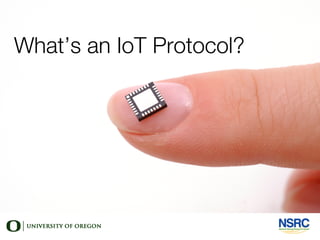
What’s an IoT Protocol?
IoT Protocols for IoT Problems
• Device Constraints
• Low Power
• Low CPU
• Small Size
• Network Constraints
• Radio Propagation Issues
• Radio Power Utilisation
• Interference from Self, Other Devices
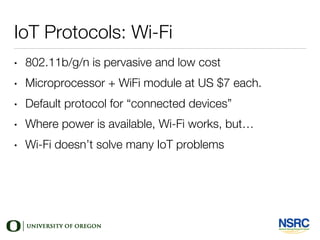
IoT Protocols: Wi-Fi
• 802.11b/g/n is pervasive and low cost
• Microprocessor + WiFi module at US $7 each.
• Default protocol for “connected devices”
• Where power is available, Wi-Fi works, but…
• Wi-Fi doesn’t solve many IoT problems
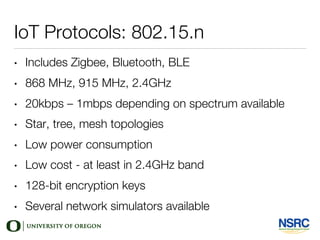
IoT Protocols: 802.15.n
• Includes Zigbee, Bluetooth, BLE
• 868 MHz, 915 MHz, 2.4GHz
• 20kbps – 1mbps depending on spectrum available
• Star, tree, mesh topologies
• Low power consumption
• Low cost - at least in 2.4GHz band
• 128-bit encryption keys
• Several network simulators available
IoT Wireless: Lo-Fi, Motenio, Etc.
• Serial across 433, 868, 915 MHz MHz
• Open Source RFM69 Libraries
• 1.2-300 kbps
• Rx Sensitivity to -120dBm at 1.2kbps
• Some support encryption using RFM69W chip
• Star topology
• Other Similar chips / protocols available
• Very inexpensive – US $3.50 per module
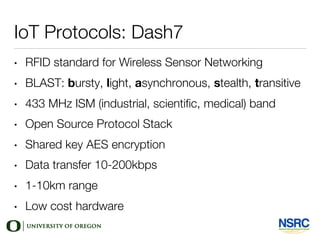
IoT Protocols: Dash7
• RFID standard for Wireless Sensor Networking
• BLAST: bursty, light, asynchronous, stealth, transitive
• 433 MHz ISM (industrial, scientific, medical) band
• Open Source Protocol Stack
• Shared key AES encryption
• Data transfer 10-200kbps
• 1-10km range
• Low cost hardware
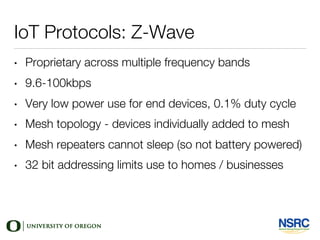
IoT Protocols: Z-Wave
• Proprietary across multiple frequency bands
• 9.6-100kbps
• Very low power use for end devices, 0.1% duty cycle
• Mesh topology - devices individually added to mesh
• Mesh repeaters cannot sleep (so not battery powered)
• 32 bit addressing limits use to homes / businesses
IoT Protocols: SigFox
• Proprietary at 868MHz & 915MHz in the US
• Low power consumption
• SigFox owns/operates the Receiver network
• European, USA, and AU/NZ Networks.
• Up to 140 12-byte messages a day
• 10-1000 bits per second
• Encryption?
• Target pricing US $1/device/year
IoT Protocols: LoRa
• Low Power Wide Area Network
• Designed for wireless, battery operated devices
• Supports bi-directional comms, mobility, localisation
• Star or star of stars topology (not mesh or p2p)
• 0.3-50kbps via adaptive data rate scheme
• Multiple levels of encryption (Net/App/Device)
• Supports time slot scheduling of device transmission
IoT Protocols: Weightless / nbIoT
• Open Standard at Multiple Frequency Bands
• Standards for TVWS & now Narrowband 868MHz
• Integrates w/ Cellular as nbIoT using re-farmed GSM
• Low power consumption - nodes can sleep for days
• From bits per second to megabits per second
• Intelligent scheduling at the tower end
• Public Key Encryption
• Supports itinerant nodes
LTE-M (LTE-MTC / LTE IoT)
• MTC = “Machine Type Communications”
• Cat-M1 version to be included in 3GPP Release 13
• Uses existing LTE base stations w/ software upgrade
• Six 230 KHz channels per 1.4 MHz carrier
• Data transmissions can be repeated at intervals
• Endpoints tell towers how often they want to talk
• extended discontinuous repetition cycle (DRX)
Matching IoT Protocols to Applications
• Agriculture
• Food Safety
• Environmental Controls
• Retail Automation
• Smart Cities
• Transportation
• Utility Metering
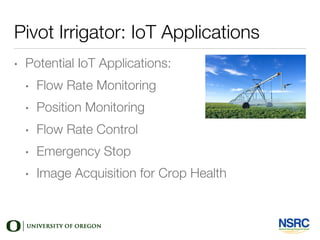
Pivot Irrigator: IoT Applications
• Potential IoT Applications:
• Flow Rate Monitoring
• Position Monitoring
• Flow Rate Control
• Emergency Stop
• Image Acquisition for Crop Health
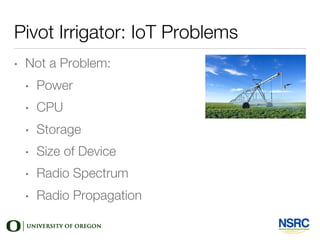
Pivot Irrigator: IoT Problems
• Not a Problem:
• Power
• CPU
• Storage
• Size of Device
• Radio Spectrum
• Radio Propagation
Pivot Irrigator: IoT Protocols
• WiFi/WiMAX/TVWS
• (Broadband Wireless)
• IPv4/IPv6
• HTTP
• REST
• JSON
• XML
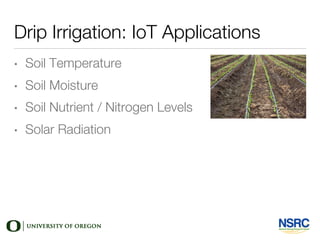
Drip Irrigation: IoT Applications
• Soil Temperature
• Soil Moisture
• Soil Nutrient / Nitrogen Levels
• Solar Radiation
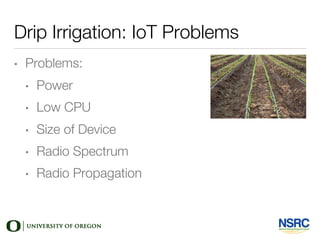
Drip Irrigation: IoT Problems
• Problems:
• Power
• Low CPU
• Size of Device
• Radio Spectrum
• Radio Propagation
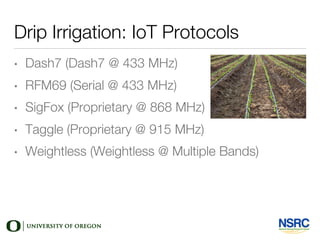
Drip Irrigation: IoT Protocols
• Dash7 (Dash7 @ 433 MHz)
• RFM69 (Serial @ 433 MHz)
• SigFox (Proprietary @ 868 MHz)
• Taggle (Proprietary @ 915 MHz)
• Weightless (Weightless @ Multiple Bands)
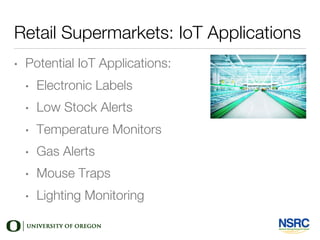
Retail Supermarkets: IoT Applications
• Potential IoT Applications:
• Electronic Labels
• Low Stock Alerts
• Temperature Monitors
• Gas Alerts
• Mouse Traps
• Lighting Monitoring
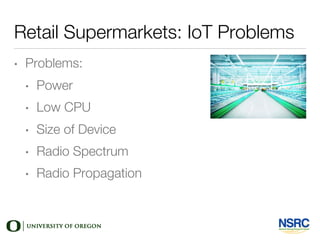
Retail Supermarkets: IoT Problems
• Problems:
• Power
• Low CPU
• Size of Device
• Radio Spectrum
• Radio Propagation
Retail Supermarkets: IoT Protocols
• Class Exercise
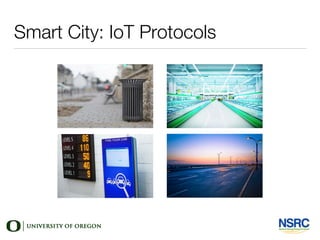
Smart City: IoT Protocols

IoT RF Protocols

  • 1.
    Radio Frequency Protocolsof The Internet of Things Jonathan Brewer Network Startup Resource Center jon@nsrc.org These materials are licensed under the Creative Commons Attribution-NonCommercial 4.0 International license (http://creativecommons.org/licenses/by-nc/4.0/)
  • 2.
    What’s an IoTProtocol?
  • 3.
    IoT Protocols forIoT Problems • Device Constraints • Low Power • Low CPU • Small Size • Network Constraints • Radio Propagation Issues • Radio Power Utilisation • Interference from Self, Other Devices
  • 4.
    IoT Protocols: Wi-Fi •802.11b/g/n is pervasive and low cost • Microprocessor + WiFi module at US $7 each. • Default protocol for “connected devices” • Where power is available, Wi-Fi works, but… • Wi-Fi doesn’t solve many IoT problems
  • 5.
    IoT Protocols: 802.15.n •Includes Zigbee, Bluetooth, BLE • 868 MHz, 915 MHz, 2.4GHz • 20kbps – 1mbps depending on spectrum available • Star, tree, mesh topologies • Low power consumption • Low cost - at least in 2.4GHz band • 128-bit encryption keys • Several network simulators available
  • 6.
    IoT Wireless: Lo-Fi,Motenio, Etc. • Serial across 433, 868, 915 MHz MHz • Open Source RFM69 Libraries • 1.2-300 kbps • Rx Sensitivity to -120dBm at 1.2kbps • Some support encryption using RFM69W chip • Star topology • Other Similar chips / protocols available • Very inexpensive – US $3.50 per module
  • 7.
    IoT Protocols: Dash7 •RFID standard for Wireless Sensor Networking • BLAST: bursty, light, asynchronous, stealth, transitive • 433 MHz ISM (industrial, scientific, medical) band • Open Source Protocol Stack • Shared key AES encryption • Data transfer 10-200kbps • 1-10km range • Low cost hardware
  • 8.
    IoT Protocols: Z-Wave •Proprietary across multiple frequency bands • 9.6-100kbps • Very low power use for end devices, 0.1% duty cycle • Mesh topology - devices individually added to mesh • Mesh repeaters cannot sleep (so not battery powered) • 32 bit addressing limits use to homes / businesses
  • 9.
    IoT Protocols: SigFox •Proprietary at 868MHz & 915MHz in the US • Low power consumption • SigFox owns/operates the Receiver network • European, USA, and AU/NZ Networks. • Up to 140 12-byte messages a day • 10-1000 bits per second • Encryption? • Target pricing US $1/device/year
  • 10.
    IoT Protocols: LoRa •Low Power Wide Area Network • Designed for wireless, battery operated devices • Supports bi-directional comms, mobility, localisation • Star or star of stars topology (not mesh or p2p) • 0.3-50kbps via adaptive data rate scheme • Multiple levels of encryption (Net/App/Device) • Supports time slot scheduling of device transmission
  • 11.
    IoT Protocols: Weightless/ nbIoT • Open Standard at Multiple Frequency Bands • Standards for TVWS & now Narrowband 868MHz • Integrates w/ Cellular as nbIoT using re-farmed GSM • Low power consumption - nodes can sleep for days • From bits per second to megabits per second • Intelligent scheduling at the tower end • Public Key Encryption • Supports itinerant nodes
  • 12.
    LTE-M (LTE-MTC /LTE IoT) • MTC = “Machine Type Communications” • Cat-M1 version to be included in 3GPP Release 13 • Uses existing LTE base stations w/ software upgrade • Six 230 KHz channels per 1.4 MHz carrier • Data transmissions can be repeated at intervals • Endpoints tell towers how often they want to talk • extended discontinuous repetition cycle (DRX)
  • 13.
    Matching IoT Protocolsto Applications • Agriculture • Food Safety • Environmental Controls • Retail Automation • Smart Cities • Transportation • Utility Metering
  • 15.
    Pivot Irrigator: IoTApplications • Potential IoT Applications: • Flow Rate Monitoring • Position Monitoring • Flow Rate Control • Emergency Stop • Image Acquisition for Crop Health
  • 16.
    Pivot Irrigator: IoTProblems • Not a Problem: • Power • CPU • Storage • Size of Device • Radio Spectrum • Radio Propagation
  • 17.
    Pivot Irrigator: IoTProtocols • WiFi/WiMAX/TVWS • (Broadband Wireless) • IPv4/IPv6 • HTTP • REST • JSON • XML
  • 19.
    Drip Irrigation: IoTApplications • Soil Temperature • Soil Moisture • Soil Nutrient / Nitrogen Levels • Solar Radiation
  • 20.
    Drip Irrigation: IoTProblems • Problems: • Power • Low CPU • Size of Device • Radio Spectrum • Radio Propagation
  • 21.
    Drip Irrigation: IoTProtocols • Dash7 (Dash7 @ 433 MHz) • RFM69 (Serial @ 433 MHz) • SigFox (Proprietary @ 868 MHz) • Taggle (Proprietary @ 915 MHz) • Weightless (Weightless @ Multiple Bands)
  • 23.
    Retail Supermarkets: IoTApplications • Potential IoT Applications: • Electronic Labels • Low Stock Alerts • Temperature Monitors • Gas Alerts • Mouse Traps • Lighting Monitoring
  • 24.
    Retail Supermarkets: IoTProblems • Problems: • Power • Low CPU • Size of Device • Radio Spectrum • Radio Propagation
  • 25.
    Retail Supermarkets: IoTProtocols • Class Exercise
  • 26.
    Smart City: IoTProtocols