CIS-189
   XSL stands for Extensible Stylesheet
    ◦ Stylesheets are used to manage organization and
      presentation of data
   Implemented as an XML language
    ◦ Rules of XML apply
   Made up of
    ◦ XSL-FO (Formatting Objects)
    ◦ XSLT (Transformations)
   XSL-FO focused on presentation to screen
    and paper
    ◦ Not well-supported by browsers
   XSLT emphasizes re-organization of data
    ◦ Typically used for presentation but can also be used
      for conversion of data storage format
    ◦ XSLT is a declarative language
      Similar to SQL, describe results not steps
   Cascading Style Sheets used to separate
    presentation from data
   XSLT used to change – transform – data
    ◦ Convert an XML document to XHTML
   Can use both together
XSL requires several steps
1. XML processor reads document
     ◦ Creates document tree
2.    XSL processor applies rules from stylesheet
     ◦ Rules applied to document tree
     ◦ Rules applied by using pattern matching
       Identify nodes to apply rules to
     ◦ Rules are stored as templates
   XSL works by using an Input Tree
    ◦ Input Tree comes from XML processor
   Process of changing input values is call Tree
    Transformation
   Result of transformation is the Result Tree
    ◦ Result Tree can include
      XML
      HTML (must adhere to XML rules, i.e., XHTML)
      Formatting Objects
   Extensible Stylesheet Transformations is
    method of changing (transforming) XML
    based on rules of a stylesheet
   Xpath allows manipulation of parts of XML
    document
    ◦ Not XML-based
    ◦ Provides compact references
      Useful in URI’s, attributes
    ◦ Document must exist as nodes (previously parsed)
   Templates are definitions of rules,
    organization
   Patterns define values searching for (where to
    apply templates)
   Expressions allow use of functions using
    nodes as inputs
   When referring to document attributes
    preface name with “@”
   <xsl:stylesheet> is root element
    ◦ Uses namespace to define elements, attributes valid
      in a stylesheet
   <xsl:template> defines the rules/
    transformations to apply
    ◦ Match attribute specifies pattern to apply rules to
      Functions similar to criteria
   <xsl:apply-templates> applies the rules
    defined for a particular element
    ◦ Select attribute specifies elements to apply to
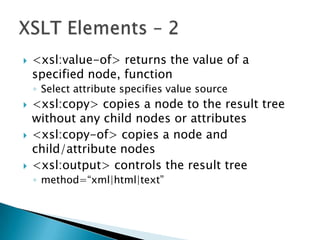
   <xsl:value-of> returns the value of a
    specified node, function
    ◦ Select attribute specifies value source
   <xsl:copy> copies a node to the result tree
    without any child nodes or attributes
   <xsl:copy-of> copies a node and
    child/attribute nodes
   <xsl:output> controls the result tree
    ◦ method=“xml|html|text”
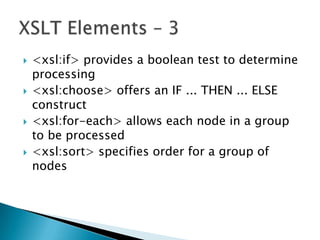
   <xsl:if> provides a boolean test to determine
    processing
   <xsl:choose> offers an IF ... THEN ... ELSE
    construct
   <xsl:for-each> allows each node in a group
    to be processed
   <xsl:sort> specifies order for a group of
    nodes
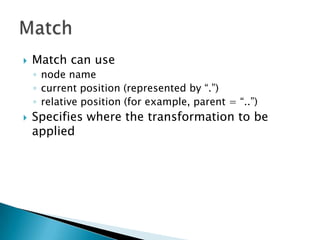
   Match can use
    ◦ node name
    ◦ current position (represented by “.”)
    ◦ relative position (for example, parent = “..”)
   Specifies where the transformation to be
    applied

XSLT Overview

  • 1.
  • 2.
    XSL stands for Extensible Stylesheet ◦ Stylesheets are used to manage organization and presentation of data  Implemented as an XML language ◦ Rules of XML apply  Made up of ◦ XSL-FO (Formatting Objects) ◦ XSLT (Transformations)
  • 3.
    XSL-FO focused on presentation to screen and paper ◦ Not well-supported by browsers  XSLT emphasizes re-organization of data ◦ Typically used for presentation but can also be used for conversion of data storage format ◦ XSLT is a declarative language  Similar to SQL, describe results not steps
  • 4.
    Cascading Style Sheets used to separate presentation from data  XSLT used to change – transform – data ◦ Convert an XML document to XHTML  Can use both together
  • 5.
    XSL requires severalsteps 1. XML processor reads document ◦ Creates document tree 2. XSL processor applies rules from stylesheet ◦ Rules applied to document tree ◦ Rules applied by using pattern matching  Identify nodes to apply rules to ◦ Rules are stored as templates
  • 6.
    XSL works by using an Input Tree ◦ Input Tree comes from XML processor  Process of changing input values is call Tree Transformation  Result of transformation is the Result Tree ◦ Result Tree can include  XML  HTML (must adhere to XML rules, i.e., XHTML)  Formatting Objects
  • 7.
    Extensible Stylesheet Transformations is method of changing (transforming) XML based on rules of a stylesheet  Xpath allows manipulation of parts of XML document ◦ Not XML-based ◦ Provides compact references  Useful in URI’s, attributes ◦ Document must exist as nodes (previously parsed)
  • 8.
    Templates are definitions of rules, organization  Patterns define values searching for (where to apply templates)  Expressions allow use of functions using nodes as inputs  When referring to document attributes preface name with “@”
  • 9.
    <xsl:stylesheet> is root element ◦ Uses namespace to define elements, attributes valid in a stylesheet  <xsl:template> defines the rules/ transformations to apply ◦ Match attribute specifies pattern to apply rules to  Functions similar to criteria  <xsl:apply-templates> applies the rules defined for a particular element ◦ Select attribute specifies elements to apply to
  • 10.
    <xsl:value-of> returns the value of a specified node, function ◦ Select attribute specifies value source  <xsl:copy> copies a node to the result tree without any child nodes or attributes  <xsl:copy-of> copies a node and child/attribute nodes  <xsl:output> controls the result tree ◦ method=“xml|html|text”
  • 11.
    <xsl:if> provides a boolean test to determine processing  <xsl:choose> offers an IF ... THEN ... ELSE construct  <xsl:for-each> allows each node in a group to be processed  <xsl:sort> specifies order for a group of nodes
  • 12.
    Match can use ◦ node name ◦ current position (represented by “.”) ◦ relative position (for example, parent = “..”)  Specifies where the transformation to be applied