Fabrication of microdevices
by
LIGA PROCESS
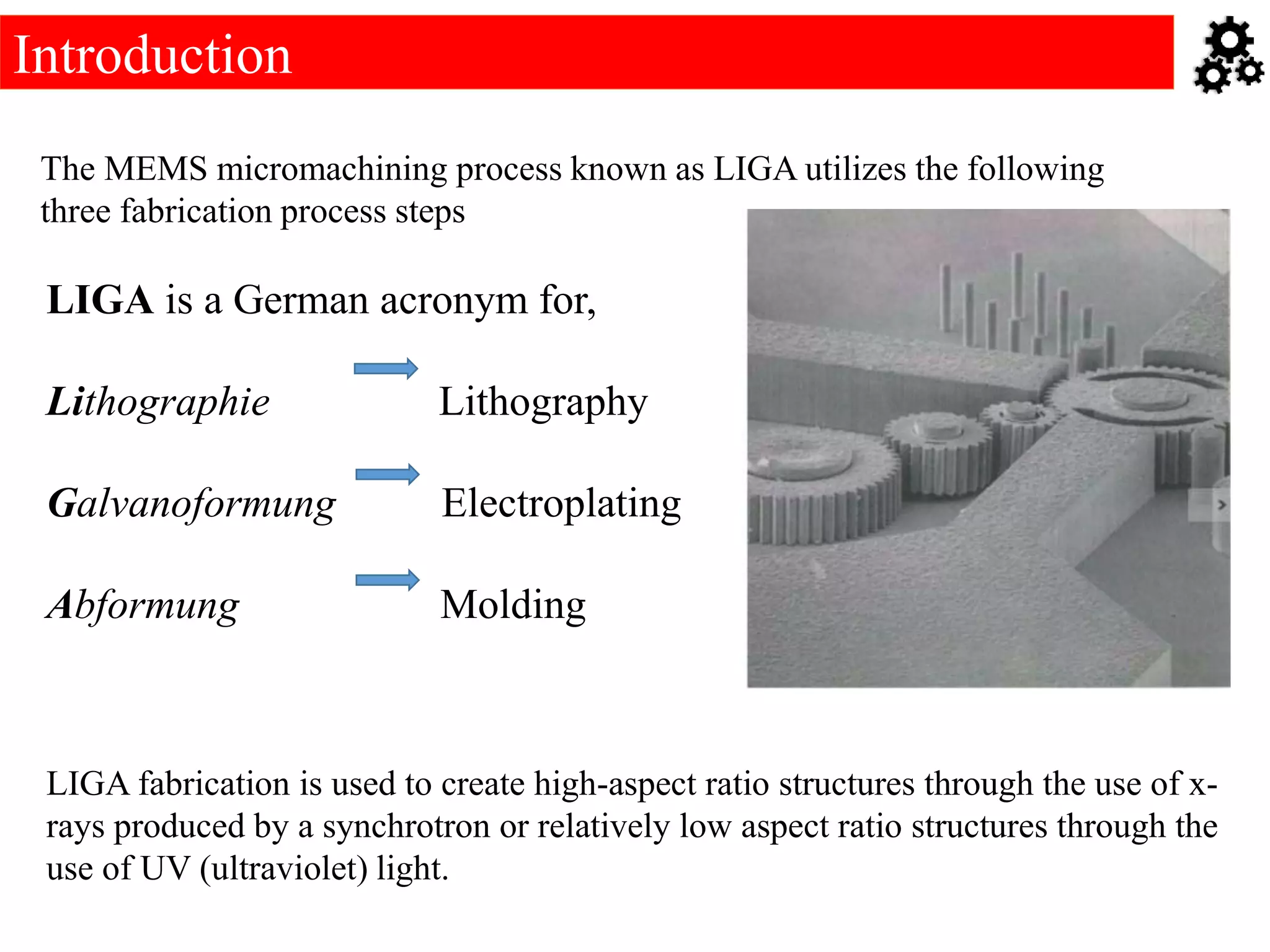
LIGA is a German acronym for,
Lithographie Lithography
Galvanoformung Electroplating
Abformung Molding
Introduction
The MEMS micromachining process known as LIGA utilizes the following
three fabrication process steps
LIGA fabrication is used to create high-aspect ratio structures through the use of x-
rays produced by a synchrotron or relatively low aspect ratio structures through the
use of UV (ultraviolet) light.
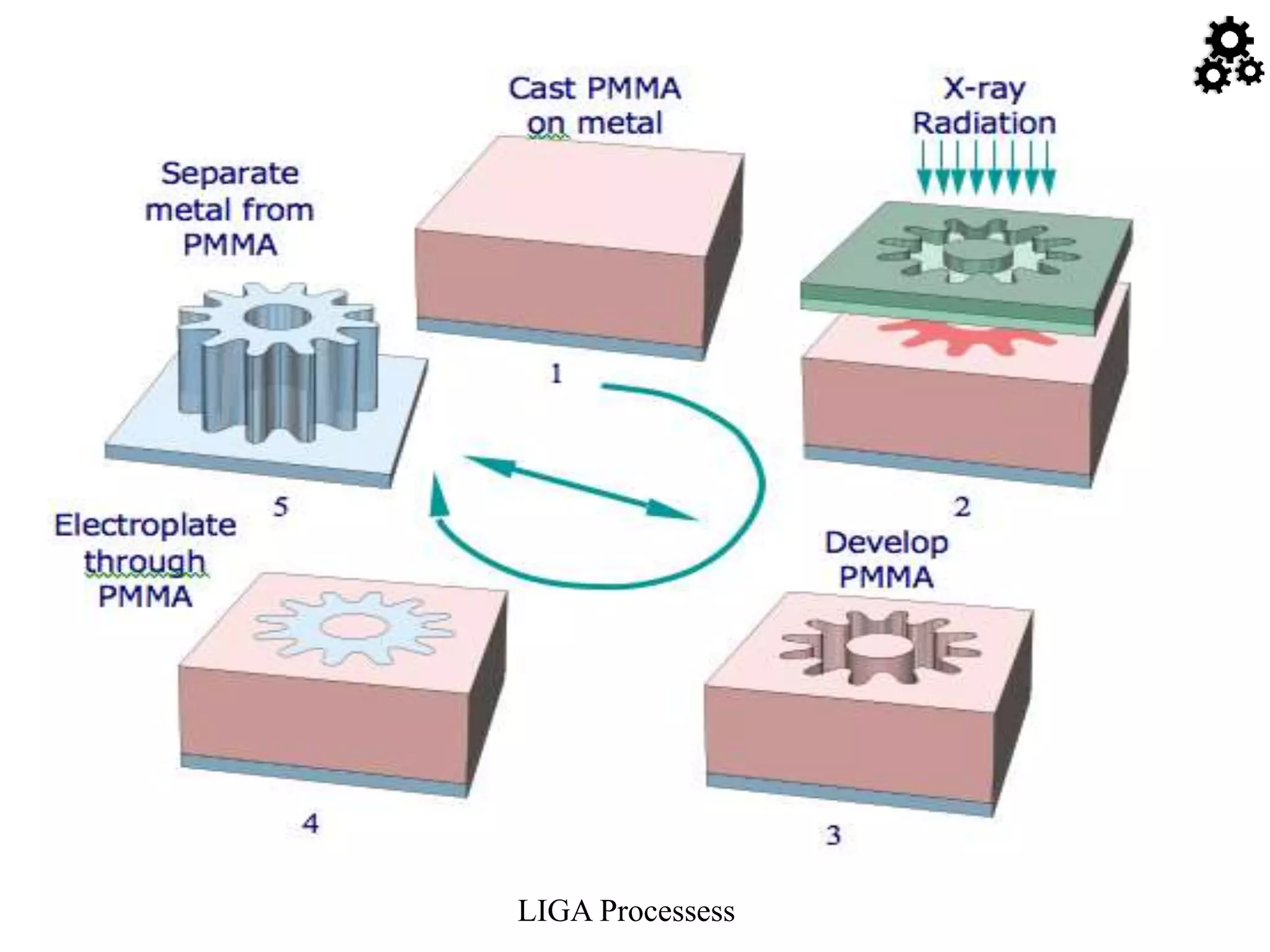
 The LIGA process involves the following steps:
 l. A very thick (up to hundreds of microns) resist layer of polymethylmethacrylate
(PMMA) is deposited onto a primary substrate.
 2. The PMMA is exposed to columnated X-rays and is developed.
 3. Metal is electrodeposited onto the primary substrate.
 4. The PMMA is removed or stripped, resulting in a freestanding metal structure.
 5. Plastic injection molding takes place.
 The LIGA-fabrication process is composed of:
1. Exposure, 2. Development
3. Electroforming 4. Stripping
5. Replication
LIGA Micromaching Process
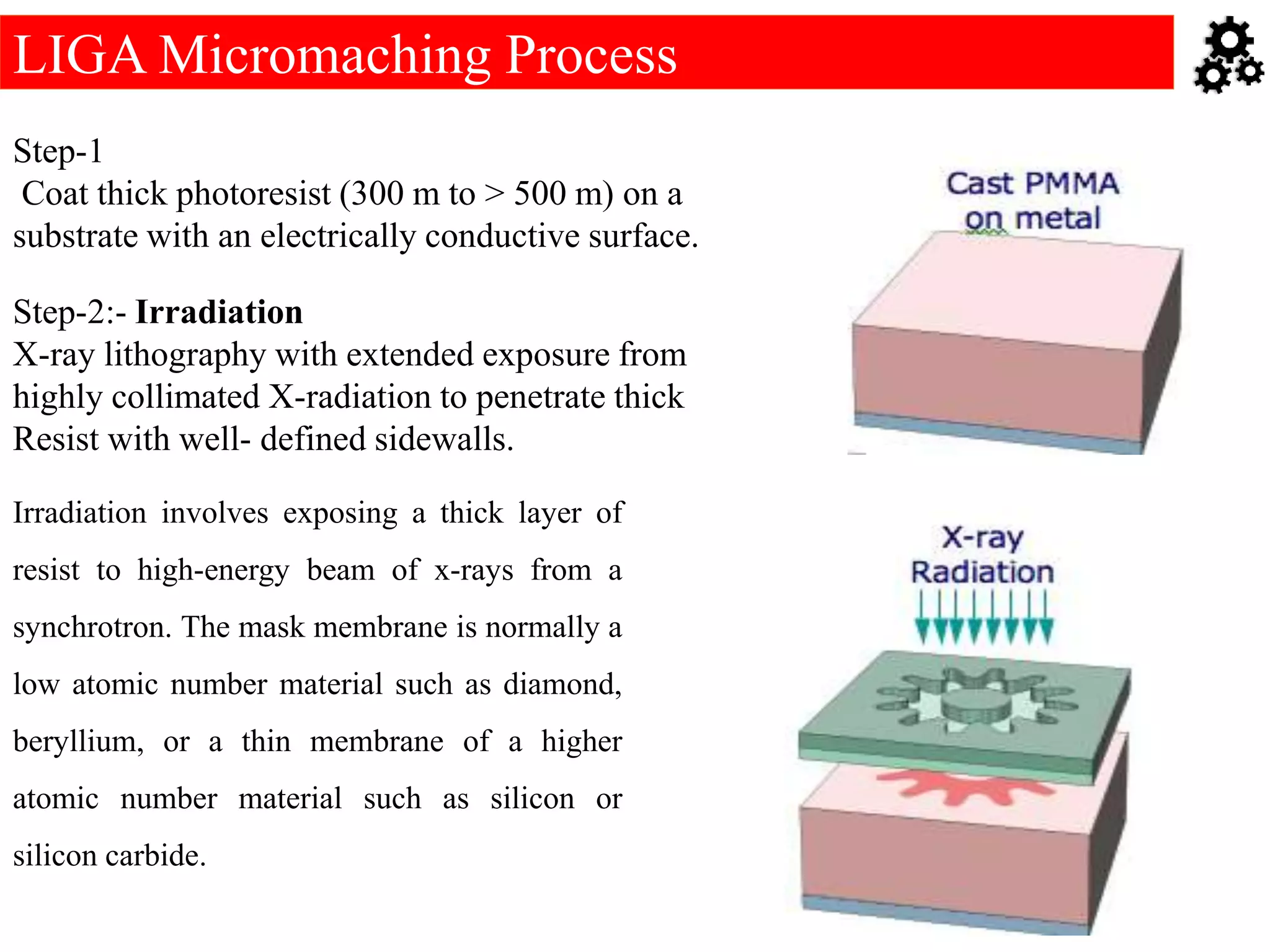
Step-1
Coat thick photoresist (300 m to > 500 m) on a
substrate with an electrically conductive surface.
Step-2:- Irradiation
X-ray lithography with extended exposure from
highly collimated X-radiation to penetrate thick
Resist with well- defined sidewalls.
Irradiation involves exposing a thick layer of
resist to high-energy beam of x-rays from a
synchrotron. The mask membrane is normally a
low atomic number material such as diamond,
beryllium, or a thin membrane of a higher
atomic number material such as silicon or
silicon carbide.
LIGA Micromaching Process
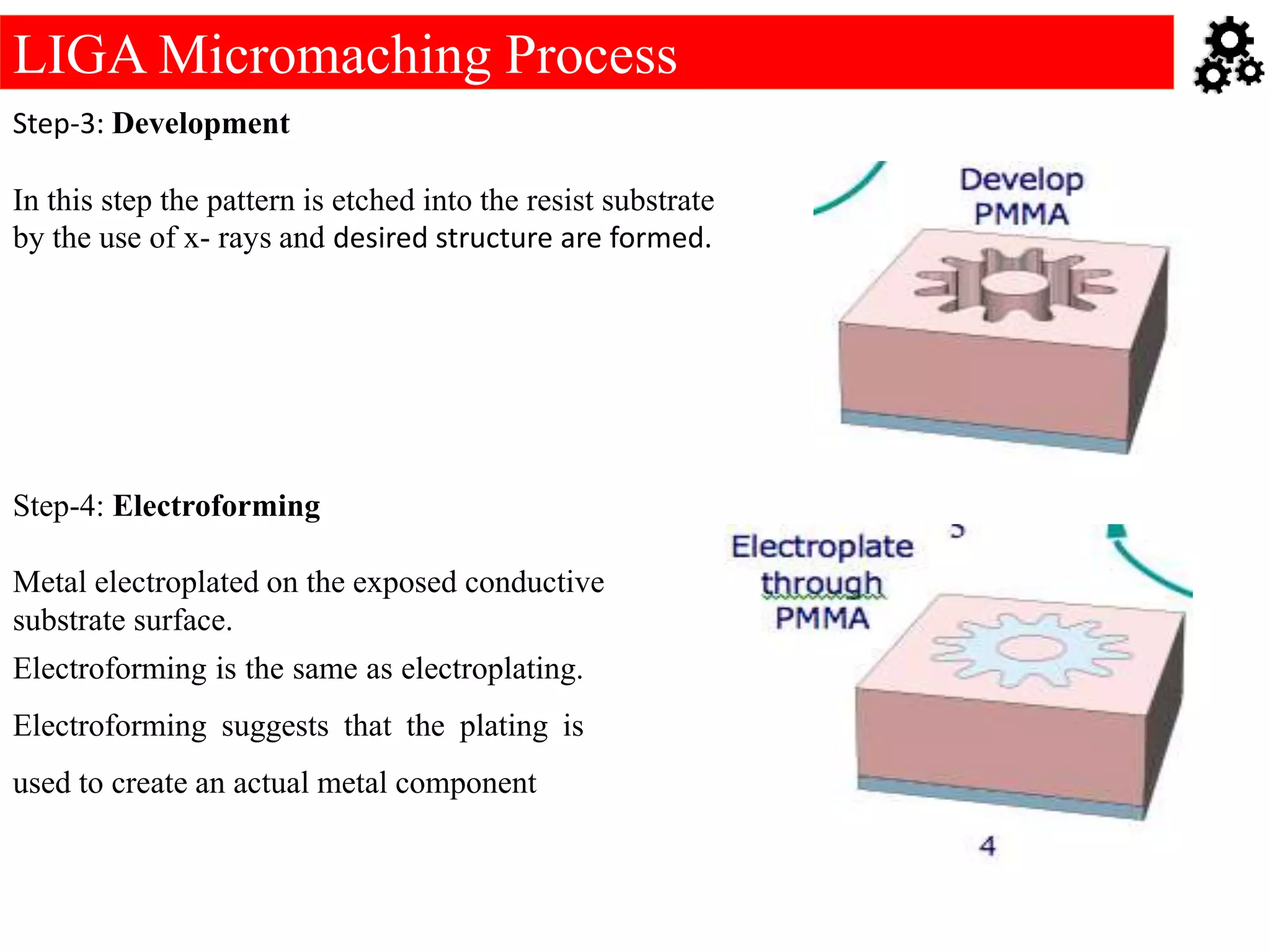
Step-3: Development
In this step the pattern is etched into the resist substrate
by the use of x- rays and desired structure are formed.
Step-4: Electroforming
Metal electroplated on the exposed conductive
substrate surface.
Electroforming is the same as electroplating.
Electroforming suggests that the plating is
used to create an actual metal component
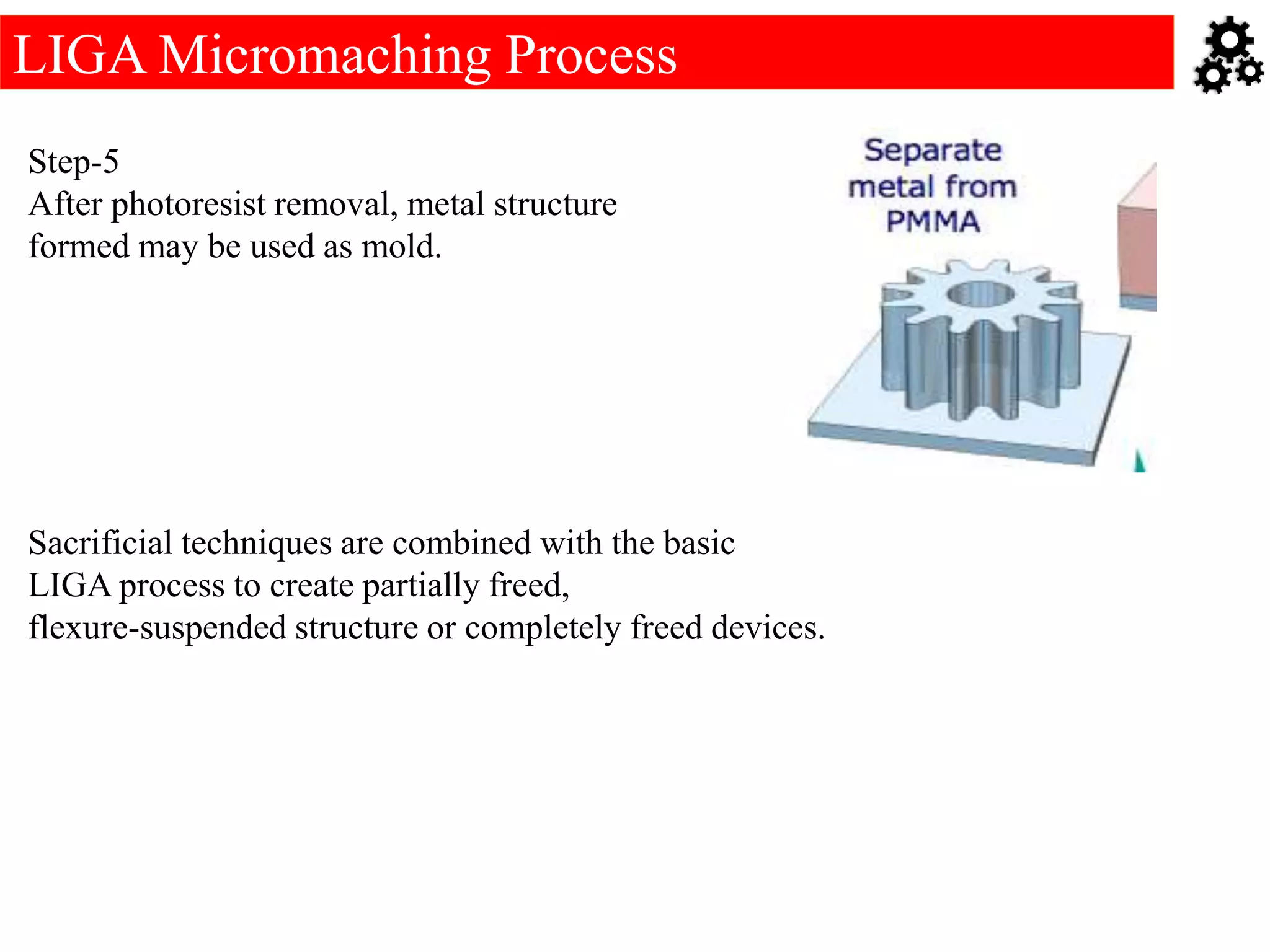
Step-5
After photoresist removal, metal structure
formed may be used as mold.
Sacrificial techniques are combined with the basic
LIGA process to create partially freed,
flexure-suspended structure or completely freed devices.
LIGA Micromaching Process
LIGA Processess
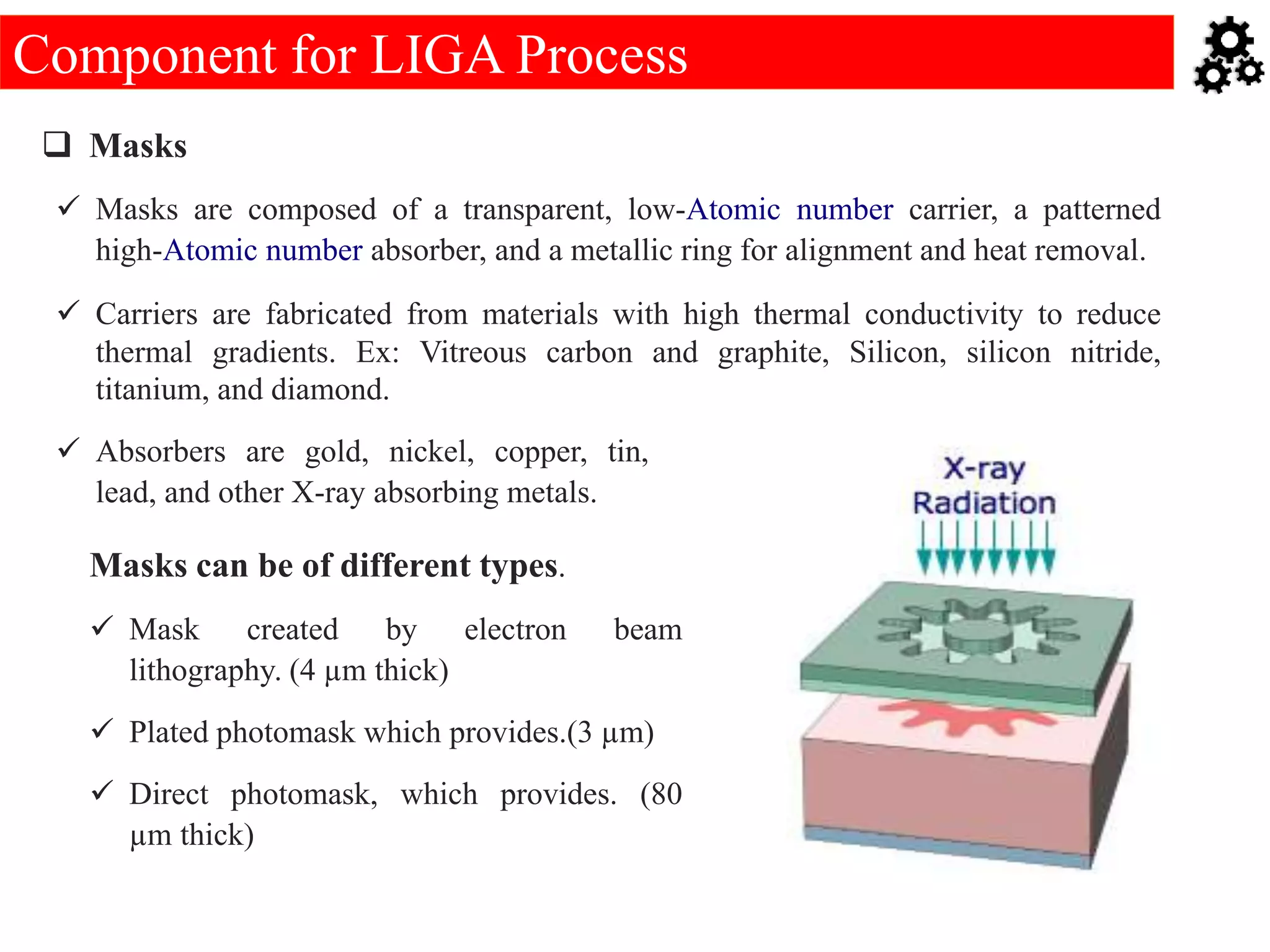
Masks can be of different types.
 Mask created by electron beam
lithography. (4 µm thick)
 Plated photomask which provides.(3 µm)
 Direct photomask, which provides. (80
µm thick)
 Masks
Component for LIGA Process
 Masks are composed of a transparent, low-Atomic number carrier, a patterned
high-Atomic number absorber, and a metallic ring for alignment and heat removal.
 Carriers are fabricated from materials with high thermal conductivity to reduce
thermal gradients. Ex: Vitreous carbon and graphite, Silicon, silicon nitride,
titanium, and diamond.
 Absorbers are gold, nickel, copper, tin,
lead, and other X-ray absorbing metals.
 The starting material is a flat substrate, such as a silicon wafer or a polished disc of
beryllium, copper, titanium, or other material. The substrate electrically conductive.
 Substrate
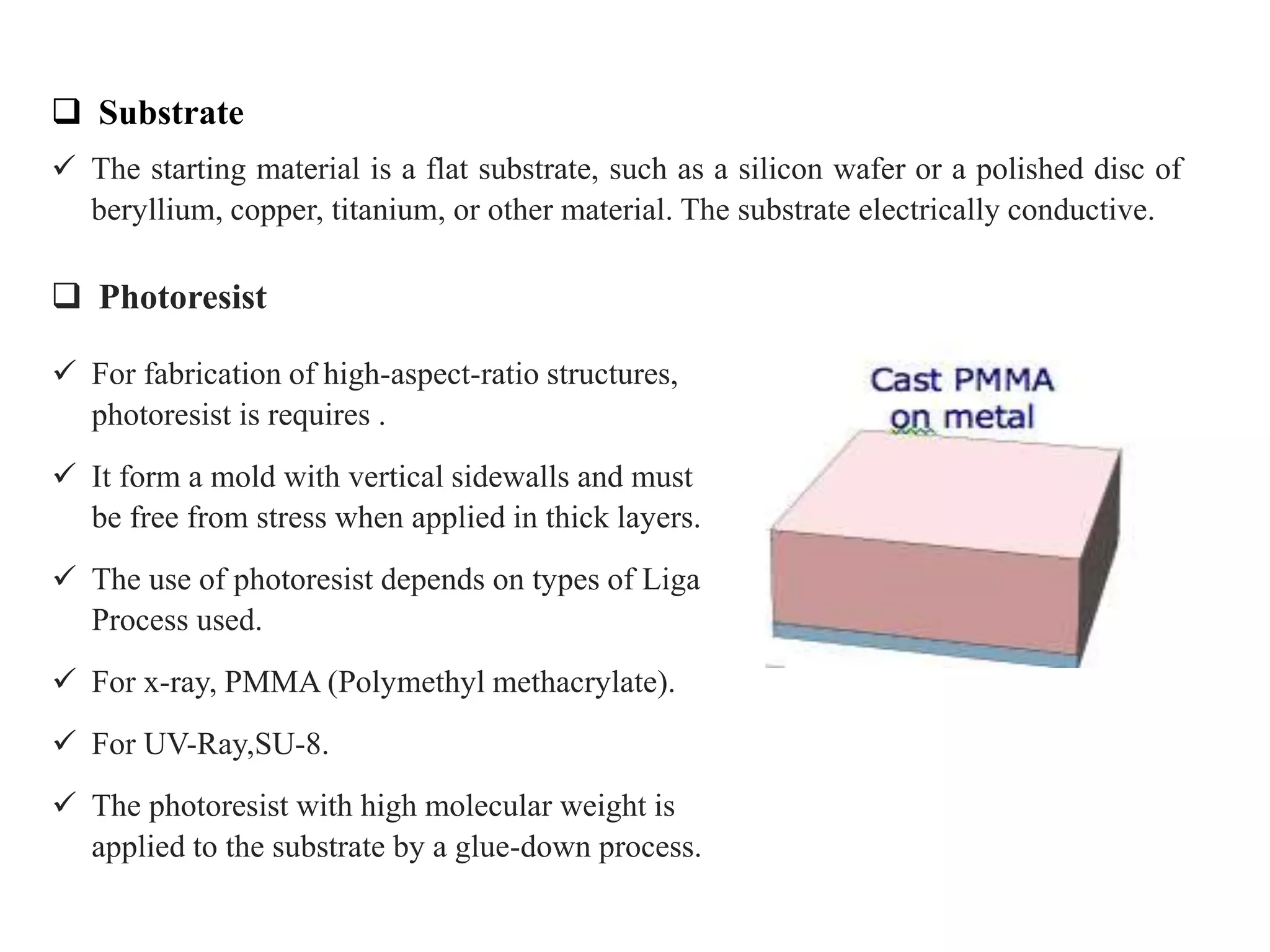
 For fabrication of high-aspect-ratio structures,
photoresist is requires .
 It form a mold with vertical sidewalls and must
be free from stress when applied in thick layers.
 The use of photoresist depends on types of Liga
Process used.
 For x-ray, PMMA (Polymethyl methacrylate).
 For UV-Ray,SU-8.
 The photoresist with high molecular weight is
applied to the substrate by a glue-down process.
 Photoresist
Photolithography,
diffraction limits resolution
E-beam lithography
(scattering,
proximity effect)
X-ray lithography,
little diffraction,
high depth of focus
Ion beam lithography,
low penetration depth
(very thin resist)
10
Lithographies
 X-rays having wavelengths of 0.4 A° to 5 A° represent radiation source for high-
resolution design reproduction into polymeric resist materials.
 X-ray lithography was first demonstrated to obtain high-resolution designs using X-
ray proximity printing by Spears and Smith.
 X-ray lithography can be extended optical resolution of 15 nm.
 Essential elements in X-ray lithography
 A mask consisting of a pattern made with an X-ray absorbing material on a thin X-ray
transparent membrane.
 An X-ray source of sufficient brightness.
 An X-ray sensitive resist material.
“It is a process used in microfabrication to pattern parts of a thin film or the bulk of
a substrate. It uses light to transfer a geometric pattern from a photomask to a light-
sensitive chemical "photoresist" on the substrate”.
X- Ray Lithography
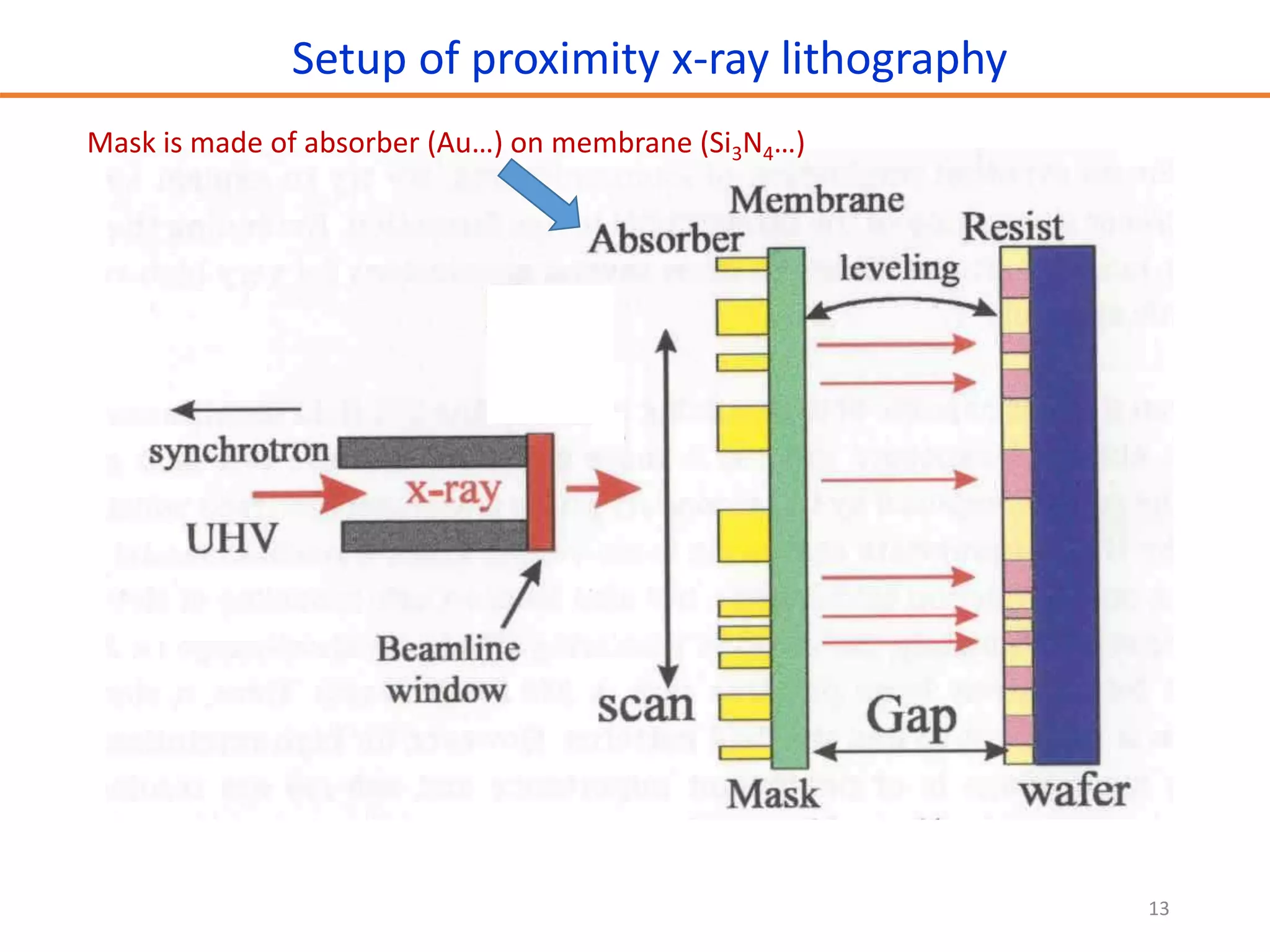
 The X-rays illuminate a mask placed in proximity of a resist-coated
wafer.
 The X-rays are typically from synchrotron radiation source,
allowing rapid exposure.
 X-ray lithography is expensive, because of the expense of
operating a synchrotron. The actual operating expenses without
considering the initial investment of tens-of-millions of dollars.
Therefore, the LIGA process was developed to reduce the
dependency on a synchrotron.
 Roentgen discovered an X-ray in 1895 (X-ray).
Wilhelm Conrad
Roentgen (1845-1923)
Setup of proximity x-ray lithography
Mask is made of absorber (Au…) on membrane (Si3N4…)
13
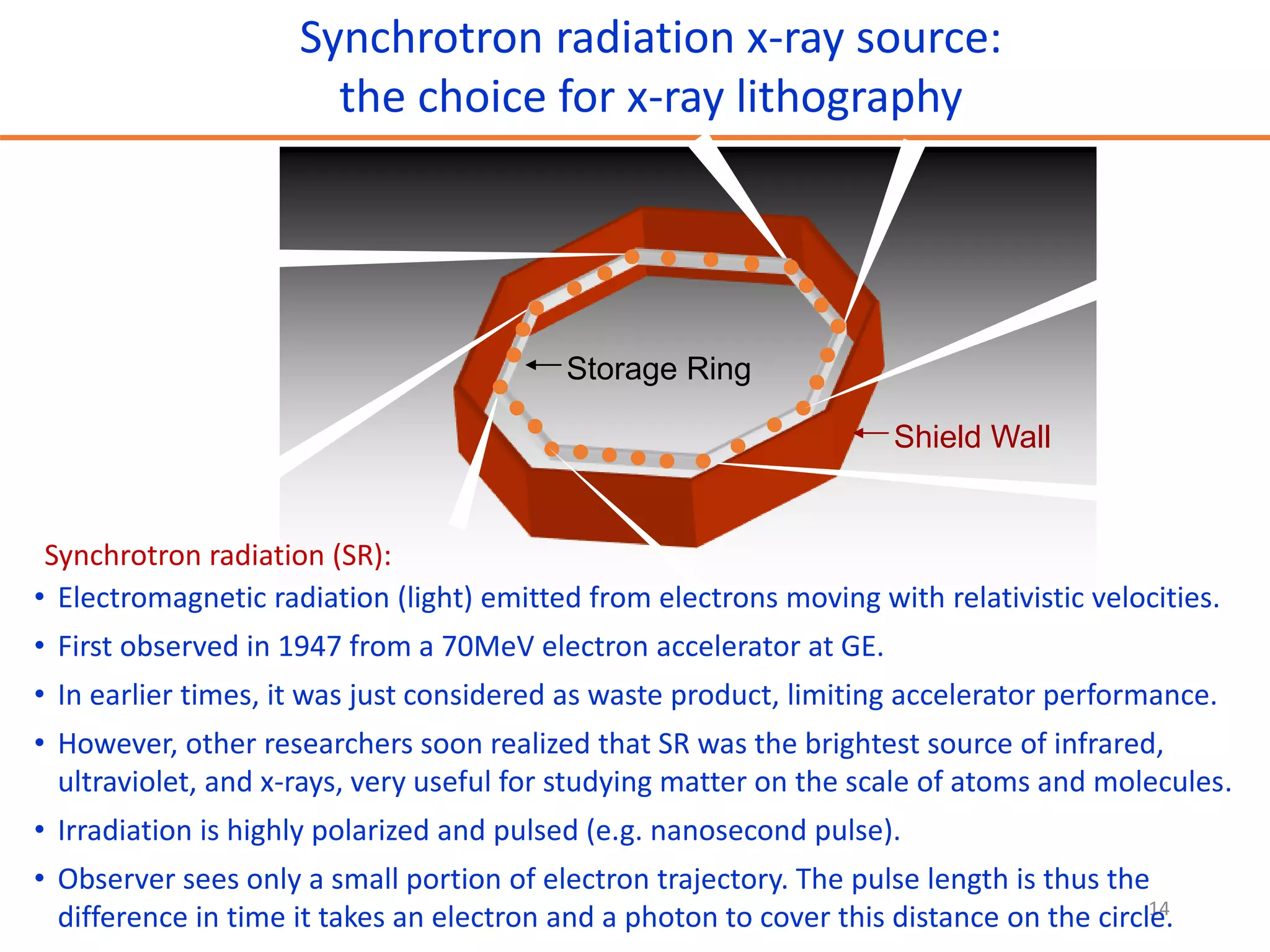
Synchrotron radiation x-ray source:
the choice for x-ray lithography
14
Shield Wall
Storage Ring
Synchrotron radiation (SR):
• Electromagnetic radiation (light) emitted from electrons moving with relativistic velocities.
• First observed in 1947 from a 70MeV electron accelerator at GE.
• In earlier times, it was just considered as waste product, limiting accelerator performance.
• However, other researchers soon realized that SR was the brightest source of infrared,
ultraviolet, and x-rays, very useful for studying matter on the scale of atoms and molecules.
• Irradiation is highly polarized and pulsed (e.g. nanosecond pulse).
• Observer sees only a small portion of electron trajectory. The pulse length is thus the
difference in time it takes an electron and a photon to cover this distance on the circle.
15
How synchrotron radiation works?
3
)GeV(
)m(559.0
)nm(
E
r
c 
• Typically a low-energy accelerator injects “bunches” of electrons into a
storage ring; the charged particle are in pico-second pulses spaced
nanoseconds apart.
• Acceleration is produced by an alternating (RF – radio frequency) electric
field that is in synchronism with orbital frequency.
• A broad continuum of radiation is emitted by each bunch when it changes
direction, with the median (or “critical”) wavelength given by
Bending magnet:
For normal-conductive B1.5 Tesla.
“C” shaped allowing radiation to exit
Straight line
Bend and
emit when
passing a
magnet
Accelerated
here
16
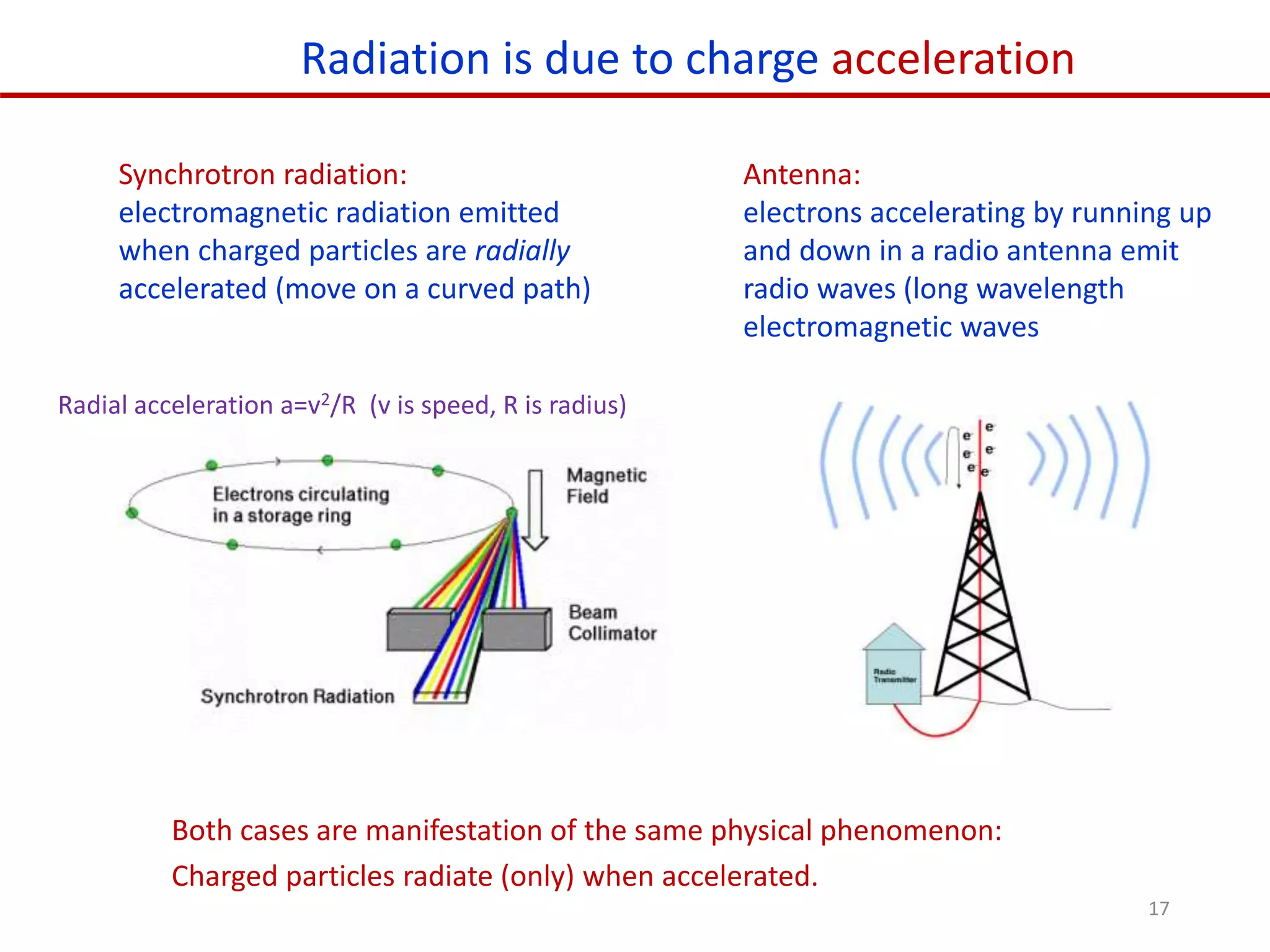
Radiation is due to charge acceleration
Synchrotron radiation:
electromagnetic radiation emitted
when charged particles are radially
accelerated (move on a curved path)
Antenna:
electrons accelerating by running up
and down in a radio antenna emit
radio waves (long wavelength
electromagnetic waves
Both cases are manifestation of the same physical phenomenon:
Charged particles radiate (only) when accelerated.
Radial acceleration a=v2/R (v is speed, R is radius)
17
Cone aperture
~ 1/g
Synchrotron radiation angular distribution
No radiation along acceleration direction.
Strongest radiation at perpendicular direction.
p: power
a: acceleration
: spherical angle
18
Bending Magnet
1.24nm
Spectrum of synchrotron radiation (bending magnet)
Electron rest energy=mc2=(9.110-31)(3108)2=8.1910-14J=0.511MeV (very small).
Total electron energy=gmc2, with g=1/(1-v2/c2)1/2.
For 1.0GeV energy, g=1000/0.511=1957, so v/c=0.99999987, indeed v is very close to c.
(critical energy)
19
Undulator radiation: Doppler shift to nm wavelength
Synchrotron radiation from relativistic electrons
In the frame moving with the electron, electron “sees” a periodic magnet structure moving toward it
with a relativistically contracted period ’=u/g (u is magnet period, g1/(1-2)1/2, v/c)
The frequency of this emitted radiation is f’=c/’=cg/u.
To the observer, the relativistic form of Doppler frequency formula is: f=f’/(g(1-))=c/(u(1-
))2g2c/u. (for 1, 1-1/2g2)
So the observed wavelength is: =c/f= u /2g2.
E.g, for 1.9GeV, g=1900/0.511=3718; with u =5cm, gives =1.8nm (x-ray).
You can try to understand the following calculation if interested. It won’t be included in exams.
20
Advantages of synchrotrons for X-ray lithography
• Extremely high intensity.
• Extremely high brilliance - small effective source size
situated a long distance from the experimental station.
• Very low divergence out of the plane of storage ring.
• Tunable, specific energies can be chosen.
• Highly polarized and short pulses.
• It offers many characteristics of visible lasers but into
the x-ray regime: partial coherence, high stability.
21
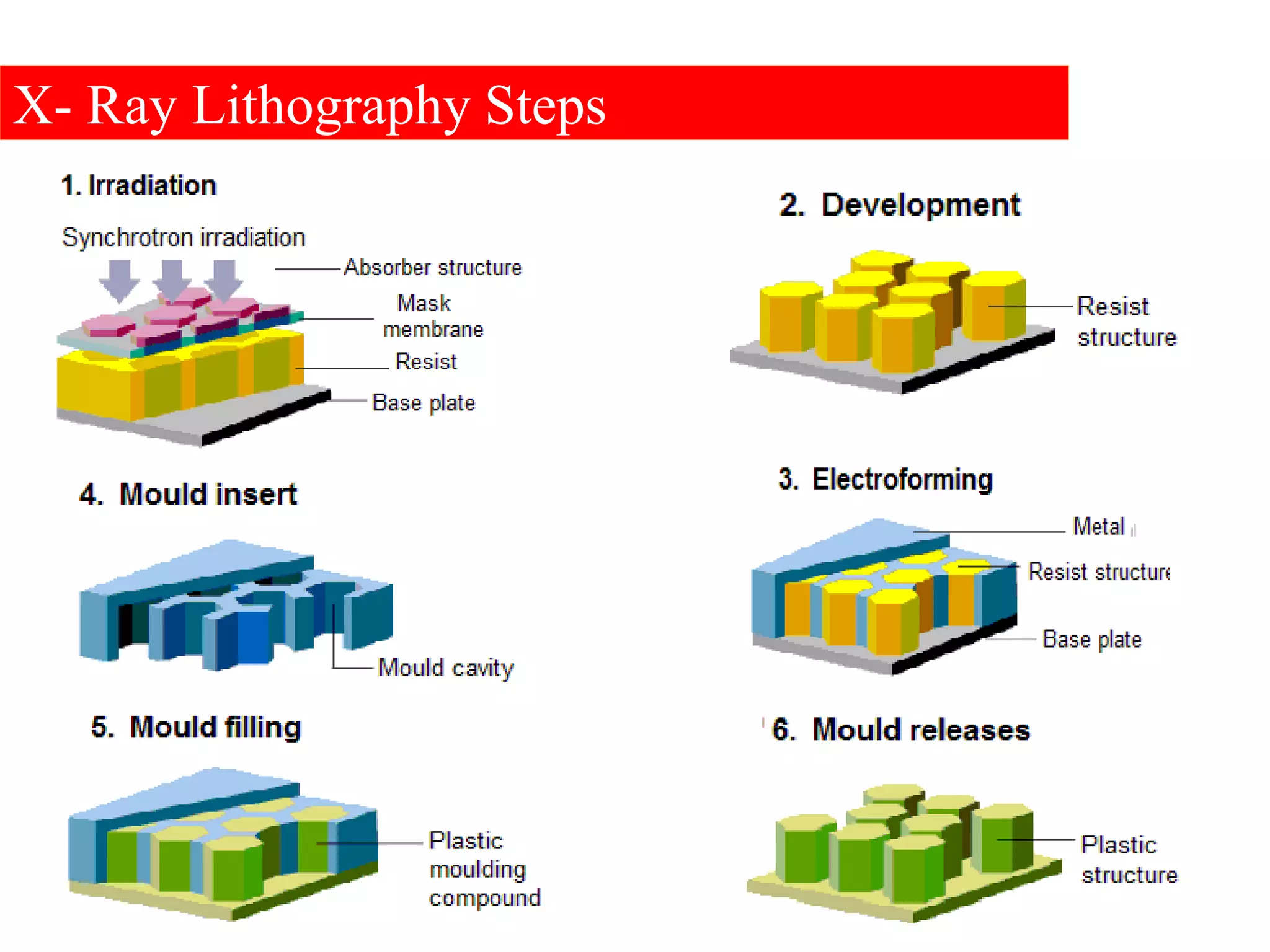
X- Ray Lithography Steps
1. Irradiation:
The first step in x- ray lithography is irradiation which involves exposing a thick layer of
resist to high-energy beam of x-rays from a synchrotron. The mask membrane is normally a
low atomic number material such as diamond, beryllium, or a thin membrane of a higher
atomic number material such as silicon or silicon carbide.
2. Development:
In this step the pattern is etched into the resist substrate by the use of x- rays.
3. Electroforming:
Electroforming is the same as electroplating. Electroforming suggests that the plating is
used to create an actual metal component.
X- Ray Lithography Steps Cont.
4. Mould insert:
A chemical solvent PMMA (poly methyl methacrylate) C5O2H8 is used to dissolve
material, resulting model of the mask pattern. After removal of the resist, a freestanding
metal structure is produced.
5. Mould filling:
The metal structure may be a final product, or serve as a mold insert for precision plastic
moulding.
6. Mould releases:
The plastic mold retains the same shape, size, and form as the original resist structure but
is produced quickly. Moulded plastic parts may then be final product.
X- Ray Lithography Steps Cont.
 Short wavelength from X-rays 0.4-4 nm
 No diffraction effect
 Simple to use
 No lens
 Faster than EBL
 Uniform refraction pattern
 High resolution for small feature size
 Thin lens
 Distortion in absorber
 Cannot be focused through lens
 Masks are expensive to produce
Advantage and Disadvantage of X-Ray Lithography
Advantages Disadvantage
LIGA Process

LIGA Process

  • 1.
  • 2.
    LIGA is aGerman acronym for, Lithographie Lithography Galvanoformung Electroplating Abformung Molding Introduction The MEMS micromachining process known as LIGA utilizes the following three fabrication process steps LIGA fabrication is used to create high-aspect ratio structures through the use of x- rays produced by a synchrotron or relatively low aspect ratio structures through the use of UV (ultraviolet) light.
  • 3.
     The LIGAprocess involves the following steps:  l. A very thick (up to hundreds of microns) resist layer of polymethylmethacrylate (PMMA) is deposited onto a primary substrate.  2. The PMMA is exposed to columnated X-rays and is developed.  3. Metal is electrodeposited onto the primary substrate.  4. The PMMA is removed or stripped, resulting in a freestanding metal structure.  5. Plastic injection molding takes place.  The LIGA-fabrication process is composed of: 1. Exposure, 2. Development 3. Electroforming 4. Stripping 5. Replication LIGA Micromaching Process
  • 4.
    LIGA Micromaching Process Step-1 Coatthick photoresist (300 m to > 500 m) on a substrate with an electrically conductive surface. Step-2:- Irradiation X-ray lithography with extended exposure from highly collimated X-radiation to penetrate thick Resist with well- defined sidewalls. Irradiation involves exposing a thick layer of resist to high-energy beam of x-rays from a synchrotron. The mask membrane is normally a low atomic number material such as diamond, beryllium, or a thin membrane of a higher atomic number material such as silicon or silicon carbide.
  • 5.
    LIGA Micromaching Process Step-3:Development In this step the pattern is etched into the resist substrate by the use of x- rays and desired structure are formed. Step-4: Electroforming Metal electroplated on the exposed conductive substrate surface. Electroforming is the same as electroplating. Electroforming suggests that the plating is used to create an actual metal component
  • 6.
    Step-5 After photoresist removal,metal structure formed may be used as mold. Sacrificial techniques are combined with the basic LIGA process to create partially freed, flexure-suspended structure or completely freed devices. LIGA Micromaching Process
  • 7.
  • 8.
    Masks can beof different types.  Mask created by electron beam lithography. (4 µm thick)  Plated photomask which provides.(3 µm)  Direct photomask, which provides. (80 µm thick)  Masks Component for LIGA Process  Masks are composed of a transparent, low-Atomic number carrier, a patterned high-Atomic number absorber, and a metallic ring for alignment and heat removal.  Carriers are fabricated from materials with high thermal conductivity to reduce thermal gradients. Ex: Vitreous carbon and graphite, Silicon, silicon nitride, titanium, and diamond.  Absorbers are gold, nickel, copper, tin, lead, and other X-ray absorbing metals.
  • 9.
     The startingmaterial is a flat substrate, such as a silicon wafer or a polished disc of beryllium, copper, titanium, or other material. The substrate electrically conductive.  Substrate  For fabrication of high-aspect-ratio structures, photoresist is requires .  It form a mold with vertical sidewalls and must be free from stress when applied in thick layers.  The use of photoresist depends on types of Liga Process used.  For x-ray, PMMA (Polymethyl methacrylate).  For UV-Ray,SU-8.  The photoresist with high molecular weight is applied to the substrate by a glue-down process.  Photoresist
  • 10.
    Photolithography, diffraction limits resolution E-beamlithography (scattering, proximity effect) X-ray lithography, little diffraction, high depth of focus Ion beam lithography, low penetration depth (very thin resist) 10 Lithographies
  • 11.
     X-rays havingwavelengths of 0.4 A° to 5 A° represent radiation source for high- resolution design reproduction into polymeric resist materials.  X-ray lithography was first demonstrated to obtain high-resolution designs using X- ray proximity printing by Spears and Smith.  X-ray lithography can be extended optical resolution of 15 nm.  Essential elements in X-ray lithography  A mask consisting of a pattern made with an X-ray absorbing material on a thin X-ray transparent membrane.  An X-ray source of sufficient brightness.  An X-ray sensitive resist material. “It is a process used in microfabrication to pattern parts of a thin film or the bulk of a substrate. It uses light to transfer a geometric pattern from a photomask to a light- sensitive chemical "photoresist" on the substrate”. X- Ray Lithography
  • 12.
     The X-raysilluminate a mask placed in proximity of a resist-coated wafer.  The X-rays are typically from synchrotron radiation source, allowing rapid exposure.  X-ray lithography is expensive, because of the expense of operating a synchrotron. The actual operating expenses without considering the initial investment of tens-of-millions of dollars. Therefore, the LIGA process was developed to reduce the dependency on a synchrotron.  Roentgen discovered an X-ray in 1895 (X-ray). Wilhelm Conrad Roentgen (1845-1923)
  • 13.
    Setup of proximityx-ray lithography Mask is made of absorber (Au…) on membrane (Si3N4…) 13
  • 14.
    Synchrotron radiation x-raysource: the choice for x-ray lithography 14 Shield Wall Storage Ring Synchrotron radiation (SR): • Electromagnetic radiation (light) emitted from electrons moving with relativistic velocities. • First observed in 1947 from a 70MeV electron accelerator at GE. • In earlier times, it was just considered as waste product, limiting accelerator performance. • However, other researchers soon realized that SR was the brightest source of infrared, ultraviolet, and x-rays, very useful for studying matter on the scale of atoms and molecules. • Irradiation is highly polarized and pulsed (e.g. nanosecond pulse). • Observer sees only a small portion of electron trajectory. The pulse length is thus the difference in time it takes an electron and a photon to cover this distance on the circle.
  • 15.
  • 16.
    How synchrotron radiationworks? 3 )GeV( )m(559.0 )nm( E r c  • Typically a low-energy accelerator injects “bunches” of electrons into a storage ring; the charged particle are in pico-second pulses spaced nanoseconds apart. • Acceleration is produced by an alternating (RF – radio frequency) electric field that is in synchronism with orbital frequency. • A broad continuum of radiation is emitted by each bunch when it changes direction, with the median (or “critical”) wavelength given by Bending magnet: For normal-conductive B1.5 Tesla. “C” shaped allowing radiation to exit Straight line Bend and emit when passing a magnet Accelerated here 16
  • 17.
    Radiation is dueto charge acceleration Synchrotron radiation: electromagnetic radiation emitted when charged particles are radially accelerated (move on a curved path) Antenna: electrons accelerating by running up and down in a radio antenna emit radio waves (long wavelength electromagnetic waves Both cases are manifestation of the same physical phenomenon: Charged particles radiate (only) when accelerated. Radial acceleration a=v2/R (v is speed, R is radius) 17
  • 18.
    Cone aperture ~ 1/g Synchrotronradiation angular distribution No radiation along acceleration direction. Strongest radiation at perpendicular direction. p: power a: acceleration : spherical angle 18
  • 19.
    Bending Magnet 1.24nm Spectrum ofsynchrotron radiation (bending magnet) Electron rest energy=mc2=(9.110-31)(3108)2=8.1910-14J=0.511MeV (very small). Total electron energy=gmc2, with g=1/(1-v2/c2)1/2. For 1.0GeV energy, g=1000/0.511=1957, so v/c=0.99999987, indeed v is very close to c. (critical energy) 19
  • 20.
    Undulator radiation: Dopplershift to nm wavelength Synchrotron radiation from relativistic electrons In the frame moving with the electron, electron “sees” a periodic magnet structure moving toward it with a relativistically contracted period ’=u/g (u is magnet period, g1/(1-2)1/2, v/c) The frequency of this emitted radiation is f’=c/’=cg/u. To the observer, the relativistic form of Doppler frequency formula is: f=f’/(g(1-))=c/(u(1- ))2g2c/u. (for 1, 1-1/2g2) So the observed wavelength is: =c/f= u /2g2. E.g, for 1.9GeV, g=1900/0.511=3718; with u =5cm, gives =1.8nm (x-ray). You can try to understand the following calculation if interested. It won’t be included in exams. 20
  • 21.
    Advantages of synchrotronsfor X-ray lithography • Extremely high intensity. • Extremely high brilliance - small effective source size situated a long distance from the experimental station. • Very low divergence out of the plane of storage ring. • Tunable, specific energies can be chosen. • Highly polarized and short pulses. • It offers many characteristics of visible lasers but into the x-ray regime: partial coherence, high stability. 21
  • 22.
  • 23.
    1. Irradiation: The firststep in x- ray lithography is irradiation which involves exposing a thick layer of resist to high-energy beam of x-rays from a synchrotron. The mask membrane is normally a low atomic number material such as diamond, beryllium, or a thin membrane of a higher atomic number material such as silicon or silicon carbide. 2. Development: In this step the pattern is etched into the resist substrate by the use of x- rays. 3. Electroforming: Electroforming is the same as electroplating. Electroforming suggests that the plating is used to create an actual metal component. X- Ray Lithography Steps Cont.
  • 24.
    4. Mould insert: Achemical solvent PMMA (poly methyl methacrylate) C5O2H8 is used to dissolve material, resulting model of the mask pattern. After removal of the resist, a freestanding metal structure is produced. 5. Mould filling: The metal structure may be a final product, or serve as a mold insert for precision plastic moulding. 6. Mould releases: The plastic mold retains the same shape, size, and form as the original resist structure but is produced quickly. Moulded plastic parts may then be final product. X- Ray Lithography Steps Cont.
  • 25.
     Short wavelengthfrom X-rays 0.4-4 nm  No diffraction effect  Simple to use  No lens  Faster than EBL  Uniform refraction pattern  High resolution for small feature size  Thin lens  Distortion in absorber  Cannot be focused through lens  Masks are expensive to produce Advantage and Disadvantage of X-Ray Lithography Advantages Disadvantage