 Development of this photolithography method lies
in the mid 1980s
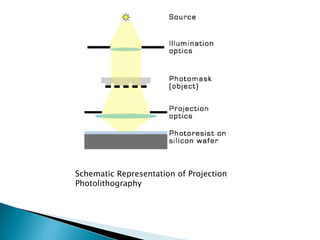
 There is some distance held between mask and
the wafer
 An Optical System is inserted for focusing the
image of mask on wafer
 Not a single-step exposure
 Three Types of projection printing
Schematic Representation of Projection
Photolithography
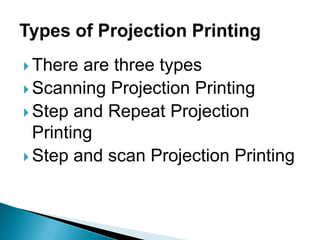
 There are three types
 Scanning Projection Printing
 Step and Repeat Projection
Printing
 Step and scan Projection Printing
 Wafer and the mask are in motion rather than
moving optical system which is quite difficult.
 Advantage: uses the best zone of optics
 No reduction of the mask
 Mask must has same dimensions as the
whole pattern to be reproduced on the wafer
 Fabrication of mask becomes delicate and
costly
 Alignment accuracy is also hard to improve
because of mechanical motion
 Division of the pattern to be reproduced on
the wafer in to identical exposure fields
 Mask contains elementary pattern
 Once the mask has been exposed on the
wafer, the latter is shifted along and the
operation is repeated on the neighbouring
field
 This process continues until the whole row of
stepper fields has been exposed
 Reduction of mask size
 Bigger will be the pattern on mask
 Ease of fabrication and great reduction of
cost
 Since the field of projection is constant so the
more repetitions are required to cover the
whole wafer
 Therefore, more time will be consumed.
 Before each projection realignment of the
system is necessary so this also increases the
time factor
 Slower than the previous technique.
 Despite this drawback, this technique
replaces the scanning projection printing at
the beginning of 1990s because of
superiority in terms of resolution and
allignment
 Mask is scanned by the optical system
 And wafer is moved so as to expose the next
field
 Best results are obtained by this technique.
 In promixity lithography resolution is
diffraction limited
 However in this technique we are dealing with
Fraunhofer diffraction
 Theory of plane waves is applicable therefore.
 A very important parameter arises aperture
 Angle made by the diffracted beams
increases with the order of diffraction
 Optical information lies in these orders
 Greater will be the aperture the more
complete will be the information gathered
 And we can get better resolution in this way
 Numerical Aperture of a lens is defined as
N.A.=nsini
 Minimal separation between two objects
imaged by a lens is given by Rayleigh
Criterion
Lmin= (0.61)λ/N.A.
 This formula works for waves without spatial
coherence
 In reality light used in photolithorgraphy is
partially coherent so numerical prefactor in
rayleigh formula is closer to 0.5 than 0.61
 Lens should not have defects and causes no
aberration and also light is perfectly
homogeneous.
 In real world these requirements can never be
fully satisfied, and we must introduce a factor
k so
Lmin= kλ/N.A.
 Wavelength reduction and enhancement of
resolution
 Problem associated with wavelength
reduction
 Off-axis Illumination
 Proximity Optical Correction
 Phase-shift Mask
 Surface Techniques
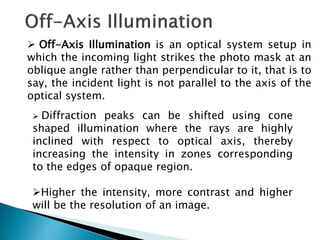
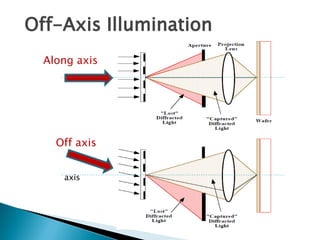
 Off-Axis Illumination is an optical system setup in
which the incoming light strikes the photo mask at an
oblique angle rather than perpendicular to it, that is to
say, the incident light is not parallel to the axis of the
optical system.
 Diffraction peaks can be shifted using cone
shaped illumination where the rays are highly
inclined with respect to optical axis, thereby
increasing the intensity in zones corresponding
to the edges of opaque region.
Higher the intensity, more contrast and higher
will be the resolution of an image.
axis
Off axis
Along axis
Off-Axis Illumination
 proximity Optical correction (POC) is
a photolithography enhancement technique
commonly used to compensate for image
errors due to diffraction or process effects.
 Sharp features are lost because higher spatial
frequencies are lost due to diffraction.
 Proximity Optical Correction corrects these errors
by moving edges or adding extra polygons to the
pattern written on the photo mask.
 This improves the resolution by decreasing k1
Photo-mask Pattern for negative resist
Proximity Optical Correction
 Phase-shift masks are photo masks that
take advantage of the interference
generated by phase differences to
improve image resolution in
Photolithography.
 PSM changes the phase of light by 180o in
adjacent pattern, leading to destructive
interference rather than constructive
interference.
 Improves the contrast of Aerial image on
wafer. Making K1 smaller.
Constructive interference
Destructive interference
Reduced contrast Reduced line-width
Improved contrast, higher resolution
(HP)
 The radiation is used to modify the resist
surface alone.
 Problems associated with diffraction in the
resist itself and reflection of the substrate is
avoided.
 Modified resist is used as a mask.
 Projection photolithography:
o Scanning Projection printing
o Step & Repeat Projection printing
o Step & Scan (Hybrid) Projection Printing
 No damage to mask compared to contact
lithography
 High Resolution compared to proximity
lithography
 Low production cost
 Easy to produce pattern of smaller
dimensions
 Mask fabrication convenient due to larger
dimensions
 Improved production (mass production)
 Smaller resolution and larger depth of field
(DOF) is desired
 Resolution is improved at the expense of DOF
 Decresaing ‘k’ alone causes decrease in
process yield
 Decreasing wavelength and increasing N.A
yields good resolution
 Features smaller than 100nm can now be
achieved on production line
 STEP & SCAN MACHINE SPECS:
 Magnification: X4
 N.A. =0.63
 Field: 26x33 mm
 Alignment: 45nm
 Production rate: 45 wafer/hr
Projection photolithography

Projection photolithography

  • 2.
     Development ofthis photolithography method lies in the mid 1980s  There is some distance held between mask and the wafer  An Optical System is inserted for focusing the image of mask on wafer  Not a single-step exposure  Three Types of projection printing
  • 3.
    Schematic Representation ofProjection Photolithography
  • 4.
     There arethree types  Scanning Projection Printing  Step and Repeat Projection Printing  Step and scan Projection Printing
  • 5.
     Wafer andthe mask are in motion rather than moving optical system which is quite difficult.  Advantage: uses the best zone of optics  No reduction of the mask  Mask must has same dimensions as the whole pattern to be reproduced on the wafer  Fabrication of mask becomes delicate and costly  Alignment accuracy is also hard to improve because of mechanical motion
  • 6.
     Division ofthe pattern to be reproduced on the wafer in to identical exposure fields  Mask contains elementary pattern  Once the mask has been exposed on the wafer, the latter is shifted along and the operation is repeated on the neighbouring field  This process continues until the whole row of stepper fields has been exposed
  • 7.
     Reduction ofmask size  Bigger will be the pattern on mask  Ease of fabrication and great reduction of cost  Since the field of projection is constant so the more repetitions are required to cover the whole wafer  Therefore, more time will be consumed.
  • 8.
     Before eachprojection realignment of the system is necessary so this also increases the time factor  Slower than the previous technique.  Despite this drawback, this technique replaces the scanning projection printing at the beginning of 1990s because of superiority in terms of resolution and allignment
  • 9.
     Mask isscanned by the optical system  And wafer is moved so as to expose the next field  Best results are obtained by this technique.
  • 10.
     In promixitylithography resolution is diffraction limited  However in this technique we are dealing with Fraunhofer diffraction  Theory of plane waves is applicable therefore.  A very important parameter arises aperture  Angle made by the diffracted beams increases with the order of diffraction  Optical information lies in these orders
  • 11.
     Greater willbe the aperture the more complete will be the information gathered  And we can get better resolution in this way  Numerical Aperture of a lens is defined as N.A.=nsini  Minimal separation between two objects imaged by a lens is given by Rayleigh Criterion Lmin= (0.61)λ/N.A.  This formula works for waves without spatial coherence
  • 12.
     In realitylight used in photolithorgraphy is partially coherent so numerical prefactor in rayleigh formula is closer to 0.5 than 0.61  Lens should not have defects and causes no aberration and also light is perfectly homogeneous.  In real world these requirements can never be fully satisfied, and we must introduce a factor k so Lmin= kλ/N.A.
  • 13.
     Wavelength reductionand enhancement of resolution  Problem associated with wavelength reduction
  • 14.
     Off-axis Illumination Proximity Optical Correction  Phase-shift Mask  Surface Techniques
  • 15.
     Off-Axis Illuminationis an optical system setup in which the incoming light strikes the photo mask at an oblique angle rather than perpendicular to it, that is to say, the incident light is not parallel to the axis of the optical system.  Diffraction peaks can be shifted using cone shaped illumination where the rays are highly inclined with respect to optical axis, thereby increasing the intensity in zones corresponding to the edges of opaque region. Higher the intensity, more contrast and higher will be the resolution of an image.
  • 16.
  • 17.
     proximity Opticalcorrection (POC) is a photolithography enhancement technique commonly used to compensate for image errors due to diffraction or process effects.  Sharp features are lost because higher spatial frequencies are lost due to diffraction.
  • 18.
     Proximity OpticalCorrection corrects these errors by moving edges or adding extra polygons to the pattern written on the photo mask.  This improves the resolution by decreasing k1
  • 19.
    Photo-mask Pattern fornegative resist Proximity Optical Correction
  • 20.
     Phase-shift masksare photo masks that take advantage of the interference generated by phase differences to improve image resolution in Photolithography.  PSM changes the phase of light by 180o in adjacent pattern, leading to destructive interference rather than constructive interference.  Improves the contrast of Aerial image on wafer. Making K1 smaller.
  • 21.
    Constructive interference Destructive interference Reducedcontrast Reduced line-width Improved contrast, higher resolution (HP)
  • 22.
     The radiationis used to modify the resist surface alone.  Problems associated with diffraction in the resist itself and reflection of the substrate is avoided.  Modified resist is used as a mask.
  • 23.
     Projection photolithography: oScanning Projection printing o Step & Repeat Projection printing o Step & Scan (Hybrid) Projection Printing
  • 24.
     No damageto mask compared to contact lithography  High Resolution compared to proximity lithography  Low production cost  Easy to produce pattern of smaller dimensions  Mask fabrication convenient due to larger dimensions  Improved production (mass production)
  • 25.
     Smaller resolutionand larger depth of field (DOF) is desired  Resolution is improved at the expense of DOF  Decresaing ‘k’ alone causes decrease in process yield  Decreasing wavelength and increasing N.A yields good resolution
  • 26.
     Features smallerthan 100nm can now be achieved on production line  STEP & SCAN MACHINE SPECS:  Magnification: X4  N.A. =0.63  Field: 26x33 mm  Alignment: 45nm  Production rate: 45 wafer/hr