Medium Access
for Wireless Sensor
Network
C‹srJeton University
Presented by:
Mohamed Ajal
connectcarleton.
ca
mala
i
Topics o
3‘ Introduction
& Power consumption in WSN's
& Wireless MAC protocols
& Differences and Constraints
& Attributes to WSN
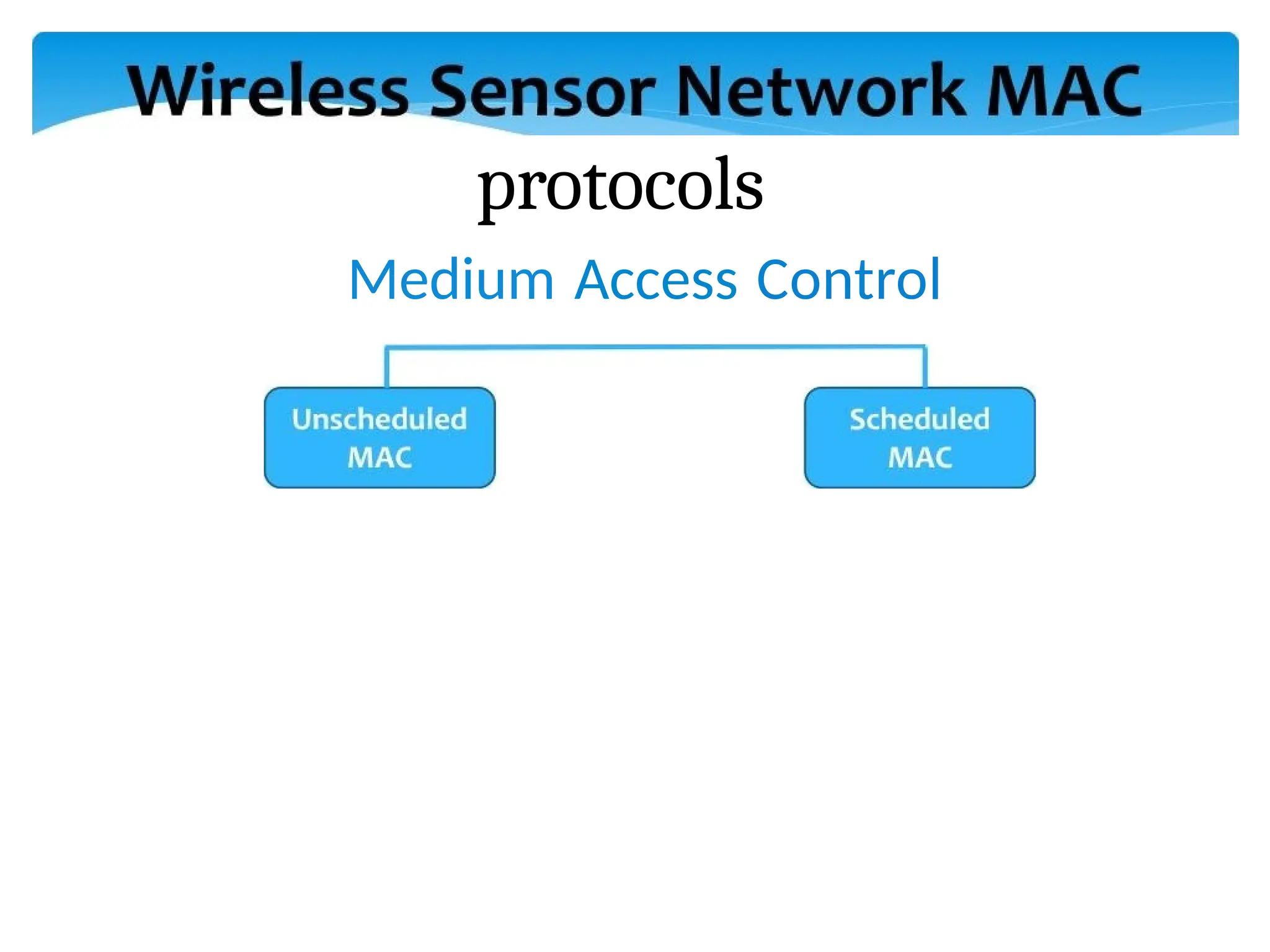
& Wireless Sensor network MAC protocols
‘ Summary
Wireless Sensor Network?
& It's a collection of devices “ sensor nodes”
& They are small, inexpensive, with constrained power
They are organized in a cooperative network
& They communicate wirelessly
in multi hop
routing
& Heavily deployment
4 Changing network
topology
mate Monltarlng
Component and Schematic of Node
Processor.
Memory.
RF
Radio.
Power Source.
Sensor.
Sensors
Signal
Processor
— Control
Processing
And
Jje pj$j ptt
M . k i . ,
.pe e
g
T«»«:t
ter/
Receiver
Goal of Wireless Sensor Network
Collect data at regular intervals.
Then transform data into an electrical signal.
Finally, send the signals to the sink or the base nod.
Types of Wireless Sensor Network
Temperature sensor.
Light sensor.
Sound sensor.
Vibration Sensor.
tensing Computing
Communication
Communication pattern:
Broadcast : Base station transmits message to all its immediate
neighbors.
Converge cast: a group of sensors communicates to a specific sensor
Local gossip: a sensor node sends a message to its neighboring nodes
within a range.
Applications of Wireless Sensor Network
& Global scale
& Battle field
& Factories
& Buildings
& Homes
P bodies
Buildings
Oh 8 Gas
Tanks
Water
The power consumption in WSN's is one of
the biggest challenges because:
Sensors have a limited source of power and it's hard to replace or
recharge “e.g sensors in the battle field, sensors in a large forest.. Etc”.
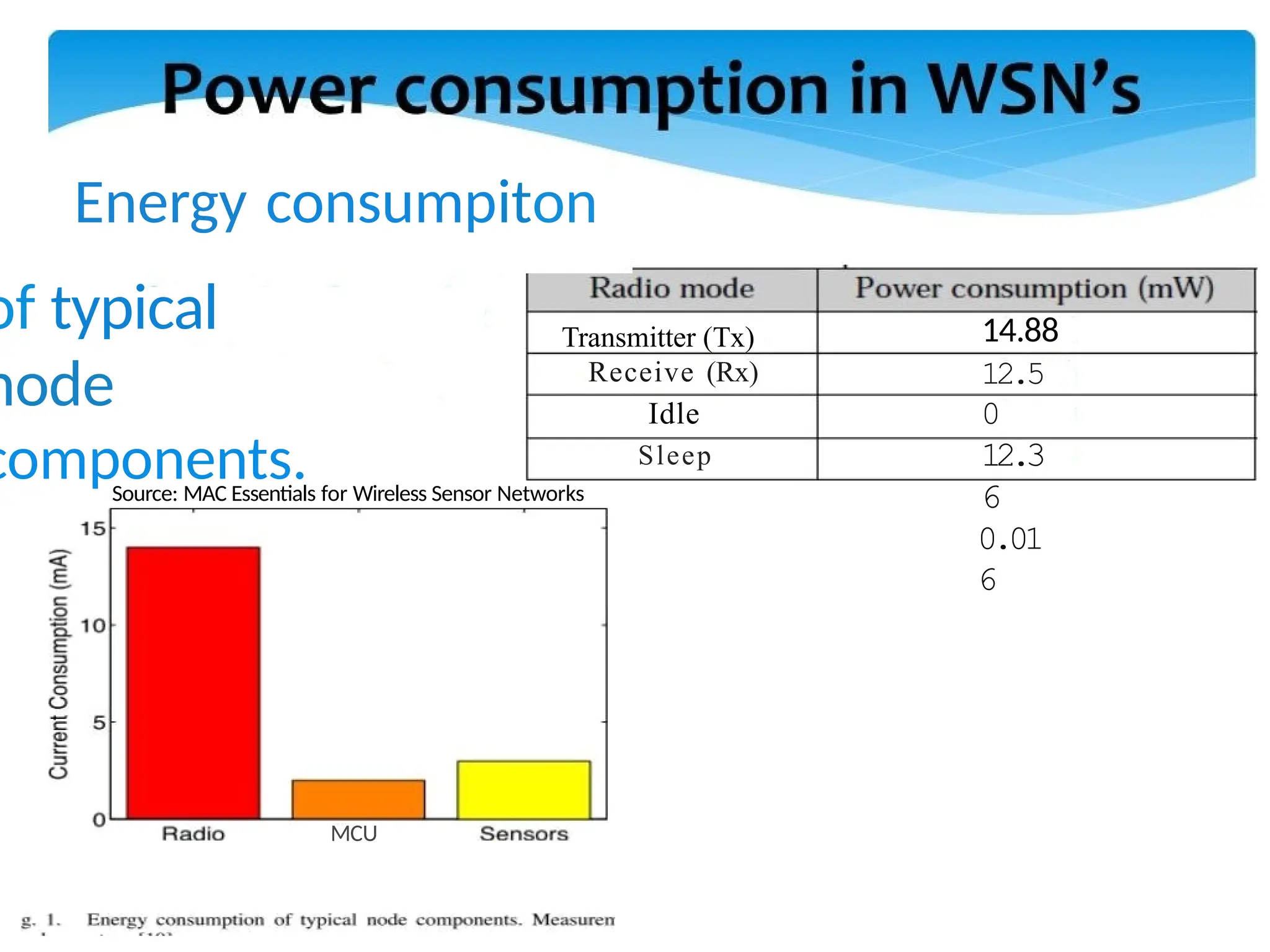
Energy consumpiton
of typical
node
components.
Transmitter (Tx)
Receive (Rx)
Idle
Sleep
Source: MAC Essentials for Wireless Sensor Networks
MCU
14.88
12.5
0
12.3
6
0.01
6
WSN's
1- useful power
consumption:
Transmitting or receiving data.
Processing queries requests.
Forwarding queries and data to the
neighbours.
WSN's Cont.
z- wasteful power consumption:
‘¥ Idle listening to the channel “waiting for possible traffic”.
Retransmitting because of collision: “e.g two packets arrived at the
same time at the same sensor”
Overhearing: when a sensor received a packet doesn't belong it”.
Generating and handling control packets.
How to minimize the energy consumption of
sensor nodes while meeting the application
requirements?
Use Protocols that aim mainly to increase the sleep periods as much as
possible
Hidden/Exposed terminal problem
Hidden terminal problem
•
•
•
B, A hear each other
B, C hear each other
A, C can not hear each other
means A, C unaware of their
interference at B
Conventional of MAC Protocols
1- CSMA :
Non Persistent: if the device detects activity on the channel, it
performs a back off by waiting before attempting to transmit.
P- Persistent: if it detects activity on the channel, it continuous to
sense the channel instead of delaying.
CSMA requires devices to remain in the receive state when not
transmitting
Disadvantages: the transceiver consumes energy too quickly.
2- CSVAJCA :
Control messages were introduced such as ( RTS and CTS) to
reserve
the channel
& The source first performs CSMA algorithm
If it determines appropriate time for transmission, it sends RTS
Then, the destination responds with CTS
Disadvantages: it might still have some collision in RTS
y-IEEE 802.11 :
v Infrastructure mode :devices communicate through a central entity called
an access point (AP) using the point coordination function (PCF),
Ad hoc mode: devices communicate with each other directly using the
distributed coordination function (DCF)
& Both the PCF and DCF use a channel access mechanism similar to CSMA/CA
and use acknowledgments for reliability.
"v In addition to physical carrier sensing, IEEE 802.11 devices perform virtual
carrier sensing “ NAV”
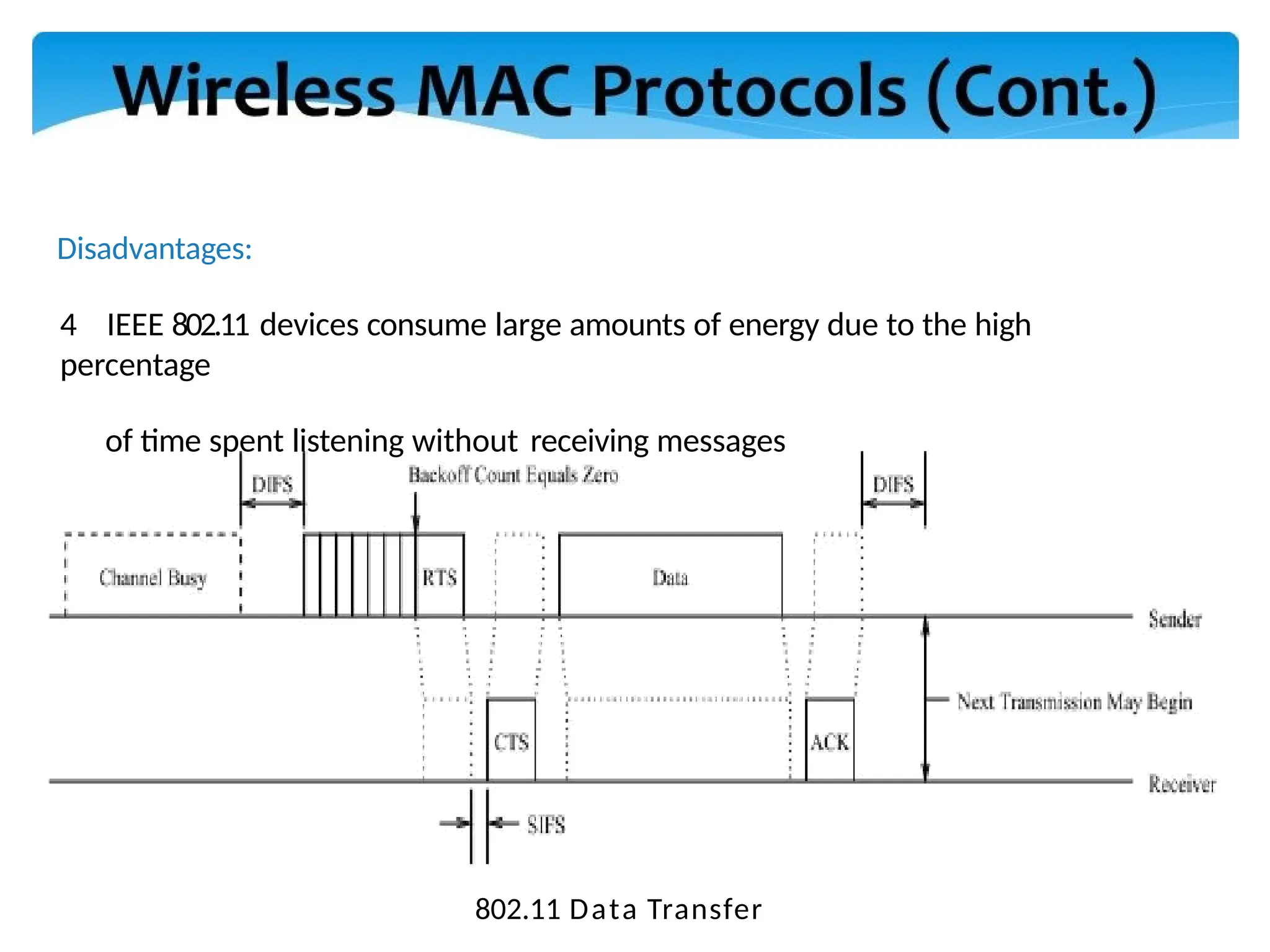
Disadvantages:
4 IEEE 802.11 devices consume large amounts of energy due to the high
percentage
of time spent listening without receiving messages
802.11 Data Transfer
Traditional MAC protocol provides:
High throughput
Low latency
Fairness
¥ Mobility But: have little consideration for energy
Improved MAC protocol provides:
Best performance of smallest amount of energy
The following attributes should be taken in WSN
Energy conservation
Scalability and adaptiveTy
6 throughput
Fairness
& Latency
MAC protocol must achieve
x Establish communication link between the sensor nodes
To share the communication medium fairly and efficiently
primary goal
less important
protocols
Medium Access Control
1- Unscheduled
MAC:
Strategy:
e Before sending a message, a sensor listens to the medium. If it's busy,
wait a random time then retry again and if it's free then it will send the
message.
Advantages:
It can adapt for changes “in the node density, traffic load or
the
topology” better than scheduled protocol.
The sensors don't have to be synchronized together.
Disadvantages:
& It's worst than scheduled MAC protocols from the power saving
perspective, since all sensors listen to the channel.
1.1- PAMASî stands for Power Aware
Multi-Access
Strategy : It uses multiple transceivers on each nOde
Advantages:
Prevent collision
Disadvantages:
Multiple radio requirement
‘X Increase energy consumption
'6 Increase device complexity and cost
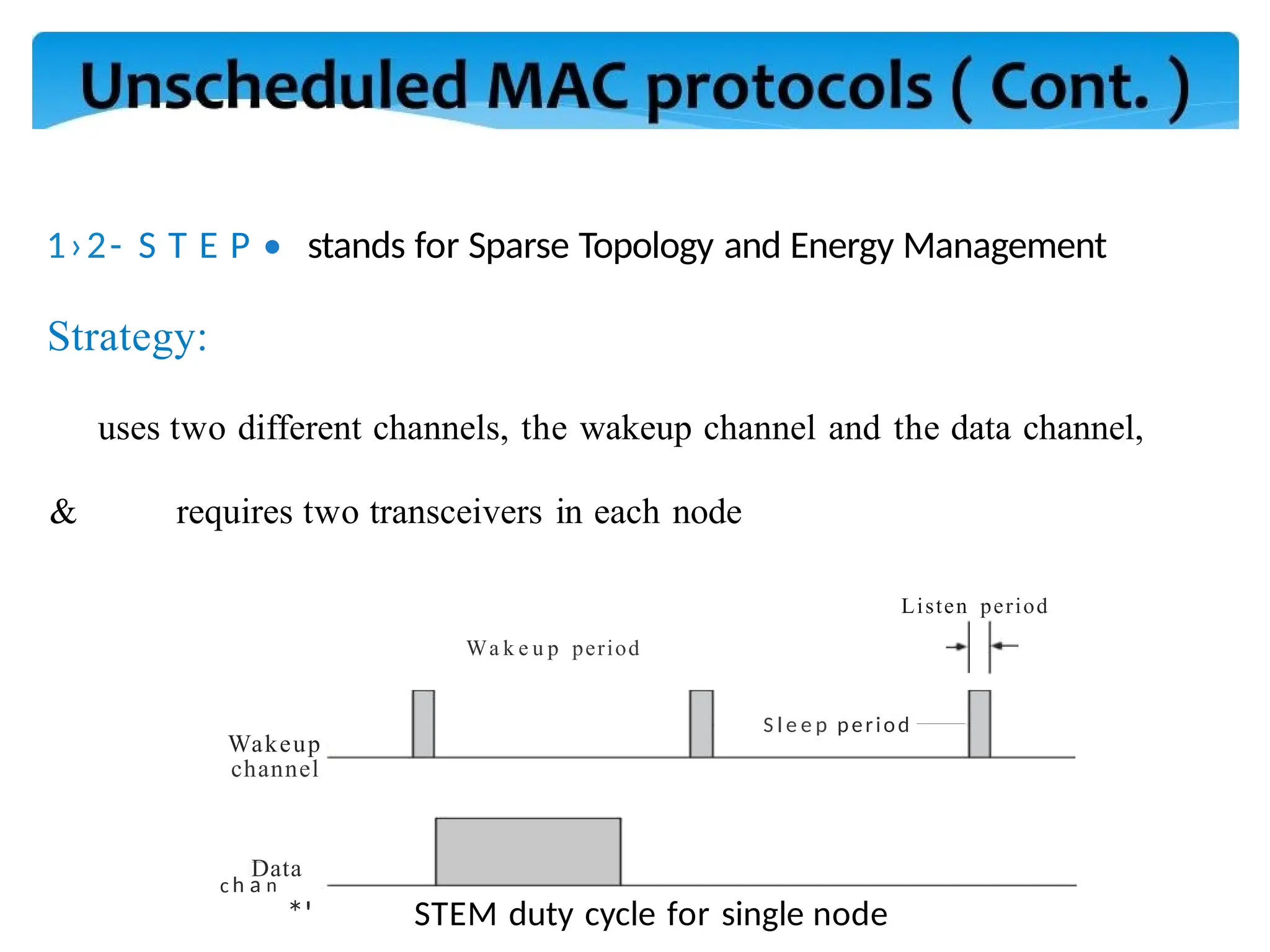
1›2- S T E P • stands for Sparse Topology and Energy Management
Strategy:
uses two different channels, the wakeup channel and the data channel,
& requires two transceivers in each node
Wakeup
channel
Data
c h a n
*'
Wa k e u p period
Listen period
S l e e p period
STEM duty cycle for single node
1.2.1- STEM-B:
Strategy : sensor nodes wakes a neighbour by transmitting a beacon
(no RTS/CTS )
advantages:
x Lower Latency
Disadvantages:
¥ More complex
High energy consumption
1.2.2- STEM-T:
Strategy : sensor nodes wakes a neighbour by transmitting a tone of
sufficient length that destination will have a high probability of sensing
Busy tone contains no destination address
Disadvantages:
High latency
k Results in overhearing
*
•
3 B-MAC:
Strategy :
& It uses a tone to wake up sleeping neighbouring similar to STEM-
T
6 It u5es very long preamble5 for message transmission.
B-MAC Data Yransfer
disadvantages:
B-MAC suffers from the overhearing problem
The long preamble dominates the energy usage.
1.g- Wise MAC:
Strategy : it uses similar technique in B-MAC but it attempt to reduce the
energy consumption by having sensor nodes remember the sampling offset
of their neighbour
Wise MAC Data Transfer
Rezeier
advantages:
It decreases the amount of time a sensor node transmits preambles and
the number of sensor nodes that overhear each message
Disadvantages:
'v the cost of an extra field in the ACK messages and the memory required
to store neighbor's sampling offsets.
2- Scheduled VAC:
Strategy : it attempts to reduce the energy consumption by coordinating
sensor nodes with a common schedule
Advantages:
Saving the power from being wasted by turning off the radio out the
allocated time slot.
Limits the collision, idle listing, and overhearing
Disadvantages:
when sensor node enters net, must wait till they learn, some delay exist
Cost of increased messages
Not flexible to changes in sensor density or movements.
Allsensorsshould bevvelsynchronized.
2.1 S-MAC:
Strategy :
the sensor node periodically goes to the fixed listen/sleep
cycle. A time frame in S MAC is divided into two parts: one for a
listening session and the other for a sleeping session.
Sleep Period
SYNC RTS CTS R«›d Data
ACK
^ SYNC RTS R••›6 ) C
T
S IJA1‘
A R
ece A
C
K
* e SYNC RTS CTS Sleep Period
S-MAC Frame Format
Disadvantages:
energy is still wasted in this protocol during listen period as the sensor
will be awake even if there is no reception/transmission.
Several MAC protocols has been introduced for both wireless network
and wireless sensor networks
All WSN MAC protocols are designed with the goal to conserve energy
There is no generic best MAC protocol
[1] K. Kredo II, P. Mohapatra, “Medium Access Control in Wireless Sensor
Networks”, in zg June zoo6.
[z] A. Bachir, M. Dohler, T. Watteyne, and K. Leung, “ MAC Essentials for
Wireless Sensor Networks, “in IEEE 2010.
E3J Salman Faiz Solehria, Sultanullah Jadoon, “ Medium Access Control
Protocol for Wireless Sensor Network —a Survey”, in IEEE 2010.
K. LANGENDOEN , “MEDIUM ACCESS CONTROL IN WIRELESS
SENSOR NETWORKS”.
Q1: Why IEEE 802.11 defines a SIFS shorter than a DIFS
*
ANS: SIFS (Short Inter Frame Spacing) has highest priority, for ACK, CTS,
polling response while DIFS (Distributed Inter Frame Spacing) has lowest
priority, for asynchronous data service. Having 'SIFS smaller than DIFS
prevents ACK and important control packets from getting killed.
DIFS
PIFS
SIFS
direct access
if medium is
free
DIFS
Q2: Suppose a device uses an 8oz.11 MAC protocol to reserve the communication channel before
transmitting. Suppose the device does sensing the channel and assumes the channel to be idle
and wants to transmit oooBytes of data. Assume the transmission rate is 1
1 Mbps. Calculate the
time required to transmit the frame and receive the Ack as function of SIFS and DIFS. Ignore the
propagation delay and assume no bit error rate. The transmission rate = No. of
bits/Transmission rate. Both a control frame and a frame without data iS 3zBytes.
DIFS
RT
S
sende
r
receiver
other
stations
S'FS
c m s SIFS
data
S I F S
D I F S
data
defer a c c e s s contention
802.1‹ Data Transfer
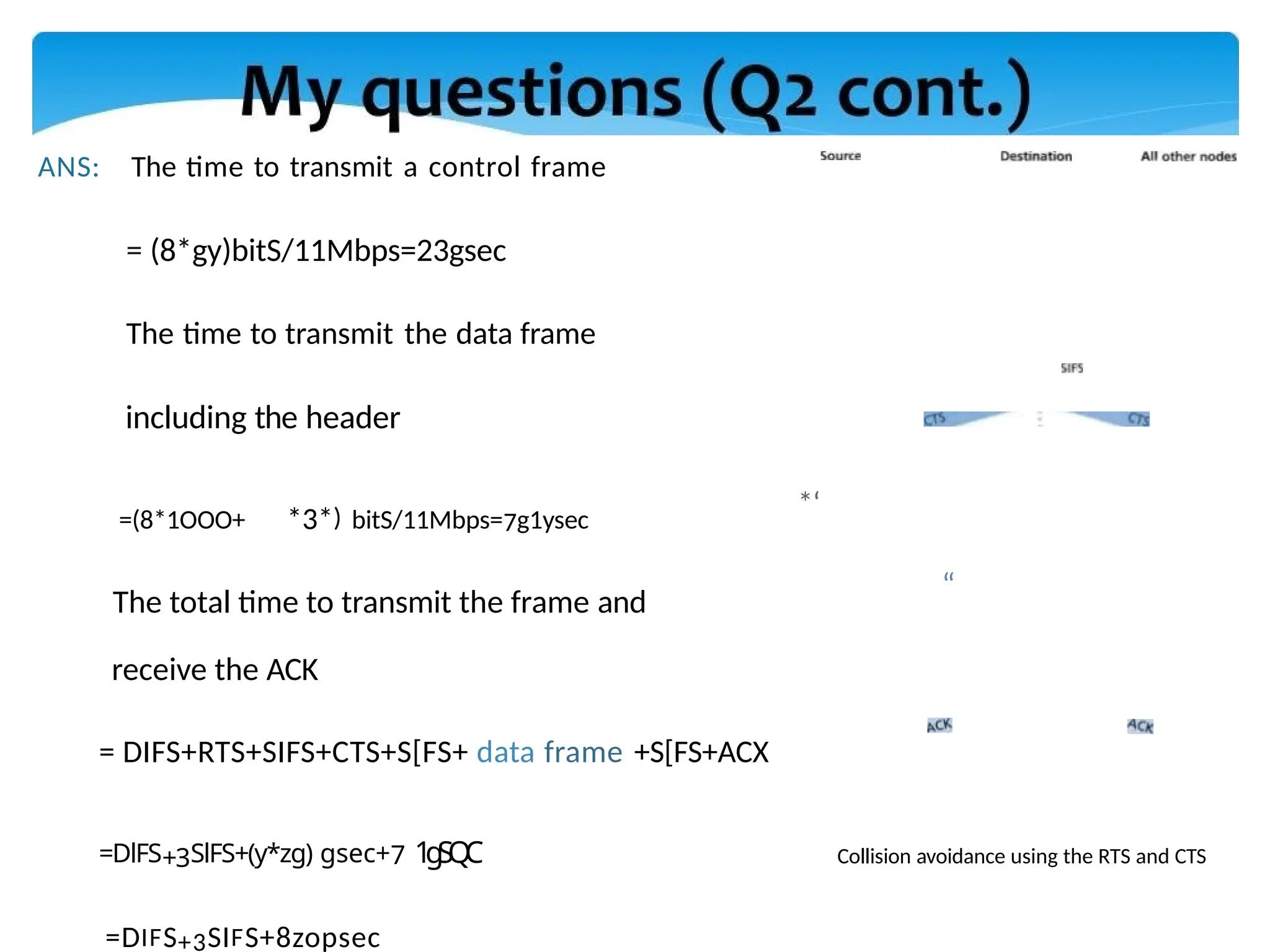
ANS: The time to transmit a control frame
= (8*gy)bitS/11Mbps=23gsec
The time to transmit the data frame
including the header
=(8*1OOO+ *3*) bitS/11Mbps=7g1ysec
The total time to transmit the frame and
*‘
“
receive the ACK
= DIFS+RTS+SIFS+CTS+S[FS+ data frame +S[FS+ACX
=DlFS+3SlFS+(y*zg) gsec+7 1
g
S
Q
C
=DIFS+3SIFS+8zopsec
Collision avoidance using the RTS and CTS
Cth-a: True or false : Before an 802.11 Station transmits a data
frame , it must first send an RTS frame and receive a
corresponding CTS frame*
Q/-b: Describe how the 8oz.11 protocol
works*
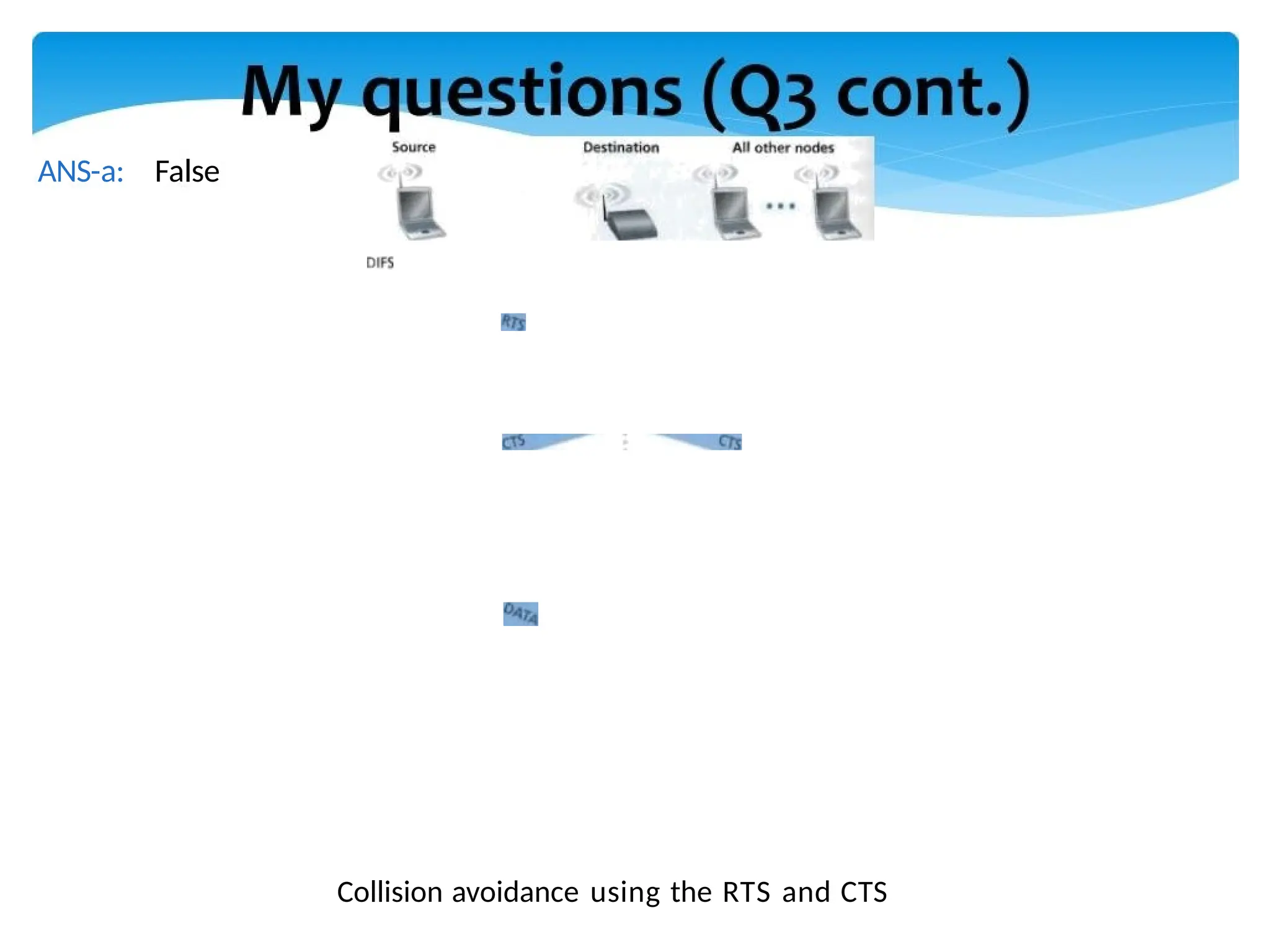
ANS-a: False
Collision avoidance using the RTS and CTS
ANS - b:
1. If initially the station senses the channel idle, it transmits its frame after a short
period of time known as the Distributed Inter-frame Space (DIFS)
z. Otherwise, the station chooses a random backoff value and counts
down this value (NAV counter) when the channel is sensed idle. While the
channel is sensed busy, the counter value “NAV” remains frozen.
g. When the counter reaches zero (note that this can only occur while
the channel is sensed idle), the station transmits the entire frame and then
waits for an acknowledgement.
The concept of the engineering and applications.pptx

The concept of the engineering and applications.pptx

  • 1.
    Medium Access for WirelessSensor Network C‹srJeton University Presented by: Mohamed Ajal connectcarleton. ca mala i
  • 2.
    Topics o 3‘ Introduction &Power consumption in WSN's & Wireless MAC protocols & Differences and Constraints & Attributes to WSN & Wireless Sensor network MAC protocols ‘ Summary
  • 3.
    Wireless Sensor Network? &It's a collection of devices “ sensor nodes” & They are small, inexpensive, with constrained power They are organized in a cooperative network & They communicate wirelessly in multi hop routing & Heavily deployment 4 Changing network topology mate Monltarlng
  • 4.
    Component and Schematicof Node Processor. Memory. RF Radio. Power Source. Sensor. Sensors Signal Processor — Control Processing And Jje pj$j ptt M . k i . , .pe e g T«»«:t ter/ Receiver
  • 5.
    Goal of WirelessSensor Network Collect data at regular intervals. Then transform data into an electrical signal. Finally, send the signals to the sink or the base nod. Types of Wireless Sensor Network Temperature sensor. Light sensor. Sound sensor. Vibration Sensor. tensing Computing Communication
  • 6.
    Communication pattern: Broadcast :Base station transmits message to all its immediate neighbors. Converge cast: a group of sensors communicates to a specific sensor Local gossip: a sensor node sends a message to its neighboring nodes within a range.
  • 7.
    Applications of WirelessSensor Network & Global scale & Battle field & Factories & Buildings & Homes P bodies Buildings Oh 8 Gas Tanks Water
  • 8.
    The power consumptionin WSN's is one of the biggest challenges because: Sensors have a limited source of power and it's hard to replace or recharge “e.g sensors in the battle field, sensors in a large forest.. Etc”.
  • 9.
    Energy consumpiton of typical node components. Transmitter(Tx) Receive (Rx) Idle Sleep Source: MAC Essentials for Wireless Sensor Networks MCU 14.88 12.5 0 12.3 6 0.01 6
  • 10.
    WSN's 1- useful power consumption: Transmittingor receiving data. Processing queries requests. Forwarding queries and data to the neighbours.
  • 11.
    WSN's Cont. z- wastefulpower consumption: ‘¥ Idle listening to the channel “waiting for possible traffic”. Retransmitting because of collision: “e.g two packets arrived at the same time at the same sensor” Overhearing: when a sensor received a packet doesn't belong it”. Generating and handling control packets.
  • 12.
    How to minimizethe energy consumption of sensor nodes while meeting the application requirements? Use Protocols that aim mainly to increase the sleep periods as much as possible
  • 13.
    Hidden/Exposed terminal problem Hiddenterminal problem • • • B, A hear each other B, C hear each other A, C can not hear each other means A, C unaware of their interference at B
  • 14.
  • 15.
    1- CSMA : NonPersistent: if the device detects activity on the channel, it performs a back off by waiting before attempting to transmit. P- Persistent: if it detects activity on the channel, it continuous to sense the channel instead of delaying. CSMA requires devices to remain in the receive state when not transmitting Disadvantages: the transceiver consumes energy too quickly.
  • 16.
    2- CSVAJCA : Controlmessages were introduced such as ( RTS and CTS) to reserve the channel & The source first performs CSMA algorithm If it determines appropriate time for transmission, it sends RTS Then, the destination responds with CTS Disadvantages: it might still have some collision in RTS
  • 17.
    y-IEEE 802.11 : vInfrastructure mode :devices communicate through a central entity called an access point (AP) using the point coordination function (PCF), Ad hoc mode: devices communicate with each other directly using the distributed coordination function (DCF) & Both the PCF and DCF use a channel access mechanism similar to CSMA/CA and use acknowledgments for reliability. "v In addition to physical carrier sensing, IEEE 802.11 devices perform virtual carrier sensing “ NAV”
  • 18.
    Disadvantages: 4 IEEE 802.11devices consume large amounts of energy due to the high percentage of time spent listening without receiving messages 802.11 Data Transfer
  • 19.
    Traditional MAC protocolprovides: High throughput Low latency Fairness ¥ Mobility But: have little consideration for energy Improved MAC protocol provides: Best performance of smallest amount of energy
  • 20.
    The following attributesshould be taken in WSN Energy conservation Scalability and adaptiveTy 6 throughput Fairness & Latency MAC protocol must achieve x Establish communication link between the sensor nodes To share the communication medium fairly and efficiently primary goal less important
  • 21.
  • 22.
    1- Unscheduled MAC: Strategy: e Beforesending a message, a sensor listens to the medium. If it's busy, wait a random time then retry again and if it's free then it will send the message.
  • 23.
    Advantages: It can adaptfor changes “in the node density, traffic load or the topology” better than scheduled protocol. The sensors don't have to be synchronized together. Disadvantages: & It's worst than scheduled MAC protocols from the power saving perspective, since all sensors listen to the channel.
  • 24.
    1.1- PAMASî standsfor Power Aware Multi-Access Strategy : It uses multiple transceivers on each nOde
  • 25.
    Advantages: Prevent collision Disadvantages: Multiple radiorequirement ‘X Increase energy consumption '6 Increase device complexity and cost
  • 26.
    1›2- S TE P • stands for Sparse Topology and Energy Management Strategy: uses two different channels, the wakeup channel and the data channel, & requires two transceivers in each node Wakeup channel Data c h a n *' Wa k e u p period Listen period S l e e p period STEM duty cycle for single node
  • 27.
    1.2.1- STEM-B: Strategy :sensor nodes wakes a neighbour by transmitting a beacon (no RTS/CTS ) advantages: x Lower Latency Disadvantages: ¥ More complex High energy consumption
  • 28.
    1.2.2- STEM-T: Strategy :sensor nodes wakes a neighbour by transmitting a tone of sufficient length that destination will have a high probability of sensing Busy tone contains no destination address Disadvantages: High latency k Results in overhearing
  • 29.
    * • 3 B-MAC: Strategy : &It uses a tone to wake up sleeping neighbouring similar to STEM- T 6 It u5es very long preamble5 for message transmission. B-MAC Data Yransfer
  • 30.
    disadvantages: B-MAC suffers fromthe overhearing problem The long preamble dominates the energy usage.
  • 31.
    1.g- Wise MAC: Strategy: it uses similar technique in B-MAC but it attempt to reduce the energy consumption by having sensor nodes remember the sampling offset of their neighbour Wise MAC Data Transfer Rezeier
  • 32.
    advantages: It decreases theamount of time a sensor node transmits preambles and the number of sensor nodes that overhear each message Disadvantages: 'v the cost of an extra field in the ACK messages and the memory required to store neighbor's sampling offsets.
  • 33.
    2- Scheduled VAC: Strategy: it attempts to reduce the energy consumption by coordinating sensor nodes with a common schedule
  • 34.
    Advantages: Saving the powerfrom being wasted by turning off the radio out the allocated time slot. Limits the collision, idle listing, and overhearing Disadvantages: when sensor node enters net, must wait till they learn, some delay exist Cost of increased messages Not flexible to changes in sensor density or movements. Allsensorsshould bevvelsynchronized.
  • 35.
    2.1 S-MAC: Strategy : thesensor node periodically goes to the fixed listen/sleep cycle. A time frame in S MAC is divided into two parts: one for a listening session and the other for a sleeping session.
  • 36.
    Sleep Period SYNC RTSCTS R«›d Data ACK ^ SYNC RTS R••›6 ) C T S IJA1‘ A R ece A C K * e SYNC RTS CTS Sleep Period S-MAC Frame Format
  • 37.
    Disadvantages: energy is stillwasted in this protocol during listen period as the sensor will be awake even if there is no reception/transmission.
  • 38.
    Several MAC protocolshas been introduced for both wireless network and wireless sensor networks All WSN MAC protocols are designed with the goal to conserve energy There is no generic best MAC protocol
  • 39.
    [1] K. KredoII, P. Mohapatra, “Medium Access Control in Wireless Sensor Networks”, in zg June zoo6. [z] A. Bachir, M. Dohler, T. Watteyne, and K. Leung, “ MAC Essentials for Wireless Sensor Networks, “in IEEE 2010. E3J Salman Faiz Solehria, Sultanullah Jadoon, “ Medium Access Control Protocol for Wireless Sensor Network —a Survey”, in IEEE 2010. K. LANGENDOEN , “MEDIUM ACCESS CONTROL IN WIRELESS SENSOR NETWORKS”.
  • 41.
    Q1: Why IEEE802.11 defines a SIFS shorter than a DIFS * ANS: SIFS (Short Inter Frame Spacing) has highest priority, for ACK, CTS, polling response while DIFS (Distributed Inter Frame Spacing) has lowest priority, for asynchronous data service. Having 'SIFS smaller than DIFS prevents ACK and important control packets from getting killed. DIFS PIFS SIFS direct access if medium is free DIFS
  • 42.
    Q2: Suppose adevice uses an 8oz.11 MAC protocol to reserve the communication channel before transmitting. Suppose the device does sensing the channel and assumes the channel to be idle and wants to transmit oooBytes of data. Assume the transmission rate is 1 1 Mbps. Calculate the time required to transmit the frame and receive the Ack as function of SIFS and DIFS. Ignore the propagation delay and assume no bit error rate. The transmission rate = No. of bits/Transmission rate. Both a control frame and a frame without data iS 3zBytes. DIFS RT S sende r receiver other stations S'FS c m s SIFS data S I F S D I F S data defer a c c e s s contention 802.1‹ Data Transfer
  • 43.
    ANS: The timeto transmit a control frame = (8*gy)bitS/11Mbps=23gsec The time to transmit the data frame including the header =(8*1OOO+ *3*) bitS/11Mbps=7g1ysec The total time to transmit the frame and *‘ “ receive the ACK = DIFS+RTS+SIFS+CTS+S[FS+ data frame +S[FS+ACX =DlFS+3SlFS+(y*zg) gsec+7 1 g S Q C =DIFS+3SIFS+8zopsec Collision avoidance using the RTS and CTS
  • 44.
    Cth-a: True orfalse : Before an 802.11 Station transmits a data frame , it must first send an RTS frame and receive a corresponding CTS frame* Q/-b: Describe how the 8oz.11 protocol works*
  • 45.
    ANS-a: False Collision avoidanceusing the RTS and CTS
  • 46.
    ANS - b: 1.If initially the station senses the channel idle, it transmits its frame after a short period of time known as the Distributed Inter-frame Space (DIFS) z. Otherwise, the station chooses a random backoff value and counts down this value (NAV counter) when the channel is sensed idle. While the channel is sensed busy, the counter value “NAV” remains frozen. g. When the counter reaches zero (note that this can only occur while the channel is sensed idle), the station transmits the entire frame and then waits for an acknowledgement.