Wireless Sensor Network’s
Architecture and Applications
 The design and development of low-cost, low-power,
multifunctional sensor nodes that are small in size and
communicate untethered in short distances have
become feasible.
 To realize the existing and potential applications for
WSNs, sophisticated and extremely efficient
communication protocols are required. WSNs are
composed of a large number of sensor nodes, which
are densely deployed either inside a physical
phenomenon or very close to it.
 Wireless Sensor Networks are networks that consists
of sensors which are distributed in an ad hoc manner.
 These sensors work with each other to sense some
physical phenomenon and then the information
gathered is processed to get relevant results.
 Wireless sensor networks consists of protocols and
algorithms with self-organizing capabilities.
 Sensor networks use source-node processing or
hierarchical processing architecture.
 Instead of sending the raw data to the nodes
responsible for the fusion, sensor nodes use their
processing capabilities to locally carry out simple
computations and transmit only the required and
partially processed data
 In a hierarchical processing architecture, processing
occurs at consecutive tiers until the information about
events of interest reaches the appropriate decision-
making and/or administrative point.
 A sensor is a device that converts a real-world
property (e.g. temperature) into data that a computer
can process.
 The properties they detect are
Temperature-Temperature
Light-Light / dark
Pressure-Pressure (e.g. someone standing on it)
Water-level-How full / empty a container is
Movement-Movement nearby
 The output of a sensor is generally a signal that is
converted to human-readable display at the sensor
location or transmitted electronically over a network for
reading or further processing.
 All sensors need to be calibrated with respect
with some reference value or standard device for
accurate measurement.
 High Sensitivity: Sensitivity indicates how much the
output of the device changes with unit change in input
(quantity to be measured). For example the voltage of a
temperature sensor changes by 1mV for every 1°C change
in temperature than the sensitivity of the sensor is said to
be 1mV/°C.
 Linearity: The output should change linearly with the
input.
 High Resolution: Resolution is the smallest change in
the input that the device can detect.
 Less Noise & Disturbance.
 Less power consumption.
 Environmental sensors
e.g.: Rain gauge, snow gauge, moisture sensor.
 Acoustic & Sound sensors
e.g.: Microphone and Hydrophone
 Optical sensors
e.g. : Photodiode, Phototransistor, Wave front
sensor
 Proximity & Presences sensors
e.g.: Doppler radar, Motion detector
 Automotive sensors
e.g.: Speedometer, Radar gun, Speedometer, fuel
ratio meter.
.
 Sensor networks are the key to gathering the information
needed by smart environments, whether in buildings,
utilities, industrial, home, shipboard, transportation
systems automation, or elsewhere.
 It consists of multiple detection stations called sensor
nodes, each of which is small, lightweight and portable
 Every sensor node is equipped with a transducer, micro
computer, trans receiver and power source.
 The transducer generates electrical signals based on
sensed physical effects and phenomena.
 The microcomputer processes and stores the sensor
output.
 The transceiver receives commands from a central
computer and transmits data to that computer.
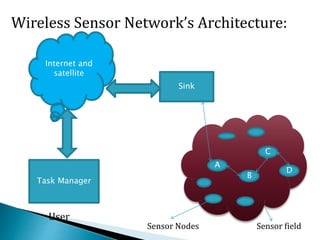
Wireless Sensor Network’s Architecture:
Task Manager
Internet and
satellite
Sink
A
C
D
B
User
Sensor Nodes Sensor field
1. The sensor nodes are usually scattered in a sensor field.
2. Each of these scattered sensor nodes has the capability to
collect data and route data back to the sink/gateway and the
end-users.
3. The sink may communicate with the task manager/end-user
via the Internet or satellite or any type of wireless network
(like WiFi, mesh networks, cellular systems, WiMAX, etc.), or
without any of these networks where the sink can be
directly connected to the end-users.
Continued…….
4. In WSNs, the sensor nodes have the dual functionality of
being both data originators and data routers. Hence,
communication is performed for two reasons:
• Source function: Source nodes with event information
perform communication functionalities in order to transmit
their packets to the sink.
• Router function: Sensor nodes also participate in forwarding
the packets received from other nodes to the next destination
in the multi-hop path to the sink.
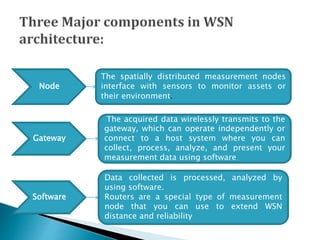
Node
The spatially distributed measurement nodes
interface with sensors to monitor assets or
their environment.
Gateway
The acquired data wirelessly transmits to the
gateway, which can operate independently or
connect to a host system where you can
collect, process, analyze, and present your
measurement data using software
Software
Data collected is processed, analyzed by
using software.
Routers are a special type of measurement
node that you can use to extend WSN
distance and reliability
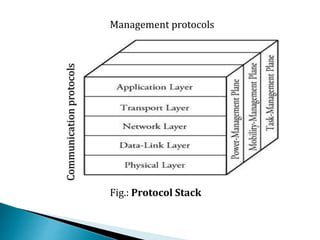
 The architecture of a protocol stack is used by the sink and
sensor node.
 This protocol stack integrates data with Networking
protocols.
 It communicates power efficiently through the wireless
medium and promotes cooperative efforts of sensor nodes.
Communicationprotocols
Management protocols
Fig.: Protocol Stack
• It is responsible for frequency selection, carrier
frequency generation, signal detection,
modulation, and data encryption
PHYSICAL
LAYER
• multiplexing of data streams, data frame
detection, and medium access and error control
• It ensures reliable point-to-point and point-to-
multipoint connections in a communication
network
DATALINK
LAYER
• The information collected relating to the
phenomenon should be transmitted to the sink,
which may be located far from the sensor field.
• This requires efficient multi-hop wireless routing
protocols between the sensor nodes and the sink
node using intermediate sensor nodes as relays.
NETWORK
LAYER
Communication protocols:
• when the network is planned to be accessed
through the Internet or other external
networks.
• power consumption and scalability, and
characteristics like data-centric routing,
mean sensor networks need different
handling in this layer
TRANSPORT
LAYER
• It includes the main application as well as
several management functionalities
• Time synchronization, localization, topology
management
APPLICATION
LAYER
Management protocols:
Power
Manageme
nt
It manages how a sensor node uses it power and manages
its power consumption among the three operations(sensing
, computation, wireless communication )
Task
Managemen
t
It balances and schedules the events i.e., sensing and
detecting tasks from a specific area.
Depending on the power level some nodes perform the
sensing task
Mobility –
Managemen
t
It detect and registers the movement/mobility of a sensor
nodes as a network control primitive
 Mesh topology
 Star topology
 Tree topology
 Switched star topology
 Peer to peer topology
 Industrial automation
 Smart home system
 Military surveillance
 Environmental monitoring
 Wireless sensor network technology has demonstrated a
great potential for industrial, commercial, and consumer
applications.
 Specifically, in process monitoring and control, process
data such as pressure, humidity, temperature, flow, level,
viscosity, density and vibration intensity measurements
can be collected through sensing units and transferred
wirelessly to a control system for operation and
management.
•cooling down a reactor by
adjusting the flow rate through
the cooling jacket is a process.
• Here, the temperature is the
controlled variable.
•The temperature value is
transmitted to the controller;
the controller implements the
functions and calculations,
transmits the output to control
the valve and issues alarm if
there are faulty conditions.
•Failure of a control loop may
cause unscheduled plant
shutdown or even severe
accidents in process-controlled
plants .
Control
room
Controller
Temperature
transmitter
Valve
positioner
Fig.: Wired process control
system
Controller
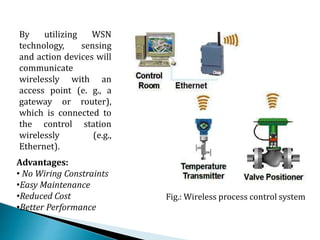
Fig.: Wireless process control system
By utilizing WSN
technology, sensing
and action devices will
communicate
wirelessly with an
access point (e. g., a
gateway or router),
which is connected to
the control station
wirelessly (e.g.,
Ethernet).
Advantages:
• No Wiring Constraints
•Easy Maintenance
•Reduced Cost
•Better Performance
 wireless sensor networks can be used by the military for a
number of purposes such as monitoring militant activities
and force protection.
 Being equipped with appropriate sensors these networks
can enable detection of enemy movement, identification of
enemy force and analysis of their movement and progress.
 Smart Home is the integration of technology and
services through home networking for better quality
of living.
 The smart home integration consists of three major
areas physical components, control system,
communication system which connects physical
components and control system.
In a smart home system the physical components sense the
environment and pass to home control system through home
sub networks and home network. Home control system takes
the decision and passes the control information to the actuators
through home network.
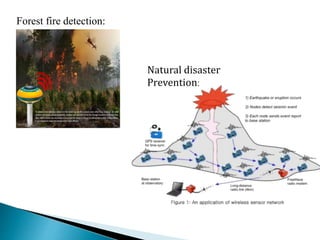
 There are many applications in monitoring environmental
parameters which share extra challenges of harsh
environments and reduced power supply.
 They are:
Forest fire detection
Natural disaster prevention
Forest fire detection:
Natural disaster
Prevention:

Wireless sensor network applications

  • 1.
  • 2.
     The designand development of low-cost, low-power, multifunctional sensor nodes that are small in size and communicate untethered in short distances have become feasible.  To realize the existing and potential applications for WSNs, sophisticated and extremely efficient communication protocols are required. WSNs are composed of a large number of sensor nodes, which are densely deployed either inside a physical phenomenon or very close to it.
  • 3.
     Wireless SensorNetworks are networks that consists of sensors which are distributed in an ad hoc manner.  These sensors work with each other to sense some physical phenomenon and then the information gathered is processed to get relevant results.  Wireless sensor networks consists of protocols and algorithms with self-organizing capabilities.
  • 4.
     Sensor networksuse source-node processing or hierarchical processing architecture.  Instead of sending the raw data to the nodes responsible for the fusion, sensor nodes use their processing capabilities to locally carry out simple computations and transmit only the required and partially processed data  In a hierarchical processing architecture, processing occurs at consecutive tiers until the information about events of interest reaches the appropriate decision- making and/or administrative point.
  • 5.
     A sensoris a device that converts a real-world property (e.g. temperature) into data that a computer can process.  The properties they detect are Temperature-Temperature Light-Light / dark Pressure-Pressure (e.g. someone standing on it) Water-level-How full / empty a container is Movement-Movement nearby
  • 6.
     The outputof a sensor is generally a signal that is converted to human-readable display at the sensor location or transmitted electronically over a network for reading or further processing.  All sensors need to be calibrated with respect with some reference value or standard device for accurate measurement.
  • 7.
     High Sensitivity:Sensitivity indicates how much the output of the device changes with unit change in input (quantity to be measured). For example the voltage of a temperature sensor changes by 1mV for every 1°C change in temperature than the sensitivity of the sensor is said to be 1mV/°C.  Linearity: The output should change linearly with the input.  High Resolution: Resolution is the smallest change in the input that the device can detect.  Less Noise & Disturbance.  Less power consumption.
  • 8.
     Environmental sensors e.g.:Rain gauge, snow gauge, moisture sensor.  Acoustic & Sound sensors e.g.: Microphone and Hydrophone  Optical sensors e.g. : Photodiode, Phototransistor, Wave front sensor  Proximity & Presences sensors e.g.: Doppler radar, Motion detector  Automotive sensors e.g.: Speedometer, Radar gun, Speedometer, fuel ratio meter. .
  • 9.
     Sensor networksare the key to gathering the information needed by smart environments, whether in buildings, utilities, industrial, home, shipboard, transportation systems automation, or elsewhere.  It consists of multiple detection stations called sensor nodes, each of which is small, lightweight and portable  Every sensor node is equipped with a transducer, micro computer, trans receiver and power source.  The transducer generates electrical signals based on sensed physical effects and phenomena.  The microcomputer processes and stores the sensor output.  The transceiver receives commands from a central computer and transmits data to that computer.
  • 10.
    Wireless Sensor Network’sArchitecture: Task Manager Internet and satellite Sink A C D B User Sensor Nodes Sensor field
  • 11.
    1. The sensornodes are usually scattered in a sensor field. 2. Each of these scattered sensor nodes has the capability to collect data and route data back to the sink/gateway and the end-users. 3. The sink may communicate with the task manager/end-user via the Internet or satellite or any type of wireless network (like WiFi, mesh networks, cellular systems, WiMAX, etc.), or without any of these networks where the sink can be directly connected to the end-users. Continued…….
  • 12.
    4. In WSNs,the sensor nodes have the dual functionality of being both data originators and data routers. Hence, communication is performed for two reasons: • Source function: Source nodes with event information perform communication functionalities in order to transmit their packets to the sink. • Router function: Sensor nodes also participate in forwarding the packets received from other nodes to the next destination in the multi-hop path to the sink.
  • 13.
    Node The spatially distributedmeasurement nodes interface with sensors to monitor assets or their environment. Gateway The acquired data wirelessly transmits to the gateway, which can operate independently or connect to a host system where you can collect, process, analyze, and present your measurement data using software Software Data collected is processed, analyzed by using software. Routers are a special type of measurement node that you can use to extend WSN distance and reliability
  • 14.
     The architectureof a protocol stack is used by the sink and sensor node.  This protocol stack integrates data with Networking protocols.  It communicates power efficiently through the wireless medium and promotes cooperative efforts of sensor nodes.
  • 15.
  • 16.
    • It isresponsible for frequency selection, carrier frequency generation, signal detection, modulation, and data encryption PHYSICAL LAYER • multiplexing of data streams, data frame detection, and medium access and error control • It ensures reliable point-to-point and point-to- multipoint connections in a communication network DATALINK LAYER • The information collected relating to the phenomenon should be transmitted to the sink, which may be located far from the sensor field. • This requires efficient multi-hop wireless routing protocols between the sensor nodes and the sink node using intermediate sensor nodes as relays. NETWORK LAYER Communication protocols:
  • 17.
    • when thenetwork is planned to be accessed through the Internet or other external networks. • power consumption and scalability, and characteristics like data-centric routing, mean sensor networks need different handling in this layer TRANSPORT LAYER • It includes the main application as well as several management functionalities • Time synchronization, localization, topology management APPLICATION LAYER
  • 18.
    Management protocols: Power Manageme nt It manageshow a sensor node uses it power and manages its power consumption among the three operations(sensing , computation, wireless communication ) Task Managemen t It balances and schedules the events i.e., sensing and detecting tasks from a specific area. Depending on the power level some nodes perform the sensing task Mobility – Managemen t It detect and registers the movement/mobility of a sensor nodes as a network control primitive
  • 19.
     Mesh topology Star topology  Tree topology  Switched star topology  Peer to peer topology
  • 23.
     Industrial automation Smart home system  Military surveillance  Environmental monitoring
  • 24.
     Wireless sensornetwork technology has demonstrated a great potential for industrial, commercial, and consumer applications.  Specifically, in process monitoring and control, process data such as pressure, humidity, temperature, flow, level, viscosity, density and vibration intensity measurements can be collected through sensing units and transferred wirelessly to a control system for operation and management.
  • 25.
    •cooling down areactor by adjusting the flow rate through the cooling jacket is a process. • Here, the temperature is the controlled variable. •The temperature value is transmitted to the controller; the controller implements the functions and calculations, transmits the output to control the valve and issues alarm if there are faulty conditions. •Failure of a control loop may cause unscheduled plant shutdown or even severe accidents in process-controlled plants . Control room Controller Temperature transmitter Valve positioner Fig.: Wired process control system Controller
  • 26.
    Fig.: Wireless processcontrol system By utilizing WSN technology, sensing and action devices will communicate wirelessly with an access point (e. g., a gateway or router), which is connected to the control station wirelessly (e.g., Ethernet). Advantages: • No Wiring Constraints •Easy Maintenance •Reduced Cost •Better Performance
  • 27.
     wireless sensornetworks can be used by the military for a number of purposes such as monitoring militant activities and force protection.  Being equipped with appropriate sensors these networks can enable detection of enemy movement, identification of enemy force and analysis of their movement and progress.
  • 29.
     Smart Homeis the integration of technology and services through home networking for better quality of living.  The smart home integration consists of three major areas physical components, control system, communication system which connects physical components and control system.
  • 30.
    In a smarthome system the physical components sense the environment and pass to home control system through home sub networks and home network. Home control system takes the decision and passes the control information to the actuators through home network.
  • 31.
     There aremany applications in monitoring environmental parameters which share extra challenges of harsh environments and reduced power supply.  They are: Forest fire detection Natural disaster prevention
  • 32.
    Forest fire detection: Naturaldisaster Prevention: