Presented By

P.Praveen Kumar(09751A0581)
B.TECH (CSE),
SITAMS.
Sensor networks are collection of sensor nodes
which co-operatively send sensed data to base station.
As sensor nodes are battery driven, an efficient
utilization of power is essential in order to use networks
for long duration hence it is needed to reduce data traffic
inside sensor networks, reduce amount of data that need
to send to base station. The main goal of data
aggregation algorithms is to gather and aggregate data
in an energy efficient manner so that network lifetime is
enhanced. Wireless sensor networks (WSN) offer an
increasingly Sensor nodes need less power for
processing as compared to transmitting data. It is
preferable to do in network processing inside network
and reduce packet size.
   Data aggregation is a process of aggregating
    the sensor data using aggregation approaches.

   The algorithm uses the sensor data from the
    sensor node and then aggregates the data by
    using some aggregation algorithms such as
    centralized approach, LEACH(low energy
    adaptive clustering hierarchy),TAG(Tiny
    Aggregation) etc.

   This aggregated data is transfer to the sink
    node by selecting the efficient path.
This is an address centric approach
 where each node sends data to a central
  node via the shortest possible route using a
  multi-hop wireless protocol.

 Thesensor nodes simply send the data
 packets to a leader, which is the powerful
 node. The leader aggregates the data which
 can be queried.
In-network aggregation is the
 Global process of gathering and routing
  information through a multi-hop network,
  processing data at intermediate nodes with
  the    objective   of     reducing resource
  consumption (in particular energy), thereby
  increasing network lifetime.

   There are two approaches for in-network
    aggregation: with size reduction and without
    size reduction.
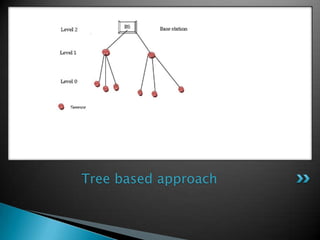
Tree based approach
In the tree-based approach perform
 Aggregation by constructing an aggregation
  tree, which could be a minimum spanning
  tree, rooted at sink and source nodes are
  considered as leaves.
 Each node has a parent node to forward its
  data.
 Flow of data starts from leaves nodes up to
  the sink and therein the aggregation done
  by parent nodes.
In cluster-based approach, whole

   Network is divided in to several clusters. Each
    cluster has a cluster-head which is selected
    among cluster members.

   Cluster heads do the role of aggregator which
    aggregate data received from cluster
    members locally and then transmit the result
    to sink.
We have plenty of simulation tools or
simulators for simulating wireless networks

The simulators which are most popular are
TOSSIM, NS-2, OPNET, OMNet++, J-Sim,
GlomoSim, and Qualnet and so on. TOSSIM
is a discrete event simulator for TinyOS (TinyOS
is a popular sensor network operating system)
sensor networks.
   1) Simple Queries
   These are aggregate queries.
   Eg. "SELECT temperature FROM sensor WHERE
    node = z".
   These are generally mapped into broadcast or
    point to point quires
   They may contain sub queries.
   Eg. "SELECT temperature FROM sensor WHERE
    room =
   (SELECT room WHERE floor = ’3’)"
   These are the continuous query that returns
    the values periodically at specified time
    intervals.
   Eg: “SELECT AVG (temperature) FROM sensor
    where node =“Z”
   With aggregation query:
    SELECT MAX (temp), AVG (light) FROM
    SENSORS SAMPLE PERIOD 2048
   Without aggregation query:
   SELECT light FROM sensors SAMPLE PERIOD
    2048
   With aggregation and with clustering query:
    SELECT AVG(light) FROM SENSORS
    GROUP BY NODEID % 2SAMPLE PERIOD 2048.
Simulation results and comparison
   Enhance robustness and accuracy of
    information

   Reduce traffic load &conserve energy of
    sensors
   Malicious attacker

   Cannot ensure correctness

   Increase power consumption
CONCLUSION

       In this work we have studied the two
most important parts of data communication in
sensor networks- query processing, data
aggregation and realized how communication
in sensor networks is different from other
wireless networks. Wireless sensor networks
are energy constrained network. Since most of
the energy consumed for transmitting and
receiving data, the process of data aggregation
becomes an important issue and optimization
is needed. Efficient data aggregations not only
provide energy conservation but also remove
redundancy data and hence provide useful data
only.
Data aggregation in wireless sensor network , 11751 d5811

Data aggregation in wireless sensor network , 11751 d5811

  • 1.
  • 2.
    Sensor networks arecollection of sensor nodes which co-operatively send sensed data to base station. As sensor nodes are battery driven, an efficient utilization of power is essential in order to use networks for long duration hence it is needed to reduce data traffic inside sensor networks, reduce amount of data that need to send to base station. The main goal of data aggregation algorithms is to gather and aggregate data in an energy efficient manner so that network lifetime is enhanced. Wireless sensor networks (WSN) offer an increasingly Sensor nodes need less power for processing as compared to transmitting data. It is preferable to do in network processing inside network and reduce packet size.
  • 4.
    Data aggregation is a process of aggregating the sensor data using aggregation approaches.  The algorithm uses the sensor data from the sensor node and then aggregates the data by using some aggregation algorithms such as centralized approach, LEACH(low energy adaptive clustering hierarchy),TAG(Tiny Aggregation) etc.  This aggregated data is transfer to the sink node by selecting the efficient path.
  • 5.
    This is anaddress centric approach  where each node sends data to a central node via the shortest possible route using a multi-hop wireless protocol.  Thesensor nodes simply send the data packets to a leader, which is the powerful node. The leader aggregates the data which can be queried.
  • 6.
    In-network aggregation isthe  Global process of gathering and routing information through a multi-hop network, processing data at intermediate nodes with the objective of reducing resource consumption (in particular energy), thereby increasing network lifetime.  There are two approaches for in-network aggregation: with size reduction and without size reduction.
  • 7.
  • 8.
    In the tree-basedapproach perform  Aggregation by constructing an aggregation tree, which could be a minimum spanning tree, rooted at sink and source nodes are considered as leaves.  Each node has a parent node to forward its data.  Flow of data starts from leaves nodes up to the sink and therein the aggregation done by parent nodes.
  • 9.
    In cluster-based approach,whole  Network is divided in to several clusters. Each cluster has a cluster-head which is selected among cluster members.  Cluster heads do the role of aggregator which aggregate data received from cluster members locally and then transmit the result to sink.
  • 10.
    We have plentyof simulation tools or simulators for simulating wireless networks The simulators which are most popular are TOSSIM, NS-2, OPNET, OMNet++, J-Sim, GlomoSim, and Qualnet and so on. TOSSIM is a discrete event simulator for TinyOS (TinyOS is a popular sensor network operating system) sensor networks.
  • 11.
    1) Simple Queries  These are aggregate queries.  Eg. "SELECT temperature FROM sensor WHERE node = z".  These are generally mapped into broadcast or point to point quires
  • 13.
    They may contain sub queries.  Eg. "SELECT temperature FROM sensor WHERE room =  (SELECT room WHERE floor = ’3’)"
  • 15.
    These are the continuous query that returns the values periodically at specified time intervals.  Eg: “SELECT AVG (temperature) FROM sensor where node =“Z”
  • 16.
    With aggregation query:  SELECT MAX (temp), AVG (light) FROM SENSORS SAMPLE PERIOD 2048  Without aggregation query:  SELECT light FROM sensors SAMPLE PERIOD 2048  With aggregation and with clustering query: SELECT AVG(light) FROM SENSORS GROUP BY NODEID % 2SAMPLE PERIOD 2048.
  • 17.
  • 18.
    Enhance robustness and accuracy of information  Reduce traffic load &conserve energy of sensors
  • 19.
    Malicious attacker  Cannot ensure correctness  Increase power consumption
  • 20.
    CONCLUSION In this work we have studied the two most important parts of data communication in sensor networks- query processing, data aggregation and realized how communication in sensor networks is different from other wireless networks. Wireless sensor networks are energy constrained network. Since most of the energy consumed for transmitting and receiving data, the process of data aggregation becomes an important issue and optimization is needed. Efficient data aggregations not only provide energy conservation but also remove redundancy data and hence provide useful data only.