AKS 15b – analyze the relationship between work, power, and time
AKS 15c – explain how machines make work easier
Brainstorming:
What does it mean to “WORK”?
Anticipation Guide:
After completing the Before Reading portion,
work with your group to write one question
that would help you determine whether a
statement (or statements) is true or false.
Before
reading Statement After
reading
Text evidence for or against
(include the page # and paragraph #
along with your citation)
Write an “A” if you agree or “D” if you disagree for each statement.
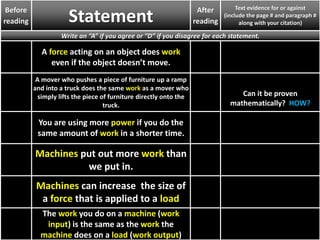
A force acting on an object does work
even if the object doesn’t move.
A mover who pushes a piece of furniture up a ramp
and into a truck does the same work as a mover who
simply lifts the piece of furniture directly onto the
truck.
Can it be proven
mathematically? HOW?
You are using more power if you do the
same amount of work in a shorter time.
Machines put out more work than
we put in.
Machines can increase the size of
a force that is applied to a load
The work you do on a machine (work
input) is the same as the work the
machine does on a load (work output)
Questions (1st Period):
1. Is force the same as work?
2. How can we calculate work?
3. What is a load?
4. If you push something and it doesn’t move, is it
still work?
5. How much work can machines put out?
6. What is work?
7. Does direction affect the force applied?
8. What is the difference between work input and
work output?
Questions (2nd Period):
1. What is the difference between power and work?
2. How much force is being applied to an object?
3. What is the sci. definition of work?
4. Can machines increase the size of force applied to a
load?
5. Is the work you do on a machine the same as the work
the machine does on a load?
6. Does the quality of the machine affect the amount done
by the machine?
7. What is the difference between force and work?
8. How can you calculate the work done by simple
machines?
Questions (3rd Period):
1. What is the difference between work input and work
output?
2. What effect do machines have on work and power?
3. How does angle/direction affect the work done on an
object?
4. Do machines apply the same amount of force and
distance as a human?
5. What is work?
6. Does an object need to move for work to be done?
7. What is a machine?
8. Can machines increase the magnitude of a force applied
to a load?
Questions (4th Period):
1. What is work?
2. How do machines make work easier?
3. In a shorter amount of time, if you use more power are
you putting more work?
4. Does the amount of time you spend doing work affect
the amount of work you do?
5. What are the differences between work input and work
output?
6. Can machines increase the magnitude of a force applied
to a load?
7. EPIC FAIL!
8. Do machines or people do more work?
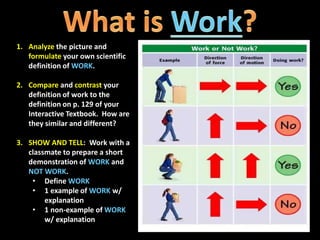
1. Analyze the picture and
formulate your own scientific
definition of WORK.
2. Compare and contrast your
definition of work to the
definition on p. 129 of your
Interactive Textbook. How are
they similar and different?
3. SHOW AND TELL: Work with a
classmate to prepare a short
demonstration of WORK and
NOT WORK.
• Define WORK
• 1 example of WORK w/
explanation
• 1 non-example of WORK
w/ explanation
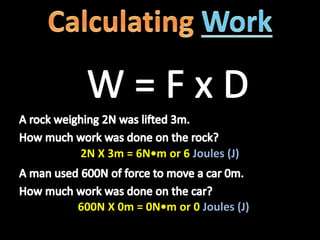
2N X 3m = 6N•m or 6 Joules (J)
600N X 0m = 0N•m or 0 Joules (J)
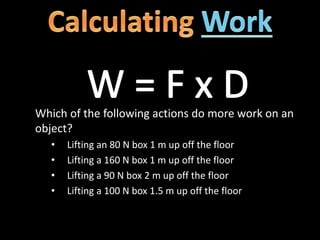
Which of the following actions do more work on an
object?
• Lifting an 80 N box 1 m up off the floor
• Lifting a 160 N box 1 m up off the floor
• Lifting a 90 N box 2 m up off the floor
• Lifting a 100 N box 1.5 m up off the floor
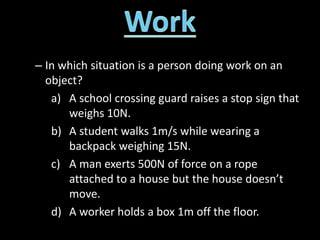
– In which situation is a person doing work on an
object?
a) A school crossing guard raises a stop sign that
weighs 10N.
b) A student walks 1m/s while wearing a
backpack weighing 15N.
c) A man exerts 500N of force on a rope
attached to a house but the house doesn’t
move.
d) A worker holds a box 1m off the floor.
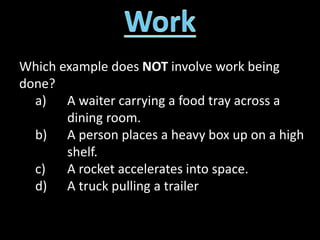
Which example does NOT involve work being
done?
a) A waiter carrying a food tray across a
dining room.
b) A person places a heavy box up on a high
shelf.
c) A rocket accelerates into space.
d) A truck pulling a trailer
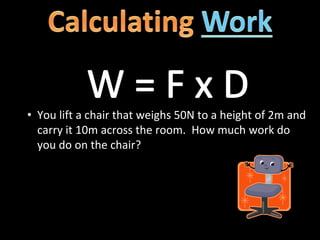
• You lift a chair that weighs 50N to a height of 2m and
carry it 10m across the room. How much work do
you do on the chair?
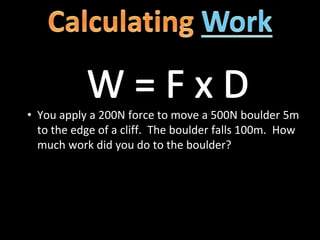
• You apply a 200N force to move a 500N boulder 5m
to the edge of a cliff. The boulder falls 100m. How
much work did you do to the boulder?
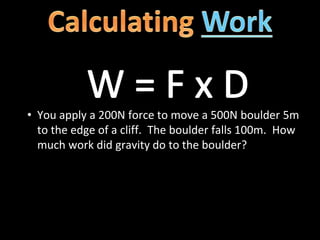
• You apply a 200N force to move a 500N boulder 5m
to the edge of a cliff. The boulder falls 100m. How
much work did gravity do to the boulder?
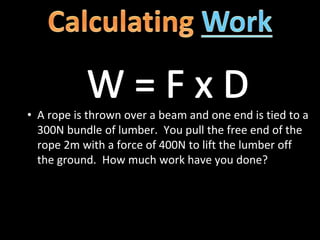
• A rope is thrown over a beam and one end is tied to a
300N bundle of lumber. You pull the free end of the
rope 2m with a force of 400N to lift the lumber off
the ground. How much work have you done?
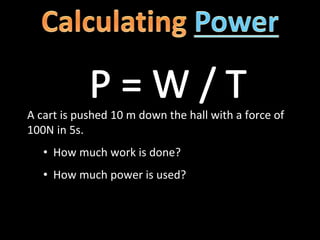
A cart is pushed 10 m down the hall with a force of
100N in 5s.
• How much work is done?
• How much power is used?
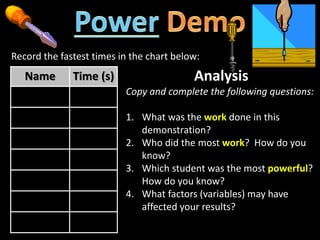
Record the fastest times in the chart below:
Name Time (s) Analysis
Copy and complete the following questions:
1. What was the work done in this
demonstration?
2. Who did the most work? How do you
know?
3. Which student was the most powerful?
How do you know?
4. What factors (variables) may have
affected your results?
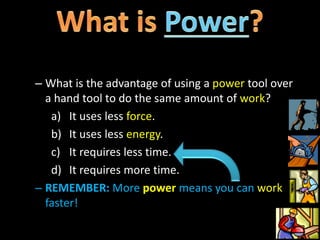
– What is the advantage of using a power tool over
a hand tool to do the same amount of work?
a) It uses less force.
b) It uses less energy.
c) It requires less time.
d) It requires more time.
– REMEMBER: More power means you can work
faster!
19
20
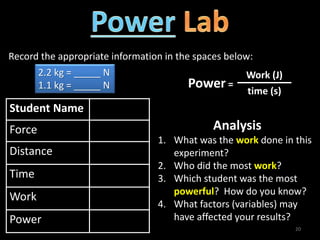
Record the appropriate information in the spaces below:
Student Name
Force
Distance
Time
Work
Power
Analysis
1. What was the work done in this
experiment?
2. Who did the most work?
3. Which student was the most
powerful? How do you know?
4. What factors (variables) may
have affected your results?
2.2 kg = _____ N
1.1 kg = _____ N Power =
Work (J)
time (s)
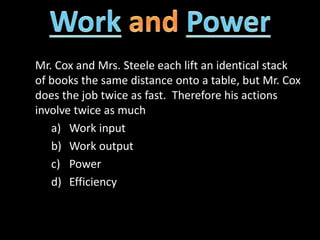
Mr. Cox and Mrs. Steele each lift an identical stack
of books the same distance onto a table, but Mr. Cox
does the job twice as fast. Therefore his actions
involve twice as much
a) Work input
b) Work output
c) Power
d) Efficiency
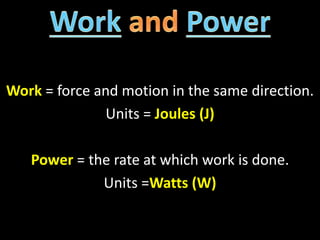
Work = force and motion in the same direction.
Units = Joules (J)
Power = the rate at which work is done.
Units =Watts (W)
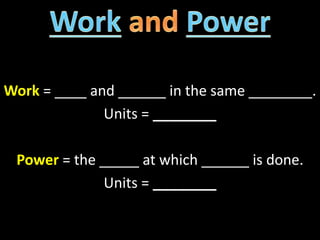
Work = ____ and ______ in the same ________.
Units = ________
Power = the _____ at which ______ is done.
Units = ________
– Mechanical Advantage and Efficiency
• What does it mean to have an ADVANTAGE?
• What does EFFICIENT mean?
– Mechanical Advantage
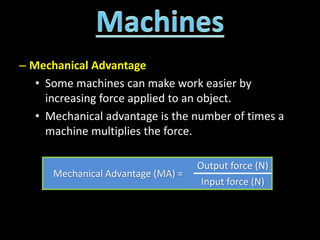
• Some machines can make work easier by
increasing force applied to an object.
• Mechanical advantage is the number of times a
machine multiplies the force.
Mechanical Advantage (MA) =
Output force (N)
Input force (N)
– Mechanical Advantage
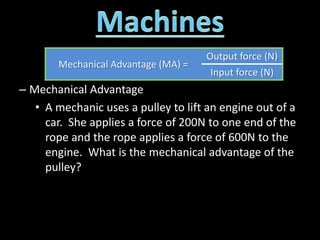
• A mechanic uses a pulley to lift an engine out of a
car. She applies a force of 200N to one end of the
rope and the rope applies a force of 600N to the
engine. What is the mechanical advantage of the
pulley?
Mechanical Advantage (MA) =
Output force (N)
Input force (N)
– Mechanical Advantage
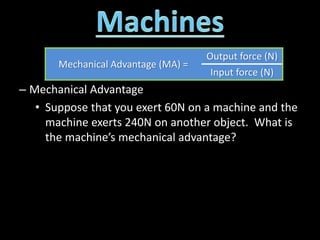
• Suppose that you exert 60N on a machine and the
machine exerts 240N on another object. What is
the machine’s mechanical advantage?
Mechanical Advantage (MA) =
Output force (N)
Input force (N)
– Mechanical Advantage
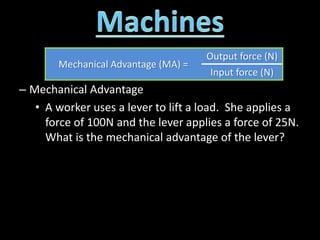
• A worker uses a lever to lift a load. She applies a
force of 100N and the lever applies a force of 25N.
What is the mechanical advantage of the lever?
Mechanical Advantage (MA) =
Output force (N)
Input force (N)
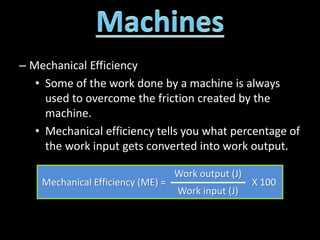
– Mechanical Efficiency
• Some of the work done by a machine is always
used to overcome the friction created by the
machine.
• Mechanical efficiency tells you what percentage of
the work input gets converted into work output.
Mechanical Efficiency (ME) =
Work output (J)
X 100
Work input (J)
– Mechanical Efficiency
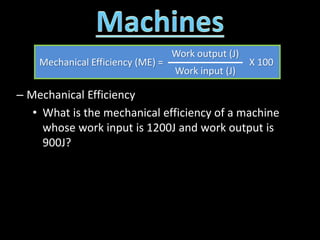
• What is the mechanical efficiency of a machine
whose work input is 1200J and work output is
900J?
Mechanical Efficiency (ME) =
Work output (J)
X 100
Work input (J)
– Mechanical Efficiency
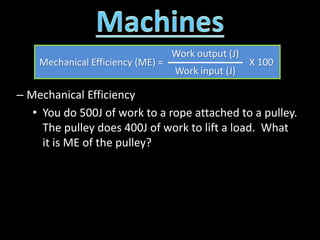
• You do 500J of work to a rope attached to a pulley.
The pulley does 400J of work to lift a load. What
it is ME of the pulley?
Mechanical Efficiency (ME) =
Work output (J)
X 100
Work input (J)
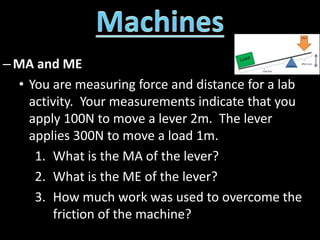
–MA and ME
• You are measuring force and distance for a lab
activity. Your measurements indicate that you
apply 100N to move a lever 2m. The lever
applies 300N to move a load 1m.
1. What is the MA of the lever?
2. What is the ME of the lever?
3. How much work was used to overcome the
friction of the machine?
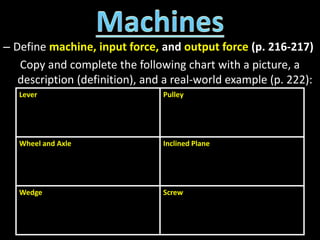
– Define machine, input force, and output force (p. 216-217)
Copy and complete the following chart with a picture, a
description (definition), and a real-world example (p. 222):
Lever Pulley
Wheel and Axle Inclined Plane
Wedge Screw
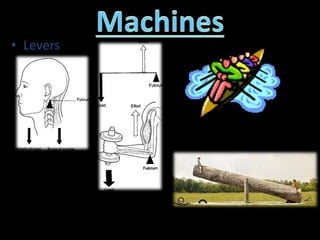
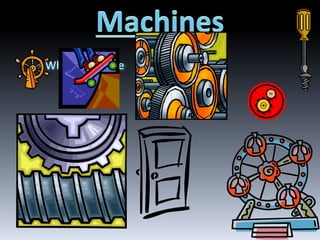
– Levers
• Levers
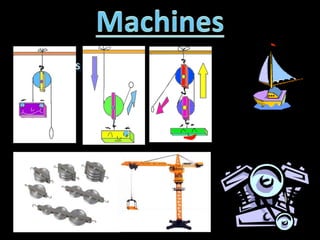
– Pulleys
– Wheel and Axle
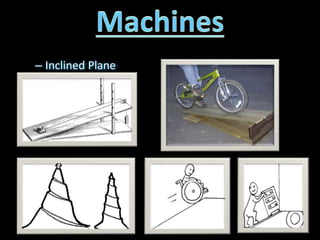
– Inclined Plane
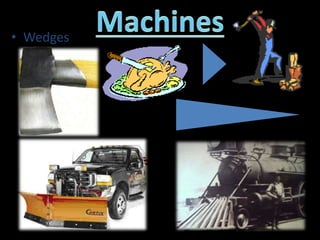
• Wedges
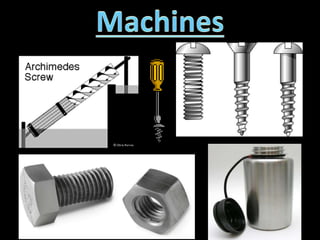
– Screw
1. Mr. Cox wants to remove the lid from a paint
can. What simple machine should he use as a
tool?
2. What type of simple machine is used to split
things apart?
3. Both the wedge and the lever are used in the
operation of which tool?
a) Shovel
b) steering wheel
c) Wheelbarrow
d) block and tackle (p. 224)
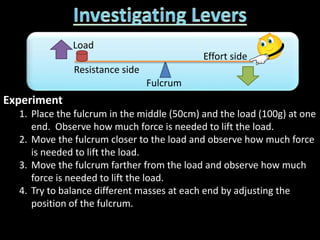
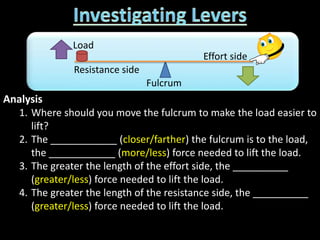
Load
Fulcrum
Effort side
Resistance side
Experiment
1. Place the fulcrum in the middle (50cm) and the load (100g) at one
end. Observe how much force is needed to lift the load.
2. Move the fulcrum closer to the load and observe how much force
is needed to lift the load.
3. Move the fulcrum farther from the load and observe how much
force is needed to lift the load.
4. Try to balance different masses at each end by adjusting the
position of the fulcrum.
Analysis
1. Where should you move the fulcrum to make the load easier to
lift?
2. The ____________ (closer/farther) the fulcrum is to the load,
the ____________ (more/less) force needed to lift the load.
3. The greater the length of the effort side, the __________
(greater/less) force needed to lift the load.
4. The greater the length of the resistance side, the __________
(greater/less) force needed to lift the load.
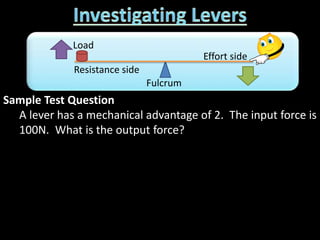
Load
Fulcrum
Effort side
Resistance side
Sample Test Question
A lever has a mechanical advantage of 2. The input force is
100N. What is the output force?
Load
Fulcrum
Effort side
Resistance side
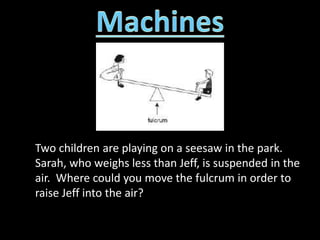
Two children are playing on a seesaw in the park.
Sarah, who weighs less than Jeff, is suspended in the
air. Where could you move the fulcrum in order to
raise Jeff into the air?
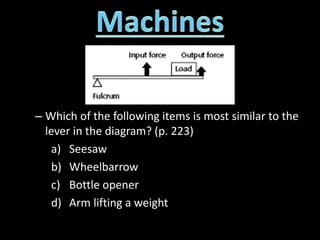
– Which of the following items is most similar to the
lever in the diagram? (p. 223)
a) Seesaw
b) Wheelbarrow
c) Bottle opener
d) Arm lifting a weight
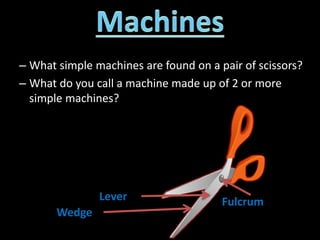
– What simple machines are found on a pair of scissors?
– What do you call a machine made up of 2 or more
simple machines?
Lever
Wedge
Fulcrum
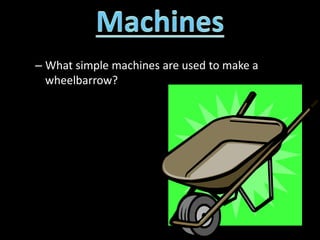
– What simple machines are used to make a
wheelbarrow?
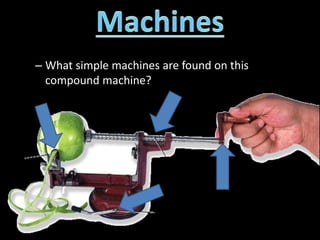
– What simple machines are found on this
compound machine?

Defining work and power

  • 1.
    AKS 15b –analyze the relationship between work, power, and time AKS 15c – explain how machines make work easier
  • 2.
    Brainstorming: What does itmean to “WORK”? Anticipation Guide: After completing the Before Reading portion, work with your group to write one question that would help you determine whether a statement (or statements) is true or false.
  • 3.
    Before reading Statement After reading Textevidence for or against (include the page # and paragraph # along with your citation) Write an “A” if you agree or “D” if you disagree for each statement. A force acting on an object does work even if the object doesn’t move. A mover who pushes a piece of furniture up a ramp and into a truck does the same work as a mover who simply lifts the piece of furniture directly onto the truck. Can it be proven mathematically? HOW? You are using more power if you do the same amount of work in a shorter time. Machines put out more work than we put in. Machines can increase the size of a force that is applied to a load The work you do on a machine (work input) is the same as the work the machine does on a load (work output)
  • 4.
    Questions (1st Period): 1.Is force the same as work? 2. How can we calculate work? 3. What is a load? 4. If you push something and it doesn’t move, is it still work? 5. How much work can machines put out? 6. What is work? 7. Does direction affect the force applied? 8. What is the difference between work input and work output?
  • 5.
    Questions (2nd Period): 1.What is the difference between power and work? 2. How much force is being applied to an object? 3. What is the sci. definition of work? 4. Can machines increase the size of force applied to a load? 5. Is the work you do on a machine the same as the work the machine does on a load? 6. Does the quality of the machine affect the amount done by the machine? 7. What is the difference between force and work? 8. How can you calculate the work done by simple machines?
  • 6.
    Questions (3rd Period): 1.What is the difference between work input and work output? 2. What effect do machines have on work and power? 3. How does angle/direction affect the work done on an object? 4. Do machines apply the same amount of force and distance as a human? 5. What is work? 6. Does an object need to move for work to be done? 7. What is a machine? 8. Can machines increase the magnitude of a force applied to a load?
  • 7.
    Questions (4th Period): 1.What is work? 2. How do machines make work easier? 3. In a shorter amount of time, if you use more power are you putting more work? 4. Does the amount of time you spend doing work affect the amount of work you do? 5. What are the differences between work input and work output? 6. Can machines increase the magnitude of a force applied to a load? 7. EPIC FAIL! 8. Do machines or people do more work?
  • 8.
    1. Analyze thepicture and formulate your own scientific definition of WORK. 2. Compare and contrast your definition of work to the definition on p. 129 of your Interactive Textbook. How are they similar and different? 3. SHOW AND TELL: Work with a classmate to prepare a short demonstration of WORK and NOT WORK. • Define WORK • 1 example of WORK w/ explanation • 1 non-example of WORK w/ explanation
  • 9.
    2N X 3m= 6N•m or 6 Joules (J) 600N X 0m = 0N•m or 0 Joules (J)
  • 10.
    Which of thefollowing actions do more work on an object? • Lifting an 80 N box 1 m up off the floor • Lifting a 160 N box 1 m up off the floor • Lifting a 90 N box 2 m up off the floor • Lifting a 100 N box 1.5 m up off the floor
  • 11.
    – In whichsituation is a person doing work on an object? a) A school crossing guard raises a stop sign that weighs 10N. b) A student walks 1m/s while wearing a backpack weighing 15N. c) A man exerts 500N of force on a rope attached to a house but the house doesn’t move. d) A worker holds a box 1m off the floor.
  • 12.
    Which example doesNOT involve work being done? a) A waiter carrying a food tray across a dining room. b) A person places a heavy box up on a high shelf. c) A rocket accelerates into space. d) A truck pulling a trailer
  • 13.
    • You lifta chair that weighs 50N to a height of 2m and carry it 10m across the room. How much work do you do on the chair?
  • 14.
    • You applya 200N force to move a 500N boulder 5m to the edge of a cliff. The boulder falls 100m. How much work did you do to the boulder?
  • 15.
    • You applya 200N force to move a 500N boulder 5m to the edge of a cliff. The boulder falls 100m. How much work did gravity do to the boulder?
  • 16.
    • A ropeis thrown over a beam and one end is tied to a 300N bundle of lumber. You pull the free end of the rope 2m with a force of 400N to lift the lumber off the ground. How much work have you done?
  • 17.
    A cart ispushed 10 m down the hall with a force of 100N in 5s. • How much work is done? • How much power is used?
  • 18.
    Record the fastesttimes in the chart below: Name Time (s) Analysis Copy and complete the following questions: 1. What was the work done in this demonstration? 2. Who did the most work? How do you know? 3. Which student was the most powerful? How do you know? 4. What factors (variables) may have affected your results?
  • 19.
    – What isthe advantage of using a power tool over a hand tool to do the same amount of work? a) It uses less force. b) It uses less energy. c) It requires less time. d) It requires more time. – REMEMBER: More power means you can work faster! 19
  • 20.
    20 Record the appropriateinformation in the spaces below: Student Name Force Distance Time Work Power Analysis 1. What was the work done in this experiment? 2. Who did the most work? 3. Which student was the most powerful? How do you know? 4. What factors (variables) may have affected your results? 2.2 kg = _____ N 1.1 kg = _____ N Power = Work (J) time (s)
  • 21.
    Mr. Cox andMrs. Steele each lift an identical stack of books the same distance onto a table, but Mr. Cox does the job twice as fast. Therefore his actions involve twice as much a) Work input b) Work output c) Power d) Efficiency
  • 22.
    Work = forceand motion in the same direction. Units = Joules (J) Power = the rate at which work is done. Units =Watts (W)
  • 23.
    Work = ____and ______ in the same ________. Units = ________ Power = the _____ at which ______ is done. Units = ________
  • 24.
    – Mechanical Advantageand Efficiency • What does it mean to have an ADVANTAGE? • What does EFFICIENT mean?
  • 25.
    – Mechanical Advantage •Some machines can make work easier by increasing force applied to an object. • Mechanical advantage is the number of times a machine multiplies the force. Mechanical Advantage (MA) = Output force (N) Input force (N)
  • 26.
    – Mechanical Advantage •A mechanic uses a pulley to lift an engine out of a car. She applies a force of 200N to one end of the rope and the rope applies a force of 600N to the engine. What is the mechanical advantage of the pulley? Mechanical Advantage (MA) = Output force (N) Input force (N)
  • 27.
    – Mechanical Advantage •Suppose that you exert 60N on a machine and the machine exerts 240N on another object. What is the machine’s mechanical advantage? Mechanical Advantage (MA) = Output force (N) Input force (N)
  • 28.
    – Mechanical Advantage •A worker uses a lever to lift a load. She applies a force of 100N and the lever applies a force of 25N. What is the mechanical advantage of the lever? Mechanical Advantage (MA) = Output force (N) Input force (N)
  • 29.
    – Mechanical Efficiency •Some of the work done by a machine is always used to overcome the friction created by the machine. • Mechanical efficiency tells you what percentage of the work input gets converted into work output. Mechanical Efficiency (ME) = Work output (J) X 100 Work input (J)
  • 30.
    – Mechanical Efficiency •What is the mechanical efficiency of a machine whose work input is 1200J and work output is 900J? Mechanical Efficiency (ME) = Work output (J) X 100 Work input (J)
  • 31.
    – Mechanical Efficiency •You do 500J of work to a rope attached to a pulley. The pulley does 400J of work to lift a load. What it is ME of the pulley? Mechanical Efficiency (ME) = Work output (J) X 100 Work input (J)
  • 32.
    –MA and ME •You are measuring force and distance for a lab activity. Your measurements indicate that you apply 100N to move a lever 2m. The lever applies 300N to move a load 1m. 1. What is the MA of the lever? 2. What is the ME of the lever? 3. How much work was used to overcome the friction of the machine?
  • 33.
    – Define machine,input force, and output force (p. 216-217) Copy and complete the following chart with a picture, a description (definition), and a real-world example (p. 222): Lever Pulley Wheel and Axle Inclined Plane Wedge Screw
  • 34.
  • 35.
  • 36.
  • 37.
  • 38.
  • 39.
  • 40.
    1. Mr. Coxwants to remove the lid from a paint can. What simple machine should he use as a tool? 2. What type of simple machine is used to split things apart? 3. Both the wedge and the lever are used in the operation of which tool? a) Shovel b) steering wheel c) Wheelbarrow d) block and tackle (p. 224)
  • 41.
    Load Fulcrum Effort side Resistance side Experiment 1.Place the fulcrum in the middle (50cm) and the load (100g) at one end. Observe how much force is needed to lift the load. 2. Move the fulcrum closer to the load and observe how much force is needed to lift the load. 3. Move the fulcrum farther from the load and observe how much force is needed to lift the load. 4. Try to balance different masses at each end by adjusting the position of the fulcrum.
  • 42.
    Analysis 1. Where shouldyou move the fulcrum to make the load easier to lift? 2. The ____________ (closer/farther) the fulcrum is to the load, the ____________ (more/less) force needed to lift the load. 3. The greater the length of the effort side, the __________ (greater/less) force needed to lift the load. 4. The greater the length of the resistance side, the __________ (greater/less) force needed to lift the load. Load Fulcrum Effort side Resistance side
  • 43.
    Sample Test Question Alever has a mechanical advantage of 2. The input force is 100N. What is the output force? Load Fulcrum Effort side Resistance side
  • 44.
    Two children areplaying on a seesaw in the park. Sarah, who weighs less than Jeff, is suspended in the air. Where could you move the fulcrum in order to raise Jeff into the air?
  • 45.
    – Which ofthe following items is most similar to the lever in the diagram? (p. 223) a) Seesaw b) Wheelbarrow c) Bottle opener d) Arm lifting a weight
  • 46.
    – What simplemachines are found on a pair of scissors? – What do you call a machine made up of 2 or more simple machines? Lever Wedge Fulcrum
  • 47.
    – What simplemachines are used to make a wheelbarrow?
  • 48.
    – What simplemachines are found on this compound machine?