14.1 Work and Power
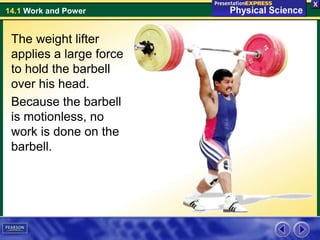
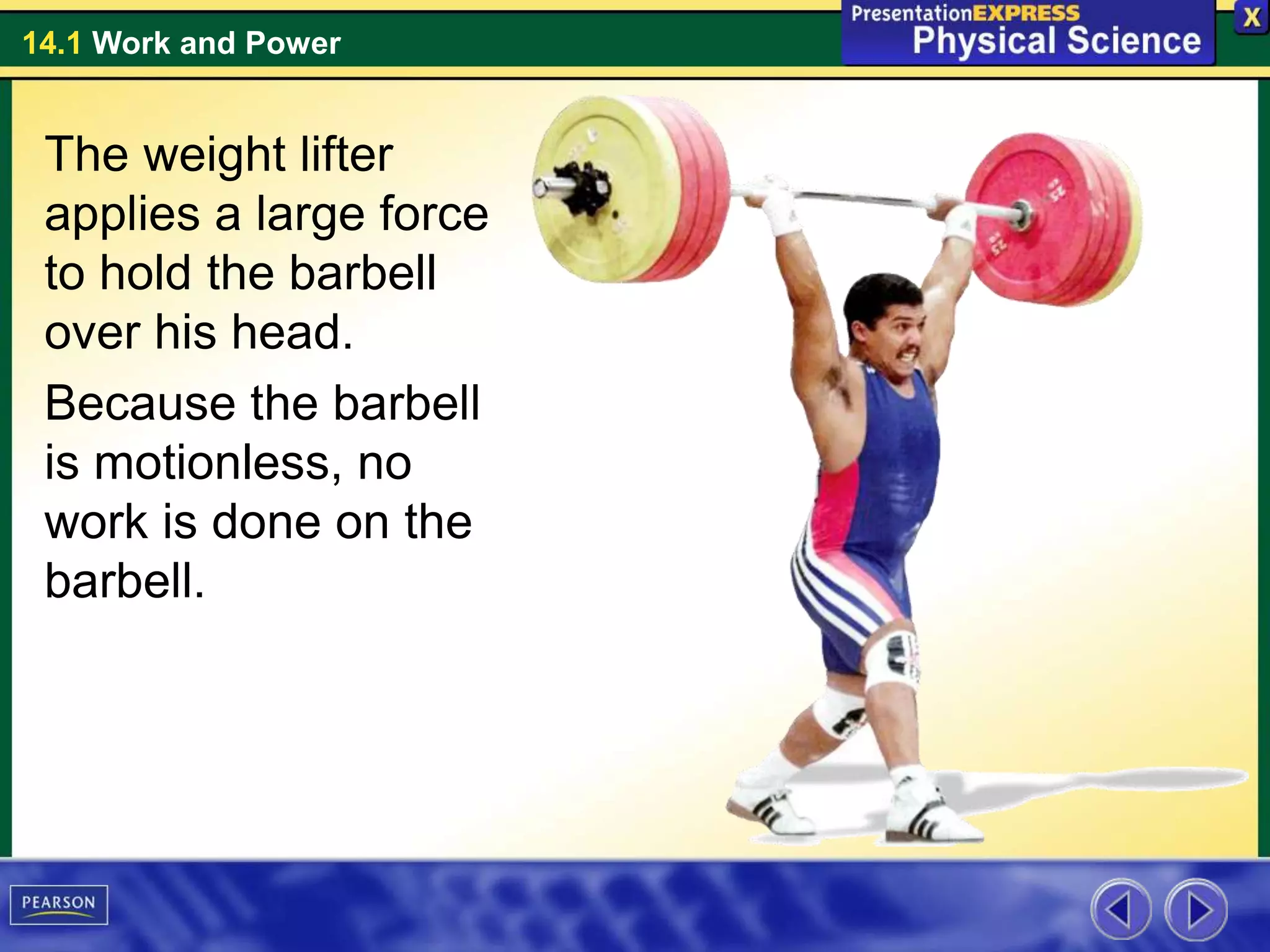
The weight lifter
applies a large force
to hold the barbell
over his head.
Because the barbell
is motionless, no
work is done on the
barbell.
14.1 Work and Power
When does a force do work?
In science, work is the product of force and
distance.
What Is Work?
14.1 Work and Power
For a force to do work on an object, some of
the force must act in the same direction as
the object moves. If there is no movement,
no work is done.
What Is Work?
Any part of a force that does not act in the
direction of motion does no work on an
object.
14.1 Work and Power
Work is done when a force acts on an object in
the direction the object moves. Work is done
when the weightlifter exerts an upward force to
raise the barbell.
What Is Work?
14.1 Work and Power
Work Requires Motion
The weight lifter does no work on the
barbell as he holds it over his head. The
force applied to the barbell does not
cause it to move.
What Is Work?
14.1 Work and Power
Work Depends on Direction
• If all of the force acts in the same
direction as the motion, all of the force
does work.
• If part of the applied force acts in the
direction of motion, that part of the
force does work.
• If none of the force is applied in the
direction of the motion, the force does
no work.
What Is Work?
14.1 Work and Power
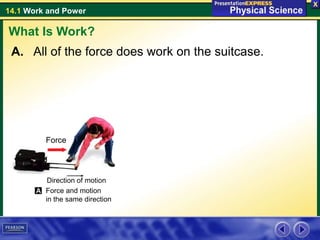
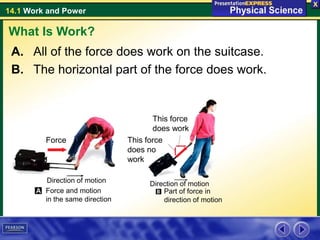
A. All of the force does work on the suitcase.
What Is Work?
Force
Direction of motion
Force and motion
in the same direction
14.1 Work and Power
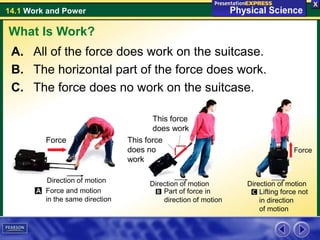
A. All of the force does work on the suitcase.
B. The horizontal part of the force does work.
What Is Work?
Force
This force
does work
This force
does no
work
Direction of motion Direction of motion
Force and motion
in the same direction
Part of force in
direction of motion
14.1 Work and Power
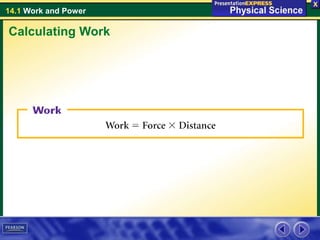
A. All of the force does work on the suitcase.
B. The horizontal part of the force does work.
C. The force does no work on the suitcase.
What Is Work?
Force
This force
does work
This force
does no
work
Force
Direction of motion Direction of motion Direction of motion
Force and motion
in the same direction
Part of force in
direction of motion
Lifting force not
in direction
of motion
14.1 Work and Power
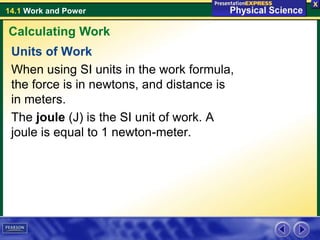
Calculating Work
14.1 Work and Power
Units of Work
When using SI units in the work formula,
the force is in newtons, and distance is
in meters.
The joule (J) is the SI unit of work. A
joule is equal to 1 newton-meter.
Calculating Work
14.1 Work and Power
Using the Work Formula
A weight lifter raises a 1600-newton
barbell to a height of 2.0 meters.
• Work = Force × Distance
• Work = 1600 N × 2.0 m
• Work = 3200 N·m = 3200 J
Calculating Work
14.1 Work and Power
How are work and power related?
Power is the rate of doing work.
What Is Power?
Doing work at a faster rate requires more
power. To increase power, you can increase
the amount of work done in a given time, or
you can do a given amount of work in less
time.
14.1 Work and Power
Work is required to move snow from one
location to another. A person using a shovel
and a person using a snow blower can both do
the work needed to remove the snow.
The snow blower can do the job much faster
because it has more power.
What Is Power?
14.1 Work and Power
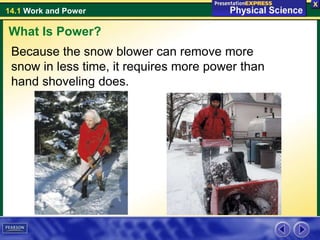
Because the snow blower can remove more
snow in less time, it requires more power than
hand shoveling does.
What Is Power?
14.1 Work and Power
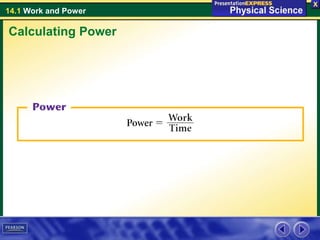
Calculating Power
14.1 Work and Power
When using SI units in the power formula,
work is measured in joules (J), and time is
measured in seconds (s).
The SI unit of power is the watt (W), which is
equal to one joule per second.
Calculating Power
14.1 Work and Power
Calculating Power
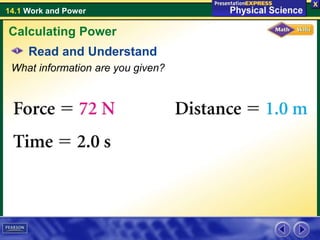
You exert a vertical force of 72 newtons to lift a
box to a height of 1.0 meter in a time of 2.0
seconds. How much power is used to lift the box?
Calculating Power
14.1 Work and Power
Read and Understand
What information are you given?
Calculating Power
14.1 Work and Power
Read and Understand
What information are you given?
Calculating Power
14.1 Work and Power
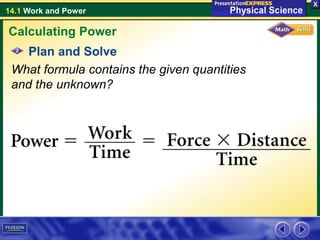
Plan and Solve
What formula contains the given quantities
and the unknown?
Calculating Power
14.1 Work and Power
Plan and Solve
What formula contains the given quantities
and the unknown?
Calculating Power
14.1 Work and Power
Plan and Solve
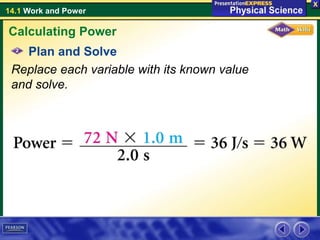
Replace each variable with its known value
and solve.
Calculating Power
14.1 Work and Power
Plan and Solve
Replace each variable with its known value
and solve.
Calculating Power
14.1 Work and Power
Look Back and Check
Is your answer reasonable?
Calculating Power
14.1 Work and Power
Look Back and Check
Is your answer reasonable?
36 watts is not a lot of power, which seems
reasonable considering the box was lifted
slowly, through a height of only 1 meter.
Calculating Power
14.1 Work and Power
1. Your family is moving to a new apartment.
While lifting a box 1.5 m straight up to put it on
a truck, you exert an upward force of 200 N for
1.0 s. How much power is required to do this?
Calculating Power
14.1 Work and Power
1. Your family is moving to a new apartment.
While lifting a box 1.5 m straight up to put it on
a truck, you exert an upward force of 200 N for
1.0 s. How much power is required to do this?
Answer: Work = Force × Distance =
200 N × 1.5 m = 300 J
Power = Work/Time = 300 J/1.0 s = 300 W
Calculating Power
14.1 Work and Power
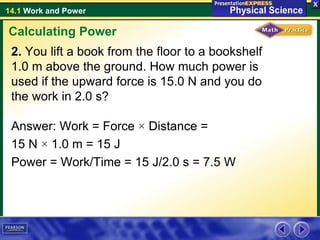
2. You lift a book from the floor to a bookshelf
1.0 m above the ground. How much power is
used if the upward force is 15.0 N and you do
the work in 2.0 s?
Calculating Power
14.1 Work and Power
2. You lift a book from the floor to a bookshelf
1.0 m above the ground. How much power is
used if the upward force is 15.0 N and you do
the work in 2.0 s?
Answer: Work = Force × Distance =
15 N × 1.0 m = 15 J
Power = Work/Time = 15 J/2.0 s = 7.5 W
Calculating Power
14.1 Work and Power
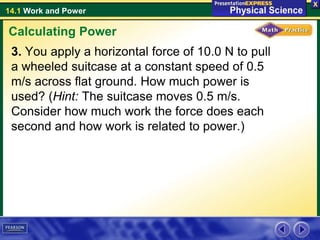
3. You apply a horizontal force of 10.0 N to pull
a wheeled suitcase at a constant speed of 0.5
m/s across flat ground. How much power is
used? (Hint: The suitcase moves 0.5 m/s.
Consider how much work the force does each
second and how work is related to power.)
Calculating Power
14.1 Work and Power
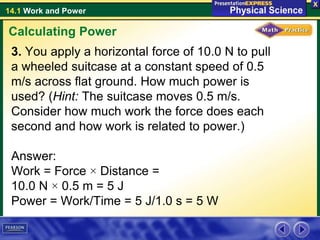
3. You apply a horizontal force of 10.0 N to pull
a wheeled suitcase at a constant speed of 0.5
m/s across flat ground. How much power is
used? (Hint: The suitcase moves 0.5 m/s.
Consider how much work the force does each
second and how work is related to power.)
Answer:
Work = Force × Distance =
10.0 N × 0.5 m = 5 J
Power = Work/Time = 5 J/1.0 s = 5 W
Calculating Power
14.1 Work and Power
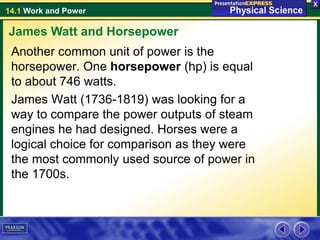
Another common unit of power is the
horsepower. One horsepower (hp) is equal
to about 746 watts.
James Watt (1736-1819) was looking for a
way to compare the power outputs of steam
engines he had designed. Horses were a
logical choice for comparison as they were
the most commonly used source of power in
the 1700s.
James Watt and Horsepower
14.1 Work and Power
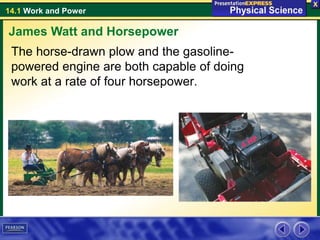
The horse-drawn plow and the gasoline-
powered engine are both capable of doing
work at a rate of four horsepower.
James Watt and Horsepower
14.1 Work and Power
Assessment Questions
1. In which of the following cases is work being done
on an object?
a. pushing against a locked door
b. suspending a heavy weight with a strong chain
c. pulling a trailer up a hill
d. carrying a box down a corridor
14.1 Work and Power
Assessment Questions
1. In which of the following cases is work being done
on an object?
a. pushing against a locked door
b. suspending a heavy weight with a strong chain
c. pulling a trailer up a hill
d. carrying a box down a corridor
ANS: C
14.1 Work and Power
Assessment Questions
2. A tractor exerts a force of 20,000 newtons to
move a trailer 8 meters. How much work was
done on the trailer?
a. 2,500 J
b. 4,000 J
c. 20,000 J
d. 160,000 J
14.1 Work and Power
Assessment Questions
2. A tractor exerts a force of 20,000 newtons to
move a trailer 8 meters. How much work was
done on the trailer?
a. 2,500 J
b. 4,000 J
c. 20,000 J
d. 160,000 J
ANS: D
14.1 Work and Power
Assessment Questions
3. A car exerts a force of 500 newtons to pull a boat
100 meters in 10 seconds. How much power does
the car use?
a. 5000 W
b. 6000 W
c. 50 W
d. 1000 W
14.1 Work and Power
Assessment Questions
3. A car exerts a force of 500 newtons to pull a boat
100 meters in 10 seconds. How much power does
the car use?
a. 5000 W
b. 6000 W
c. 50 W
d. 1000 W
ANS: A
14.1 Work and Power
Assessment Questions
4. One horsepower is a unit of power equal to
a. 0.746 W.
b. 1.0 W.
c. 746 W.
d. 2,000 W.
14.1 Work and Power
Assessment Questions
4. One horsepower is a unit of power equal to
a. 0.746 W.
b. 1.0 W.
c. 746 W.
d. 2,000 W.
ANS: C

Ch14.1 powerpoint

  • 1.
    14.1 Work andPower The weight lifter applies a large force to hold the barbell over his head. Because the barbell is motionless, no work is done on the barbell.
  • 2.
    14.1 Work andPower When does a force do work? In science, work is the product of force and distance. What Is Work?
  • 3.
    14.1 Work andPower For a force to do work on an object, some of the force must act in the same direction as the object moves. If there is no movement, no work is done. What Is Work? Any part of a force that does not act in the direction of motion does no work on an object.
  • 4.
    14.1 Work andPower Work is done when a force acts on an object in the direction the object moves. Work is done when the weightlifter exerts an upward force to raise the barbell. What Is Work?
  • 5.
    14.1 Work andPower Work Requires Motion The weight lifter does no work on the barbell as he holds it over his head. The force applied to the barbell does not cause it to move. What Is Work?
  • 6.
    14.1 Work andPower Work Depends on Direction • If all of the force acts in the same direction as the motion, all of the force does work. • If part of the applied force acts in the direction of motion, that part of the force does work. • If none of the force is applied in the direction of the motion, the force does no work. What Is Work?
  • 7.
    14.1 Work andPower A. All of the force does work on the suitcase. What Is Work? Force Direction of motion Force and motion in the same direction
  • 8.
    14.1 Work andPower A. All of the force does work on the suitcase. B. The horizontal part of the force does work. What Is Work? Force This force does work This force does no work Direction of motion Direction of motion Force and motion in the same direction Part of force in direction of motion
  • 9.
    14.1 Work andPower A. All of the force does work on the suitcase. B. The horizontal part of the force does work. C. The force does no work on the suitcase. What Is Work? Force This force does work This force does no work Force Direction of motion Direction of motion Direction of motion Force and motion in the same direction Part of force in direction of motion Lifting force not in direction of motion
  • 10.
    14.1 Work andPower Calculating Work
  • 11.
    14.1 Work andPower Units of Work When using SI units in the work formula, the force is in newtons, and distance is in meters. The joule (J) is the SI unit of work. A joule is equal to 1 newton-meter. Calculating Work
  • 12.
    14.1 Work andPower Using the Work Formula A weight lifter raises a 1600-newton barbell to a height of 2.0 meters. • Work = Force × Distance • Work = 1600 N × 2.0 m • Work = 3200 N·m = 3200 J Calculating Work
  • 13.
    14.1 Work andPower How are work and power related? Power is the rate of doing work. What Is Power? Doing work at a faster rate requires more power. To increase power, you can increase the amount of work done in a given time, or you can do a given amount of work in less time.
  • 14.
    14.1 Work andPower Work is required to move snow from one location to another. A person using a shovel and a person using a snow blower can both do the work needed to remove the snow. The snow blower can do the job much faster because it has more power. What Is Power?
  • 15.
    14.1 Work andPower Because the snow blower can remove more snow in less time, it requires more power than hand shoveling does. What Is Power?
  • 16.
    14.1 Work andPower Calculating Power
  • 17.
    14.1 Work andPower When using SI units in the power formula, work is measured in joules (J), and time is measured in seconds (s). The SI unit of power is the watt (W), which is equal to one joule per second. Calculating Power
  • 18.
    14.1 Work andPower Calculating Power You exert a vertical force of 72 newtons to lift a box to a height of 1.0 meter in a time of 2.0 seconds. How much power is used to lift the box? Calculating Power
  • 19.
    14.1 Work andPower Read and Understand What information are you given? Calculating Power
  • 20.
    14.1 Work andPower Read and Understand What information are you given? Calculating Power
  • 21.
    14.1 Work andPower Plan and Solve What formula contains the given quantities and the unknown? Calculating Power
  • 22.
    14.1 Work andPower Plan and Solve What formula contains the given quantities and the unknown? Calculating Power
  • 23.
    14.1 Work andPower Plan and Solve Replace each variable with its known value and solve. Calculating Power
  • 24.
    14.1 Work andPower Plan and Solve Replace each variable with its known value and solve. Calculating Power
  • 25.
    14.1 Work andPower Look Back and Check Is your answer reasonable? Calculating Power
  • 26.
    14.1 Work andPower Look Back and Check Is your answer reasonable? 36 watts is not a lot of power, which seems reasonable considering the box was lifted slowly, through a height of only 1 meter. Calculating Power
  • 27.
    14.1 Work andPower 1. Your family is moving to a new apartment. While lifting a box 1.5 m straight up to put it on a truck, you exert an upward force of 200 N for 1.0 s. How much power is required to do this? Calculating Power
  • 28.
    14.1 Work andPower 1. Your family is moving to a new apartment. While lifting a box 1.5 m straight up to put it on a truck, you exert an upward force of 200 N for 1.0 s. How much power is required to do this? Answer: Work = Force × Distance = 200 N × 1.5 m = 300 J Power = Work/Time = 300 J/1.0 s = 300 W Calculating Power
  • 29.
    14.1 Work andPower 2. You lift a book from the floor to a bookshelf 1.0 m above the ground. How much power is used if the upward force is 15.0 N and you do the work in 2.0 s? Calculating Power
  • 30.
    14.1 Work andPower 2. You lift a book from the floor to a bookshelf 1.0 m above the ground. How much power is used if the upward force is 15.0 N and you do the work in 2.0 s? Answer: Work = Force × Distance = 15 N × 1.0 m = 15 J Power = Work/Time = 15 J/2.0 s = 7.5 W Calculating Power
  • 31.
    14.1 Work andPower 3. You apply a horizontal force of 10.0 N to pull a wheeled suitcase at a constant speed of 0.5 m/s across flat ground. How much power is used? (Hint: The suitcase moves 0.5 m/s. Consider how much work the force does each second and how work is related to power.) Calculating Power
  • 32.
    14.1 Work andPower 3. You apply a horizontal force of 10.0 N to pull a wheeled suitcase at a constant speed of 0.5 m/s across flat ground. How much power is used? (Hint: The suitcase moves 0.5 m/s. Consider how much work the force does each second and how work is related to power.) Answer: Work = Force × Distance = 10.0 N × 0.5 m = 5 J Power = Work/Time = 5 J/1.0 s = 5 W Calculating Power
  • 33.
    14.1 Work andPower Another common unit of power is the horsepower. One horsepower (hp) is equal to about 746 watts. James Watt (1736-1819) was looking for a way to compare the power outputs of steam engines he had designed. Horses were a logical choice for comparison as they were the most commonly used source of power in the 1700s. James Watt and Horsepower
  • 34.
    14.1 Work andPower The horse-drawn plow and the gasoline- powered engine are both capable of doing work at a rate of four horsepower. James Watt and Horsepower
  • 35.
    14.1 Work andPower Assessment Questions 1. In which of the following cases is work being done on an object? a. pushing against a locked door b. suspending a heavy weight with a strong chain c. pulling a trailer up a hill d. carrying a box down a corridor
  • 36.
    14.1 Work andPower Assessment Questions 1. In which of the following cases is work being done on an object? a. pushing against a locked door b. suspending a heavy weight with a strong chain c. pulling a trailer up a hill d. carrying a box down a corridor ANS: C
  • 37.
    14.1 Work andPower Assessment Questions 2. A tractor exerts a force of 20,000 newtons to move a trailer 8 meters. How much work was done on the trailer? a. 2,500 J b. 4,000 J c. 20,000 J d. 160,000 J
  • 38.
    14.1 Work andPower Assessment Questions 2. A tractor exerts a force of 20,000 newtons to move a trailer 8 meters. How much work was done on the trailer? a. 2,500 J b. 4,000 J c. 20,000 J d. 160,000 J ANS: D
  • 39.
    14.1 Work andPower Assessment Questions 3. A car exerts a force of 500 newtons to pull a boat 100 meters in 10 seconds. How much power does the car use? a. 5000 W b. 6000 W c. 50 W d. 1000 W
  • 40.
    14.1 Work andPower Assessment Questions 3. A car exerts a force of 500 newtons to pull a boat 100 meters in 10 seconds. How much power does the car use? a. 5000 W b. 6000 W c. 50 W d. 1000 W ANS: A
  • 41.
    14.1 Work andPower Assessment Questions 4. One horsepower is a unit of power equal to a. 0.746 W. b. 1.0 W. c. 746 W. d. 2,000 W.
  • 42.
    14.1 Work andPower Assessment Questions 4. One horsepower is a unit of power equal to a. 0.746 W. b. 1.0 W. c. 746 W. d. 2,000 W. ANS: C