Wireless sensor network survey
Author: Jennifer Yick, Biswanath Mukherjee, Dipak Ghosal
Reported by Jiang
2
Introduction
•
Subject: wireless sensor network (WSN)
•
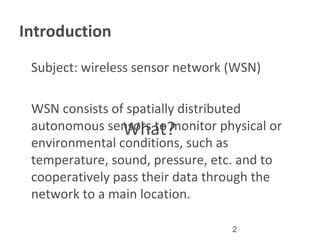
WSN consists of spatially distributed
autonomous sensors to monitor physical or
environmental conditions, such as
temperature, sound, pressure, etc. and to
cooperatively pass their data through the
network to a main location.
What?
3
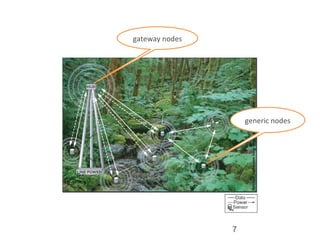
Overall image
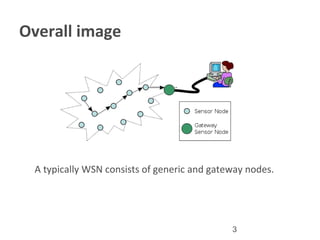
A typically WSN consists of generic and gateway nodes.
4
Typically WSN
•
A WSN typically has little or no infrastructure.
There are two types of WSNs.

Structured WSN

Unstructured WSN
5
Structured WSN
•
Deployed in a pre-planned manner
•
Fewer nodes
•
Lower network maintenance
•
Lower cost
•
No uncovered regions
6
Unstructured WSN
•
Densely deployed (many node)
•
Randomly Deployed
•
Can have uncovered regions
•
Left unattended to perform the task
•
Maintenance is difficult
a . managing connectivity
b. detecting failures
7
generic nodes
gateway nodes
8
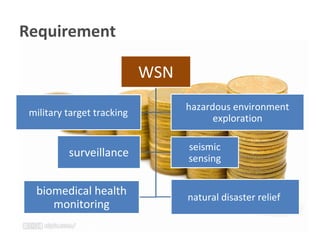
Requirement
WSN
military target tracking
hazardous environment
exploration
natural disaster relief
surveillance
biomedical health
monitoring
seismic
sensing
9
Why we select WSN ?
Not traditional networks.
•
Power and environment constraints
determine us to design a lower power,
feasible, and smart network.
•
Sensors that are smaller, cheaper, and
intelligent.
10
About this paper
•
Goal: present a comprehensive review of the
recent literature.
a . An overview of the key issues in a WSN
b. Compare different types of sensor
networks
c. Applications on WSN
d. Internal sensor system
e . Network services
f. Communication protocol
11
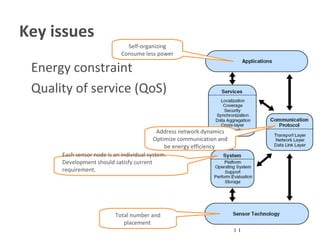
Key issues
•
Energy constraint
•
Quality of service (QoS)
Each sensor node is an individual system.
Development should satisfy current
requirement.
Self-organizing
Consume less power
Total number and
placement
Address network dynamics
Optimize communication and
be energy efficiency
12
Types of sensor networks
1. terrestrial WSN
•
Ad Hoc (unstructured)
•
Preplanned (structured)
1. underground WSN
•
Preplanned, with additional sink nodes to relay data.
•
more expensive equipment, deployment,
maintenance
1. underwater WSN
•
fewer sensor nodes( sparse deployment)
•
more expensive than terrestrial
•
acoustic wave communication
–
Limited bandwidth
–
long propagation delay
–
signal fading
13
Types of sensor networks(cont.)
4. multi-media WSN
•
sensor nodes equipped with cameras and
microphones
•
pre-planned to guarantee coverage
•
High bandwidth/low energy, QoS, filtering, data
processing and compressing techniques
4. mobile WSN
•
ability to reposition and organize itself in the network
•
Start with Initial deployment and spread out to gather
information
•
deployment, localization, self-organization, navigation
and control, coverage, energy, maintenance, data
14
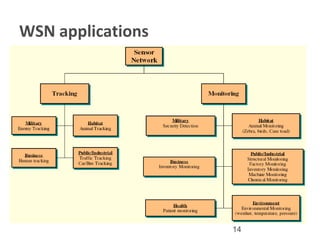
WSN applications
15
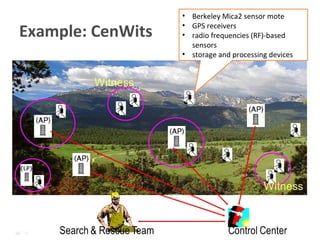
Example: CenWits
• Berkeley Mica2 sensor mote
• GPS receivers
• radio frequencies (RF)-based
sensors
• storage and processing devices
16
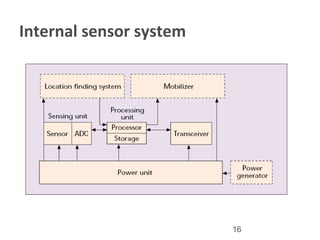
Internal sensor system
17
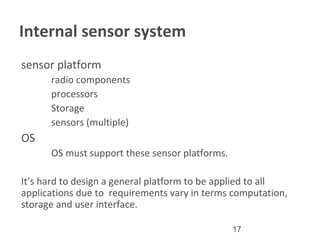
Internal sensor system
•
sensor platform
–
radio components
–
processors
–
Storage
–
sensors (multiple)
•
OS
–
OS must support these sensor platforms.
It’s hard to design a general platform to be applied to all
applications due to requirements vary in terms computation,
storage and user interface.
18
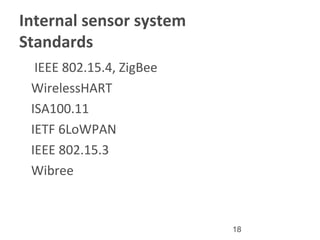
Internal sensor system
Standards
•
IEEE 802.15.4, ZigBee
•
WirelessHART
•
ISA100.11
•
IETF 6LoWPAN
•
IEEE 802.15.3
•
Wibree
19
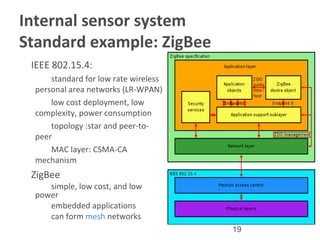
Internal sensor system
Standard example: ZigBee
•
IEEE 802.15.4:
–
standard for low rate wireless
personal area networks (LR-WPAN)
–
low cost deployment, low
complexity, power consumption
–
topology :star and peer-to-
peer
–
MAC layer: CSMA-CA
mechanism
•
ZigBee
–
simple, low cost, and low
power
–
embedded applications
–
can form mesh networks
20
Internal sensor system
Storage
•
problems
–
storage space is limited
–
Communication is expensive
•
Solutions
–
Aggregation and compression
–
query-and-collect (selective gathering)
–
a storage model to satisfy storage constraints and query
requirements
21
Internal sensor system
Testbeds
•
Provides researchers a way to test their protocols,
algorithms, network issues and applications in real
world setting
•
Controlled environment to deploy, configure, run,
and monitoring of sensor remotely
22
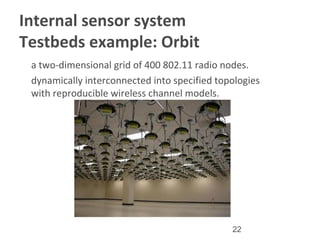
Internal sensor system
Testbeds example: Orbit
•
a two-dimensional grid of 400 802.11 radio nodes.
•
dynamically interconnected into specified topologies
with reproducible wireless channel models.
23
Internal sensor system
Diagnostics and debugging support
•
Measure and monitor the sensor node
performance of the overall network
•
To guarantee the success of the sensor
network in the real environment
24
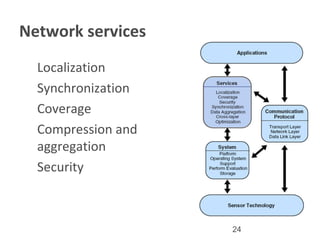
Network services
a . Localization
b. Synchronization
c. Coverage
d. Compression and
aggregation
e . Security
25
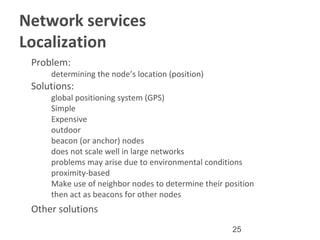
Network services
Localization
•
Problem:
–
determining the node’s location (position)
•
Solutions:
–
global positioning system (GPS)
•
Simple
•
Expensive
•
outdoor
–
beacon (or anchor) nodes
•
does not scale well in large networks
•
problems may arise due to environmental conditions
–
proximity-based
•
Make use of neighbor nodes to determine their position
•
then act as beacons for other nodes
•
Other solutions
26
Network services
Synchronization
•
Time synchronization is important for
–
routing
–
power conservation
–
Lifetime
–
Cooperation
–
Scheduling
27
Network services
Coverage
•
Is important in evaluating effectiveness
•
Degree of coverage is application dependent
•
Impacts on energy conservation
•
Techniques:
–
selecting minimal set of active nodes to be
awake to maintain coverage
–
sensor deployment strategies
28
Network services
Compression and aggregation
•
Both of them
–
reduce communication cost
–
increase reliability of data transfer
•
Data-compression
–
compressing data before transmission to base
–
Decompression occurs at the base station
–
no information should be lost
•
data aggregation
–
data is collected from multiple sensors
–
combined together to transmit to base station
–
Is used in cluster base architectures
29
Network services
Security
•
Constraints in incorporating security into a
WSN
–
limitations in storage
–
limitations in communication
–
limitations in computation
–
limitations in processing capabilities
30
Network services
Open research issues
•
localization
–
efficient algorithms
–
minimum energy
–
minimum cost
–
minimum localization errors
•
Coverage: optimizing for better energy conservation
•
time synchronization: minimizing uncertainty errors over long periods of
time and dealing with precision
•
compression and aggregation: Development of various scheme
–
event-based data collection
–
continuous data collection
•
Secure monitoring: protocols have to monitor, detect, and respond to
attacks
–
It has done for network and data-link layer (can be improved)
–
Should be done for different layers of the protocol stack
–
Cross-layer secure monitoring is another research area
31
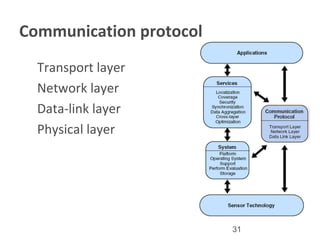
Communication protocol
a . Transport layer
b. Network layer
c. Data-link layer
d. Physical layer
32
Communication protocol
Transport layer
•
Packet loss
–
may be due to
•
bad radio communication,
•
congestion,
•
packet collision,
•
memory full,
•
node failures
–
Detection and recovering
•
Improve throughput
•
Energy expenditure
33
Communication protocol
Transport layer
•
Congestion control/packet recovery
–
hop-by-hop
•
intermediate cache
•
more energy efficient (shorter
retransmission)
•
higher reliability
–
end-to-end
•
source caches the packet
•
Variable reliability
34
Communication protocol
Transport layer(Open research issues)
•
cross-layer optimization
–
selecting better paths for retransmission
–
getting error reports from the link layer
•
Fairness
–
assign packets with priority
–
frequently-changing topology
•
Congestion control with active queue
management
35
Communication protocol
Network layer
•
Important:
–
energy efficiency
–
traffic flows
•
Routing protocols
–
location-based: considers node location to route
data
–
cluster-based: employs cluster heads to do data
aggregation and relay to base station
36
Communication protocol
Network layer (Open research issues)
•
Future research issues should address
–
Security
•
Experimental studies regarding security applied to
different routing protocols in WSNs should be examined
–
QoS
•
guarantees end-to-end delay and energy efficient routing
–
node mobility
•
handle frequent topology changes and reliable delivery
37
Communication protocol
Data-link layer (Open research issues)
•
system performance optimization
•
Cross-layer optimization
–
Cross-layer interaction can
•
reduce packet overhead on each layer
•
reduce energy consumption
–
Interaction with the MAC layer provide
•
congestion control information
•
enhance route selection
–
Comparing performance of existing protocols of static
network in a mobile network
–
improve communication reliability and energy efficiency
38
Communication protocol
Physical layer
•
Minimizing the energy consumption
–
Optimizing of circuitry energy
•
reduction of wakeup and startup times
–
Optimizing of transmission energy
•
Modulation schemes
•
Future work
–
new innovations in low power radio design with emerging
technologies
–
exploring ultra-wideband techniques as an alternative for
communication
–
creating simple modulation schemes to reduce synchronization and
transmission power
–
building more energy-efficient protocols and algorithms
39
Communication protocol
Cross-layer interactions (Open research issues)
•
Collaboration between all the layers to
achieve higher
–
energy saving
–
network performance
–
network lifetime
40
Thanks!
That’s all for today.

Wireless sensor network survey

  • 1.
    Wireless sensor networksurvey Author: Jennifer Yick, Biswanath Mukherjee, Dipak Ghosal Reported by Jiang
  • 2.
    2 Introduction • Subject: wireless sensornetwork (WSN) • WSN consists of spatially distributed autonomous sensors to monitor physical or environmental conditions, such as temperature, sound, pressure, etc. and to cooperatively pass their data through the network to a main location. What?
  • 3.
    3 Overall image A typicallyWSN consists of generic and gateway nodes.
  • 4.
    4 Typically WSN • A WSNtypically has little or no infrastructure. There are two types of WSNs.  Structured WSN  Unstructured WSN
  • 5.
    5 Structured WSN • Deployed ina pre-planned manner • Fewer nodes • Lower network maintenance • Lower cost • No uncovered regions
  • 6.
    6 Unstructured WSN • Densely deployed(many node) • Randomly Deployed • Can have uncovered regions • Left unattended to perform the task • Maintenance is difficult a . managing connectivity b. detecting failures
  • 7.
  • 8.
    8 Requirement WSN military target tracking hazardousenvironment exploration natural disaster relief surveillance biomedical health monitoring seismic sensing
  • 9.
    9 Why we selectWSN ? Not traditional networks. • Power and environment constraints determine us to design a lower power, feasible, and smart network. • Sensors that are smaller, cheaper, and intelligent.
  • 10.
    10 About this paper • Goal:present a comprehensive review of the recent literature. a . An overview of the key issues in a WSN b. Compare different types of sensor networks c. Applications on WSN d. Internal sensor system e . Network services f. Communication protocol
  • 11.
    11 Key issues • Energy constraint • Qualityof service (QoS) Each sensor node is an individual system. Development should satisfy current requirement. Self-organizing Consume less power Total number and placement Address network dynamics Optimize communication and be energy efficiency
  • 12.
    12 Types of sensornetworks 1. terrestrial WSN • Ad Hoc (unstructured) • Preplanned (structured) 1. underground WSN • Preplanned, with additional sink nodes to relay data. • more expensive equipment, deployment, maintenance 1. underwater WSN • fewer sensor nodes( sparse deployment) • more expensive than terrestrial • acoustic wave communication – Limited bandwidth – long propagation delay – signal fading
  • 13.
    13 Types of sensornetworks(cont.) 4. multi-media WSN • sensor nodes equipped with cameras and microphones • pre-planned to guarantee coverage • High bandwidth/low energy, QoS, filtering, data processing and compressing techniques 4. mobile WSN • ability to reposition and organize itself in the network • Start with Initial deployment and spread out to gather information • deployment, localization, self-organization, navigation and control, coverage, energy, maintenance, data
  • 14.
  • 15.
    15 Example: CenWits • BerkeleyMica2 sensor mote • GPS receivers • radio frequencies (RF)-based sensors • storage and processing devices
  • 16.
  • 17.
    17 Internal sensor system • sensorplatform – radio components – processors – Storage – sensors (multiple) • OS – OS must support these sensor platforms. It’s hard to design a general platform to be applied to all applications due to requirements vary in terms computation, storage and user interface.
  • 18.
    18 Internal sensor system Standards • IEEE802.15.4, ZigBee • WirelessHART • ISA100.11 • IETF 6LoWPAN • IEEE 802.15.3 • Wibree
  • 19.
    19 Internal sensor system Standardexample: ZigBee • IEEE 802.15.4: – standard for low rate wireless personal area networks (LR-WPAN) – low cost deployment, low complexity, power consumption – topology :star and peer-to- peer – MAC layer: CSMA-CA mechanism • ZigBee – simple, low cost, and low power – embedded applications – can form mesh networks
  • 20.
    20 Internal sensor system Storage • problems – storagespace is limited – Communication is expensive • Solutions – Aggregation and compression – query-and-collect (selective gathering) – a storage model to satisfy storage constraints and query requirements
  • 21.
    21 Internal sensor system Testbeds • Providesresearchers a way to test their protocols, algorithms, network issues and applications in real world setting • Controlled environment to deploy, configure, run, and monitoring of sensor remotely
  • 22.
    22 Internal sensor system Testbedsexample: Orbit • a two-dimensional grid of 400 802.11 radio nodes. • dynamically interconnected into specified topologies with reproducible wireless channel models.
  • 23.
    23 Internal sensor system Diagnosticsand debugging support • Measure and monitor the sensor node performance of the overall network • To guarantee the success of the sensor network in the real environment
  • 24.
    24 Network services a .Localization b. Synchronization c. Coverage d. Compression and aggregation e . Security
  • 25.
    25 Network services Localization • Problem: – determining thenode’s location (position) • Solutions: – global positioning system (GPS) • Simple • Expensive • outdoor – beacon (or anchor) nodes • does not scale well in large networks • problems may arise due to environmental conditions – proximity-based • Make use of neighbor nodes to determine their position • then act as beacons for other nodes • Other solutions
  • 26.
    26 Network services Synchronization • Time synchronizationis important for – routing – power conservation – Lifetime – Cooperation – Scheduling
  • 27.
    27 Network services Coverage • Is importantin evaluating effectiveness • Degree of coverage is application dependent • Impacts on energy conservation • Techniques: – selecting minimal set of active nodes to be awake to maintain coverage – sensor deployment strategies
  • 28.
    28 Network services Compression andaggregation • Both of them – reduce communication cost – increase reliability of data transfer • Data-compression – compressing data before transmission to base – Decompression occurs at the base station – no information should be lost • data aggregation – data is collected from multiple sensors – combined together to transmit to base station – Is used in cluster base architectures
  • 29.
    29 Network services Security • Constraints inincorporating security into a WSN – limitations in storage – limitations in communication – limitations in computation – limitations in processing capabilities
  • 30.
    30 Network services Open researchissues • localization – efficient algorithms – minimum energy – minimum cost – minimum localization errors • Coverage: optimizing for better energy conservation • time synchronization: minimizing uncertainty errors over long periods of time and dealing with precision • compression and aggregation: Development of various scheme – event-based data collection – continuous data collection • Secure monitoring: protocols have to monitor, detect, and respond to attacks – It has done for network and data-link layer (can be improved) – Should be done for different layers of the protocol stack – Cross-layer secure monitoring is another research area
  • 31.
    31 Communication protocol a .Transport layer b. Network layer c. Data-link layer d. Physical layer
  • 32.
    32 Communication protocol Transport layer • Packetloss – may be due to • bad radio communication, • congestion, • packet collision, • memory full, • node failures – Detection and recovering • Improve throughput • Energy expenditure
  • 33.
    33 Communication protocol Transport layer • Congestioncontrol/packet recovery – hop-by-hop • intermediate cache • more energy efficient (shorter retransmission) • higher reliability – end-to-end • source caches the packet • Variable reliability
  • 34.
    34 Communication protocol Transport layer(Openresearch issues) • cross-layer optimization – selecting better paths for retransmission – getting error reports from the link layer • Fairness – assign packets with priority – frequently-changing topology • Congestion control with active queue management
  • 35.
    35 Communication protocol Network layer • Important: – energyefficiency – traffic flows • Routing protocols – location-based: considers node location to route data – cluster-based: employs cluster heads to do data aggregation and relay to base station
  • 36.
    36 Communication protocol Network layer(Open research issues) • Future research issues should address – Security • Experimental studies regarding security applied to different routing protocols in WSNs should be examined – QoS • guarantees end-to-end delay and energy efficient routing – node mobility • handle frequent topology changes and reliable delivery
  • 37.
    37 Communication protocol Data-link layer(Open research issues) • system performance optimization • Cross-layer optimization – Cross-layer interaction can • reduce packet overhead on each layer • reduce energy consumption – Interaction with the MAC layer provide • congestion control information • enhance route selection – Comparing performance of existing protocols of static network in a mobile network – improve communication reliability and energy efficiency
  • 38.
    38 Communication protocol Physical layer • Minimizingthe energy consumption – Optimizing of circuitry energy • reduction of wakeup and startup times – Optimizing of transmission energy • Modulation schemes • Future work – new innovations in low power radio design with emerging technologies – exploring ultra-wideband techniques as an alternative for communication – creating simple modulation schemes to reduce synchronization and transmission power – building more energy-efficient protocols and algorithms
  • 39.
    39 Communication protocol Cross-layer interactions(Open research issues) • Collaboration between all the layers to achieve higher – energy saving – network performance – network lifetime
  • 40.