Syncob
     Collaborative Time Synchronization
         in Wireless Sensor Networks

Albert Krohn1, Michael Beigl2, Christian Decker3, Till Riedel3

                 Particle GmbH, Germany
                 1
        2
          DUS/Universität Braunschweig, Germany
          3
            TecO/Universität Karlsruhe, Germany
08.06.07 - INSS '07   Syncob: Collaborative Time Synchronization in Wireless Sensor Networks   2


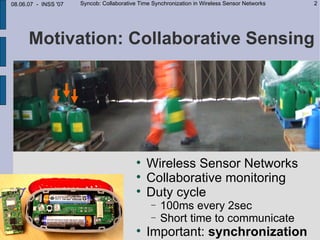
      Motivation: Collaborative Sensing


                                           
                                               Wireless Sensor Networks
                                           
                                               Collaborative monitoring
                                           
                                               Duty cycle
                                                −   100ms every 2sec
                                                −   Short time to communicate
                                           
                                               Important: synchronization
08.06.07 - INSS '07   Syncob: Collaborative Time Synchronization in Wireless Sensor Networks   3


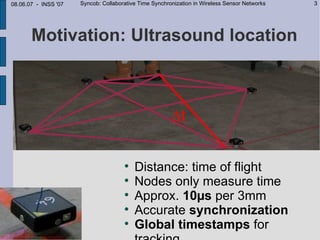
       Motivation: Ultrasound location


                                                        ∆t

                                      
                                          Distance: time of flight
                                      
                                          Nodes only measure time
                                      
                                          Approx. 10µs per 3mm
                                      
                                          Accurate synchronization
                                      
                                          Global timestamps for
08.06.07 - INSS '07   Syncob: Collaborative Time Synchronization in Wireless Sensor Networks   4


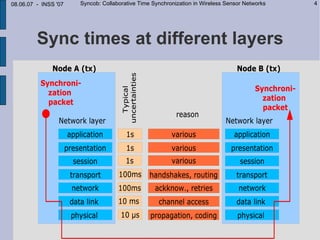
         Sync times at different layers
08.06.07 - INSS '07   Syncob: Collaborative Time Synchronization in Wireless Sensor Networks   5


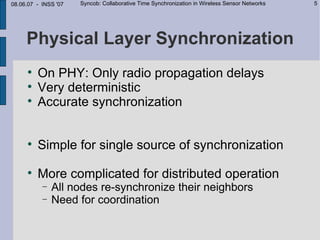
     Physical Layer Synchronization
     
         On PHY: Only radio propagation delays
     
         Very deterministic
     
         Accurate synchronization


     
         Simple for single source of synchronization
     
         More complicated for distributed operation
           −   All nodes re-synchronize their neighbors
           −   Need for coordination
08.06.07 - INSS '07   Syncob: Collaborative Time Synchronization in Wireless Sensor Networks   6


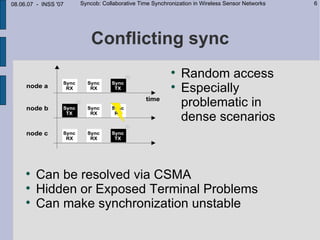
                          Conflicting sync
                                                        
                                                            Random access
                                                        
                                                            Especially
                                                            problematic in
                                                            dense scenarios


     
         Can be resolved via CSMA
     
         Hidden or Exposed Terminal Problems
     
         Can make synchronization unstable
08.06.07 - INSS '07   Syncob: Collaborative Time Synchronization in Wireless Sensor Networks   7


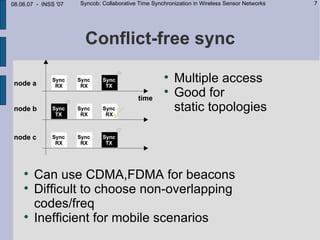
                       Conflict-free sync
                                                     
                                                         Multiple access
                                                     
                                                         Good for
                                                         static topologies


    
        Can use CDMA,FDMA for beacons
    
        Difficult to choose non-overlapping
        codes/freq
    
        Inefficient for mobile scenarios
08.06.07 - INSS '07   Syncob: Collaborative Time Synchronization in Wireless Sensor Networks   8


          SynCob: Collaborative Sync
     
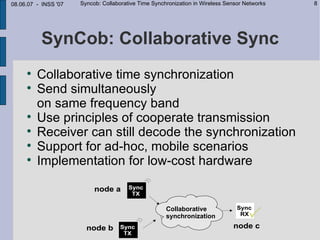
         Collaborative time synchronization
     
         Send simultaneously
         on same frequency band
     
         Use principles of cooperate transmission
     
         Receiver can still decode the synchronization
     
         Support for ad-hoc, mobile scenarios
     
         Implementation for low-cost hardware


                                                      Collaborative
                                                      synchronization
08.06.07 - INSS '07   Syncob: Collaborative Time Synchronization in Wireless Sensor Networks   9


                              Related Work
 
     Link Layer: e.g. LTS, mini-sync
 
     Physical layer: RBS, BITMac

 BitMAC
       −   Collision-free
           synchronization
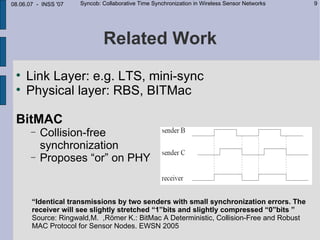
       −   Proposes “or” on PHY


       “Identical transmissions by two senders with small synchronization errors. The
       receiver will see slightly stretched “1”bits and slightly compressed “0”bits ”
       Source: Ringwald,M. ,Römer K.: BitMac A Deterministic, Collision-Free and Robust
       MAC Protocol for Sensor Nodes. EWSN 2005
08.06.07 - INSS '07   Syncob: Collaborative Time Synchronization in Wireless Sensor Networks   10


                  Sync symbol sequence


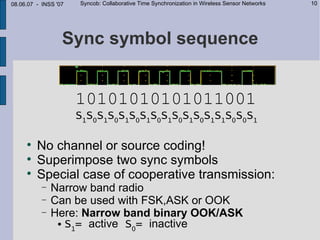
                      10101010101011001
                      S1S0S1S0S1S0S1S0S1S0S1S0S1S1S0S0S1

     
         No channel or source coding!
     
         Superimpose two sync symbols
     
         Special case of cooperative transmission:
           −   Narrow band radio
           −   Can be used with FSK,ASK or OOK
           −   Here: Narrow band binary OOK/ASK
                 S = active S = inactive
                   1          0
08.06.07 - INSS '07   Syncob: Collaborative Time Synchronization in Wireless Sensor Networks   11


      Excursion:superimposed radio


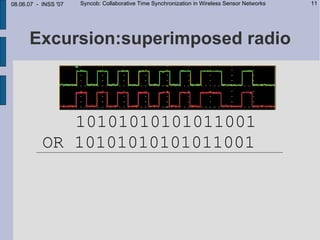
              10101010101011001
           OR 10101010101011001
08.06.07 - INSS '07   Syncob: Collaborative Time Synchronization in Wireless Sensor Networks   12


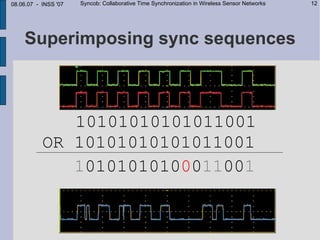
    Superimposing sync sequences


              10101010101011001
           OR 10101010101011001
              10101010100011001
08.06.07 - INSS '07   Syncob: Collaborative Time Synchronization in Wireless Sensor Networks   13


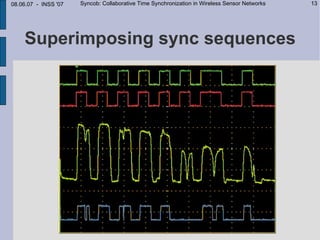
    Superimposing sync sequences
08.06.07 - INSS '07    Syncob: Collaborative Time Synchronization in Wireless Sensor Networks   14


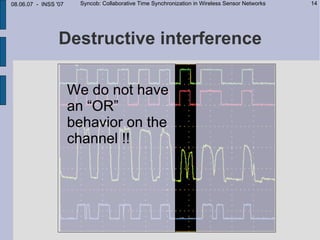
                 Destructive interference

                      We do not have
                      an “OR”
                      behavior on the
                      channel !!
08.06.07 - INSS '07   Syncob: Collaborative Time Synchronization in Wireless Sensor Networks   15


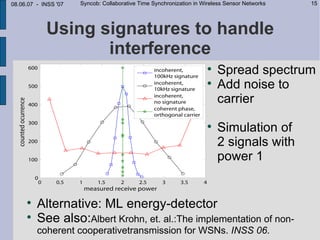
            Using signatures to handle
                   interference
                                                                     
                                                                         Spread spectrum
                                                                     
                                                                         Add noise to
                                                                         carrier
                                                                     
                                                                         Simulation of
                                                                         2 signals with
                                                                         power 1


     
         Alternative: ML energy-detector
     
         See also:Albert Krohn, et. al.:The implementation of non-
         coherent cooperativetransmission for WSNs. INSS 06.
08.06.07 - INSS '07   Syncob: Collaborative Time Synchronization in Wireless Sensor Networks   16


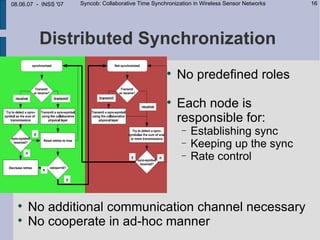
          Distributed Synchronization
                                                      
                                                          No predefined roles
                                                      
                                                          Each node is
                                                          responsible for:
                                                            −   Establishing sync
                                                            −   Keeping up the sync
                                                            −   Rate control


  
      No additional communication channel necessary
  
      No cooperate in ad-hoc manner
08.06.07 - INSS '07   Syncob: Collaborative Time Synchronization in Wireless Sensor Networks   17


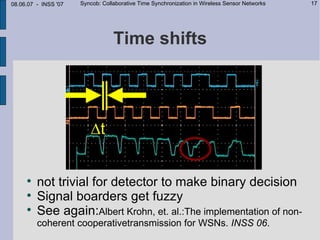
                                  Time shifts


                         ∆t


     
         not trivial for detector to make binary decision
     
         Signal boarders get fuzzy
     
         See again:Albert Krohn, et. al.:The implementation of non-
         coherent cooperativetransmission for WSNs. INSS 06.
08.06.07 - INSS '07   Syncob: Collaborative Time Synchronization in Wireless Sensor Networks         18


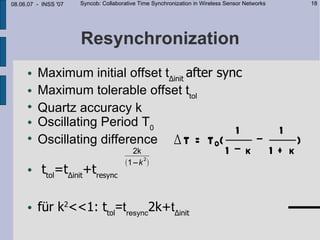
                      Resynchronization
        Maximum initial offset t∆init after sync
        Maximum tolerable offset ttol
     
         Quartz accuracy k
        Oscillating Period T0
                                                1                                1
     
         Oscillating difference ∆ T = T 0(                                     −     )
                                        2k
                                           2
                                                                            1−k 1+ k
                                      1−k 
          ttol=t∆init+tresync

                                                                                                   2k
        für k2<<1: ttol=tresync2k+t∆init = t∆ init + tresync
                                    ttol                                                       (
                                                                                                 1 − k2
08.06.07 - INSS '07   Syncob: Collaborative Time Synchronization in Wireless Sensor Networks   19


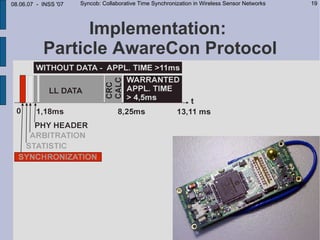
                 Implementation:
           Particle AwareCon Protocol
08.06.07 - INSS '07   Syncob: Collaborative Time Synchronization in Wireless Sensor Networks   20


                 Implementation:
           Particle AwareCon Protocol
     
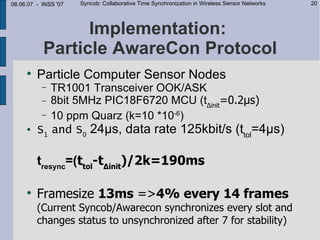
         Particle Computer Sensor Nodes
           −TR1001 Transceiver OOK/ASK
          − 8bit 5MHz PIC18F6720 MCU (t∆init=0.2µs)
          − 10 ppm Quarz (k=10 *10-6)
        S1 and S0 24µs, data rate 125kbit/s (ttol=4µs)

         tresync=(ttol-t∆init)/2k=190ms

     
         Framesize 13ms =>4% every 14 frames
         (Current Syncob/Awarecon synchronizes every slot and
         changes status to unsynchronized after 7 for stability)
08.06.07 - INSS '07                                     Syncob: Collaborative Time Synchronization in Wireless Sensor Networks   21


                        Implementation:
                      Sync propagation time
                                                                  Sync to network                  Sync to single partner


                                                        1
                      cumulated probability functions


                                                        0            20                Delay [ms]             100
08.06.07 - INSS '07   Syncob: Collaborative Time Synchronization in Wireless Sensor Networks   22


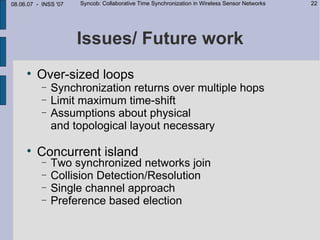
                      Issues/ Future work
     
         Over-sized loops
           −   Synchronization returns over multiple hops
           −   Limit maximum time-shift
           −   Assumptions about physical
               and topological layout necessary

     
         Concurrent island
           −   Two synchronized networks join
           −   Collision Detection/Resolution
           −   Single channel approach
           −   Preference based election
08.06.07 - INSS '07   Syncob: Collaborative Time Synchronization in Wireless Sensor Networks   23


                                 Conclusion
     
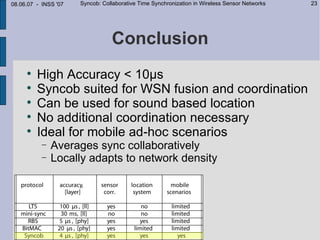
         High Accuracy < 10µs
     
         Syncob suited for WSN fusion and coordination
     
         Can be used for sound based location
     
         No additional coordination necessary
     
         Ideal for mobile ad-hoc scenarios
           −   Averages sync collaboratively
           −   Locally adapts to network density
08.06.07 - INSS '07   Syncob: Collaborative Time Synchronization in Wireless Sensor Networks   24


                                   Question?

Syncob

  • 1.
    Syncob Collaborative Time Synchronization in Wireless Sensor Networks Albert Krohn1, Michael Beigl2, Christian Decker3, Till Riedel3 Particle GmbH, Germany 1 2 DUS/Universität Braunschweig, Germany 3 TecO/Universität Karlsruhe, Germany
  • 2.
    08.06.07 - INSS'07 Syncob: Collaborative Time Synchronization in Wireless Sensor Networks 2 Motivation: Collaborative Sensing  Wireless Sensor Networks  Collaborative monitoring  Duty cycle − 100ms every 2sec − Short time to communicate  Important: synchronization
  • 3.
    08.06.07 - INSS'07 Syncob: Collaborative Time Synchronization in Wireless Sensor Networks 3 Motivation: Ultrasound location ∆t  Distance: time of flight  Nodes only measure time  Approx. 10µs per 3mm  Accurate synchronization  Global timestamps for
  • 4.
    08.06.07 - INSS'07 Syncob: Collaborative Time Synchronization in Wireless Sensor Networks 4 Sync times at different layers
  • 5.
    08.06.07 - INSS'07 Syncob: Collaborative Time Synchronization in Wireless Sensor Networks 5 Physical Layer Synchronization  On PHY: Only radio propagation delays  Very deterministic  Accurate synchronization  Simple for single source of synchronization  More complicated for distributed operation − All nodes re-synchronize their neighbors − Need for coordination
  • 6.
    08.06.07 - INSS'07 Syncob: Collaborative Time Synchronization in Wireless Sensor Networks 6 Conflicting sync  Random access  Especially problematic in dense scenarios  Can be resolved via CSMA  Hidden or Exposed Terminal Problems  Can make synchronization unstable
  • 7.
    08.06.07 - INSS'07 Syncob: Collaborative Time Synchronization in Wireless Sensor Networks 7 Conflict-free sync  Multiple access  Good for static topologies  Can use CDMA,FDMA for beacons  Difficult to choose non-overlapping codes/freq  Inefficient for mobile scenarios
  • 8.
    08.06.07 - INSS'07 Syncob: Collaborative Time Synchronization in Wireless Sensor Networks 8 SynCob: Collaborative Sync  Collaborative time synchronization  Send simultaneously on same frequency band  Use principles of cooperate transmission  Receiver can still decode the synchronization  Support for ad-hoc, mobile scenarios  Implementation for low-cost hardware Collaborative synchronization
  • 9.
    08.06.07 - INSS'07 Syncob: Collaborative Time Synchronization in Wireless Sensor Networks 9 Related Work  Link Layer: e.g. LTS, mini-sync  Physical layer: RBS, BITMac BitMAC − Collision-free synchronization − Proposes “or” on PHY “Identical transmissions by two senders with small synchronization errors. The receiver will see slightly stretched “1”bits and slightly compressed “0”bits ” Source: Ringwald,M. ,Römer K.: BitMac A Deterministic, Collision-Free and Robust MAC Protocol for Sensor Nodes. EWSN 2005
  • 10.
    08.06.07 - INSS'07 Syncob: Collaborative Time Synchronization in Wireless Sensor Networks 10 Sync symbol sequence 10101010101011001 S1S0S1S0S1S0S1S0S1S0S1S0S1S1S0S0S1  No channel or source coding!  Superimpose two sync symbols  Special case of cooperative transmission: − Narrow band radio − Can be used with FSK,ASK or OOK − Here: Narrow band binary OOK/ASK  S = active S = inactive 1 0
  • 11.
    08.06.07 - INSS'07 Syncob: Collaborative Time Synchronization in Wireless Sensor Networks 11 Excursion:superimposed radio 10101010101011001 OR 10101010101011001
  • 12.
    08.06.07 - INSS'07 Syncob: Collaborative Time Synchronization in Wireless Sensor Networks 12 Superimposing sync sequences 10101010101011001 OR 10101010101011001 10101010100011001
  • 13.
    08.06.07 - INSS'07 Syncob: Collaborative Time Synchronization in Wireless Sensor Networks 13 Superimposing sync sequences
  • 14.
    08.06.07 - INSS'07 Syncob: Collaborative Time Synchronization in Wireless Sensor Networks 14 Destructive interference We do not have an “OR” behavior on the channel !!
  • 15.
    08.06.07 - INSS'07 Syncob: Collaborative Time Synchronization in Wireless Sensor Networks 15 Using signatures to handle interference  Spread spectrum  Add noise to carrier  Simulation of 2 signals with power 1  Alternative: ML energy-detector  See also:Albert Krohn, et. al.:The implementation of non- coherent cooperativetransmission for WSNs. INSS 06.
  • 16.
    08.06.07 - INSS'07 Syncob: Collaborative Time Synchronization in Wireless Sensor Networks 16 Distributed Synchronization  No predefined roles  Each node is responsible for: − Establishing sync − Keeping up the sync − Rate control  No additional communication channel necessary  No cooperate in ad-hoc manner
  • 17.
    08.06.07 - INSS'07 Syncob: Collaborative Time Synchronization in Wireless Sensor Networks 17 Time shifts ∆t  not trivial for detector to make binary decision  Signal boarders get fuzzy  See again:Albert Krohn, et. al.:The implementation of non- coherent cooperativetransmission for WSNs. INSS 06.
  • 18.
    08.06.07 - INSS'07 Syncob: Collaborative Time Synchronization in Wireless Sensor Networks 18 Resynchronization  Maximum initial offset t∆init after sync  Maximum tolerable offset ttol  Quartz accuracy k  Oscillating Period T0 1 1  Oscillating difference ∆ T = T 0( − ) 2k 2 1−k 1+ k 1−k   ttol=t∆init+tresync 2k  für k2<<1: ttol=tresync2k+t∆init = t∆ init + tresync ttol ( 1 − k2
  • 19.
    08.06.07 - INSS'07 Syncob: Collaborative Time Synchronization in Wireless Sensor Networks 19 Implementation: Particle AwareCon Protocol
  • 20.
    08.06.07 - INSS'07 Syncob: Collaborative Time Synchronization in Wireless Sensor Networks 20 Implementation: Particle AwareCon Protocol  Particle Computer Sensor Nodes −TR1001 Transceiver OOK/ASK − 8bit 5MHz PIC18F6720 MCU (t∆init=0.2µs) − 10 ppm Quarz (k=10 *10-6)  S1 and S0 24µs, data rate 125kbit/s (ttol=4µs) tresync=(ttol-t∆init)/2k=190ms  Framesize 13ms =>4% every 14 frames (Current Syncob/Awarecon synchronizes every slot and changes status to unsynchronized after 7 for stability)
  • 21.
    08.06.07 - INSS'07 Syncob: Collaborative Time Synchronization in Wireless Sensor Networks 21 Implementation: Sync propagation time Sync to network Sync to single partner 1 cumulated probability functions 0 20 Delay [ms] 100
  • 22.
    08.06.07 - INSS'07 Syncob: Collaborative Time Synchronization in Wireless Sensor Networks 22 Issues/ Future work  Over-sized loops − Synchronization returns over multiple hops − Limit maximum time-shift − Assumptions about physical and topological layout necessary  Concurrent island − Two synchronized networks join − Collision Detection/Resolution − Single channel approach − Preference based election
  • 23.
    08.06.07 - INSS'07 Syncob: Collaborative Time Synchronization in Wireless Sensor Networks 23 Conclusion  High Accuracy < 10µs  Syncob suited for WSN fusion and coordination  Can be used for sound based location  No additional coordination necessary  Ideal for mobile ad-hoc scenarios − Averages sync collaboratively − Locally adapts to network density
  • 24.
    08.06.07 - INSS'07 Syncob: Collaborative Time Synchronization in Wireless Sensor Networks 24 Question?