Wireless Sensor Networks
Davide Quaglia
based on slides
by Seapahn Megerian and Damiano Carra
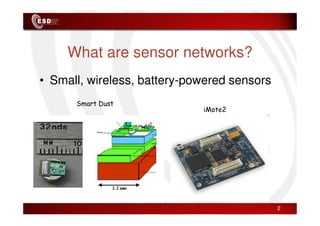
What are sensor networks?
• Small, wireless, battery-powered sensors
iMote2
Smart Dust
iMote2
2
Architecture
• CPU (also called micro-controller unit - MCU)
• Memory
– Static and dynamic memory to store volatile data
– Flash memory to store persistent data
• A/D converter and digital I/O
• Sensors (e.g., temperature, humidity, light, motion, etc.)
• Actuators
• Radio transmitter/receiver (transceiver)
• CPU, memory, A/D are usually in the same chip
• Antenna
• Battery or energy harvesting (collector)
• Packaging for harsh environment
3
Architecture (2)
• Sensors and radio may be either in
separate chips or in a single System on
Chip
Chip
• Actuators are always separated
components
4
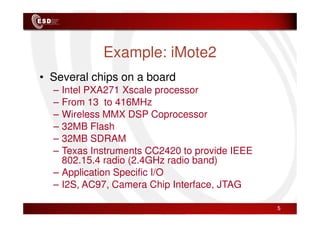
Example: iMote2
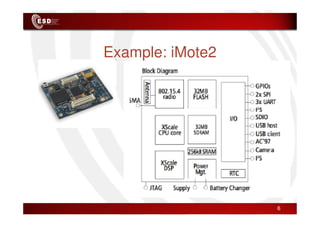
• Several chips on a board
– Intel PXA271 Xscale processor
– From 13 to 416MHz
– Wireless MMX DSP Coprocessor
5
– Wireless MMX DSP Coprocessor
– 32MB Flash
– 32MB SDRAM
– Texas Instruments CC2420 to provide IEEE
802.15.4 radio (2.4GHz radio band)
– Application Specific I/O
– I2S, AC97, Camera Chip Interface, JTAG
Example: iMote2
6
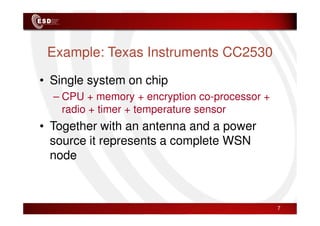
Example: Texas Instruments CC2530
• Single system on chip
– CPU + memory + encryption co-processor +
radio + timer + temperature sensor
• Together with an antenna and a power
source it represents a complete WSN
node
7
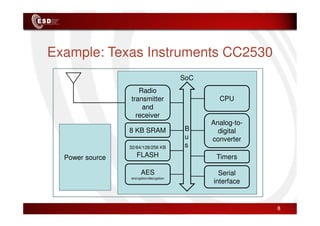
Example: Texas Instruments CC2530
CPU
Radio
transmitter
and
receiver
SoC
8
Power source
B
u
s
Analog-to-
digital
converter
Timers
Serial
interface
8 KB SRAM
32/64/128/256 KB
FLASH
receiver
AES
encryption/decryption
Why small, wireless, battery-
powered sensors?
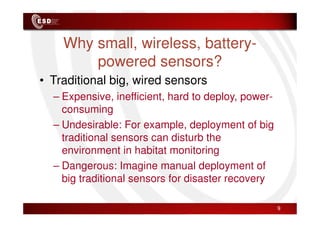
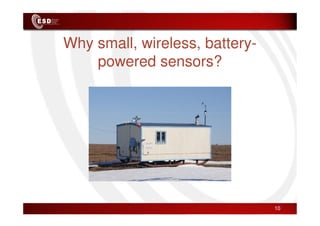
• Traditional big, wired sensors
– Expensive, inefficient, hard to deploy, power-
consuming
consuming
– Undesirable: For example, deployment of big
traditional sensors can disturb the
environment in habitat monitoring
– Dangerous: Imagine manual deployment of
big traditional sensors for disaster recovery
9
Why small, wireless, battery-
powered sensors?
10
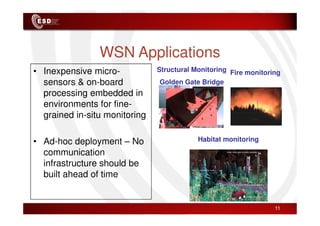
WSN Applications
• Inexpensive micro-
sensors & on-board
processing embedded in
environments for fine-
grained in-situ monitoring
Fire monitoring
Structural Monitoring
Golden Gate Bridge
11
grained in-situ monitoring
• Ad-hoc deployment – No
communication
infrastructure should be
built ahead of time
Habitat monitoring
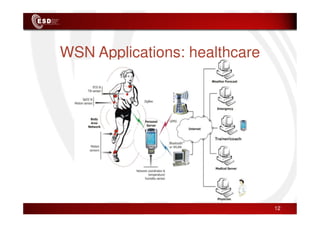
WSN Applications: healthcare
12
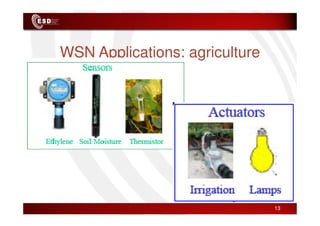
WSN Applications: agriculture
13
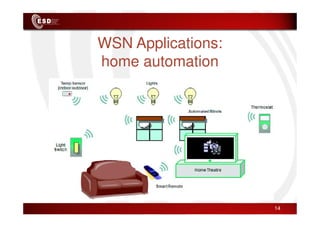
WSN Applications:
home automation
14
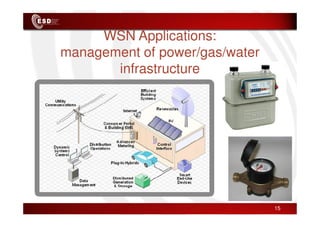
WSN Applications:
management of power/gas/water
infrastructure
15
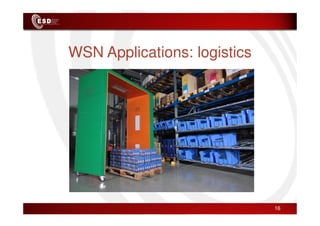
WSN Applications: logistics
16
Applications
• Interface between Physical and Digital Worlds
– Cyber-Physical Systems
• Industry: industrial monitoring, fault-detection…
• Civilian: traffic, medical…
• Scientific: eco-monitoring, seismic sensors,
plume tracking…
17
Objective
• Large-scale, fine-grained, heterogeneous
sensing
– 100s to 1000s of nodes providing high
resolution
resolution
– Spaced a few feet to 10s of meters apart
– In-situ sensing
– Hetegerogeneous sensors
18
Properties
• Wireless
– Easy to deploy: ad hoc deployment
– Most power-consuming: transmitting 1 bit ≈ executing 1000
instructions
• Distributed, multi-hop
– Closer to phenomena
– Improved opportunity for LOS
– Radio signal attenuation is proportional to 1/r4
– Centralized approach do not scale
– Spatial multiplexing
• Collaborative
– Each sensor has a limited view in terms of location and sensor type
– Sensors are battery powered
– In-network processing to reduce power consumption and data
redundancy
19
Basic Terminology and Concepts
• Phenomenon: Physical entity being monitored
• Sink or base station or gateway: a collection
point to which the sensor data is sent
– Relatively resource-rich node
– Connection to the “normal” network and Internet
• Sensor network periodically samples
phenomena in space and time
– Data are sent to the sink periodically
– The sink can send queries
20
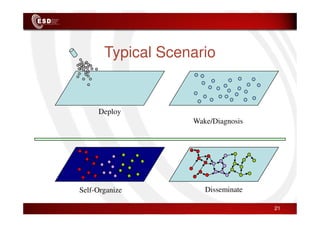
Typical Scenario
Deploy
Deploy
Wake/Diagnosis
Self-Organize Disseminate
21
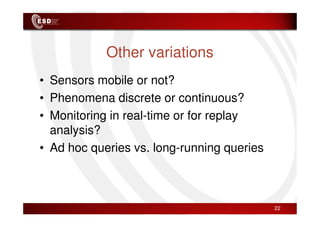
Other variations
• Sensors mobile or not?
• Phenomena discrete or continuous?
• Monitoring in real-time or for replay
analysis?
• Ad hoc queries vs. long-running queries
22
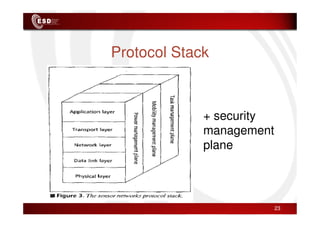
Protocol Stack
+ security
23
+ security
management
plane
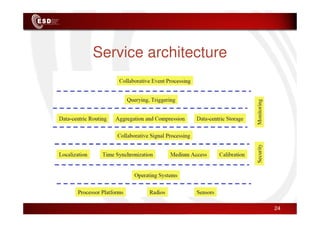
Service architecture
24
Protocol Stack: Physical Layer
• Frequency selection
• Carrier frequency generation
• Signal detection
• Signal detection
• Modulation
• Not the focus of this class
– We will focus on the link layer and above
25
Protocol Stack: Physical Layer
• Issues
– Hardware cost
• How do we get down to $1/node?
– Example
• IEEE 802.15.4
– 2.4GHz radio band (= WiFi & Bluetooth) or 868/915 MHz
radio band
– 250 kb/s
– CSMA/CA (= WiFi)
26
Protocol Stack: Data Link Layer
• PDU detection
• Point-to-point transmission
• Creation of the network infrastructure
• Addressing
• Medium access control
• Multiplexing of data streams
• Ack and retransmission
• Error detection
27
Data Link Layer: Medium Access
Control
• Basic strategy:
– Only one RF interface per node (RX vs. TX)
– Turn off RF interface as much as possible
between receiving and transmitting intervals
• Techniques: Application-layer transmission
scheduling, TDMA, SMAC, ZMAC, BMAC,
...
28
Protocol Stack: Network Layer
• Main goals:
– addressing
– Routing
– Multi-hop forwarding
• Design principles:
– Power efficiency
– Data-centric
– Data aggregation when desired and possible
– Attribute-based addressing vs. IP-like addresses
29
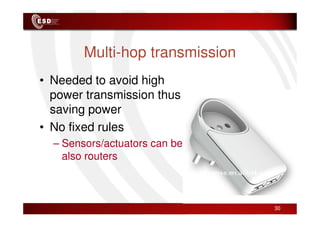
Multi-hop transmission
• Needed to avoid high
power transmission thus
saving power
saving power
• No fixed rules
– Sensors/actuators can be
also routers
30
Minimum Energy Routing
• Maximum power available route
• Minimum energy route
• Minimum hop (MH) route
• Simple tree to avoid computational
complexity
31
Example: Directed Diffusion
• One of the first data-centric routing protocols
• Route based on attributes and interests
• How it works:
• How it works:
– Sink floods interest on some attributes
– Sensors send data toward the sink
– Sink add/reinforces node/attribute association
• In general flooding is too energy demanding
32
Protocol Stack: Transport Layer
• Application multiplexing
• Application discovery
• End-to-end security
– Like SSL: authentication, encryption, data
integrity
– Feasible? What about data aggregation?
33
Protocol Stack: Application Layer
• Actual WSN applications
• Sensor database
– TinyDB
– TinyDB
– Cougar
• Virtual machines
• Middleware
34
Other Important Issues
• Operating system
– TinyOS: Event-driven
– FreeRTOS
– MANTIS OS, LiteOS, etc: Multithreaded
• Localization, Timing Synchronization, and Calibration
• Aggregation/Data Fusion
• Security
– Encryption
– Authentication
– Data integrity
– Availability: denial-of-service attacks
35
Time and Space Problems
• Timing synchronization
• Node Localization
• Sensor Coverage
• Sensor Coverage
36
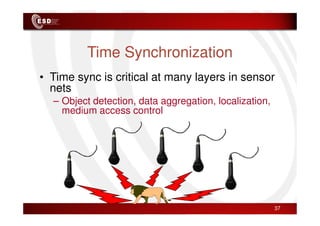
Time Synchronization
• Time sync is critical at many layers in sensor
nets
– Object detection, data aggregation, localization,
medium access control
37
Sources of time synchronization
errors
• Send/receive time
– OS processing
– Interrupt latency
– Context switches
– Context switches
– Transfer from host to network interface
• Medium access time
– Depending on the MAC protocol
• E.g. in CSMA/CA, sender must wait for free channel
• Propagation time
– Function of the number of hops
• Clock drift
38
Conventional Approaches
• GPS at every node (around 10ns accuracy)
– Doesn’t work indoor
– Cost, size, and energy issues
• Network Time Protocol
– Primary time servers are synchronized through atomic
clock
– Pre-defined server hierarchy
– Nodes synchronize with one server of a pre-specified set
– Can support coarse-grain time synchronization
• Inefficient when fine-grain sync is required
– Sensor net applications, e.g., localization, TDMA
– Discovery of time servers
– Potentially long and varying paths to time-servers
– Delay and jitter due to MAC and store-and-forward relaying
39
Localization
• Why each node should find its location?
– Data meaningless without context (e.g. RF tag for
asset tracking)
– Support to commissioning (=configuration)
– Geographical forwarding/addressing (less important)
• Why not just GPS at every node?
– Large size and expensive
– High power consumption (it is a receiver)
– Works only outdoors with line of sight to satellites
– Overkill: often only relative position is needed
40
What is Location?
• Absolute position on geoids
• Location relative to fixed anchor points
• Location relative to other WSN nodes
• Specific area inside a set of possible areas
• Most applications:
– location relative to other people or objects, whether
moving or stationary, or room number within a
building
41
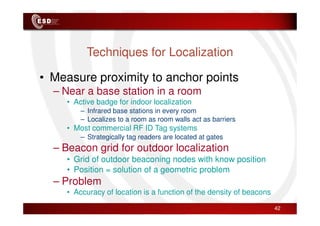
Techniques for Localization
• Measure proximity to anchor points
– Near a base station in a room
• Active badge for indoor localization
– Infrared base stations in every room
– Localizes to a room as room walls act as barriers
• Most commercial RF ID Tag systems
– Strategically tag readers are located at gates
– Beacon grid for outdoor localization
• Grid of outdoor beaconing nodes with know position
• Position = solution of a geometric problem
– Problem
• Accuracy of location is a function of the density of beacons
42
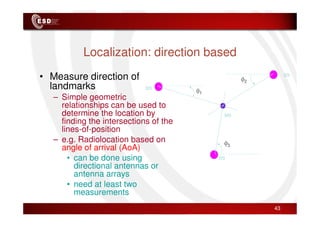
Localization: direction based
• Measure direction of
landmarks
– Simple geometric
relationships can be used to
determine the location by
BS
BS
MS
φ
φ
φ
φ1
φ
φ
φ
φ2
determine the location by
finding the intersections of the
lines-of-position
– e.g. Radiolocation based on
angle of arrival (AoA)
• can be done using
directional antennas or
antenna arrays
• need at least two
measurements
43
BS
MS
φ
φ
φ
φ3
Localization: Range-based
• Measure distance to anchor points
– Measure signal-strength or time-of-flight
– Estimate distance via received signal strength
• Mathematical model that describes the path loss
attenuation with distance
• Use pre-measured signal strength contours around
fixed beacon nodes
– Distance via Time-of-arrival (ToA)
• Distance measured by the propagation delay
– Distance = time * c
– N+1 anchor points give N+1 distance measurements to
locate in N dimensions
44
Many other issues
• Localization in presence of transmission
errors
• Beacon signal is too weak
• Localization frequency in case of mobile
nodes
45
Sensor Network Coverage
• Given:
– Ad hoc sensor field with some number of
nodes with known location
– Start and end positions of an agent
• How well can the field be observed?
46
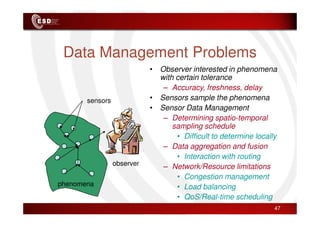
Data Management Problems
sensors
• Observer interested in phenomena
with certain tolerance
– Accuracy, freshness, delay
• Sensors sample the phenomena
• Sensor Data Management
phenomena
observer
– Determining spatio-temporal
sampling schedule
• Difficult to determine locally
– Data aggregation and fusion
• Interaction with routing
– Network/Resource limitations
• Congestion management
• Load balancing
• QoS/Real-time scheduling
47
Key Design Challenges
• Energy efficiency
– Sensor nodes should run for several years
without battery replacement
– Energy efficient protocols are required
– More efficient batteries
• But, efficient battery development is always slower
than processor/memory/network development
– Energy harvesting
48
Key Design Challenges
• Responsiveness
– Crucial in real-time applications
– Periodic sleep & wake-up can reduce the
responsiveness of sensors and the data rate
• Important events could be missed
• Transmission could be delayed
– Network congestion can increase the access
time in CSMA MAC and delay spent in queues
49
Key Design Challenges
• Robustness
– Inexpensive sensors deployed in a harsh
physical environment could be unreliable
• Some sensor could be faulty or broken
– Global performance should not be sensitive to
individual sensor failures
– Graceful performance degradation is desired
when there are faulty sensors
50
Key Design Challenges
• Synergy
– Moore’s law applies differently
• Sensors may not become more powerful in terms of
computation and communication capability
• Cost reduction is the key to a large number of sensor
deployment
– A WSN as a whole needs to be much more capable
than a simple sum of the capabilities of the sensors
• Exploit contextual information to send meaningful information
rather than raw data
– Sharing of computation, communication, and storage
resources
51
Key Design Challenges
• Scalability
– 10000 or more nodes for fine-granularity
sensing & large coverage area
– Distributed, localized communication
– Utilize hierarchical structure
– Address fundamental problems first
• Failure handling
• In-situ reprogramming
• Network throughput & capacity limits?
52
Key Design Challenges
• Heterogeneity
– Heterogeneous sensing, computation, and
communication capabilities
• e.g., a small number of devices of higher
computational capabilities & a large number of low
capability nodes -> two-tier WSN architecture
– Best architecture exist for all application?
NO!!!
• How to determine the right combination of
heterogeneous devices for a given application?
53
Key Design Challenges
• Self-configuration
– WSNs are unattended distributed systems
– Nodes have to configure their own network
topology
• Localize, synchronize & calibrate
• Coordinate communications for themselves
– The network should repair itself in case of
node failures
54
Key Design Challenges
• Self-optimization & adaptation
– WSN cannot be optimized a priori
– Environment is unpredictable, and may
change drastically
– WSN protocols should be adaptive & should
adapt themselves at run-time
55
Key Design Challenges
• Design methodologies
– Tradeoff between two alternatives
• (1) Fine-tuning to exploit application specific
characteristics to improve performance
• (2) More flexible, easy-to-generalize design
approaches sacrificing some performance
– Design methodologies for reuse, modularity &
run-time adaptation are required
56
Key Design Challenges
• Security & Privacy
– Security support to avoid actions and data
replacement
replacement
• e.g., remote control of plants
– Support privacy to protect data
• e. g., medical sensing, asset tracking
57

matdid473708.pdf

  • 1.
    Wireless Sensor Networks DavideQuaglia based on slides by Seapahn Megerian and Damiano Carra
  • 2.
    What are sensornetworks? • Small, wireless, battery-powered sensors iMote2 Smart Dust iMote2 2
  • 3.
    Architecture • CPU (alsocalled micro-controller unit - MCU) • Memory – Static and dynamic memory to store volatile data – Flash memory to store persistent data • A/D converter and digital I/O • A/D converter and digital I/O • Sensors (e.g., temperature, humidity, light, motion, etc.) • Actuators • Radio transmitter/receiver (transceiver) • CPU, memory, A/D are usually in the same chip • Antenna • Battery or energy harvesting (collector) • Packaging for harsh environment 3
  • 4.
    Architecture (2) • Sensorsand radio may be either in separate chips or in a single System on Chip Chip • Actuators are always separated components 4
  • 5.
    Example: iMote2 • Severalchips on a board – Intel PXA271 Xscale processor – From 13 to 416MHz – Wireless MMX DSP Coprocessor 5 – Wireless MMX DSP Coprocessor – 32MB Flash – 32MB SDRAM – Texas Instruments CC2420 to provide IEEE 802.15.4 radio (2.4GHz radio band) – Application Specific I/O – I2S, AC97, Camera Chip Interface, JTAG
  • 6.
  • 7.
    Example: Texas InstrumentsCC2530 • Single system on chip – CPU + memory + encryption co-processor + radio + timer + temperature sensor radio + timer + temperature sensor • Together with an antenna and a power source it represents a complete WSN node 7
  • 8.
    Example: Texas InstrumentsCC2530 CPU Radio transmitter and receiver SoC 8 Power source B u s Analog-to- digital converter Timers Serial interface 8 KB SRAM 32/64/128/256 KB FLASH receiver AES encryption/decryption
  • 9.
    Why small, wireless,battery- powered sensors? • Traditional big, wired sensors – Expensive, inefficient, hard to deploy, power- consuming consuming – Undesirable: For example, deployment of big traditional sensors can disturb the environment in habitat monitoring – Dangerous: Imagine manual deployment of big traditional sensors for disaster recovery 9
  • 10.
    Why small, wireless,battery- powered sensors? 10
  • 11.
    WSN Applications • Inexpensivemicro- sensors & on-board processing embedded in environments for fine- grained in-situ monitoring Fire monitoring Structural Monitoring Golden Gate Bridge 11 grained in-situ monitoring • Ad-hoc deployment – No communication infrastructure should be built ahead of time Habitat monitoring
  • 12.
  • 13.
  • 14.
  • 15.
    WSN Applications: management ofpower/gas/water infrastructure 15
  • 16.
  • 17.
    Applications • Interface betweenPhysical and Digital Worlds – Cyber-Physical Systems • Industry: industrial monitoring, fault-detection… • Civilian: traffic, medical… • Scientific: eco-monitoring, seismic sensors, plume tracking… 17
  • 18.
    Objective • Large-scale, fine-grained,heterogeneous sensing – 100s to 1000s of nodes providing high resolution resolution – Spaced a few feet to 10s of meters apart – In-situ sensing – Hetegerogeneous sensors 18
  • 19.
    Properties • Wireless – Easyto deploy: ad hoc deployment – Most power-consuming: transmitting 1 bit ≈ executing 1000 instructions • Distributed, multi-hop – Closer to phenomena – Closer to phenomena – Improved opportunity for LOS – Radio signal attenuation is proportional to 1/r4 – Centralized approach do not scale – Spatial multiplexing • Collaborative – Each sensor has a limited view in terms of location and sensor type – Sensors are battery powered – In-network processing to reduce power consumption and data redundancy 19
  • 20.
    Basic Terminology andConcepts • Phenomenon: Physical entity being monitored • Sink or base station or gateway: a collection point to which the sensor data is sent – Relatively resource-rich node – Relatively resource-rich node – Connection to the “normal” network and Internet • Sensor network periodically samples phenomena in space and time – Data are sent to the sink periodically – The sink can send queries 20
  • 21.
  • 22.
    Other variations • Sensorsmobile or not? • Phenomena discrete or continuous? • Monitoring in real-time or for replay • Monitoring in real-time or for replay analysis? • Ad hoc queries vs. long-running queries 22
  • 23.
    Protocol Stack + security 23 +security management plane
  • 24.
  • 25.
    Protocol Stack: PhysicalLayer • Frequency selection • Carrier frequency generation • Signal detection • Signal detection • Modulation • Not the focus of this class – We will focus on the link layer and above 25
  • 26.
    Protocol Stack: PhysicalLayer • Issues – Hardware cost • How do we get down to $1/node? • How do we get down to $1/node? – Example • IEEE 802.15.4 – 2.4GHz radio band (= WiFi & Bluetooth) or 868/915 MHz radio band – 250 kb/s – CSMA/CA (= WiFi) 26
  • 27.
    Protocol Stack: DataLink Layer • PDU detection • Point-to-point transmission • Creation of the network infrastructure • Creation of the network infrastructure • Addressing • Medium access control • Multiplexing of data streams • Ack and retransmission • Error detection 27
  • 28.
    Data Link Layer:Medium Access Control • Basic strategy: – Only one RF interface per node (RX vs. TX) – Turn off RF interface as much as possible – Turn off RF interface as much as possible between receiving and transmitting intervals • Techniques: Application-layer transmission scheduling, TDMA, SMAC, ZMAC, BMAC, ... 28
  • 29.
    Protocol Stack: NetworkLayer • Main goals: – addressing – Routing – Multi-hop forwarding • Design principles: – Power efficiency – Data-centric – Data aggregation when desired and possible – Attribute-based addressing vs. IP-like addresses 29
  • 30.
    Multi-hop transmission • Neededto avoid high power transmission thus saving power saving power • No fixed rules – Sensors/actuators can be also routers 30
  • 31.
    Minimum Energy Routing •Maximum power available route • Minimum energy route • Minimum hop (MH) route • Minimum hop (MH) route • Simple tree to avoid computational complexity 31
  • 32.
    Example: Directed Diffusion •One of the first data-centric routing protocols • Route based on attributes and interests • How it works: • How it works: – Sink floods interest on some attributes – Sensors send data toward the sink – Sink add/reinforces node/attribute association • In general flooding is too energy demanding 32
  • 33.
    Protocol Stack: TransportLayer • Application multiplexing • Application discovery • End-to-end security • End-to-end security – Like SSL: authentication, encryption, data integrity – Feasible? What about data aggregation? 33
  • 34.
    Protocol Stack: ApplicationLayer • Actual WSN applications • Sensor database – TinyDB – TinyDB – Cougar • Virtual machines • Middleware 34
  • 35.
    Other Important Issues •Operating system – TinyOS: Event-driven – FreeRTOS – MANTIS OS, LiteOS, etc: Multithreaded – MANTIS OS, LiteOS, etc: Multithreaded • Localization, Timing Synchronization, and Calibration • Aggregation/Data Fusion • Security – Encryption – Authentication – Data integrity – Availability: denial-of-service attacks 35
  • 36.
    Time and SpaceProblems • Timing synchronization • Node Localization • Sensor Coverage • Sensor Coverage 36
  • 37.
    Time Synchronization • Timesync is critical at many layers in sensor nets – Object detection, data aggregation, localization, medium access control medium access control 37
  • 38.
    Sources of timesynchronization errors • Send/receive time – OS processing – Interrupt latency – Context switches – Context switches – Transfer from host to network interface • Medium access time – Depending on the MAC protocol • E.g. in CSMA/CA, sender must wait for free channel • Propagation time – Function of the number of hops • Clock drift 38
  • 39.
    Conventional Approaches • GPSat every node (around 10ns accuracy) – Doesn’t work indoor – Cost, size, and energy issues • Network Time Protocol – Primary time servers are synchronized through atomic – Primary time servers are synchronized through atomic clock – Pre-defined server hierarchy – Nodes synchronize with one server of a pre-specified set – Can support coarse-grain time synchronization • Inefficient when fine-grain sync is required – Sensor net applications, e.g., localization, TDMA – Discovery of time servers – Potentially long and varying paths to time-servers – Delay and jitter due to MAC and store-and-forward relaying 39
  • 40.
    Localization • Why eachnode should find its location? – Data meaningless without context (e.g. RF tag for asset tracking) – Support to commissioning (=configuration) – Support to commissioning (=configuration) – Geographical forwarding/addressing (less important) • Why not just GPS at every node? – Large size and expensive – High power consumption (it is a receiver) – Works only outdoors with line of sight to satellites – Overkill: often only relative position is needed 40
  • 41.
    What is Location? •Absolute position on geoids • Location relative to fixed anchor points • Location relative to other WSN nodes • Location relative to other WSN nodes • Specific area inside a set of possible areas • Most applications: – location relative to other people or objects, whether moving or stationary, or room number within a building 41
  • 42.
    Techniques for Localization •Measure proximity to anchor points – Near a base station in a room • Active badge for indoor localization – Infrared base stations in every room – Infrared base stations in every room – Localizes to a room as room walls act as barriers • Most commercial RF ID Tag systems – Strategically tag readers are located at gates – Beacon grid for outdoor localization • Grid of outdoor beaconing nodes with know position • Position = solution of a geometric problem – Problem • Accuracy of location is a function of the density of beacons 42
  • 43.
    Localization: direction based •Measure direction of landmarks – Simple geometric relationships can be used to determine the location by BS BS MS φ φ φ φ1 φ φ φ φ2 determine the location by finding the intersections of the lines-of-position – e.g. Radiolocation based on angle of arrival (AoA) • can be done using directional antennas or antenna arrays • need at least two measurements 43 BS MS φ φ φ φ3
  • 44.
    Localization: Range-based • Measuredistance to anchor points – Measure signal-strength or time-of-flight – Estimate distance via received signal strength • Mathematical model that describes the path loss attenuation with distance attenuation with distance • Use pre-measured signal strength contours around fixed beacon nodes – Distance via Time-of-arrival (ToA) • Distance measured by the propagation delay – Distance = time * c – N+1 anchor points give N+1 distance measurements to locate in N dimensions 44
  • 45.
    Many other issues •Localization in presence of transmission errors • Beacon signal is too weak • Beacon signal is too weak • Localization frequency in case of mobile nodes 45
  • 46.
    Sensor Network Coverage •Given: – Ad hoc sensor field with some number of nodes with known location – Start and end positions of an agent • How well can the field be observed? 46
  • 47.
    Data Management Problems sensors •Observer interested in phenomena with certain tolerance – Accuracy, freshness, delay • Sensors sample the phenomena • Sensor Data Management phenomena observer – Determining spatio-temporal sampling schedule • Difficult to determine locally – Data aggregation and fusion • Interaction with routing – Network/Resource limitations • Congestion management • Load balancing • QoS/Real-time scheduling 47
  • 48.
    Key Design Challenges •Energy efficiency – Sensor nodes should run for several years without battery replacement without battery replacement – Energy efficient protocols are required – More efficient batteries • But, efficient battery development is always slower than processor/memory/network development – Energy harvesting 48
  • 49.
    Key Design Challenges •Responsiveness – Crucial in real-time applications – Periodic sleep & wake-up can reduce the – Periodic sleep & wake-up can reduce the responsiveness of sensors and the data rate • Important events could be missed • Transmission could be delayed – Network congestion can increase the access time in CSMA MAC and delay spent in queues 49
  • 50.
    Key Design Challenges •Robustness – Inexpensive sensors deployed in a harsh physical environment could be unreliable physical environment could be unreliable • Some sensor could be faulty or broken – Global performance should not be sensitive to individual sensor failures – Graceful performance degradation is desired when there are faulty sensors 50
  • 51.
    Key Design Challenges •Synergy – Moore’s law applies differently • Sensors may not become more powerful in terms of computation and communication capability computation and communication capability • Cost reduction is the key to a large number of sensor deployment – A WSN as a whole needs to be much more capable than a simple sum of the capabilities of the sensors • Exploit contextual information to send meaningful information rather than raw data – Sharing of computation, communication, and storage resources 51
  • 52.
    Key Design Challenges •Scalability – 10000 or more nodes for fine-granularity sensing & large coverage area sensing & large coverage area – Distributed, localized communication – Utilize hierarchical structure – Address fundamental problems first • Failure handling • In-situ reprogramming • Network throughput & capacity limits? 52
  • 53.
    Key Design Challenges •Heterogeneity – Heterogeneous sensing, computation, and communication capabilities • e.g., a small number of devices of higher computational capabilities & a large number of low capability nodes -> two-tier WSN architecture – Best architecture exist for all application? NO!!! • How to determine the right combination of heterogeneous devices for a given application? 53
  • 54.
    Key Design Challenges •Self-configuration – WSNs are unattended distributed systems – Nodes have to configure their own network – Nodes have to configure their own network topology • Localize, synchronize & calibrate • Coordinate communications for themselves – The network should repair itself in case of node failures 54
  • 55.
    Key Design Challenges •Self-optimization & adaptation – WSN cannot be optimized a priori – Environment is unpredictable, and may – Environment is unpredictable, and may change drastically – WSN protocols should be adaptive & should adapt themselves at run-time 55
  • 56.
    Key Design Challenges •Design methodologies – Tradeoff between two alternatives • (1) Fine-tuning to exploit application specific • (1) Fine-tuning to exploit application specific characteristics to improve performance • (2) More flexible, easy-to-generalize design approaches sacrificing some performance – Design methodologies for reuse, modularity & run-time adaptation are required 56
  • 57.
    Key Design Challenges •Security & Privacy – Security support to avoid actions and data replacement replacement • e.g., remote control of plants – Support privacy to protect data • e. g., medical sensing, asset tracking 57